
A complete issue · 40 pages · 1918
Life — March 28, 1918
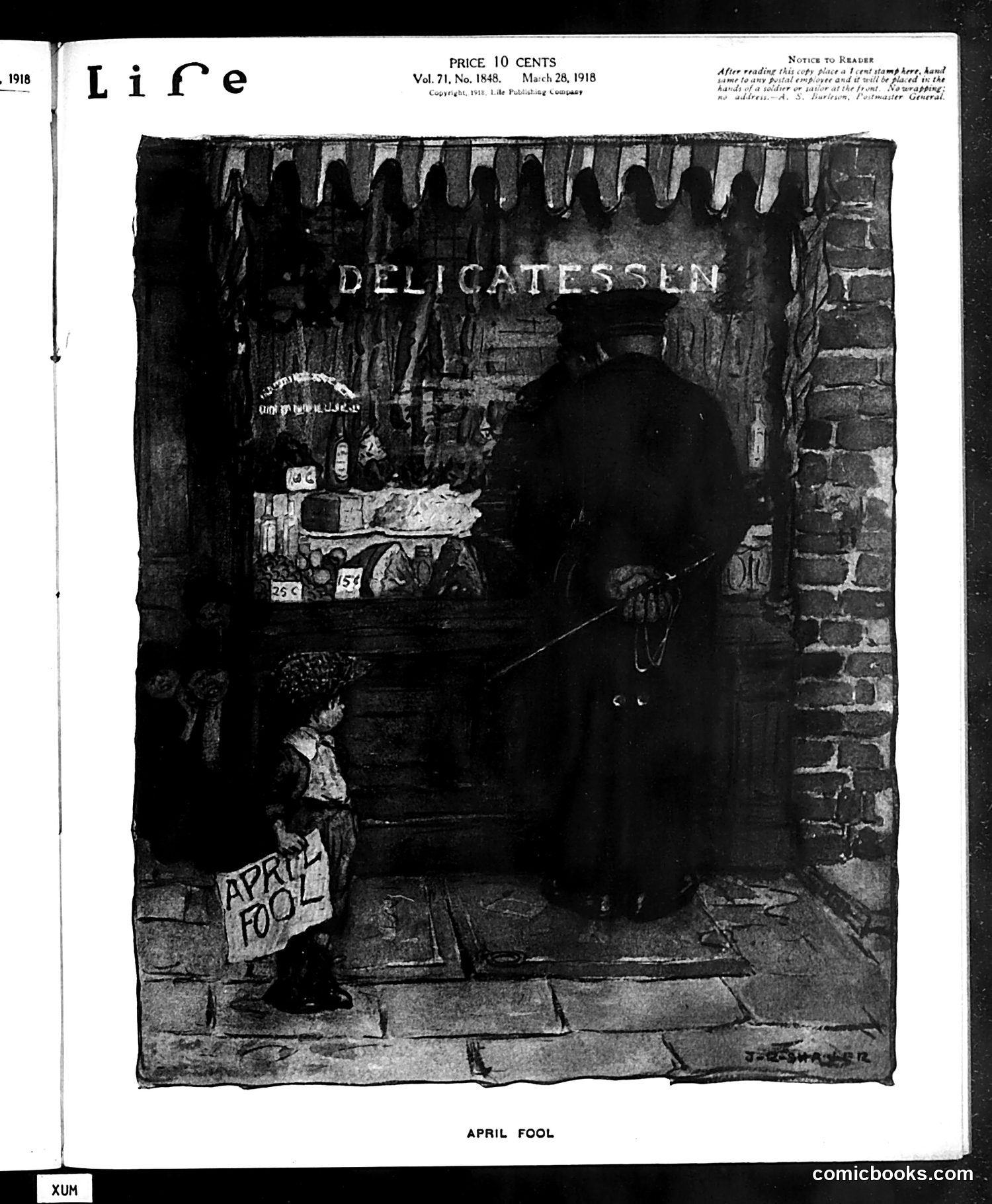
This illustration depicts an April Fool's Day prank playing out at a delicatessen storefront. A well-dressed man peers into the shop window, apparently fooled by what appears to be an elaborate display. A child outside holds a sign reading "APRIL FOOL," indicating the man is the victim of a practical joke. The cartoon's humor relies on the classic April Fool's tradition of tricks and deception. The "Delicatessen" sign and various shop items visible suggest the prank may involve the window display itself—possibly items are fake or arranged deceptively. Published during World War I, the image offers light domestic humor, providing satirical relief from wartime concerns through this innocent, timeless prank scenario.
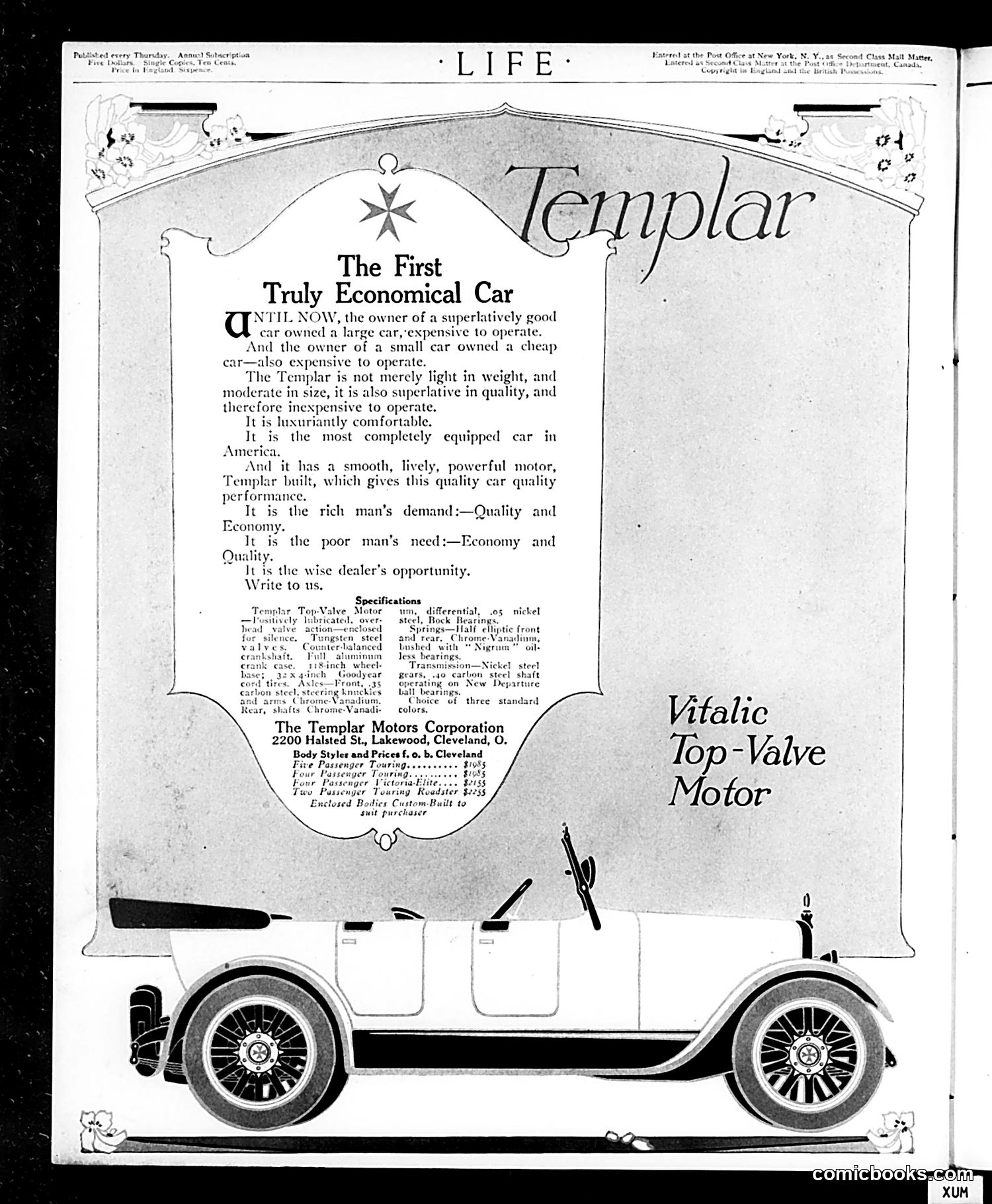
This page is primarily a **commercial advertisement**, not satirical content. It promotes the Templar automobile, manufactured by the Templar Motors Corporation of Cleveland, Ohio. The advertisement's pitch is straightforward: the Templar is "The First Truly Economical Car," positioned to appeal to both wealthy and poor buyers. The copy contrasts the expensive large car with the cheap small car, positioning the Templar as superior because it offers quality *and* economy—meeting "the rich man's demand" (quality) and "the poor man's need" (economy). The vehicle illustration shows a simple open-air automobile typical of the early automotive era. Specifications and pricing information appear in small text. This represents standard early-20th-century automotive marketing, not satire.
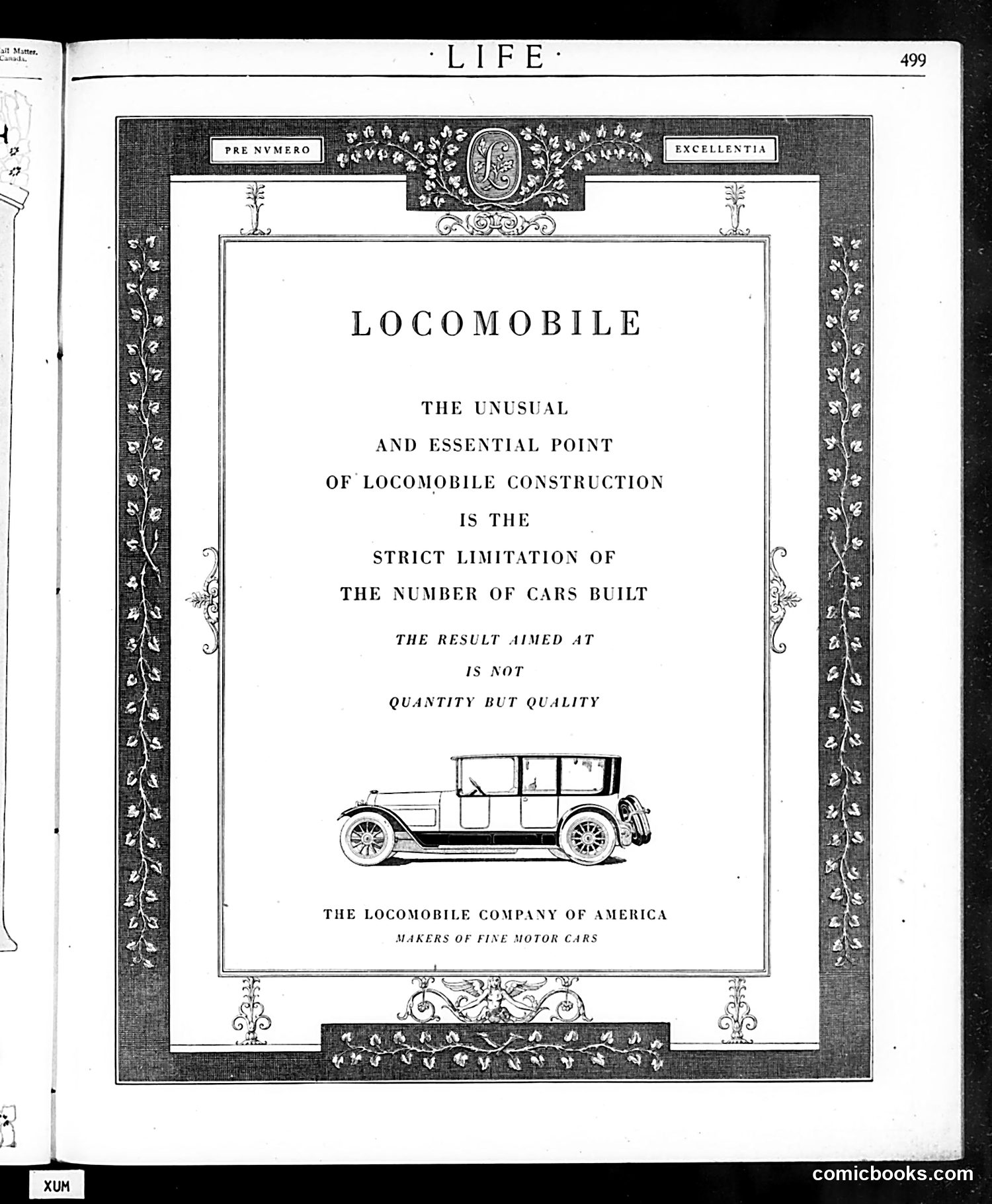
This is a **straightforward advertisement**, not political satire or cartoon content. The Locomobile Company of America presents a quality-over-quantity marketing pitch. The ad emphasizes that Locomobile deliberately limits production—the opposite of mass-market competitors like Ford—to maintain high standards. The accompanying illustration shows a luxury touring car of the era (early 1900s). The message targets wealthy consumers: restricting output ensures exclusivity and superior craftsmanship rather than competing on affordability or volume. This reflects the pre-Model T luxury automobile market, where limited production signaled prestige. For modern readers: this represents pre-mass-production automotive strategy, when "luxury" meant handcrafted scarcity rather than technological innovation or features.
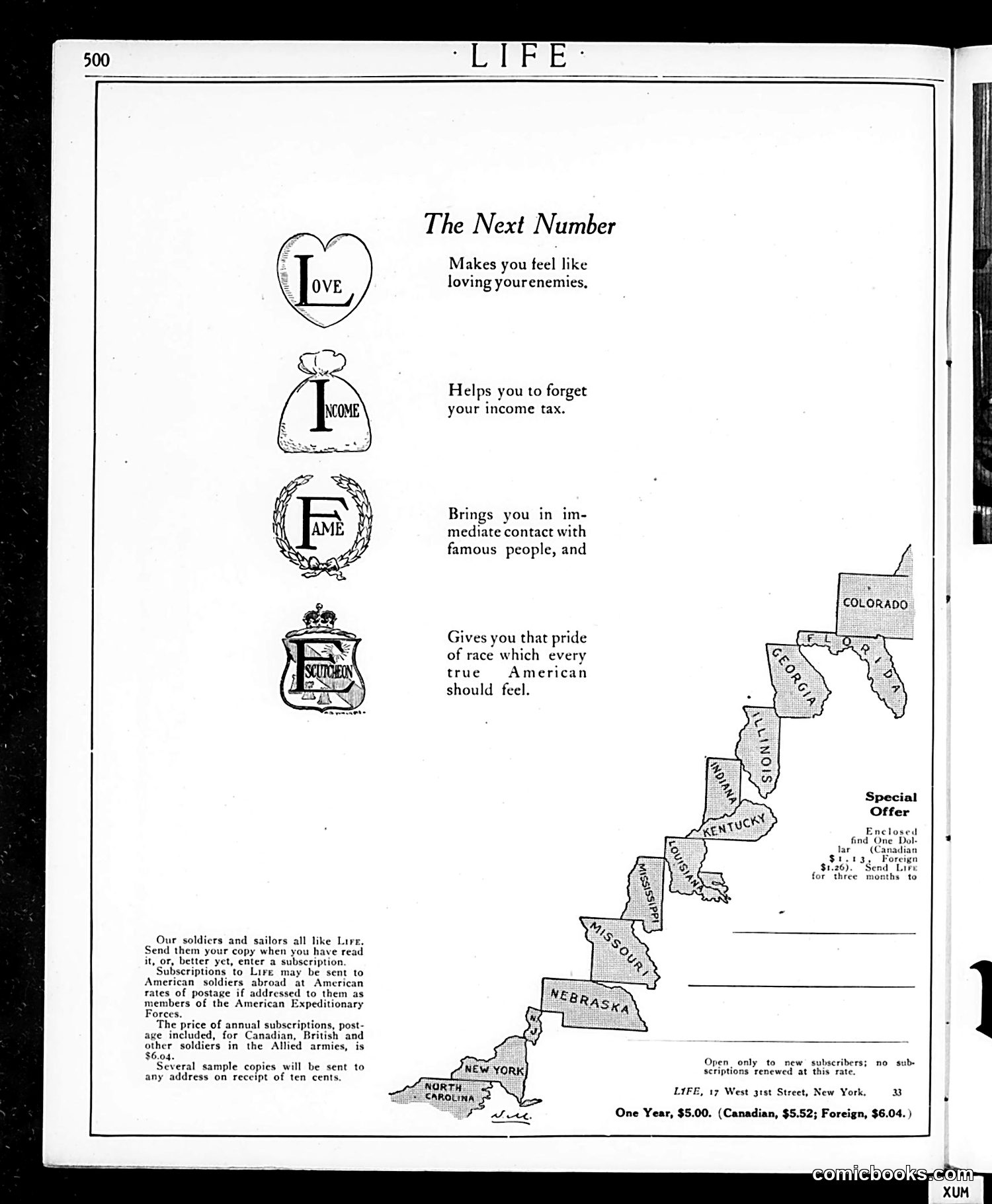
This is primarily a **subscription advertisement for Life magazine**, not political satire. The page uses a numbering system as a humorous hook: - **LOVE** (heart): "Makes you feel like loving your enemies" - **INCOME** (purse): "Helps you to forget your income tax" - **FAME** (laurel wreath): "Brings you in immediate contact with famous people" - **PATRIOTISM** (shield): "Gives you that pride of race which every true American should feel" The ad emphasizes Life's appeal to American soldiers and sailors, offering subscriptions at reduced rates ($5.00 annually; cheaper for Canadian and foreign military). A map of eastern U.S. states illustrates distribution. The humor relies on relatable, tongue-in-cheek benefits—reading Life supposedly addresses common concerns like taxes and patriotic pride during what appears to be the World War I era.
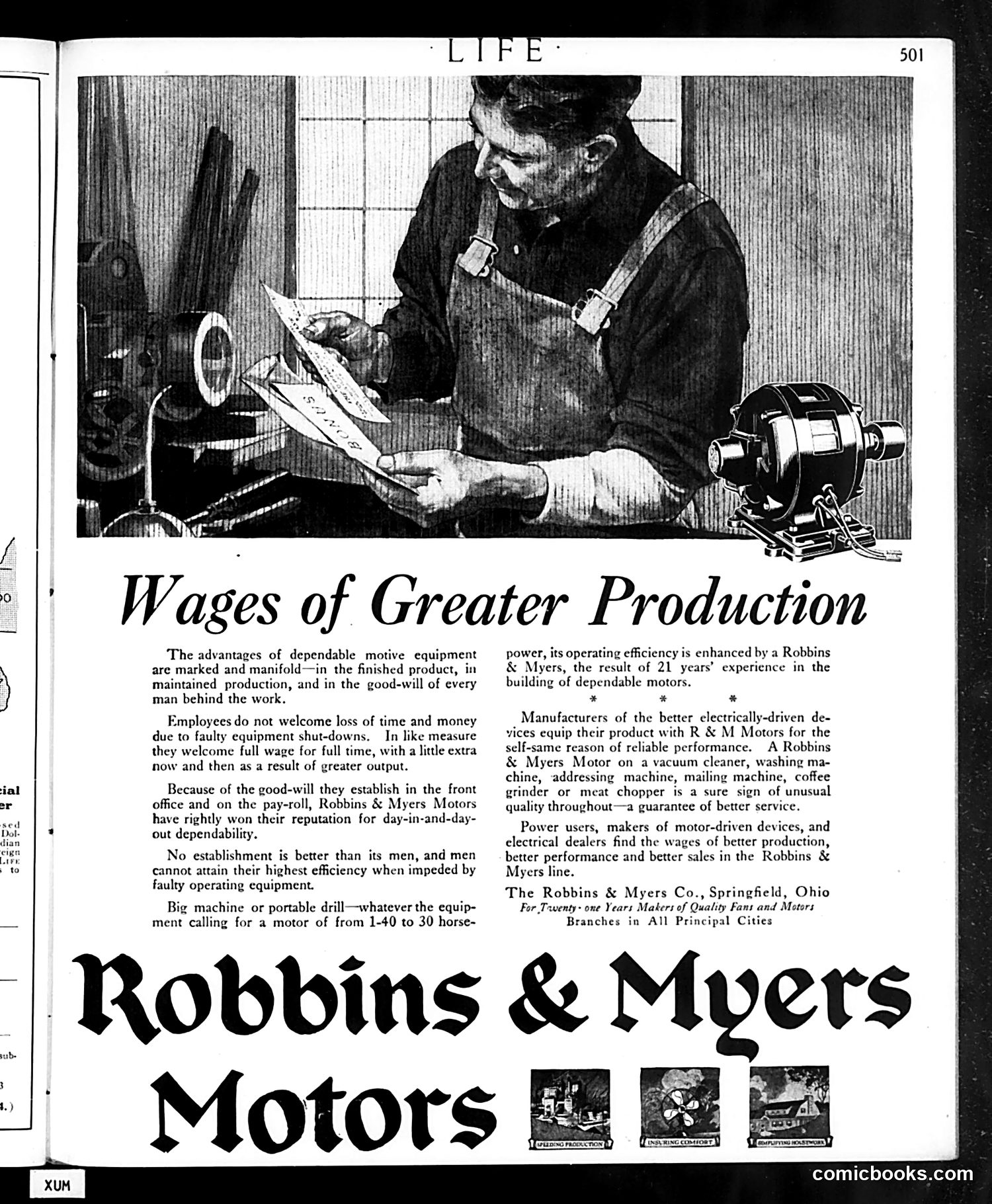
This page is **primarily advertising**, not satire. It's a Robbins & Myers Motors advertisement from *Life* magazine (page 501). The image shows a worker examining or inspecting equipment, illustrating the ad's central message: that reliable electric motors improve workplace productivity and worker morale. The headline "Wages of Greater Production" suggests that dependable equipment enables higher output, which benefits employers through increased efficiency and workers through better job security and potentially higher wages. The text emphasizes that faulty equipment causes costly downtime, while quality R&M motors build goodwill and reputation. It's a straightforward industrial marketing pitch targeting manufacturers, power users, and electrical dealers—not political commentary or satire.
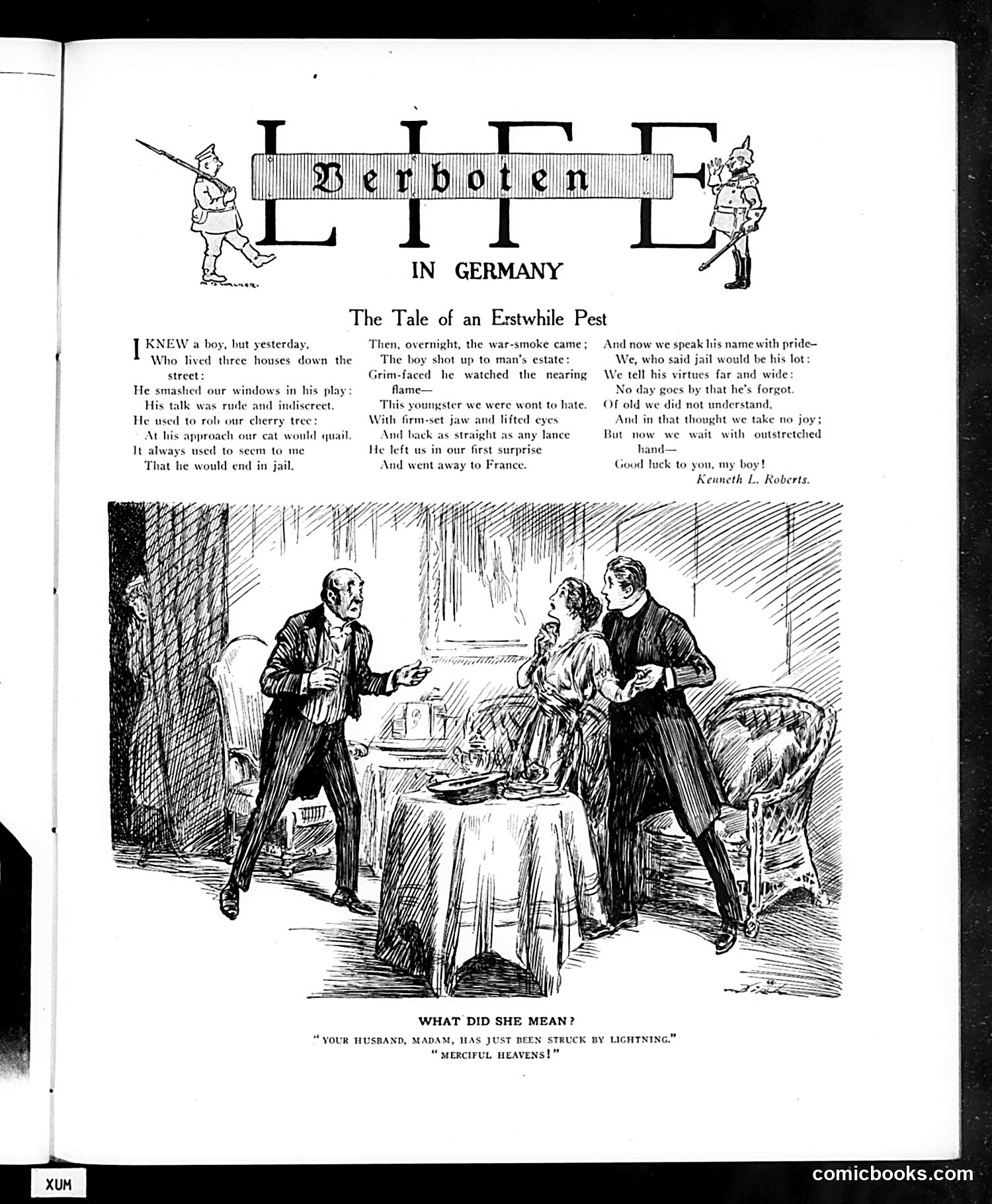
This page presents a satirical poem titled "Verboten Life in Germany: The Tale of an Erstwhile Pest," attributed to Kenneth L. Roberts. The poem describes a mischievous boy—a neighborhood nuisance who breaks windows, steals cherries, and causes trouble—who mysteriously reforms overnight after "war-smoke came," suggesting he was conscripted into military service and sent to France. The accompanying illustration shows three well-dressed adults in conversation, with the caption "WHAT DID SHE MEAN?" followed by "YOUR HUSBAND, MADAM, HAS JUST BEEN STRUCK BY LIGHTNING. MERCIFUL HEAVENS!" The satire appears to mock German military discipline and suggests that war—or even divine intervention—could reform troublemakers. The poem's tone is darkly humorous about conscription's transformative effects on unruly youth.
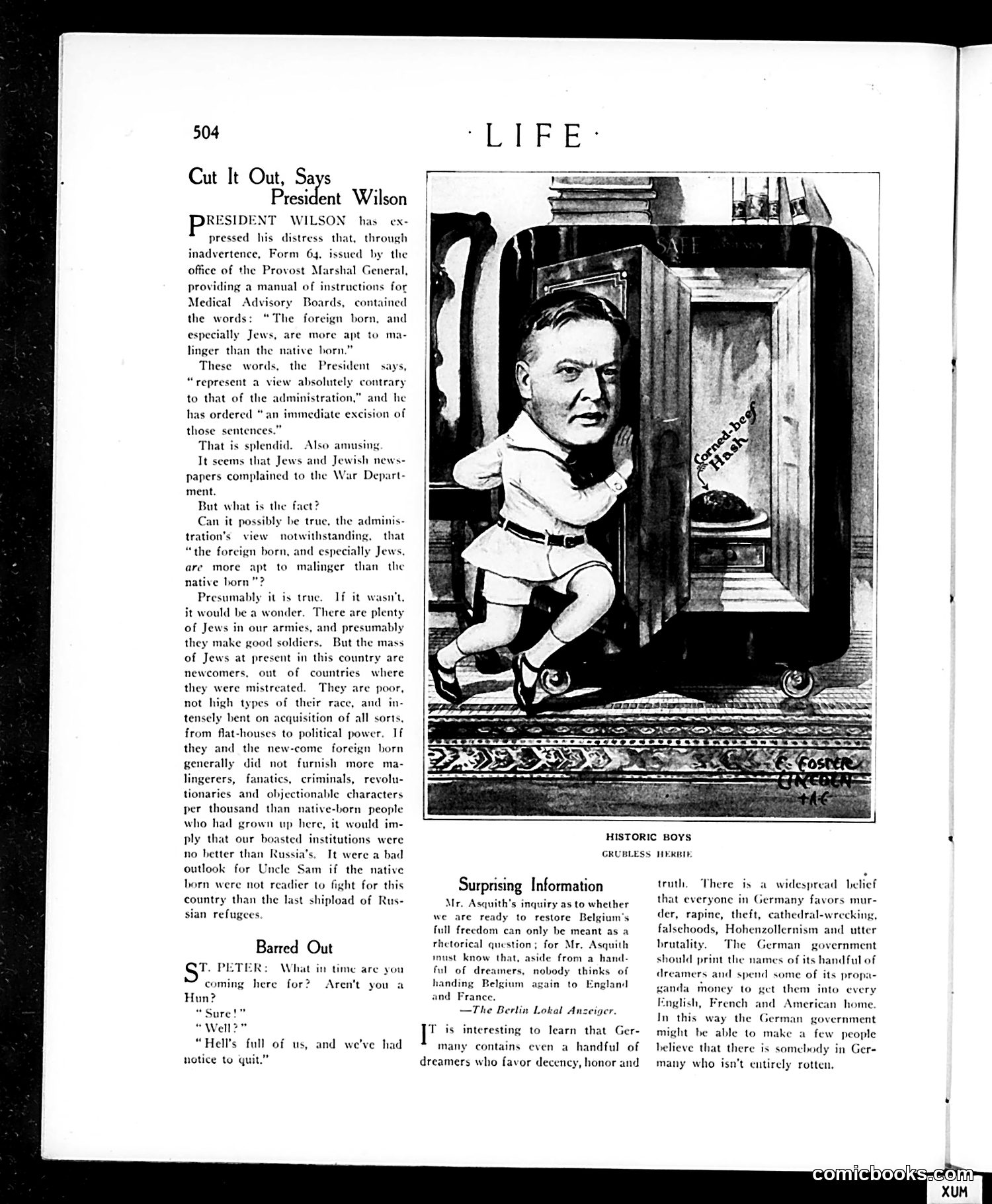
This page satirizes President Wilson's discomfort with an anti-Semitic statement from Form 64, a War Department manual instructing Medical Advisory Boards. The form claimed "foreign born, and especially Jews, are more apt to malinger than the native born." The cartoon titled "Historic Hoys" (captioned "Grueless Humor") depicts a caricatured figure in a doorway—likely representing either the manual's author or Wilson himself—shown in an exaggerated, undignified posture. The satire mocks the absurdity and prejudice of the official document. The accompanying text argues that despite Wilson's quick correction, the statement reflects genuine attitudes about Jewish immigrants being allegedly prone to malingering and criminal behavior—stereotypes the author challenges as false and damaging to national institutions.
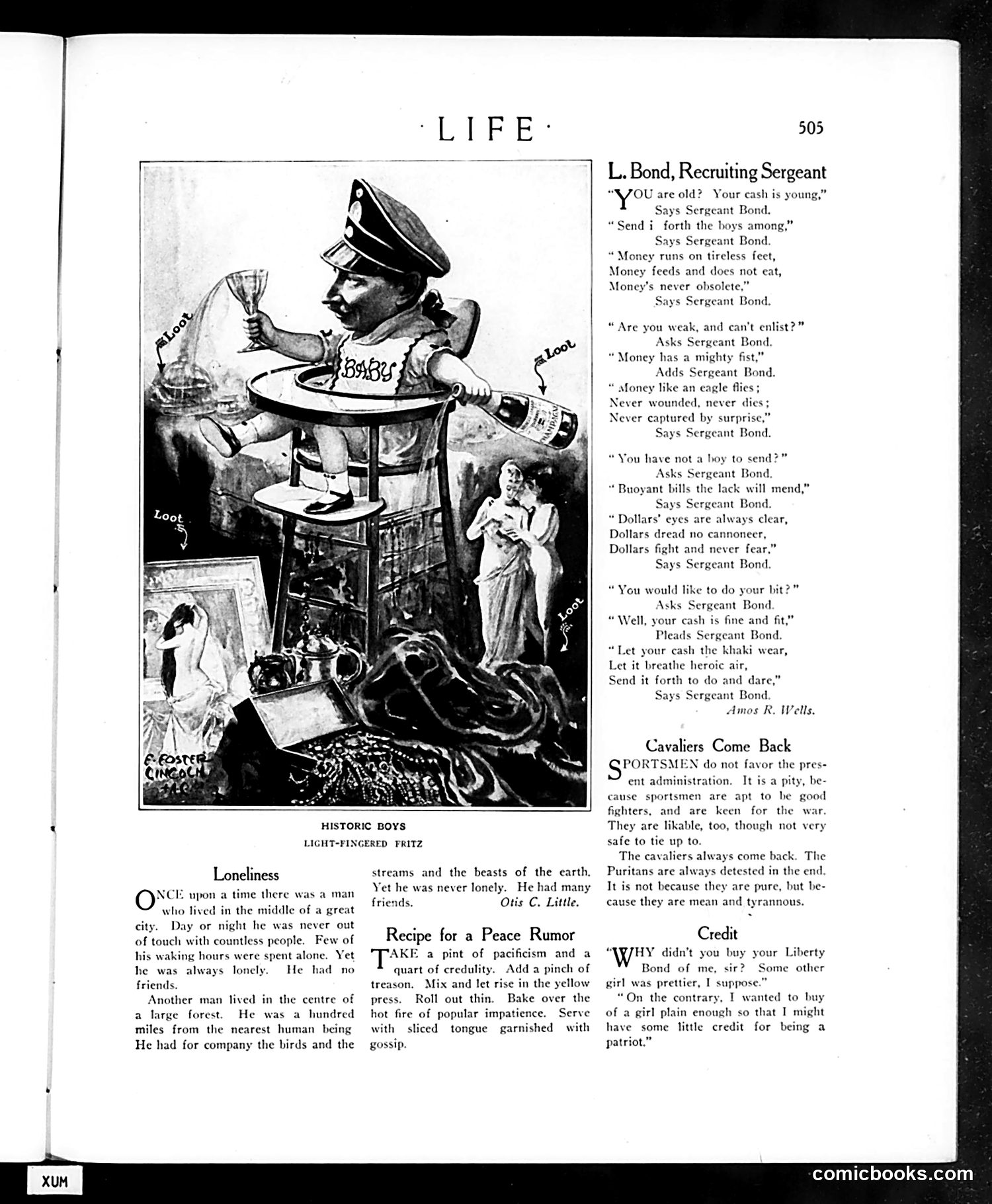
This page contains satirical commentary on military recruitment and patriotism during what appears to be WWI era. **Main Cartoon (left):** Shows "L. Bond, Recruiting Sergeant" as a portly figure juggling money and recruiting young men. The accompanying poem mocks his pitch, portraying him as cynically using financial arguments to convince poor boys to enlist—"Money runs on tireless feet" and "Dollars' eyes are always clear, Dollars dread no cannoneer." **Satirical Articles (right):** Include "Cavaliers Come Back" (criticizing sportsmen's political influence) and "Recipe for a Peace Rumor" (mocking peace talk speculation). **The Point:** The satire attacks the disconnect between wealthy recruiters profiting from war and poor youth being manipulated into enlisting. It suggests recruitment relies on financial desperation rather than genuine patriotism, critiquing how money drives military mobilization.
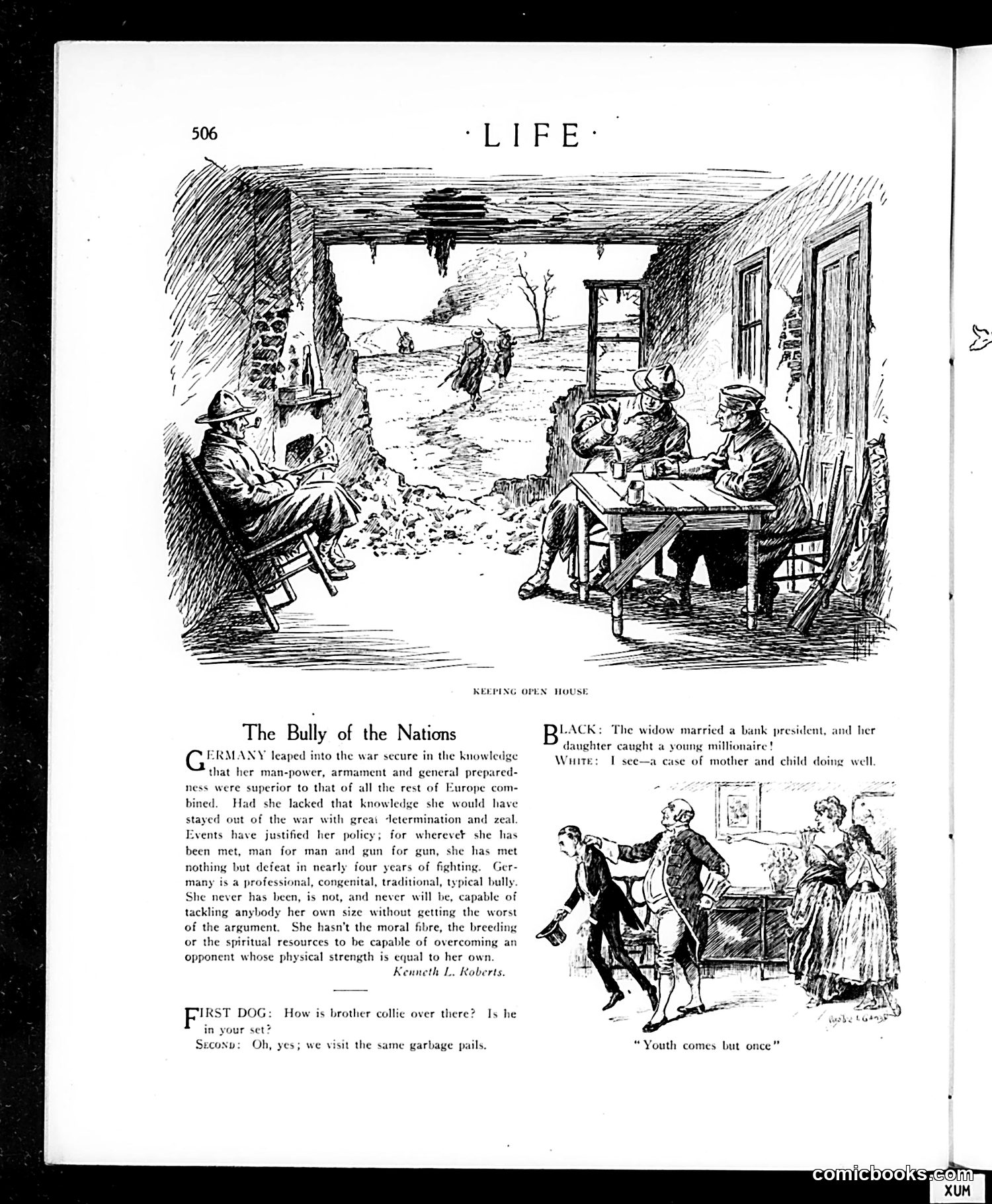
**Main Article: "The Bully of the Nations"** This piece by Kenneth L. Roberts characterizes Germany as a aggressive, unprincipled bully incapable of moral reflection or spiritual growth. It argues Germany will inevitably lose because it lacks the moral resources to overcome an opponent of equal physical strength. This appears to be WWI propaganda, written when Germany was portrayed as the primary aggressor. **Cartoons:** - Top illustration shows soldiers in a dugout during wartime - Bottom cartoon titled "Youth comes but once" depicts a romantic mishap—apparently a young man's awkward encounter with a woman, likely satirizing social embarrassment during wartime The page reflects early-20th-century American perspectives on the war and gender relations.
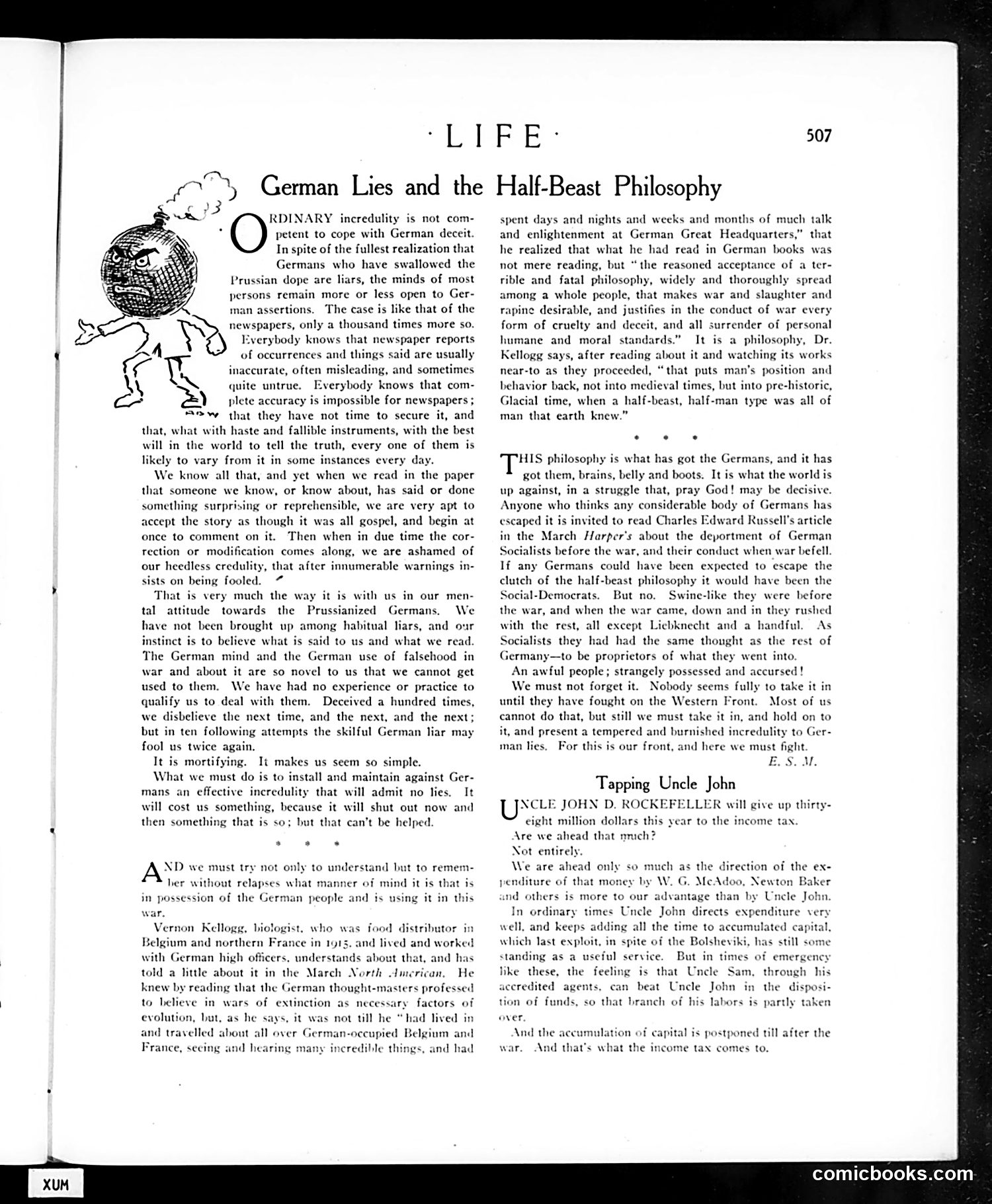
The cartoon depicts a grotesque figure—half-human, half-beast—representing German ideology and propaganda during World War I. The imagery satirizes the article's central argument: that German philosophy and military conduct embody a primitive, animalistic worldview that justifies cruelty as "natural." The text criticizes German wartime deceptions and philosophical justifications for their actions. It references Vernon Kellogg's observations from German military headquarters, arguing that German thought-leaders believed in "half-beast" evolutionary philosophy to rationalize brutality. The cartoon visually embodies this concept—Germans as intellectually and morally "half" civilized—making the abstract philosophical critique concrete through grotesque caricature. This represents American WWI anti-German propaganda.
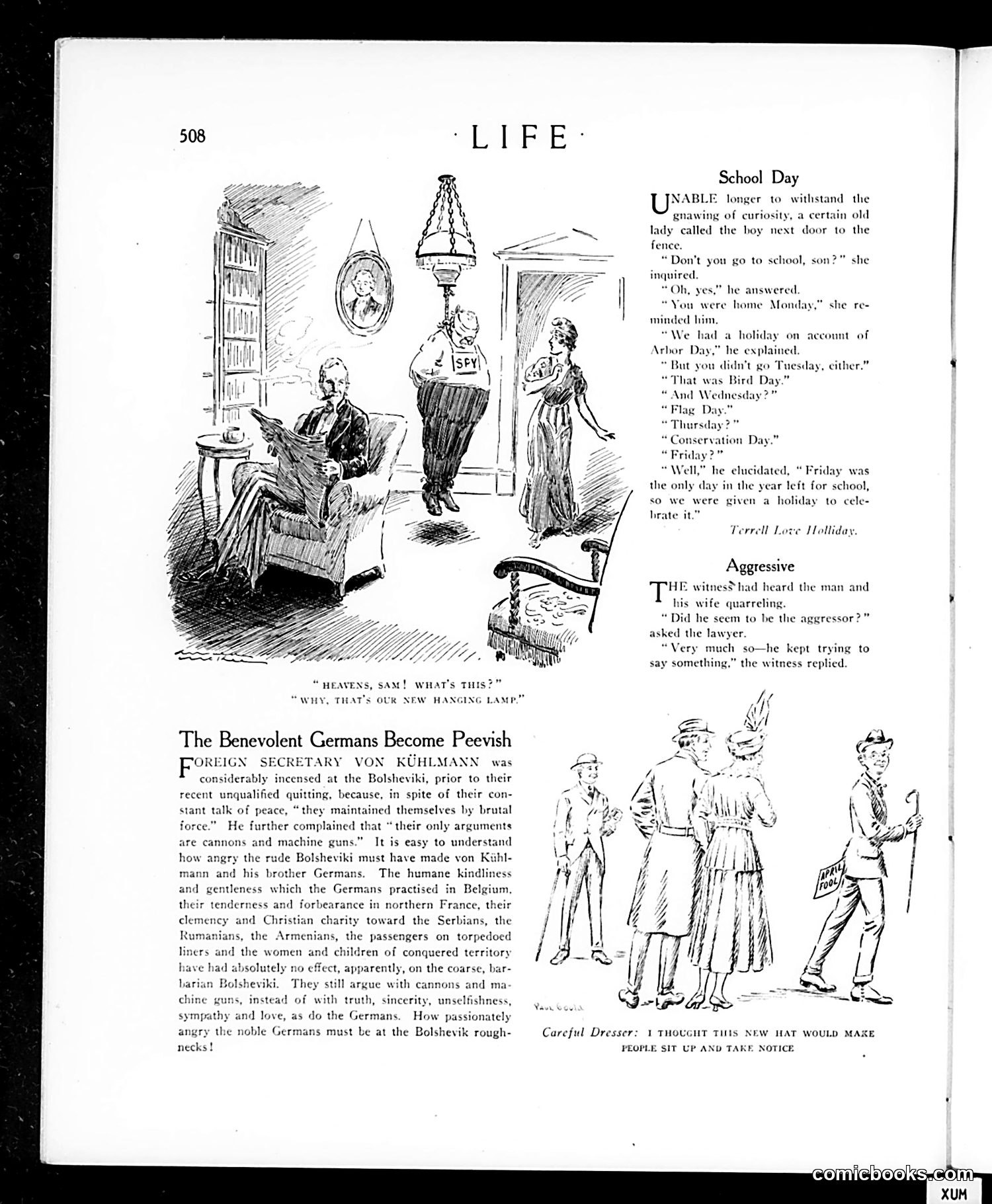
This page contains three separate satirical pieces: 1. **"School Day"** - A humorous dialogue where a boy claims every day of the week was a holiday, leaving only Friday for actual school attendance. The joke mocks childhood excuses and creative interpretations of "holidays." 2. **"Aggressive"** - A brief courtroom anecdote about witness testimony regarding a quarreling couple, with dark humor about the husband's aggressive behavior. 3. **"The Benevolent Germans Become Peevish"** - Political satire criticizing German leadership (Foreign Secretary von Kühlmann mentioned) during what appears to be WWI. It contrasts Germany's claimed "peace" rhetoric with their brutal military actions, arguing their anger at the Bolsheviks reveals their true nature. The accompanying illustration shows military figures. The page reflects wartime American attitudes toward Germany and uses humor to critique both domestic behavior and international political hypocrisy.
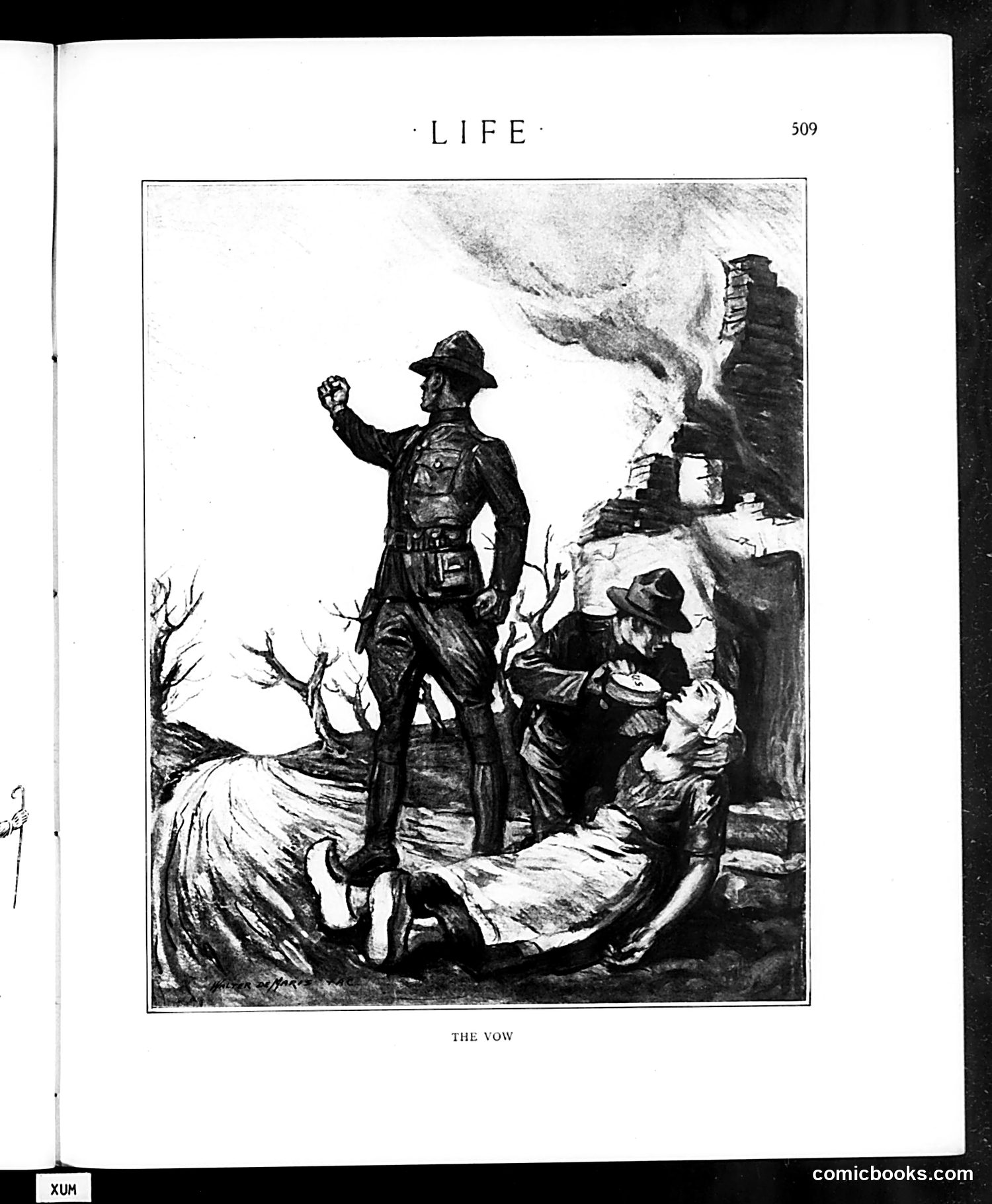
This illustration depicts a military figure in uniform taking an oath or vow, with his fist raised, while a seated civilian watches. The ruins visible in the background suggest a war-torn setting. Without additional context from the magazine issue, the specific historical reference remains unclear. However, the composition—a soldier making a solemn pledge amid destruction—suggests this satirizes a military commitment or oath made during wartime. The civilian observer's role is ambiguous: they may represent the public, leadership, or those affected by the soldier's vow. The dramatic, earnest tone of the illustration indicates this is likely serious political commentary rather than comedic satire, possibly critiquing military promises or their consequences. The exact event or figure referenced cannot be definitively identified from the image alone.
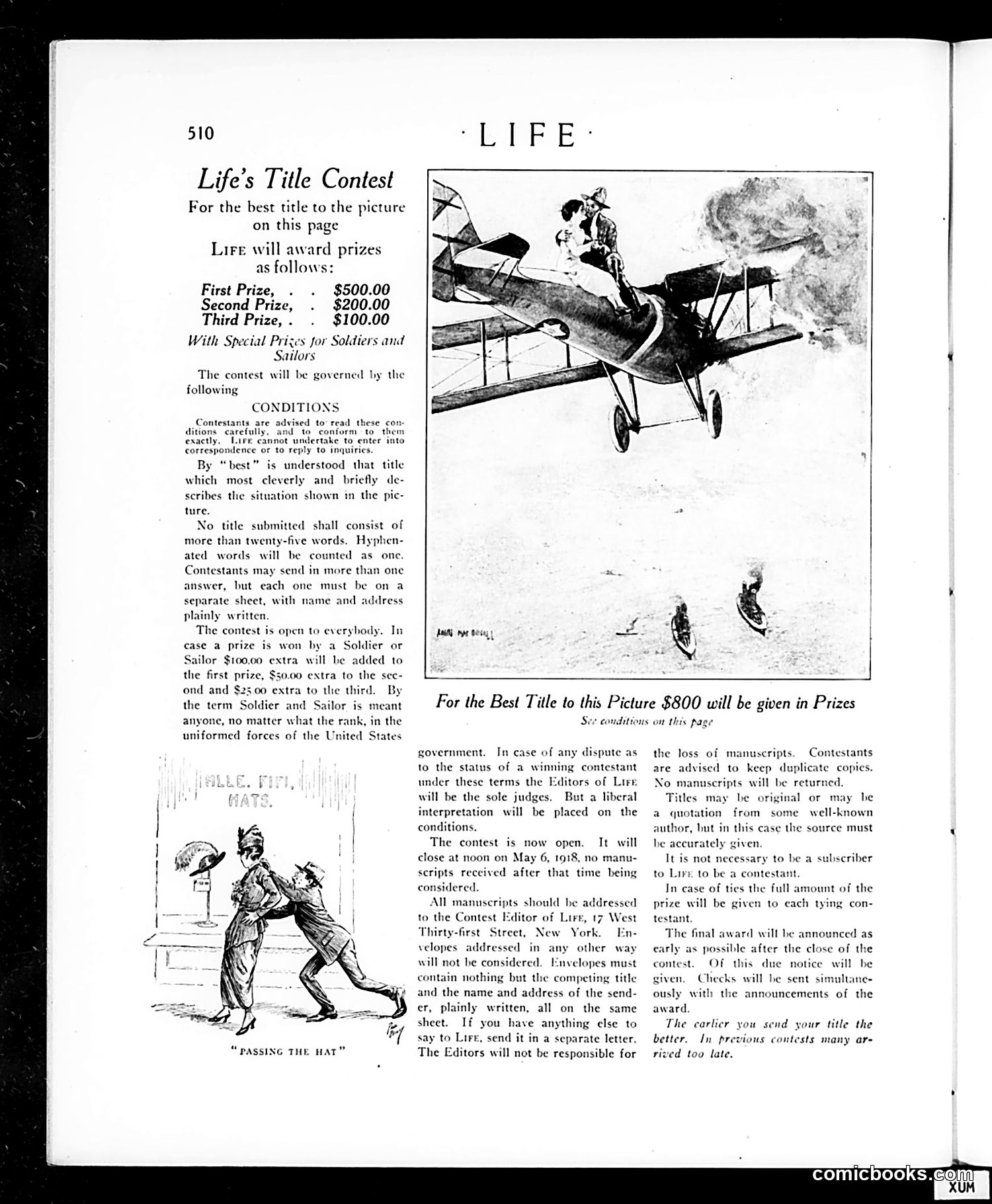
This page announces a **title-writing contest** for the central illustration—an early aircraft with two figures. The contest offers $500 (first prize), $200 (second), and $100 (third), with **special bonus prizes for soldiers and sailors**. The contest image shows what appears to be a **WWI-era biplane** with two people in or on it, likely depicting some dramatic aviation scenario. The contest rules specify titles must be 25 words or fewer and cleverly describe the situation. The small cartoon below titled **"Passing the Hat"** appears to be unrelated humor, showing figures in what looks like a fundraising or collection scenario. **Context**: This reflects **wartime enthusiasm for aviation** (a relatively new technology) and patriotic engagement, with special recognition for military participants.
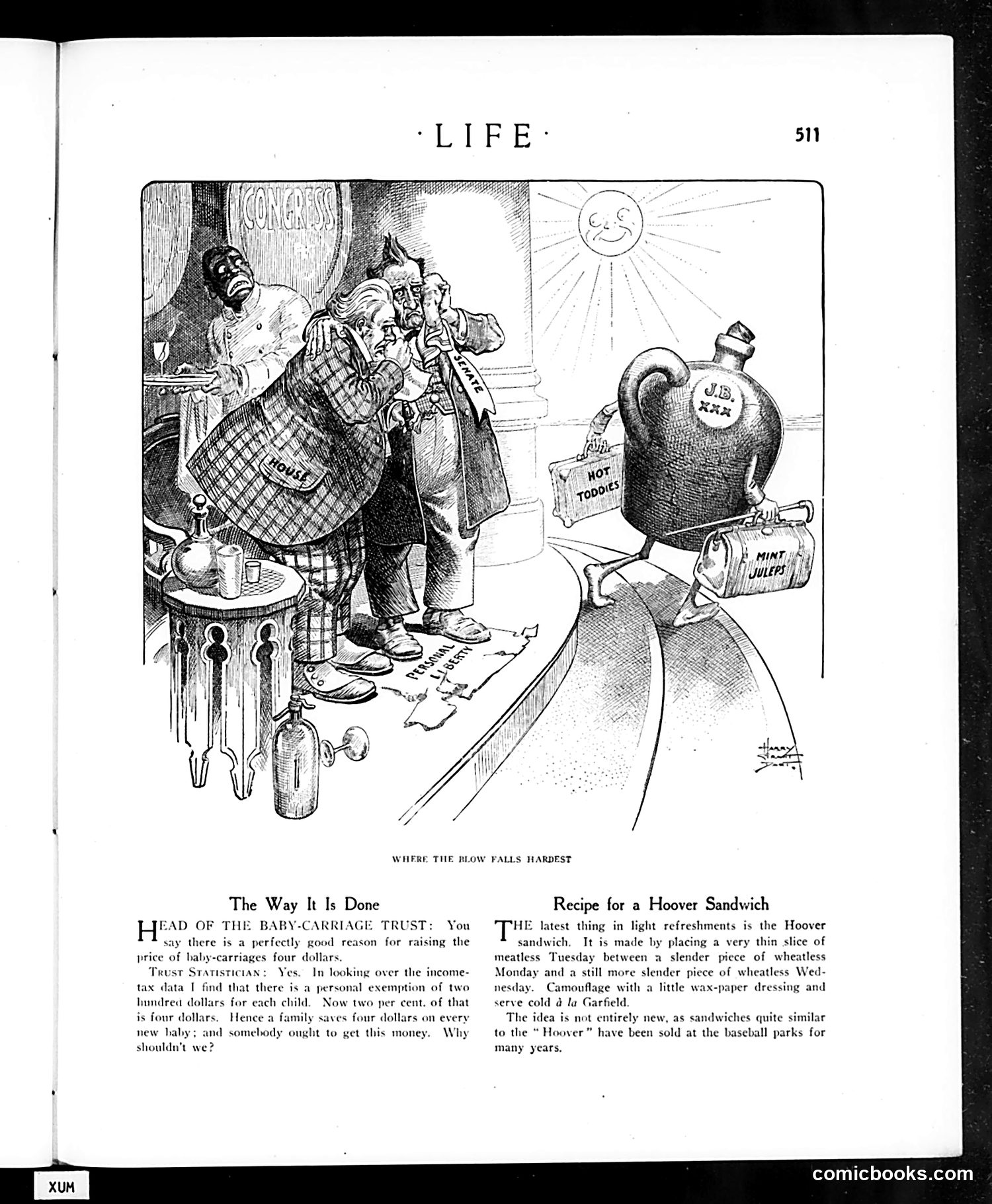
This satirical cartoon critiques the **Baby-Carriage Trust**—a monopoly controlling infant carriage prices. The accompanying text presents a cynical "defense" from a trust head claiming the price increase (from two to four dollars) represents a reasonable "personal exemption" that saves families money overall. The cartoon shows a large, personified money bag labeled "J.D. ROCKEFELLER" (or similar industrial figure) with "NOT TODAY" written on it, holding "MINT JULEPS." It confronts distressed working-class figures on the left—representing ordinary families burdened by inflated baby-carriage costs. The satire exposes the absurdity of monopolistic price-fixing justified through circular economic reasoning, while the title emphasizes that ordinary citizens bear the financial burden of corporate greed.
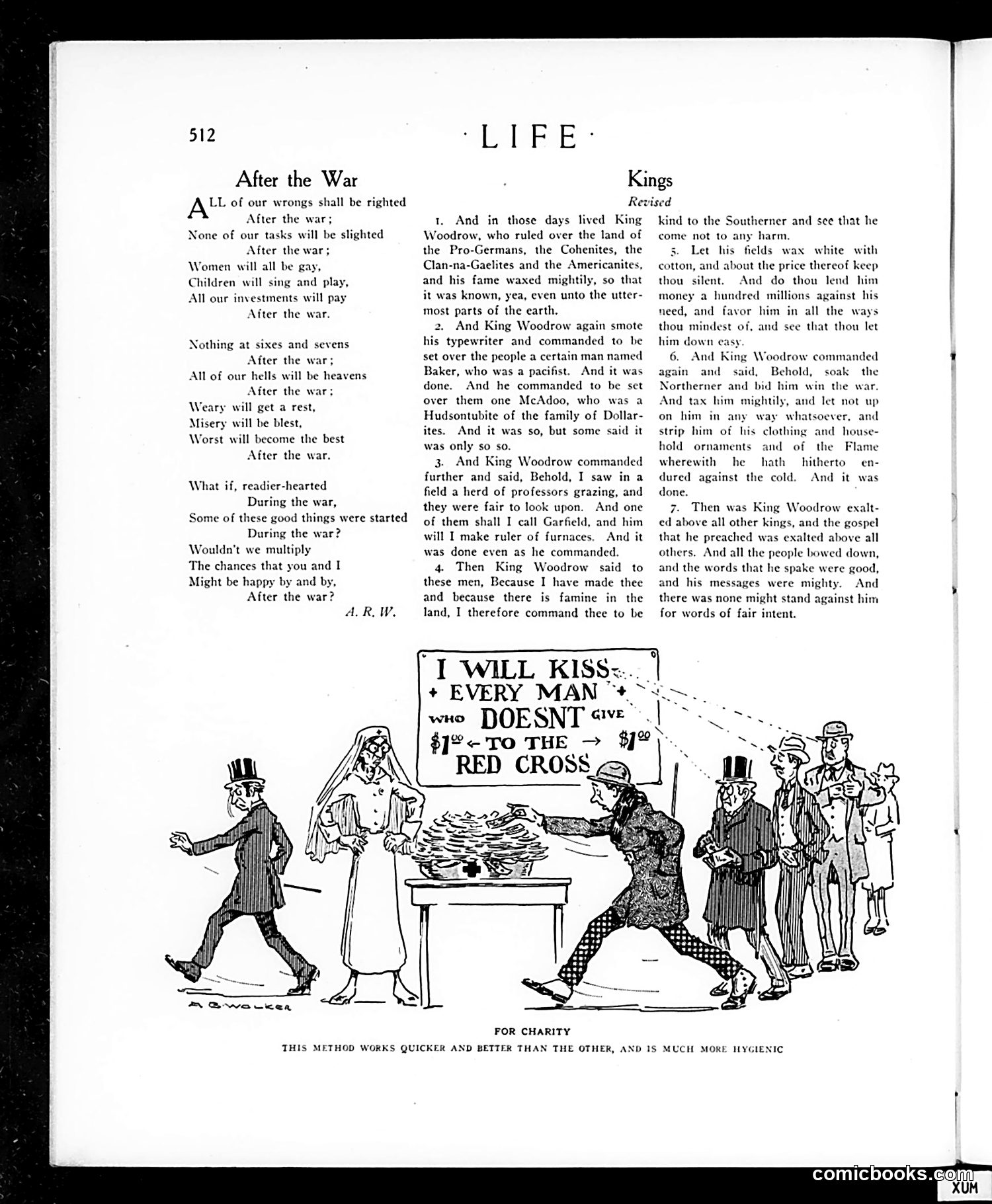
This page contains **anti-Wilson satire** from WWI-era *Life* magazine. The left poem mocks post-war optimism, suggesting people delay social improvements until "after the war"—then questions why they don't start *now*. The right section parodies the Bible to critique President Woodrow Wilson's wartime policies. "King Woodrow" appoints officials (Baker, McAdoo, Garfield—recognizable cabinet members) and shows favoritism: he protects the South financially while heavily taxing and stripping the North. The satire suggests Wilson's administration exploited regional differences and played favorites during wartime. The cartoon below illustrates coercive Red Cross fundraising: a woman with a collection plate threatens to kiss men unless they donate $1-$2, while onlookers watch. The caption claims this method is "quicker, better, and more hygienic" than other collection methods—satirizing both aggressive charity tactics and wartime social upheaval.
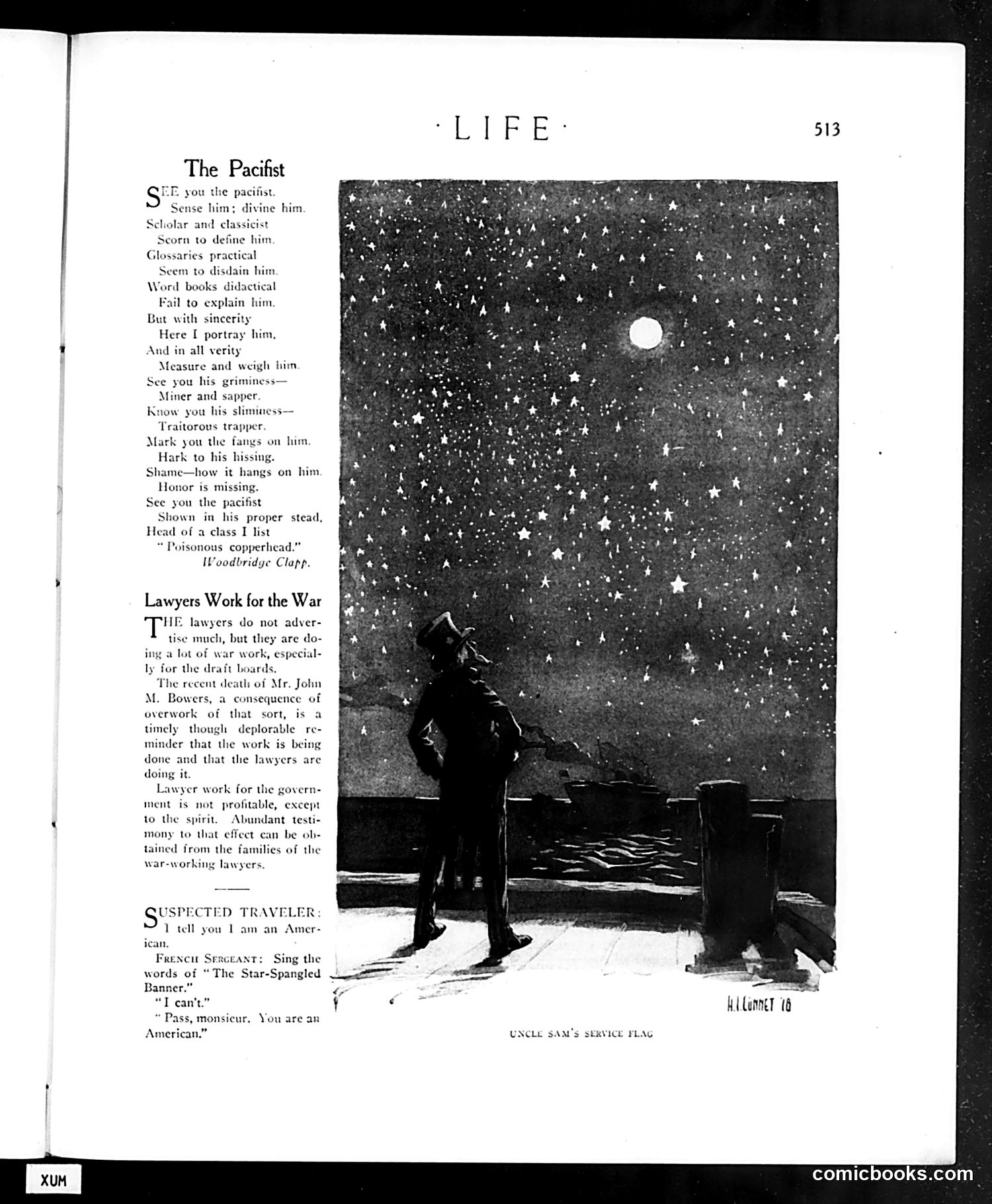
This page contains **three distinct satirical pieces** from an era when America was debating entry into World War I: 1. **"The Pacifist" (poem by Woodbridge Clapp)**: A vicious attack on pacifists, portraying them as treacherous "copperheads" (a Civil War-era term for Northern sympathizers with the South). The poem uses animal imagery—"fangs," "hissing"—to dehumanize anti-war advocates, calling them dishonorable traitors. 2. **"Lawyers Work for the War"**: A tribute noting lawyers' unpaid war service, mentioning John M. Bowers's death from overwork on draft board duties. This validates legal professionals' patriotic contributions. 3. **"Suspected Traveler" (cartoon with starry night image)**: A French sergeant tests an American's nationality by demanding he sing "The Star-Spangled Banner." The American's inability to do so ironically proves his authenticity—implying only a "fake" American would know the words. This satirizes wartime loyalty tests and national identity anxieties. The page reflects pro-war, interventionist sentiment and hostility toward pacifism.
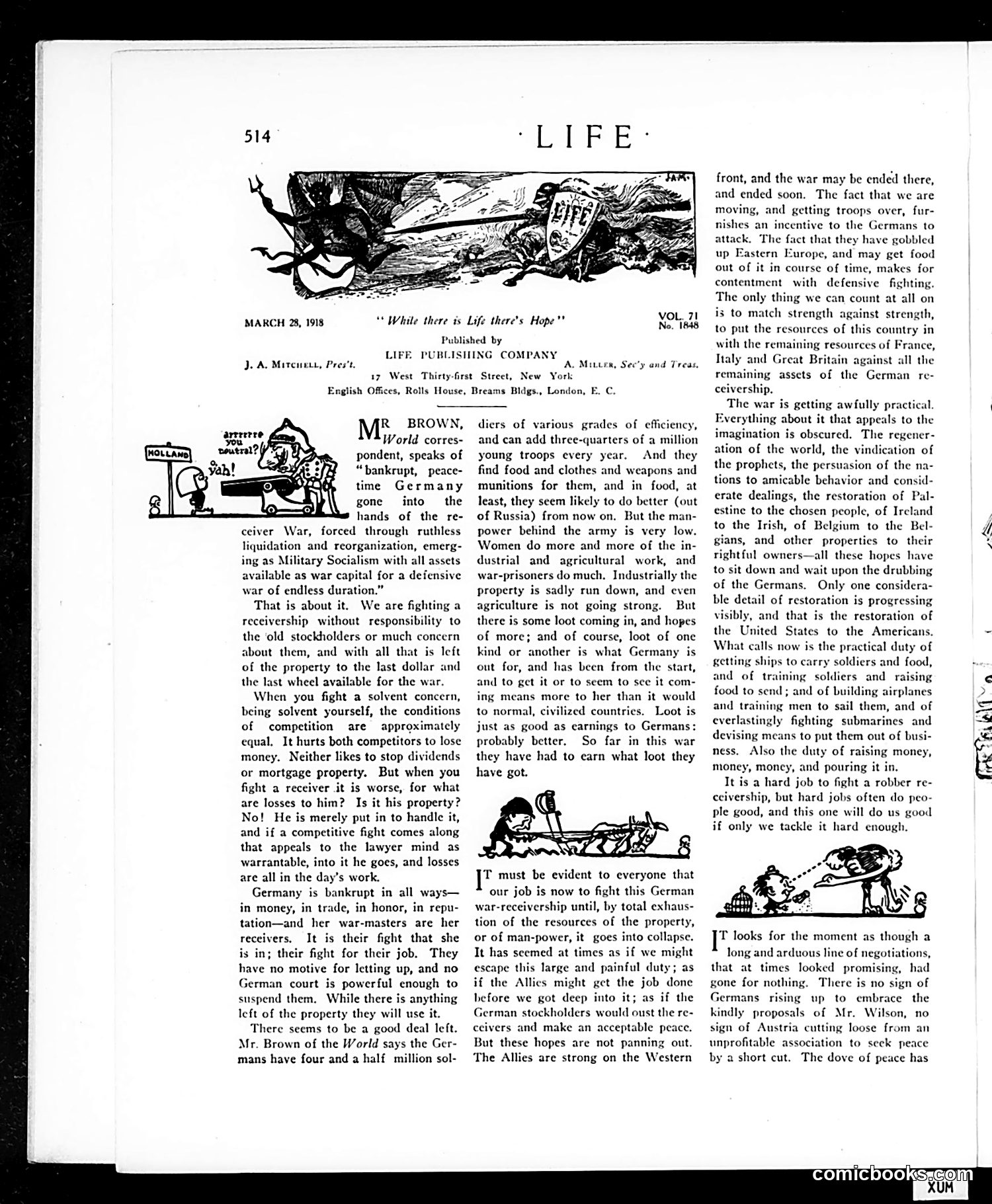
This editorial article uses an extended financial metaphor to explain America's war strategy against Germany. The author compares Germany to a bankrupt company in "receivership"—placed under court supervision—while the Allies are solvent competitors fighting it. The key argument: Germany's leaders (the "receivers") have no incentive to stop fighting because they're not risking their own property; they're merely managing a failing state's remaining assets for war. This makes them more dangerous than a solvent opponent, since losses don't discourage them personally. The article cites "Mr. Brown of the World" (a journalist) who notes Germany still commands 4.5 million soldiers and can replace troops, though industrial capacity is degraded and reliant on looted Eastern European resources. The conclusion: America must exhaust Germany's remaining resources entirely through sustained military pressure—there's no shortcut to victory through negotiation or German internal collapse. This reflects early 1918 Allied anxieties about prolonged conflict.
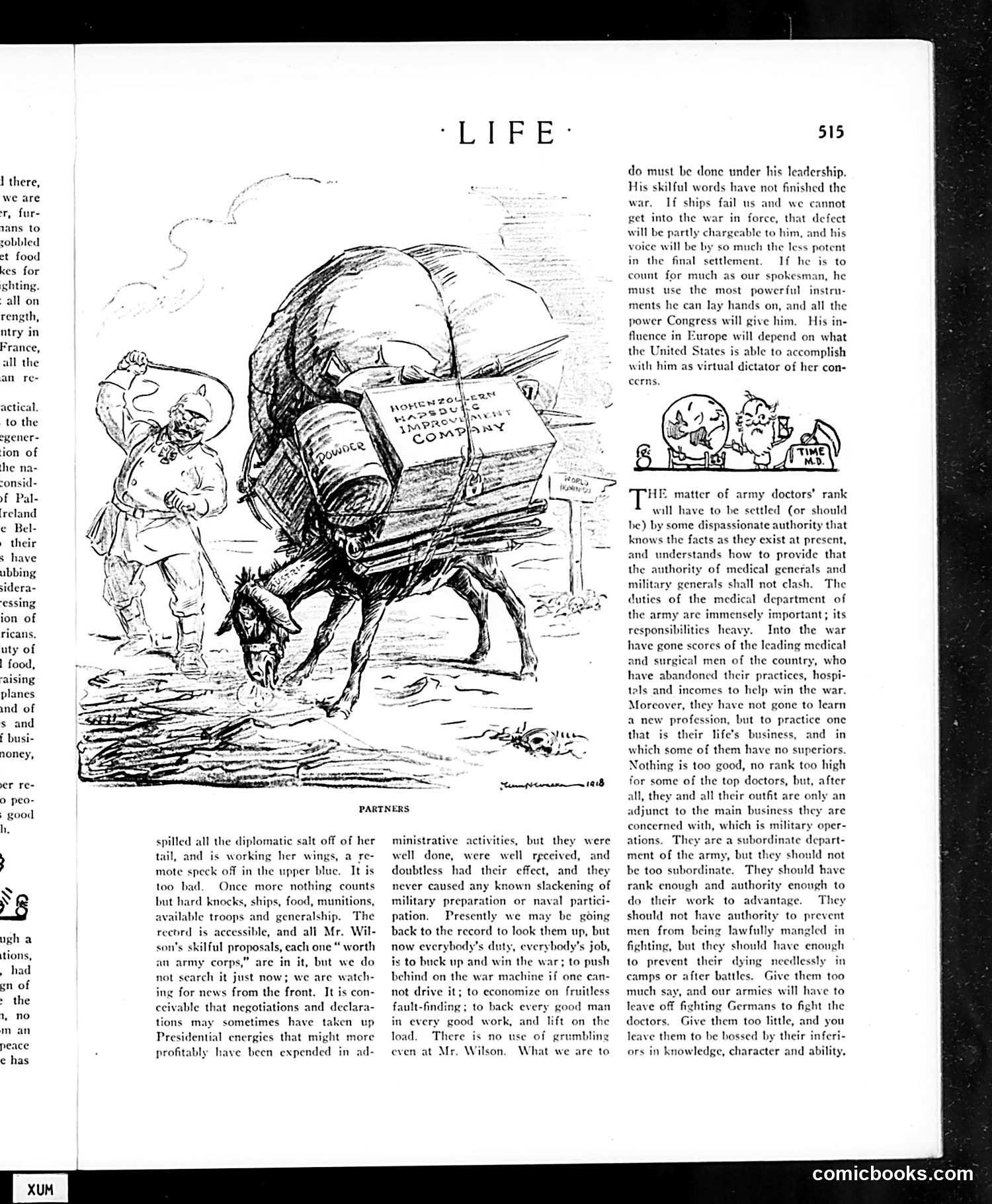
This cartoon depicts a donkey laboring under heavy loads of supplies and documents labeled "HOME FRONT IMPRESSIONS" and similar administrative materials. A small soldier figure stands beside it. The satire criticizes President Wilson's administration during World War I. The accompanying text argues that while Wilson's diplomatic proposals are valuable, what matters now is military action—"hard knocks, ships, food, munitions." The donkey represents the war effort being overburdened by bureaucratic paperwork and civilian concerns rather than focused on winning. The point: administrative and diplomatic activities, however well-intentioned, are secondary to actual military preparation and resources. The text explicitly states Wilson's "skilful words have not finished the war," suggesting his proposals must be backed by tangible military power and congressional support to have influence in Europe. The cartoon reflects public frustration that American entry into WWI required less talking and more decisive military action.
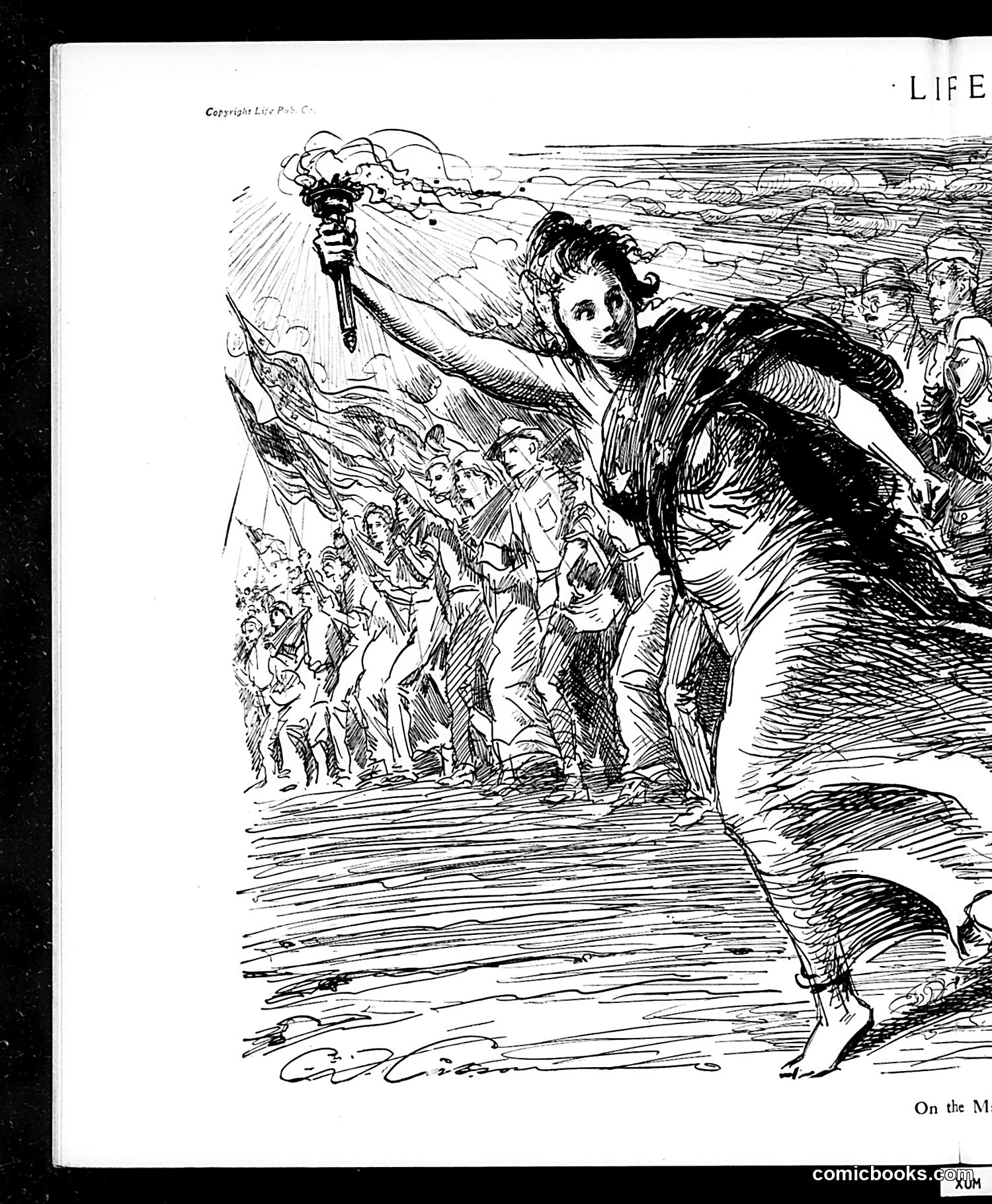
This appears to be a satirical illustration from Life magazine showing a dramatic scene with classical allegorical elements. A central female figure (likely representing Liberty or a similar national virtue) holds an illuminated torch aloft while gesturing toward a crowd of ordinary citizens below. The composition suggests an inspirational or patriotic theme, with the torch-bearer appearing to lead or rally the masses. The style and dramatic rendering—with its emphasis on heroic pose and crowd dynamics—suggests commentary on civic engagement, democratic participation, or national leadership. However, without visible date markers or clearer textual context on this page, the specific historical moment or political target remains unclear. The classical iconography points to early 20th-century American political satire.
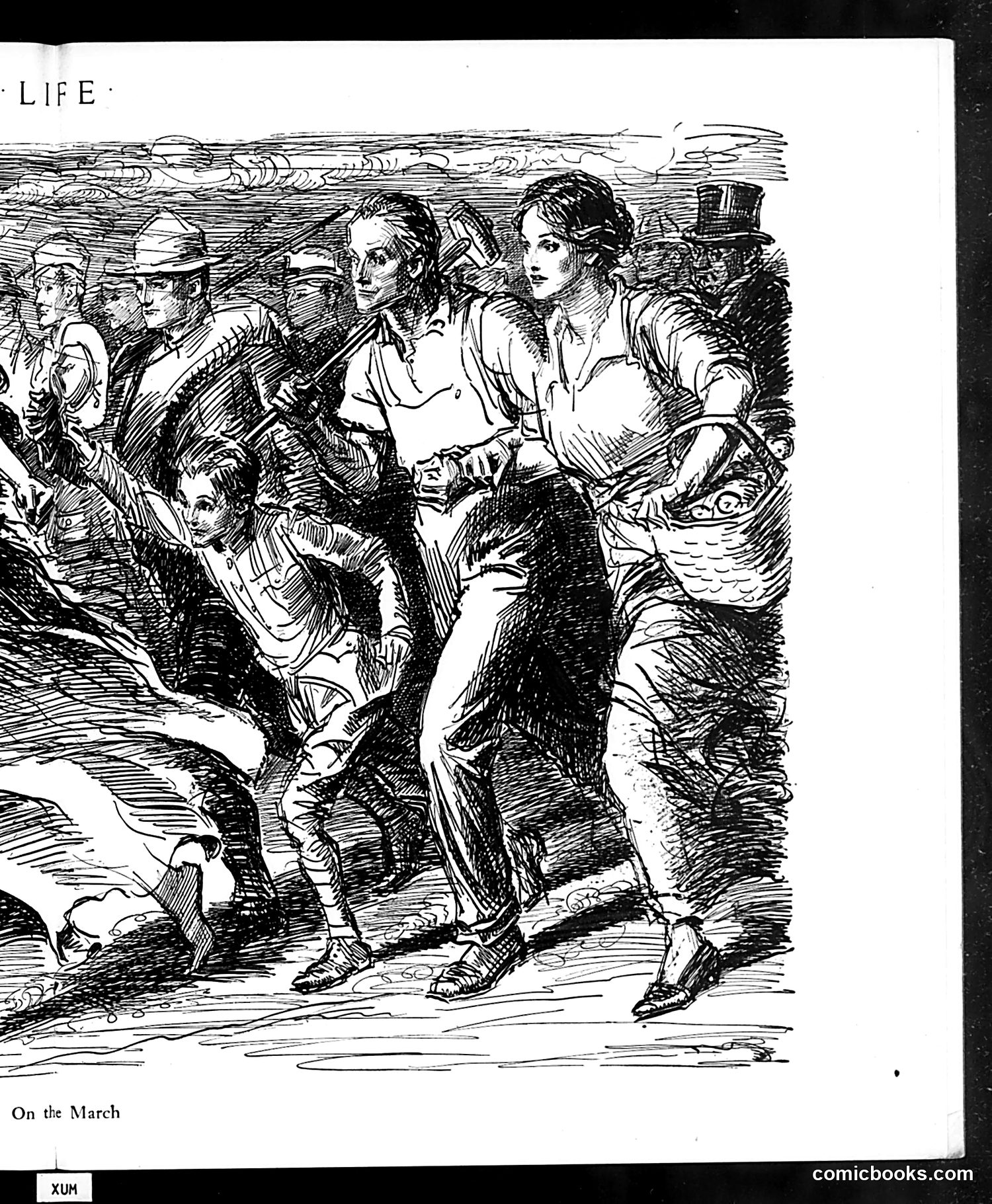
This engraving depicts a group of working-class and military figures marching together, with women and men in various states of dress and armor. The title "On the March" suggests movement toward some collective goal or protest. Without additional context about the specific issue date, the exact historical reference remains unclear. However, based on the composition—mixing civilians, soldiers, and apparent working-class figures—this likely satirizes either a labor march, military mobilization, or social movement of the period when *Life* was publishing. The heterogeneous group's unified forward motion suggests commentary on mass movements, possibly critiquing or documenting contemporary social upheaval. The detailed cross-hatching and expressive style is characteristic of *Life*'s satirical engravings from the late 19th or early 20th century. The specific political target requires the magazine's issue date to identify with certainty.
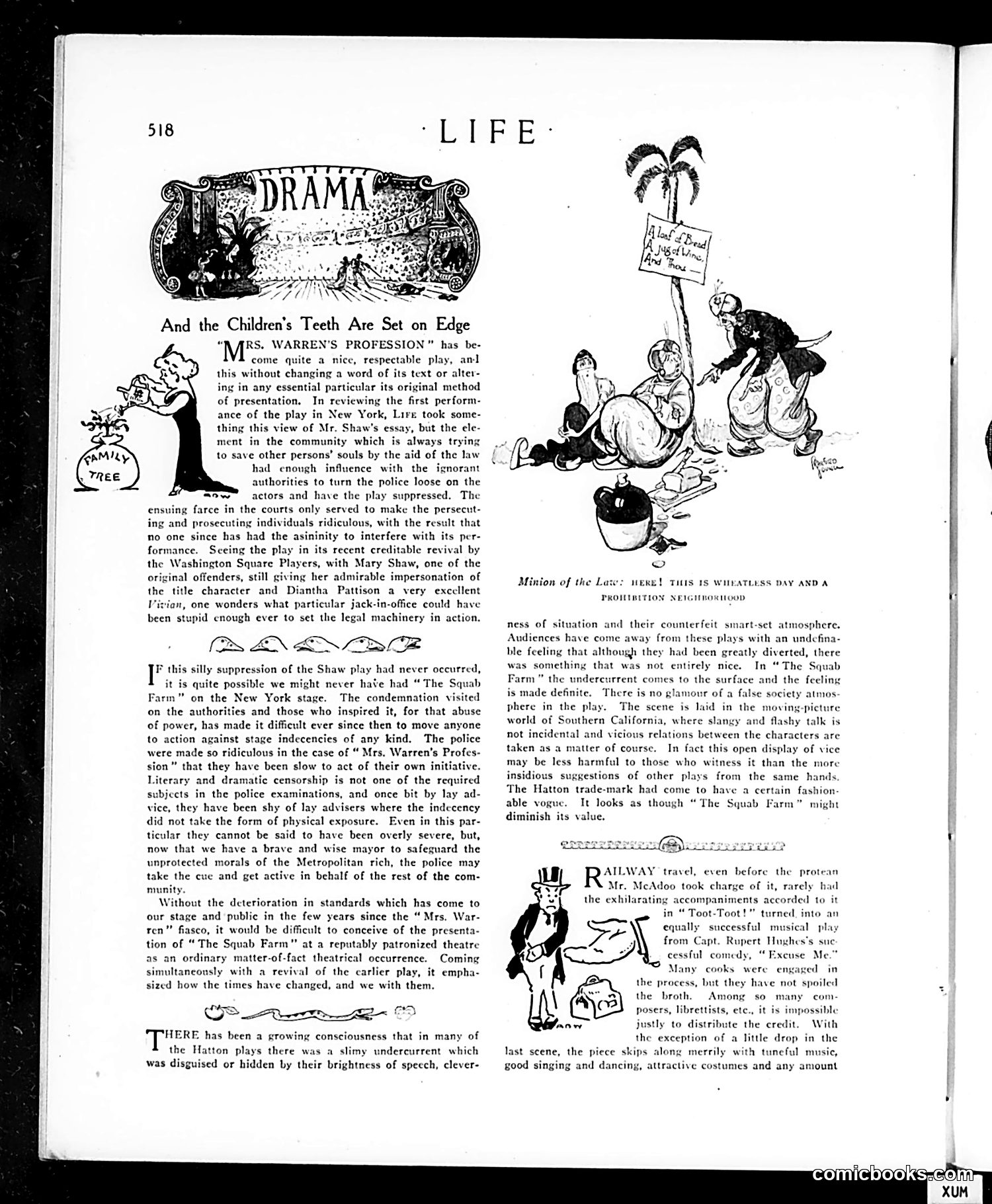
This page discusses two plays: Shaw's "Mrs. Warren's Profession" and "The Squab Farm." The main article explains that Shaw's play—which deals with a woman's morally questionable profession—was initially suppressed by police/authorities as indecent, but the censorship attempt became so ridiculous it actually backfired, making future theatrical censorship efforts difficult. The cartoon "Minion of the Law" (bottom right) depicts a police officer during Prohibition, satirizing law enforcement's selective moral judgment: they were emboldened to censor theatrical "indecency," yet the same authorities now face Prohibition (alcohol ban) enforcement—a "wheatless day" rationing context suggesting wartime. The satire's point: authorities who aggressively policed stage morality now look foolish trying to enforce contradictory laws. The cartoon critiques government overreach in defining and punishing "vice" while overlooking actual corruption or harmful policies.
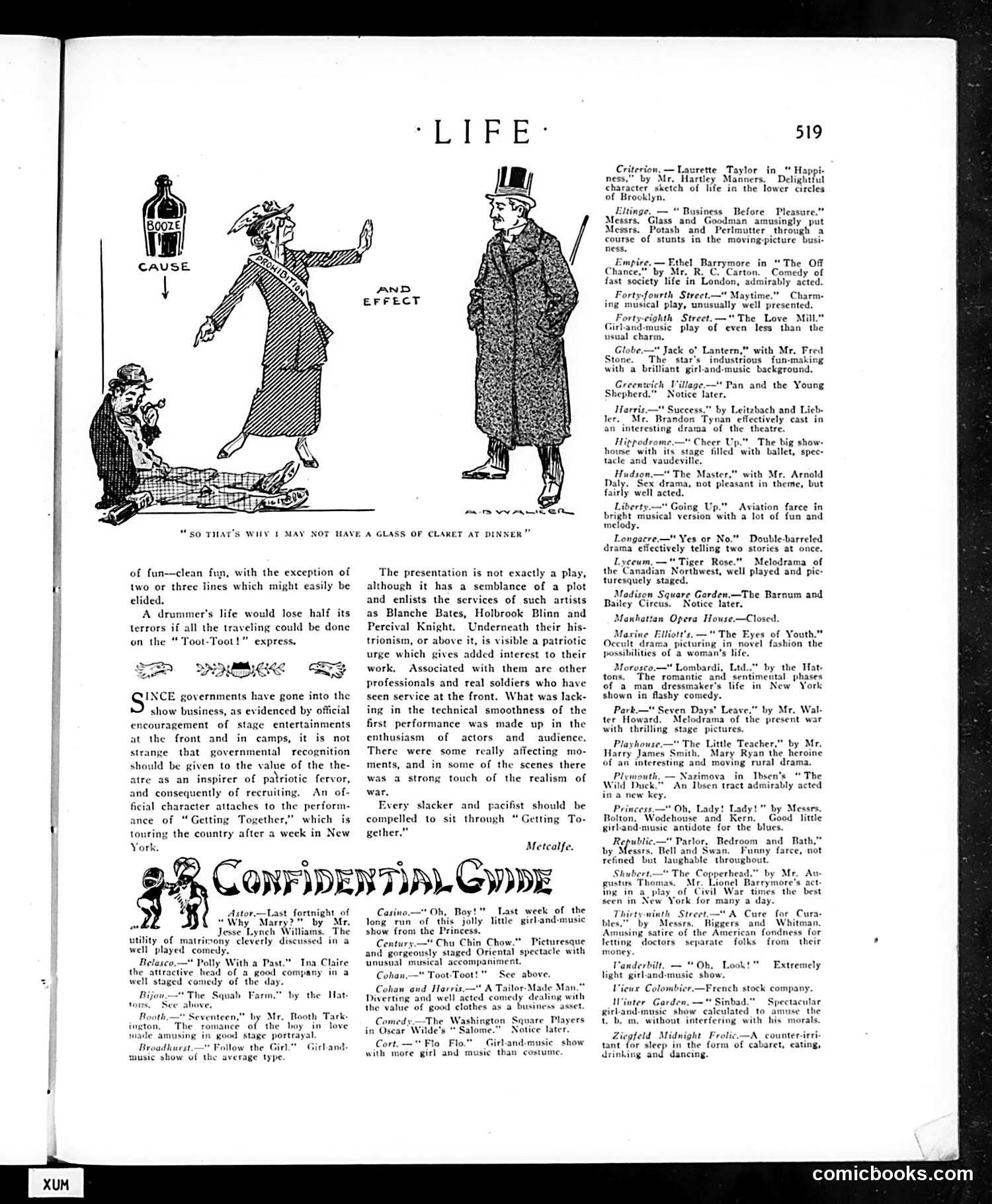
This cartoon satirizes **Prohibition-era restrictions** on alcohol consumption. The image shows a bottle labeled "BOOZE" as the "CAUSE," with an arrow pointing to its "EFFECT"—a disheveled man lying drunk on the ground while a woman gestures in disapproval. The caption's irony suggests that government restrictions on drinking are justified by the visible consequences of excess alcohol. The cartoon implies that without such regulations, citizens would suffer public drunkenness and social disorder, thereby losing the privilege of responsible wine consumption at dinner. This reflects early 20th-century American debates about alcohol regulation, culminating in Prohibition (1920-1933). The satire targets those arguing alcohol should be banned entirely, suggesting their reasoning—though visible evidence of alcohol's harms exists—overlooks moderate, civilized consumption. The joke's edge critiques both excessive drinkers *and* prohibitionists' heavy-handed approach.
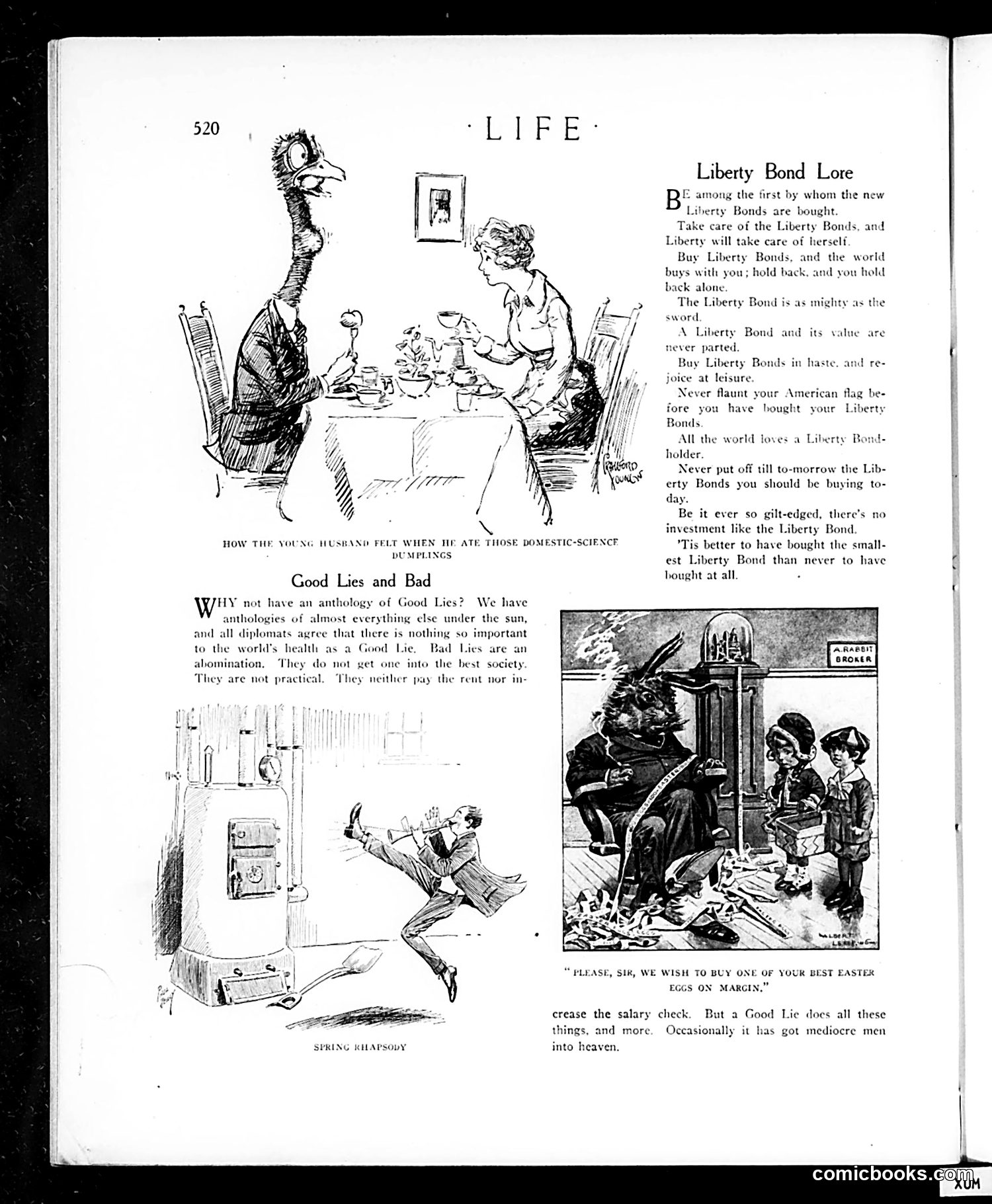
This page contains three distinct satirical pieces from the World War I period: **"Good Lies and Bad"**: An essay arguing that "good lies" (diplomatic falsehoods) serve society better than "bad lies" (practical deceptions that don't pay bills). The accompanying cartoons illustrate domestic absurdities—a husband reacting badly to his wife's "domestic science" cooking, and a man being launched by a spring-loaded contraption. **"Liberty Bond Lore"**: Patriotic propaganda written as mock-sacred text, urging Americans to purchase Liberty Bonds (government war bonds) using quasi-religious language ("Liberty will take care of herself"). This reflects WWI fundraising efforts. **"Easter Eggs on Margin"**: A political cartoon showing children asking a merchant to buy luxury Easter eggs on credit ("margin"). This satirizes postwar inflation and consumer excess despite economic constraints—the absurdity of buying luxury goods on borrowed money during uncertain times. The page blends humor with wartime messaging, using satire to comment on American society's contradictions during and after WWI.
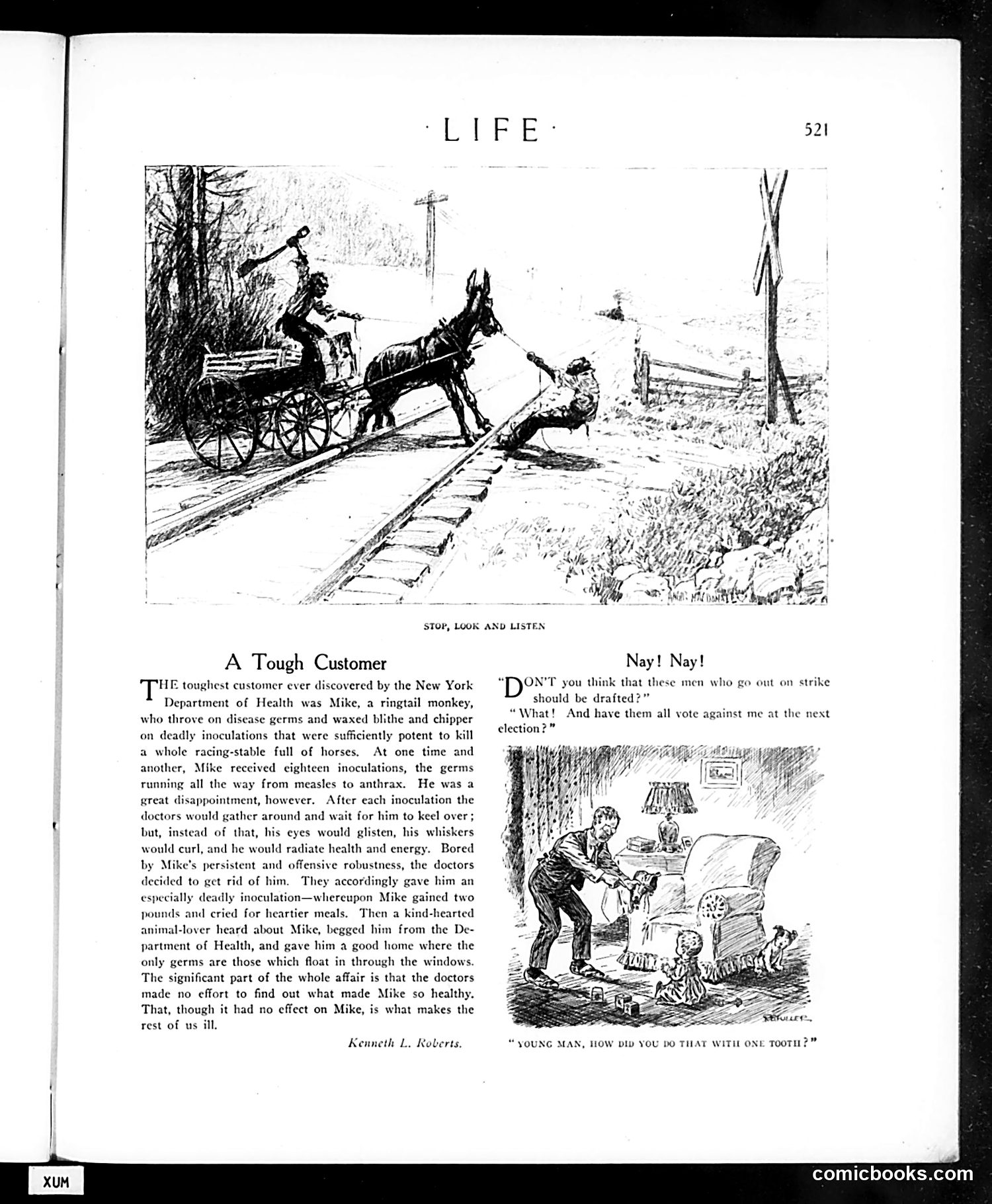
This page contains two satirical pieces: **"A Tough Customer"** (left): A humorous story about Mike, a ringtail monkey at the New York Department of Health who survives eighteen disease inoculations (measles to anthrax) that would kill horses. Rather than sicken, Mike thrives—gaining weight and energy after each injection. The satire targets medical establishment arrogance: doctors gave up trying to kill him but made zero effort to understand *why* he remained healthy. The author (Kenneth L. Roberts) uses this to critique how people ignore the actual causes of health, focusing instead on symptom-fighting. **"Nay! Nay!"** (right): A political cartoon showing a man refusing to draft striking workers. His reasoning: drafted workers would gain voting rights and subsequently vote *against* him in elections. The satire mocks self-serving politicians who oppose labor conscription not from principle, but from fear of electoral consequences—exposing cynical political calculation masquerading as reasoned debate. Both pieces exemplify Life's satirical style: attacking institutional hypocrisy through exaggeration and pointed humor.
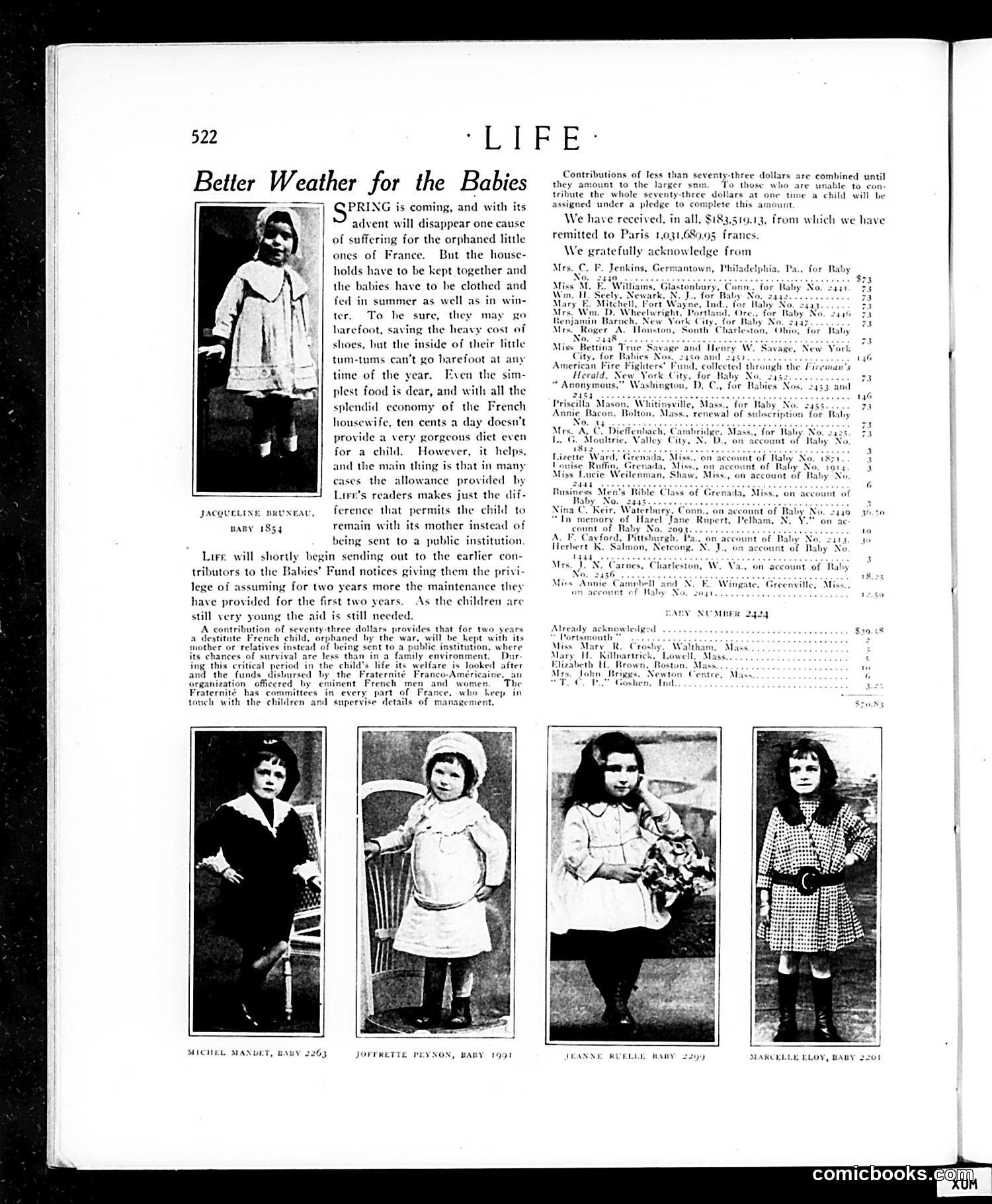
This page documents a charitable fundraising campaign by *Life* magazine to aid French war orphans. The article describes a "Babies' Fund" providing seventy-three dollars to keep orphaned children with relatives rather than placing them in public institutions—a significant concern in post-WWI France. The four photographs show individual French children being supported through donor contributions (identified by number: Baby 2263, Baby 1921, Baby 2299, Baby 2208). The accompanying lists detail donors' names and amounts contributed. Rather than satire, this is earnest philanthropy. *Life* uses its platform to solicit ongoing support, explaining that spring's arrival will ease suffering but that children still need clothing and food year-round. The intimate photographs humanize the cause, while the detailed donor acknowledgments provide accountability and encourage additional contributions through public recognition.
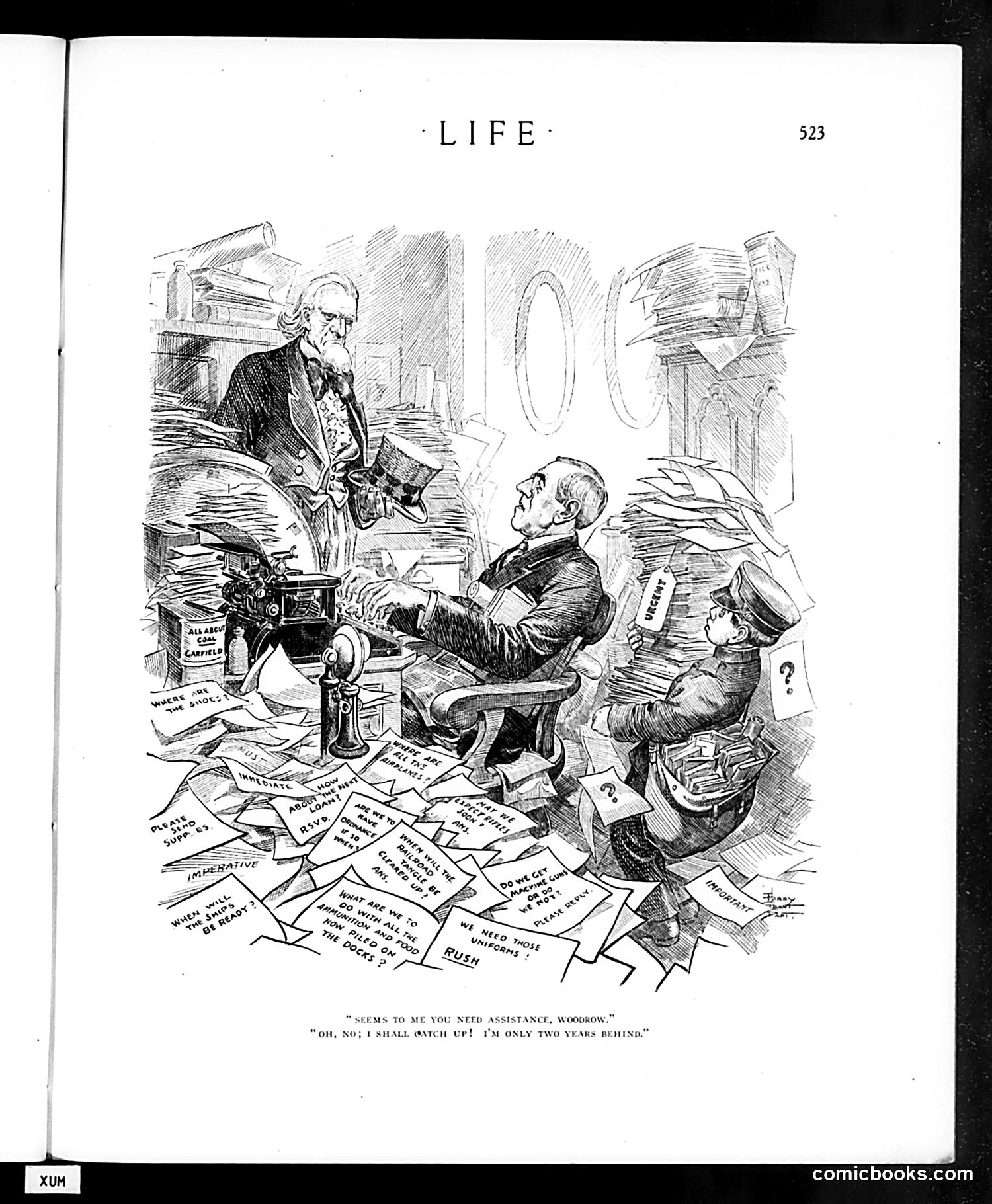
This Life magazine cartoon satirizes governmental bureaucracy and administrative backlog. Three men are depicted in an office drowning in paperwork and documents marked with various requests ("IMPERATIVE," "URGENT," etc.). The standing figure addresses "Woodrow" (likely President Woodrow Wilson), offering assistance with the overwhelming workload. Wilson's response—"I'm only two years behind"—is the satirical punch line, suggesting the administration is hopelessly backlogged despite claiming they'll eventually catch up. The cartoon critiques the inefficiency of government during Wilson's presidency, depicting how administrative duties had accumulated into an unmanageable mountain of bureaucratic work. The humor lies in the absurdity of being two years behind schedule while confidently insisting improvement is forthcoming.
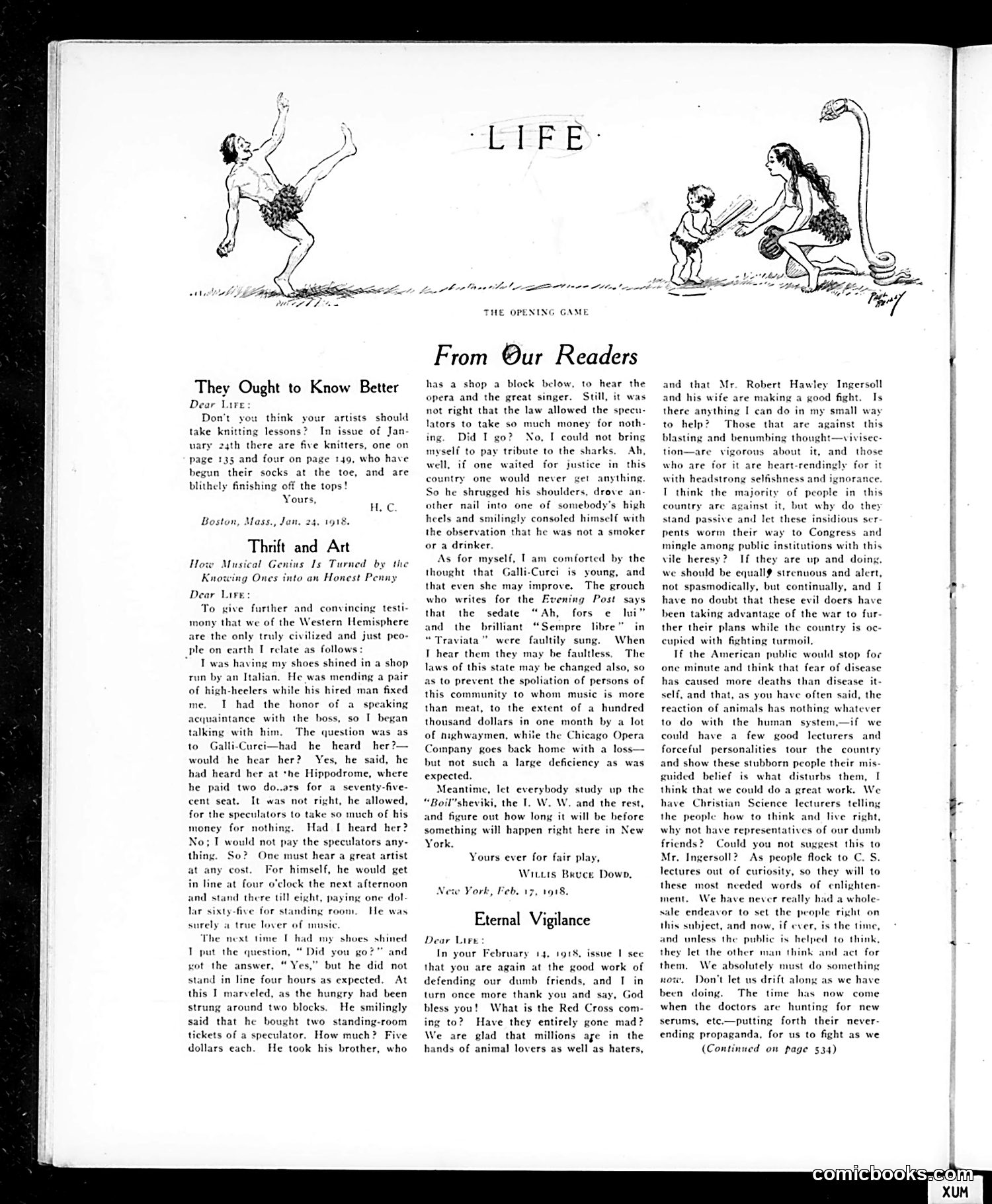
**The Cartoon ("The Opening Game"):** A simple illustration shows children playing outdoors—likely referencing innocent childhood or natural human activity, contrasting with the serious letters below. **"They Ought to Know Better":** A reader criticizes Life's artists for anatomically incorrect knitting illustrations (socks begun at the toe rather than properly). **"Thrift and Art":** A correspondent describes an Italian shoemaker who morally objects to ticket scalpers charging inflated prices for opera singer Galli-Curci, yet hypocritically pays scalpers $5 per ticket anyway. The satire targets hypocrisy: the man preaches against exploitation while participating in it. **"Eternal Vigilance":** References defend animal welfare advocates (specifically Robert Hawley Ingersoll) against implied Red Cross criticism. The letter defends protecting animals' rights. **Context:** Published during WWI (1918), these letters represent reader correspondence reflecting domestic concerns: consumer ethics, entertainment access, and animal welfare—issues distinct from wartime itself.
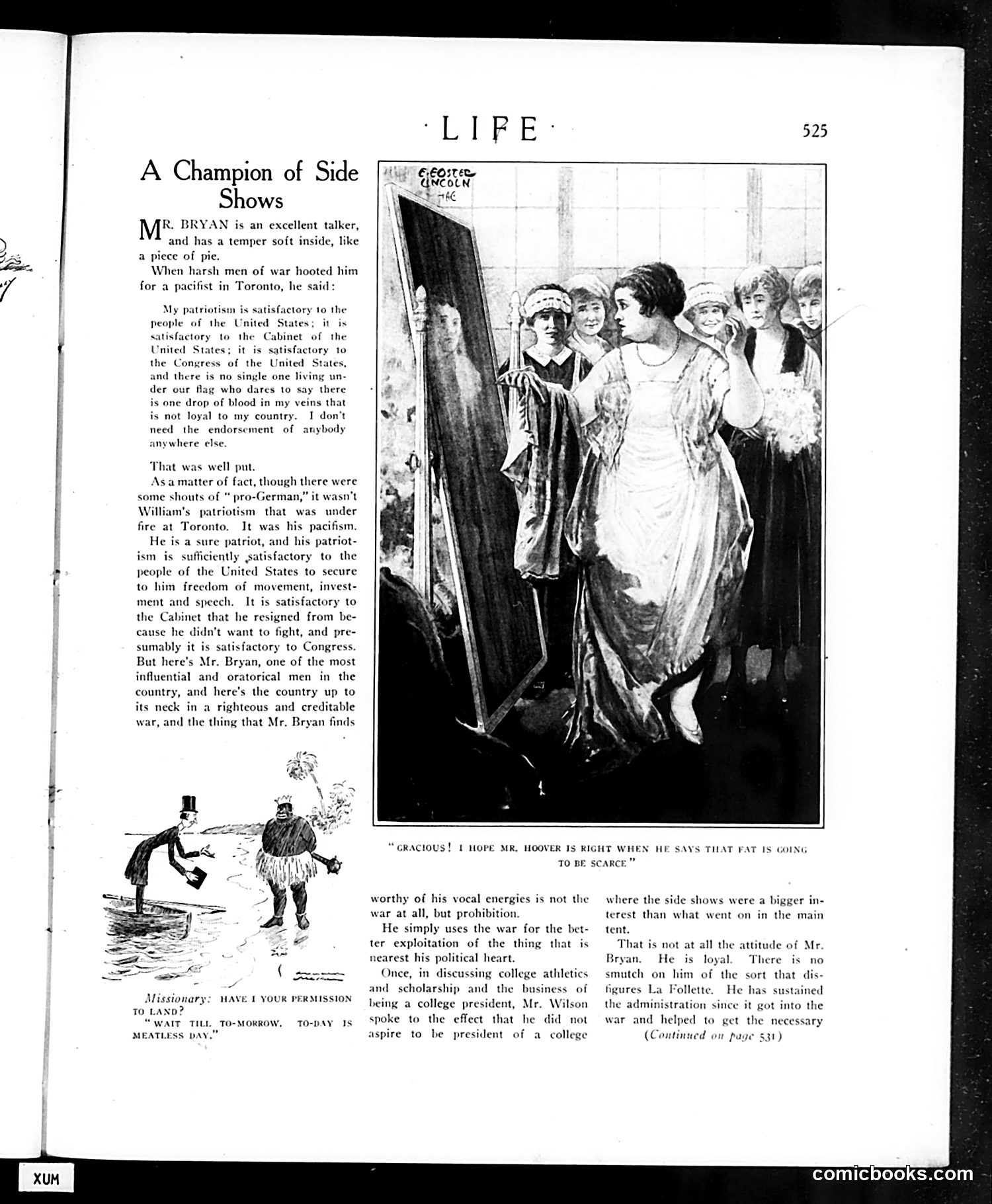
This page satirizes **William Jennings Bryan**, the three-time presidential candidate and former Secretary of State who resigned in 1915 over Wilson's handling of German submarine warfare. **The satire's point**: Though Bryan claims his patriotism is unquestionable, Life argues he's using WWI (which America entered in 1917) as a platform for **prohibition**—his actual passion. The cartoon mocks him for treating the war as mere backdrop to his preferred cause, like a carnival's "side shows" overshadowing the main tent. **Key references**: - Bryan's resignation is acknowledged but reframed: he left not from principle but from political calculation - The "meatless day" cartoon references food rationing during wartime - Comparison to La Follette (senator who opposed war entry) distinguishes Bryan's loyalty while criticizing his priorities - The implication: Bryan exploits wartime patriotism to advance prohibition, not vice versa **The joke**: Bryan gets credit for patriotism he doesn't deserve, while his real agenda—prohibition—remains the true driver.
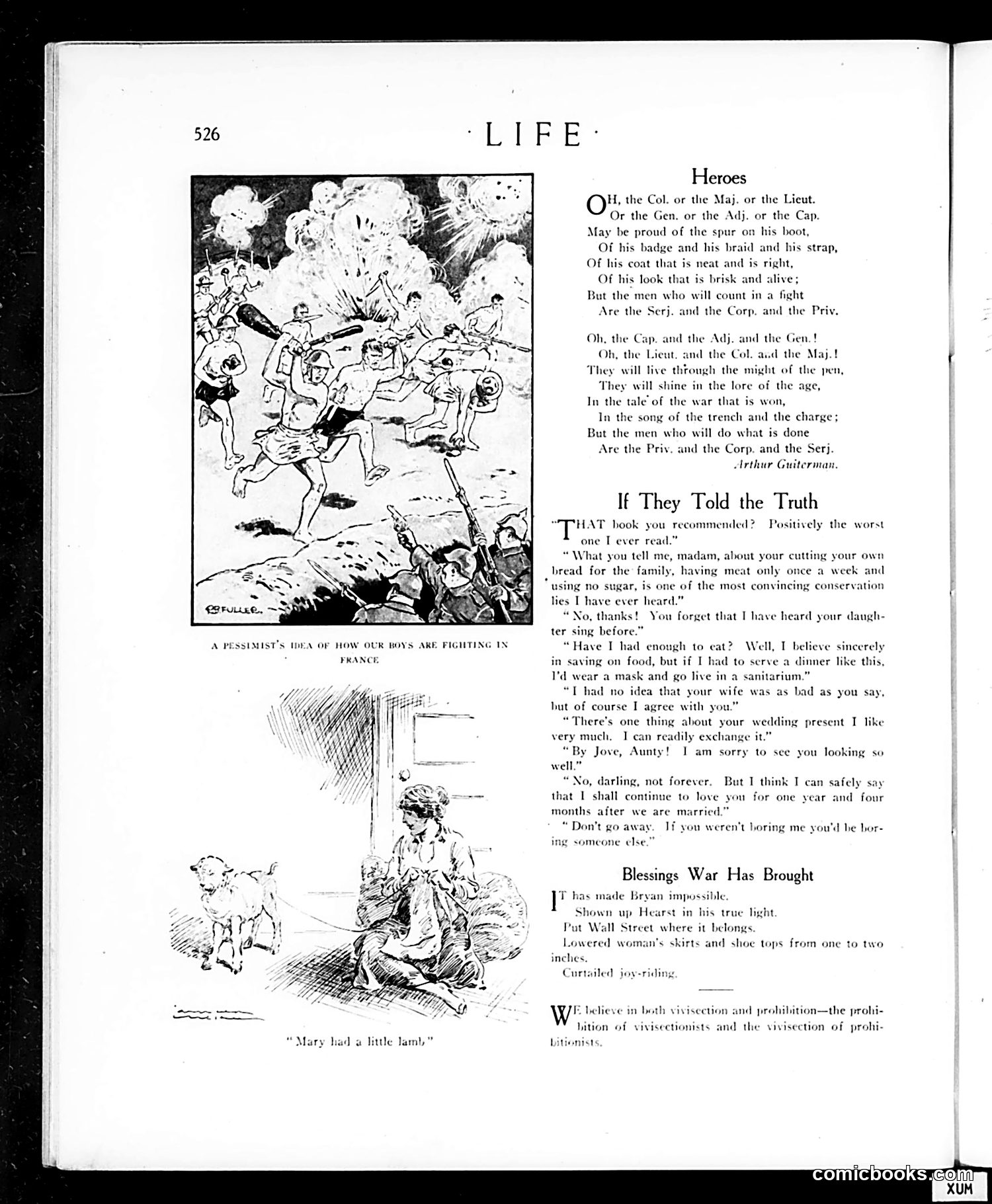
This page contains WWI-era satire critiquing American attitudes about war and daily life. The top cartoon, "A Pessimist's Idea of How Our Boys Are Fighting in France," depicts chaotic combat while the accompanying poem argues that enlisted men (Privates, Corporals, Sergeants) will do the actual fighting, though officers will receive glory. It mocks the disconnect between military hierarchy and battlefield reality. "If They Told the Truth" satirizes social hypocrisy—people claiming wartime sacrifices (food rationing, conservation) while speaking falsehoods to maintain appearances. The dialogue exposes insincerity about austerity measures and relationships. "Blessings War Has Brought" uses bitter irony, listing supposed benefits: Bryan's political decline, exposing Hearst's influence, reducing women's hemlines, and curbing joyrides. The final jab attacks both prohibitionists and vivisectionists equally. Overall, the page mocks American pretense about sacrifice, women's fashion "reforms," and political self-righteousness during wartime.
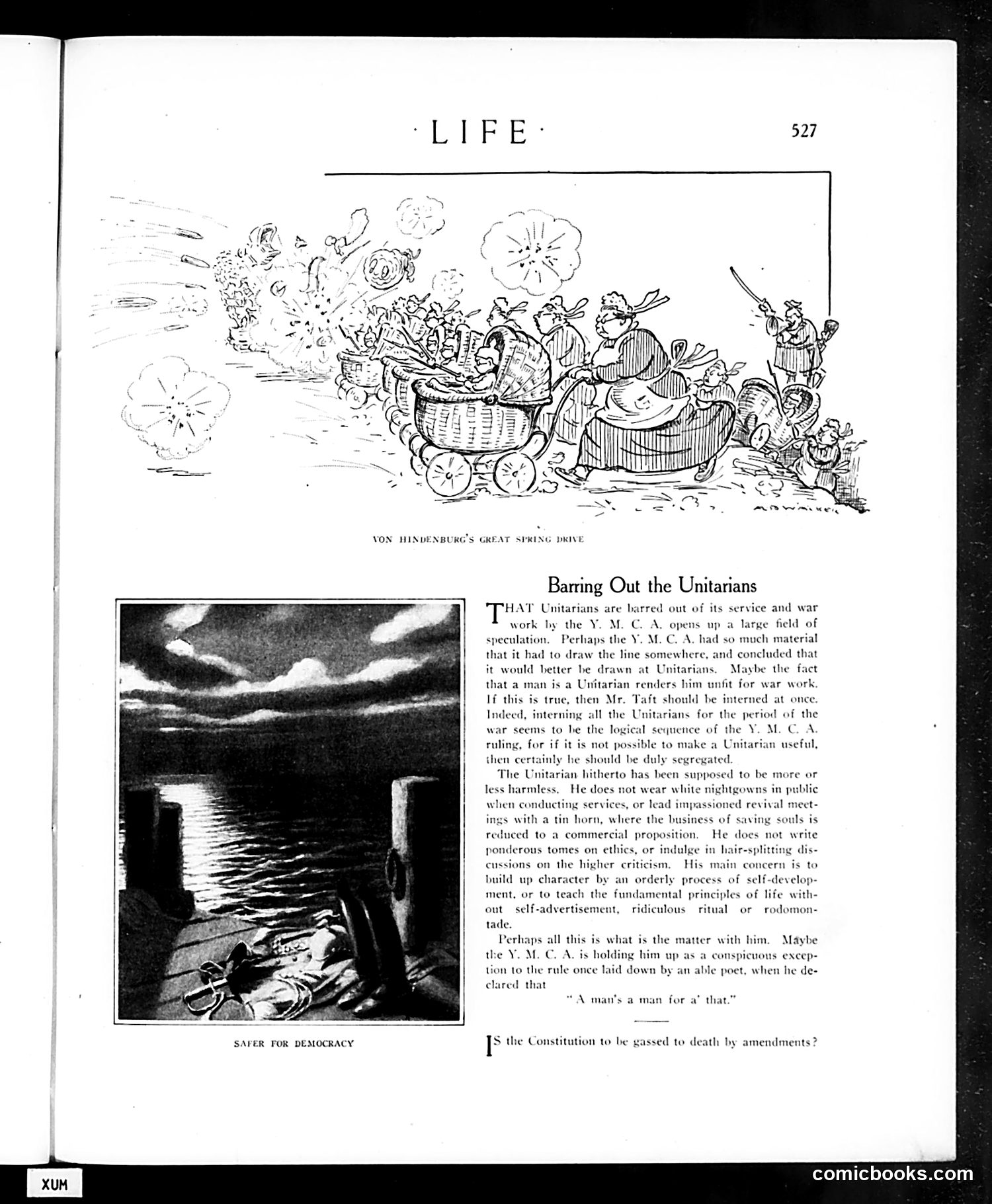
This article satirizes the YMCA's exclusion of Unitarians from its wartime service programs. The author argues the YMCA's policy is absurd: Unitarians are described as harmless, intellectually serious people who conduct themselves modestly—lacking the theatrical evangelicalism of other denominations. The satire's point: if the YMCA truly believes Unitarians are unsuitable for war work, it should intern *all* Unitarians, including William Howard Taft (a prominent Unitarian). The author mocks the YMCA's selective intolerance, suggesting its reasoning contradicts its own values. The concluding quotation ("A man's a man for a' that") invokes Robert Burns's egalitarian principle to highlight the discriminatory absurdity. The top cartoon references Von Hindenburg's WWI spring offensive; the bottom photograph labeled "Safer for Democracy" appears to show wartime destruction.
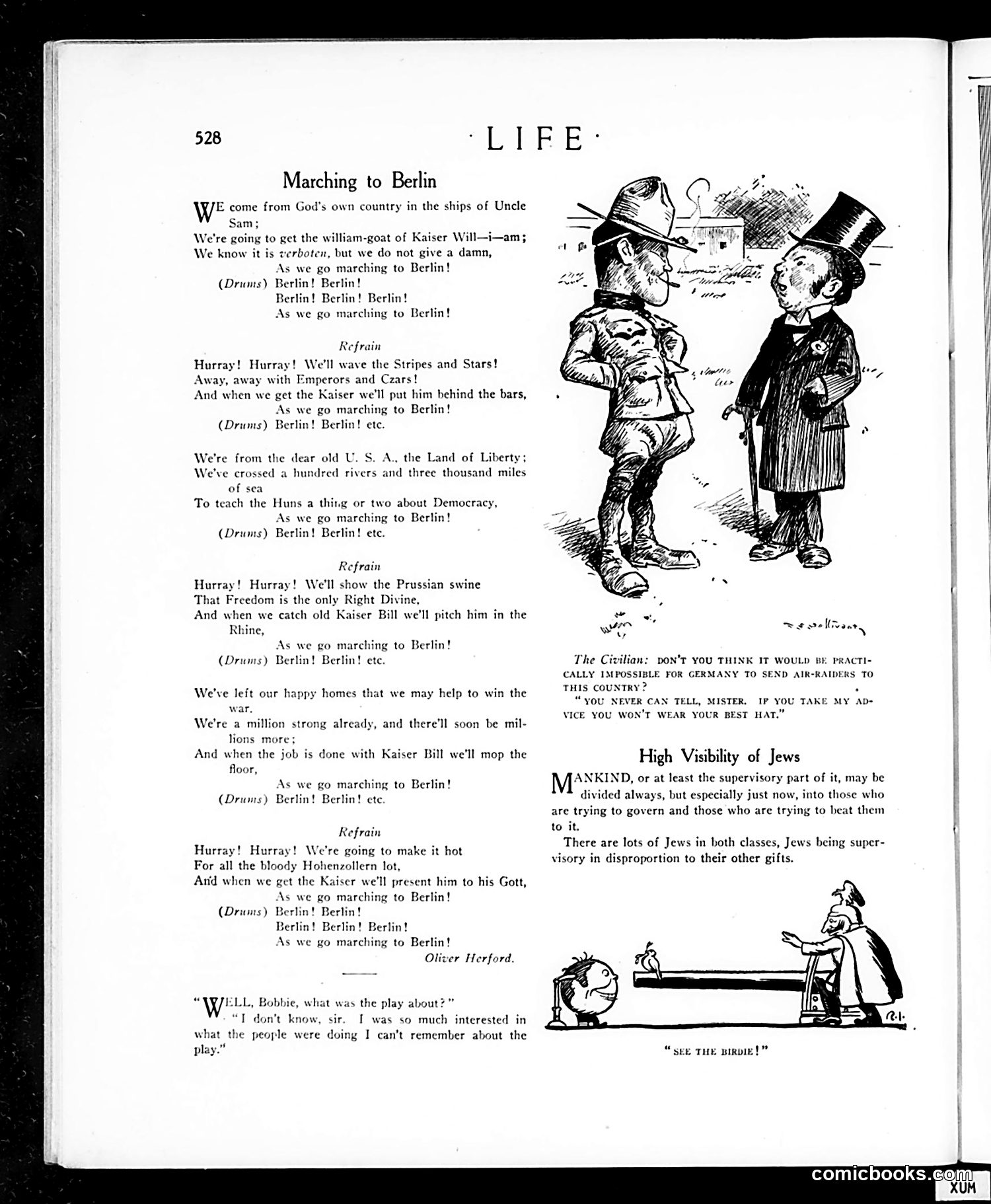
This WWI-era song by Oliver Herford celebrates American soldiers marching toward Berlin to defeat Kaiser Wilhelm II ("Kaiser Bill"). The lyrics use patriotic American rhetoric—democracy, freedom, the Stars and Stripes—to frame the war as a righteous crusade against German ("Hun") autocracy and Prussian militarism. The accompanying cartoon shows an American soldier and a German civilian in conversation. The civilian skeptically questions whether Germany could mount air raids on America; the soldier responds with a tongue-in-cheek warning about wearing one's best hat—likely satirizing both German military threats and American civilian preparedness anxieties. The "High Visibility of Jews" section below is a separate editorial comment on Jewish prominence in governance and supervision during wartime—a problematic observation reflecting contemporary prejudices. The final anecdote about "Bobbie" humorously deflates the serious patriotic song by suggesting audience members cared more about spectacle than substance.
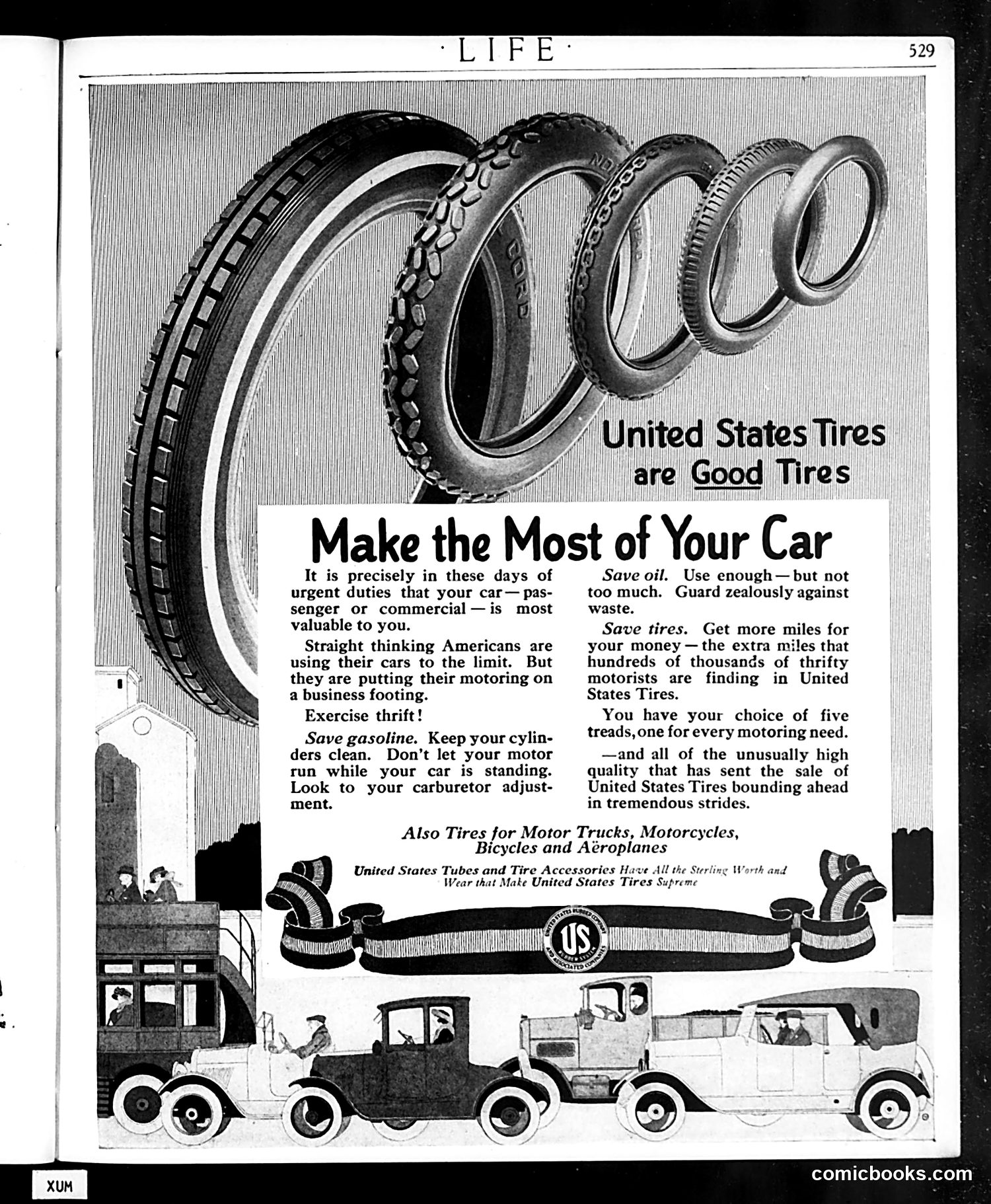
This is primarily a **United States Tires advertisement**, not satire or political commentary. The page promotes tire conservation during what appears to be **wartime or national emergency** (references to "urgent duties" and "business footing" suggest WWI era). The ad urges Americans to practice thrift by: - Saving gasoline and oil - Maintaining vehicles properly - Maximizing tire mileage The bottom illustration shows various vehicles (cars, trucks, possibly commercial vehicles) representing diverse American motorists who should follow these conservation principles. **Key context for modern readers**: This reflects an era when Americans were expected to voluntarily ration resources for national purposes, and corporations positioned themselves as patriotic by promoting efficiency rather than consumption. The tone assumes car ownership was widespread and that motorists would embrace wartime sacrifice. The "five treads" marketing point and emphasis on quality are standard advertising claims, not satire.
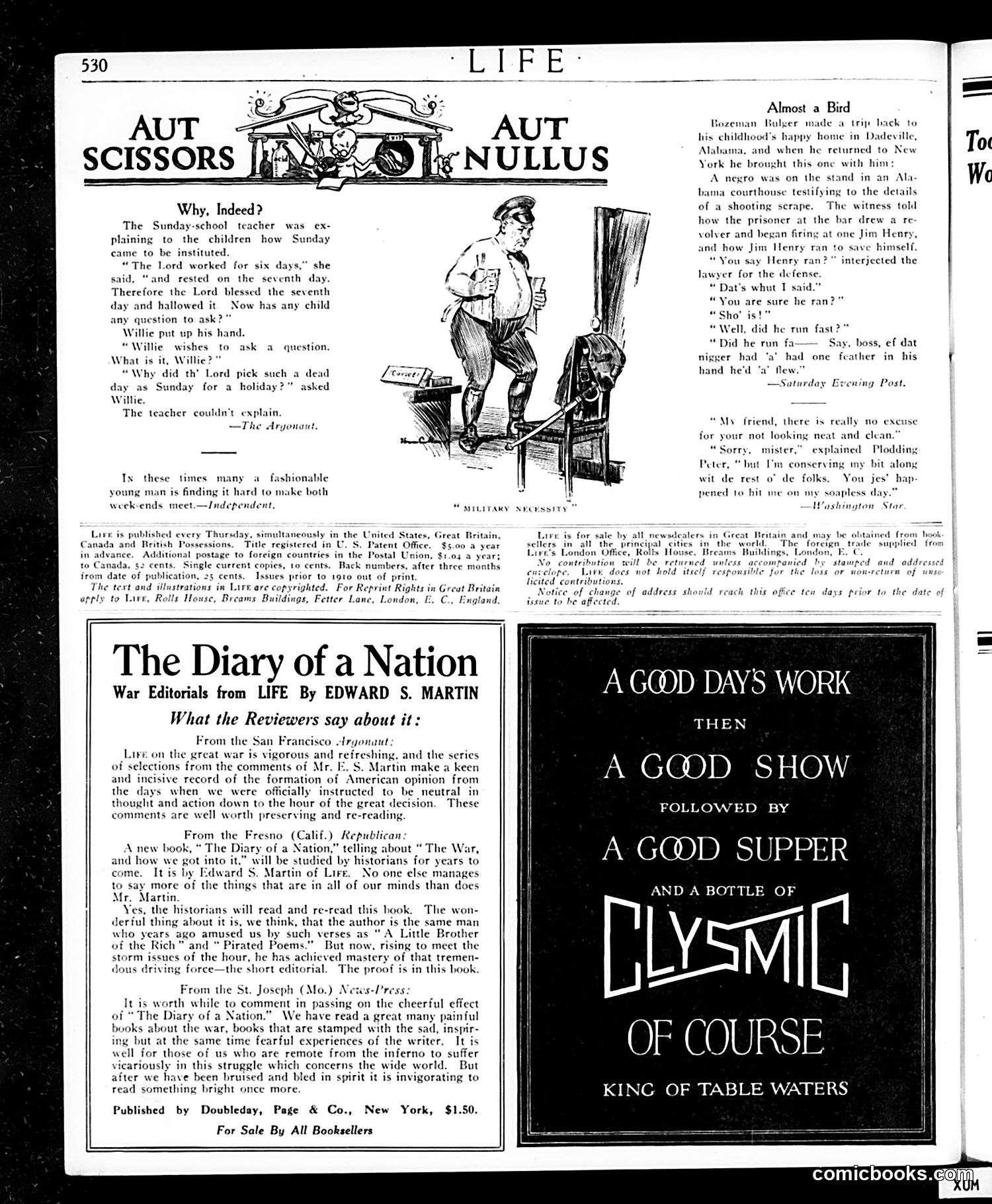
## Main Cartoon: "Military Necessity" The central illustration satirizes wartime logic by showing a man literally using scissors to cut off his own legs while standing on crutches—a visual metaphor for self-destructive "necessity." The title suggests authorities justify harmful actions as militarily required. ## Small Jokes **"Why, Indeed?"** mocks religious instruction: a student asks why God chose Sunday—a workday—as the holy day rather than a holiday. The humor lies in the child's literal, practical reasoning contradicting religious tradition. **"Almost a Bird"** presents a racist anecdote from Alabama, using heavy dialect to mock a Black witness's testimony about running from gunfire. The "joke" relies on period stereotypes and offensive caricature. ## Context This is wartime Life (WWI period, based on "Diary of a Nation" promotion). The page mixes anti-war satire ("Military Necessity") with light humor and advertising, reflecting the magazine's role as satirical commentary on American society and the war effort.
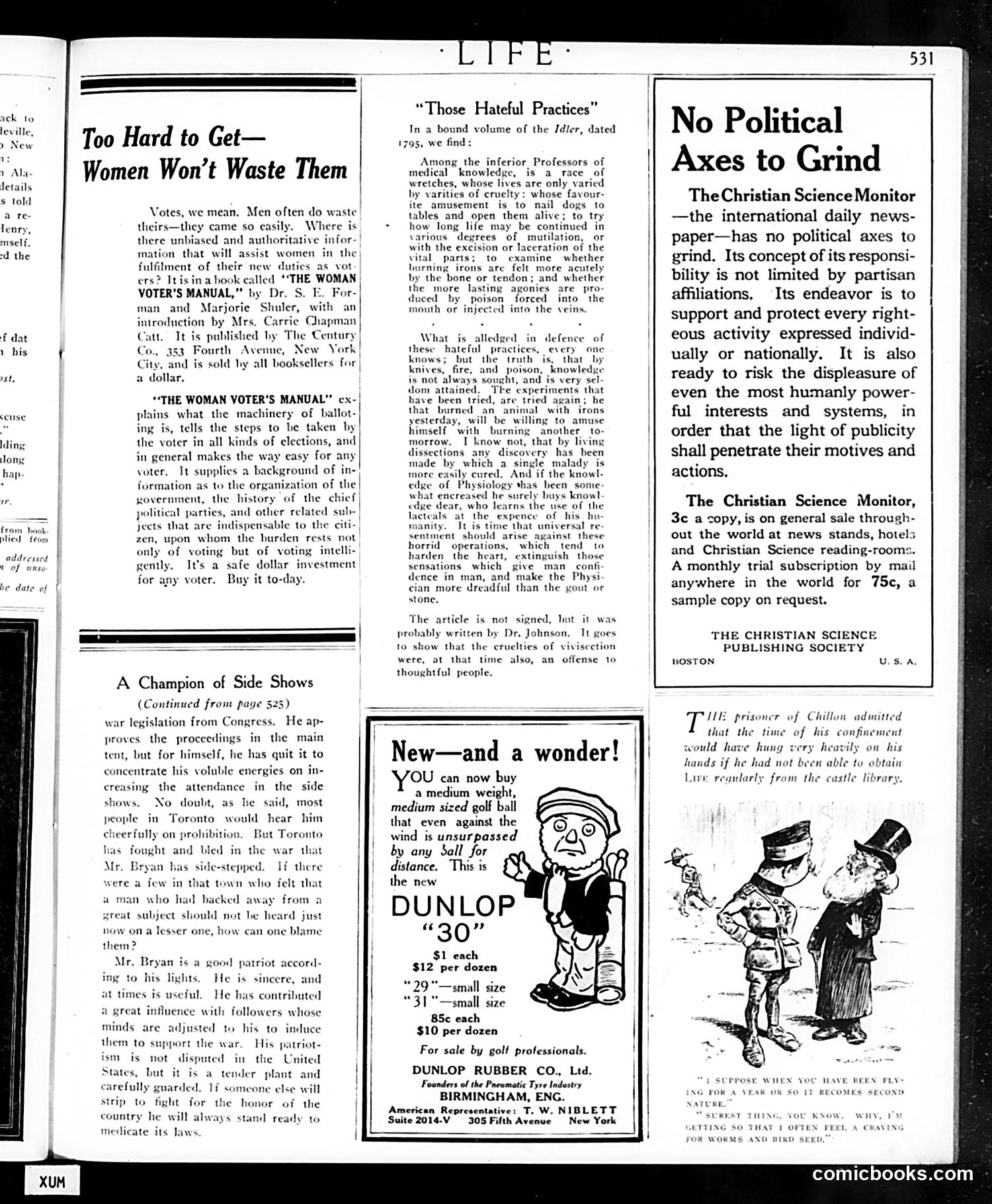
This *Life* magazine page contains three distinct items: **"Too Hard to Get—Women Won't Waste Them"** argues that women voters (recently enfranchised) should not squander their voting power, recommending "The Woman Voter's Manual" as an educational resource—a direct appeal to new female voters to take their civic duty seriously. **"Those Hateful Practices"** quotes a historical medical text condemning vivisection (live animal experimentation), attacking doctors who conducted cruel experiments for knowledge's sake, arguing their practices harmed scientific progress rather than advancing it. This reflects turn-of-the-century animal welfare concerns. **"No Political Axes to Grind"** is an advertisement for *The Christian Science Monitor*, emphasizing its editorial independence and commitment to exposing institutional wrongdoing through transparency—a pitch to readers valuing unbiased journalism. The remaining content includes a political commentary section and advertising (notably a Dunlop golf ball ad). The page reflects 1920s-era concerns: women's political participation, scientific ethics, and media credibility.
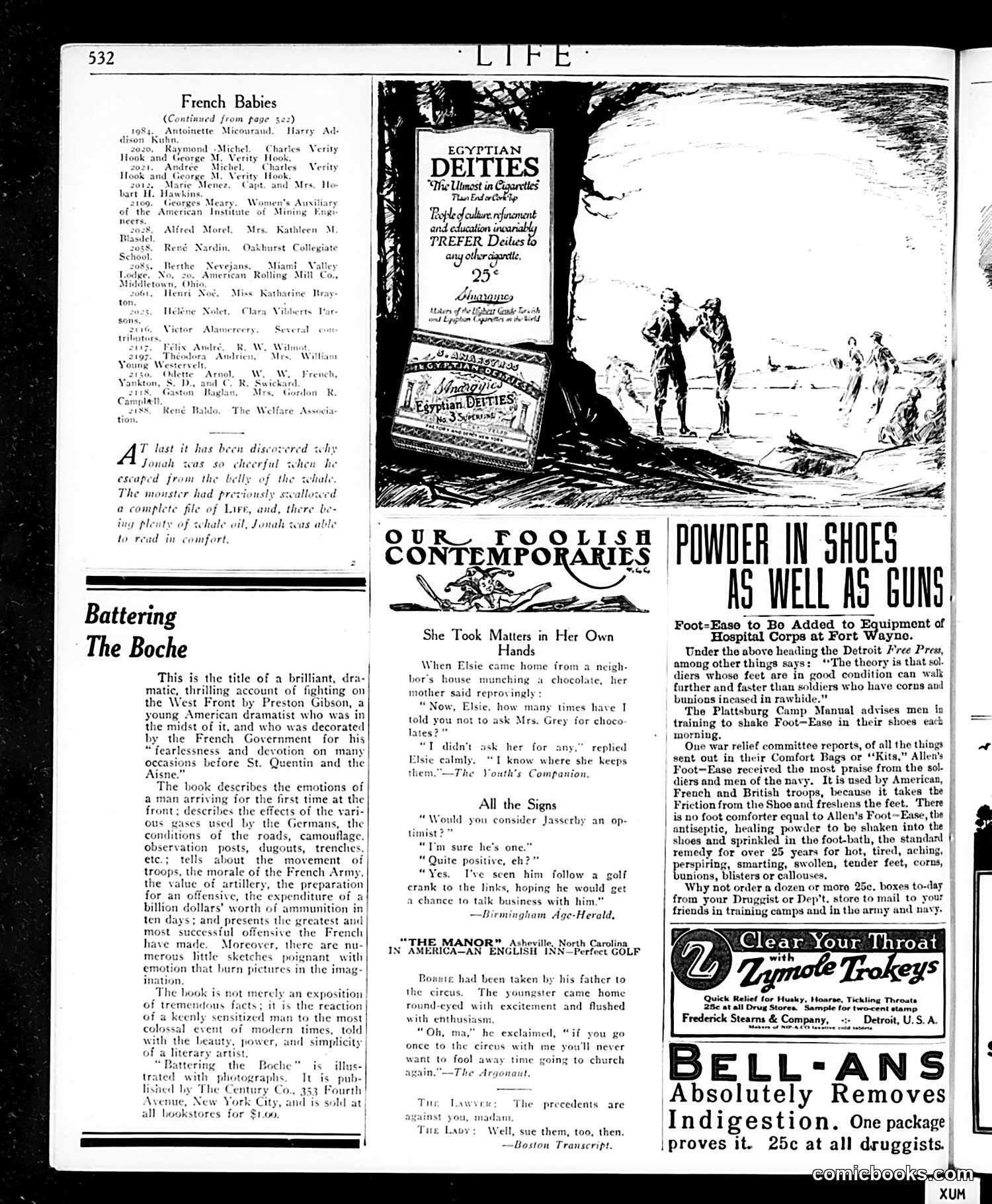
This page contains mostly **book reviews and advertisements** rather than political cartoons. The main content includes: **"Battering the Boche"** — a review of Preston Gibson's dramatic account of WWI fighting on the Western Front. "Boche" is a derogatory French term for Germans. The book describes trench warfare's realities: poison gas, dugouts, artillery, and a major French offensive—presenting the war through a sensitized soldier's perspective. **Advertisements** dominate the lower half, notably promoting **Allen's Foot-Ease powder** for soldiers, referencing Fort Wayne hospital corps and Plattsburg training camps. This reflects WWI's practical concerns: maintaining troops' physical fitness for marching and combat. The lighter content includes humor pieces like "She Took Matters in Her Own Hands" (a child's cheeky logic about asking for chocolate). The page overall captures wartime American publishing: serious soldier narratives mixed with products marketed as supporting the war effort.
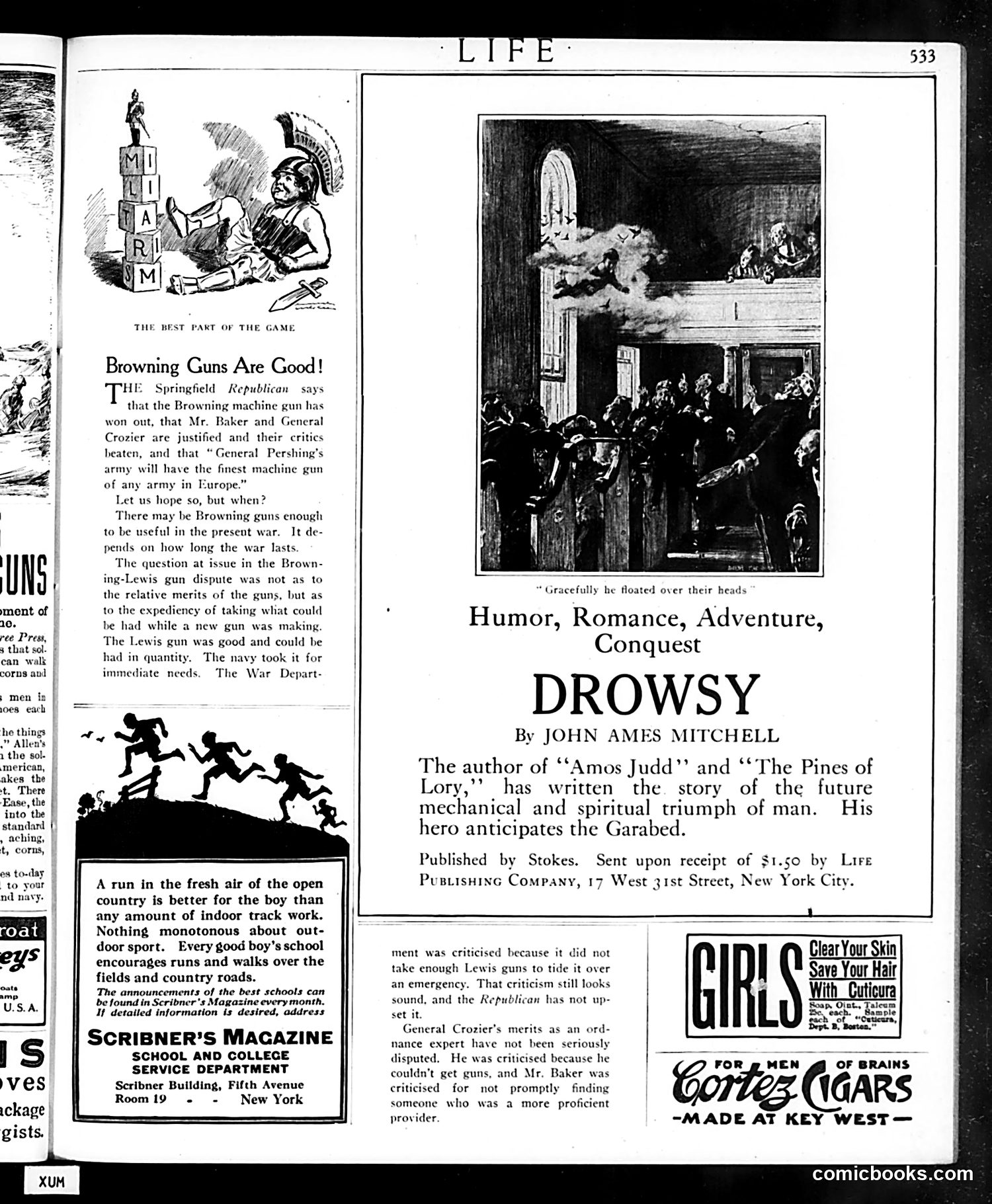
The left side features editorial commentary on the **Browning machine gun debate** during World War I. It defends the Browning gun's superiority while acknowledging a practical criticism: the U.S. military chose the immediately available Lewis gun over waiting for the superior Browning. The piece critiques War Secretary Baker and ordnance expert General Crozier—not for their judgment, but for failing to secure enough Lewis guns quickly during the emergency. The cartoon shows a child building blocks labeled "MIRM" (likely representing military preparedness), satirizing the debate as childish obstruction. The right side advertises a novel, *Drowsy* by John Ames Mitchell, promoting it as adventure and romance fiction about humanity's spiritual and mechanical progress. The page represents typical **Life magazine satirical approach**: using humor to critique government military procurement failures while maintaining patriotic support for U.S. forces in the war effort.
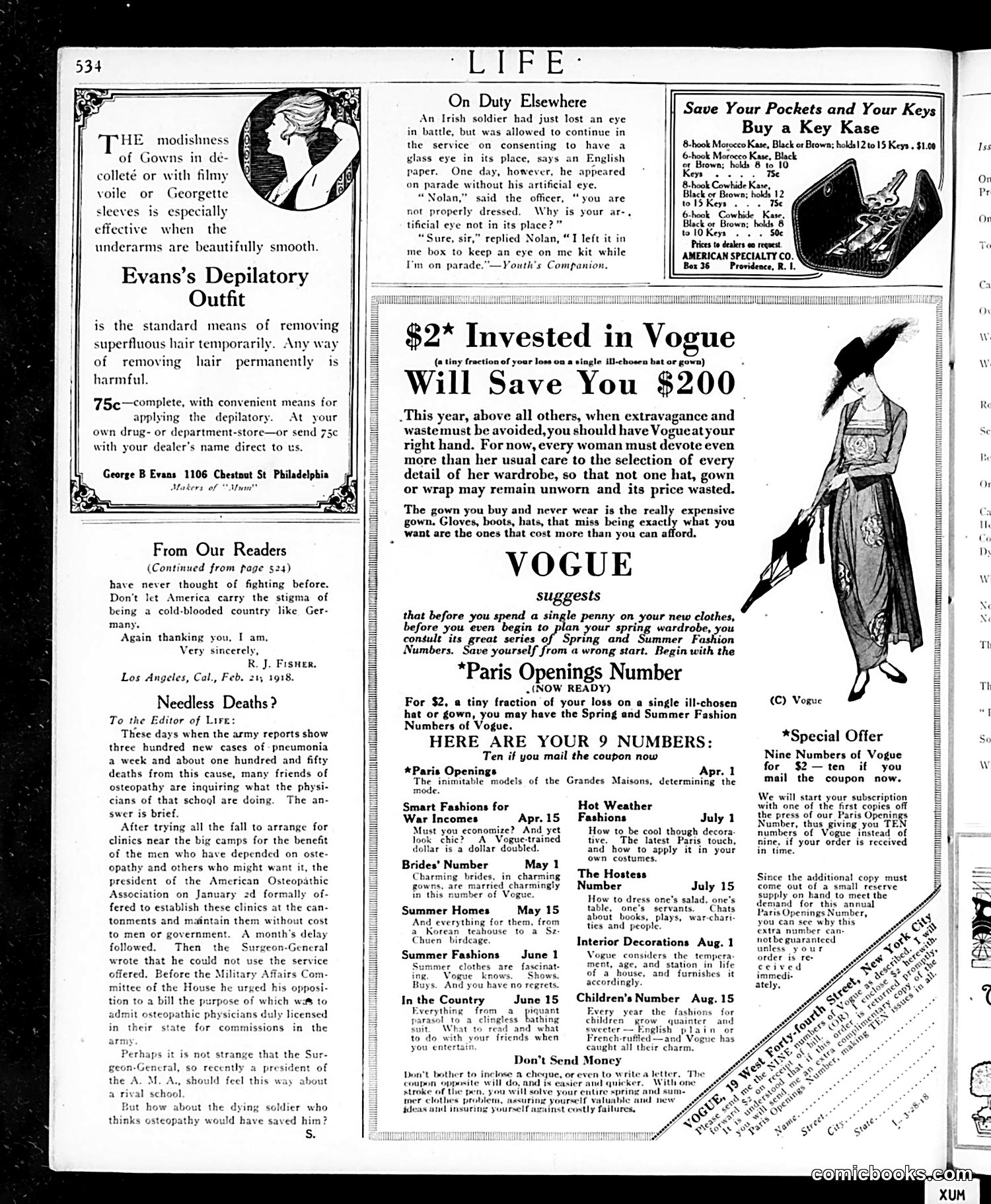
This page mixes advertisements with reader letters and humor typical of Life's satirical format during World War I. **The "On Duty Elsewhere" Joke:** A brief humorous anecdote about an Irish soldier who lost an eye in battle. When questioned why he's missing his artificial eye on parade, he explains he left it in his box "to keep an eye on me kit"—a pun playing on the literal and figurative meanings of "keep an eye on." The humor relies on Irish dialect stereotyping common to the era. **Reader Letters:** Serious correspondence addressing contemporary concerns: one reader urges America to match other nations' military courage; another criticizes military rejection of osteopathic physicians during a pneumonia crisis, questioning whether prejudice costs soldiers' lives. **Advertisements:** Evans's Depilatory (hair removal), Key Kases, and notably a full-page Vogue promotion selling magazine subscriptions as wartime budget guidance—positioning fashion magazines as practical tools preventing wasteful clothing purchases during economic constraint. The juxtaposition reflects Life's dual nature: entertainment mixed with social commentary about the war effort.
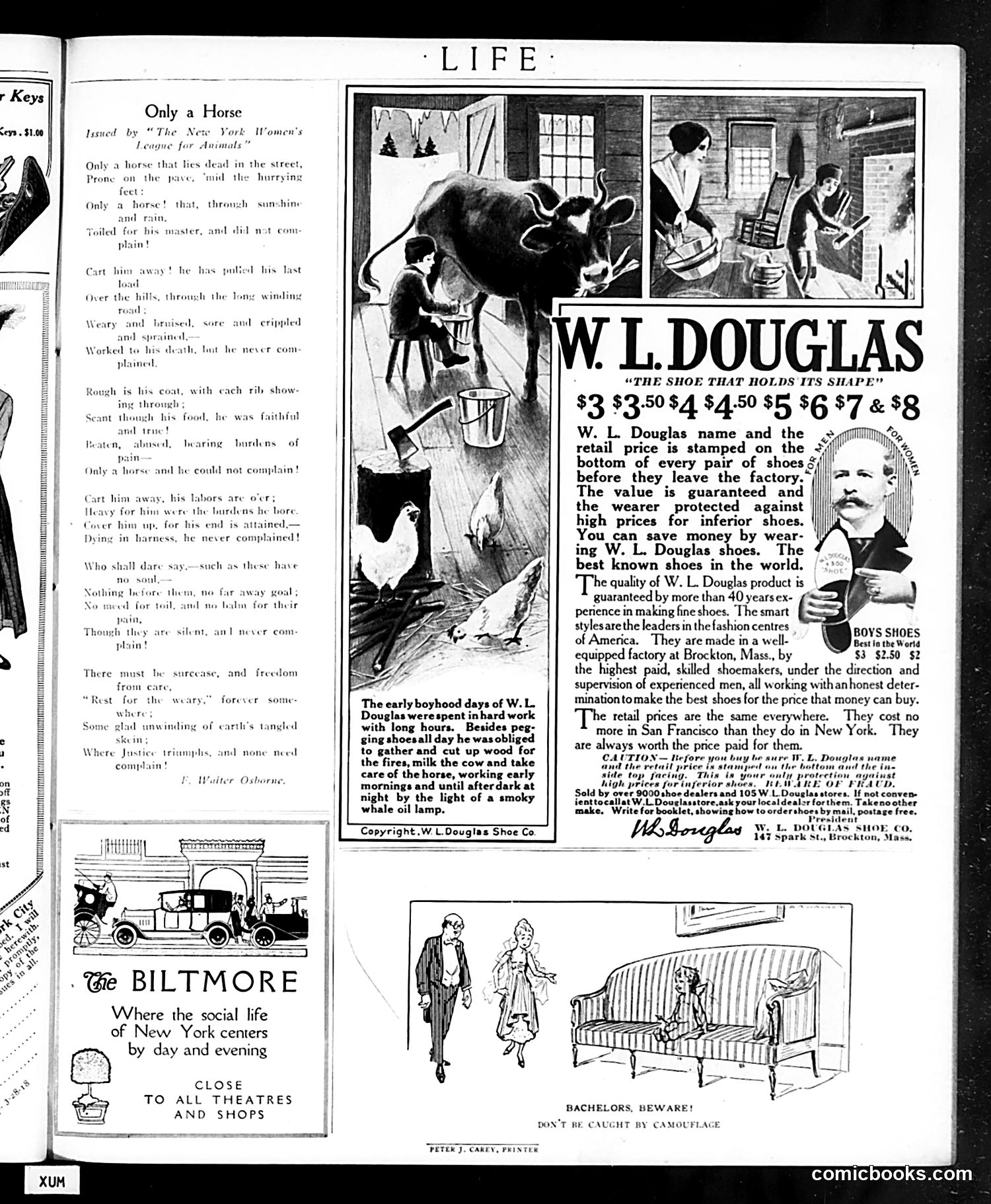
This page combines **social advocacy poetry with commercial advertising**. ## "Only a Horse" Poem The left side features a sentimental poem issued by the New York Women's League for Animals. It mourns an overworked, abused horse that has collapsed and died in the street. The poem uses repetition ("only a horse," "never complained") to argue that working animals deserve compassion and dignity—that they have souls and suffer like humans. It's an animal welfare advocacy piece typical of early 20th-century reformist sentiment, appealing to readers' empathy for exploited creatures. ## Advertisements The dominant right side contains two ads: W.L. Douglas shoes (emphasizing quality, fair pricing, and the founder's humble origins) and the Biltmore hotel. A small bottom cartoon titled "Bachelors, Beware! Don't Be Caught by Camouflage" appears to satirize deceptive women's fashion or appearance. The juxtaposition is jarring—highbrow animal welfare advocacy sits alongside consumer marketing, typical of Life's mixed editorial-advertising format of the era.
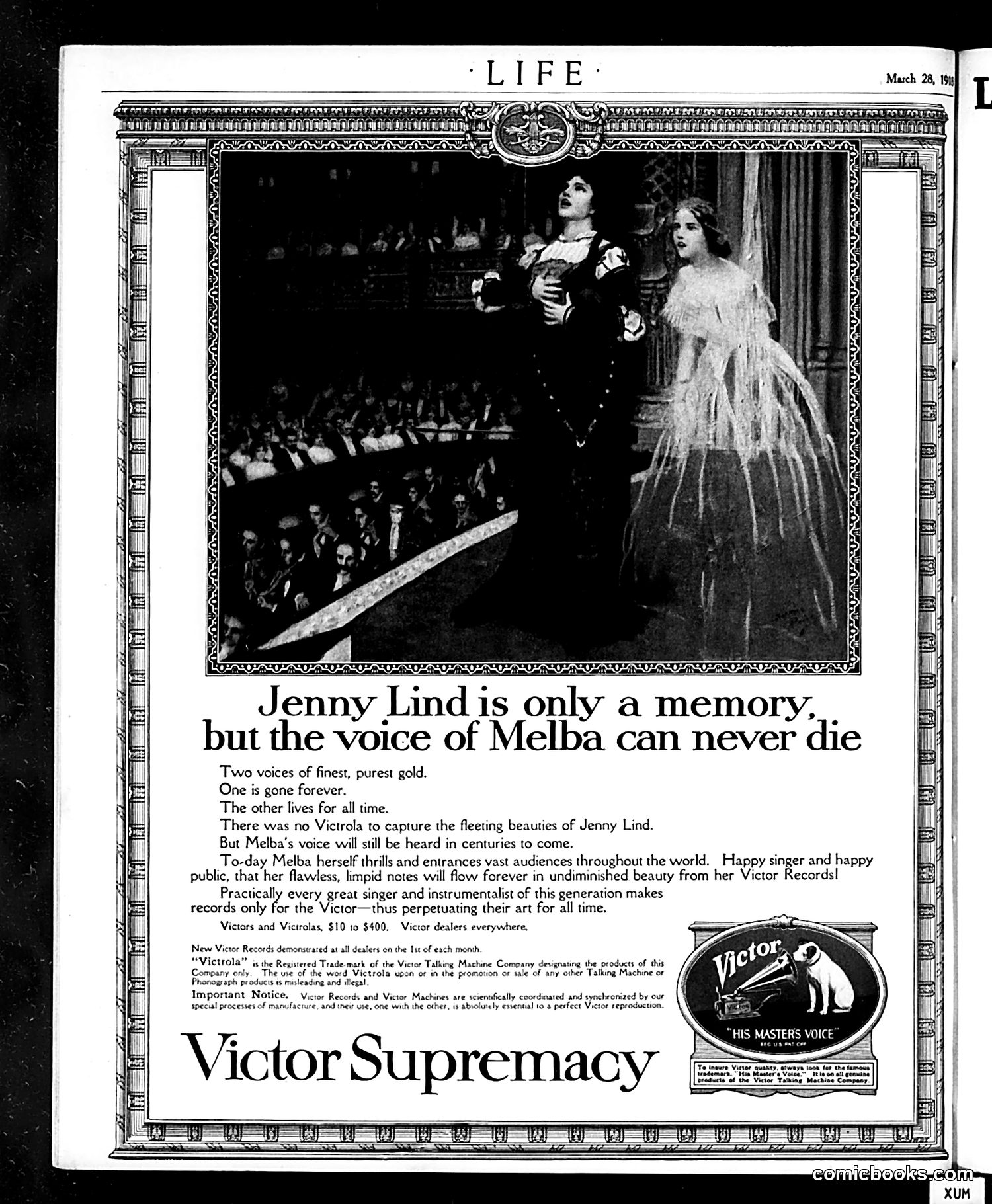
This is a **Victor Talking Machine Company advertisement**, not satirical content. It compares two famous singers to promote phonograph recording technology. The ad contrasts **Jenny Lind** (a 19th-century Swedish opera singer, now deceased) with **Nelba** (likely Damita de Melba, a celebrated soprano), arguing that while Lind's voice is lost to history, Melba's voice is "immortalized" through Victor Records. The implicit message: recording technology preserves artistry forever—buy Victor phonographs and records. The staged theatrical image shows performers on stage before an audience, emphasizing Melba's live appeal while the text argues recordings make her permanent. For modern readers: this predates widespread radio and film. Recording technology was revolutionary and novel as a preservation medium. The ad positions Victor machines as essential for experiencing great music, whether live or recorded.