
Life, 1918-03-28 · page 22 of 40
Life — March 28, 1918 — page 22: what you’re looking at
What you’re looking at
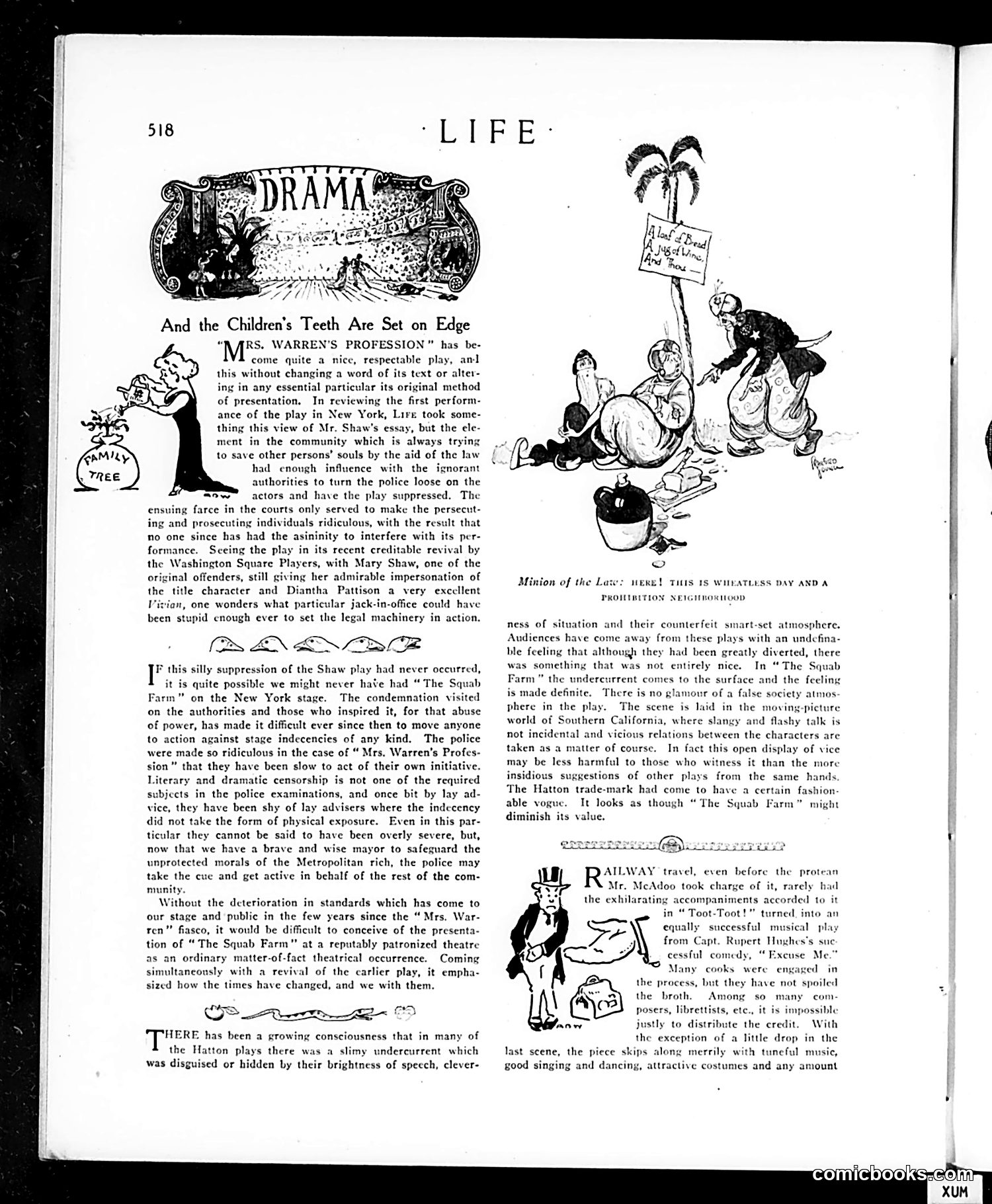
This page discusses two plays: Shaw's "Mrs. Warren's Profession" and "The Squab Farm." The main article explains that Shaw's play—which deals with a woman's morally questionable profession—was initially suppressed by police/authorities as indecent, but the censorship attempt became so ridiculous it actually backfired, making future theatrical censorship efforts difficult. The cartoon "Minion of the Law" (bottom right) depicts a police officer during Prohibition, satirizing law enforcement's selective moral judgment: they were emboldened to censor theatrical "indecency," yet the same authorities now face Prohibition (alcohol ban) enforcement—a "wheatless day" rationing context suggesting wartime. The satire's point: authorities who aggressively policed stage morality now look foolish trying to enforce contradictory laws. The cartoon critiques government overreach in defining and punishing "vice" while overlooking actual corruption or harmful policies.
📄 Transcribed text from this page (OCR, searchable)
Machine-transcribed from the original scan — historical spelling and the odd misread are preserved.
And the Children’s Teeth Are Set on Edge “\ RS. WARREN'S PROFESSION” has be- come quite a nice, respectable play, aml this without changing a word of its text or alter- ing in any essential particular its original method of presentation. In reviewing the first perform- ance of the play in New York, Lire took some- thing this view of Mr. Shaw's essay, but the ele- ment in the community which is always try to save other persons’ souls by the aid of the law had enough influence with the ignorant authorities to turn the police loose on the sow actors and have the play suppressed, The ensuing farce in the courts only served to make the persecut- ing and prosecuting individuals ridiculous, with the result that no one since has had the asininity to interfere with its per- formance. Sceing the play in its recent creditable revival by the Washington Square Players, with Mary Shaw, one of the original offenders, still giving her admirable impersonation of the title character and Diantha Pattison a very excellent Vivian, one wonders what particular jack-in-office could have been stupid cnough ever to set the legal machinery in action. (PS LN ESE y had never occurred, I this silly suppression of the Shaw pla it is quite possible we might never have had “ The Squab Farm” on the New York stage. The condemnation visited on the authorities and those who inspired it, for that abuse of power, has made it difficult ever since then to move anyone to action against stage indecencies of any kind. The police were made so ridiculous in the case of “ Mrs. Warren's Profes- sion” that they have been slow to act of their own initiative. Literary and dramatic censorship is not one of the required jects in the police examinations, and once bit by lay ad- vice, they have been shy of lay advisers where the indecency did not take the form of physical exposure. Even in this par- ticular they cannot be said to have been overly severe, but, now that we have a brave and wise mayor to safeguard the unprotected morals of the Metropolitan rich, the police may take the cue and get active in behalf of the rest of the com- munity. Without the deterioration in standards which has come to our stage and public in the few years since the “ Mrs. War- ren” fiasco, it would be difficult to conceive of the presenta- tion of “ The Squab Farm" at a reputably patronized theatre as an ordinary matter-of-fact theatrical occurrence. Coming simultaneously with a revival of the carlier play, it empha- sized how the times have changed, and we with them. OP ate HERE has been a growing consciousness that in many of the Hatton plays there was a slimy undercurrent which was disguised or hidden by their brightness of speech, clever- Minion of the Law: were! THIS 18 WHEATLESS DAY AND A PROMUIBITION NEIGITHOR MOOD and their counterfeit smart-set atmosphere. way from these plays with an undefina- they had been greatly diverted, there was something that was not entirely nice. In “The Squab Farm” the undercurrent comes to the surface and the feeling is made definite. There is no glamour of a false society atmos: phere in the play. The scene is laid in the moving-picture world of Southern California, where slangy and flashy talk is not incidental and vicious relations between the characters are taken as a matter of course. In fact this open display of vice may be less harmful to those who witness it than the more insidious suggestions of other plays from the same hands The Hatton trade-mark had come to have a certain fashion- able vogue. It looks as though “The Squab Farm” might diminish its value. ness of situation Audiences have come ble feeling that althou AILWAY travel, even before the protean Mr. McAdoo took charge of it, rarely had the Sehharaiog accompaniments accorded to it “ Toot-Toot!" turned. into an euaily suecessful musical play from Capt. Rupert Hughes's sue cessful comedy, “Excuse Me Many cooks were 1 in the process, but they the broth. Among so n posers, librettists, ete., it is impossible justly to distribute the credit. With the exception of a little drop in the last scene, the piece skips along merrily with tuneful music, good singing and dancing, attractive costumes and any amount have not spoiled any com-