
Life, 1918-03-28 · page 28 of 40
Life — March 28, 1918 — page 28: what you’re looking at
What you’re looking at
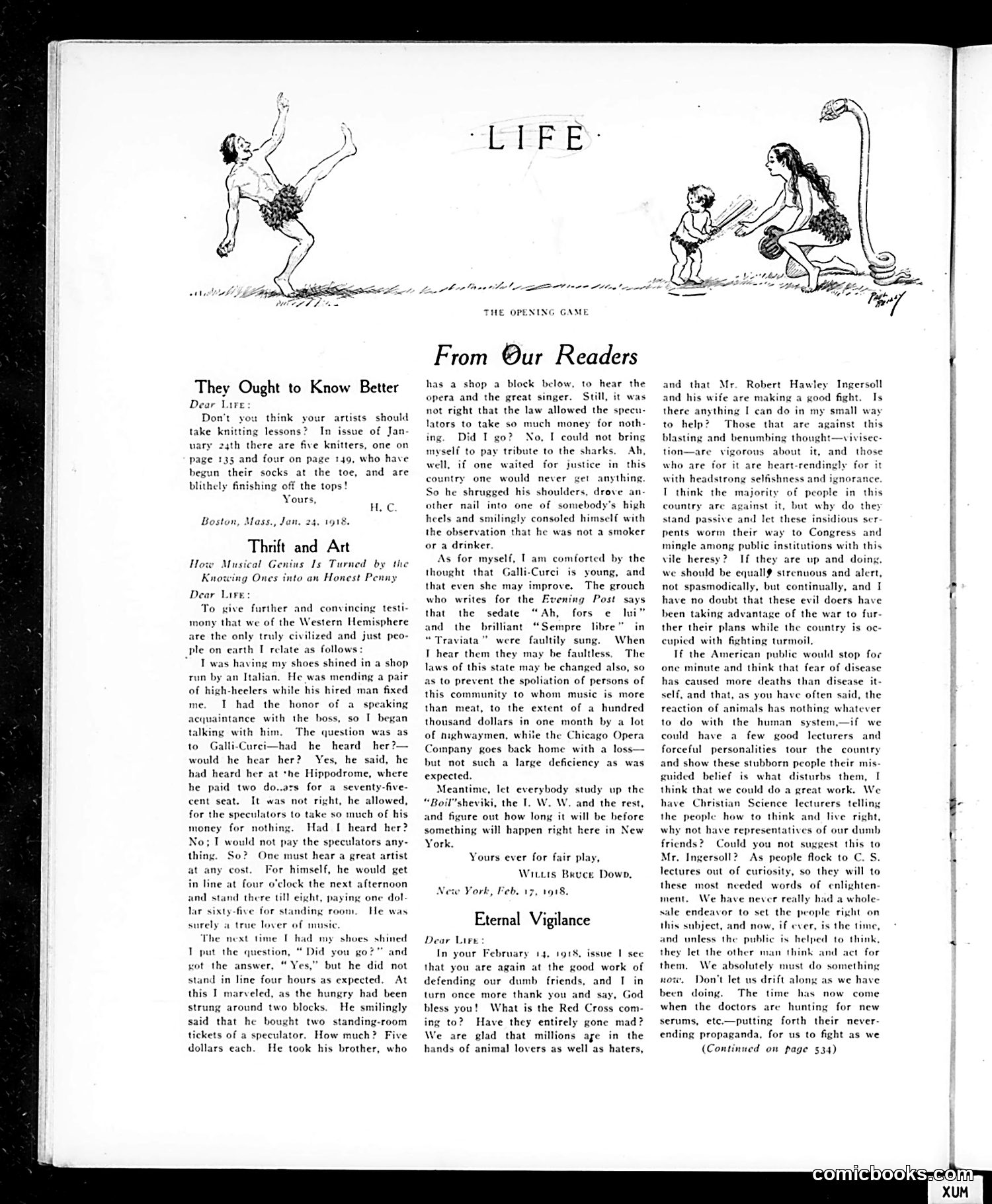
**The Cartoon ("The Opening Game"):** A simple illustration shows children playing outdoors—likely referencing innocent childhood or natural human activity, contrasting with the serious letters below. **"They Ought to Know Better":** A reader criticizes Life's artists for anatomically incorrect knitting illustrations (socks begun at the toe rather than properly). **"Thrift and Art":** A correspondent describes an Italian shoemaker who morally objects to ticket scalpers charging inflated prices for opera singer Galli-Curci, yet hypocritically pays scalpers $5 per ticket anyway. The satire targets hypocrisy: the man preaches against exploitation while participating in it. **"Eternal Vigilance":** References defend animal welfare advocates (specifically Robert Hawley Ingersoll) against implied Red Cross criticism. The letter defends protecting animals' rights. **Context:** Published during WWI (1918), these letters represent reader correspondence reflecting domestic concerns: consumer ethics, entertainment access, and animal welfare—issues distinct from wartime itself.
📄 Transcribed text from this page (OCR, searchable)
Machine-transcribed from the original scan — historical spelling and the odd misread are preserved.
They Ought to Know Better Dear Lire Don’t you think your artists should take knitting lessons? In issue of Jan uary 24th there are five knitters, one on page 135 and four on page 149, who have begun their socks at the toe, and are blithely finish the tops! Yours, oer H.C. n, Mass. Thrift and Art How Musical Genius Is Turned by the Knowing Ones into an Honest Penny Bost Jan, 24, 1918. Dear Lire: To give further and convincing testi phere mony that we of the Western Hem are the only truly civilized and just peo- ple on earth [ relate as follows: T was having my shoes shined in a shop run by an Italian, He was mending a pair of high-heelers while his hired man fixed me. T had the honor of a speaking acquaintance with the boss, so T began talking with him. The question was as to. Galli-Curcihad_ he heard her ?— would he hear her? Yes, he said, he had heard her at the Hippodrome, where five- cent seat. It was not right, he allowed, for the speculators to take so much of his money for nothing. Had [ heard her? Yo; T would not pay the spe thing. So? One he paid two do..ars for a seveni lors any- must hear a great artist at any cost. For himself, he would get in line at four o'clock the next afternoon and stand there till eight, paying one dol- lar sixty-five for stay ng room. He was surely a true lover of music. r Ip next time [had my shoes shined Did you go?" and xot the answer, “Yes,” but he did not stand in line four hours as expected. At this I marveled, as the hungry had been strung around two blocks. He smilingly the question, said that he bought two standing-room tickets of a speculator. How much? Five dollars each. He took his brother, who we le eee ee to THE OPENING GAME From ur Readers has a shop a block below, to hear the opera and the great singer. Still, it was not right that the law allowed the specu- lators to take so much money for noth- ing. Did I go? No, I could not bring myself to pay tribute to the sharks. Ab, well, if one waited for justice in this country one would never get anything. So he shrugged his shoulders, drove an- other nail into one of somebody's high heels and smilingly consoled himself with the observation that he was not a smoker or a drinker As for myself, [ am comforted by the thought that Galli-Curci is young, and that even she may improve. The grouch who writes for the Evening Post says that the sedate h, forse Ini” and the brilliant “Sempre libre” in “Traviata” were faultily sung. When I hear them they may be faultless, The laws of this state may be changed also, so as to prevent the spoliation of persons of this community to whom music is more than meat, to the extent of a hundred thousand dollars in one month by a lot of nighwaymen, white the Chicago Opera Company goes back home with a loss— but not such a large deficiency as was expected. Meantime, let everybody study up the “Boil sheviki, the I. W. W. and the rest, and figure out how long it will be hefore something will happen right here in New York. Yours ever for fair play, Wittts Bruce Down, York, Feb. 17, 1918. Eternal Vigilance Dear Lire In your February 14, 1918, issue I see you are again at the good work of defending our dumb friends, and [in turn once more thank you and say, God bless you! What is the Red Cross com- ing to? Have they entirely gone mad? We are glad that millions age in the hands of animal lovers as well as haters, and that Mr. Robert Hawley Ingersoll and his wife are making a good fight. Is there anything I can do in my small way to help? Those that are against this thought—vivisec- blasting and benumbin; orous about it, and those tion—are vi t are heart-rendingly for it with headstrong selfishness and ignorance. T think the majority of people in this country are against it, but why do they stand passive and let these insidious ser pents worm their way to Congress and mingle among public institutions with this vile heresy? If they are up and doing, we should be equallf strenuous and not spasmodically, but continually, and have no doubt th been taking advantage of the war to fur- ther their plans while the countr; cupied with fighting turmoi who are for ert, these evil doers have is oc- If the American public would stop for one minute and think that fear of disease has caused more deaths than disease it- self, and that, as you have often said, the reaction of animals has nothing whatever to do with the human system,—if we could have a few good lecturers and forceful personalities tour the country and show these stubborn people their mis guided belief is what disturbs them, I think that we could do a great work. We have Christian Science lecturers telling le how to think and live right, why not have representatives of our dumb friends? Could you not suggest this to Mr. Ingersoll? As people flock to C. S. lectures out of curiosity, so they will to these most needed words of enlighten- ment. We have never really had a whole. the peo sale endeavor to set the people right on this subject, and now, if ever, is the time, and unless the public is helped to think. they let the other man think and act for them, We absolutely must do something now. Don't let us drift along as we have been doing. The time has now come when the doctors are hunting for new Serums, etc.—putting forth their never- ending propaganda, for us to fight as we (Continued on page 534)