
Life, 1918-03-28 · page 19 of 40
Life — March 28, 1918 — page 19: what you’re looking at
What you’re looking at
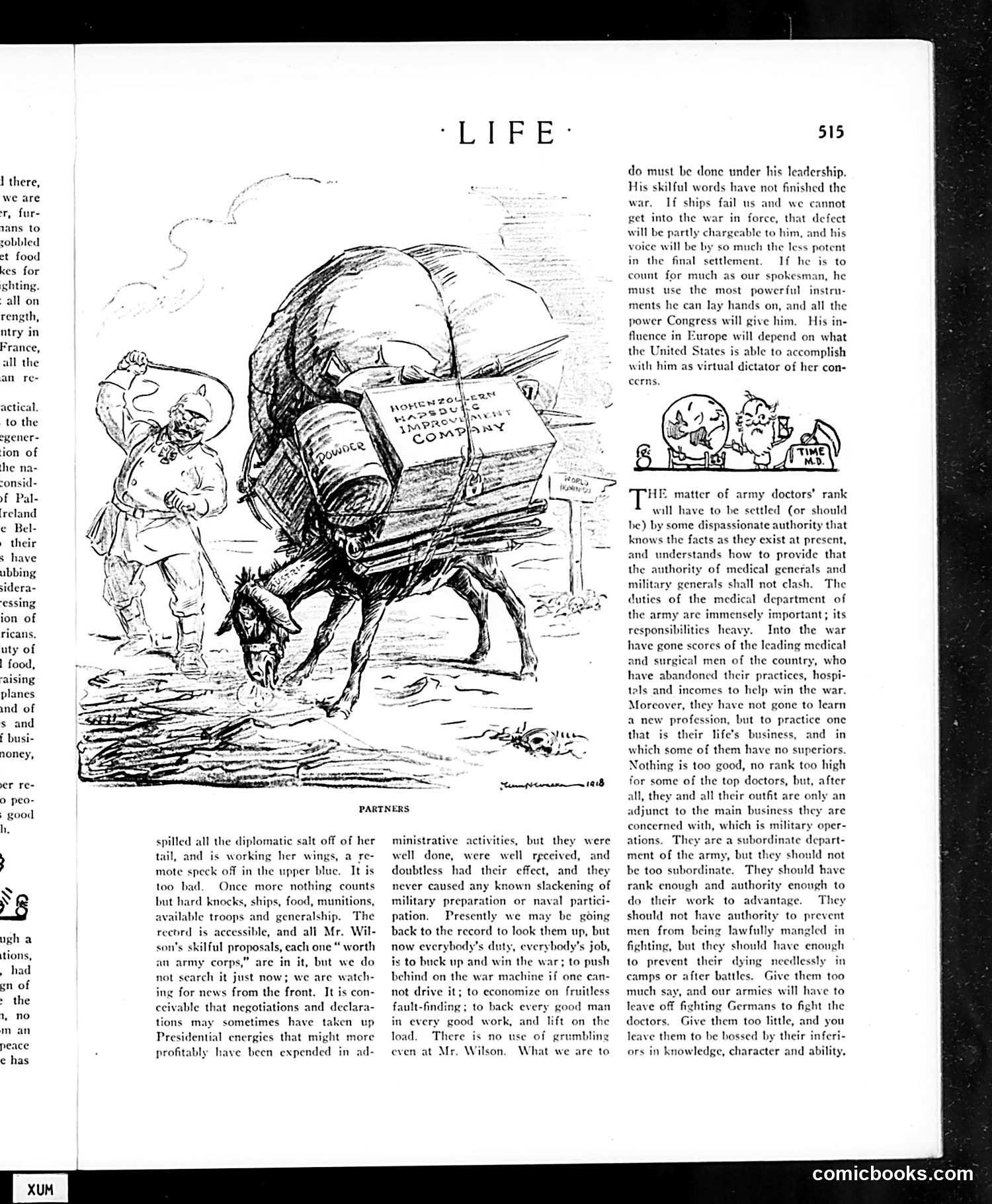
This cartoon depicts a donkey laboring under heavy loads of supplies and documents labeled "HOME FRONT IMPRESSIONS" and similar administrative materials. A small soldier figure stands beside it. The satire criticizes President Wilson's administration during World War I. The accompanying text argues that while Wilson's diplomatic proposals are valuable, what matters now is military action—"hard knocks, ships, food, munitions." The donkey represents the war effort being overburdened by bureaucratic paperwork and civilian concerns rather than focused on winning. The point: administrative and diplomatic activities, however well-intentioned, are secondary to actual military preparation and resources. The text explicitly states Wilson's "skilful words have not finished the war," suggesting his proposals must be backed by tangible military power and congressional support to have influence in Europe. The cartoon reflects public frustration that American entry into WWI required less talking and more decisive military action.
📄 Transcribed text from this page (OCR, searchable)
Machine-transcribed from the original scan — historical spelling and the odd misread are preserved.
1 there, we are r, fur- lans to sobbled ct food kes for ghting. all on rength, ntry in rance, all the an re actical. to the ner- ion of he na- consid- of Pal- ireland e Bel ) their s have ubbing side essing ion of ricans, uty of | food, ‘aising planes ind of s and f busi- noney, er re > peo- good h. peace e has PARTNERS spilled all the diplomatic salt off of her tail, and is working her wings, a re- mote speck off in the upper blue. It is too bad, Once more nothing counts but hard knocks, ships, food, munitions, ailable troops and generalship. The record is accessible, and all Mr. Wil- son's skilful proposals, each one “ worth an army corps,” are in it, but we do av not search it just now; we are watch- ing for news from the front. It is con- ccivable that negotiations and declara- tions sometimes have taken up Presidential energies that might more profitably have been expended in ad- ministrative activit well done, were well received, and doubtless had their effect, and they never caused any known slackening of military preparation or naval partici- pation. Presently we may be going back to the record to look them up, but y y yhody's job, is to buck up and win the war; to push behind on the war machine if one can- but they were not drive it; to economize on fruitless fault-finding ; to back every good man in every good work, and lift on load. There is no use of grumbling even at Mr. Wilson. What we are to 515 do must be done under his leadership. His skilful words have not finished the war. If ships fail us and we cannot get into the war in force, that defect will be partly chargeable to him, and his voice will be by so much the less potent in the final settlement. If he is to count for much as our spokesman, he must use the most powerful instru- ments he can lay hands on, and all the power Congress will give him. His in- fluence in Europe will depend on what the United States is able to accomplish with him as virtual dictator of her con- cerns. HE matter of army doctors’ rank will have to be settled (or should be) by some dispassionate authority that knows the facts as they exist at present, and understands how to provide that the authority of medical generals and ary generals shall not clash. The duties of the medical department of the army are immensely important; its responsibilities heavy. Into the war have gone scores of the leading medical and surgical men of the country, who have abandoned their practices, hospi- tals and incomes to help win the war. Moreover, they have not gone to learn a new profession, but to practice one that is their life’s business, and in which some of them have no superiors. Nothing is too good, no rank too high for some of the top doctors, but, after all, they and all their outfit are only an adjunct to the main business they are concerned with, which is military oper- ations. They are a subordinate depart- ment of the army, but they should not be too subordinate. They should have rank enough and authority enough to do their work to advantage. They should not have authority to prevent men from being lawfully mangled in fighting, but they should have enough to prevent their dying needlessly in camps or after battles. Give them too much say, and our armies will have to leave of fighting Germans to fight the doctors. Give them too little, and you ¢ them to be bossed by their inferi- lea ors in knowledge, character and ability, comicbooks.com