
Life, 1918-03-28 · page 18 of 40
Life — March 28, 1918 — page 18: what you’re looking at
What you’re looking at
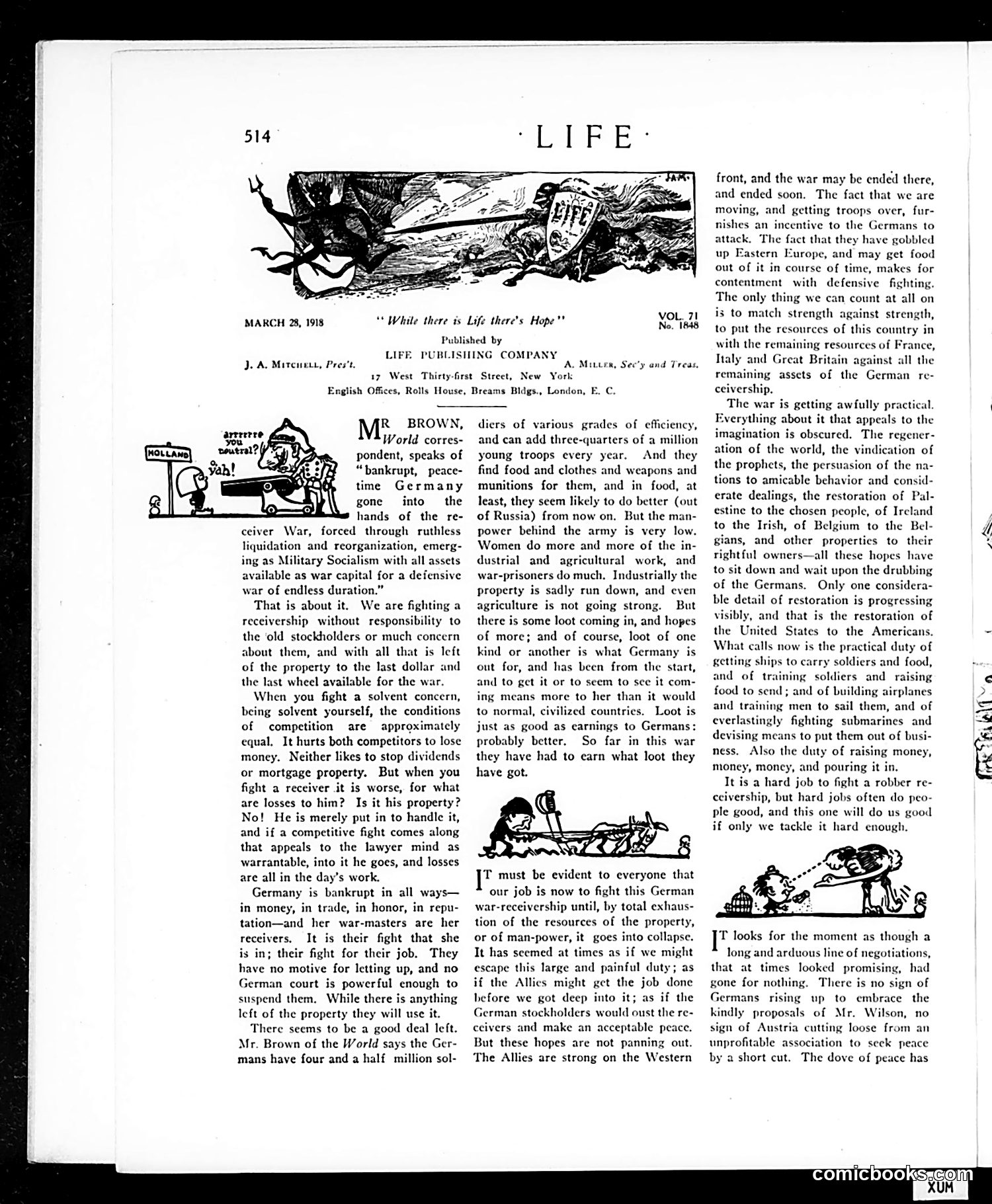
This editorial article uses an extended financial metaphor to explain America's war strategy against Germany. The author compares Germany to a bankrupt company in "receivership"—placed under court supervision—while the Allies are solvent competitors fighting it. The key argument: Germany's leaders (the "receivers") have no incentive to stop fighting because they're not risking their own property; they're merely managing a failing state's remaining assets for war. This makes them more dangerous than a solvent opponent, since losses don't discourage them personally. The article cites "Mr. Brown of the World" (a journalist) who notes Germany still commands 4.5 million soldiers and can replace troops, though industrial capacity is degraded and reliant on looted Eastern European resources. The conclusion: America must exhaust Germany's remaining resources entirely through sustained military pressure—there's no shortcut to victory through negotiation or German internal collapse. This reflects early 1918 Allied anxieties about prolonged conflict.
📄 Transcribed text from this page (OCR, searchable)
Machine-transcribed from the original scan — historical spelling and the odd misread are preserved.
MARCH 28, 1918 “While there is Life there's Hope" No. 1848 Published by J. A. Mitcuete, Pres't. RLISHING COMPANY A. Mittra, Sec’y and Treas, 17 West Thirty-first Street, New York English Offices, Rolls House, Breams Bldgs., London, E. C. R_ BROWN, World corres- pondent, speaks of “bankrupt, peace- time Germany gone into the hands of the re- ceiver War, forced through ruthl liquidation and reorganization, emerg- ing as Military Socialism with all assets available as war capital for a defensive war of endless duration.” That is about it. We are fighting a receivership without responsibility to the ‘old stockholders or much concern about them, and with all that is left of the property to the last dollar and the last wheel available for the war. When you fight a solvent concern, being solvent yourself, the conditions of competition are approximately equal, It hurts both competitors to lose moncy. Neither likes to stop dividends or mortgage property. But when you fight a receiver it is worse, for what are losses to him? Is it his property? No! He is merely put in to handle it, and if a competitive fight comes along that appeals to the lawyer mind as warrantable, into it he goes, and losses are all in the day’s work. Germany is bankrupt in all ways— in money, in trade, in honor, in repu- tation—and her war-masters are her receivers, It is their fight that she is in; their fight for their job. They have no motive for letting up, and no German court is powerful enough to suspend them, While there is anything left of the property they will use it. There seems to be a good deal left. Mr. Brown of the World says the Ger- mans have four and a half million sol- diers of various grades of efficiency, and can add three-quarters of a million young troops every year. And they find food and clothes and weapons and munitions for them, and in food, at least, they seem likely to do better (out of Russia) from now on. But the man- power behind the army is very low. Women do more and more of the in- dustrial and agricultural work, and war-prisoners do much, Industrially the property is sadly run down, and even agriculture is not going strong. But there is some loot coming in, and hopes of more; and of course, loot of one kind or another is what Germany is out for, and has been from the start, and to get it or to seem to see it com- ing means more to her than it would to normal, civilized countries. Loot is just as good as earnings to Germans: probably better, So far in this war they have had to earn what loot they have got. must be evident to everyone that our job is now to fight this German war-receivership until, by total exhaus- tion of the resources of the property, or of man-power, it goes into collapse. It has seemed at times as if we might escape this large and painful duty; as if the Allics might get the job done before we got deep into it; as if the German stockholders would oust the re- ceivers and make an acceptable peace. But these hopes are not panning out. The Allies are strong on the Western front, and the war may be ended there, and ended soon. The fact that we are ing, and getting troops over, fur- an incentive to the Germans to ct that they have gobbled up Eastern Europe, and may get food out of it in course of time, makes for contentment with defensive fighting. The only thing we can count at all on is to match strength against strength, to put the resources of this country in with the remaining resources of Franc Italy and Great Britain against all the remaining assets of the German re- ceivership. The war is getting awfully practical. erything about it that appeals to the imagination is obscured. The regener- ation of the world, the vindication of the prophets, the persuasion of the na- tions to amicable behavior and consid- erate dealings, the restoration of Pal- estine to the chosen people, of Ireland to the Irish, of Belgium to the Bel- gians, and other propertics to their rightful owners—all these hopes h to sit down and wait upon the drubbing of the Germans. Only one considera- ble detail of restoration is progressing visibly, and that is the restoration of the United States to the Americans. What calls now is the practical duty of getting ships to carry soldiers and food, and of training soldiers and. raising food to send; and of building airplanes and training men to sail them, and of everlastingly fighting submarines and devising means to put them out of busi- ness. Also the duty of raising money, money, moncy, and pouring it in. It is a hard job to fight a robber re- ccivership, but hard jobs often do peo- ple good, and this one will do us good if only we tackle it hard enough. € T looks for the moment as though a long and arduous line of negotiations, that at times looked promising, had gone for nothing. There is no sign of Germans rising up to embrace the kindly proposals of Mr. Wilson, no sign of Austria cutting loose from an unprofitable association to seck peace by a short cut. The dove of peace has ks;