
Life, 1918-03-28 · page 23 of 40
Life — March 28, 1918 — page 23: what you’re looking at
What you’re looking at
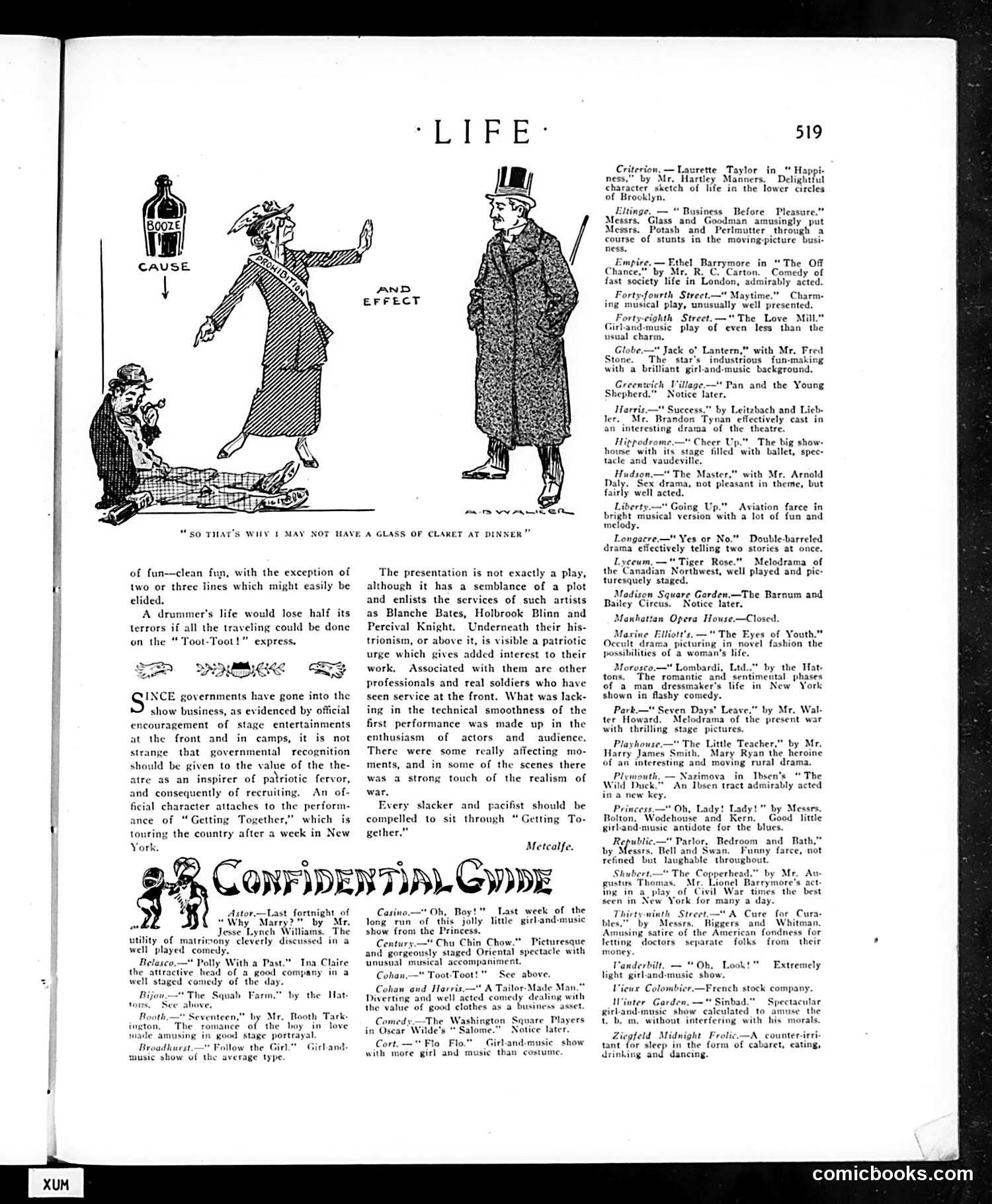
This cartoon satirizes **Prohibition-era restrictions** on alcohol consumption. The image shows a bottle labeled "BOOZE" as the "CAUSE," with an arrow pointing to its "EFFECT"—a disheveled man lying drunk on the ground while a woman gestures in disapproval. The caption's irony suggests that government restrictions on drinking are justified by the visible consequences of excess alcohol. The cartoon implies that without such regulations, citizens would suffer public drunkenness and social disorder, thereby losing the privilege of responsible wine consumption at dinner. This reflects early 20th-century American debates about alcohol regulation, culminating in Prohibition (1920-1933). The satire targets those arguing alcohol should be banned entirely, suggesting their reasoning—though visible evidence of alcohol's harms exists—overlooks moderate, civilized consumption. The joke's edge critiques both excessive drinkers *and* prohibitionists' heavy-handed approach.
📄 Transcribed text from this page (OCR, searchable)
Machine-transcribed from the original scan — historical spelling and the odd misread are preserved.
f | t EFFECT AND aor wate “so THAT'S WHY 1 MAY NOT HAVE A GLASS OF CLARET AT DINNER” of fun—clean fun, with the exception of two or three lines which might easily be clided. A drummer's life would lose half its Il the traveling could be done ‘oot-Toot !" express. INCE governments have gone into the show business, as evidenced by official encouragement of stage entertainments at the front and in camps, it is not strange that governmental recognition should be given to the value of the the- atre as an inspirer of patriotic fervor, and consequently of recruiting. An of- ficial character attaches to the perform- ance of “Getting Together,” which is touring the country after a week in New York. terrors if on the “ Gye % é Astor.—Last fortnight, of “Why Marry?" by Mr. rs Jesse Lynch Williams. The utility of matrimony cleverly discussed in a well played comedy. “Polly With a Past." Tn: attractive he: well staged comedy of the day. —"The Squab Farm, by the Hat- oth — teen,” hy Mr. Booth Tark: The romance of the boy in love amusing in good stage portrayal. Jhurst.—" Follow the Girl.” Girkan how of the average type. The presentation is not exactly a play, although it has a semblance of a plot and enlists the services of such artists as Blanche Bates, Holbrook Blinn and Percival Knight. Underneath their his- trionisn ible a patriotic urge which gives added interest to their work, Associated with them are other professionals and real soldiers who have seen service at the front. What was lack- ing in the technical smoothness of the first. performance was made up in the enthusiasm of actors and audience. There were some really affecting mo- ments, and in some of the scenes there was a strong touch of the realism of war, Every slacker and pacifist should be compelled to sit through “Getting To- gether.” or above it, is vi Metcalfe. CONFIDENTIA). GE “Oh, Boy!" Last week of the sic Casi . long run of this jolly little girland- show from the Princess. Century.—" Chu Chin Chow." Picturesque and gorgeously staged Oriental spectacle with unusual musical accompaniment. Cohan.—" Toot-Toot! ” See above. Cohan and Harr A Tailor-Made Man.” Diverting and well acted comedy dealing with the value of good clothes as a business asset, medy.—The Washington Square Players scar Wilde's * Salome.” Notice later. Cort, —" Flo Flo.” Girland-musie show with more girl and music than costume 519 Criterion, — Laurette Taylor in“ Happi- ness,” by Mr. Hartley Manners, Delightful character sketch of life in the lower circles of Brooklyn. Eltinge, — “Business Before Pleasure.” Messrs. Glass and Goodman amusingly put Messrs. Potash and Perlmutter through a course of stunts in the moving:picture busi- ness, Empire. — Ethel Barrymore in “The Off Chance,” by Mr. R. C. Carton, Comedy of fast society life in London, admirably acted. Forty-fourth Street.—" Maytime.”” Charm: ing musical play, unusually well presented. Forty-cighth Street. —“ The Love Mill.” land-music play of even less than the usual charm, Globe" Jack 0° Lantern,” with Mr, Fred Stone. The star's industrious fun-makin, with a brilliant girland-music background, Cree Shepherd. Harris.—* Success.” by Leitzbach and Lieb- ler. Mr. Brandon Tynan effectively cast in an interesting drama of the theatre. Hitpodrome.—" Cheer Up." The big show: house with its stage filled with ballet, spec- tacle and vaudeville. Hudson.—" The Master,” with Mr. Arnold Daly.” Sex drama, not pleasant in theme, but fairly well acted, Liberty.—" Going Up." Aviation farce in bright musical version with a lot of fun and melody. Longacre.—" Yes or No.” Double-barreled drama effectively telling two stories at once. Lycew Tiger Rose.” Melodrama of the Canadian Northwest, well played and pic- turesquely staged. Madison Square Garden.—The Barnum and Bailey Circus. Notice later. fanhattan Opera House—Closed. Marine —"The Eyes of Youth.” Occult drama picturing in novel fashion the possibilities of a woman's life, “Lombardi, Ltd.” by the THat- tons. The romantic and sentimental phases of a man_dressmaker's life in New York shown in flashy comedy. Park.—" Seven Days’ Leave,” by Mr. Wal- ter Howard, Melodrama of the present war with thrilling stage pictures. The Little Teacher.” by Mr. mith, Mary Ryan the heroine g and moving rural drama. Nazimova in Ibsen's “ The An Ibsen tract admirably acted ich Village.—" Pan and the Young Notice later. Playhouse. Harry James of an interesti Plemout! Wild Duck in a new key. Princess —" Oh, Lady! Lady!" by Messrs. Rolton, Wodehouse and Kern. Good little girland-music antidote for the blues. Republic-—" Parlor, Bedroom and Bath,” by Messrs. Bell and Swan. Funny farce, not refined but laughable throughout. Shubert. —" The Copperhead.” by Mr, Av. gusts T Mr. Lionel Barrymore's act. ing in a play of Civil War times the best seen in New York for many a day. th Street—" A Cure for Cura- Messrs. Riggers and Whitman. satire of the American fondness for letting doctors separate folks from their money. Vanderbilt, — “Oh, light gitl-and-musie show. ook! Extremely View Colombier.—French stock company. Winter Garden. —" Sinbad.” ctacular girland-music show calculated to amuse the t. b. m, without interfering with his morals. i Ziegfeld Midnight Frotic.—A_ counter-irri tant for sleep in the form of cabaret, eating, drinking and dancing. comicbooks.com