
A complete issue · 40 pages · 1918
Life — January 24, 1918
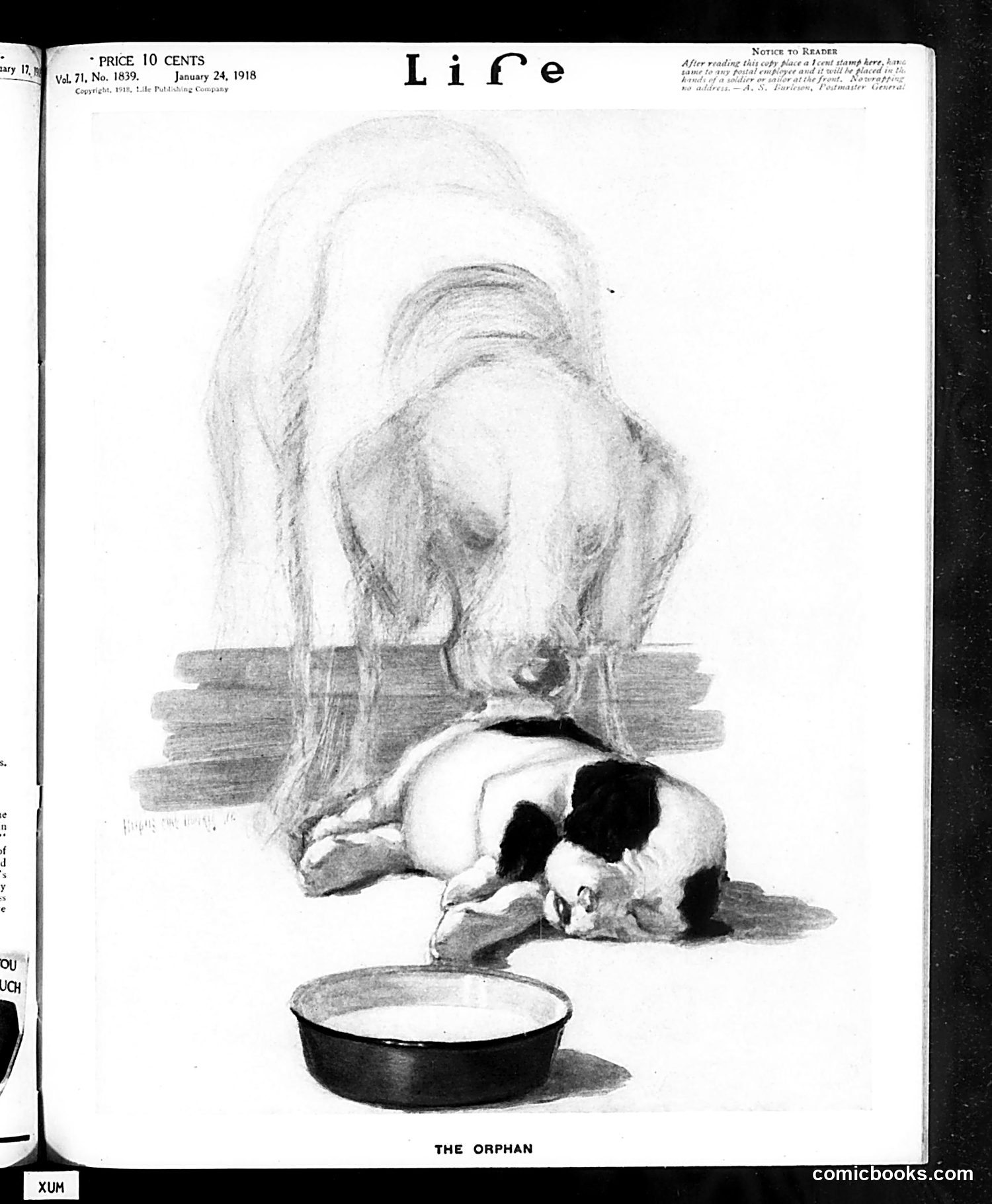
This cartoon depicts a starving puppy eating from a bowl while an adult dog with long, flowing hair looks away—apparently indifferent to the young animal's plight. The title "The Orphan" suggests the puppy has been abandoned. Given the 1918 publication date during World War I, this likely functions as political allegory rather than literal animal commentary. The "orphan" probably represents a nation or people affected by the war—possibly Belgium, whose suffering under German occupation was widely publicized in American media. The neglectful adult dog could represent an Allied power or the international community failing to adequately aid war victims. The satire critiques insufficient humanitarian response to wartime suffering.
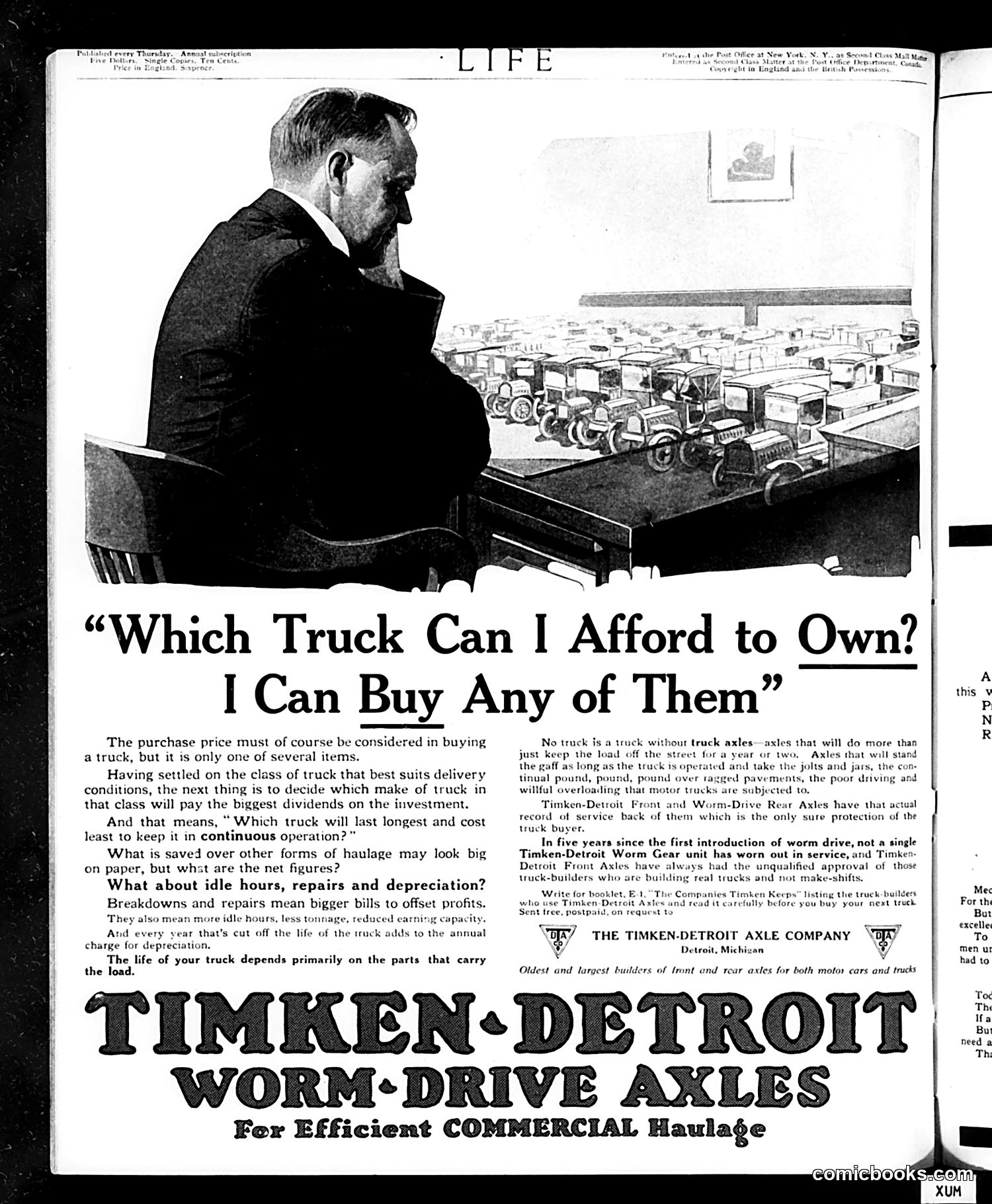
This page is primarily **advertising, not satire or political commentary**. It features a Timken-Detroit Axle Company advertisement promoting worm-drive axles for commercial trucks. The image shows a businessman examining a display of toy/model trucks—a visual metaphor suggesting he's carefully considering which truck to purchase. The headline "Which Truck Can I Afford to Own? I Can Buy Any of Them" addresses practical purchasing concerns for fleet operators. The advertisement emphasizes that while purchase price matters, the real consideration should be **operating costs and reliability**. It highlights Timken-Detroit axles' durability, claiming they reduce breakdowns, repairs, and depreciation—thus lowering total cost of ownership. This represents standard early 20th-century commercial advertising targeting business decision-makers.
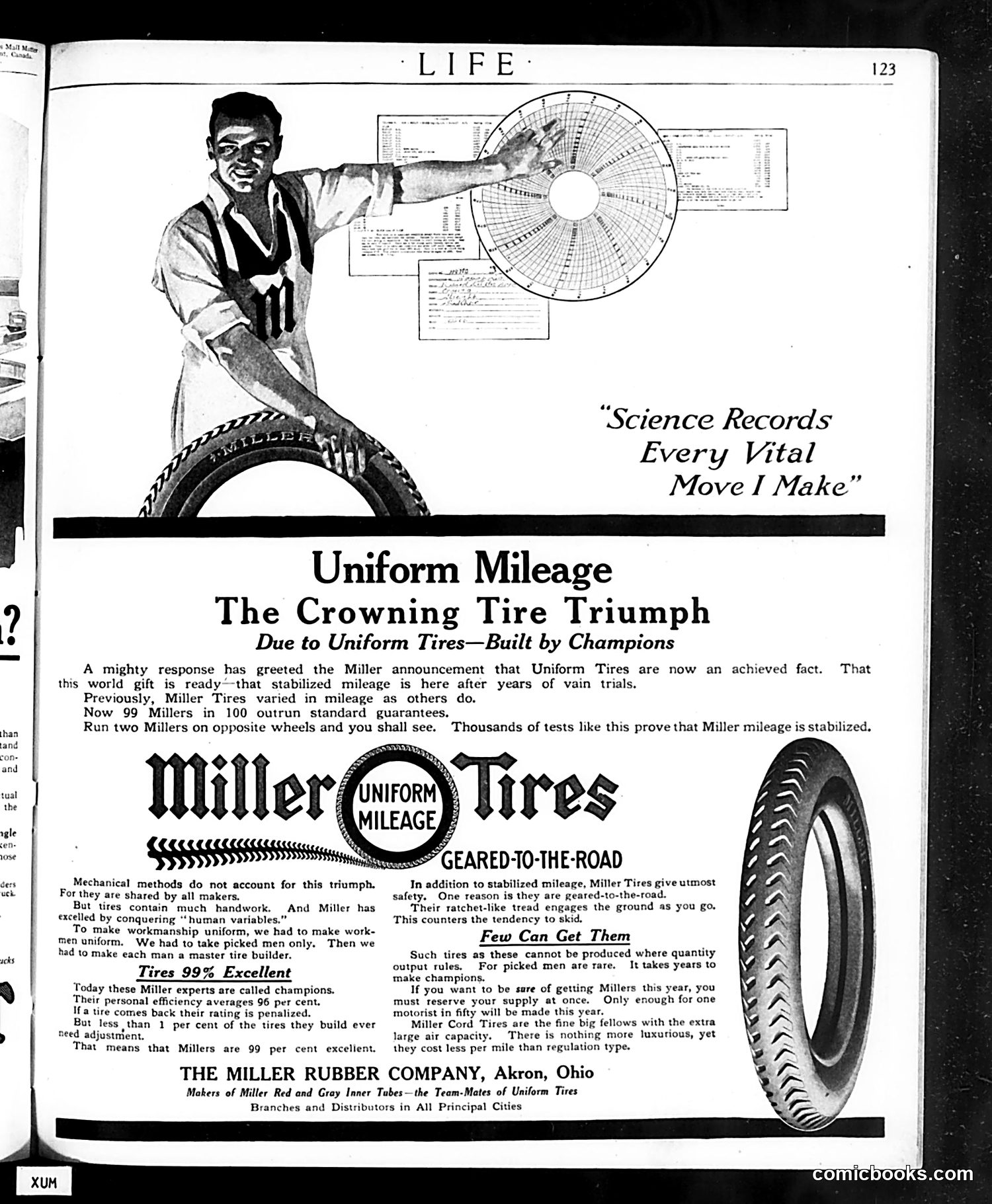
This page is primarily **advertising**, not satire or editorial content. It's a Miller Rubber Company advertisement for "Uniform Mileage" tires, appearing in *Life* magazine (page 123). The illustration shows a man in work clothes pointing to technical diagrams and tire test data, emphasizing scientific validation. The quote "Science Records Every Vital Move I Make" suggests Miller tires undergo rigorous testing. The ad claims Miller achieved "uniform mileage"—consistent tire wear across multiple tires—through employing expert "champions" (skilled tire builders) and mechanical standardization. It positions the product as superior because competitors' tires varied in performance. This reflects early 20th-century marketing that leveraged scientific authority and industrial craftsmanship to differentiate consumer goods.
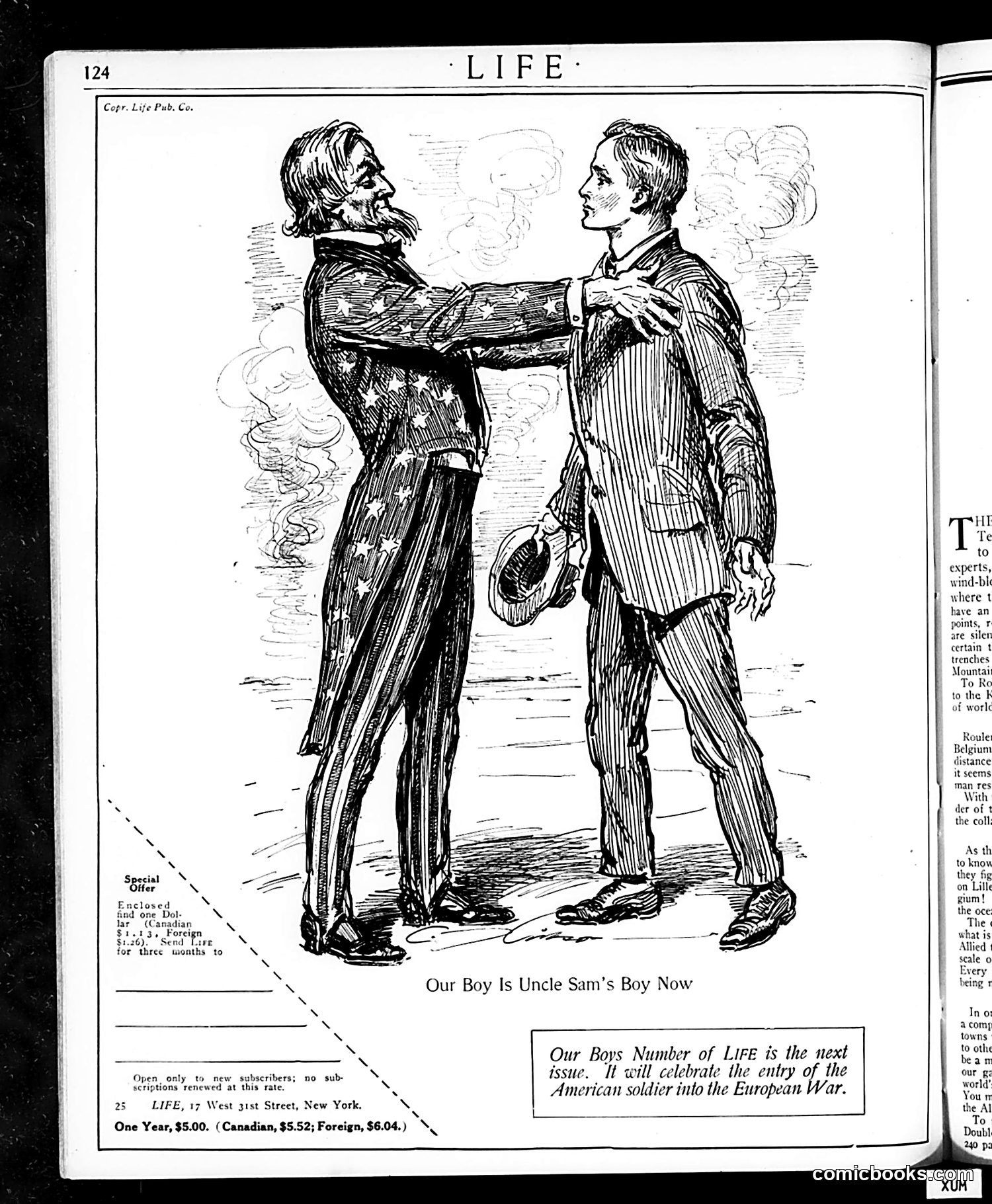
This Life magazine page (page 124) features a political cartoon titled "Our Boy Is Uncle Sam's Boy Now," depicting two men in formal attire shaking hands. The figure on the left appears to be a caricatured European leader (possibly German, given the historical context), while the figure on the right represents an American, likely symbolizing the United States. The cartoon satirizes America's entry into World War I and the resulting military partnership between the U.S. and European powers. The boxed text announces that the next issue will "celebrate the entry of the American soldier into the European War," confirming this is wartime propaganda/commentary. The "Special Offer" subscription promotion at bottom indicates this is a recruitment-era publication encouraging American readership and patriotic support.
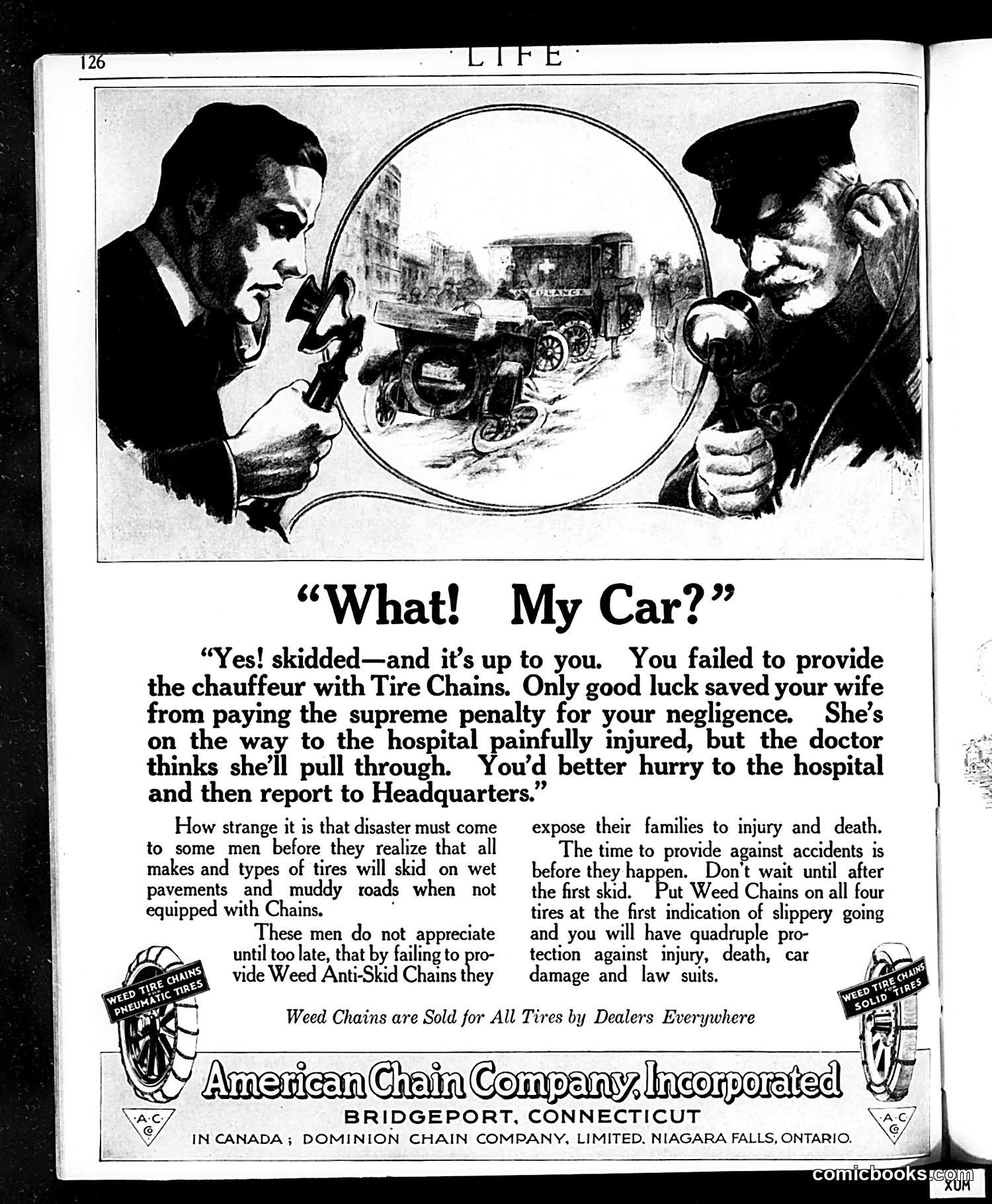
This is a **safety advertisement**, not political satire. The American Chain Company uses a dramatic scenario to promote Weed Anti-Skid Tire Chains. The cartoon depicts two men in conversation—one appears to be a police officer or authority figure (right) informing a distressed car owner (left) that his vehicle skidded on wet pavement because he failed to equip it with tire chains. The accident injured the man's wife, who's being taken to the hospital. The ad's message: winter tire chains prevent skids on icy/wet roads, avoiding injury, death, and legal liability. The text emphasizes that chains should be installed *before* accidents occur, not after. The stark, threatening tone—mentioning "supreme penalty" and hospital visits—was typical of early 20th-century safety advertising, using fear to motivate consumer behavior.
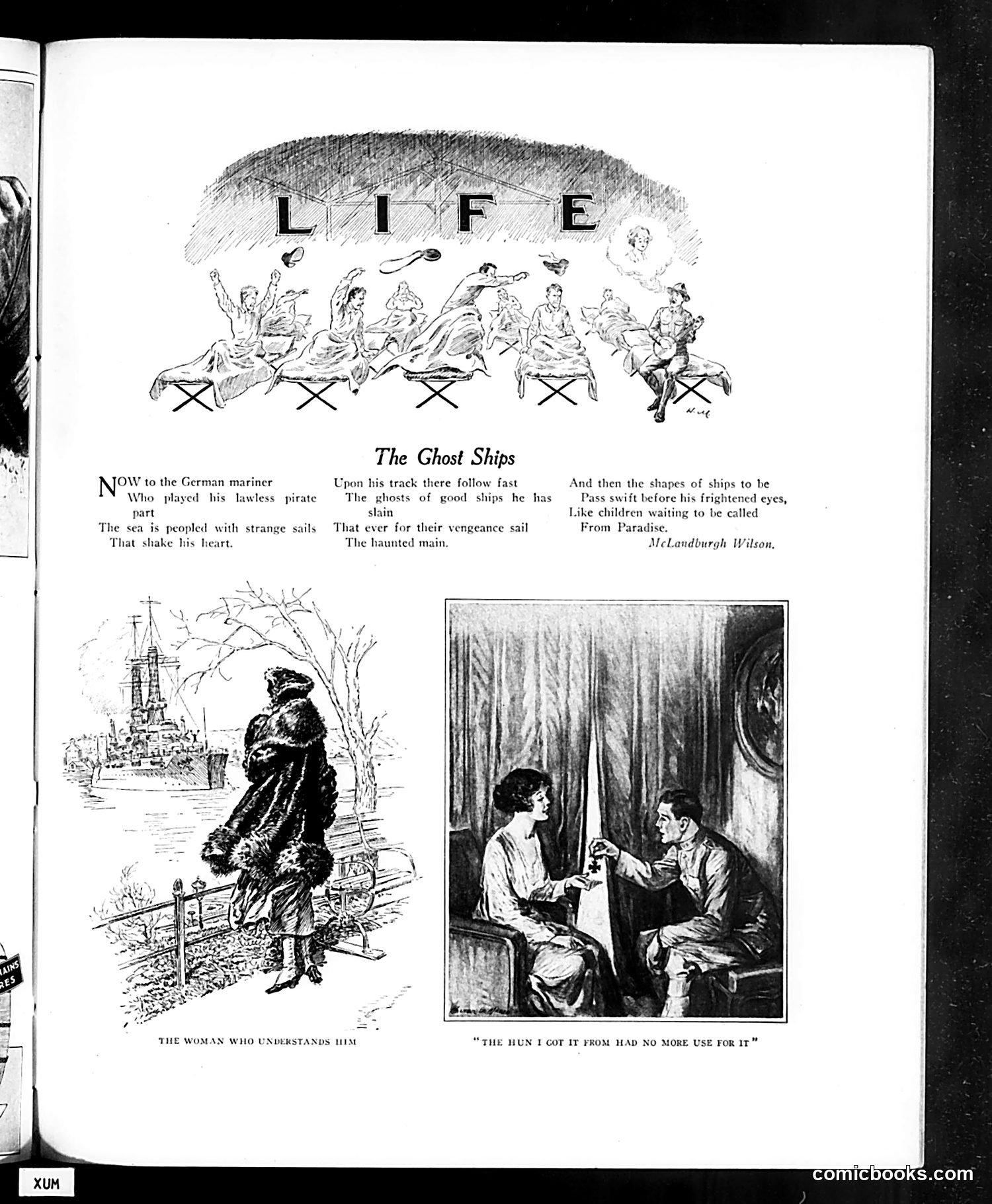
This page presents a wartime satirical piece, likely from World War I based on the naval references. "The Ghost Ships" poem by McLandburgh Wilson describes German naval threats—a "German mariner" and "lawless pirate" haunted by vengeance and the ghosts of ships he's destroyed. The accompanying illustrations depict: 1. **Left**: A mysterious woman by the shore, observing warships—"The Woman Who Understands Him" 2. **Right**: An interior scene where someone explains acquiring something sinister—"The Hun I Got It From Had No More Use for It" The satire appears to mock German naval warfare and U-boat tactics while depicting civilians' anxieties about maritime threats. The illustrations suggest espionage or black-market dealings related to the naval conflict, though specific historical references remain somewhat unclear without additional context.
This page contains a poem titled "Coal" by Arthur Guiterman (left column) and an article called "The Call for Big Men" (right column). There is no cartoon visible on this page. The article discusses criticism of the American delegation to an Allied War Conference. It defends the delegation against complaints that members lacked sufficient stature, specifically addressing criticism of Colonel House and defending President Wilson's choices. The piece argues that delegates like Mr. Wilson and General Wood were competent, and criticizes those who grumble about the selection—including mentions of competing figures like Roosevelt and various political opponents. The article appears to address WWI-era diplomatic debates about American representation.
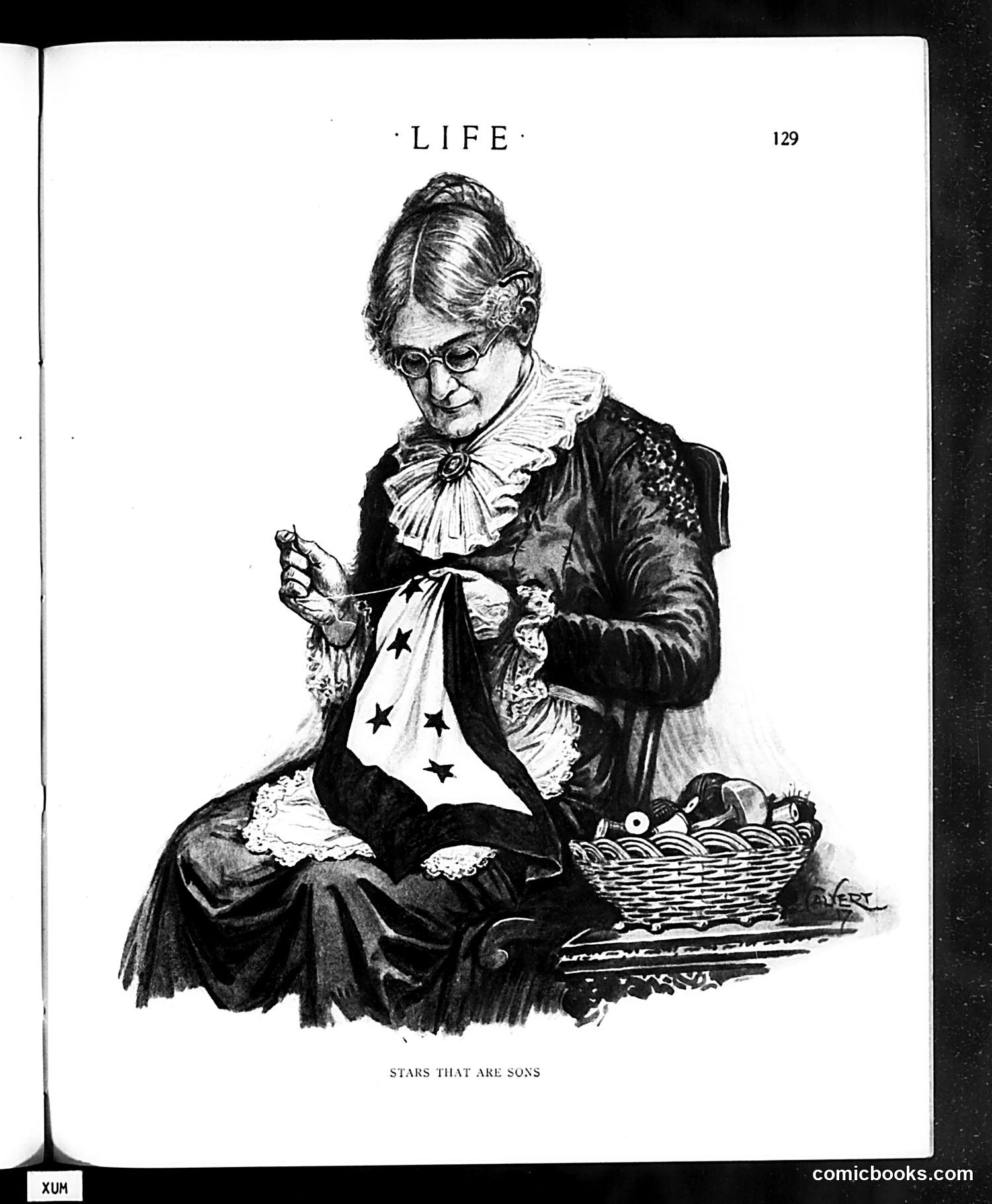
This satirical illustration depicts an elderly woman with spectacles and period dress examining a cloth or handkerchief decorated with stars. A basket of what appears to be produce or goods sits beside her. The title "Stars That Are Sons" suggests a play on words—likely referencing both celestial stars and notable male figures (sons) of the era. The woman's careful, almost suspicious examination of the starred fabric implies satire about maternal pride, patriotism, or possibly concerns about sons' achievements or conduct. Without additional context about Life magazine's publication date or contemporary events, the specific targets remain unclear. However, the image appears to mock either sentimental motherhood, jingoism, or perhaps scrutiny of public figures' reputations—common Life magazine subjects. The refined domestic setting and elderly female figure suggest commentary on middle-class or upper-class social attitudes.
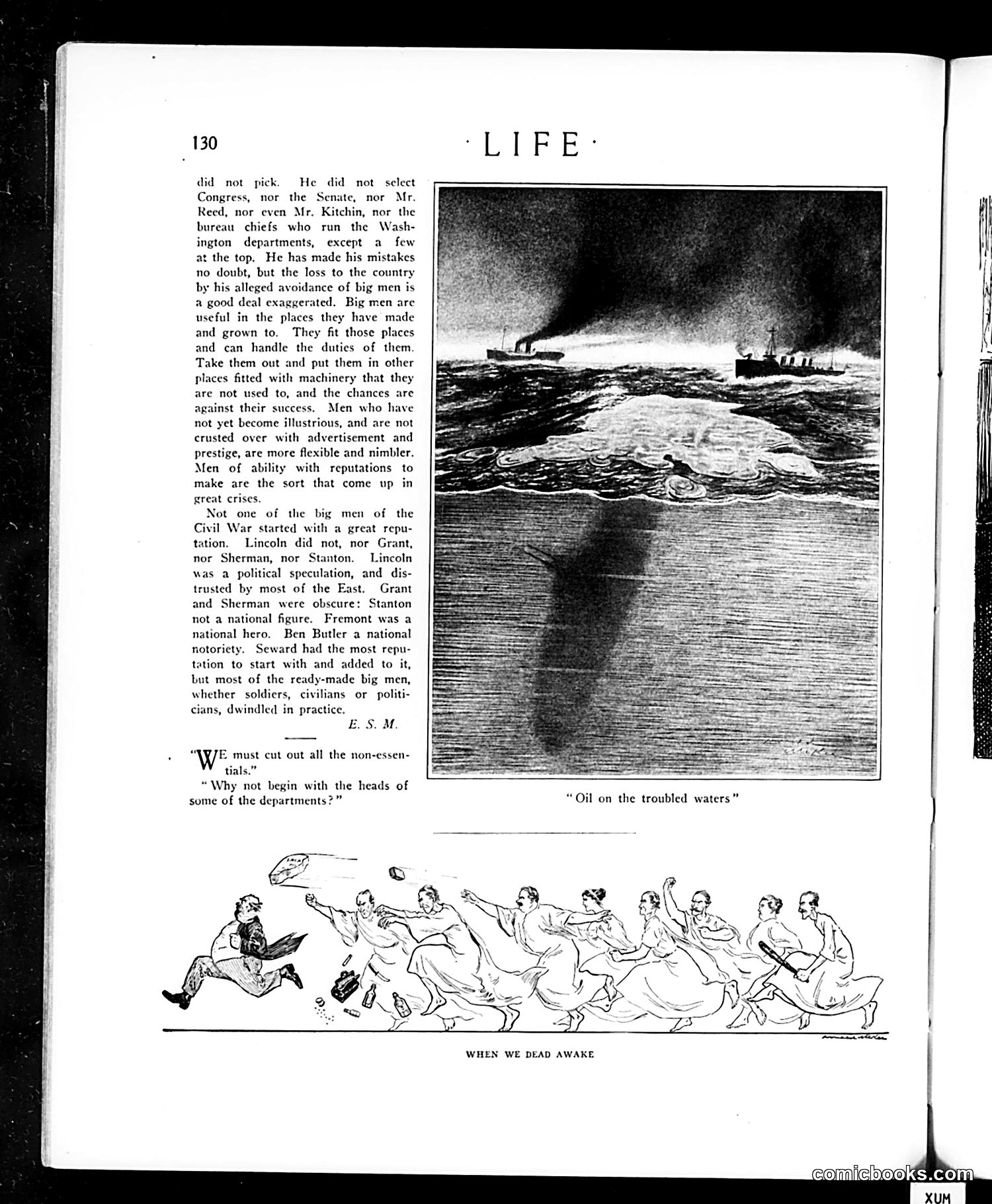
The page critiques President Wilson's cabinet selections and administrative choices. The main text argues Wilson failed to appoint experienced "big men" to key positions—he avoided selecting major political figures like those who led the Civil War (Lincoln, Grant, Sherman). Instead, Wilson chose less-established figures, which the author suggests makes government less effective. The political cartoon "When We Dead Awake" (bottom) depicts figures in a tug-of-war, likely representing competing political factions or interests pulling at the government during Wilson's administration. The ship photograph titled "Oil on the troubled waters" (top right) appears metaphorical—illustrating attempts to calm turbulent political or economic conditions through governmental action. The overall message: Wilson's cabinet lacked sufficient gravitas to handle national crises effectively.
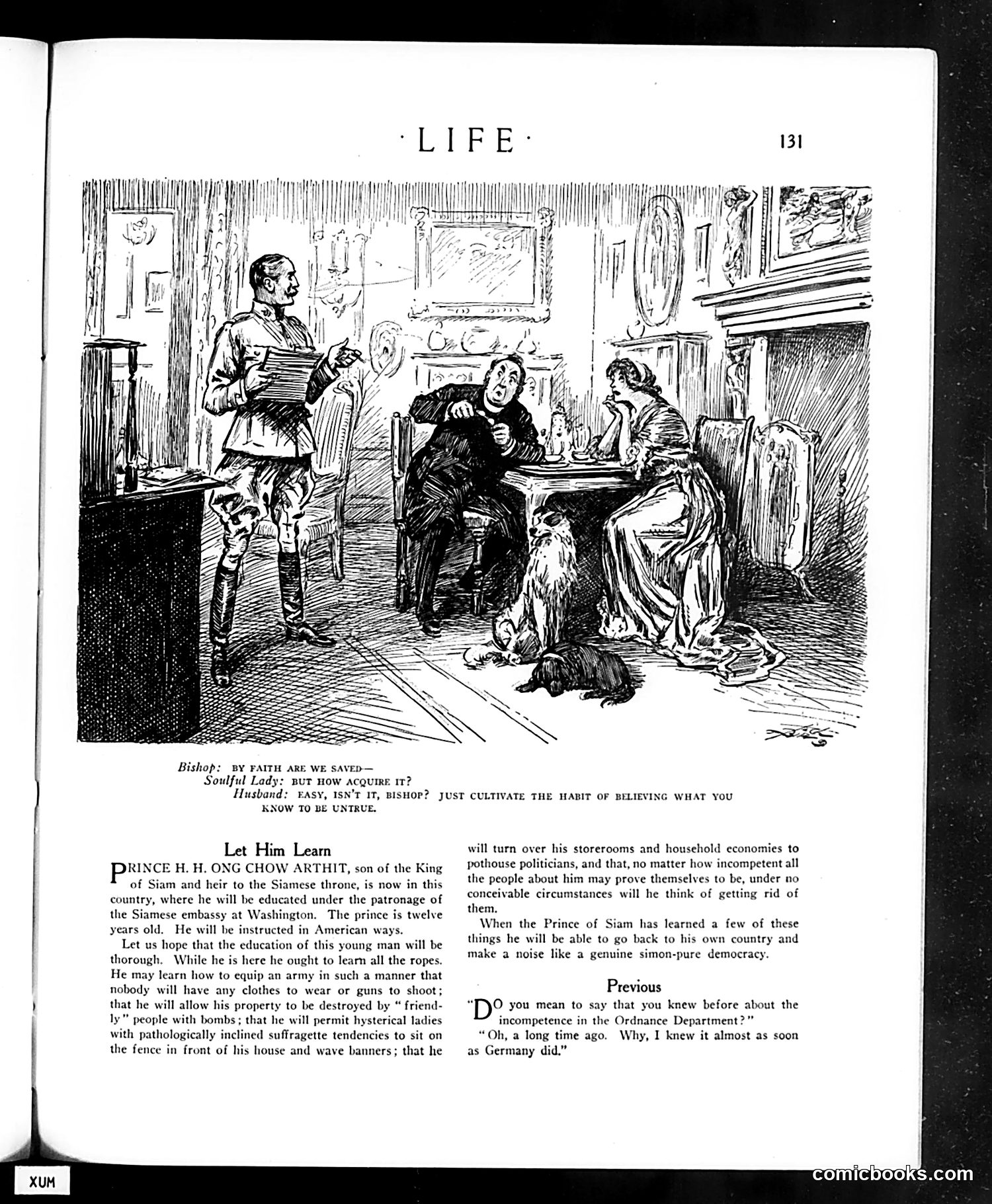
**The Cartoon:** A bishop lectures a couple about faith and belief while dogs sit nearby. The husband suggests they simply adopt the habit of believing what they know to be untrue—satirizing how people rationalize convenient falsehoods. **The Article:** "Let Him Learn" concerns Prince H.H. Ong Chow Arthit of Siam, being educated in America under Siamese embassy patronage. The satire anticipates his return to Siam, where he'll likely abandon American democratic ideals upon facing entrenched corruption and incompetence—specifically mentioning that ridding his country of "friend-like" corrupt officials would prove impossible due to established power structures and social resistance. **The Point:** Both pieces satirize how people, whether individuals or nations, ultimately default to accepting the status quo despite knowing better—faith in improvement proves naive against institutional reality.
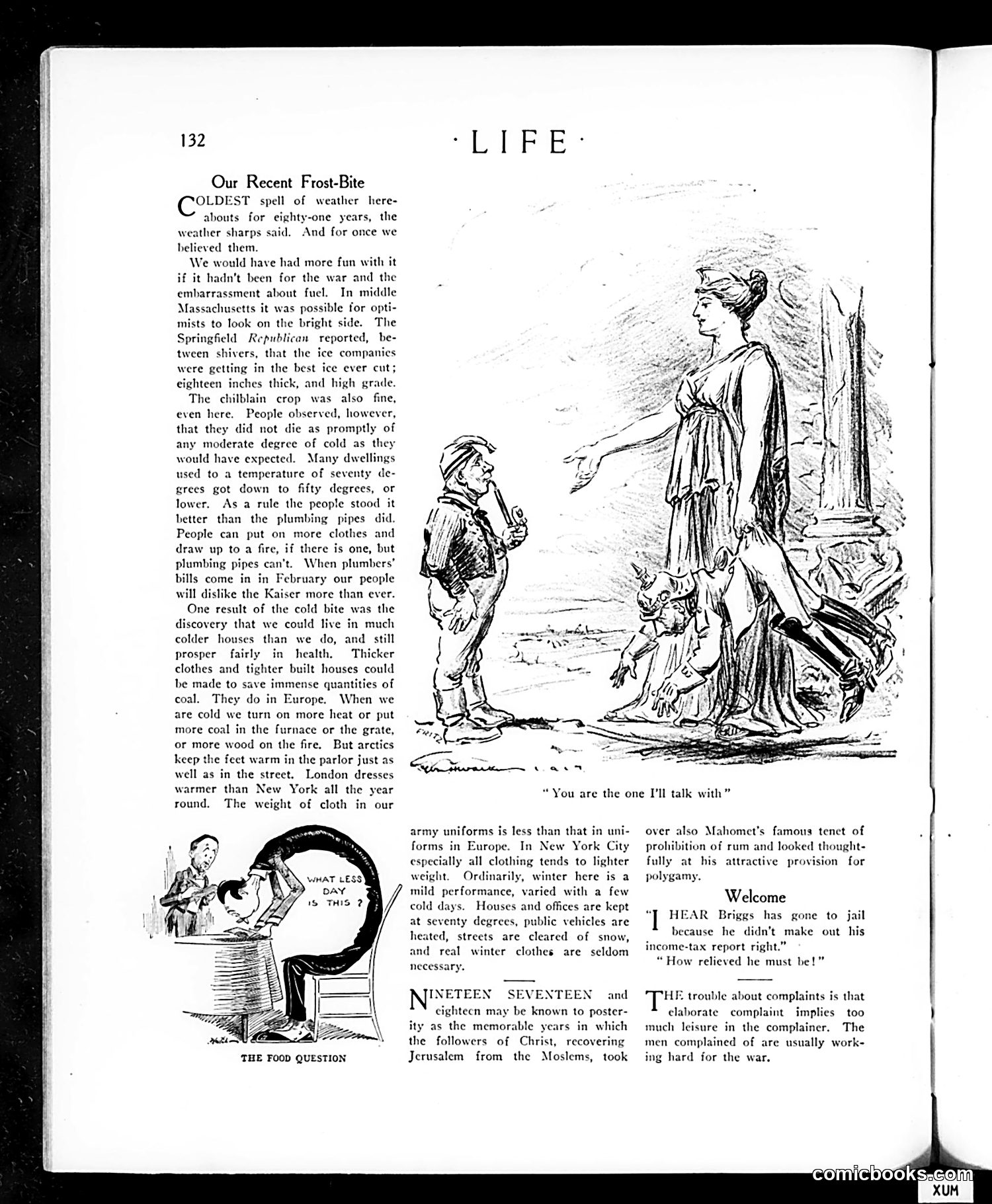
This page contains three distinct pieces: 1. **"Our Recent Frost-Bite"** - An editorial essay about an unusually severe cold spell in Massachusetts, noting it was the coldest in 81 years. The piece humorously observes that despite hardship, Americans could live in colder conditions than Europeans if necessary. 2. **"The Food Question"** - A small cartoon showing a person at a desk asking "What less do I eat this?" - a reference to wartime food rationing or scarcity (likely WWI era, given contextual references to "the war"). 3. **"Welcome"** and **"Hear Brings has gone to jail"** - Brief satirical notes about someone failing to file income-tax reports and complaints about wartime hardships. The overall tone reflects American home-front experiences during wartime, mixing humor with social commentary about resource management and citizen complaints.
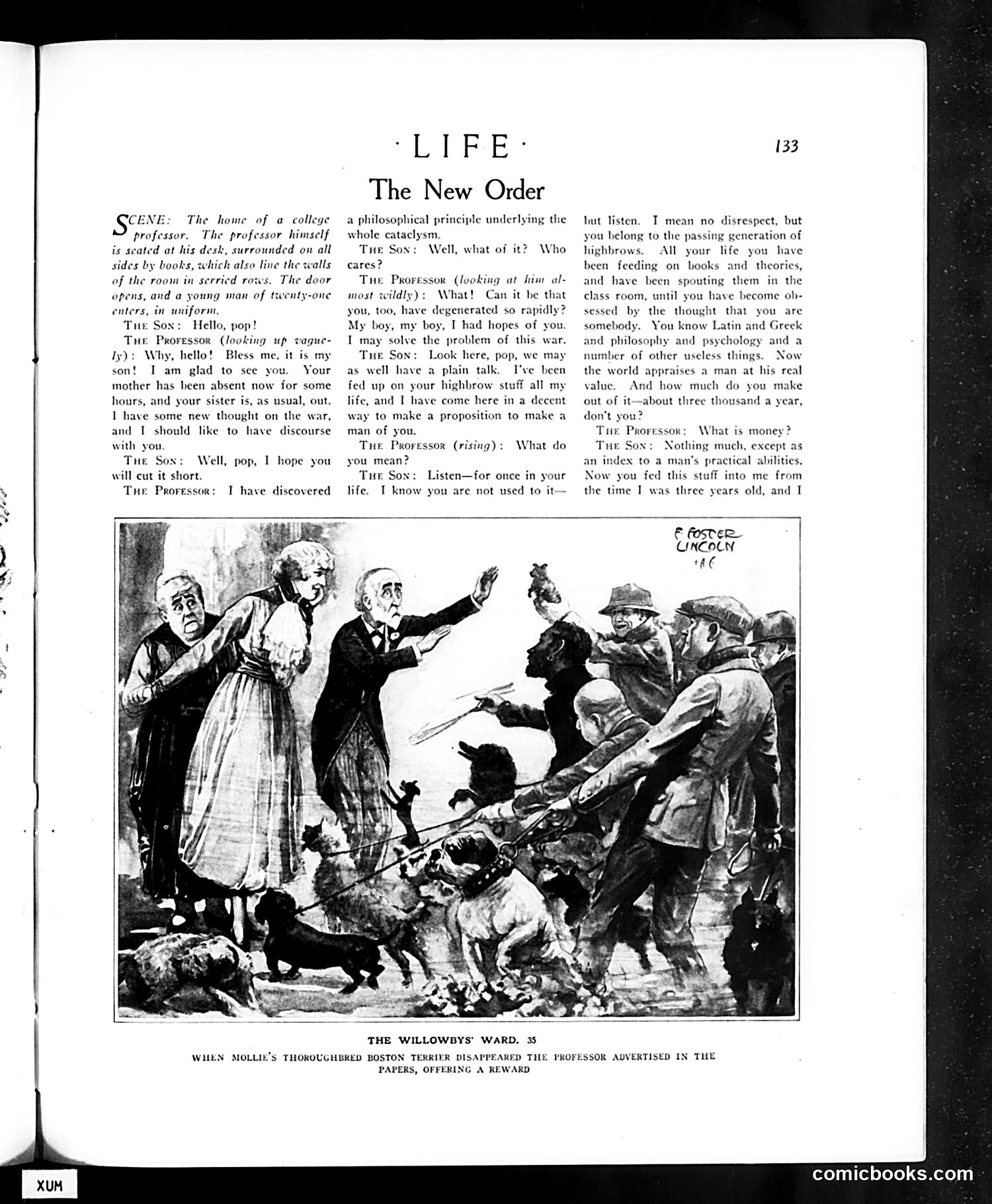
This satirical cartoon depicts what appears to be a domestic scene where a professor has advertised in newspapers offering a reward for his missing dog, Mollie—a thoroughbred Boston Terrier. The illustration shows the professor (in formal dress, center-left) addressing a crowd of rough-looking men who've apparently gathered in response to the reward notice. The satire targets both the absurdity of offering monetary rewards for lost pets and the social commentary on who such rewards attract—here portrayed as disreputable characters. The professor's earnest appeal contrasts with the unsavory types surrounding him, suggesting satirical commentary on class differences and the folly of wealthy individuals seeking help from the working classes.
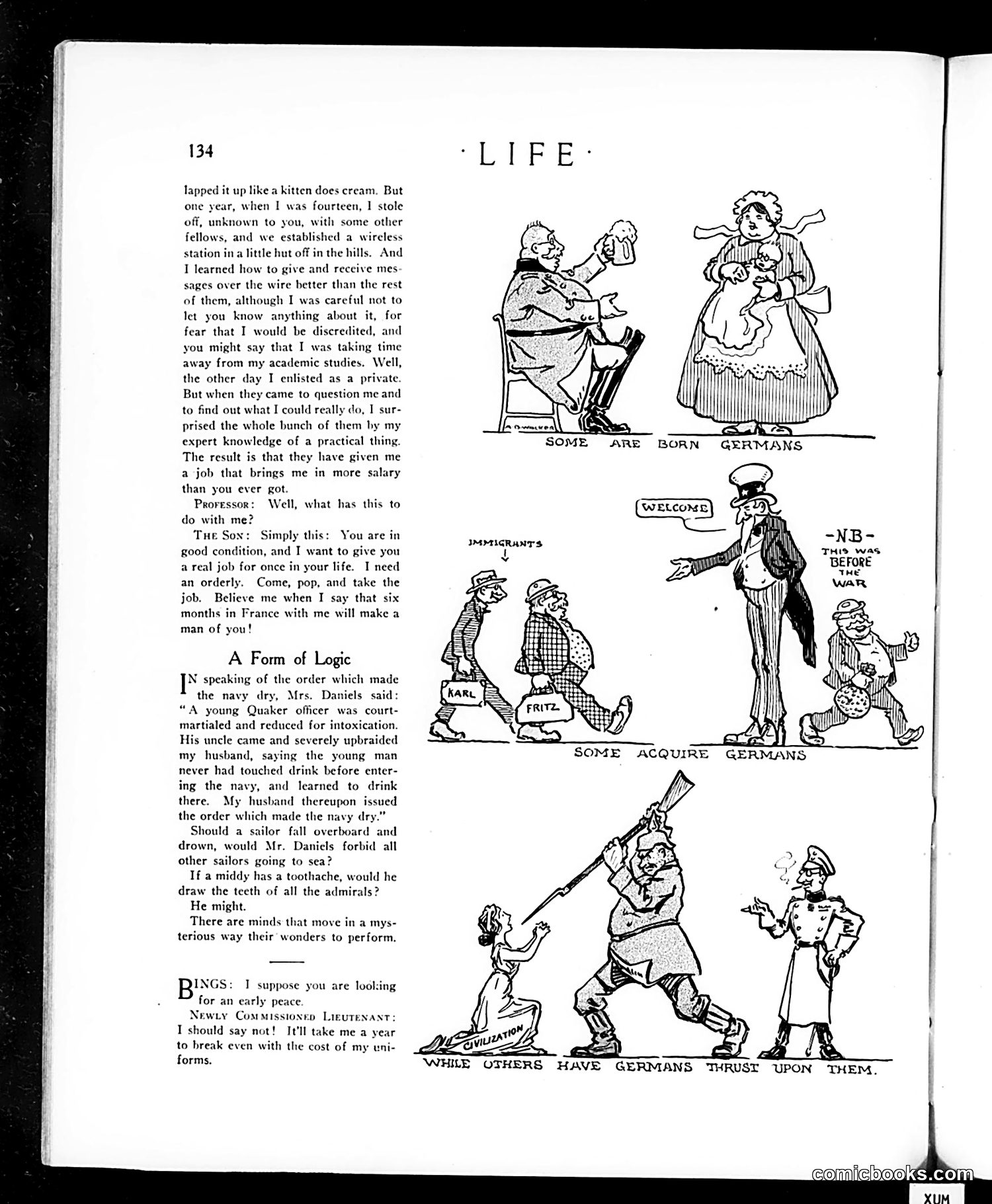
This page contains satirical cartoons about German immigration to America, likely from the early 20th century. The top panel shows Germans arriving as immigrants ("Some Are Born Germans") contrasted with those who "acquire" German identity through naturalization. The lower cartoons mock German militarism and aggression. One panel shows a German soldier wielding a large club menacingly while others cower, captioned "While Others Have Germans Thrust Upon Them." This satirizes German imperial ambitions as threatening to peaceful nations. The accompanying text discusses naval discipline and military order, using anecdotes to satirize overly rigid authority structures—likely referencing German military culture as emblematic of authoritarianism versus democratic values. The satire suggests American anxiety about German immigration and military expansion during a period of international tension.
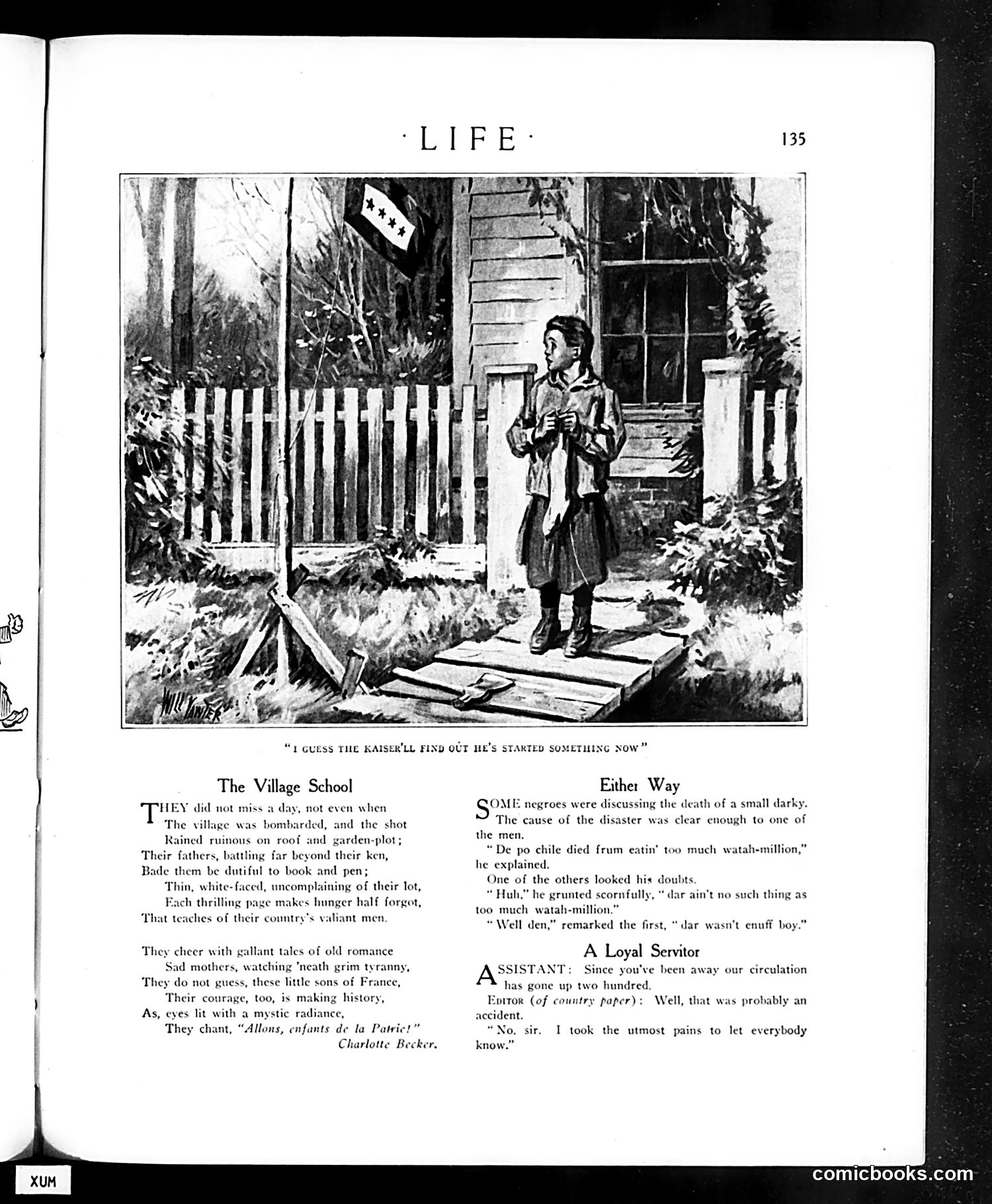
The main illustration shows a child at a house gate with a Chicago flag visible, captioned "I guess the Kaiser'll find out he's started something now." This is WWI-era propaganda depicting American patriotic sentiment. Below are three short pieces: "The Village School" (a poem by Charlotte Becker about villagers discussing war), "Either Way" (a joke about a child dying from overeating watah-miltion), and "A Loyal Servitor" (a brief humor piece about circulation figures). The page's central message uses the child's patriotic declaration to frame American resolve against the Kaiser (German WWI leader). The other content appears to be filler humor typical of Life magazine's satirical format. The overall theme emphasizes American civilian support for the war effort through earnest, if sometimes dark, humor.
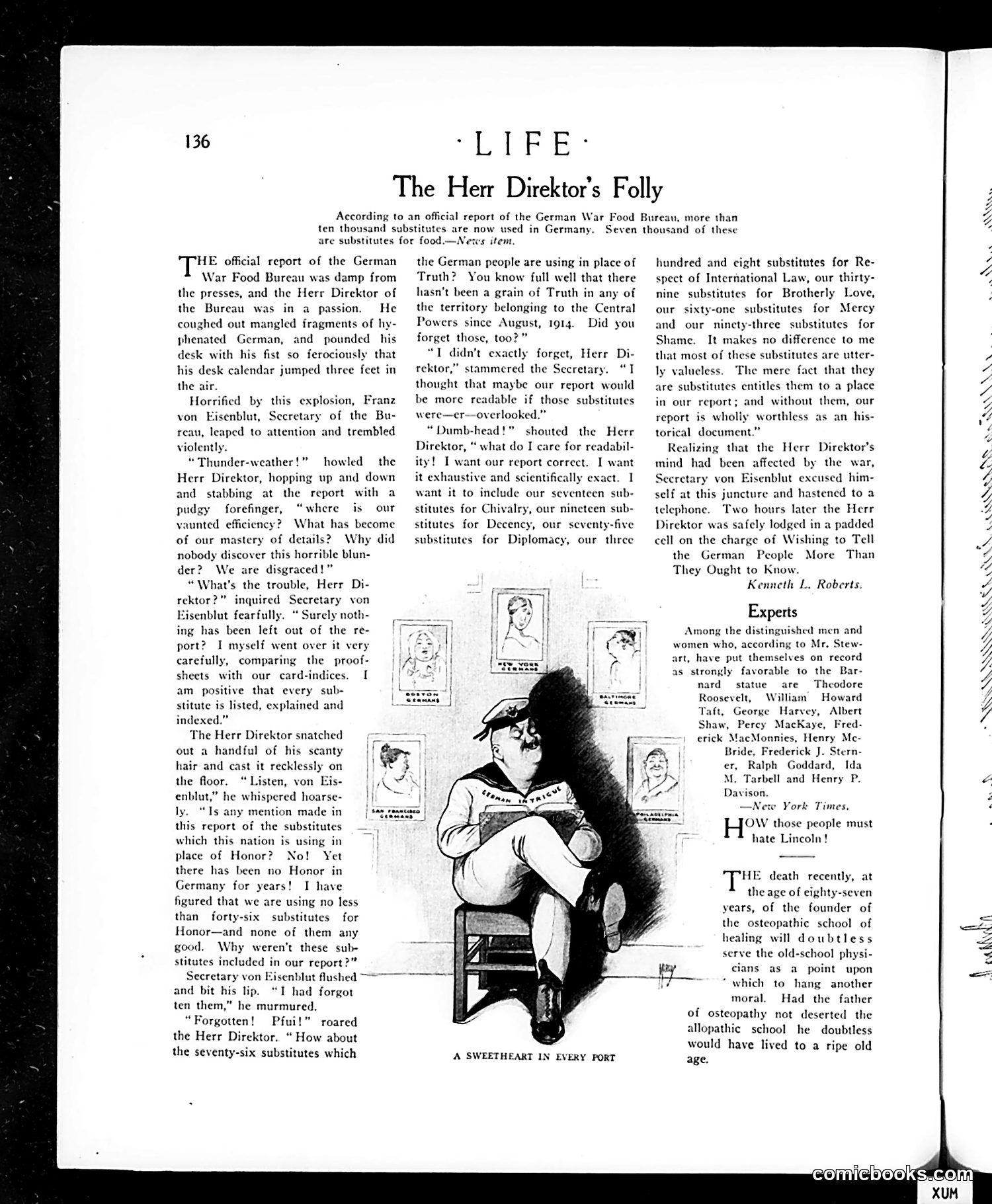
This is a satirical story mocking German official deception during World War I. The Herr Direktor, a bureaucrat at the German War Food Bureau, rages that a report omits "substitutes" for abstract virtues—honor, truth, chivalry, decency, diplomacy, mercy, and shame. He demands the report document all their fraudulent replacements for these values. The joke is biting: Germany has systematically replaced genuine moral qualities with mere substitutes (lies, propaganda, false appearances), yet the Direktor treats this as a bureaucratic oversight to be corrected in official paperwork. The satire suggests Germany's wartime conduct was fundamentally dishonest—they'd actually *catalogued* their own moral bankruptcy. The story ends with the Direktor committed to an asylum for wanting to tell Germans "more than they ought to know"—mocking German censorship and thought control. This targets German militarism, propaganda, and the Central Powers' WWI conduct, published in *Life* magazine for American readers.
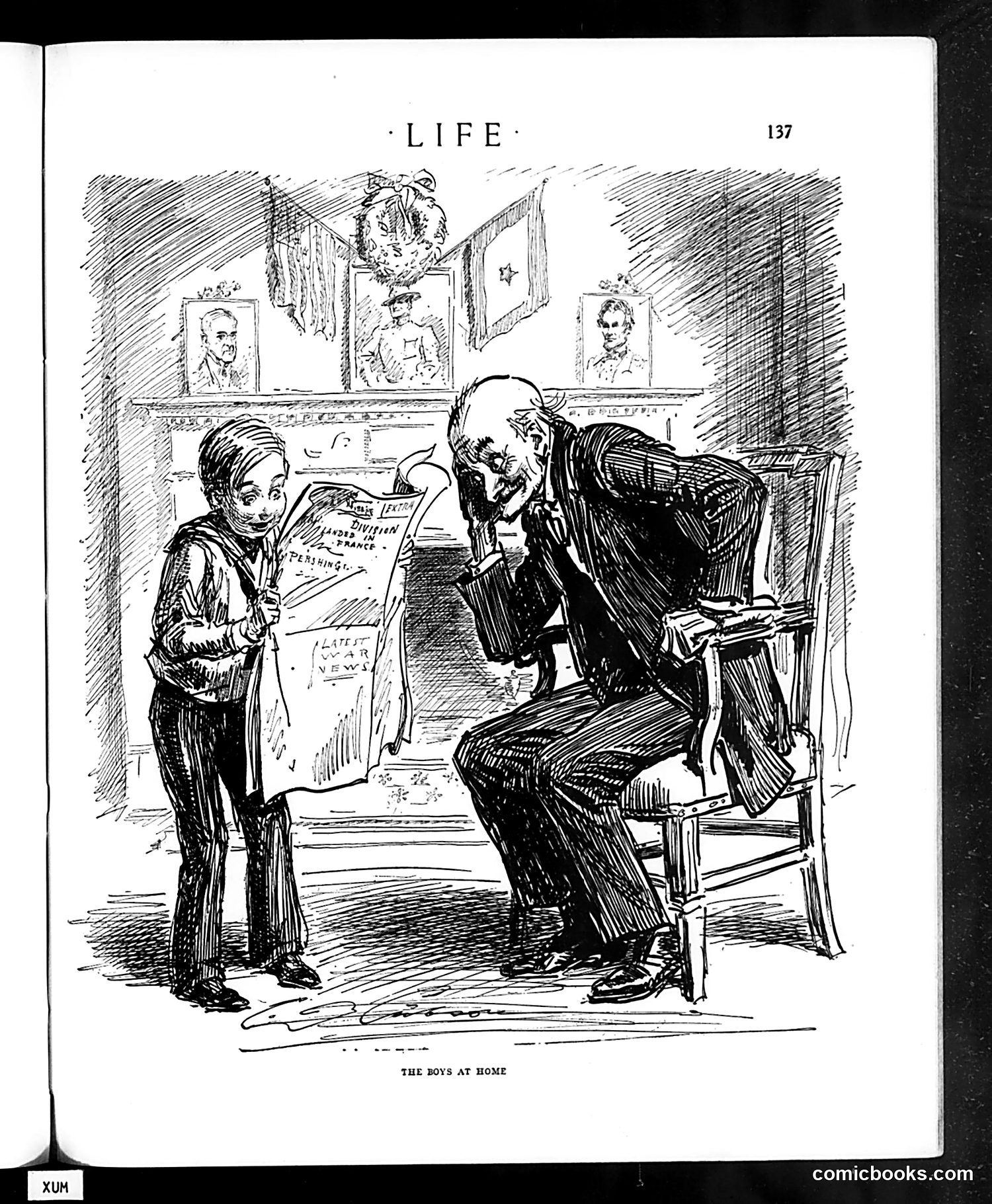
This cartoon depicts a domestic scene with a man seated in a chair examining what appears to be a document or ledger, while a young boy stands beside him holding papers. Three framed portraits hang on the wall behind them, suggesting family or notable figures. The satire likely comments on domestic financial management or parental authority—the man's scrutinizing expression and the boy's presentation of documents suggest an accounting or disciplinary interaction. The formal portraits above may reference propriety or respectability the household wishes to maintain. Without additional context or legible text on the document, the specific political or social reference remains unclear, though it appears to mock either paternal oversight of household accounts or a child's attempt at explaining financial matters to an authority figure.
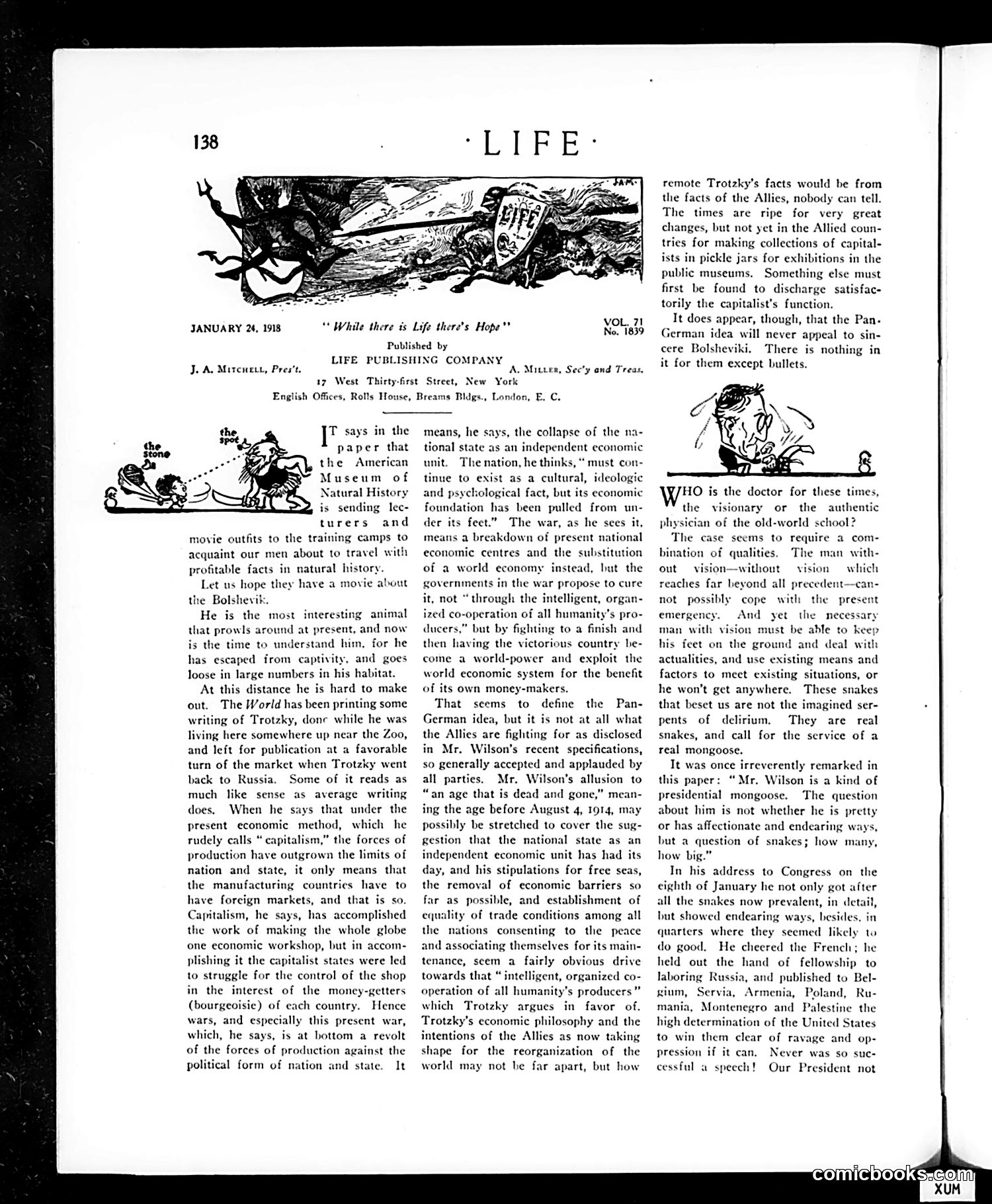
This editorial cartoon and accompanying article satirize **Leon Trotsky**, the Russian Bolshevik revolutionary. The cartoon depicts him as a dangerous animal escaped from captivity—referencing his recent escape from Russia after the Bolshevik Revolution (October 1917). The article acknowledges that Trotsky's economic critique of capitalism contains *some* logical points: that industrial production has outgrown individual nation-states, requiring global economic cooperation. However, the satire's bite lies in the sharp distinction drawn between Trotsky's *theory* and Allied *practice*. The author notes that President Wilson's recent peace proposals (the Fourteen Points, January 1918) accidentally align with Trotsky's vision of international economic cooperation—but the Allies fight for entirely different reasons and will implement it differently. The joke: these bitter enemies' stated goals coincidentally overlap, yet their actual intentions remain worlds apart. The "hope" in the title thus carries dark irony: ideological compatibility won't prevent conflict.
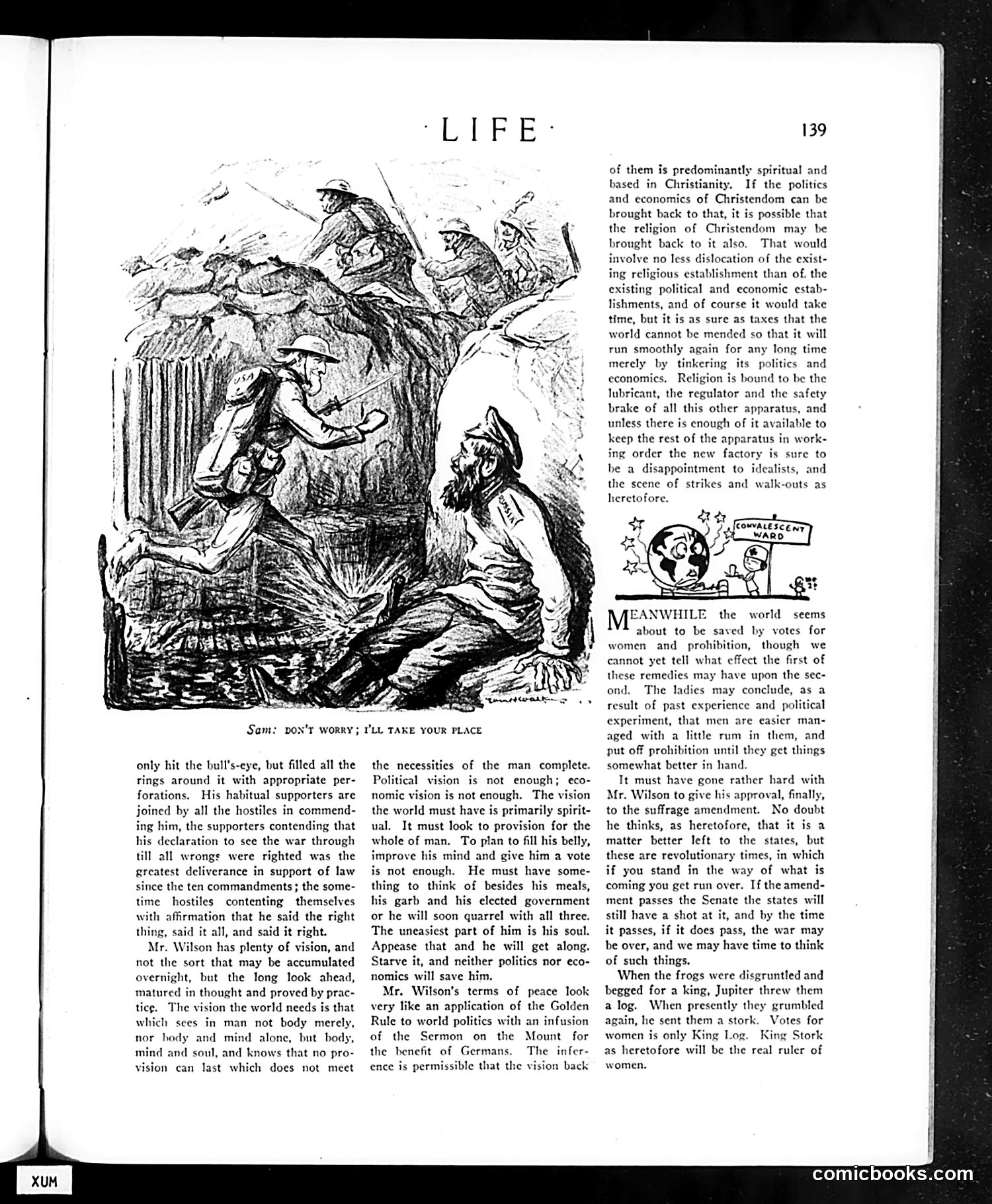
The main cartoon depicts a figure labeled "Sam" offering to take someone's place, likely referencing President Wilson's war leadership during World War I. The accompanying text praises Wilson's vision as spiritual and Christian-based, contrasting it with mere political or economic solutions. The secondary cartoon (small inset) uses Aesop's fable: frogs requesting a king receive first a log, then a stork. This satirizes contemporary hopes for women's suffrage and prohibition as simplistic "solutions." The text suggests women voters might prove easier to "manage with rum" and questions whether these reforms will actually improve society. The overall satire targets naive faith in quick political fixes—whether Wilson's peace terms or women's voting rights—arguing that spiritual/moral renewal, not procedural changes, solves deeper societal problems. The piece reflects skepticism about progressive reforms during the WWI era.
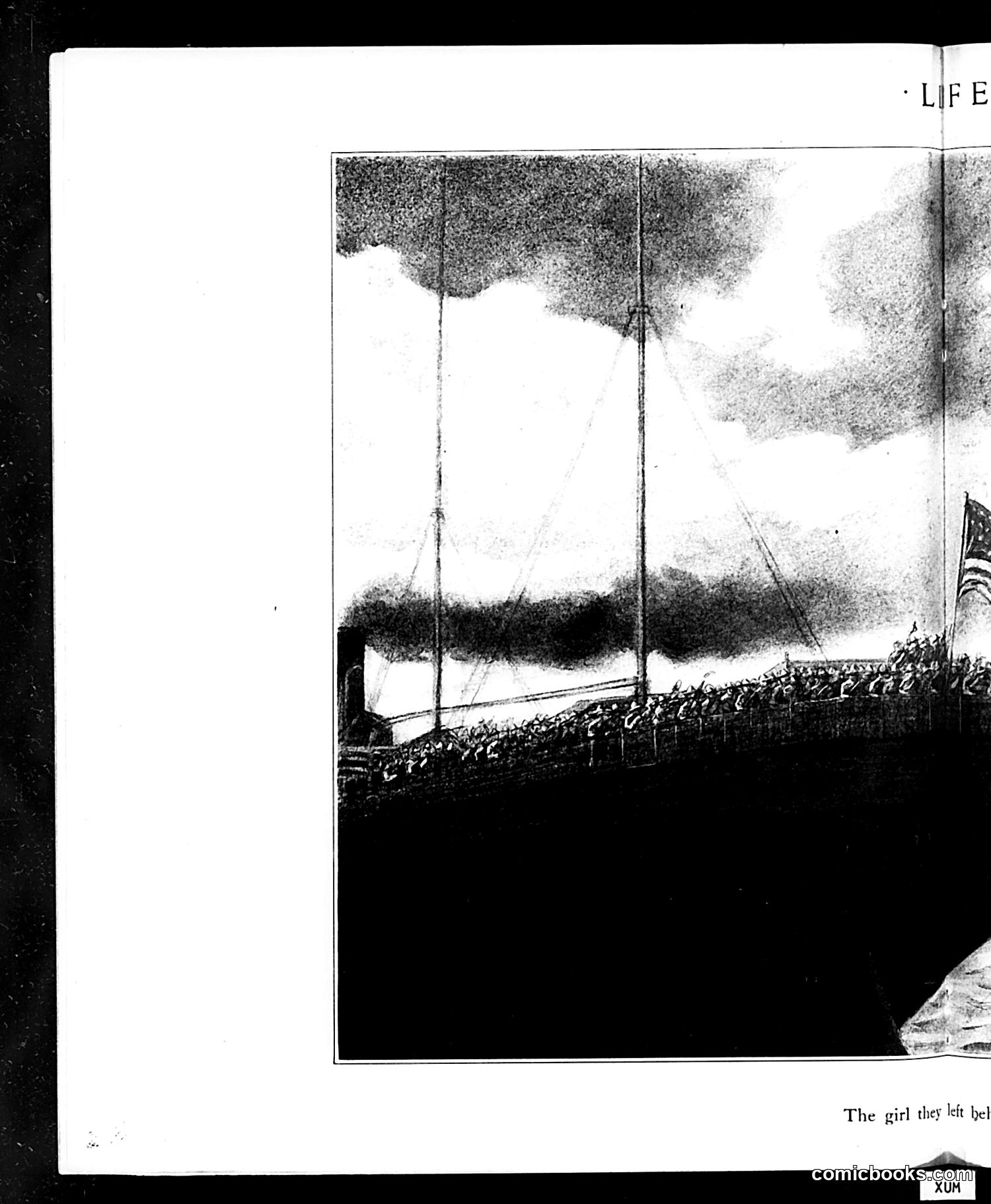
This page shows a dramatic illustration of what appears to be a large naval vessel with prominent smokestacks, surrounded by crowds of people along a dock or waterfront. An American flag is visible on the right. The image quality and composition suggest this depicts a significant public event—likely a ship launch, naval review, or similar maritime spectacle that drew crowds. The partial caption at bottom reads "The girl they left beh[ind]," suggesting a narrative about separation during wartime or military service. Without the complete text or date visible, the exact historical reference remains unclear, though the style and subject matter indicate this relates to early 20th-century American military or maritime affairs presented with satirical commentary typical of *Life* magazine's editorial approach.
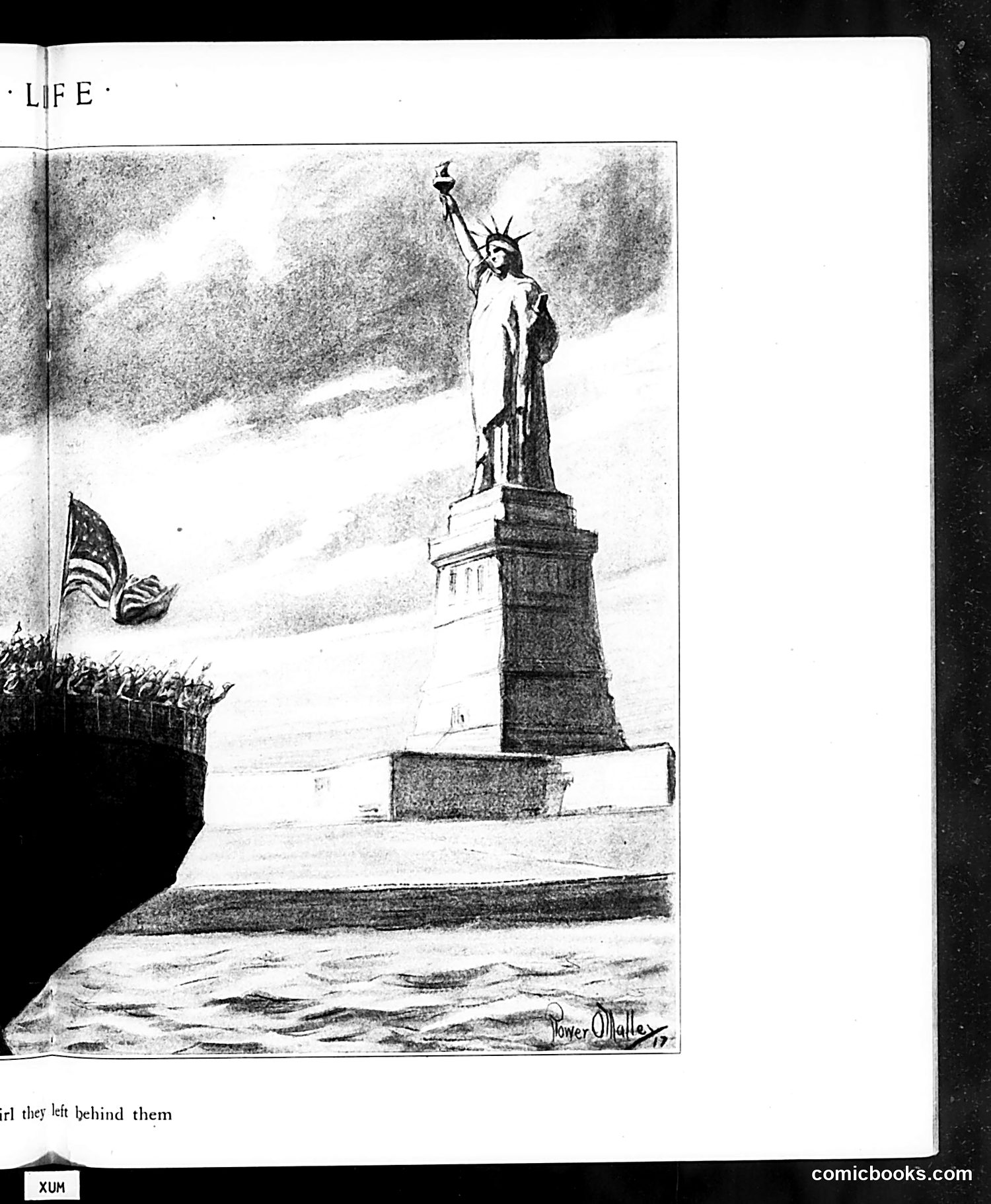
This page shows an illustration of the Statue of Liberty standing on her pedestal, with an American flag visible on a cliff or fortification to the left. The drawing is signed by "Cesare Viola" (or similar). The visible OCR text "irl they left behind them" appears incomplete and unclear in context. Without the full caption or surrounding article text, the cartoon's specific satirical point is difficult to determine with certainty. The image could reference American immigration, departure, or abandonment themes—common satirical subjects in *Life* magazine. However, I cannot confidently identify what specific historical event, political situation, or social commentary this addresses without more complete textual context or a visible date.
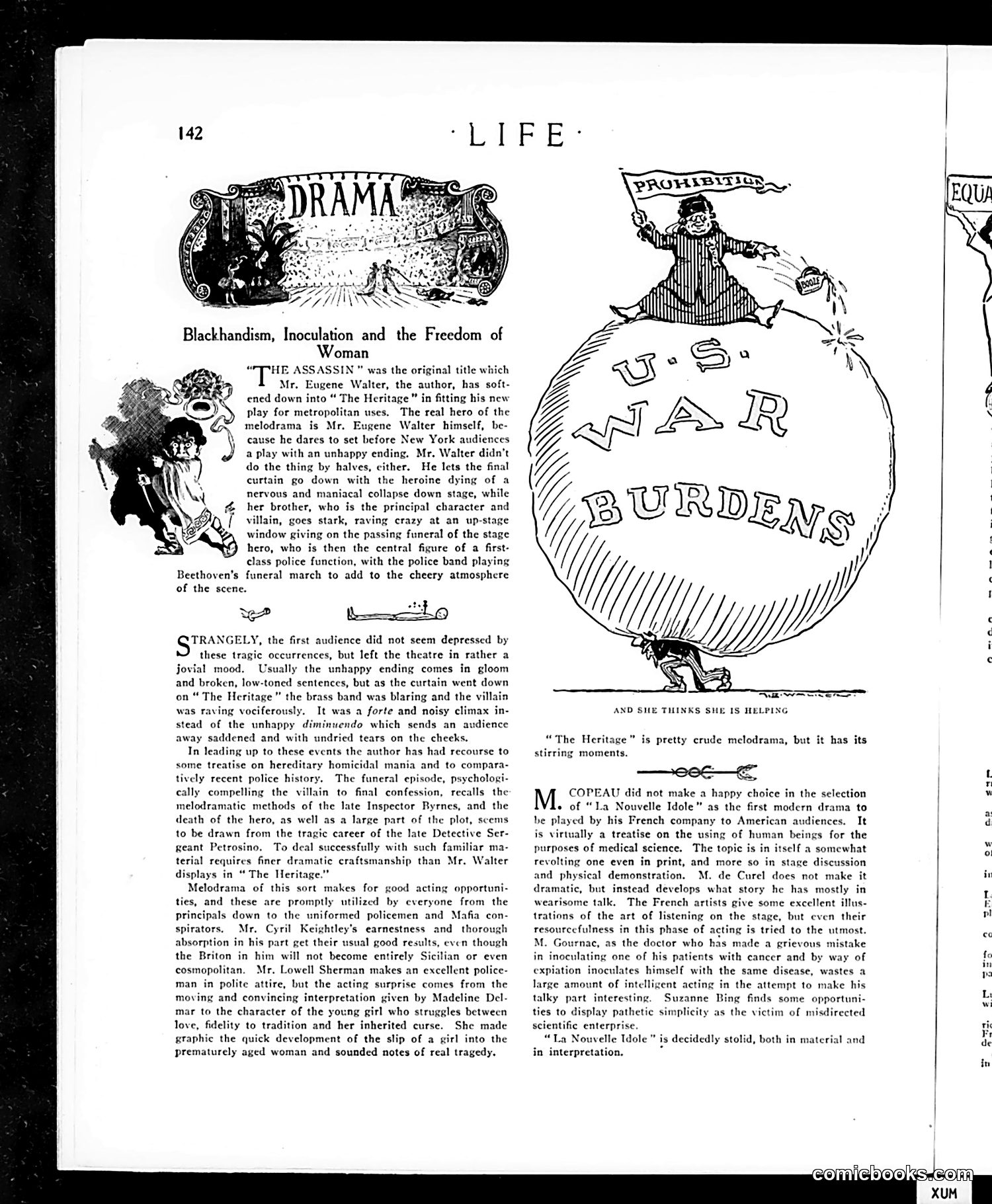
This page reviews theatrical productions, focusing on Eugene Walter's play "The Heritage" (originally titled "The Assassin"). The review discusses the melodrama's dark plot involving hereditary homicidal mania, Mafia conspirators, and a tragic ending where the heroine dies on stage while a villain goes mad—climaxing with a police funeral march rather than traditional tearful denouement. The satirical cartoon depicts Uncle Sam (identifiable by his top hat and striped clothing) sitting atop a large sphere labeled "U.S. WAR BURDENS," holding a "PROHIBITION" banner. A small figure beneath pushes the burden upward, captioned "AND SHE THINKS SHE IS HELPING." This appears to satirize how Prohibition—likely supported by women's reform movements—adds to America's governmental and social burdens rather than solving problems. The page also briefly mentions a French play "La Nouvelle Idole" that the reviewer finds tediously focused on medical ethics discussions rather than drama.
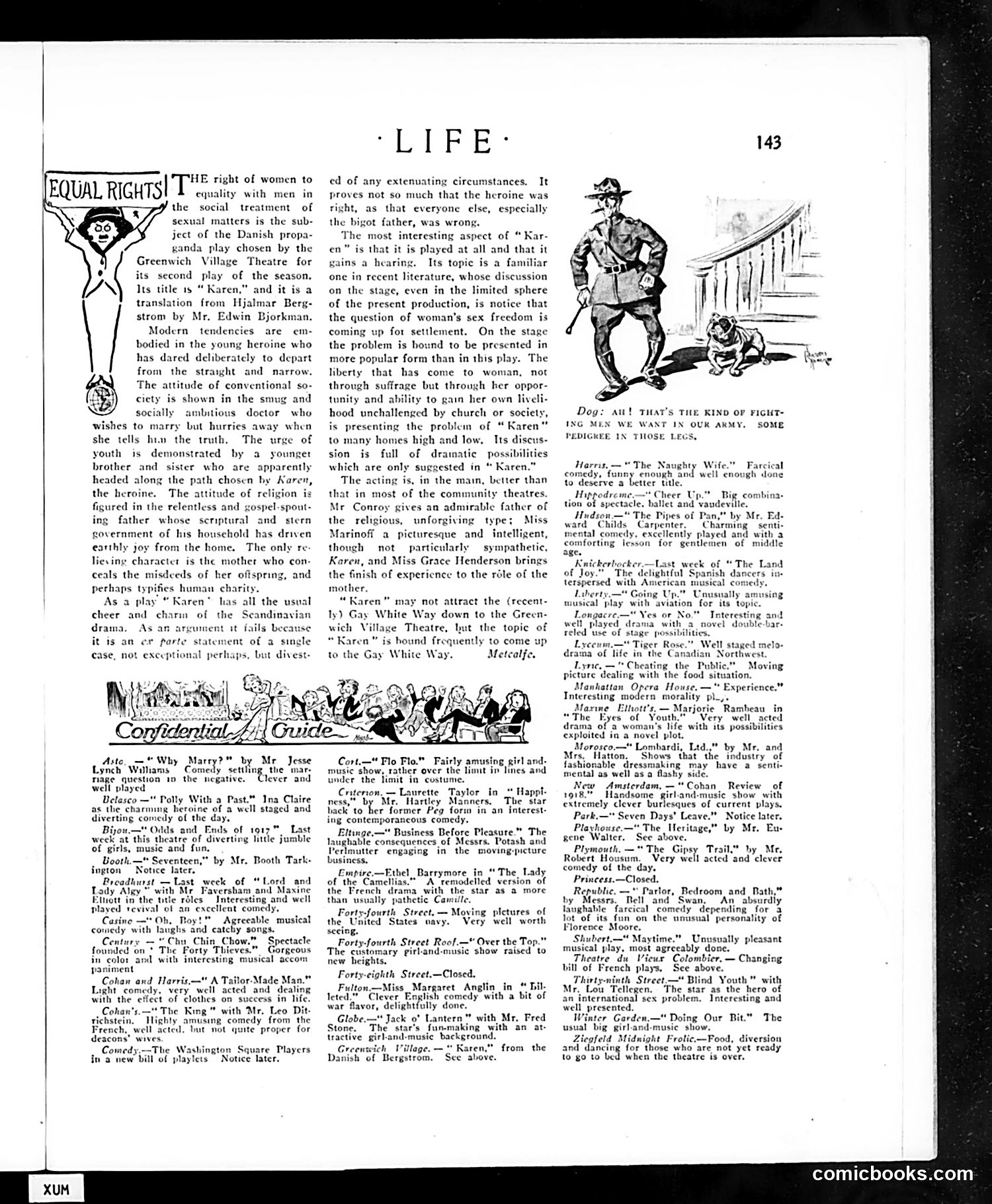
This page analyzes a Danish play called "Karen," performed at Greenwich Village Theatre. The title cartoon, "Equal Rights," depicts a woman figure asserting women's rights—a reference to early 20th-century feminism and suffrage movements. The play concerns a young woman who defies social convention by living unmarried. The review examines how the drama presents competing social forces: the rigid, religiously authoritarian father (representing conservative society), the pragmatic doctor (social hypocrisy), and the sympathetic mother (human charity). The critic argues "Karen" matters not because it validates the heroine's choices, but because it signals that women's economic independence—their ability to earn livelihood outside church/societal control—is forcing society to reckon with female sexual autonomy and marriage rights. The page notes this "modern tendency" will inevitably move from bohemian Greenwich Village theater to mainstream Broadway ("the Gay White Way"). This reflects 1910s debates over women's independence, sexual morality, and marriage—issues gaining theatrical and social urgency as women entered the workforce.
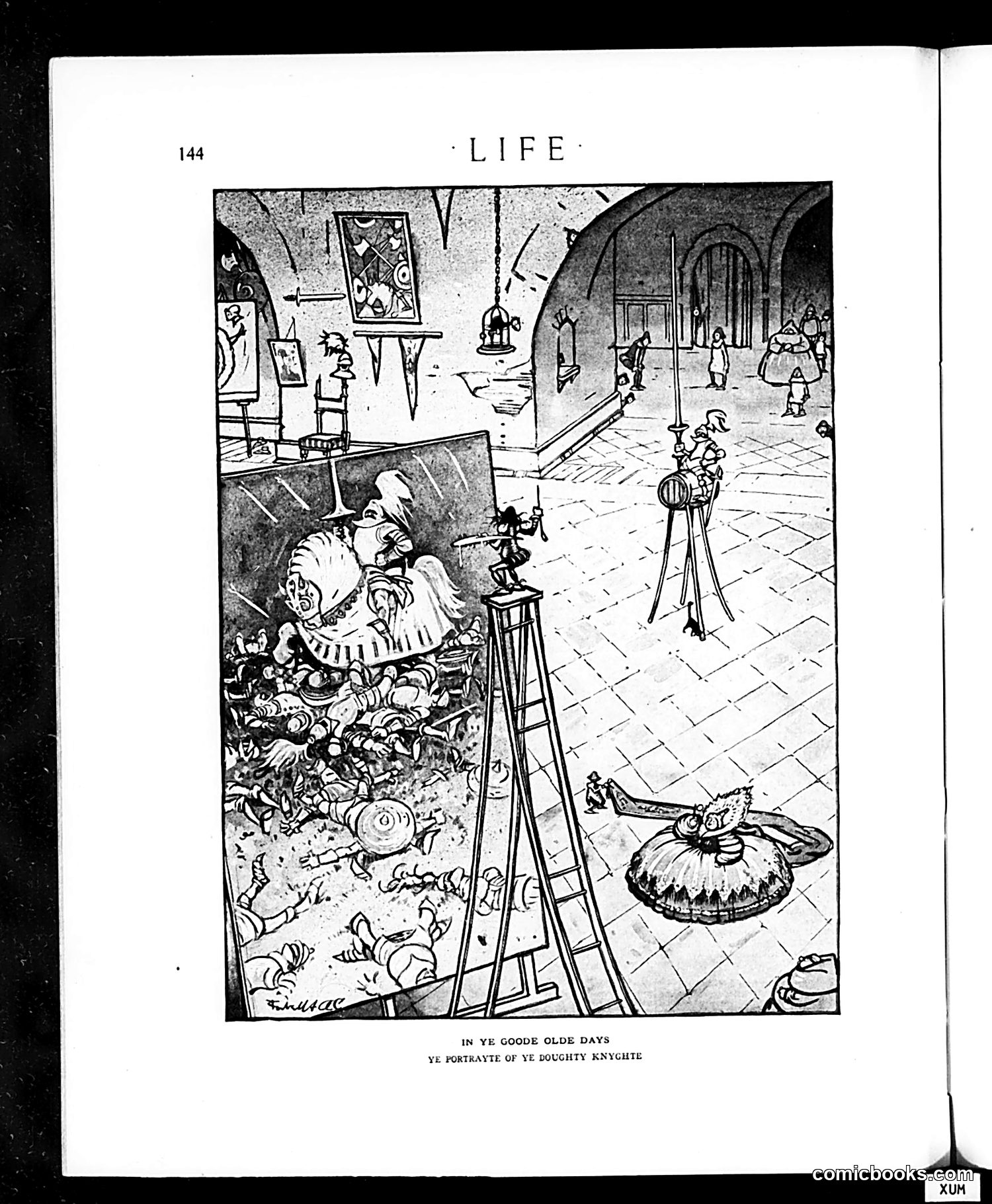
This satirical cartoon depicts "ye goode olde days" of chivalry through deliberate anachronism and absurdist humor. The title promises a portrait of a "doughty knight" (brave warrior), but instead shows a knight in armor lounging indolently on a couch surrounded by luxuries—cushions, food, and entertainment—while tiny figures attend to him in a grand hall. The joke relies on contrasting the idealized medieval knight (noble, active, valorous) with this lazy, pampered reality. The deliberately archaic spelling ("ye goode olde") and pseudo-medieval language mock nostalgic romanticism about the past. The tiny scale of servants emphasizes the knight's self-indulgent excess. This appears to satirize either contemporary nostalgia for "better times" or wealthy idleness disguised as gentility—a common Life magazine target.
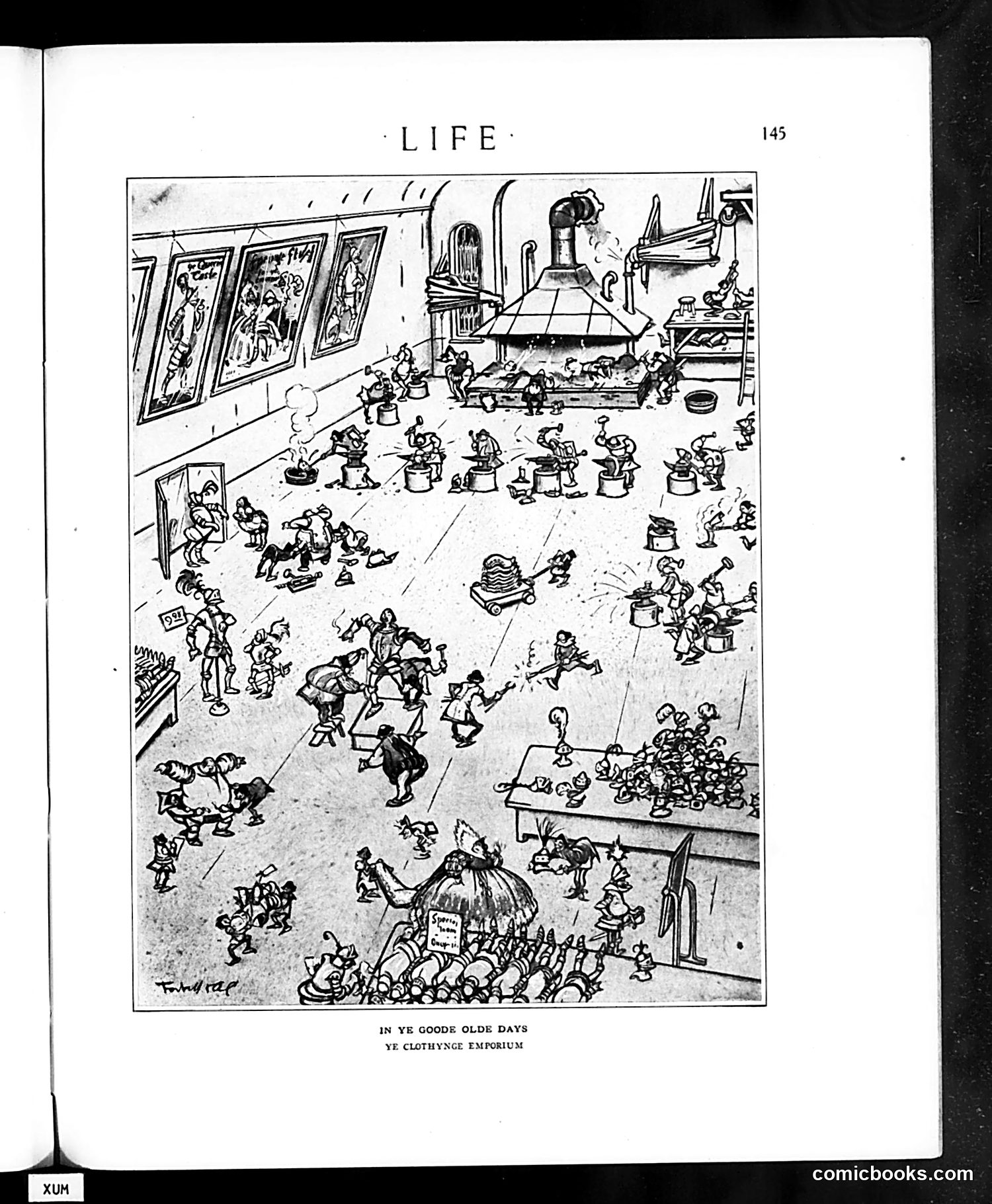
This is a humorous illustration satirizing a clothing store ("emporium") from "ye goode olde days"—a nostalgic reference to an idealized past. The cartoon depicts chaos: numerous tiny figures swarm throughout an interior space, some fighting, some conducting business, others appearing to steal or cause mayhem. A large umbrella or parasol dominates the lower portion, and various clothing items are visible. The satire likely mocks the romanticization of "the good old days" by showing that commercial establishments were actually disorderly, crowded, and chaotic—contradicting the myth of simpler, more orderly times. The exaggerated crowd and bedlam suggest that shopping has always been frenzied and unpleasant, despite nostalgic claims otherwise. This is a common Life magazine approach: deflating sentimental mythology through absurdist visual humor.
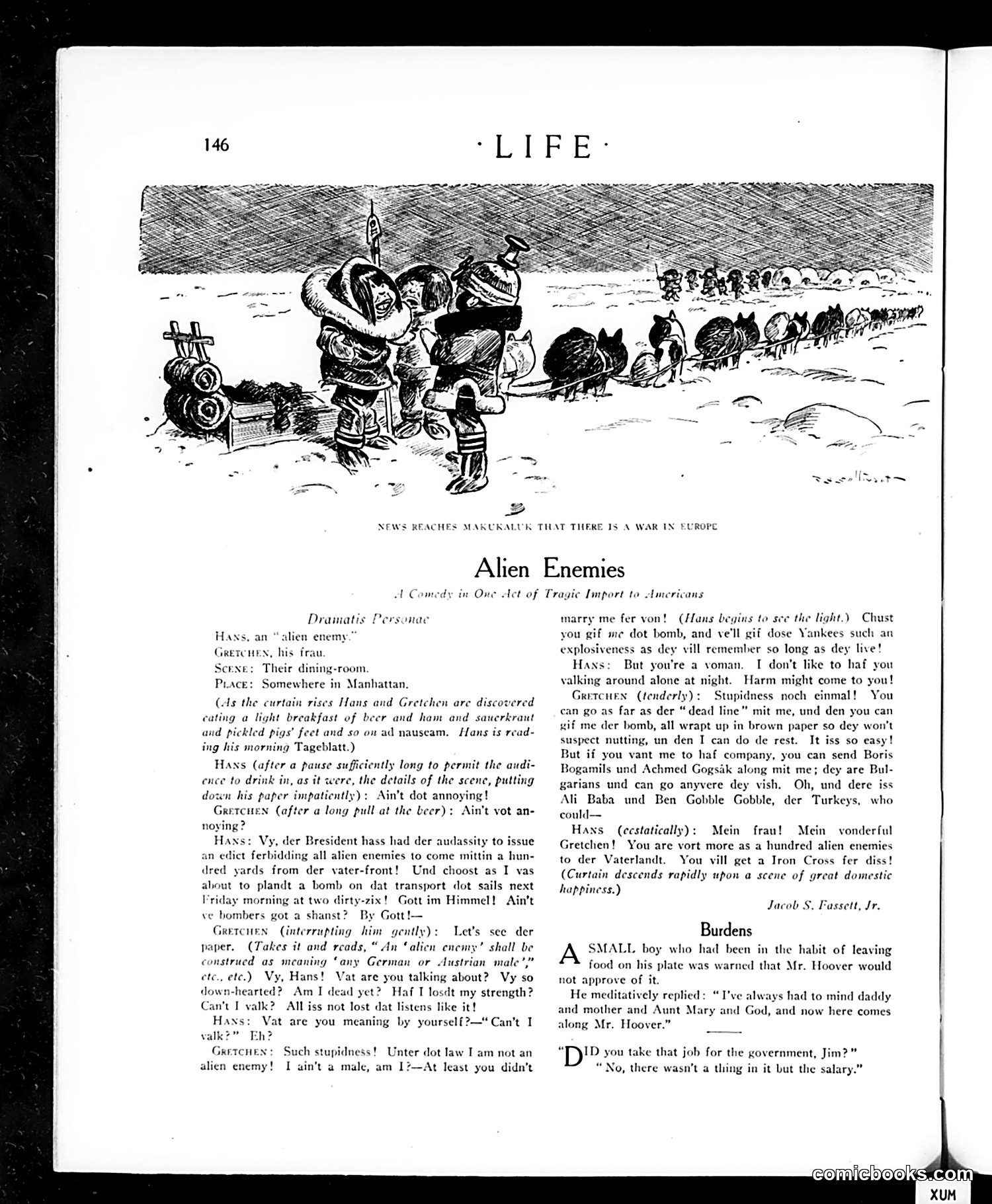
This one-act play satirizes World War I-era paranoia about German immigrants in America. The joke targets both the government's overzealous restrictions AND anti-German stereotypes. **The setup:** Hans, a German immigrant ("alien enemy"), laments that President Wilson's edict forbids aliens from approaching the waterfront—ruining his plan to plant a bomb on a departing transport ship. **The punchline:** His wife Gretchen points out that *she* isn't classified as an "alien enemy" because the law specifies "males." She volunteers to deliver the bomb herself, and even suggests enlisting other "neutral" allies (Bulgarians, Turks). Hans celebrates her patriotic willingness. **The satire's target:** This caricatures anti-German hysteria by depicting German-Americans as would-be saboteurs, while mocking the government's crude legal definitions that might accidentally exclude actual threats. The exaggerated dialect and domestic scene reinforce period stereotypes. The cartoon above shows news of European war reaching remote settlements, setting the comedic context for homefront anxieties.
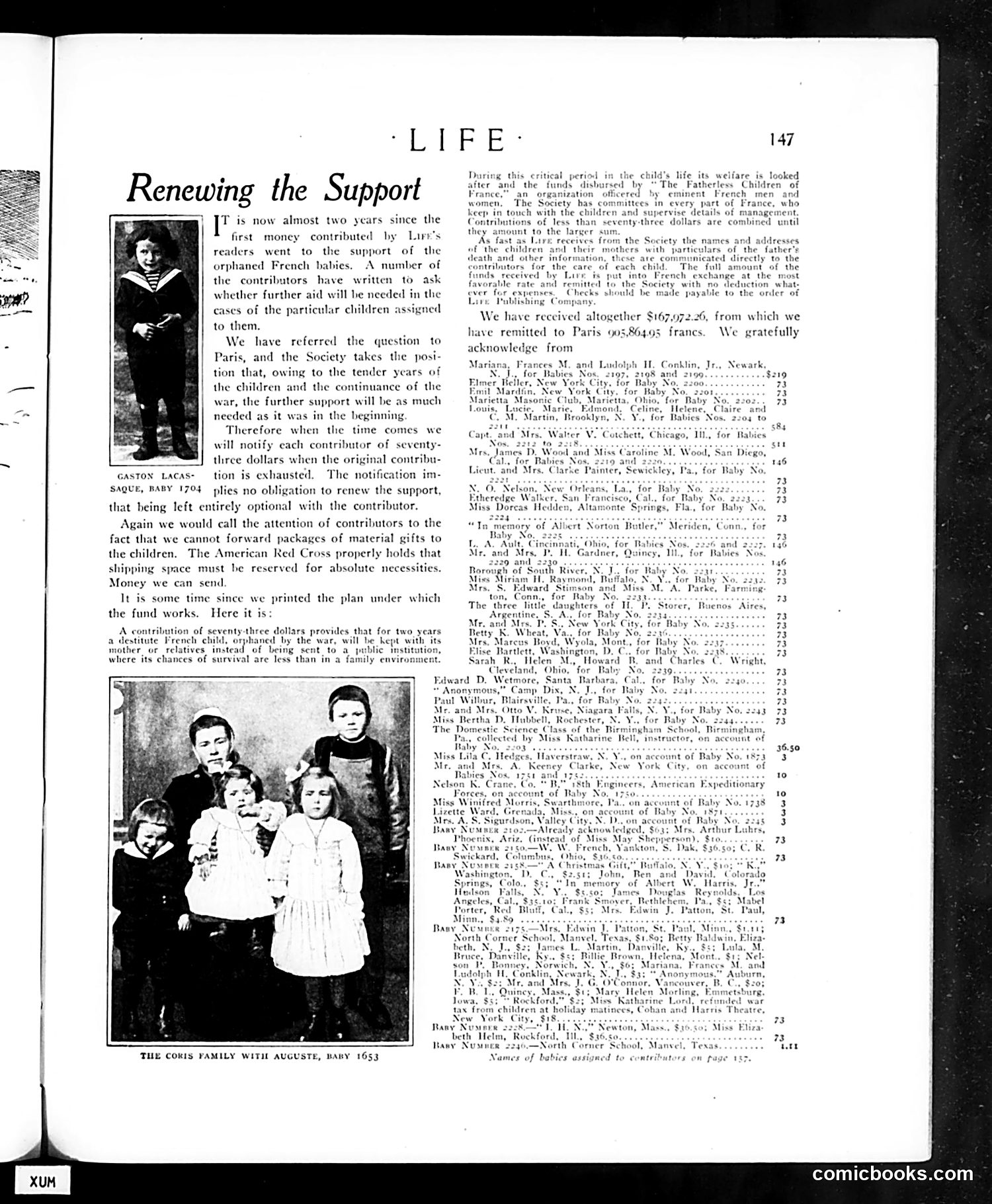
This page documents **Life magazine's charitable fundraising campaign for French war orphans** during World War I. The text explains that readers contributed $167,972.26 to support children orphaned by the war through an organization called "The Fatherless Children of France." The two photographs show **actual beneficiary children**: Gaston Lacasque (top) and the Cokis family with Auguste (bottom), representing the real children supported by American donors. The bulk of the page lists **individual contributors and their donations** (typically $73—the standard amount to support one child for two years). The campaign appeals to donors to renew support, emphasizing that children still need assistance and that contributions directly support keeping orphans in family care rather than public institutions. **The satire/advocacy here is implicit**: by publishing donor names and showing photographs of actual children, Life validates charitable giving while creating social pressure through publicity—a common progressive-era fundraising tactic.
This is a satirical story about an overly complicated home heating system called the "Jiggerjag." A salesman convinces Mr. Caperton to install this supposedly revolutionary automatic furnace, promising it will maintain perfect 70-degree temperatures with minimal effort—just winding a clock nightly. The joke is that the machine is a disaster. Once installed, it malfunctions catastrophically: first leaking coal gas into the house, then overheating it to dangerous levels. The salesman's promises of "no supervision needed" and "foolproof" automation prove false, and Caperton can't even figure out how to turn it off. The satire mocks early-20th-century enthusiasm for technological solutions and salesmen's exaggerated claims. It suggests that overly complex machines requiring no user understanding are inherently unreliable—a timeless critique of gadgetry that remains relatable today.
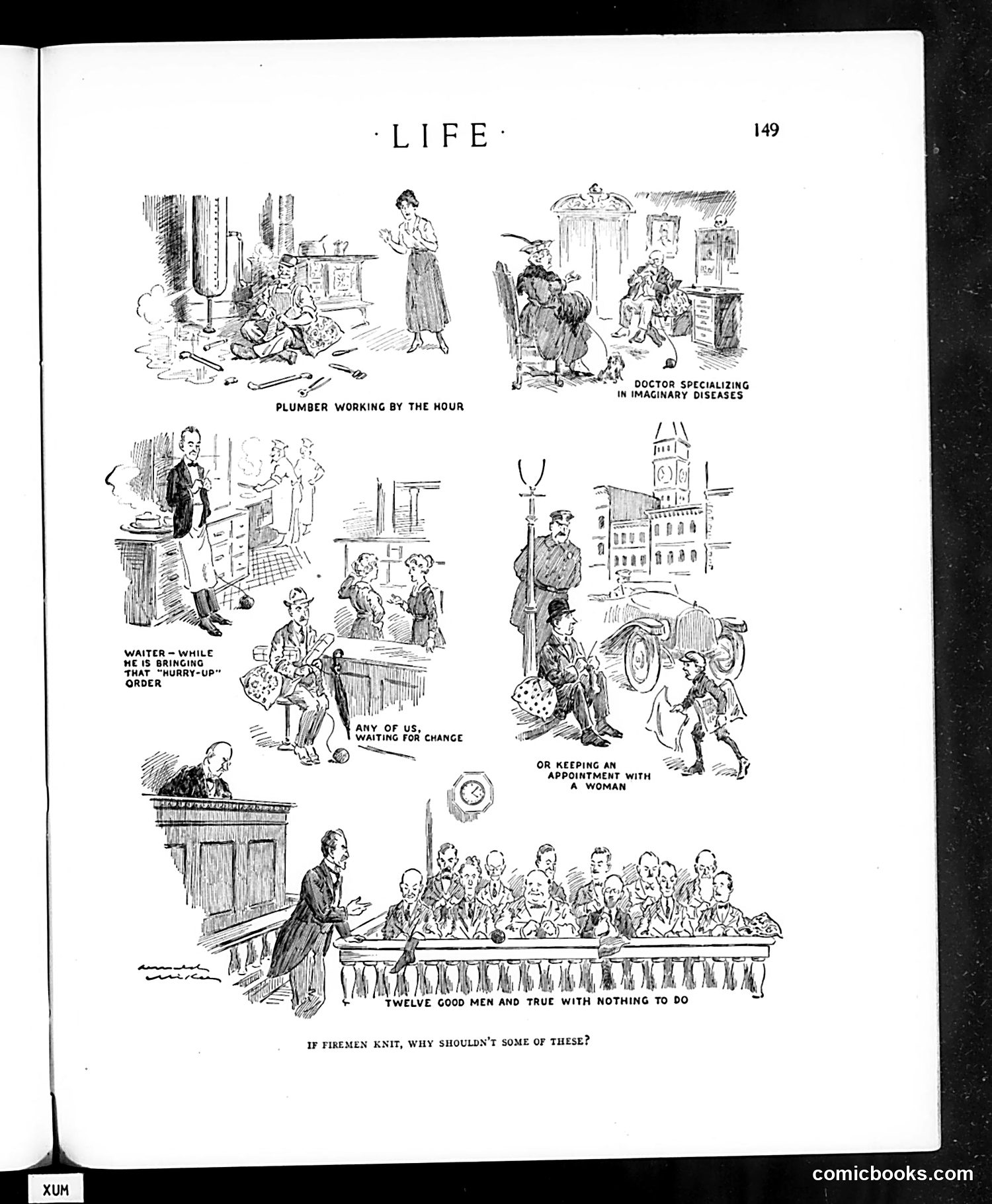
This page presents six satirical vignettes mocking various professions and social situations circa early 20th century: 1. **Plumber billing by the hour** - critiques inflated labor costs 2. **Fake doctor** - ridicules physicians treating non-existent ailments 3. **Hurried waiter** - satirizes poor service 4. **People waiting for change** - mocks bureaucratic delays 5. **Late appointment with a woman** - stereotypes female punctuality 6. **Bottom panel**: "Twelve good men and true with nothing to do" beneath jurors, with the headline "If firemen knit, why shouldn't some of these?" - suggests idle jurors should be productively occupied, referencing firefighters' knitting during downtime The humor relies on period stereotypes about professions, gender, and social inefficiency, presenting everyday frustrations as commentary on institutional and professional absurdities.
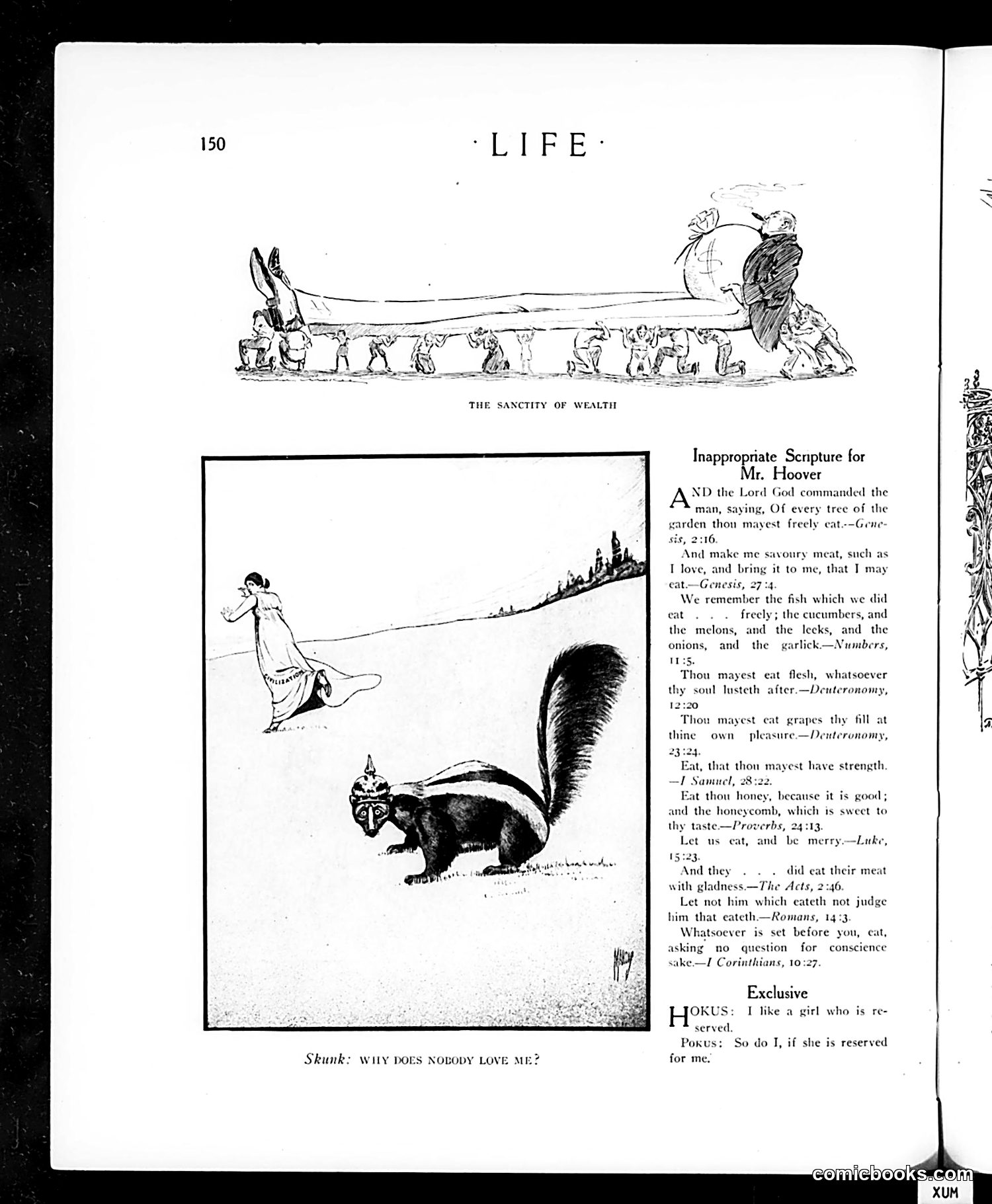
This page satirizes Herbert Hoover's economic philosophy during the Great Depression. The top cartoon shows wealthy figures stretching a massive rope while poor people underneath struggle to hold it up—illustrating how wealth concentration depends on labor exploitation. The skunk cartoon ("Why does nobody love me?") represents the unpopular wealthy, scorned by society for their selfishness. The right-side text mockingly presents Biblical passages about eating and enjoying food to Hoover, sarcastically suggesting these scriptures justify unlimited consumption by the rich while others starve. The title "Inappropriate Scripture for Mr. Hoover" criticizes his belief that wealth should be left untouched by government intervention—a position Life's editors viewed as morally indefensible during widespread hunger. The "Exclusive" dialogue jokes that the wealthy hoard resources for themselves alone, withholding from others.
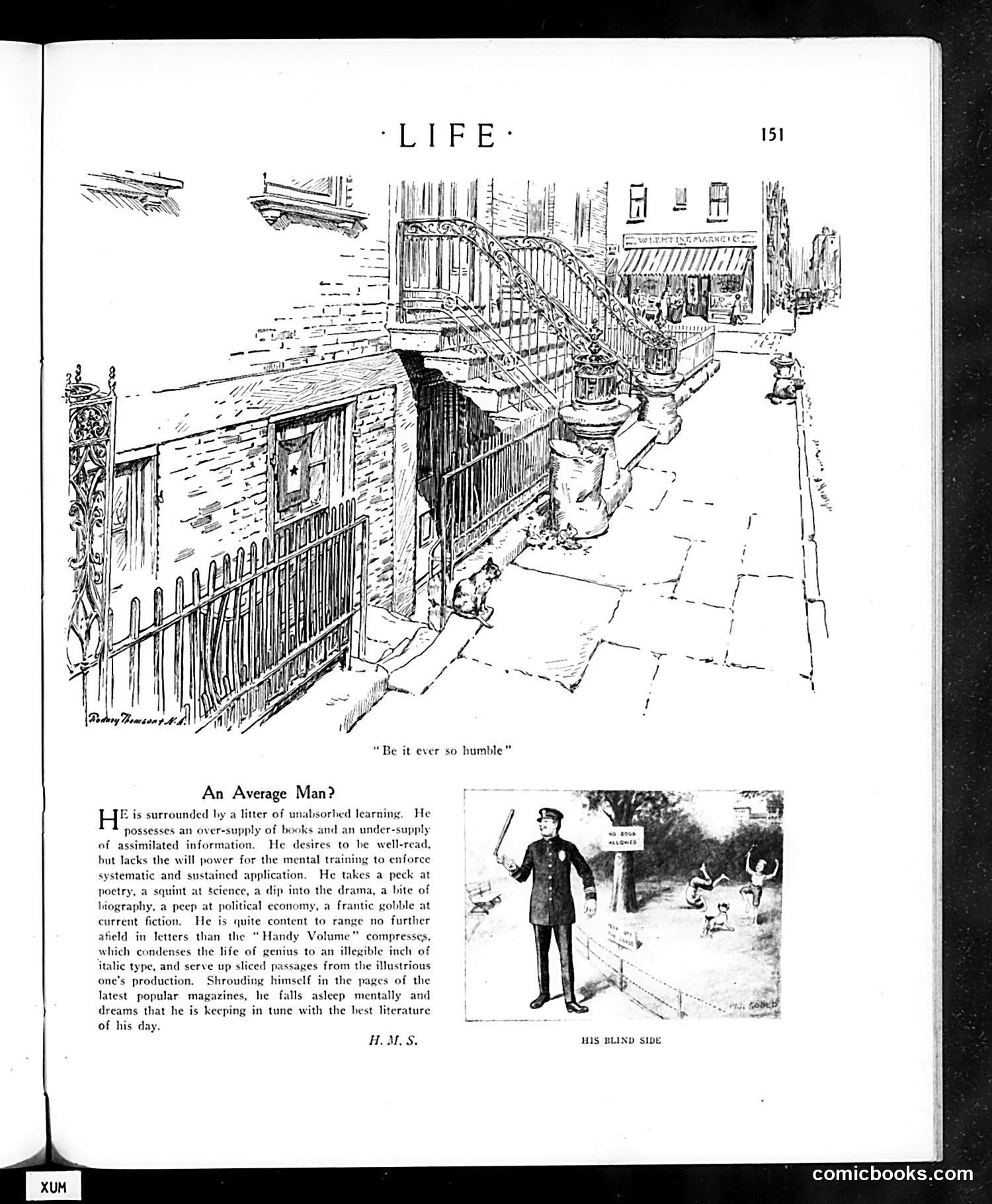
The top illustration satirizes pretentious middle-class aspiration: a well-dressed man enters an ornate building (likely a library or cultural institution), captioned "Be it ever so humble"—ironically inverting the humble-home sentiment from the popular song. The accompanying essay "An Average Man?" mocks the superficially educated person who surrounds himself with unread books and intellectual trappings but lacks genuine learning. He dabbles in poetry, science, and literature without sustained engagement, relying on condensed "Handy Volume" summaries and popular magazines. The satire targets his self-deception: he falls asleep while reading yet believes himself cultured and "keeping in tune with the best literature." The photograph below, labeled "His Blind Side," appears to show a man with a cane, likely illustrating his intellectual or moral blindness—he cannot perceive his own pretension or shallow education. The overall message criticizes early 20th-century middle-class cultural posturing and the gap between the appearance of refinement and actual intellectual substance.
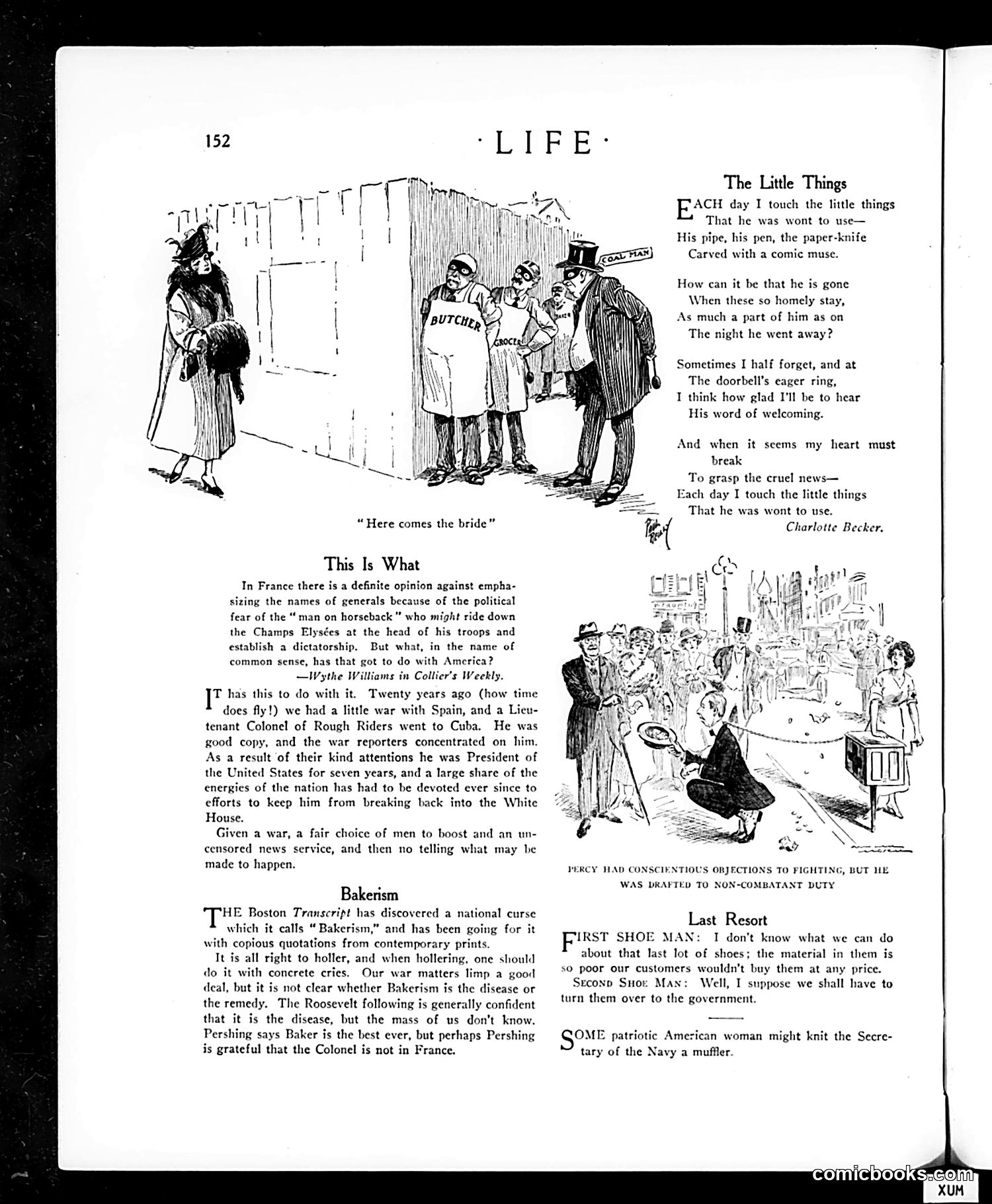
This page contains three distinct pieces of commentary on American politics and World War I: **"This Is What"** attacks Theodore Roosevelt's political dominance. The article references his Spanish-American War fame (as a "Lieutenant Colonel of Rough Riders") leading to his presidency and subsequent influence. The satire warns that uncensored media coverage of military leaders during wartime can inadvertently create political strongmen—alluding to fears that Roosevelt might return to power. The France/dictatorship reference suggests anxiety about militaristic leadership. **"Bakerism"** critiques Newton Baker (likely Secretary of War), debating whether he's the disease or remedy for America's war effort. The tone suggests conflicting opinions about his competence. **The remaining content** includes a sentimental poem about lost loved ones (likely referencing WWI casualties), a cartoon about conscientious objectors drafted to non-combat duty, and a dark joke about shoe manufacturers pawning inferior products to the government—satirizing profiteering during wartime.
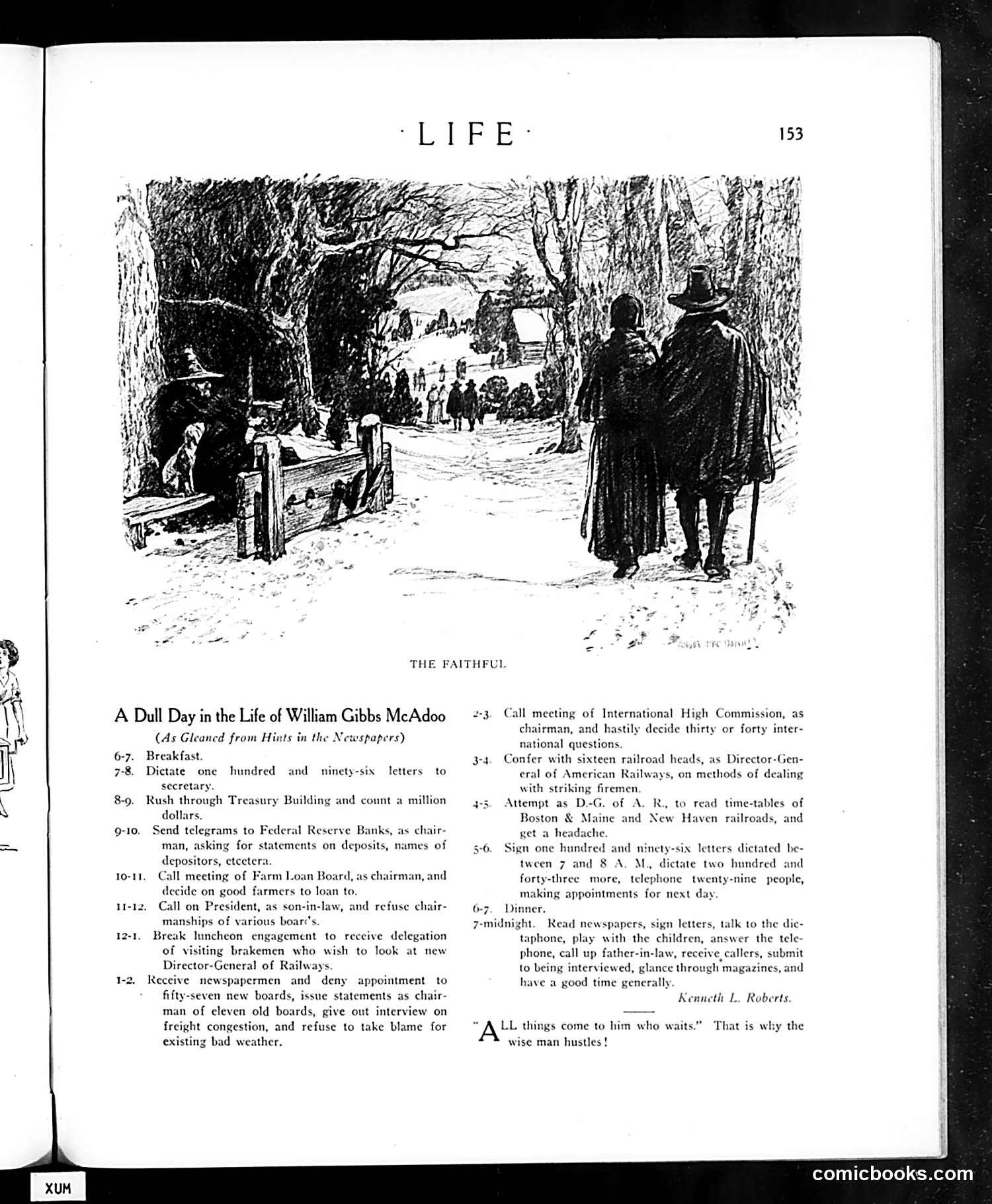
This is a satirical schedule mocking **William Gibbs McAdoo**, Secretary of the Treasury under Woodrow Wilson (and Wilson's son-in-law). The joke is that despite holding *multiple simultaneous leadership roles*—chairman of the Federal Reserve, Farm Loan Board, and International High Commission, plus Director-General of American Railways—his day is portrayed as exhaustingly bureaucratic busywork: counting money, dictating hundreds of letters, attending endless meetings, refusing board positions. The satire suggests McAdoo is absurdly overextended and his authority diluted across too many positions. References to "striking firemen" and "freight congestion" indicate labor unrest and transportation problems of the WWI era that he couldn't solve. The final irony—that a "dull day" of relentless, meaningless activity represents success—critiques administrative bloat and the illusion of executive productivity. The quote "All things come to him who waits" suggests McAdoo's power derived from proximity to the President rather than merit.
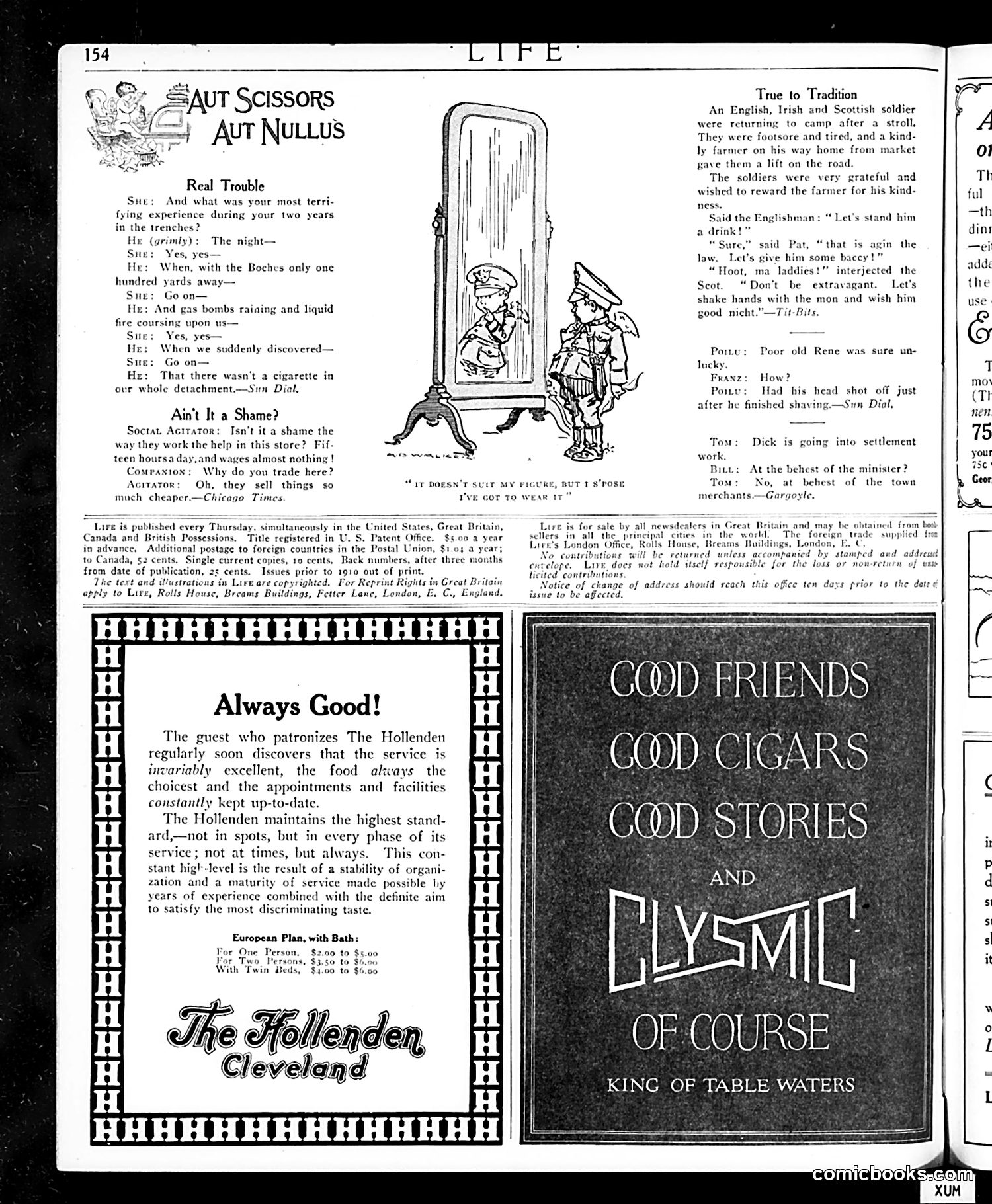
This page contains three satirical cartoons and humorous anecdotes typical of early 20th-century Life magazine: **"Real Trouble"** mocks soldiers' complaints about trenches. A soldier recounts horrifying WWI experiences—enemy proximity, gas bombs, liquid fire—but the ultimate "terror" was discovering no cigarettes in the detachment. The joke trivializes combat hardships by treating cigarette shortage as the worst ordeal. **"Ain't It a Shame?"** critiques hypocrisy. A social activist denounces a store's exploitative labor practices (15-hour days, minimal wages), yet patronizes the store because goods are cheaper. The joke exposes how moral outrage conflicts with consumer self-interest. **The final cartoon** shows a soldier in ill-fitting military clothing, captioning "It doesn't suit my figure, but I suppose I've got to wear it"—a visual gag about uniform discomfort and resigned acceptance. The page otherwise contains advertisements (The Hollenden hotel, Lysol cigars) and brief humorous anecdotes about soldiers and civilian life. The overall tone reflects WWI-era humor emphasizing soldiers' complaints, working-class ironies, and consumer culture contradictions.
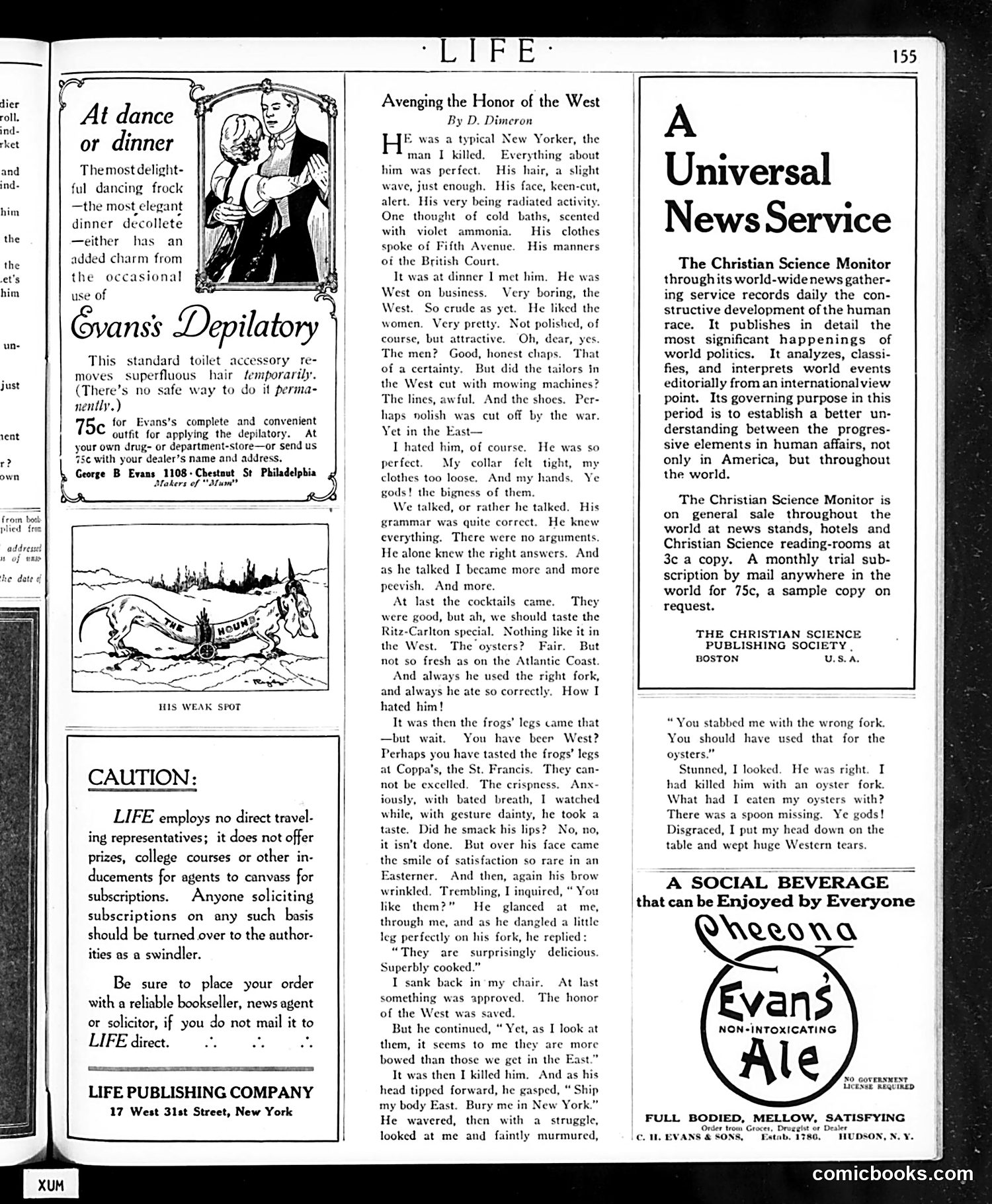
This short story satirizes the pretentious superiority of East Coast (New York) elites toward Westerners. The narrator, an Easterner, murders a visiting Western businessman over dinner—not from genuine offense, but from seething resentment at the man's effortless perfection and confidence. The joke is the narrator's absurd hypersensitivity: he's offended by the Westerner's correct manners, good clothes, and grammatical precision, viewing these as arrogant rather than admirable. The murder itself is triggered by the final insult—the Westerner's mild observation that Eastern frogs' legs seem slightly more "bowed" than Western ones. The satire mocks Eastern provincial vanity and defensive insecurity masquerading as refinement. The Easterner's jealous rage over minor social details reveals how hollow his cultural superiority actually is.
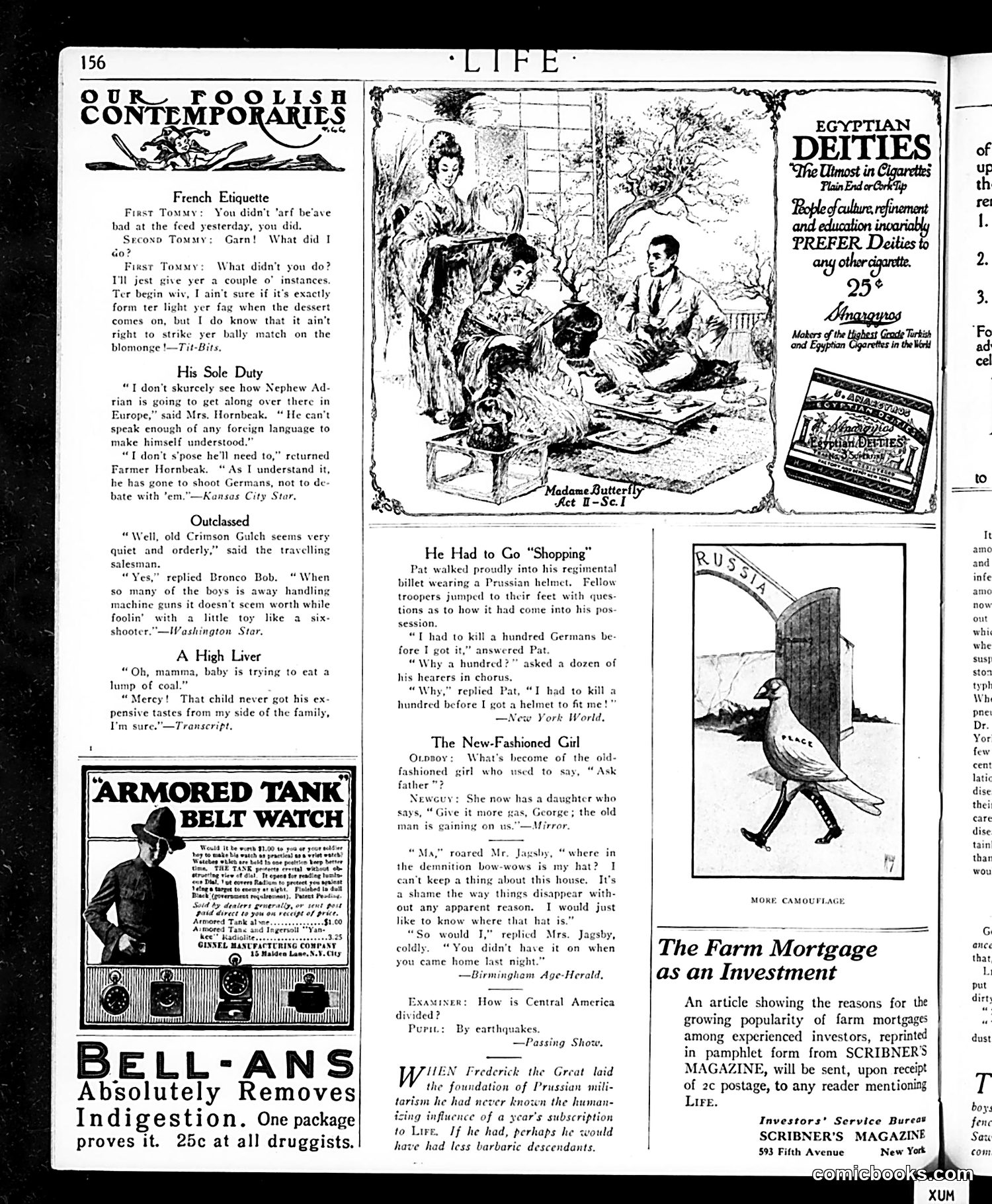
This page contains several brief satirical pieces typical of Life magazine's humor: **"Our Foolish Contemporaries"** presents short jokes mocking social behavior—British working-class men's table manners, a farmer's dismissal of language skills as irrelevant to soldiers, and similar observations. **"He Had to Go Shopping"** jokes about an Irish soldier (Pat) wearing a captured Prussian helmet, claiming he killed a hundred Germans to get one that fit. The humor plays on Irish stereotypes and the absurdity of war accounting. **"The New-Fashioned Girl"** satirizes changing gender roles—the modern woman now takes charge ("Give it more gas, George") rather than deferring to men, inverting traditional dynamics. The page also contains period advertisements (Egyptian Deities cigarettes, Armored Tank Belt Watch, Bell-Ans antacid) and a brief article about farm mortgages as investments. The humor relies on class stereotypes, gender role reversals, and Irish caricatures common to 1910s-era American satire.
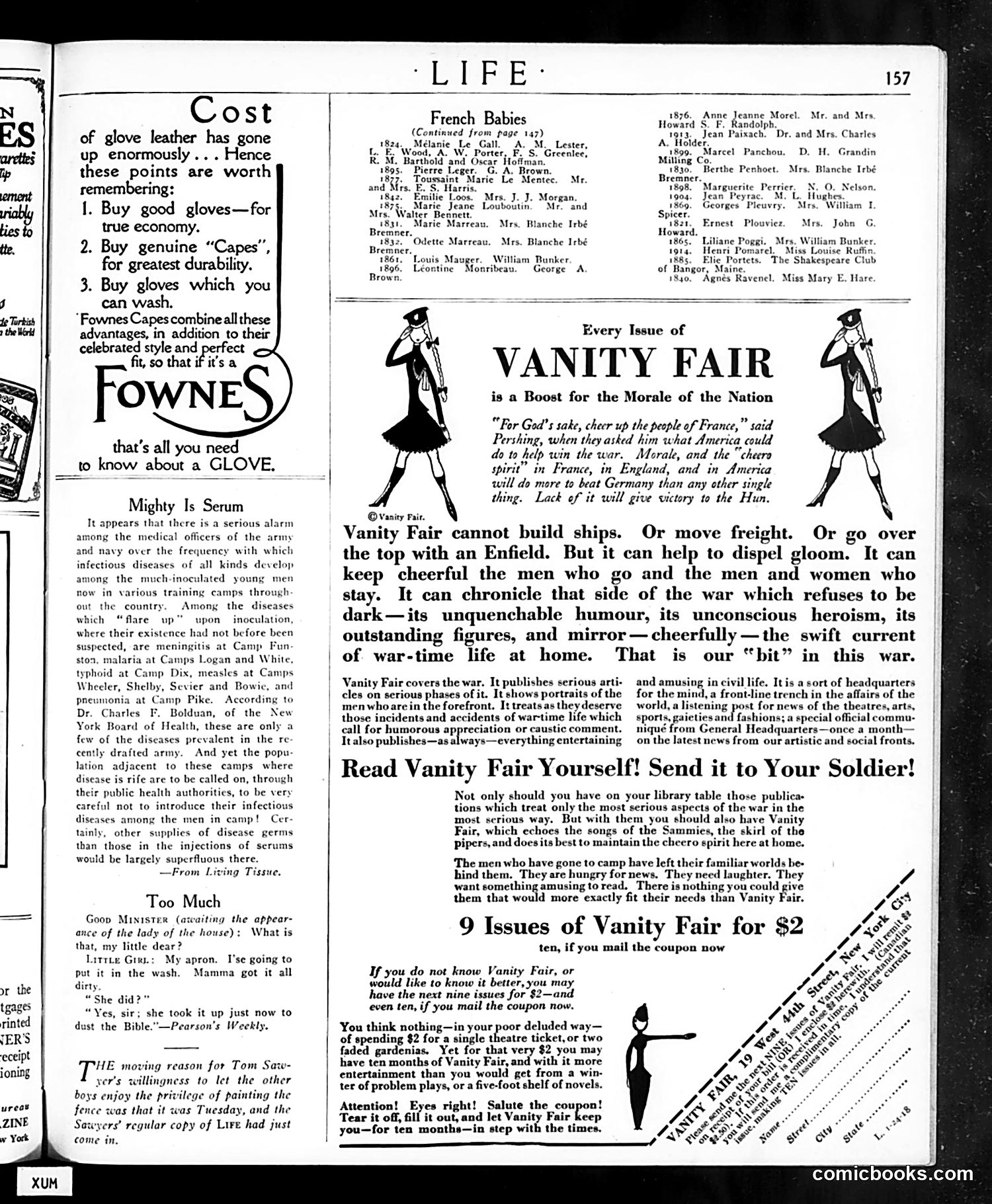
This page, dated during **World War I** (references to Pershing and the war effort date it to 1917-1918), contains two distinct elements: **Left side**: A **Fownes Gloves advertisement** offering practical buying advice—typical commercial content. **Right side**: A **propaganda piece for Vanity Fair magazine**, framed as a patriotic appeal. The text argues that Vanity Fair serves the war effort by maintaining civilian **morale**—described as essential to victory. It explicitly quotes General Pershing stating that keeping French and American spirits up matters as much as military hardware. The **political point**: This represents how American magazines positioned themselves as contributors to the war effort, not merely as entertainment. By publishing humor, theater news, and "cheerful" content, Vanity Fair claims to fight Germany as effectively as ships or ammunition. The repeated phrase "That is our 'bit' in this war" reflects the era's "home front" mentality, where civilians believed maintaining optimism was a patriotic duty. The page reveals **WWI-era attitudes**: morale as a weapon, magazines as propaganda tools, and entertainment as patriotic service.
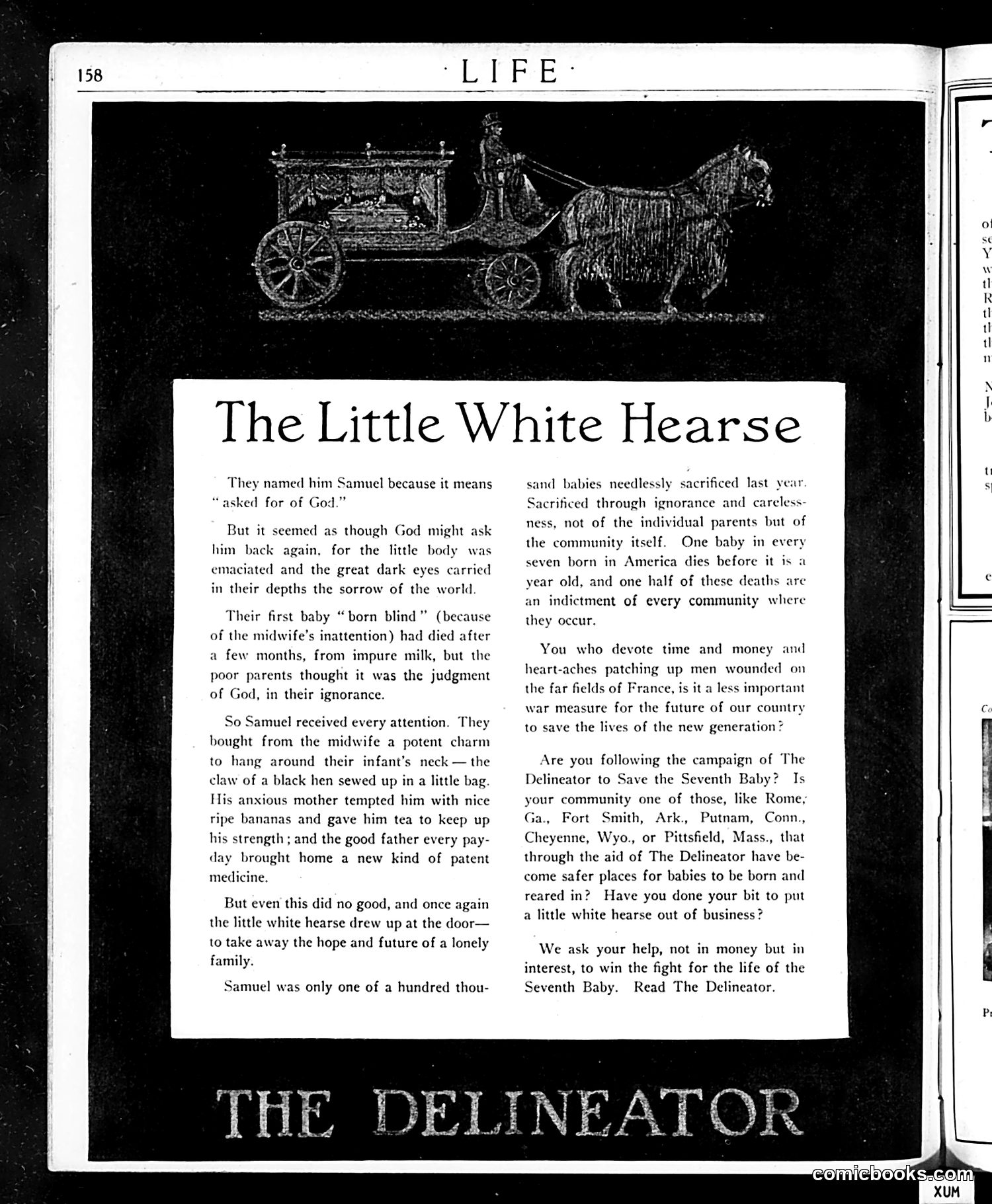
This is an advertisement for *The Delineator* magazine's public health campaign to reduce infant mortality. The piece uses the fictional case of "Samuel," a baby who dies despite his parents' loving efforts—including folk remedies (a charm from a midwife) and patent medicines—to illustrate how preventable deaths occur through community negligence rather than parental failure. The text argues that one in seven American babies dies before age one, making infant mortality a national crisis comparable to World War I casualties. The campaign references specific cities (Rome, Georgia; Fort Smith, Arkansas; Putnam, Connecticut; Pittsfield, Massachusetts) that supposedly achieved safer childbirth conditions through *The Delineator's* advocacy. The "little white hearse" is a literal symbol of child death. The appeal asks readers to support this progressive-era public health initiative through interest and awareness rather than donations—essentially urging them to champion better sanitation, medical care, and maternal education in their communities.
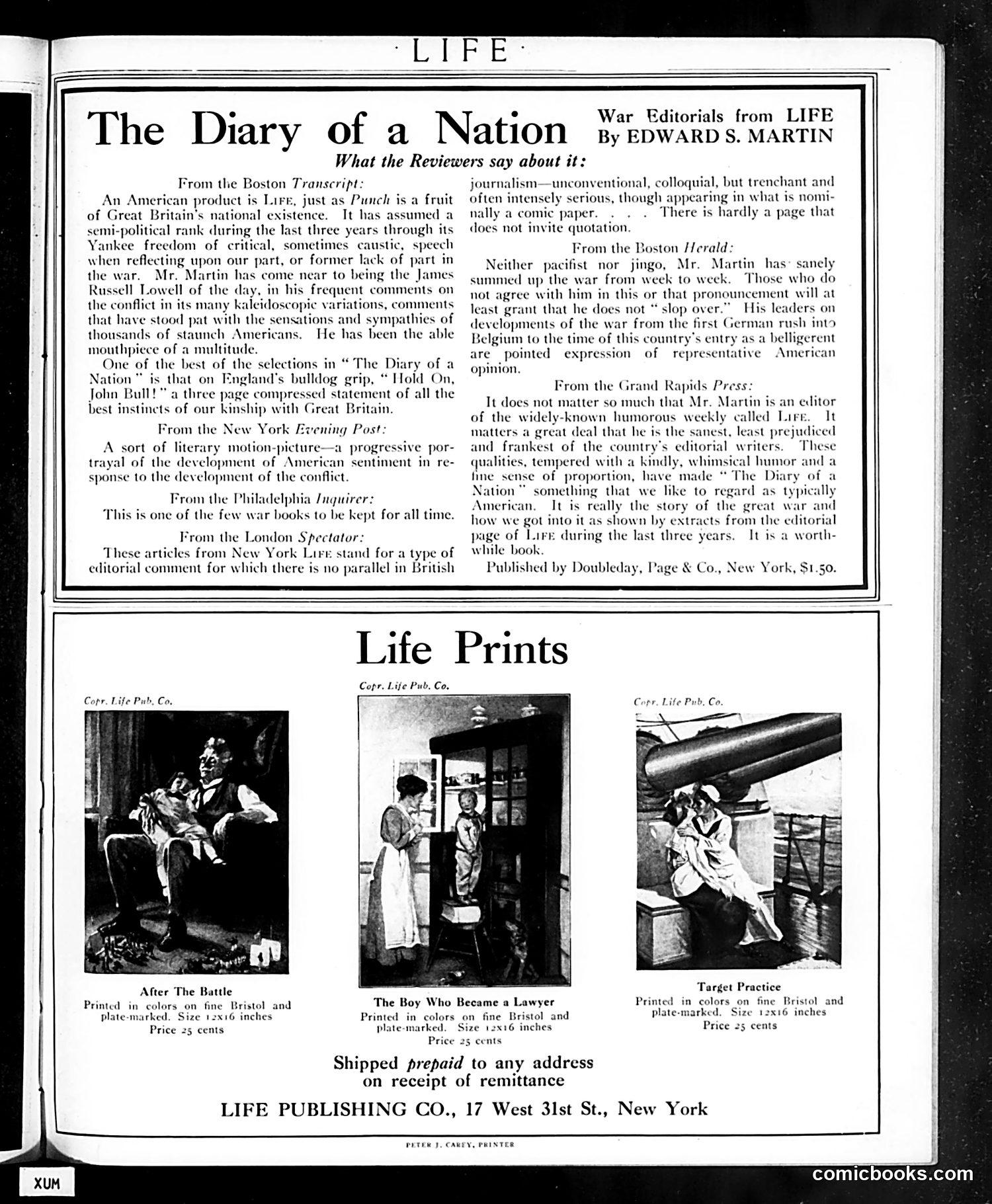
This page primarily advertises **"The Diary of a Nation,"** a book of war editorials by Edward S. Martin, editor of *Life* magazine. The upper section compiles positive reviews from major newspapers (Boston, New York, Philadelphia, London, Grand Rapids) praising Martin's balanced, unsentimental commentary on America's entry into World War I. The reviews emphasize Martin's even-handedness—he's described as "neither pacifist nor jingo," offering "representative American opinion" without excessive emotion ("slop"). The comparisons to James Russell Lowell and British *Punch* establish *Life's* legitimacy as serious editorial commentary despite being "a comic paper." Below are three **Life Prints** for sale: sentimental domestic scenes ("After The Battle," "The Boy Who Became a Lawyer," "Target Practice"), unrelated to the book's war focus—these appear to be standard product offerings. The page itself is primarily **promotional/advertising content** rather than satire or political commentary, showcasing *Life's* authority on war commentary circa 1919.
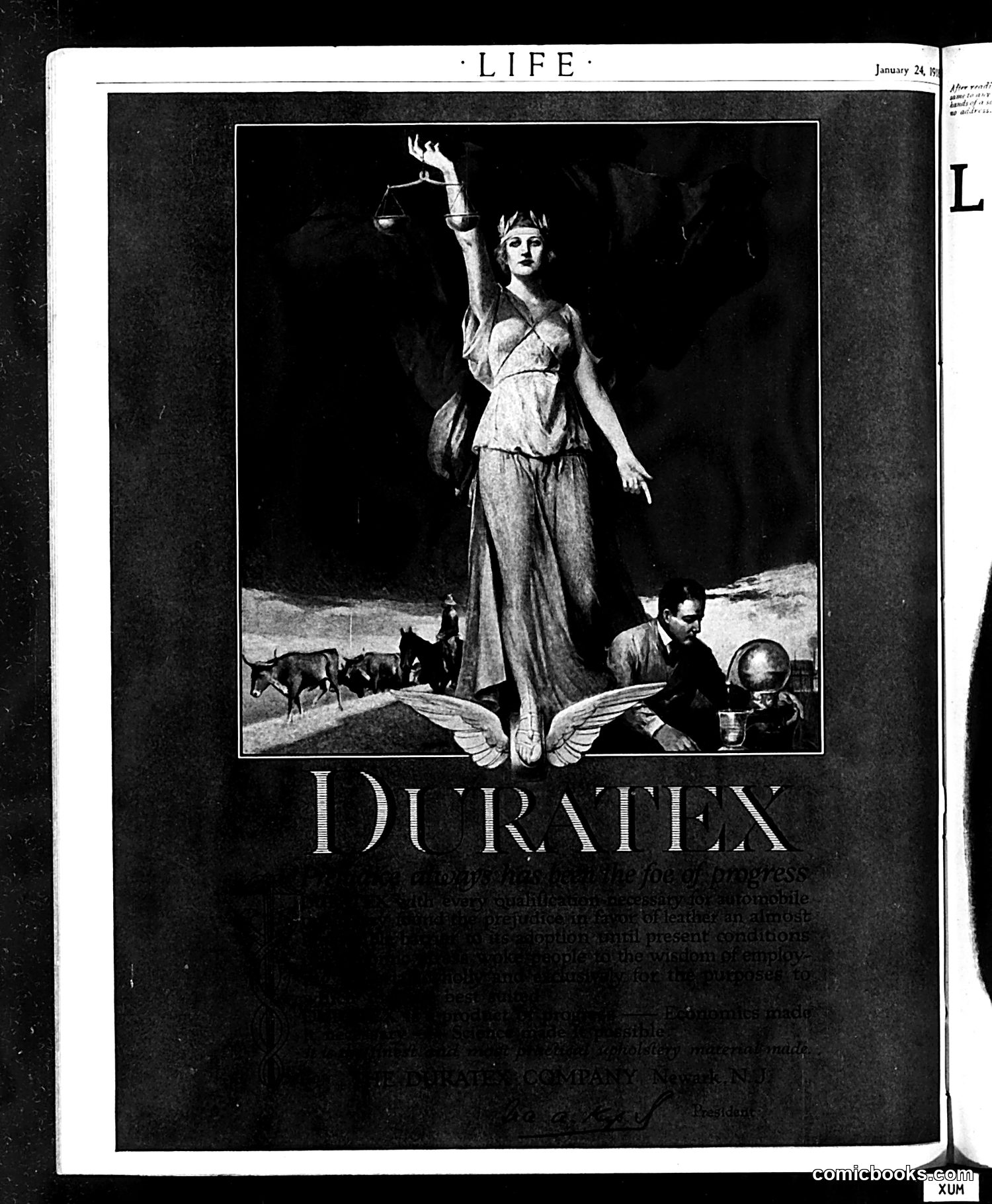
This is an advertisement for **Duratex** (a product whose specific purpose is unclear from the visible text). The image depicts Lady Justice—the allegorical female figure traditionally symbolizing the legal system—holding scales and a torch. She stands prominently in classical dress with winged figures below her. The advertisement appears to invoke ideals of fairness, progress, and enduring quality by associating the product with Justice itself. The classical imagery and allegorical presentation were common advertising strategies in early-to-mid 20th century American magazines, lending products an air of reliability and moral authority. The OCR'd text below the image is too degraded to read clearly, but likely explains how Duratex embodies these virtues of justice and permanence.