
Life, 1918-01-24 · page 16 of 40
Life — January 24, 1918 — page 16: what you’re looking at
What you’re looking at
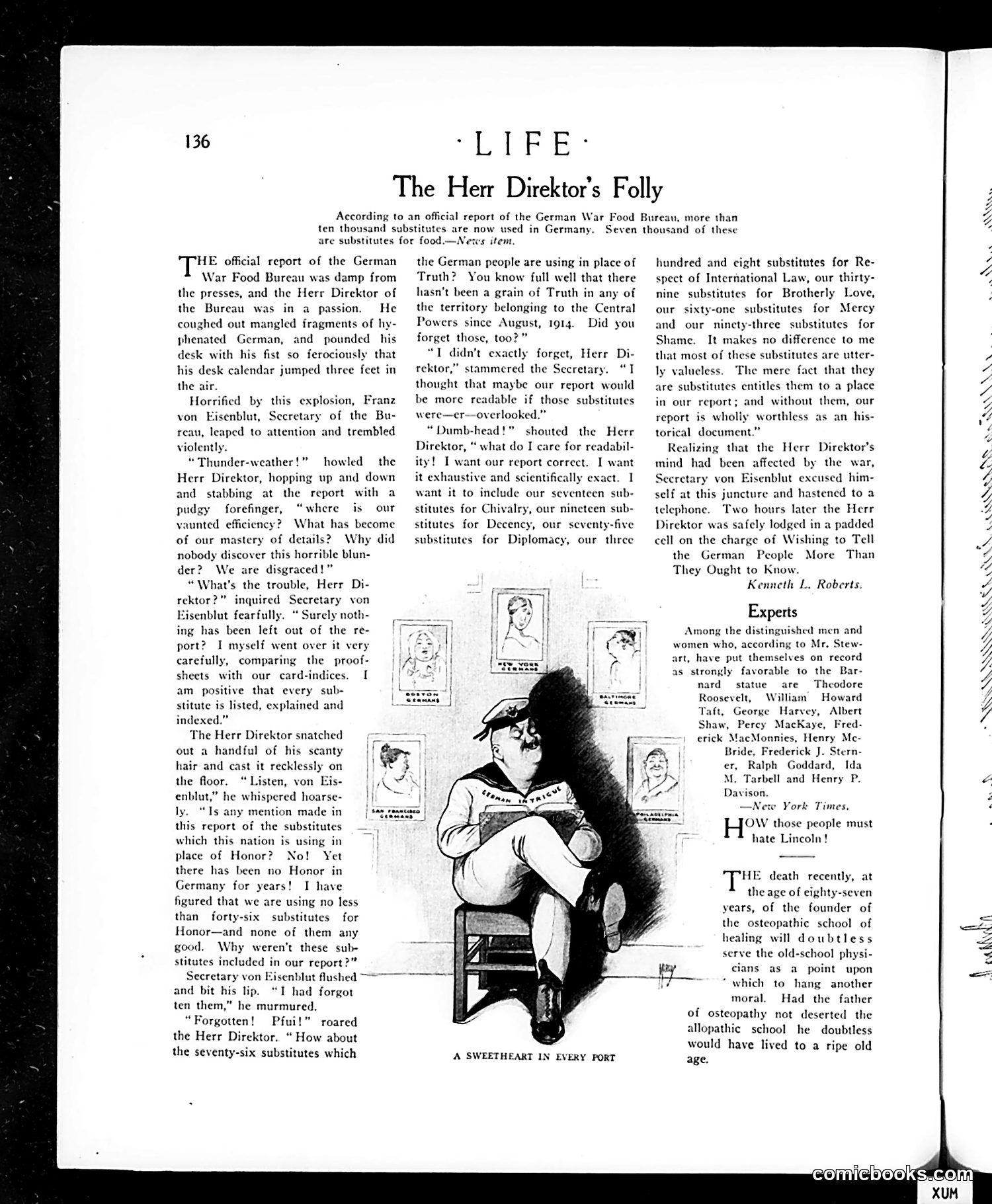
This is a satirical story mocking German official deception during World War I. The Herr Direktor, a bureaucrat at the German War Food Bureau, rages that a report omits "substitutes" for abstract virtues—honor, truth, chivalry, decency, diplomacy, mercy, and shame. He demands the report document all their fraudulent replacements for these values. The joke is biting: Germany has systematically replaced genuine moral qualities with mere substitutes (lies, propaganda, false appearances), yet the Direktor treats this as a bureaucratic oversight to be corrected in official paperwork. The satire suggests Germany's wartime conduct was fundamentally dishonest—they'd actually *catalogued* their own moral bankruptcy. The story ends with the Direktor committed to an asylum for wanting to tell Germans "more than they ought to know"—mocking German censorship and thought control. This targets German militarism, propaganda, and the Central Powers' WWI conduct, published in *Life* magazine for American readers.
📄 Transcribed text from this page (OCR, searchable)
Machine-transcribed from the original scan — historical spelling and the odd misread are preserved.
“LI s - The Herr Direktor’s Folly According to an official report of the German War Food Bureau, more than ten thousand substitutes are now used in Germany. Seven thousand of these are substitutes for food.—News item. HE official report of the German War Food Bureau was damp from the presses, and the Herr Direktor of the Bureau was in a passion, He coughed out mangled fragments of hy- phenated German, and pounded hi desk with his fist so ferociously that his desk calendar jumped three feet in the air. Horrified by this explosion, Franz von Eisenblut, Secretary of the Bu- reau, leaped to attention and trembled violently. “Thunder-weather!” howled — the Herr Direktor, hopping up and down and stabbing at the report with a pudgy forefinger, “where is our nted efficiency? What has become of our mastery of details? Why did nobody discover this horrible blun- der? We are disgraced!” “What's the trouble, Herr Di- rektor?” inquired Secretary von Zisenblut fearfully. “ Surely noth- ing has been left out of the re- I myself went over it very carefully, comparing the proof- sheets with our card-indices. [ am positive that every sub- stitute is listed, explained and indexed.” The Herr Direktor snatched out a handful of his scanty hair and cast it recklessly on the floor. “Listen, von Ei enblut,” he whispered hoarse- ly. “Is any mention made in this report of the substitutes which this nation is using in place of Honor? No! Yet there has been no Honor in Germany for years! I have figured that we are using no less than forty-six substitutes for Honor—and none of them any good. Why weren't these sub- stitutes included in our report?” Secretary von Eisenblut flushed =~ and bit his lip. I had forgot ten them,” he murmured. “Forgotten! Pfuil” roared the Herr Direktor. “ How about the seventy-six substitutes which the German people are using in place of Truth? You know full well that there hasn't been a grain of Truth in any of the territory belonging to the Central Powers since August, 1914. Did you forget those, too? “I didn't exactly forget, Herr Di- rektor,” stammered the Secretary. “1 thought that maybe our report would be more readable if those substitutes were—cr—overlooked.” “Dumb-head!” shouted the Herr Direktor, “ what do I care for readabil- ity! I want our report correct. I want it exhaustive and scientifically exact. 1 want it to include our seventeen sub- stitutes for Chivalry, our nineteen sub- stitutes for Decency, our seventy-five substitutes for Diplomacy, our three A SWEETHEART IN EVERY PORT hundred and cight substitutes for Re- spect of International Law, our thirty- ine substitutes for Brotherly Love, our sixty-one substitutes for Mercy and our ninety-three substitutes for Shame. It makes no difference to me that most of these substitutes are utter- ly valueless. The mere fact that they are substitutes entitles them to a place in our report; and without them, our report is wholly worthless as an his- torical document.” Realizing that the Herr Direktor’s mind had been affected by the war, Secretary von Eisenblut excused him- self at this juncture and hastened to a telephone. Two hours later the Herr Direktor was safely lodged in a padded cell on the charge of Wishing to Tell the German People More Than They Ought to Know. Kenneth L. Roberts. Experts Among the distinguished men and women who, according to Mr, Stew- art, have put themselves on record as strongly favorable to the Bar- nard statue are Theodore Roosevelt, William’) Howard Taft, George Harvey, Albert Shaw, Percy MacKaye, Fred- erick MacMonnies, Henry Me- Bride, Frederick J. Stern- er, Ralph Goddard, Ida M. Tarbell and Henry P. Davison. —New York Times, OW those people must hate Lincoln! HE death recently, at the age of eighty-seven years, of the founder of the osteopathic school of healing will doubtless serve the old-school physi- cians as a point upon “which to hang another moral. Had the father of osteopathy not deserted the allopathic school he doubtless would have lived to a ripe old age. BasK Qe R® An BARRE HAL Chandan f e PRRQCRAMXYYVBQ{HRAY