
Life, 1918-01-24 · page 18 of 40
Life — January 24, 1918 — page 18: what you’re looking at
What you’re looking at
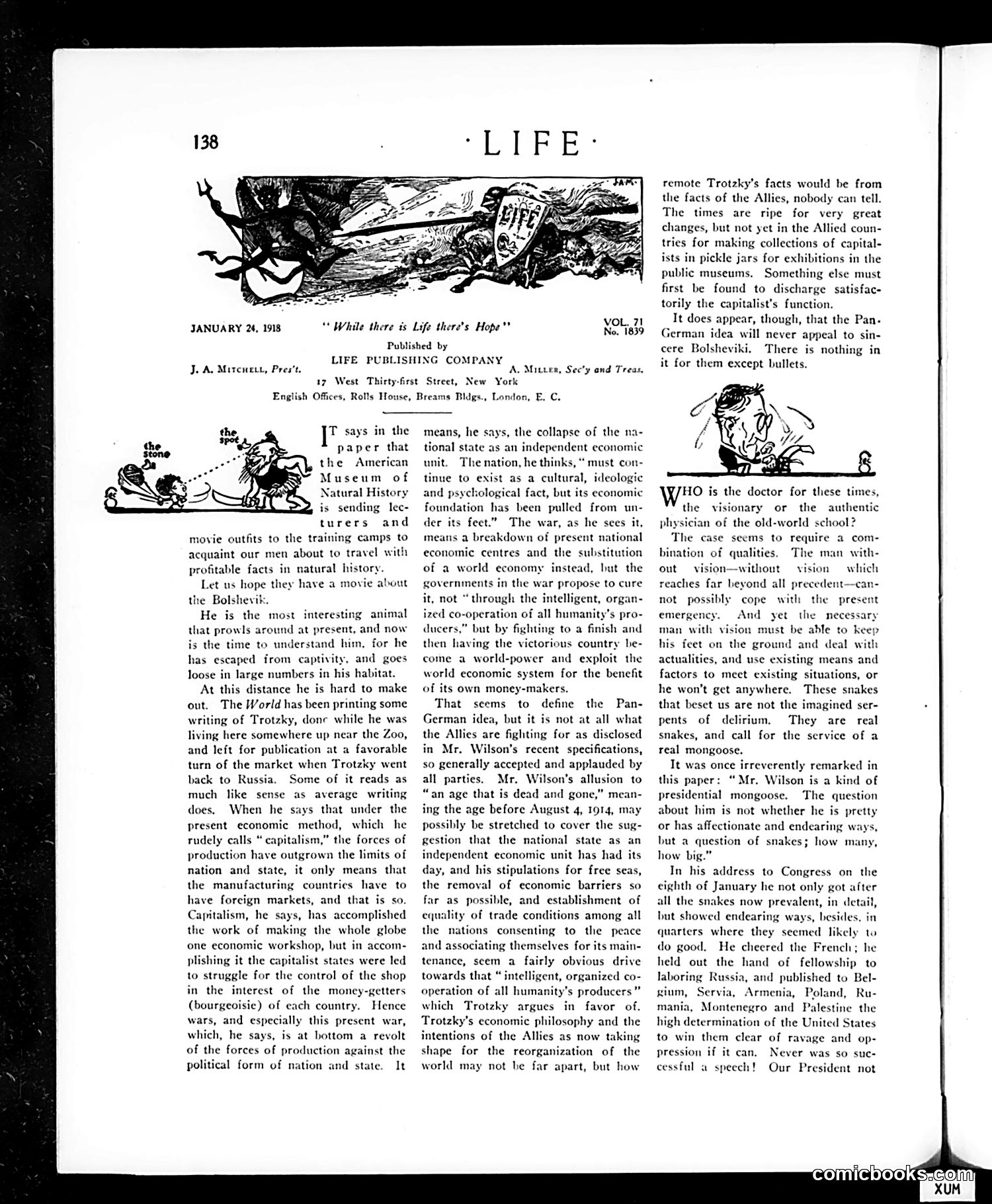
This editorial cartoon and accompanying article satirize **Leon Trotsky**, the Russian Bolshevik revolutionary. The cartoon depicts him as a dangerous animal escaped from captivity—referencing his recent escape from Russia after the Bolshevik Revolution (October 1917). The article acknowledges that Trotsky's economic critique of capitalism contains *some* logical points: that industrial production has outgrown individual nation-states, requiring global economic cooperation. However, the satire's bite lies in the sharp distinction drawn between Trotsky's *theory* and Allied *practice*. The author notes that President Wilson's recent peace proposals (the Fourteen Points, January 1918) accidentally align with Trotsky's vision of international economic cooperation—but the Allies fight for entirely different reasons and will implement it differently. The joke: these bitter enemies' stated goals coincidentally overlap, yet their actual intentions remain worlds apart. The "hope" in the title thus carries dark irony: ideological compatibility won't prevent conflict.
📄 Transcribed text from this page (OCR, searchable)
Machine-transcribed from the original scan — historical spelling and the odd misread are preserved.
JANUARY 24, 1918 “* While there ts Life there's Hope" No. 1839 Published by LIFE PUBLISHING COMPANY J. A. Mitcnett, Pres’t. 17 West Thirty-first Street, English Off T says in the paper that the American Museum of Natural History is sending lec- turers and camps to movie outfits to the training acquaint our men about to travel with profitable facts in natural history. Let us hope they have a movie about re Bolshevik. He is the most interesting animal that prowls around at present, and now is the time to understand him, for he has escaped irom captivity, and goes loose in large numbers in his habitat. At this distance he is hard to make out. The World has been printing some writing of Trotzky, done while he was living here somewhere up near the Zoo, and left for publication at a favorable turn of the market when Trotzky went back to Russia. Some of it reads as much like sense as average writing does. When he says that under the present economic method, which he rudely calls “ capitalism,” the forces of production have outgrown the limits of nation and state, it only means that the manufacturing countries have to have foreign markets, and that is so. Capitalism, he says, has accomplished the work of making the whole globe one economic workshop, but in accom- plishing it the capitalist states were led to struggle for the control of the shop in the interest of the moncy-getters (bourgeoisie) of each country. Hence wars, and especially this present war, which, he says, is at bottom a revolt of the forces of production against the political form of nation and state. It . Rolls House, Brea A, Mitten, Sec’y and Treas, New York 6 Bldgs., London, E. C. means, he says, the collapse of the na- tional state as an independent economic u The nation, he thinks, “* must con- tinue to exist as a cultural, ideologi and psychological fact, but its economic foundation has been pulled from un- der its feet.” The war, as he sees it, means a breakdown of present national economic centres and the substitution of a world economy instead, but the governments in the war propose to cure it, not “through the intelligent, organ- ized co-operation of all humanity's pro- ducers,” but by fighting to a finish and then having the victorious country be- come a world-power and exploit the world economic system for the benefit of its own money-makers. That seems to define the Pan- German idea, but it is not at all what the Allies are fighting for as disclosed in Mr. Wilson’s recent specifications, so generally accepted and applauded by all parties. Mr. Wilson’s allusion to “an age that is dead and gone,” mean- ing the age before August 4, 1914, may possibly be stretched to cover the sug gestion that the national state as an independent economic unit has had its day, and his stipulations for free seas, the removal of economic barriers so far as possible, and establishment of equality of trade conditions among all the nations consenting to the peace and associating themselves for its main- tenance, scem a fairly obvious drive towards that “intelligent, organized co- operation of all humanity’s producers” which Trotzky argues in favor of. Trotzky’s economic philosophy and the intentions of the Allies as now taking shape for the reorganization of the world may not be far apart, but how remote Trotzky’s facts would be from the facts of the Allies, nobody can tell, The times are ripe for very great changes, but not yet in the Allied coun- tries for making collections of capital- ists in pickle jars for exhibitions in the public museums. Something else must first be found to discharge satisfac- torily the capitalist’s function. It does appear, though, that the Pan. German idea will never appeal to sin- cere Bolsheviki. There is nothing in it for them except bullets. HO is the doctor for these times, the visionary or the authentic physician of the old-world school ? The case seems to require a com- bination of qualities. The man with- out — vision—without which reaches far heyond all precedent—can- not possibly cope with the present emergency. And yet the necessary man with vision must be able to k his feet on the ground and deal with actualities, and use existing means and factors to meet existing situations, or he won't get anywhere. These snakes that beset us are not the imagined ser- pents of delirium. They are real snakes, and call for the service of a real mongoose. It was once irreverently remarked in this paper: “Mr. Wilson is a kind of presidential mongoose. The question about him is not whether he is pretty or has affectionate and endearing ways, but a question of snakes; how many, how bij In his address to Congress on the eighth of January he not only got after all the snakes now prevalent, in detail, but showed endearing ways, besides, in quarters where they seemed likely to do good. He cheered the French; he held out the hand of fellowship to laboring Russia, and published to Bel- gium, Servia, Armenia, Poland, Ru- mania, Montenegro and Palestine the high determination of the United States to win them clear of ravage and op- Never was so suc- Our President not vision pression if it can, cessful a speech!