
Life, 1918-01-24 · page 28 of 40
Life — January 24, 1918 — page 28: what you’re looking at
What you’re looking at
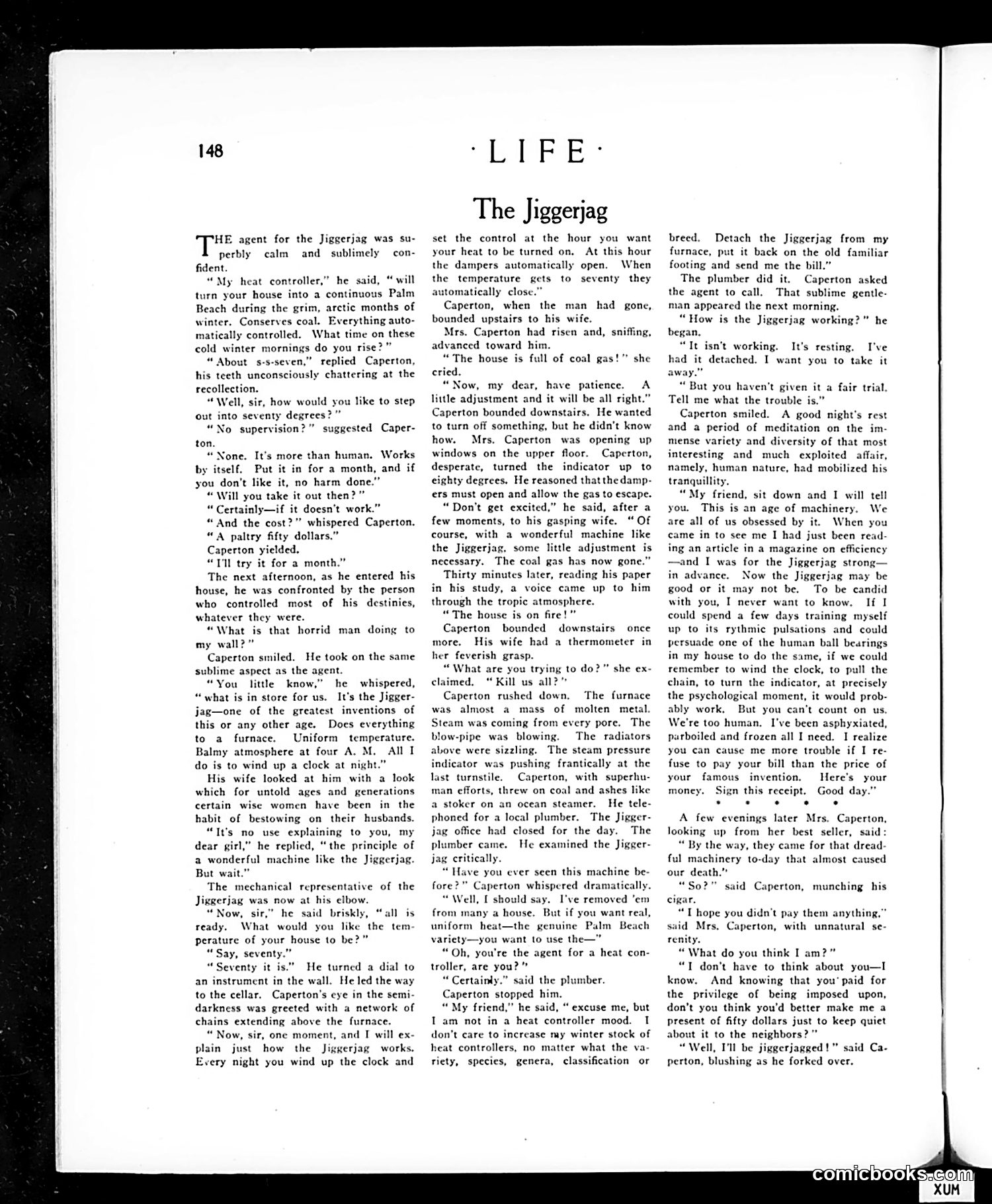
This is a satirical story about an overly complicated home heating system called the "Jiggerjag." A salesman convinces Mr. Caperton to install this supposedly revolutionary automatic furnace, promising it will maintain perfect 70-degree temperatures with minimal effort—just winding a clock nightly. The joke is that the machine is a disaster. Once installed, it malfunctions catastrophically: first leaking coal gas into the house, then overheating it to dangerous levels. The salesman's promises of "no supervision needed" and "foolproof" automation prove false, and Caperton can't even figure out how to turn it off. The satire mocks early-20th-century enthusiasm for technological solutions and salesmen's exaggerated claims. It suggests that overly complex machines requiring no user understanding are inherently unreliable—a timeless critique of gadgetry that remains relatable today.
📄 Transcribed text from this page (OCR, searchable)
Machine-transcribed from the original scan — historical spelling and the odd misread are preserved.
HE agent for the Jiggerjag was su- perbly calm and sublimely con- fident. “My heat controller,” he said, “ will turn your house into a continuous Palm Beach during the grim, arctic months of winter. Conserves coal. Everything auto- matically controlled. What time on these cold winter mornings do you rise?” “ About. s-s-seven,” replied Caperton, his teeth unconsciously chattering at the recollection. “Well, sir, how would you like to step out into seventy degrees?” “No supervision?” suggested Caper- ton. “None. It’s more than human. Works by itself, Put it in for a month, and if you don't like it, no harm done.” “Will you take it out then?” “ Certainly—if it doesn’t work.” “And the cost?” whispered Caperton. “A paltry fifty dollars.” Caperton yielded. “Tl try it for a month.” The next afternoon, as he entered his house, he was confronted by the person who controlled most of his destinies, whatever they were. “What is that horrid man doing to my wall?” Caperton smiled. He took on the same sublime aspect as the agent. “You little know he whispered, “what is in store for us. It's the Jigger- jag—one of the greatest inventions of this or any other age. Does everything to a furnace. Uniform temperature. Balmy atmosphere at four A. M. All I do is to wind up a clock at night.” His wife looked at him with a look which for untold ages and generations certain wise women have been in the habit of bestowing on their husbands. “It's no use explaining to you, my dear girl,” he replied, “the principle of a wonderful machine like the Jiggerjag. But wait.” The mechanical representative of the Jiggerjay was now at his elbow. Now, sir,” he said briskly, “all is ready. What would you like the tem perature of your house to be?” “Say, seventy.” “Seventy it is.” He turned a dial to an instrument in the wall. He led the way to the cellar. Caperton’s eye in the semi- darkness was greeted with a network of chains extending above the furnace. Now, sir, one moment, and I will ex- plain just how the Jiggerjag works. Every night you wind up the clock and ‘LIFE: The Jiggerjag set the control at the hour you want your heat to be turned on, At this hour the dampers automatically open. When the temperature to seventy they automatically close.” Caperton, when the man bounded upstairs to his wife. Mrs. Caperton had risen and, sniffing, advanced toward him. “The house is full of coal gas!” she cried. Now, my dear, have patience. A little adjustment and it will be all right.” Caperton bounded downstairs. He wanted to turn off something, but he didn't know how. Mrs. Caperton was opening up windows on the upper floor. Caperton, desperate, turned the indicator up to eighty degrees. He reasoned that thedamp- ers must open and allow the gas to escape. “Don't get excited,” he said, after a few moments, to his gasping wife. “ Of course, with a wonderful machine like the Jiggerjag, some little adjustment is necessary. The coal gas has now gone.” Thirty minutes later, reading his paper in his study, a voice came up to him through the tropic atmosphere. “The house is on fire! Caperton bounded downstairs more. His wife had a thermometer in her feverish grasp. “What are you trying to do?” she ex- claimed, “Kill us all?" Caperton rushed down. was mass of molten metal. Steam was coming from every pore. The blow-pipe blowing. The radiators above were sizzling. The steam pressure indicator was pushing frantically at the last turnstile. Caperton, with superhu- man efforts, threw on coal and ashes like a stoker on an ocean steamer. He tele- phoned for a local plumber. The Jigger- jag office had closed for the day. The plumber came, He examined the Jigger- jag critically. “ Have you ever seen this machine be- fore?” Caperton whispered dramatically. “Well, [ should say. I've removed ‘em from many a house. But if you want real, uniform heat—the genuine Palm Beach variety—you want to use the—" “Oh, you're the agent for a heat con- troller, are you?” “ Certainly.” said the plumber. Caperton stopped him. “ My friend,” he said, “ excuse me, but I am not in a heat controller mood. 1 don't care to increase my winter stock of heat controllers, no matter what the va- riety, species, genera, classification or had gone, once The furnace almost a breed. Detach the Jiggerjag from my furnace, put it back on the old familiar footing and send me the bill.” The plumber did it. Caperton asked the agent to call, That sublime gentle- man appeared the next morning. “How is the Jiggeriag working?” he began. “It isn’t working. It's resting, I've had it detached. I want you to take it awa: “But you haven't given it a fair trial. Tell me what the trouble is.” Caperton smiled. A good night's re: and a period of meditation on the im- mense variety and diversity of that most interesting and much exploited affair, namely, human nature, had mobilized his tranquillity. “My friend, sit down and I will tell you. This is an age of machinery. We are all of us obsessed by it. When you came in to see me I had just been read- ing an article in a magazine on efficiency —and I was for the Jiggerjag strong— in advance. Now the Jiggerjag may be good or it may not be. To be candid with you, I never want to know. If I could spend a few days training myself up to its rythmic pulsations and could persuade one of the human ball bearings in my house to do the same, if we could remember to wind the clock, to pull the chain, to turn the indicator, at precisely the psychological moment, it would prob- ably work, But you can’t count on us. We're too human. I've been asphyxiated, parboiled and frozen all I need. I realize you can cause me more trouble if I re- fuse to pay your bill than the price of your famous invention, Here's your money. Sign this receipt. Good day.” . 8 8 ee A few evenings later Mrs. Caperton, looking up from her best seller, said: “ By the way, they came for that dread- ful machinery to-day that almost caused our death.’ “So?” cigar. I hope you didn’t pay them anything,” said Mrs, Caperton, with unnatural se- renity. “What do you think I am?” “TI don't have to think about you—I know. And knowing that you’ paid for the privilege of being imposed upon, don’t you think you'd better make me a present of fifty dollars just to keep quiet about it to the neighbors?” “Well, I'll be jiggerjagged!" said Ca- perton, blushing as he forked over. said Caperton, munching his