
Life, 1918-01-24 · page 23 of 40
Life — January 24, 1918 — page 23: what you’re looking at
What you’re looking at
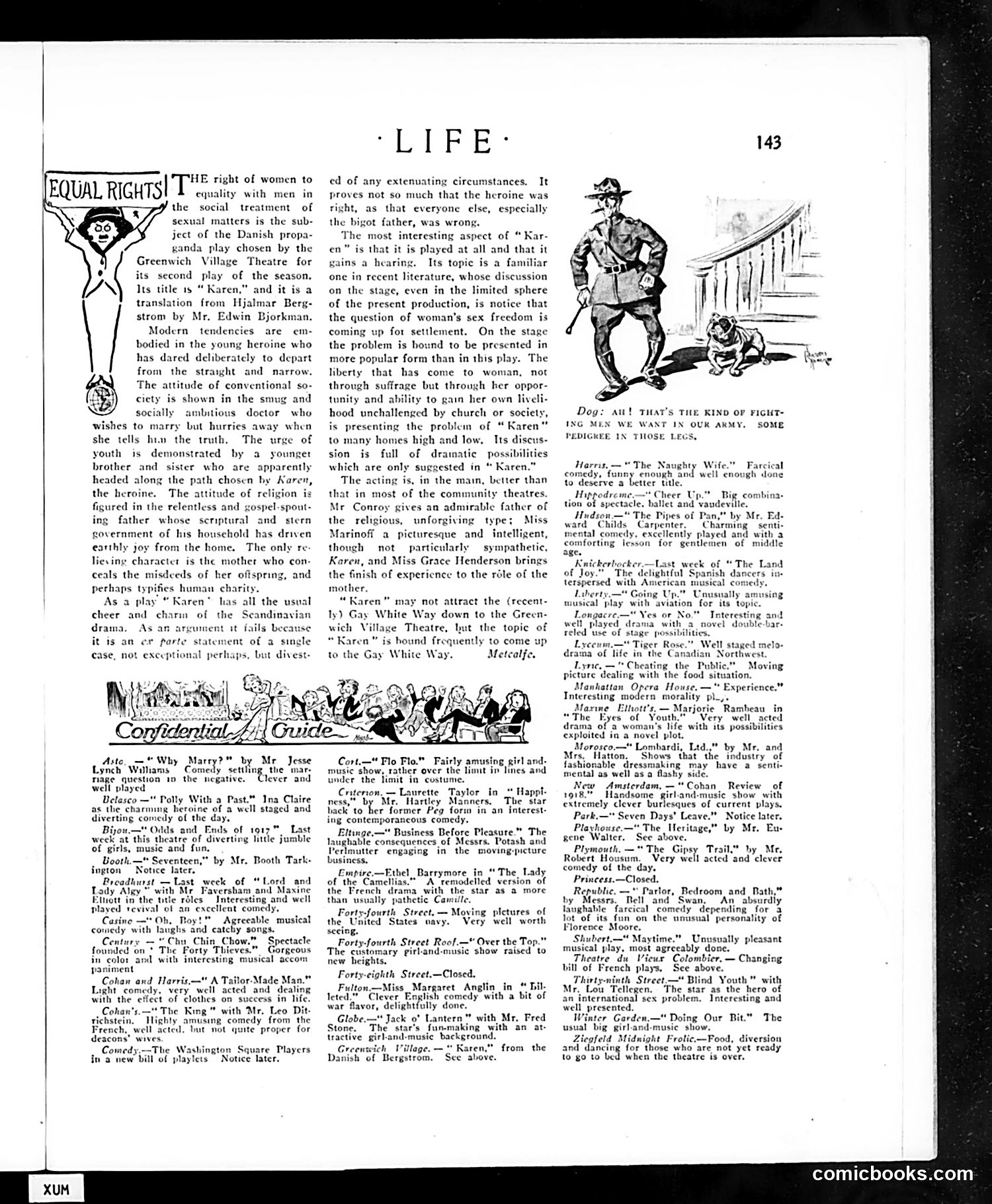
This page analyzes a Danish play called "Karen," performed at Greenwich Village Theatre. The title cartoon, "Equal Rights," depicts a woman figure asserting women's rights—a reference to early 20th-century feminism and suffrage movements. The play concerns a young woman who defies social convention by living unmarried. The review examines how the drama presents competing social forces: the rigid, religiously authoritarian father (representing conservative society), the pragmatic doctor (social hypocrisy), and the sympathetic mother (human charity). The critic argues "Karen" matters not because it validates the heroine's choices, but because it signals that women's economic independence—their ability to earn livelihood outside church/societal control—is forcing society to reckon with female sexual autonomy and marriage rights. The page notes this "modern tendency" will inevitably move from bohemian Greenwich Village theater to mainstream Broadway ("the Gay White Way"). This reflects 1910s debates over women's independence, sexual morality, and marriage—issues gaining theatrical and social urgency as women entered the workforce.
📄 Transcribed text from this page (OCR, searchable)
Machine-transcribed from the original scan — historical spelling and the odd misread are preserved.
EQUAL RIGHTS! HE right of women to equality with men in the social treatment of <>. ject of the Danish propa- ganda play chosen by the Greenwich Village Theatre for its second play of the season, Its title 1s “ Karen," and it is a translation from Hjalmar Berg- strom by Mr. Edwin Bjorkman, Modern tendencies are em- bodied in the young heroine who has dared deliberately to depart from the straight and narrow. The attitude of conventional so- ciety is shown in the smug and socially ambitious doctor who wishes to marry but hurries away when she tells hi» the truth, The urge of youth is demonstrated by a younger brother and sister who are apparently headed along the path chosen by Karen, the heroine. The attitude of rel figured in the relentless and gospel-spout- ing father whose scriptural and stern government of his houschold has driven earthly joy from the home. The only re- lieving character is the mother who con- ceals the misdeeds of her offspring, and perhaps typifies human charity. As a play “ Karen’ has all the usual cheer and charm of the Scandinavi drama, it is an ce parte state case, not excem igion nt it fails because ent of a single jonal perhaps, U As an arg divest. *“LIPE? ed of any extenuating circumstances, It Proves not so much that the heroine was right, as that everyone else, especially the bigot father, was wrong. The most interesting aspect of “Kar- en” is that it is played at all and that it gains a hearing, Its topic is a familiar one in recent literature, whose discussion on the stage, even in the limited sphere of the present production, is notice that the question of woman's sex freedom is coming up for settlement. On the stage the problem is bound to be presented in more popular form than in this play. The liberty that has come to woman, not through suffrage but through her oppor- tunity and ability to gain her own liveli- hood unchallenged by church or society, is presenting the problem of “Karen” to many homes high and low. Its discus- sion is full of dramatic possibilities which are only suggested in “ Karen.” The acting is, in the main, better than that in most of the community theatres. Mr Conroy gives an admirable father of the religious, unforgiving type; Miss Marinofi a picturesque and intelligent, though not particularly sympathetic, Karen, and Miss Grace Henderson brings the finish of experience to the rile of the mother. “Karen” may not attract the (recent- ly) Gay White Way down to the Green- wich Village Theatre, hut the topic of “Karen” is hound frequently to come up to the Gay White Way. Metcalfe. Aste, —* Why Marry?" by Mr Jesse Lynch Wahams” Comedy settling. the nage question 19 the negative. Clever and well played Belasco —" Polly With a Past.” Ina Claire as the charming heroine of a well staged and diverting comedy of the day, Biyou—" Odds and Ends of 1017" Last week at this theatre of diverting httle jumble of girls, music and fun, Booth." Seventeen,” by Mr, Booth Tark- ington Notice later. Broadhurst — Last week of “Lord and Lody Algy © with Mr Faversham and Maxine Etnott in the title réles Interesting and well played tevival of an excellent comedy, Casine —" Oh, Toy!” Agrecable musical comedy with laughs and cateby son Century — “Chu Chin Chow." Spectacle founded on * The Forty Thieves.” Gorgeous in color and with interesting musical accom paniment Cohan and Harris," A Tailor-Made Man.” Light comedy, very’ well acted and dealing with the effect of clothes on success in life Cohan's.—"* The King” with Mr, Leo Dit: richstein, Highly amusing comedy from the French, well acted. but not quite proper for deacons’ wives , Comedy.—The Washingt: in a new bill of playtets Square Players Notice later. Cort, —" Flo Flo." Fairly amusing music show, rather over the liout under the fimit in costume. Criterion, — Laurette Taylor in Happt- pesgit by Mr. Hartisy Manners, |The’ star hack’ to her former Peg fori in ‘an interest: ing contemporaneous comedy. Itinge.—"" Business Before Pleasure.” The laughable consequences of Messrs. Potash and Perlmutter engaging in the moving-picture business, Empire.—Fthel, Barrymore in “The. Lady of the Camellias.” A ‘remodelled version of the Trench drama with the star as a more than usually pathetic Camille. Forty-fourth Strect. — Moving pletures of the United States navy. Very well worth seeing. Forty-fourth Street Roof.—" Over the Top The customary gitland-music show raised to new heights. Forty-eighth Street.—Closed. Fulton.—Miss Margaret Anglin in“ D leted.” Clever English comedy with a bit war Bavor, delightfully dor Globe.—" Jack o° Lantern” with Mr. Fred Stone. The star's fun-making with an at- tractive girl-and-music background. Greenwich Village. =‘ Karen.” from the Danish of Bergstrom. See above. lines and 143 Dog: au! THAT's THE KIND OF FIGHT- ING MEN WE WANT IN OUK AKMY, SOME PEDIGKEE IN THOSE Le Harris, —“ The N: comedy, funny enou to deserve a better title. Hippodreme.—" Cheer Up." Big. combina- tion of spectacle, ballet and vaudeville, Hudson —" The Pipes of Pan,” by Mr, Ed- ward “Childs Carpenter, Charming senti- mental comedy, excellently played and with a comforting lesson for gentlemen of middle age. Knickerbocker.—Last_ wee of Joy.” of “The Le: nish dancers i terspersed with Am sical comedy. Liherty.—" Going Up.” Unusually amusing musical play with aviation for its topic. Longacre.—“ Yes or No.” Interesting and well played drama with a novel double-bar- reled use of stage possibilities. Lyceunt.—" Tiger Rose.” Well staged melo- draina of life in the Canadian Northwest _Lyne, —" Cheating the Pub Moving picture dealing with the food situation, Manhattan Opera House, —* Experience.” Interes! nodern morality pl... Marine Elott's, — Marjorie Rambeau in “The Eyes of Youth.” | Very well acted drama of a woman's life with its possibilities exploited in a novel plot. Morosco.—" Lombardi, Ltd." by Mr, and Mrs, Hatton, Shows that the industry of fashionable dressmaking may have a sen mental as well asa flashy side. New Amsterdam, — "Cohan Review of 1918." Handsome girland:music show with extremely Clever burlesques of current plays. Park.—" Seven Days’ Leave.” Notice later. Playhouse. —"" The Meritage,” by Mr. Eus gene Walter, See above. Plymouth. —"The Gipsy Trail” by Me, Robert H Very well acted and clever comedy of the day. Princess.—Closed. Republic. —* Parlor, Bedroom and Rath,” by Messrs. Rell and’ Swan, An absurdiy laughable farcical comedy depending for a lot of its fun on the unusual personality of Florence Moore. Shubert.— Maytime.” Unusually pleasant musical play, most agreeably done. Theatre du Views Colombier, — Changing Dill of French plays, See above. Thirty-ninth Street,— Blind Youth” with Mr, Lou Tellegen. The star as the hero of an international sex problem. Interesting and well presented. Winter Garden,—" Doing Our Bit." The music show. Ziegfeld Midnight Frotic.—Food, diversion and dancing for those who are not yet ready to go to bed when the theatre is over. usual big girla comicbooks.com