
Life, 1918-01-24 · page 8 of 40
Life — January 24, 1918 — page 8: what you’re looking at
What you’re looking at
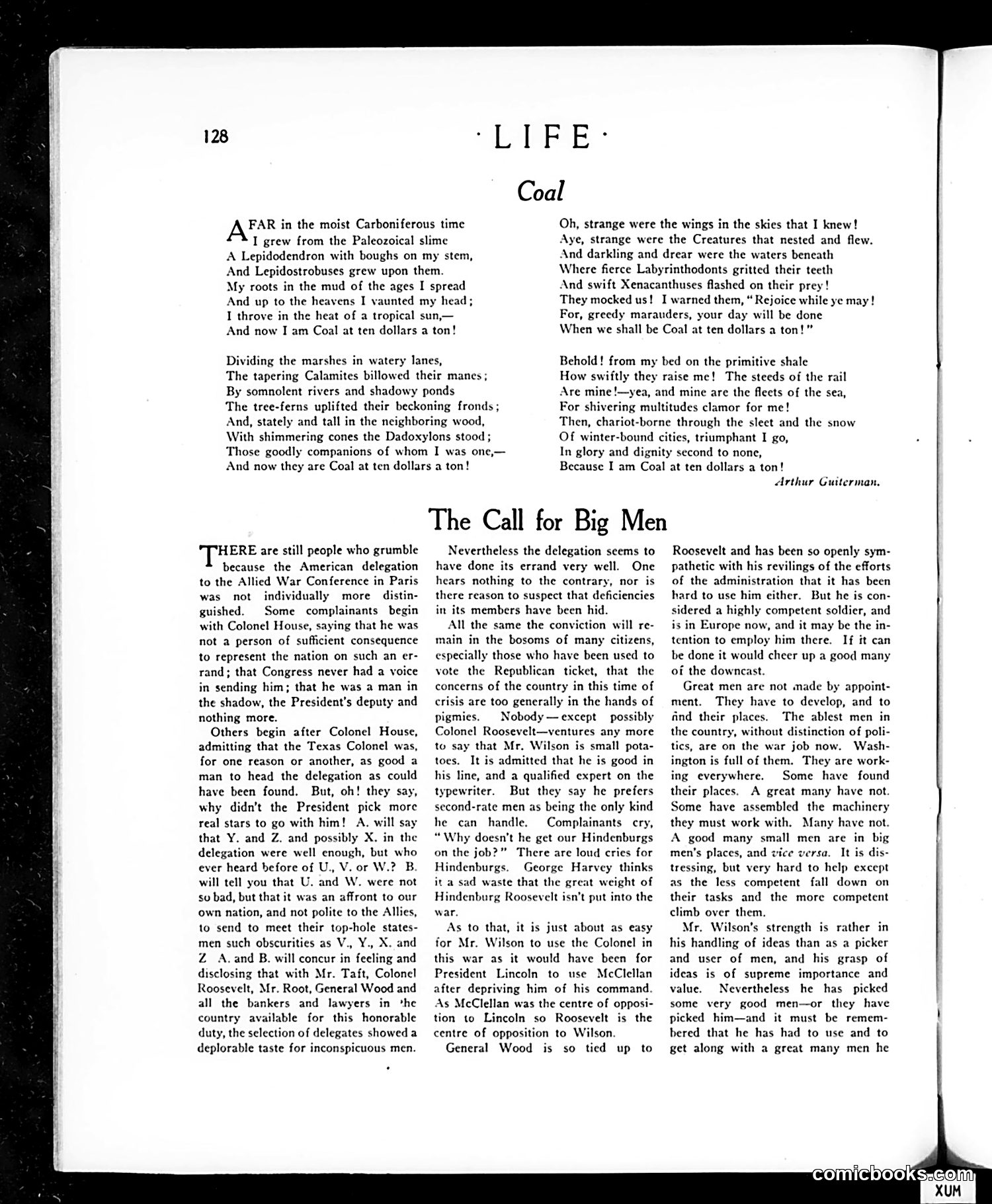
This page contains a poem titled "Coal" by Arthur Guiterman (left column) and an article called "The Call for Big Men" (right column). There is no cartoon visible on this page. The article discusses criticism of the American delegation to an Allied War Conference. It defends the delegation against complaints that members lacked sufficient stature, specifically addressing criticism of Colonel House and defending President Wilson's choices. The piece argues that delegates like Mr. Wilson and General Wood were competent, and criticizes those who grumble about the selection—including mentions of competing figures like Roosevelt and various political opponents. The article appears to address WWI-era diplomatic debates about American representation.
📄 Transcribed text from this page (OCR, searchable)
Machine-transcribed from the original scan — historical spelling and the odd misread are preserved.
"THERE are still people who grumble because the American delegation to the Allied War Conference in Paris was not individually more distin- guished. Some complainants begin with Colonel House, saying that he was not a person of sufficient consequence to represent the nation on such an er- rand; that Congress never had a voice in sending him; that he was a man in the shadow, the President's deputy and nothing more. Others begin after Colonel House, admitting that the Texas Colonel was, for one reason or another, as good a man to head the delegation as could have been found. But, oh! they say, why didn’t the President pick more real stars to go with him! A. will say that Y. and Z. and possibly X. in the delegation were well enough, but who ever heard before of U., V. or W.? B. will tell you that U. and W. were not so bad, but that it was an affront to our own nation, and not polite to the Allies, to send to meet their top-hole states- men such obscurities as V., Y., X. and Z A.and B. will concur in feeling and disclosing that with Mr. Taft, Colonel Roosevelt, Mr. Root, General Wood and all the bankers and lawyers in *he country available for this honorable duty, the selection of delegates showed a deplorable taste for inconspicuous men. ‘AR in the moist Carboniferous time I grew from the Paleozoical slime A Lepidodendron with boughs on my stem, And Lepidostrobuses grew upon them. My roots in the mud of the ages I spread And up to the heavens I vaunted my head; I throve in the heat of a tropical sun,— And now I am Coal at ten dollars a ton! Dividing the marshes in watery lanes, The tapering Calamites billowed their manes ; By somnolent rivers and shadowy ponds The tree-ferns uplifted their beckoning fronds; And, stately and tall in the neighboring wood, With shimmering cones the Dadoxylons stood ; Those goodly companions of whom I was one,— And now they are Coal at ten dollars a ton! “LIFE- Coal Are mine! Oh, strange were the wings in the skies that I knew! Aye, strange were the Creatures that nested and flew. And darkling and drear were the waters beneath Where fierce Labyrinthodonts gritted their teeth And swift Xenacanthuses flashed on their prey! They mocked us! I warned them, “ Rejoice while ye may ! For, greedy marauders, your day will be done When we shall be Coal a Behold! from my bed on the primitive shale How swiftly they raise me! The steeds of the rail yea, and mine are the fleets of the sea, For shivering multitudes Then, chariot-borne through the sleet and the snow Of winter-bound cities, triumphant I go, In glory and dignity Because I am Coal at ten dollars a ton! ten dollars a ton!” amor for me! econd to none, Arthur Guiterman, The Call for Big Men Nevertheless the delegation seems to have done its errand very well. One hears nothing to the contrary, nor is there reason to suspect that deficiencies in its members have been hid. All the same the conviction will re- main in the bosoms of many citizens, especially those who have been used to vote the Republican ticket, that the concerns of the country in this time of crisis are too generally in the hands of pigmies. | Nobody—except possibly Colonel Roosevelt—ventures any more to say that Mr. Wilson is small pota- toes. It is admitted that he is good in his line, and a qualified expert on the typewriter. But they say he prefers second-rate men as being the only kind he can handle, Complainants cry, “Why doesn’t he get our Hindenburgs on the job?” There are loud cries for Hindenburgs. George Hart thinks i ad waste that the great weight of Hindenburg Roosevelt isn’t put into the war. As to that, it is just about as easy for Mr. Wilson to use the Colonel this war as it would have been for President Lincoln to use McClellan after depriving him of his command. As McClellan was the centre of opposi- tion to Lincoln so Roosevelt is the centre of opposition to Wilson. General Wood is so tied up to Roosevelt and has been so openly sym- pathetic with his revilings of the efforts of the administration that it has been hard to use him either. But he is con- sidered a highly competent soldier, and is in Europe now, and it may be the in- tention to employ him there. If it can be done it would cheer up a good many of the downca: Great men are not made by appoint- ment. They have to develop, and to find their places. The ablest men in the country, without distinction of poli- tics, are on the war job now. Wash- ington is full of them. They are work- ing everywhere. Some have found their places. A great many have not. Some have assembled the machinery they must work with. Many have not. A good many small men are in big men's places, and vice versa. It is dis- tressing, but very hard to help except as the less competent fall down on their tasks and the more competent climb over them. Mr. Wilson's strength is rather in his handling of ideas than as a picker and user of men, and his grasp of ideas is of supreme importance and value. Nevertheless he has picked some very good men—or they have picked him—and it must be remem- bered that he has had to use and to get along with a great many men he