
Life, 1918-01-24 · page 32 of 40
Life — January 24, 1918 — page 32: what you’re looking at
What you’re looking at
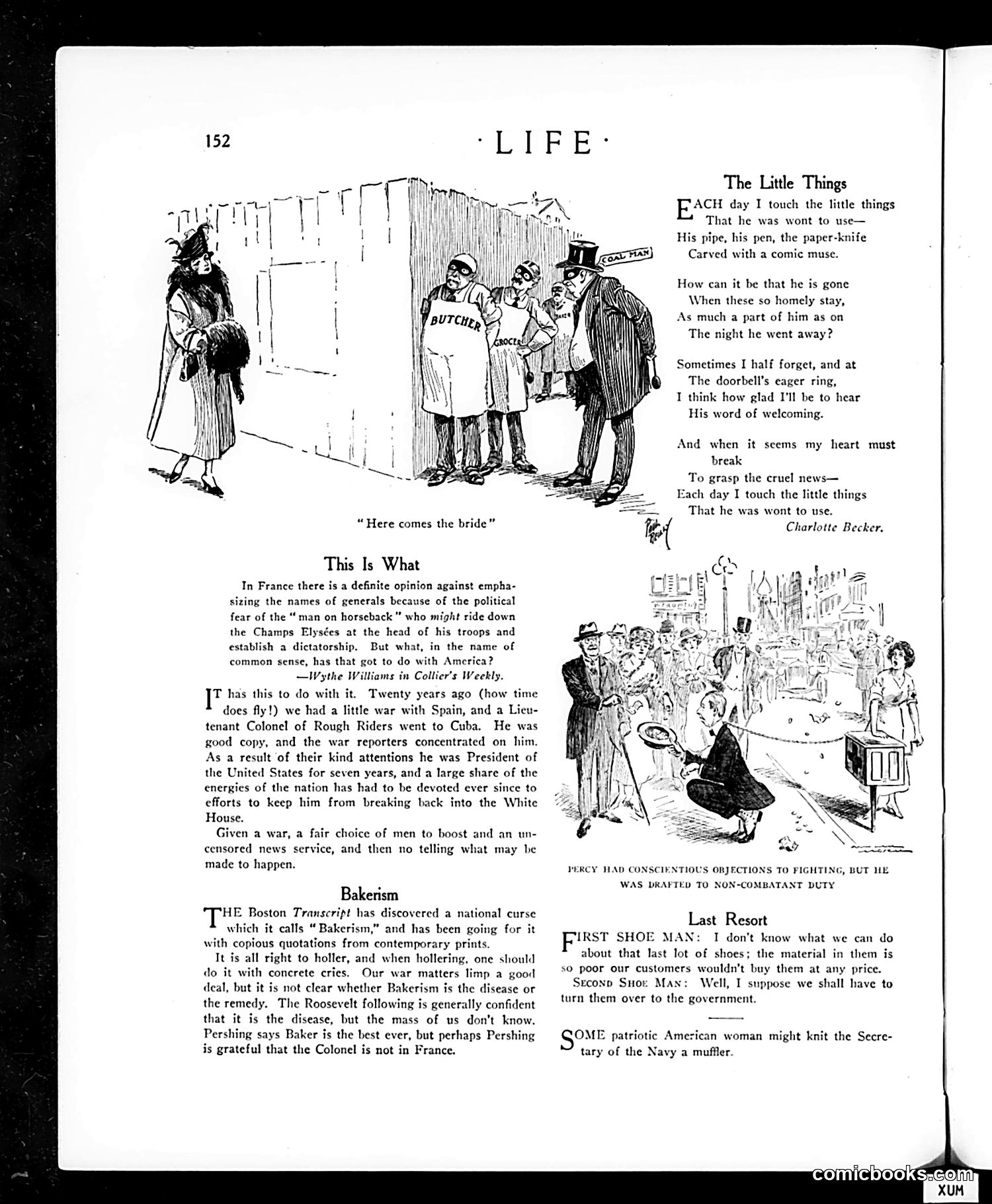
This page contains three distinct pieces of commentary on American politics and World War I: **"This Is What"** attacks Theodore Roosevelt's political dominance. The article references his Spanish-American War fame (as a "Lieutenant Colonel of Rough Riders") leading to his presidency and subsequent influence. The satire warns that uncensored media coverage of military leaders during wartime can inadvertently create political strongmen—alluding to fears that Roosevelt might return to power. The France/dictatorship reference suggests anxiety about militaristic leadership. **"Bakerism"** critiques Newton Baker (likely Secretary of War), debating whether he's the disease or remedy for America's war effort. The tone suggests conflicting opinions about his competence. **The remaining content** includes a sentimental poem about lost loved ones (likely referencing WWI casualties), a cartoon about conscientious objectors drafted to non-combat duty, and a dark joke about shoe manufacturers pawning inferior products to the government—satirizing profiteering during wartime.
📄 Transcribed text from this page (OCR, searchable)
Machine-transcribed from the original scan — historical spelling and the odd misread are preserved.
“Here comes the bride” This Is What In France there is a definite opinion against empha- sizing the names of generals because of the political fear of the “man on horseback" who might ride down the Champs Elysées at the head of his troops and establish a dictatorship. But what, in the name of common sense, has that got to do with America? —Wythe Williams in Collier's Weekly. T has this to do with it. Twenty years ago (how time does fly!) we had a little war with Spain, and a Licu- tenant Colonel of Rough Riders went to Cuba. He was good copy, and the war reporters concentrated on him. As a result of their kind attentions he was President of the United States for seven years, and a large share of the energies of the nation has had to be devoted ever since to efforts to keep him from breaking back into the White House. Given a war, a fair choice of men to boost and an un- censored news service, and then no telling what may be made to happen. Bakerism HE Boston Transcript has discovered a national curse which it calls “Bakerism,” and has been going for it with copious quotations from contemporary prints. It is all right to holler, and when hollering, one should do it with concrete cries. Our war matters limp a good deal, but it is not clear whether Bakerism is the disease or the remedy. The Roosevelt following is generally confident that it is the disease, but the mass of us don’t know. Pershing says Baker is the best ever, but perhaps Pershing is grateful that the Colonel is not in France. The Little Things EA day I touch the little things That he was wont to use— His pipe, his pen, the paper-knife Carved with a comic muse. How can it be that he is gone When these so homely stay, As much a part of him as on The night he went away? Sometimes I half forget, and at The doorbell’s eager ring, I think how glad I'll be to hear His word of welcoming. And when it seems my heart must break To grasp the cruel news— Each day I touch the little things That he was wont to use. Charlotte Becker. oO oe VERCY HAD CONSCIENTIOUS OBJECTIONS TO FIGHTING, BUT HE WAS DRAFTED TO NON-COMBATANT DUTY Last Resort IRST SHOE MAN: I don't know what we can do about that last lot of shoes; the material in them is so poor our customers wouldn't buy them at any price. Seconn Suor Man: Well, I suppose we shall have to turn them over to the government. OME patriotic American woman might knit the Secre- tary of the Navy a muffler.