
Life, 1918-01-24 · page 22 of 40
Life — January 24, 1918 — page 22: what you’re looking at
What you’re looking at
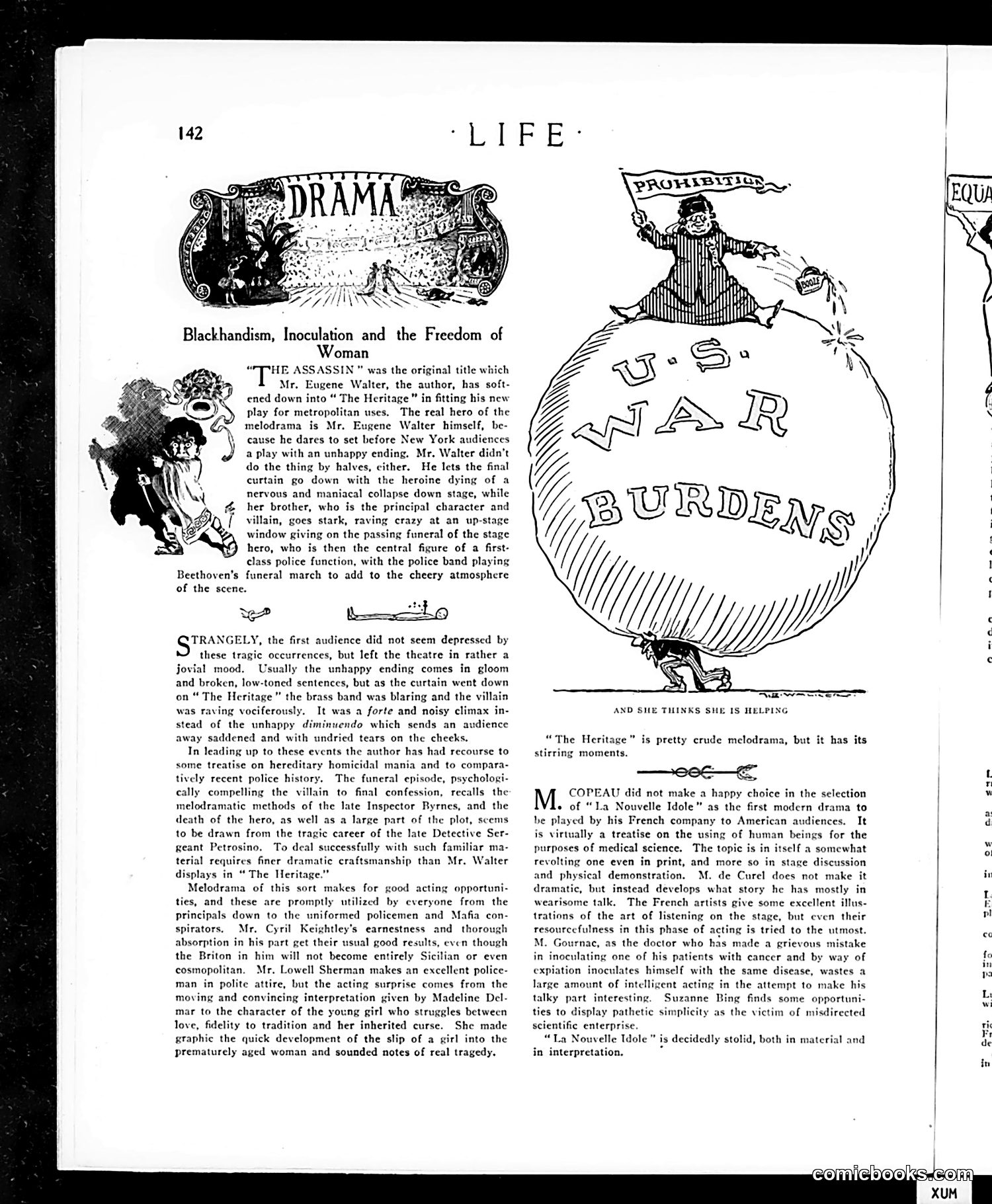
This page reviews theatrical productions, focusing on Eugene Walter's play "The Heritage" (originally titled "The Assassin"). The review discusses the melodrama's dark plot involving hereditary homicidal mania, Mafia conspirators, and a tragic ending where the heroine dies on stage while a villain goes mad—climaxing with a police funeral march rather than traditional tearful denouement. The satirical cartoon depicts Uncle Sam (identifiable by his top hat and striped clothing) sitting atop a large sphere labeled "U.S. WAR BURDENS," holding a "PROHIBITION" banner. A small figure beneath pushes the burden upward, captioned "AND SHE THINKS SHE IS HELPING." This appears to satirize how Prohibition—likely supported by women's reform movements—adds to America's governmental and social burdens rather than solving problems. The page also briefly mentions a French play "La Nouvelle Idole" that the reviewer finds tediously focused on medical ethics discussions rather than drama.
📄 Transcribed text from this page (OCR, searchable)
Machine-transcribed from the original scan — historical spelling and the odd misread are preserved.
Blackhandism, Inoculation and the Freedom of Woman “THE ASSASSIN ” was the original title which Mr. Eugene Walter, the author, has soft- ened down into “ The Heritage” in fitting his new play for metropolitan uses. The real hero of the melodrama is Mr. Eugene Walter himself, be- cause he dares to set before New York audiences a play with an unhappy ending. Mr. Walter didn’t do the thing by halves, cither. He lets the final curtain go down with the heroine dying of a nervous and maniacal collapse down stage, while her brother, who is the principal character and villain, goes stark, raving crazy at an up-stage window giving on the passing funeral of the stage hero, who is then the central figure of a first- class police function, with the police band playing Beethoven's funeral march to add to the cheery atmosphere of the scene. TRANGELY, the first audience did not seem depressed by these tragic occurrences, but left the theatre in rather a jovial mood. Usually the unhappy ending comes in gloom and broken, low-toned sentences, but as the curtain went down on “ The Heritage” the brass band was blaring and the villain was raving vociferously. It was a forte and noisy climax in- ead of the unhappy diminuendo which sends an audience y saddened and with undried tears on the cheeks. In leading up to these events the author has had recourse to some treatise on hereditary homicidal mania and to compara tively recent police histor: The funeral episode, psycholog' cally compelling the villain to final confession, recalls the melodramatic methods of the late Inspector Byrnes, and the death of the hero, as well as a large part of the plot, scems to be drawn from the tragic career of the late Detective Ser- geant Petrosino, To deal successfully with such familiar ma- terial requires finer dramatic craftsmanship than Mr. Walter displays in “ The Heritage Melodrama of this sort makes for good acting opportuni- ties, and these are promptly utilized by everyone from the principals down to the uniformed policemen and Mafia con- spirators. Mr. Cyril Keightley’s earnestness and thorough absorption in his part get their usual good results, even though the Briton in him will not become entirely Sicilian or even cosmopolitan. Mr. Lowell Sherman makes an excellent police- man in polite attire, but the acting surprise comes from the moving and convincing interpretation given by Madeline Del- mar to the character of the young girl who struggles between love, fidelity to tradition and her inherited curse. She made graphic the quick development of the slip of a girl into the prematurely aged woman and sounded notes of real tragedy, a AND SHE THINKS SHE IS HELPING “The Heritage” is pretty crude melodrama, but it has its stirring moments. ee EE COPEAU did not make a happy choice in the selection « of “La Nouvelle Idole” as the first modern drama to he played by his French company to American audiences. It is virtually a treatise on the using of human beings for the purposes of medical science. The topic is in itself a somewhat revolting one even in print, and more so in stage discussion and physical demonstration. M. de Curel does not make it dramatic, but instead develops what story he has mostly in wearisome talk, The French artists give some excellent illus- trations of the art of listening on the stage, but even their resourcefulness in this phase of acting is tried to the utmost. M. Gournac, as the doctor who has made a grievous mistake in inoculating one of his patients with cancer and by w expiation inocu s himself with the same disease, ws large amount of intelligent acting in the attempt to make his talky part interesting. Suzanne Bing finds some opportuni- ties to display pathetic simplicity as the victim of misdirected scientific enterprise. “La Nouvelle Idole in interpretation, s decidedly stolid, both in material and