
A complete issue · 40 pages · 1917
Life — November 15, 1917
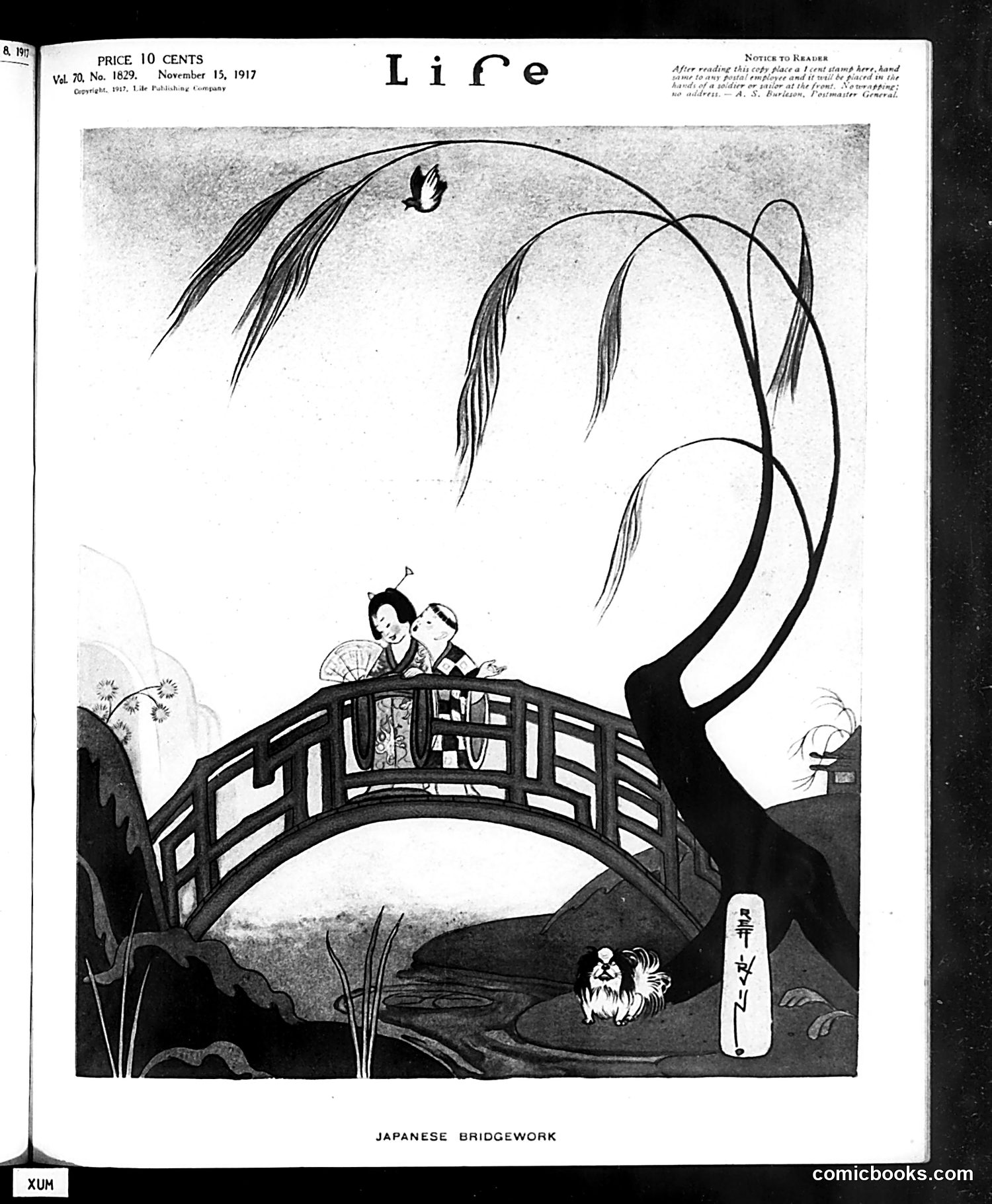
This cartoon satirizes Japanese-American relations during World War I. Two figures (appearing to be a Japanese woman and Western man) stand on an ornate curved bridge overlooking a landscape with a small figure below—likely representing a third party or observer. The title "Japanese Bridgework" suggests the cartoon comments on delicate diplomatic relations or negotiations between Japan and America. The bridge itself—a traditional Japanese structure—symbolizes the fragile connection between the nations. The precarious positioning and the watching figure below suggest unstable political footing. Given the 1917 date, this likely references wartime alliance concerns or trade negotiations between the two powers, though the specific context remains unclear without additional editorial content from that issue.
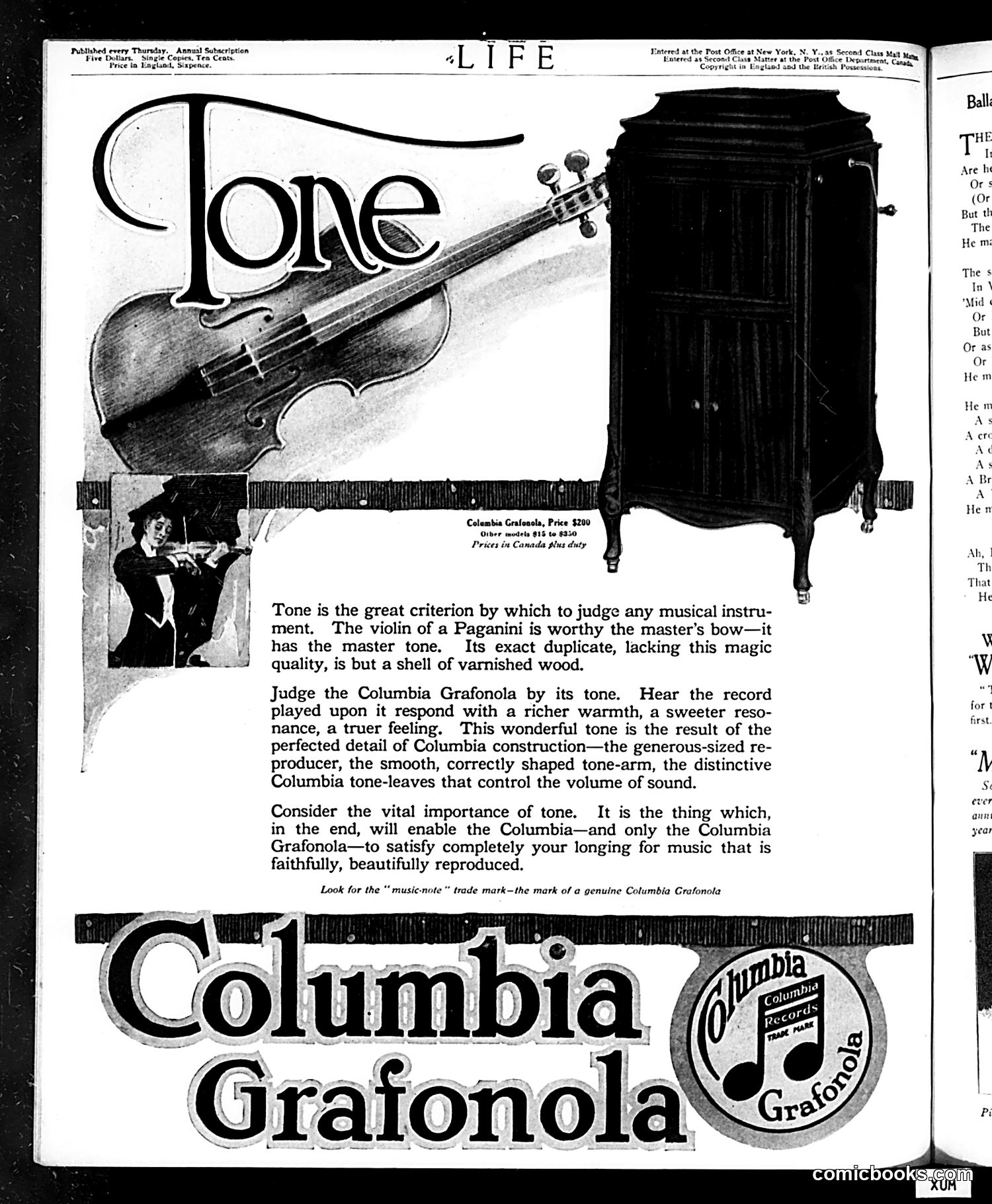
This is primarily a **product advertisement** for the Columbia Grafonola (an early phonograph/record player), not a political cartoon. The page features: - A large illustration of a violin labeled "Tone" at top - An image of the wooden Grafonola cabinet machine - Marketing copy emphasizing sound quality, comparing the phonograph's reproduction to a Paganini violin's tone The advertisement argues that "tone is the great criterion" for judging musical instruments, claiming the Columbia Grafonola achieves superior sound reproduction through superior construction—specifically its "tone-arm" and "tone-leaves." There is **no political satire or social commentary** on this page. It's straightforward early 20th-century product marketing targeting consumers interested in home music reproduction technology.
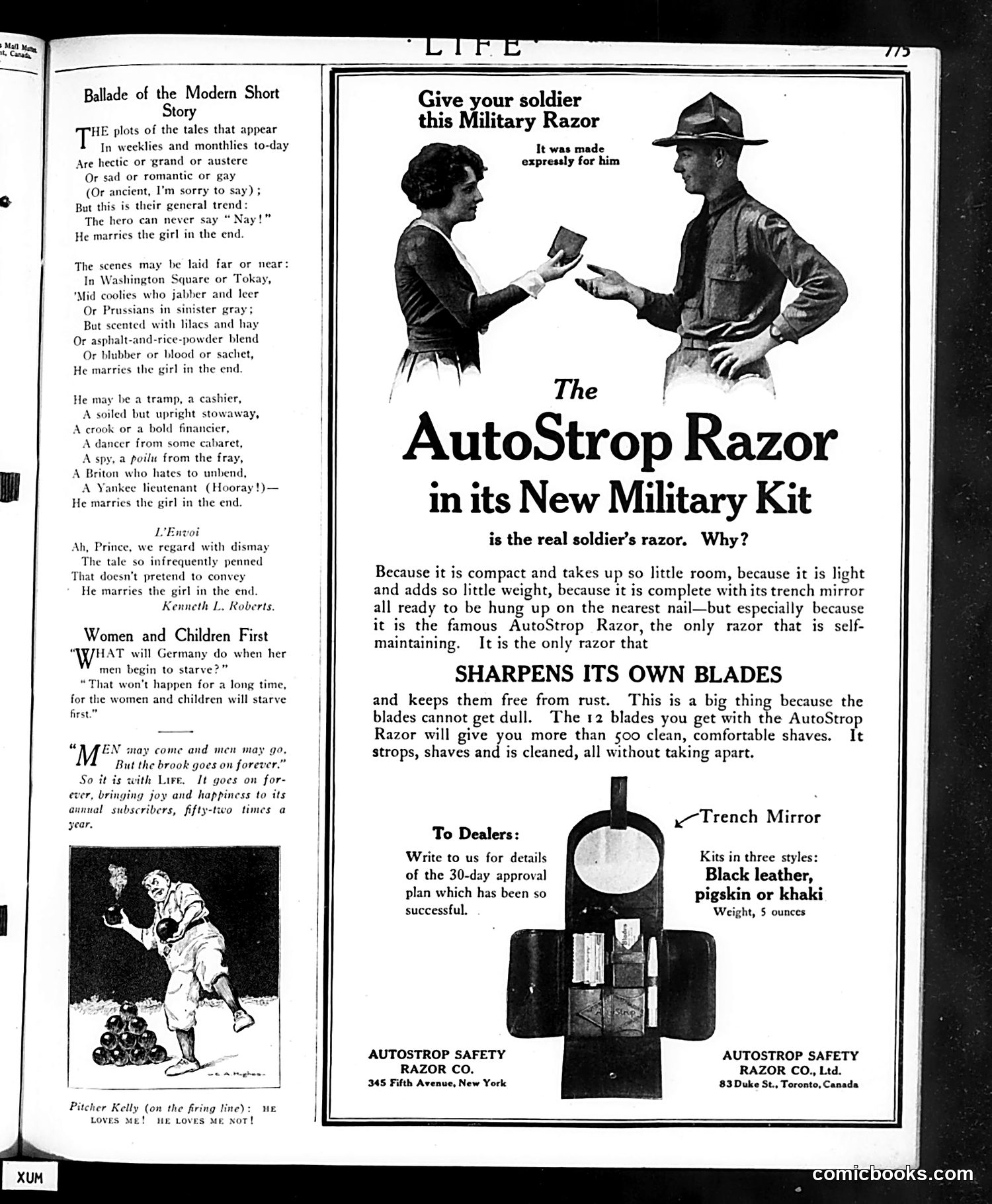
This page contains two distinct sections: **Left side:** A satirical poem titled "Ballad of the Modern Short Story" mocking popular fiction trends. It jokes that regardless of plot details or settings, modern stories always end the same way: "He marries the girl in the end." Below is a section called "Women and Children First" quoting a German statement about starvation during wartime (likely WWI), with an accompanying illustration showing a figure amid destruction. **Right side:** A full-page advertisement for the AutoStrop Military Razor, marketed to soldiers as compact, self-sharpening, and requiring minimal maintenance. The ad features a woman giving the razor to a uniformed soldier. The page juxtaposes cynical commentary on American culture with wartime product marketing, reflecting early 20th-century concerns about both literary conventions and military readiness.
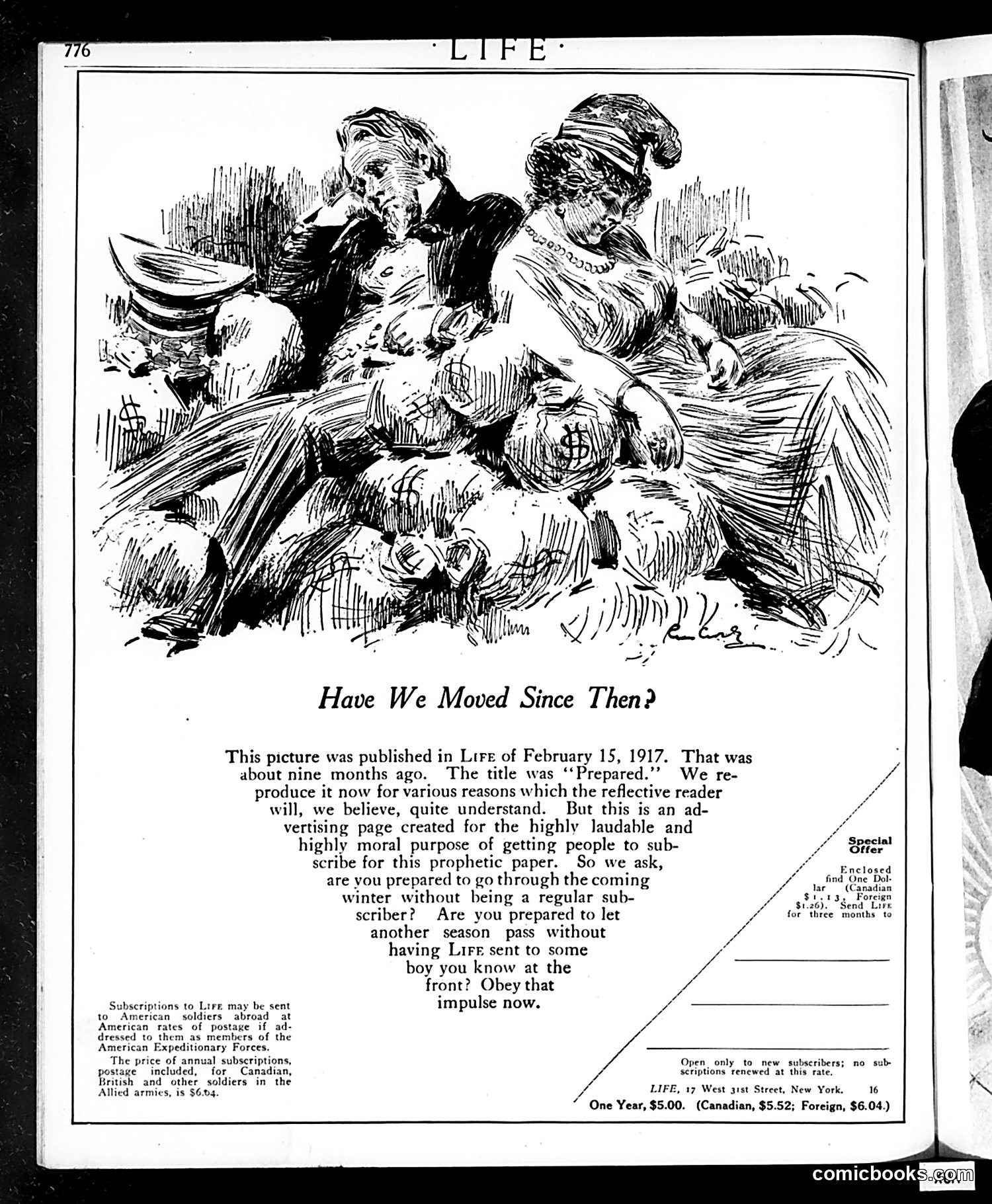
This cartoon reprints a satirical image originally published in Life on February 15, 1917—nine years earlier. The sketch depicts three figures distributing money or valuables to children, likely representing war profiteering or financial exploitation during World War I. By republishing it in 1926, Life poses a pointed question: has American society progressed morally since the war ended? The implication is that similar corruption or exploitation continues in the post-war period. The accompanying text appeals to readers' consciences, urging subscriptions to support the magazine's moral mission. The cartoon critiques persistent inequality and the failure of wartime promises of reform, suggesting that despite the passage of time, systemic problems remain unchanged.
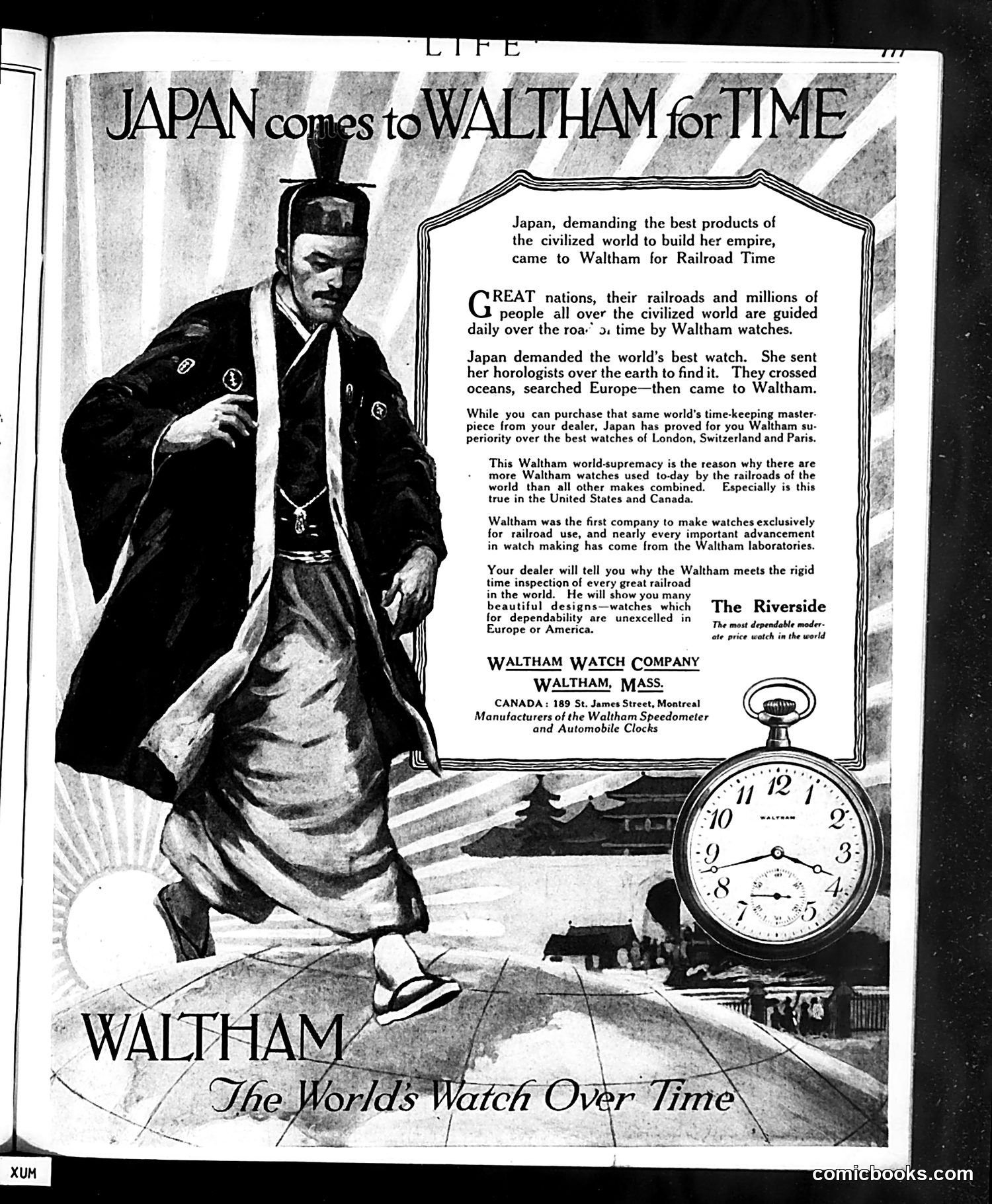
This is primarily a **Waltham Watch Company advertisement**, not a satirical cartoon. The page uses a Japanese figure in traditional dress to market watches, playing on early 20th-century fascination with Japan as a modernizing industrial power. The ad's premise: Japan sought the world's finest watches and chose Waltham, supposedly proving the brand's superiority. This reflects actual historical context—Japan was rapidly industrializing and adopting Western technology around this era. The imagery relies on **Orientalist stereotyping** common to period advertising, depicting Japan as exotic yet materially ambitious. The globe and railroad imagery emphasize Waltham's role in modern commerce and transportation infrastructure globally. The tagline "The World's Watch Over Time" positions Waltham as indispensable to international progress and industrial timekeeping.
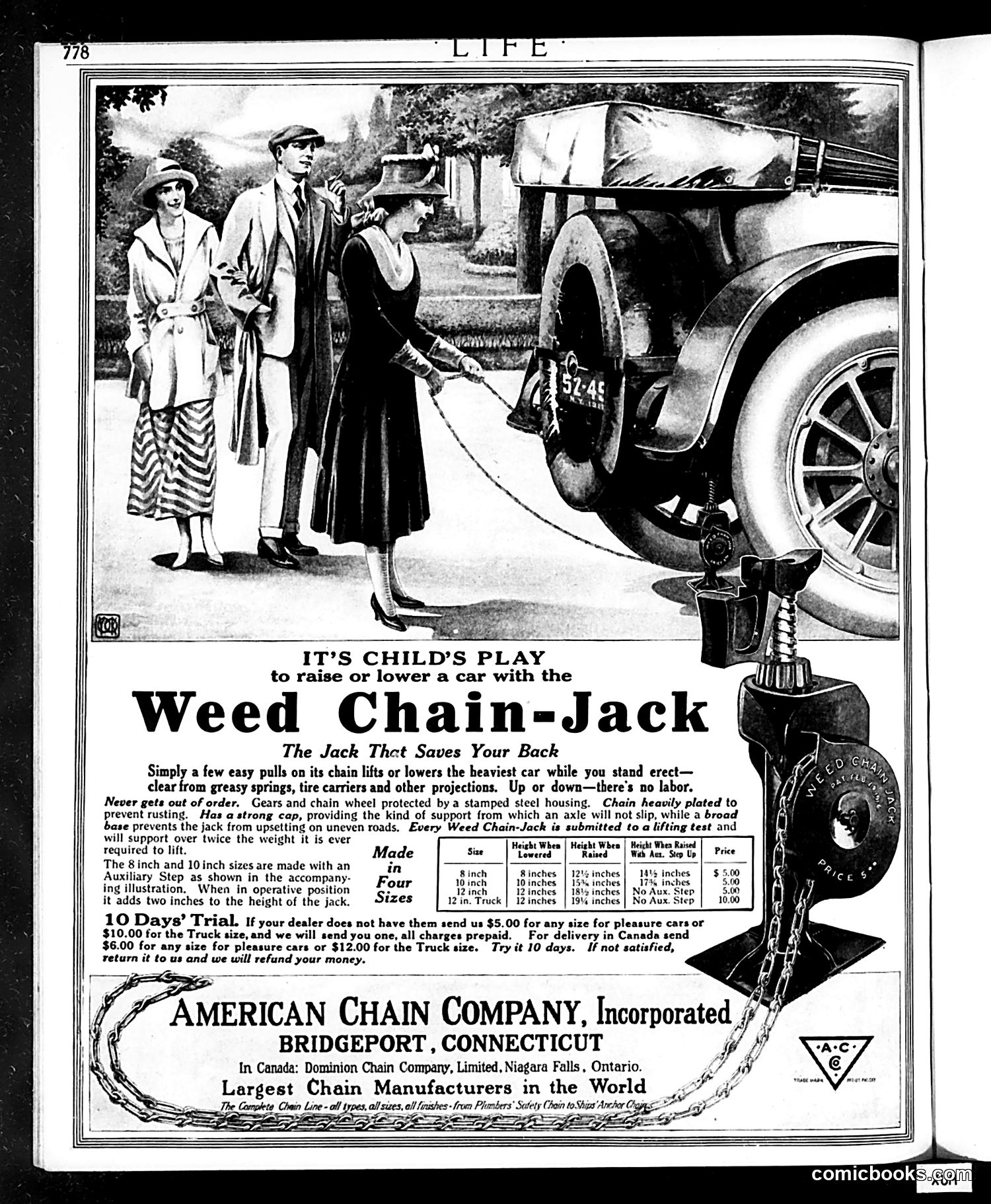
This page is **primarily an advertisement**, not political satire. It promotes the "Weed Chain-Jack," a mechanical device for raising or lowering automobiles. The advertisement uses a humorous social scenario rather than satire: it depicts well-dressed people (appearing to be from the 1920s based on clothing and the car style) operating the jack, with the tagline "It's Child's Play." The joke is that raising a car requires no physical effort—even a woman in formal dress can do it easily while standing upright, without getting dirty or strained. This reflects early 20th-century attitudes about gender and labor: the ad's humor relies on the notion that women shouldn't have to perform heavy mechanical work. The product is positioned as a modern convenience that eliminates back-breaking effort for all users.
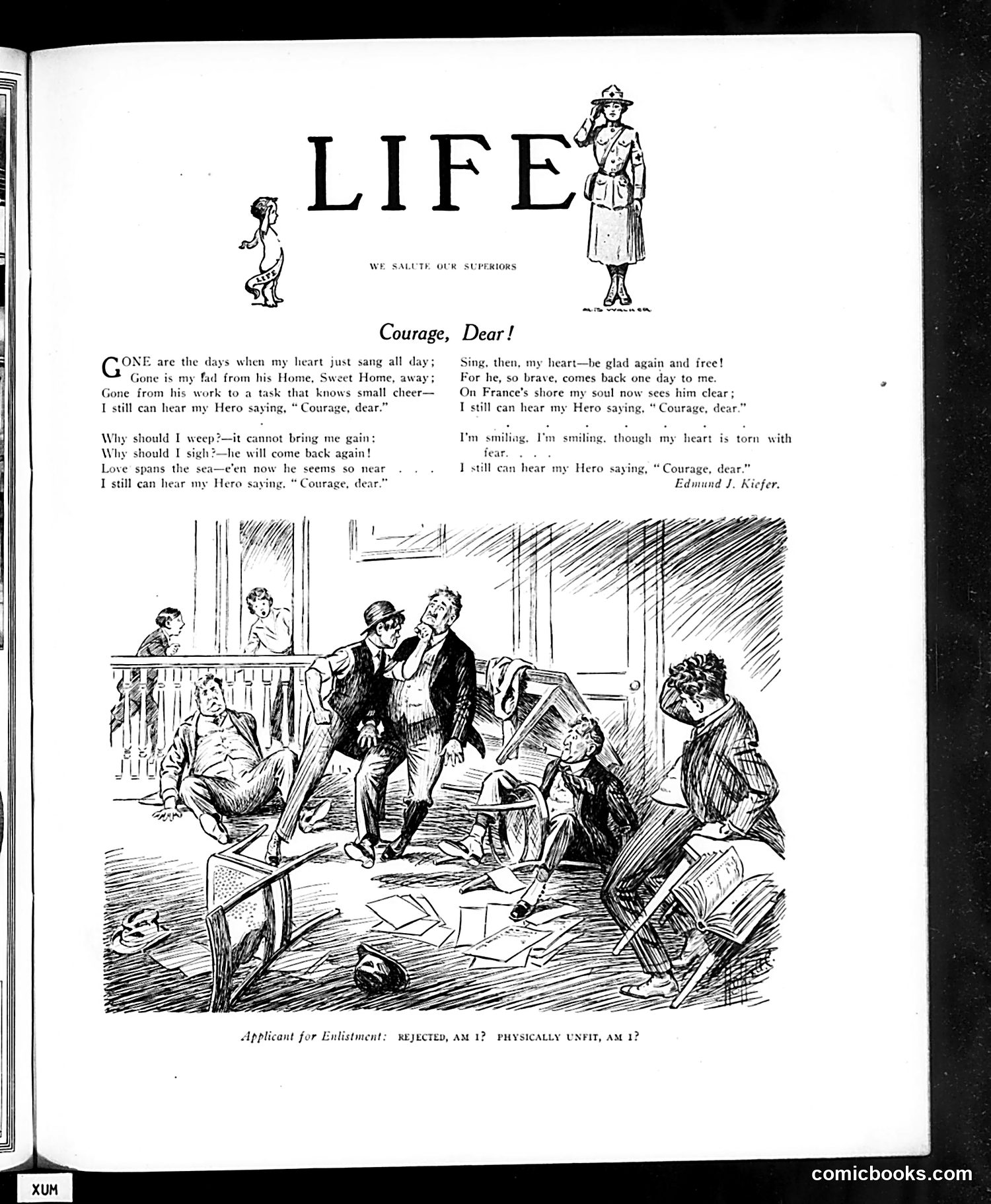
This page presents a patriotic poem by Edmund Kiefer titled "Courage, Dear!" addressing someone (likely a soldier) departing for military service, presumably during World War I given the historical context of Life magazine. The satirical cartoon below depicts a military recruitment or conscription scene. An official appears to be rejecting an applicant, declaring him "REJECTED, AM I? PHYSICALLY UNFIT, AM I?" The figures surrounding him—appearing disheveled and desperate—suggest men anxious about or struggling with military acceptance standards. The satire likely mocks the tension between patriotic calls for service and the physical examination process that determined eligibility. It contrasts the emotional rhetoric of courage with the bureaucratic reality of fitness assessments, poking fun at both recruiting protocols and applicants' reactions to rejection or acceptance.
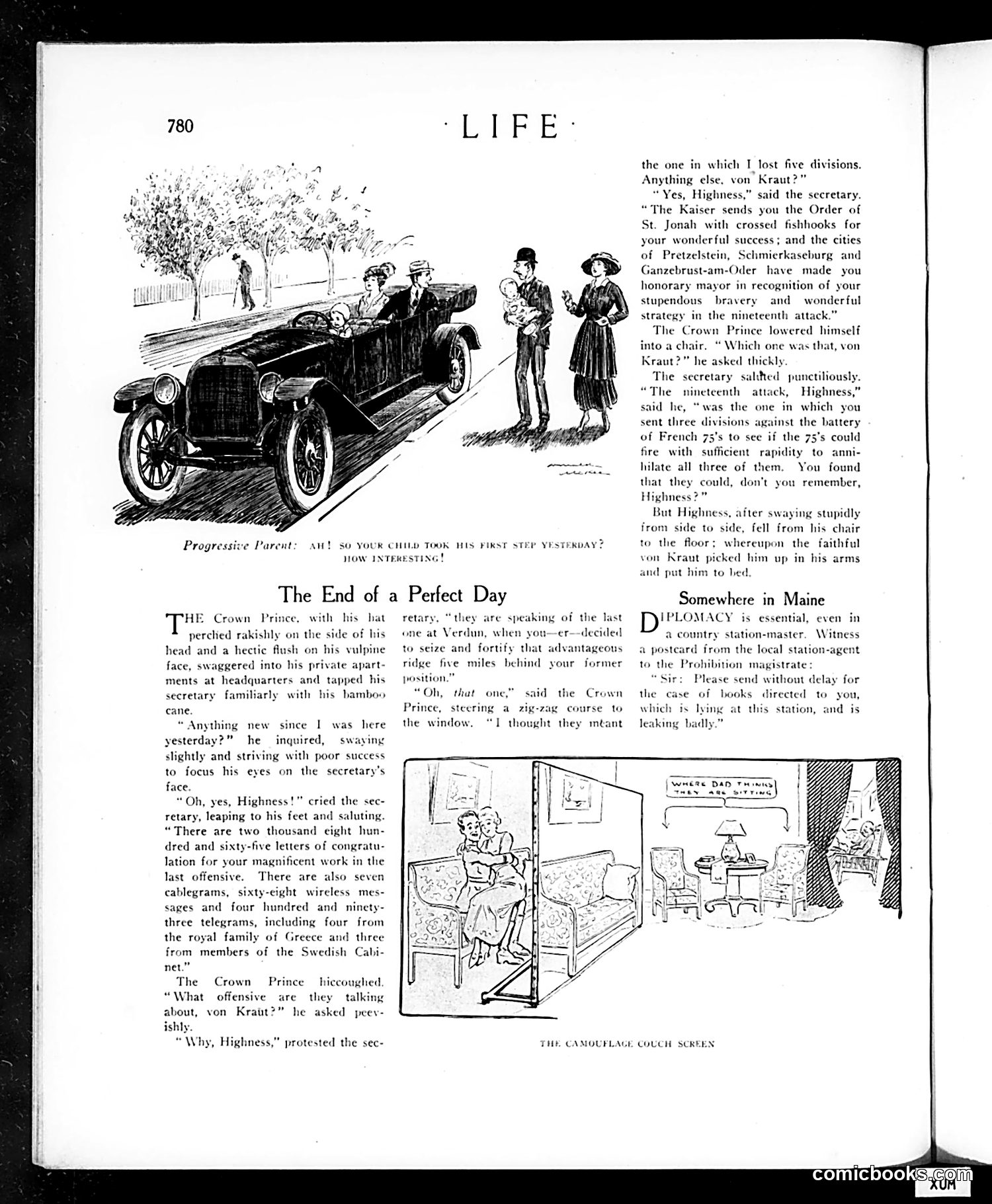
This page contains two distinct pieces: **Top illustration**: A satirical cartoon titled "Progressive Parent" showing a father proudly presenting his young child taking a first step, suggesting modern parenting celebrates even mundane developmental milestones as noteworthy achievements. **Main story/cartoon**: "The End of a Perfect Day" features the Crown Prince (appears to be Austro-Hungarian royalty based on context clues) receiving congratulations for military victories. The secretary recounts offensive operations—attacks on French battery positions and divisions—presented as accomplishments. The cartoon satirizes militarism and the pride taken in warfare, portraying military success as a leisurely accomplishment worthy of celebration, similar to the "progressive parent" celebrating a child's first step. The humor lies in comparing trivial achievements to serious warfare.
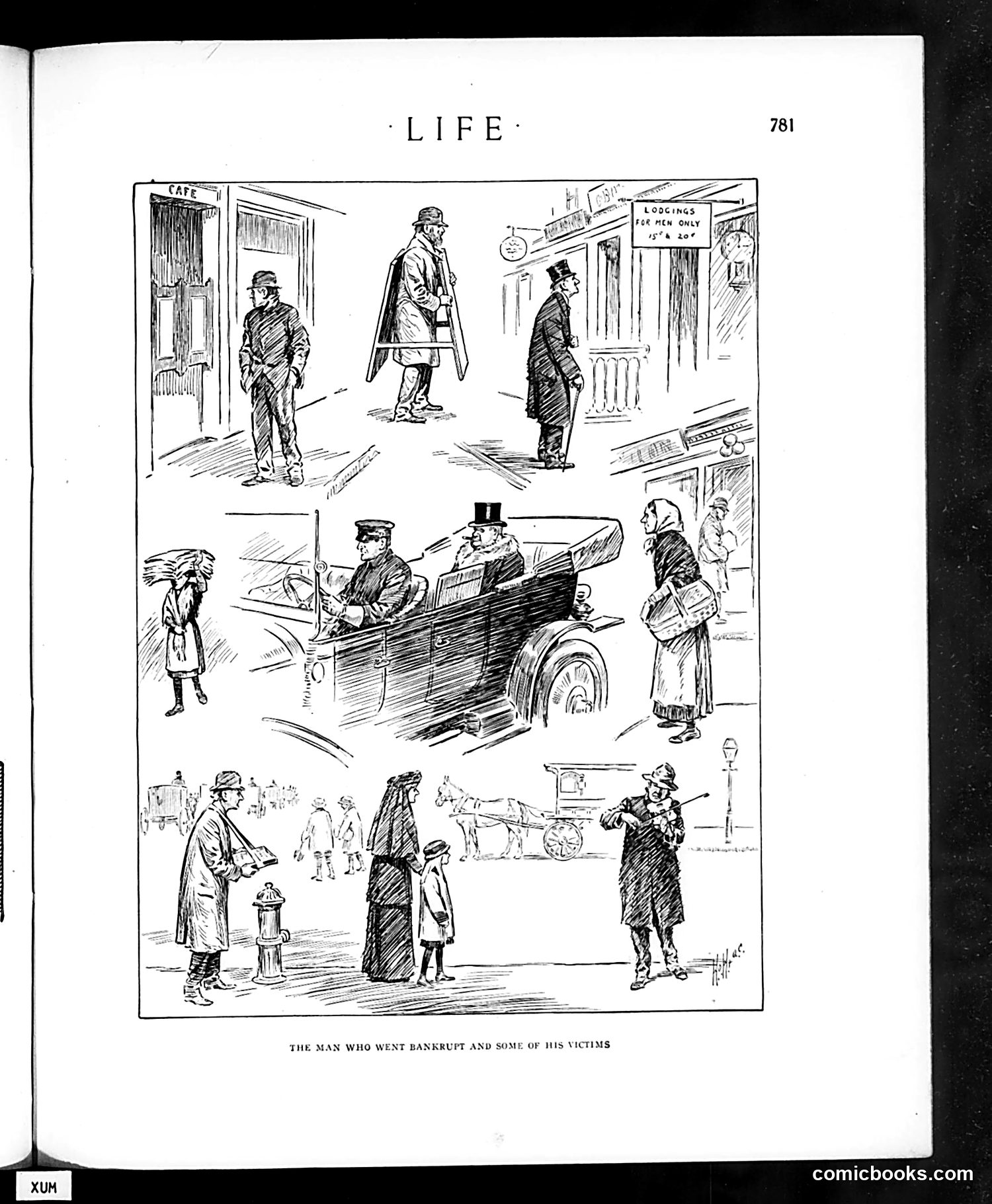
This satirical cartoon depicts the social consequences of a man's financial collapse. The upper panels show various creditors and business associates confronting the bankrupt man in different settings—a café, lodgings, and a street—each representing different unpaid debts or broken business relationships. The lower panels illustrate the human cost: a woman with a child by a fire hydrant, a widow in mourning clothes with a young child, and a man in distress, apparently representing dependents or people economically harmed by the bankruptcy. The satire critiques how financial ruin by one person cascades into hardship for vulnerable populations—particularly women and children—who had no control over the failed business decisions but suffer the consequences.
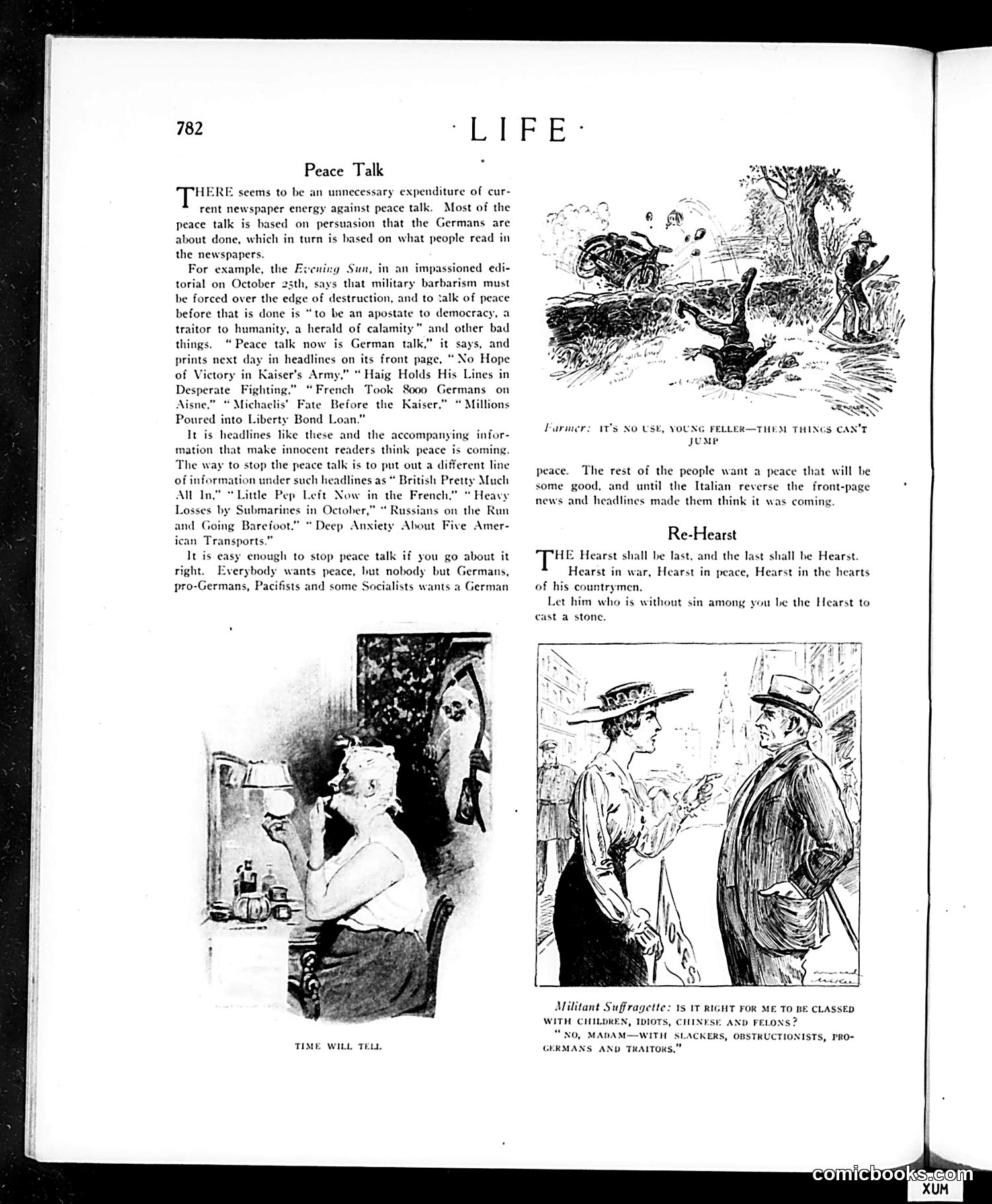
This page satirizes WWI-era "peace talk" propaganda. The text argues that newspapers exaggerate peace rumors, citing sensational headlines about German surrender and Allied victories. The author contends that only Germans, pro-Germans, Pacifists, and Socialists actually want a German-negotiated peace—implying such desire is unpatriotic. The cartoons illustrate this theme: - "Time Will Tell" shows a figure watching their reflection, suggesting patience will reveal truth - "Farmer: It's No Use, Young Feller—Them Things Can't Jump" depicts rural skepticism about peace prospects - "Militant Suffragette" portrays a woman dismissing German sympathizers as traitors, equating pacifism with supporting the enemy The page reflects American pro-war sentiment and suspicion of peace advocates during WWI.
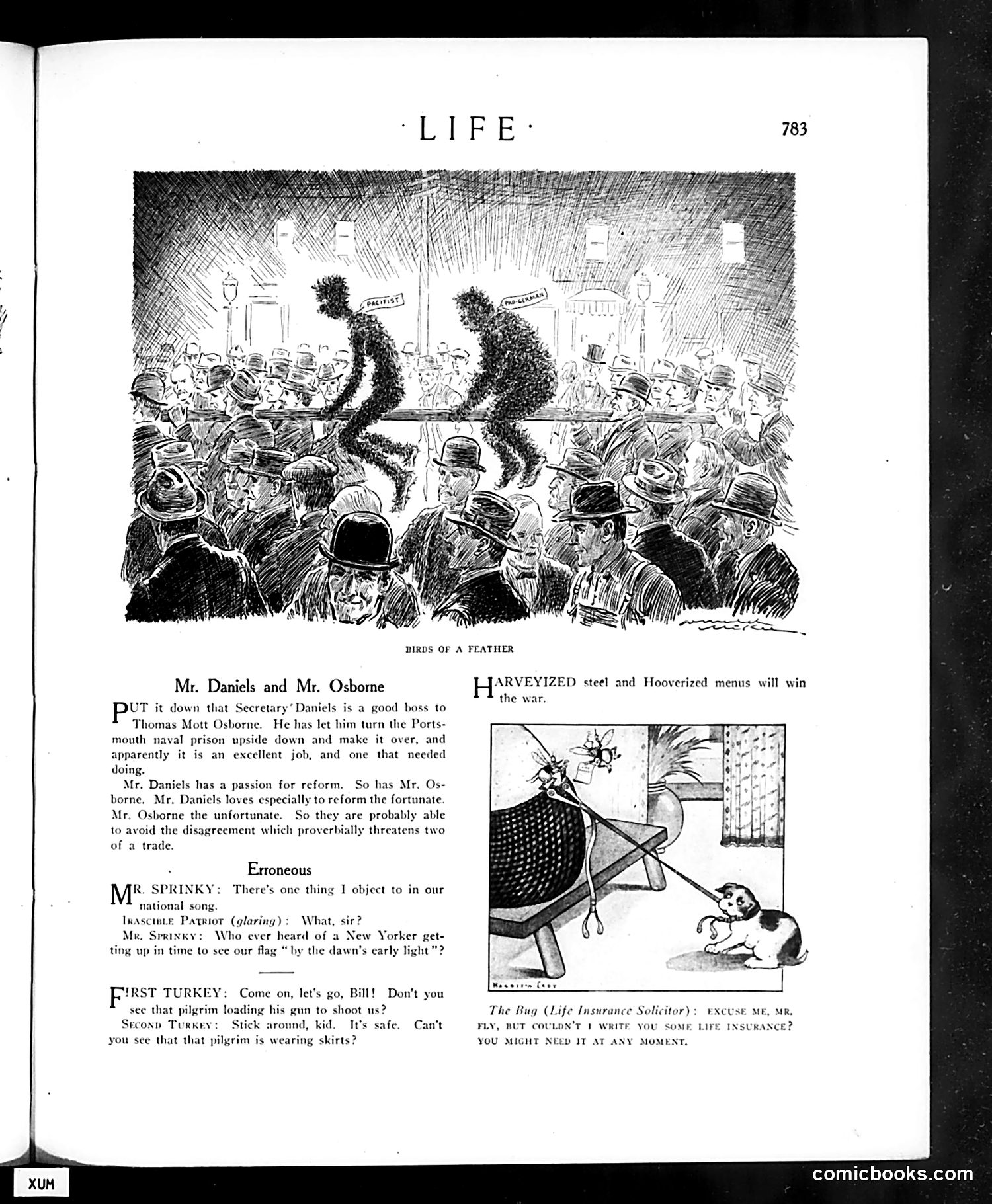
**Top Cartoon ("Birds of a Feather")**: Depicts two figures walking a tightrope above a crowded street scene. The cartoon illustrates the article about Mr. Daniels and Mr. Osborne, apparently naval administrators reforming Portsmouth prison. The "tightrope" metaphor suggests they walk a precarious line between reform efforts and avoiding professional conflict—they must "avoid the disagreement which proverbially threatens two of a trade." **Bottom Cartoon ("The Bug")**: Shows a life insurance solicitor as a bug attempting to interest a sleeping pilgrim in life insurance. The joke plays on the solicitor as an irritating "bug" and the pilgrim's dismissal that he doesn't need insurance "at any moment"—dark humor about mortality and persistent salesmanship. Both pieces use visual metaphor to satirize institutional and commercial pressures of early 20th-century American life.
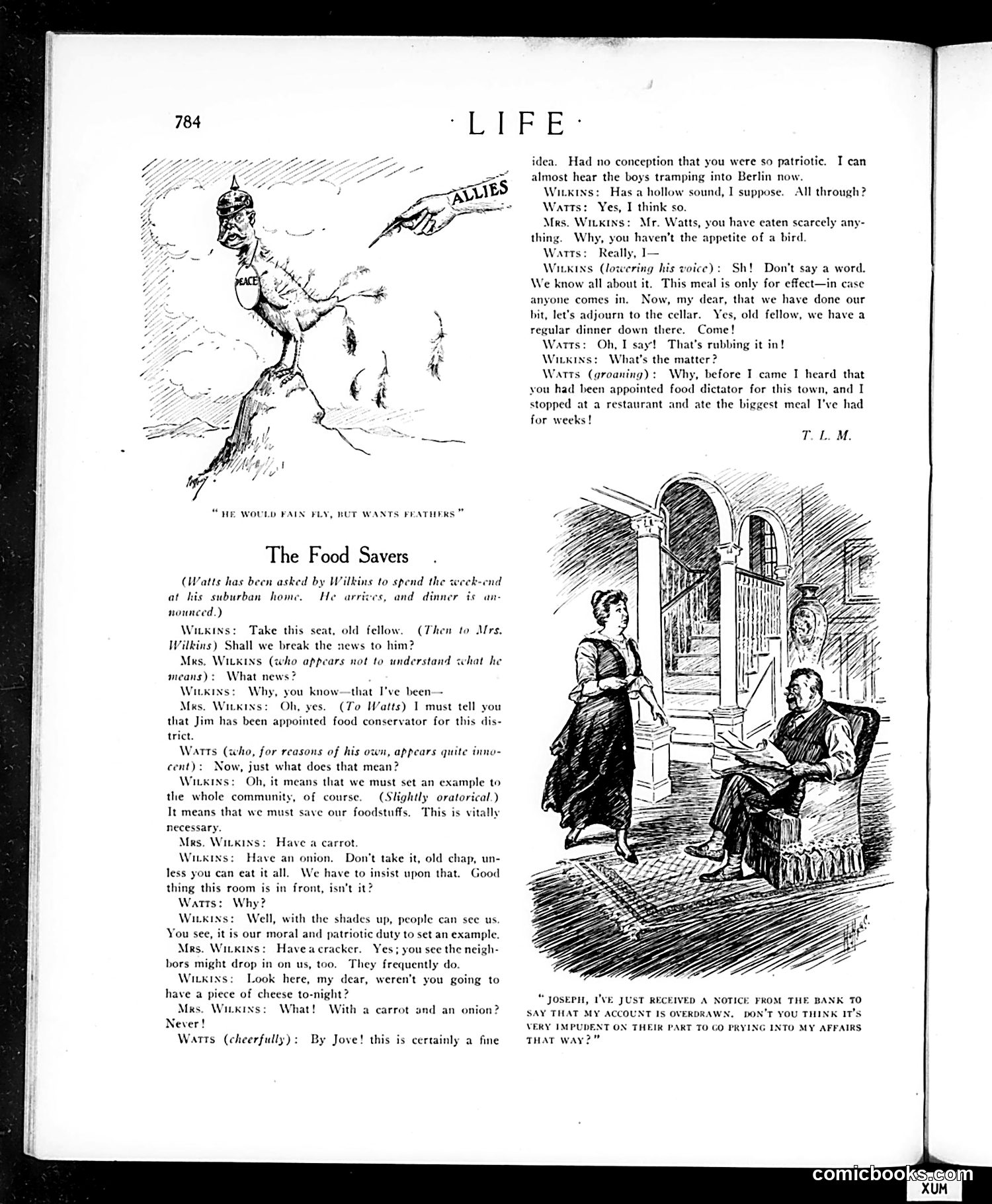
This sketch satirizes wartime food conservation efforts. Wilkins, apparently a food conservationist appointed to enforce rationing in his district, visits his suburban home and insists on an austere meal—just carrot and onion—to set a patriotic example for the community. The humor lies in the hypocrisy: Wilkins claims moral duty requires visible sacrifice, yet his wife reveals he'd recently eaten lavishly at restaurants for weeks. The top cartoon shows a German soldier labeled "ALLIES," mocking the notion that eating less helps the war effort. The satire critiques both self-righteous wartime moralizing and the gap between public virtue-signaling and private excess during food rationing—a real concern during World War I.
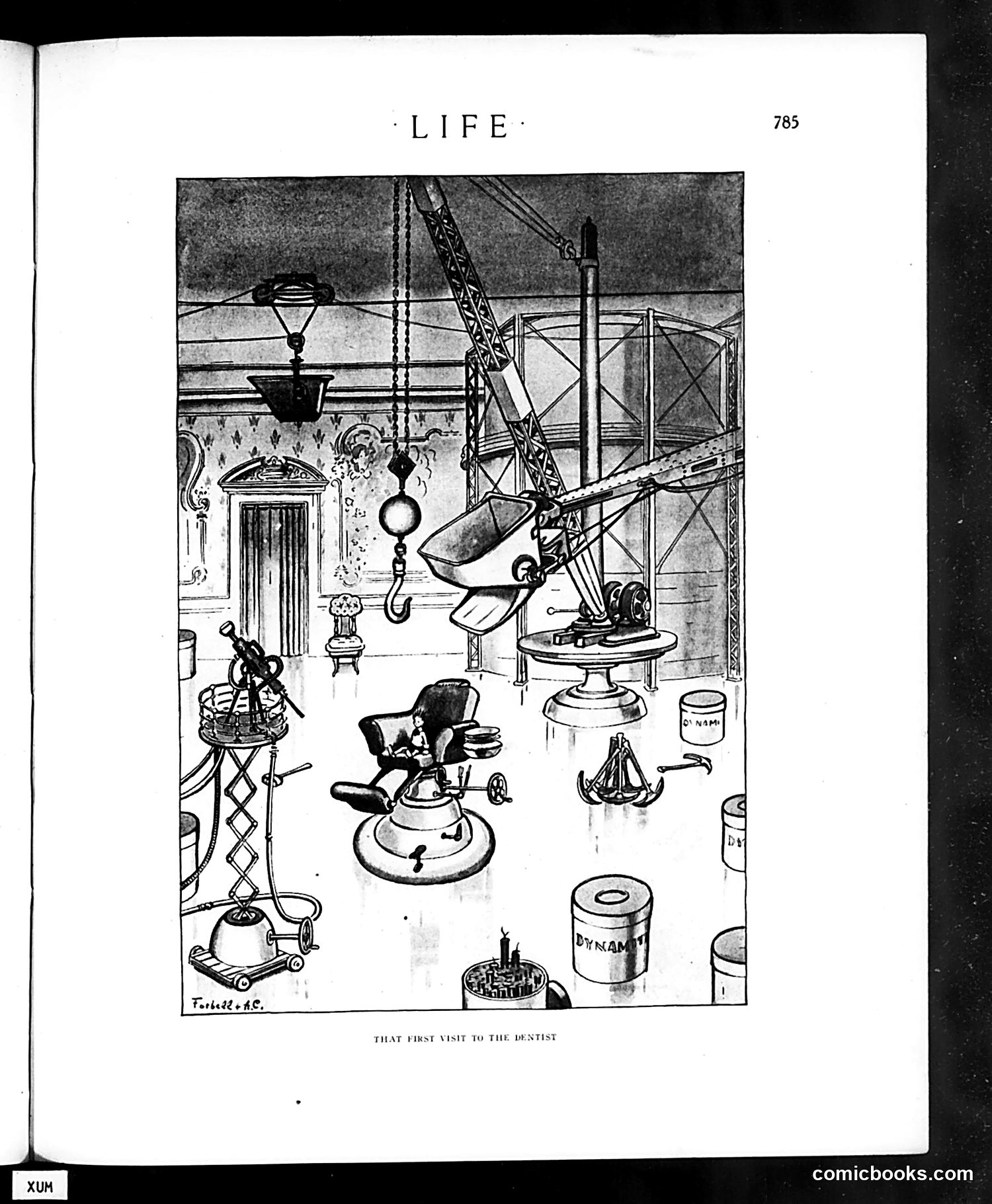
This is a satirical illustration depicting a dentist's office filled with an absurd array of mechanical contraptions and equipment. The cartoon shows exaggerated, intimidating dental apparatus—pulleys, chains, drills, and various industrial-looking devices—creating a chaotic, almost torture-chamber atmosphere. The humor targets dental anxiety, a common fear. By rendering the dentist's office as an overcomplicated, mechanical nightmare filled with unnecessary gadgetry, the artist mocks both the genuine fear patients have of dental visits and perhaps also satirizes the era's rapid technological advancement and dentists' tendency to showcase newfangled equipment. The caption emphasizes this is the "first visit," suggesting the patient's innocent terror at encountering this bewildering mechanical landscape.
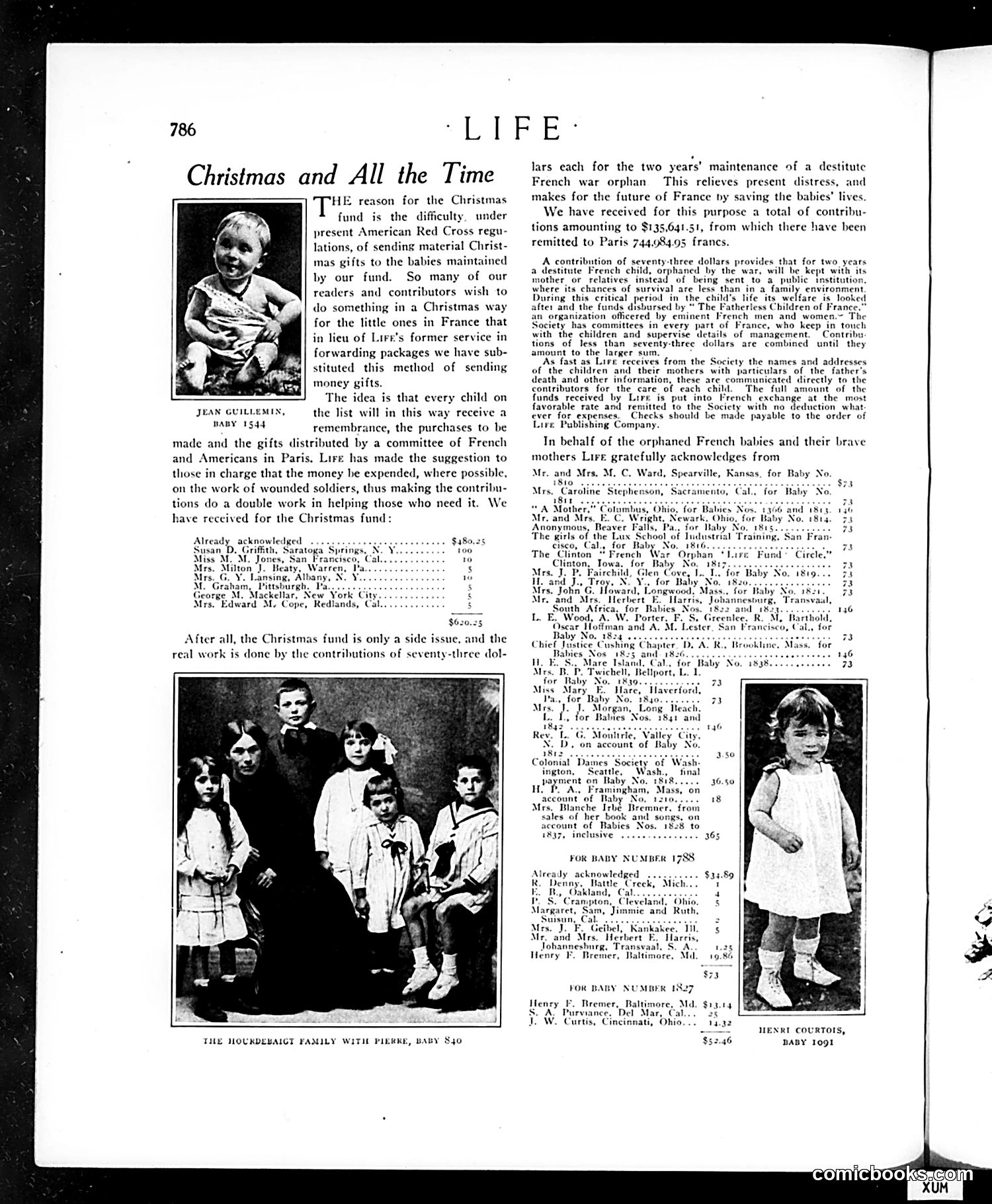
This page is **not a political cartoon** but rather a charitable appeal. The main content describes "Christmas and All the Time," a LIFE magazine fundraising effort for French war orphans during or after World War I. The two photographs show: 1. **The Houlbreght family with Pierre, Baby 840** — a French orphan being supported through the program 2. **Henri Courtois, Baby 1091** — another orphan child The text explains that contributors donate money (as little as $73 for two years) to support French children orphaned by war. The appeal emphasizes survival rates are better in institutional care than in families with limited resources. This represents early 20th-century American humanitarian aid to war-devastated Europe, presented as feel-good donor recognition.
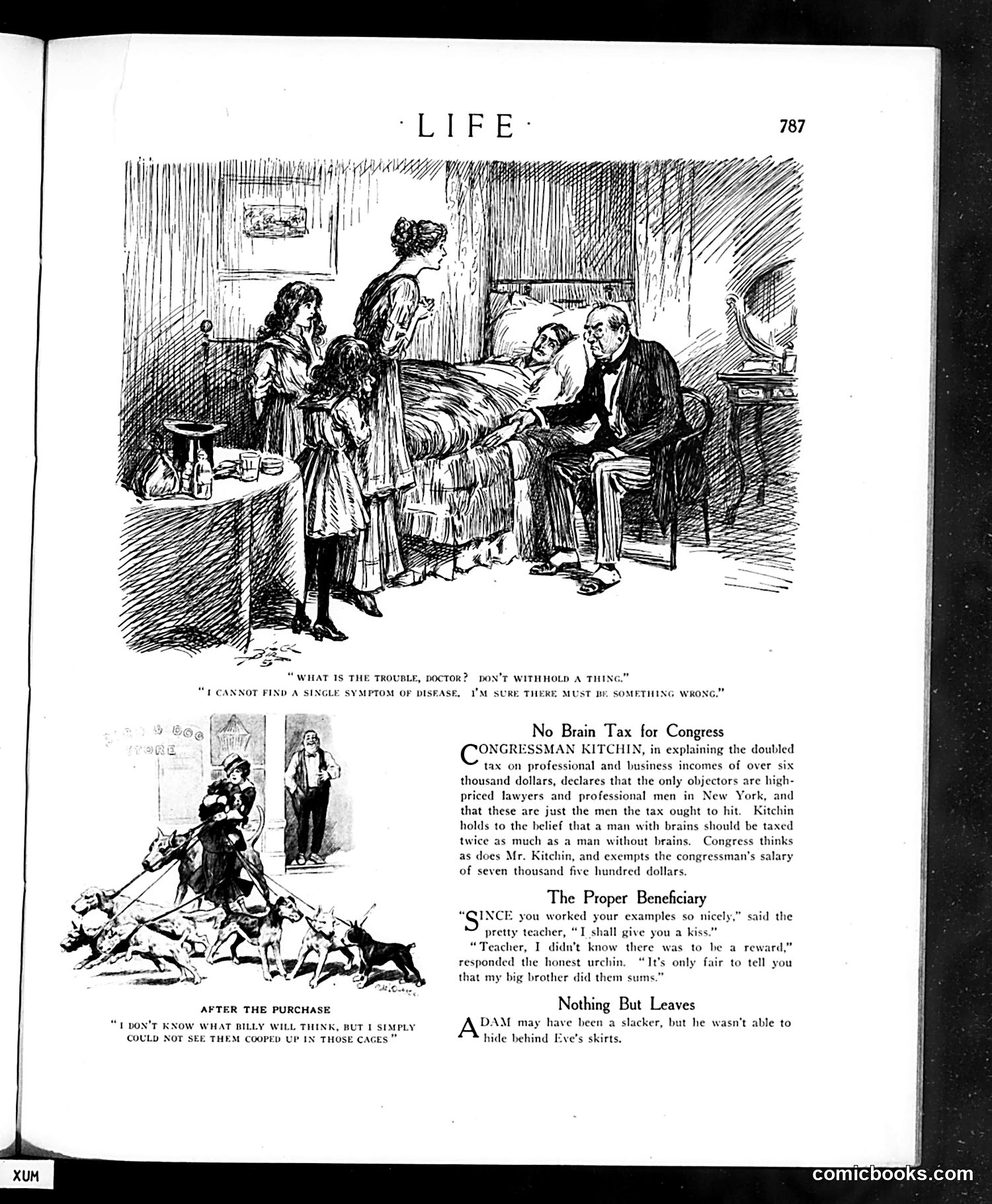
**Top cartoon:** A doctor examines a bedridden patient while family members look on. The caption reads: "What is the trouble, doctor? Isn't withhold a thing. I cannot find a single symptom of disease. I'm sure there must be something wrong." This satirizes hypochondriacs—people convinced they're ill despite medical evidence to the contrary. **"No Brain Tax for Congress":** Political commentary on Congressman Kitchin's proposal to tax professional incomes higher for those "with brains." The satirist argues this unfairly targets educated professionals while exempting congressmen, whose "salary of seven thousand five hundred dollars" goes untaxed—implying Congress lacks the intellect to be so taxed. **Bottom section:** Two brief humorous anecdotes about reward-seeking and Adam's disadvantage relative to Eve.
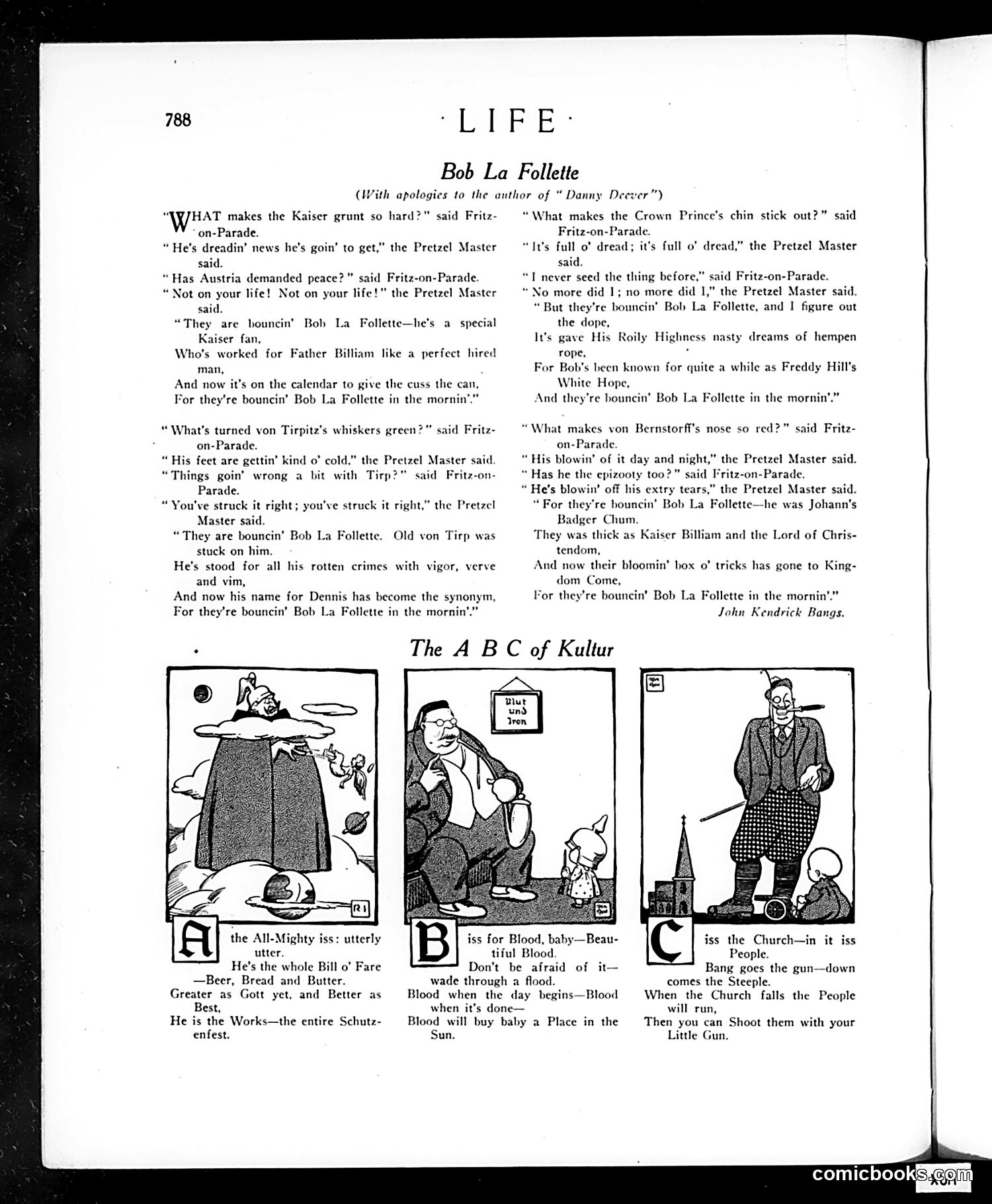
This page contains two distinct satirical pieces attacking Germany and its American sympathizers during World War I. **"Bob La Follette"** is a poem (credited to John Kendrick Bangs) mocking Senator Robert La Follette, a prominent isolationist and anti-war advocate. The satire presents German leaders (the Kaiser, Crown Prince, von Tirpitz, von Bernstorff) celebrating La Follette as their "special Kaiser fan" and "hired man"—implying he unwittingly serves German interests. His political defeat ("bouncin'") delights the Germans, suggesting his anti-war stance aligned with enemy goals. **"The ABC of Kultur"** is a three-panel cartoon brutally satirizing German militarism and ideology as "culture." It depicts: - **(A)** German militarism as grotesque excess - **(B)** Glorification of bloodlust and violence as national virtue - **(C)** The Church as merely a target for destruction and population control The piece portrays German "kultur" as fundamentally barbaric—equating it with militarism, bloodshed, and tyranny rather than civilization.
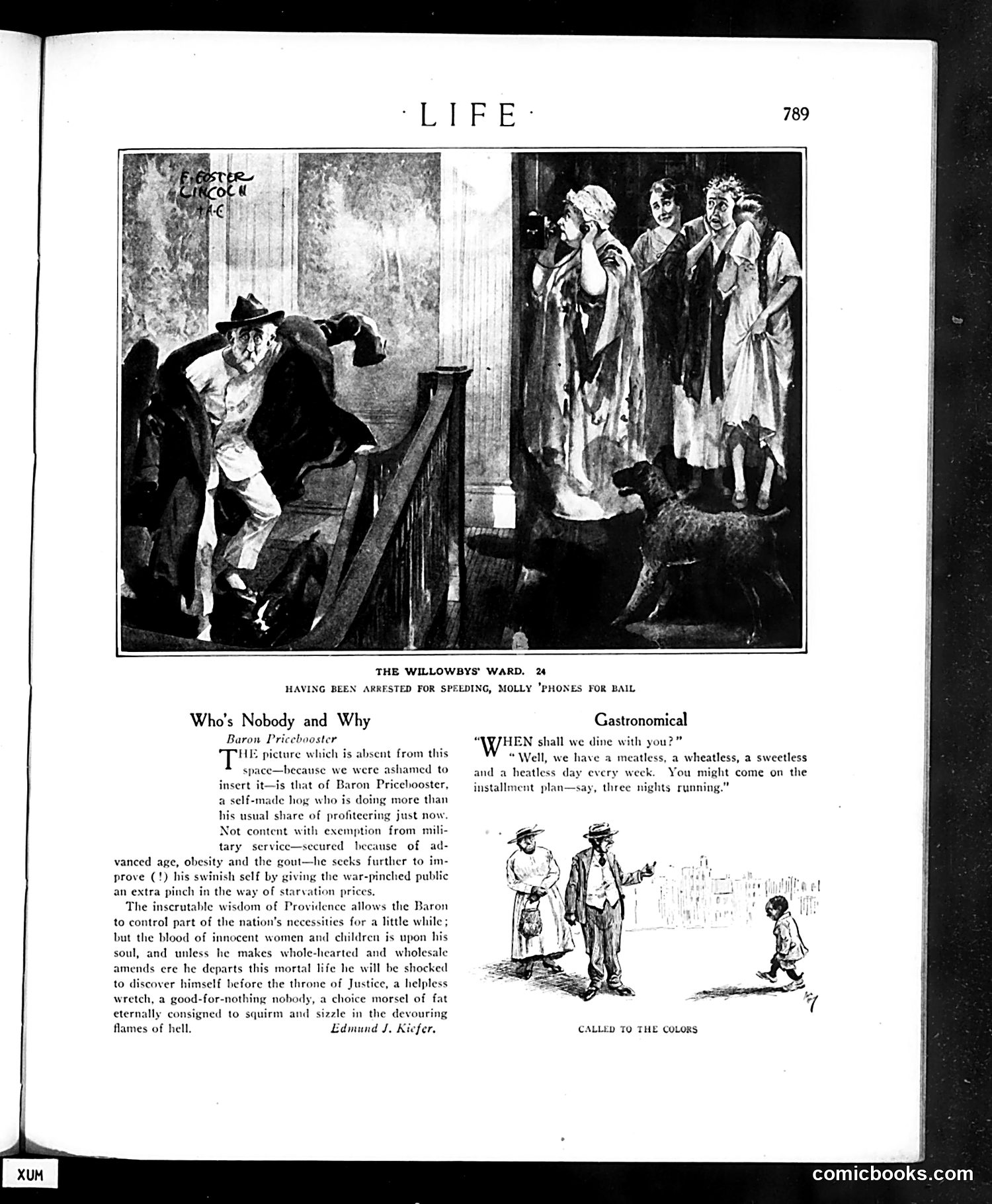
This page contains two distinct satirical pieces from Life magazine during WWI. **"Who's Nobody and Why"** attacks Baron Pricebooster, a profiteer exploiting wartime food shortages. The text condemns him as a self-made businessman avoiding military service through age and obesity while price-gouging the hungry public. The moral critique is severe—he's depicted as damned unless he makes amends, destined for hell as punishment for profiting off civilian suffering during wartime. **"Gastronomical"** is a brief joke about rationing during the war. The humor plays on food restrictions—"meatless," "wheatless," "sweetless," and "heatless" days were actual government conservation measures. The punchline suggests dining on an "installment plan" spread across three nights because portions are so meager each night provides only one course of a full meal. Both pieces reflect WWI-era anxieties: food scarcity, profiteering, and sacrifice. The Baron represents widespread anger at those exploiting national hardship.
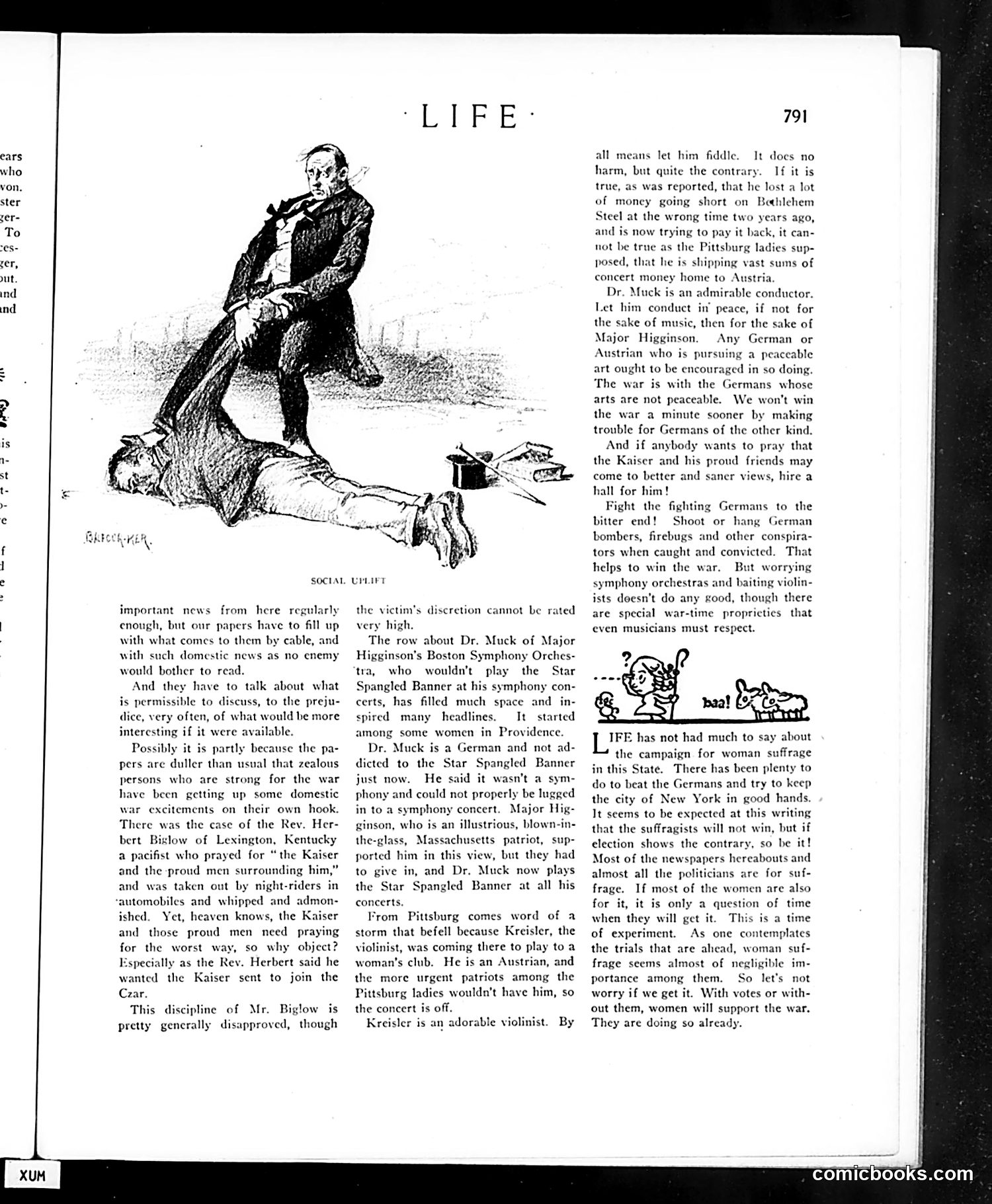
This editorial cartoon and accompanying text satirize American wartime hysteria during World War I. The central image shows a man standing triumphantly over a prostrate figure, illustrating the piece's critique of domestic persecution disguised as patriotism. The text discusses three cases: Rev. Herbert Bislow, a Kentucky pacifist whipped by vigilantes for praying for the Kaiser; Dr. Karl Muck, a German conductor forced to play the Star-Spangled Banner at Boston Symphony concerts despite his objection that it wasn't a symphony; and violinist Fritz Kreisler, an Austrian whose Pittsburgh concert was canceled by patriotic women. Life's satirical point: persecuting German and Austrian artists and clergy helps the war effort not at all, while actual German "conspirators" and "bombers" deserve fighting. The magazine mocks the disconnect between genuine military threat and civilian mob-driven "patriotism" that targets harmless cultural figures simply for their nationality—a critique of intolerant nationalism masked as war support.
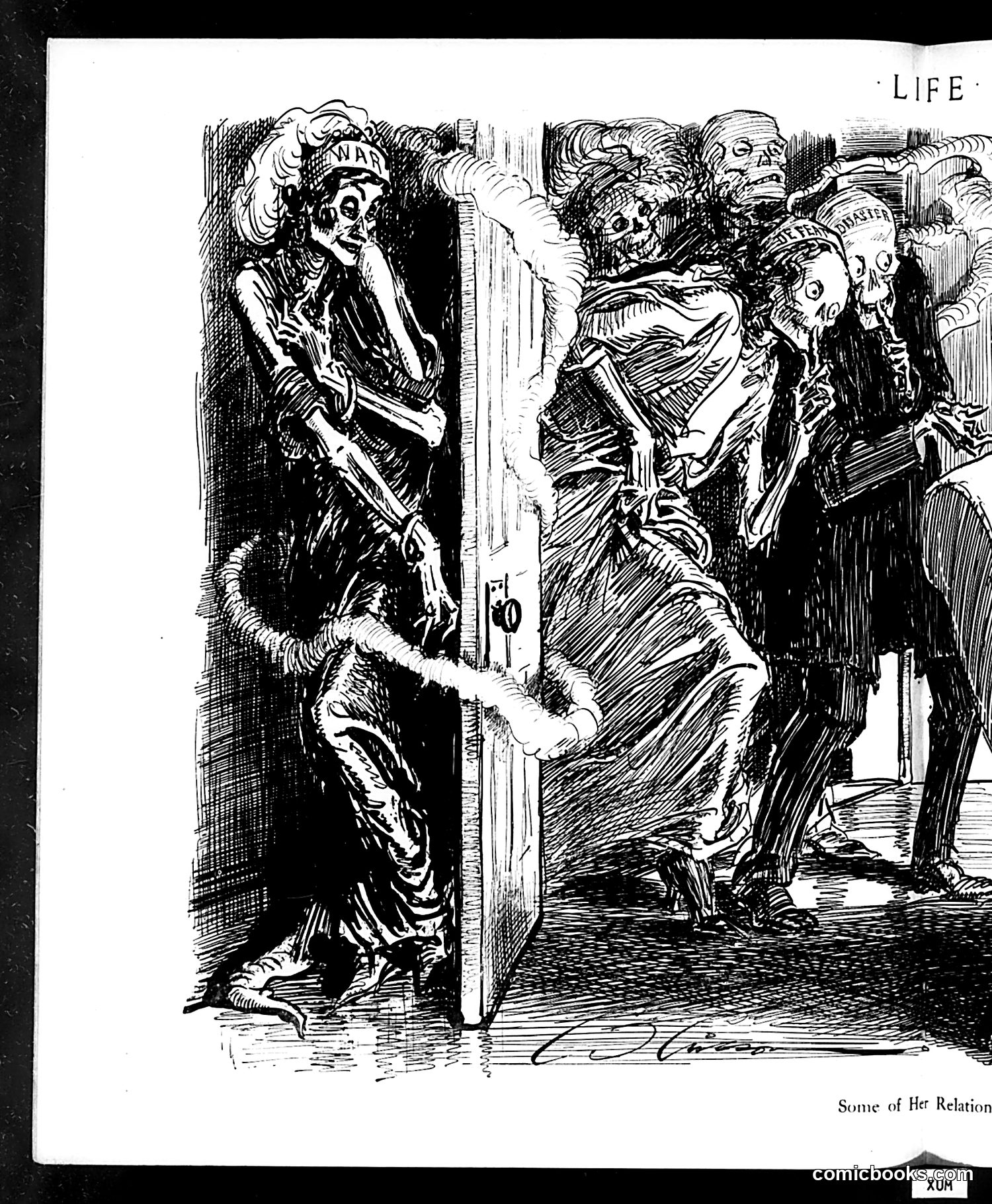
This Life magazine cartoon satirizes a woman (on the left, appearing disheveled or grotesque) encountering what appears to be wealthy or aristocratic relatives on the right side of a doorway. The figures on the right are depicted as well-dressed, pompous characters with exaggerated features typical of Gilded Age caricature. The title "Some of Her Relation" suggests commentary on class disparity or social embarrassment—likely mocking either newly wealthy individuals ashamed of poorer relatives, or conversely, critiquing the snobbery of established society toward outsiders. The stark contrast in appearance between the two groups emphasizes the satire's point about social pretense and the arbitrary nature of class distinctions in early American society.
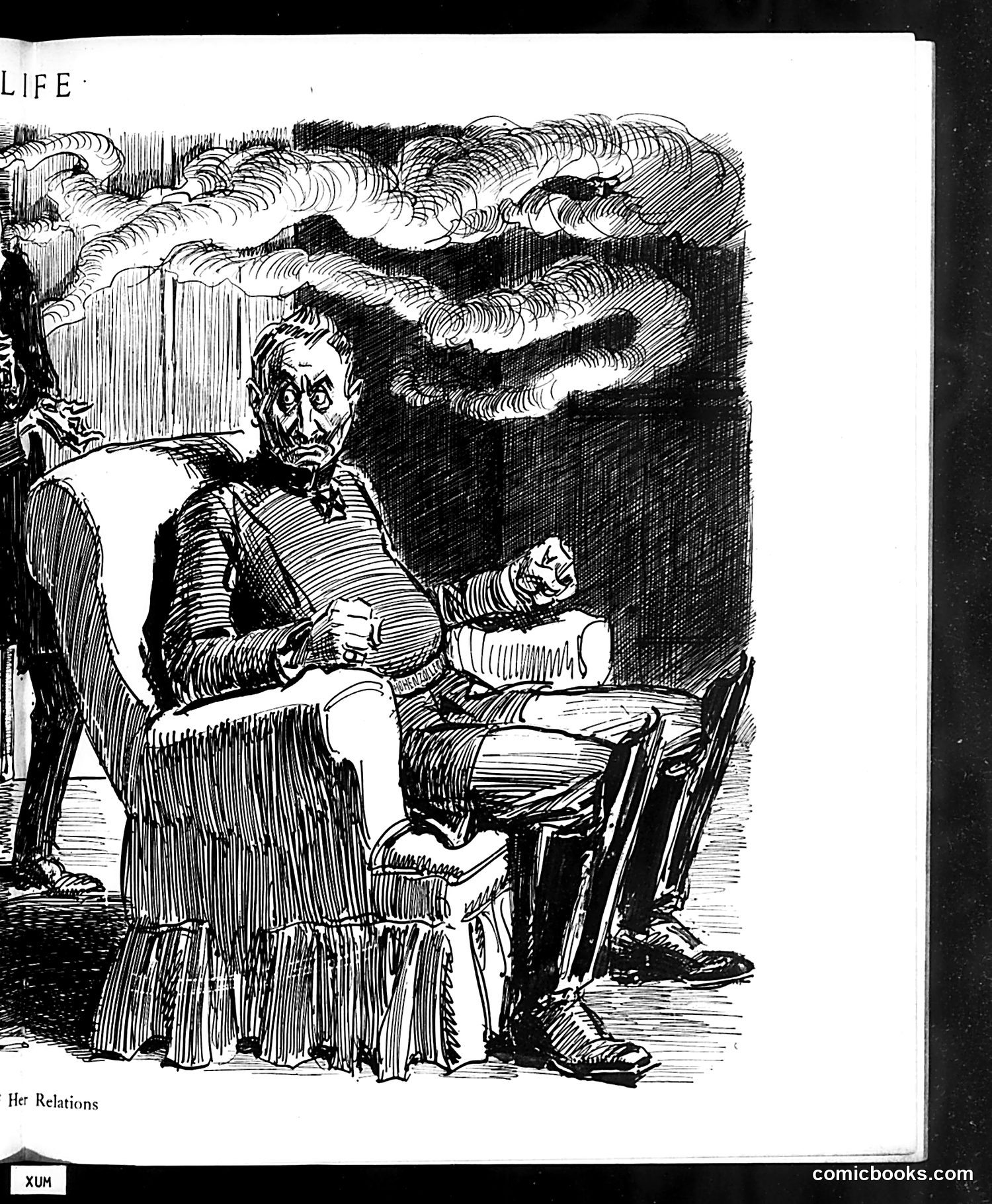
This satirical cartoon depicts a military officer in formal uniform sitting uncomfortably while storm clouds gather overhead. The caption "Her Relations" suggests a commentary on the officer's problematic family connections or associates. The exaggerated facial expression—worry or distress—combined with the ominous weather imagery indicates the cartoon criticizes how an official's reputation or career is threatened by associations beyond his control. The "relations" (likely family members or political allies) represented by the dark, turbulent clouds suggest scandal or troublemaking that could damage his standing. Without specific dating or identified figures, the precise political target remains unclear, but the satire typically critiques how powerful individuals face consequences for their connections rather than their own actions—a recurring theme in early 20th-century American political humor.
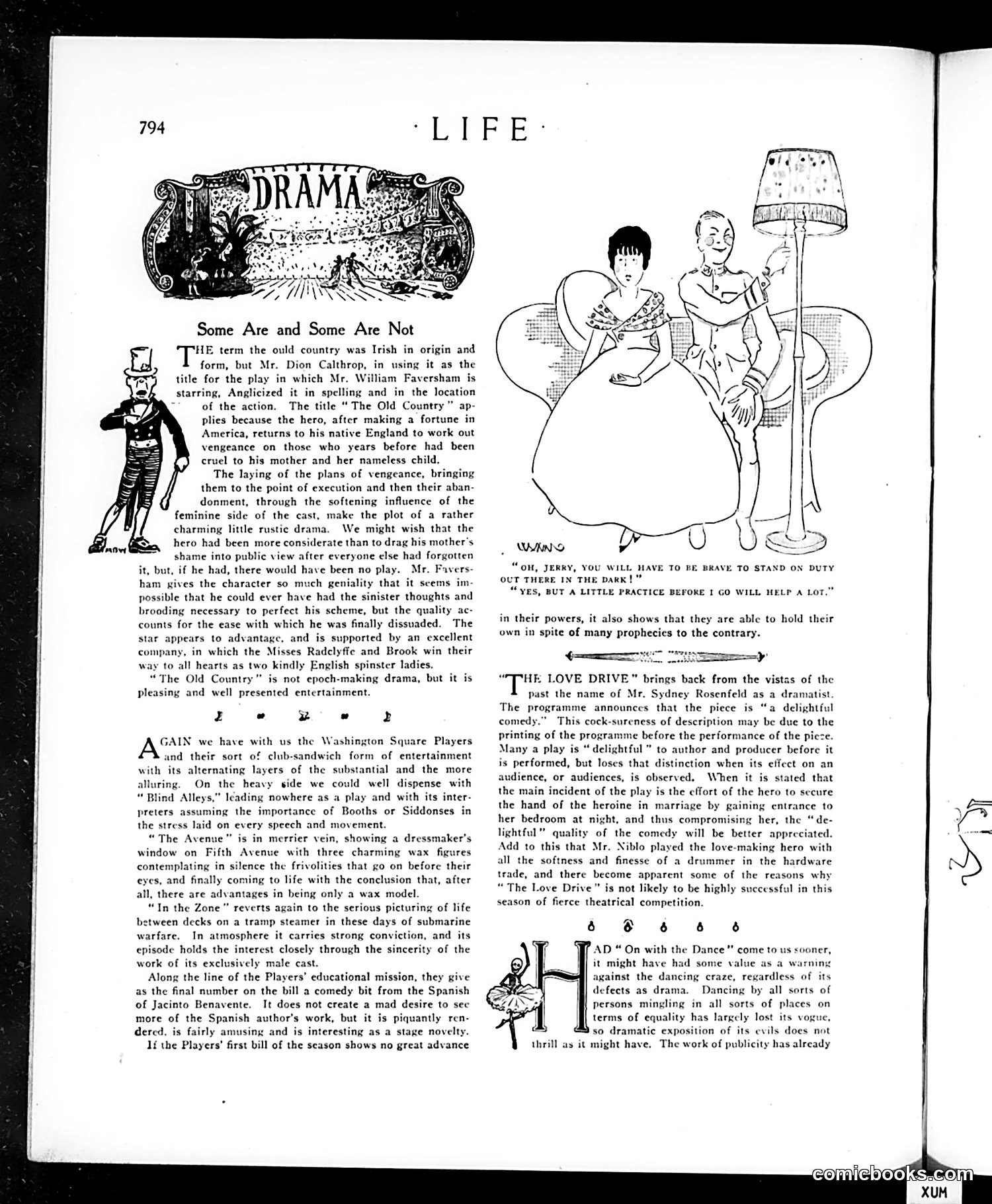
This page contains drama reviews from *Life* magazine, a satirical publication. The content includes: **"Some Are and Some Are Not"** reviews a stage production of "The Old Country" starring William Faversham. The play concerns an Englishman returning from America seeking revenge on those who wronged his mother, but ultimately abandoning his plan through romantic influence. The reviewer finds it pleasant but unremarkable entertainment. **The cartoon** (by Wang) depicts two figures in what appears to be a wartime domestic scene—a woman holding what looks like a rifle, instructing a man ("Jerry") about duty "in the dark." This likely references World War I home-front preparation or civilian defense training, a relevant concern when this magazine was published. **Additional reviews** discuss the Washington Square Players' theatrical productions, critiquing their experimental work with varying degrees of enthusiasm. The page represents typical early 20th-century theatrical criticism blended with satirical social commentary characteristic of *Life* magazine's editorial approach.
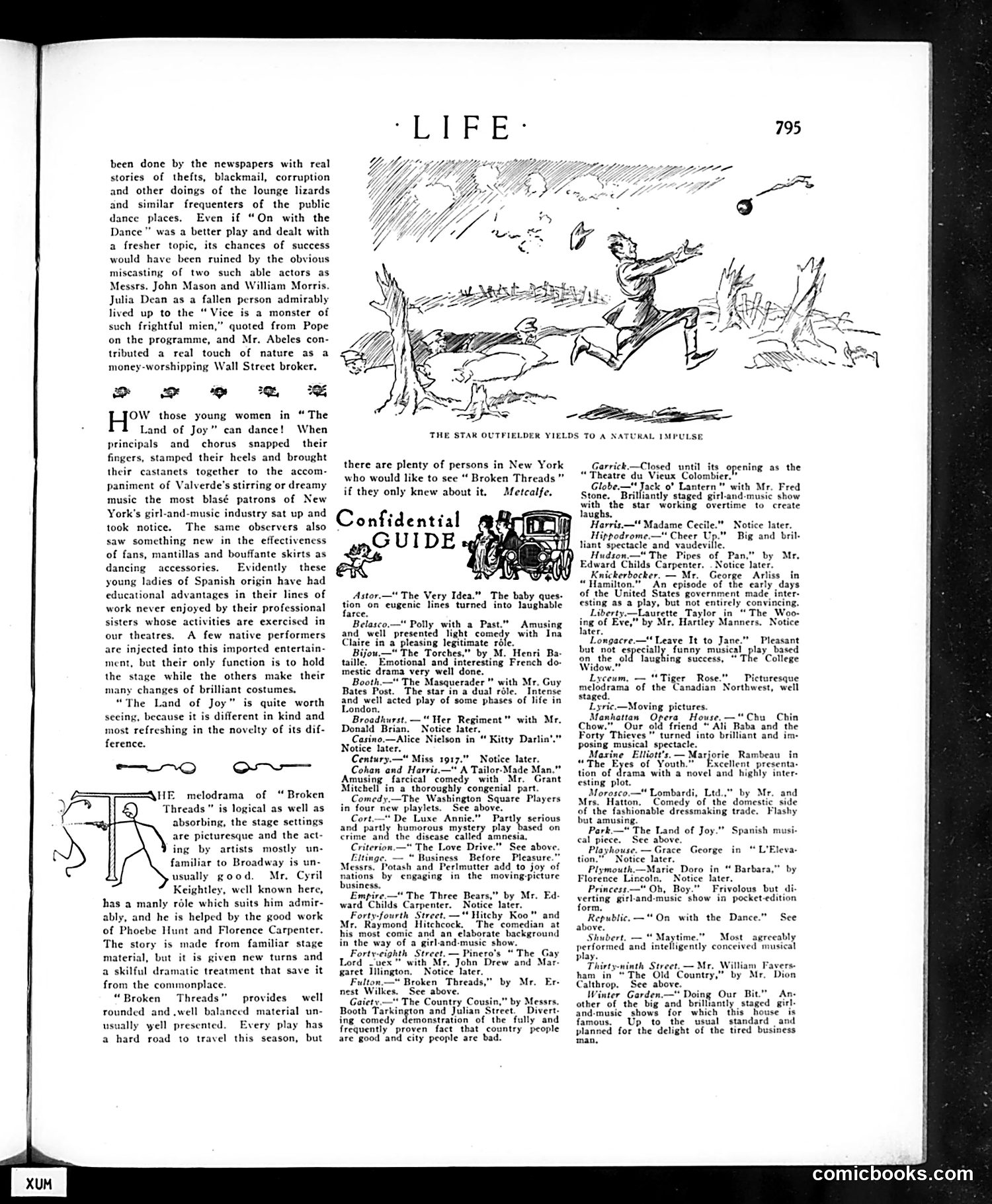
This page from *Life* magazine contains theater reviews and a single cartoon titled "The Star Outfielder Yields to a Natural Impulse." **The Cartoon:** The illustration depicts a baseball player executing an exaggerated diving or leaping motion, apparently chasing a ball. The humor lies in the caption's suggestion that the player is responding to an instinctive "natural impulse"—the visual exaggeration implies the player is overreacting or behaving in an absurdly physical manner to catch the ball. This appears to be gentle sports satire poking fun at athletic intensity or perhaps the theatrical nature of professional baseball performance. **The Text:** The bulk of the page consists of brief theater reviews under a "Confidential Guide" header, evaluating Broadway productions including "Polly with a Past," "The Masquerader," and "The Land of Joy." The reviews offer commentary on performances, casting choices, and plot quality for New York theatergoers. The tone is critical but generally encouraging toward attending these shows. The page reflects early 20th-century entertainment journalism mixing sports and theatrical criticism for an educated urban audience.
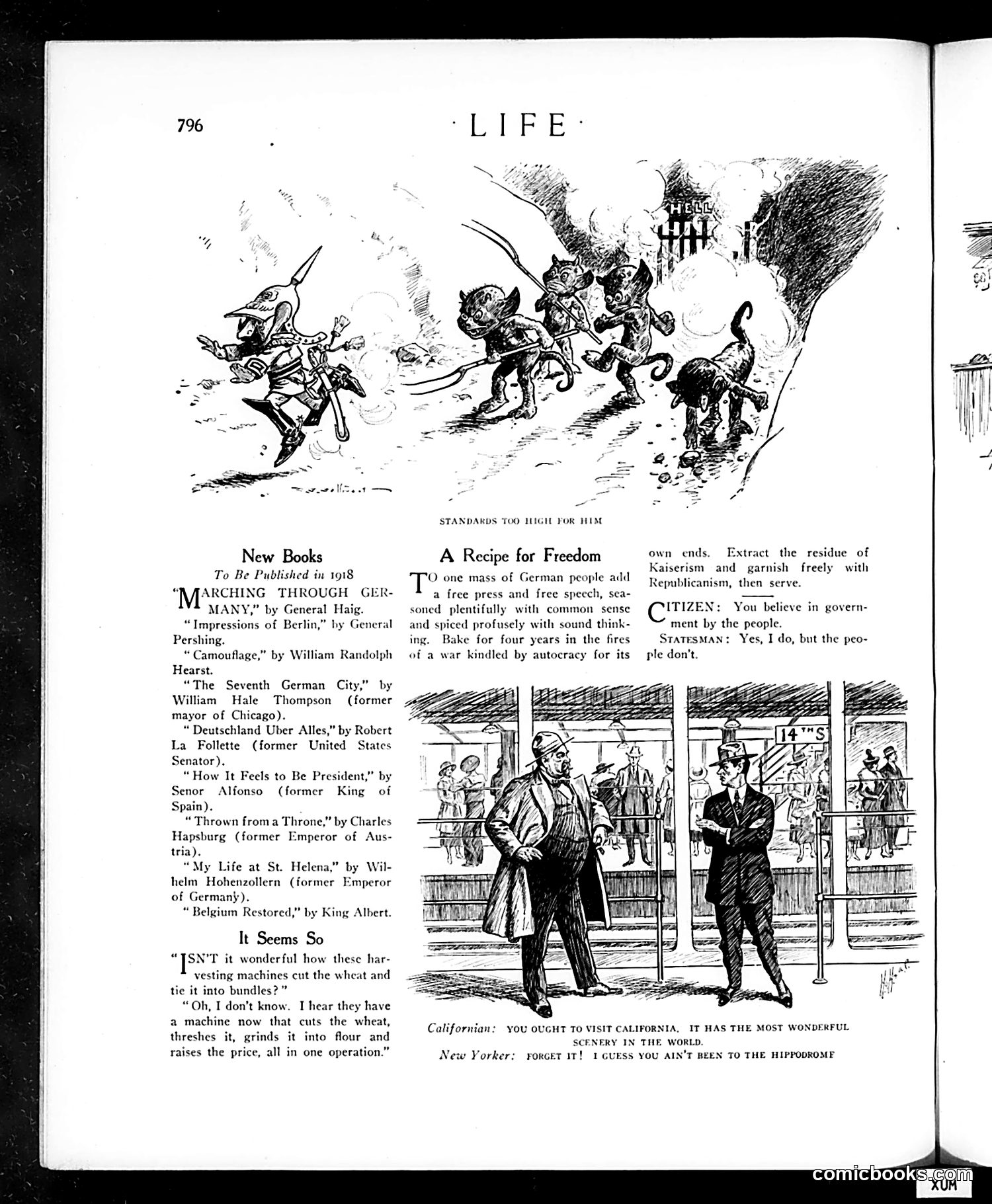
This page contains WWI-era American satire mocking both enemies and allies. The "New Books" section ridicules German and Austro-Hungarian leaders by imagining they'll write memoirs *after losing the war*—works like "Marching Through Germany" (attributed to British General Haig) and "My Life at St. Helena" (comparing Kaiser Wilhelm II to Napoleon's exile). American figures are also satirized: William Randolph Hearst's "Camouflage" mocks his pro-German sympathies; La Follette's inclusion suggests suspicion of his pacifist stance. The "Recipe for Freedom" cartoon prescribes democracy for Germany through free press and speech, suggesting Germany lacks these. The wheat-harvesting joke targets wartime profiteering—machines that increase efficiency while raising prices. The final exchanges mock shallow political engagement: citizens claim to believe in democracy while admitting people don't govern themselves well; regional boasting replaces substance.
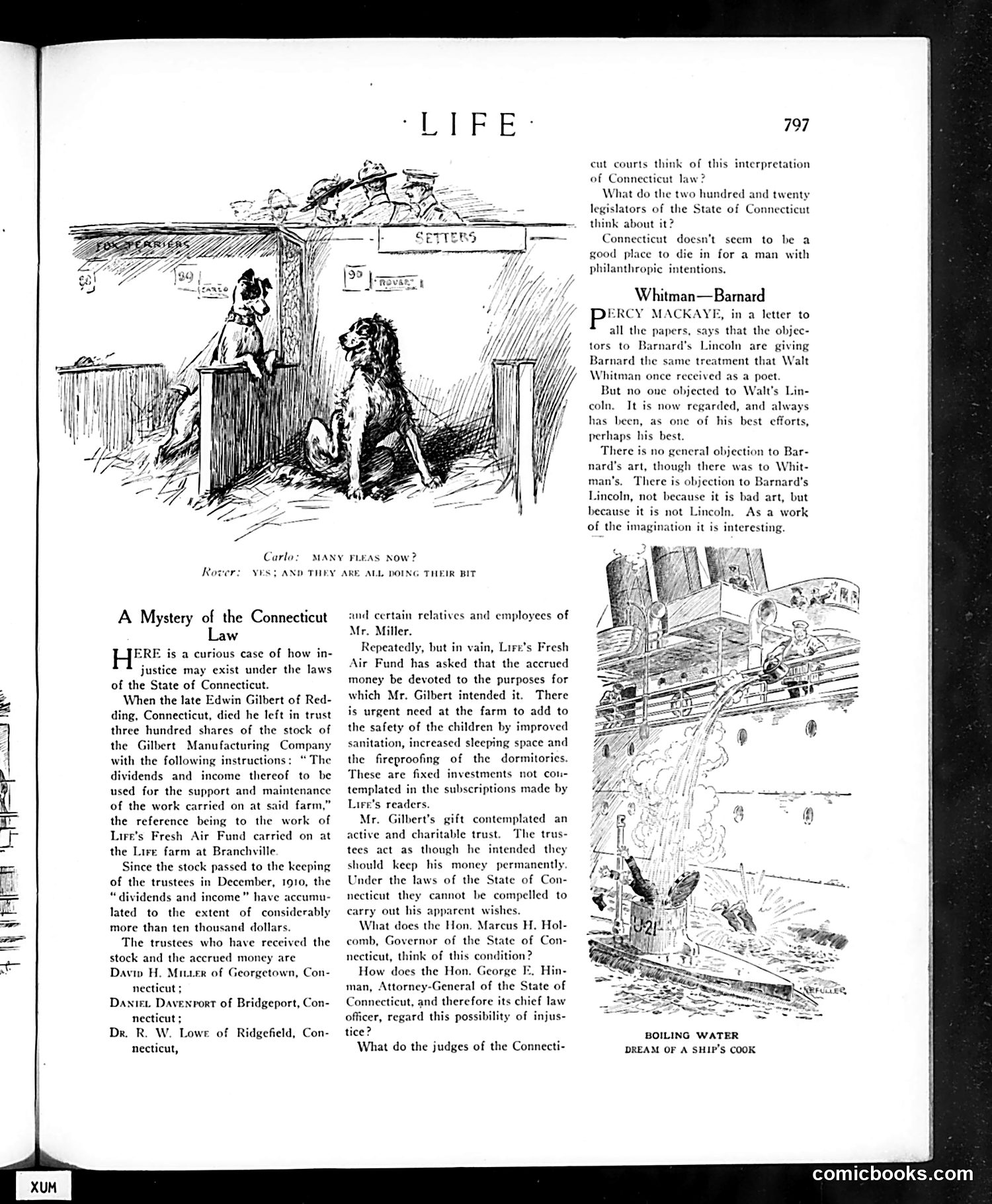
This page contains two distinct satirical pieces: **"A Mystery of the Connecticut Law"** (main article with cartoon): This exposes a legal loophole in Connecticut. When philanthropist Edwin Gilbert died in 1910, he left stock dividends to support a children's farm (Lire's Fresh Air Fund). The trustees—led by David H. Miller—have accumulated over $10,000 in accrued funds but refuse to distribute them for the farm's needed improvements (sanitation, dormitory fireproofing). The law apparently allows trustees to withhold money indefinitely. The cartoon shows a dog with fleas, captioned with dialogue about fleas "doing their bit"—a visual metaphor for parasites draining resources. Life sarcastically questions whether Connecticut's governor, attorney general, judges, and legislators will address this injustice, concluding Connecticut is "not a good place to die in for a man with philanthropic intentions." **"Whitman—Barnard"** (brief commentary): Discusses sculptor Barnard's Lincoln statue, defending it against critics by noting Walt Whitman faced similar objections to his poetry, yet his Lincoln poem is now considered excellent.
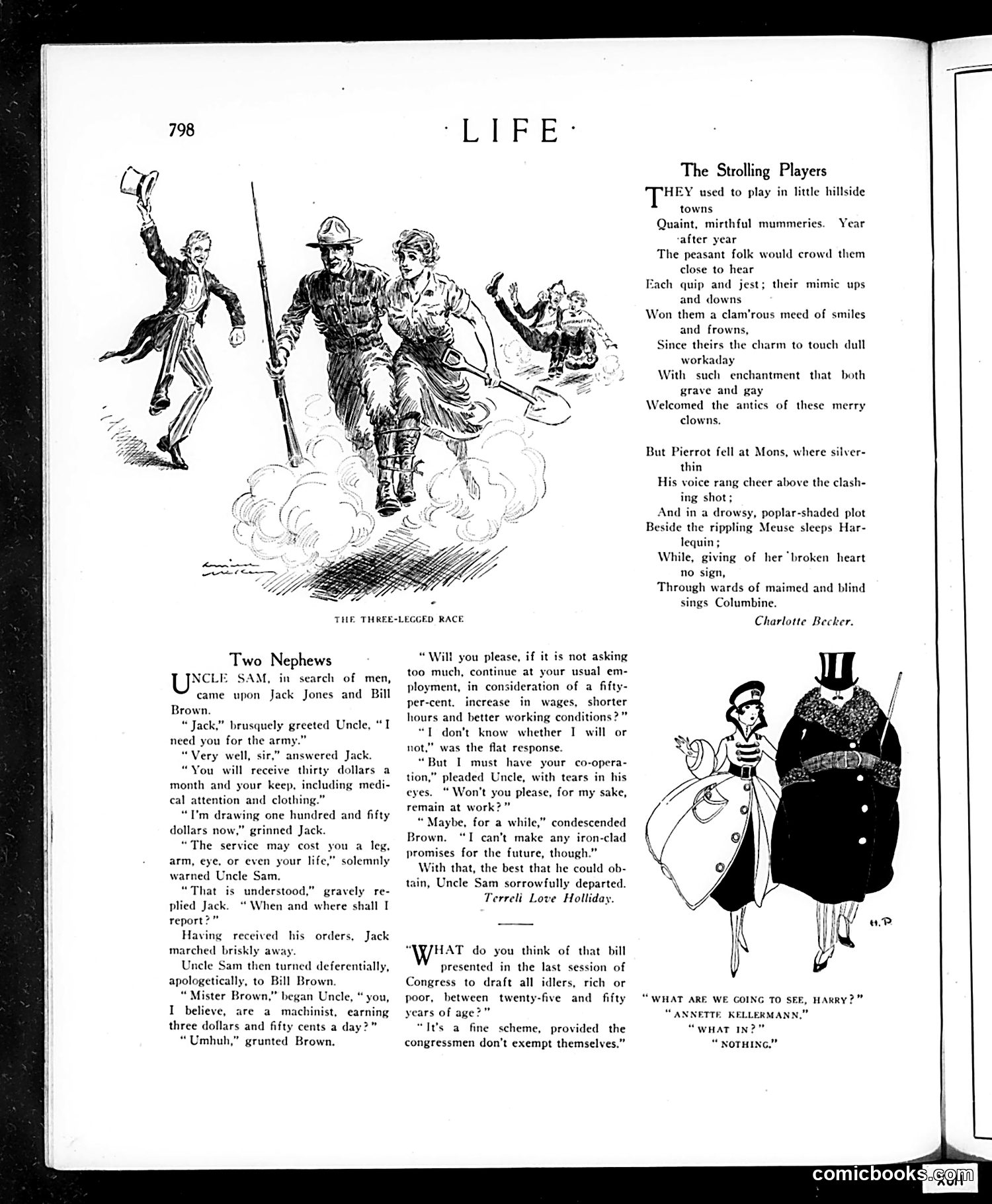
## "Two Nephews" (Main Cartoon) This satirical piece contrasts how Uncle Sam recruits for military service. When approaching Jack, a working man, Uncle Sam frankly warns of death or dismemberment—yet Jack eagerly enlists despite earning $150/month. When approaching Bill Brown, a machinist earning only $3.50/day, Uncle Sam *begs* and pleads, offering a 50% wage increase, shorter hours, and better conditions. Brown reluctantly agrees "for a while." **The satire's point**: The cartoon mocks the unequal treatment of rich versus poor during wartime recruitment. The wealthy/privileged are wooed with incentives, while the poor are expected to sacrifice without compensation. It critiques how industrial workers held bargaining power and were treated as more valuable than ordinary soldiers. ## Secondary Content A poem about traveling theater performers, referencing casualties of World War I (the Battle of Mons, 1914). A brief joke about actress Annette Kellermann appearing in "nothing" (likely a swimwear-heavy film), playing on contemporary scandal around her bathing costumes.

This page is **not a cartoon or satire**, but rather a **print advertisement** for Resinol Soap from an early 20th-century *Life* magazine. The image shows a woman at a vanity mirror examining her complexion with a hand mirror—a straightforward product advertisement. The text makes claims typical of period skincare marketing: that the soap is pure, medicated, and will solve complexion problems like redness, roughness, and blotches. For modern readers, the notable elements are: 1. **The pitch**: The ad assumes "complexion worries" are a primary concern for women and solvable through soap 2. **The "Resinol medication"**: A vague medicinal ingredient meant to sound scientific and therapeutic 3. **The price point**: Twenty-five cents presented as remarkably affordable, indicating era and economic context 4. **The gender assumption**: Marketed exclusively to women's appearance concerns This represents period advertising conventions before modern consumer protection laws regulated health claims on cosmetics.
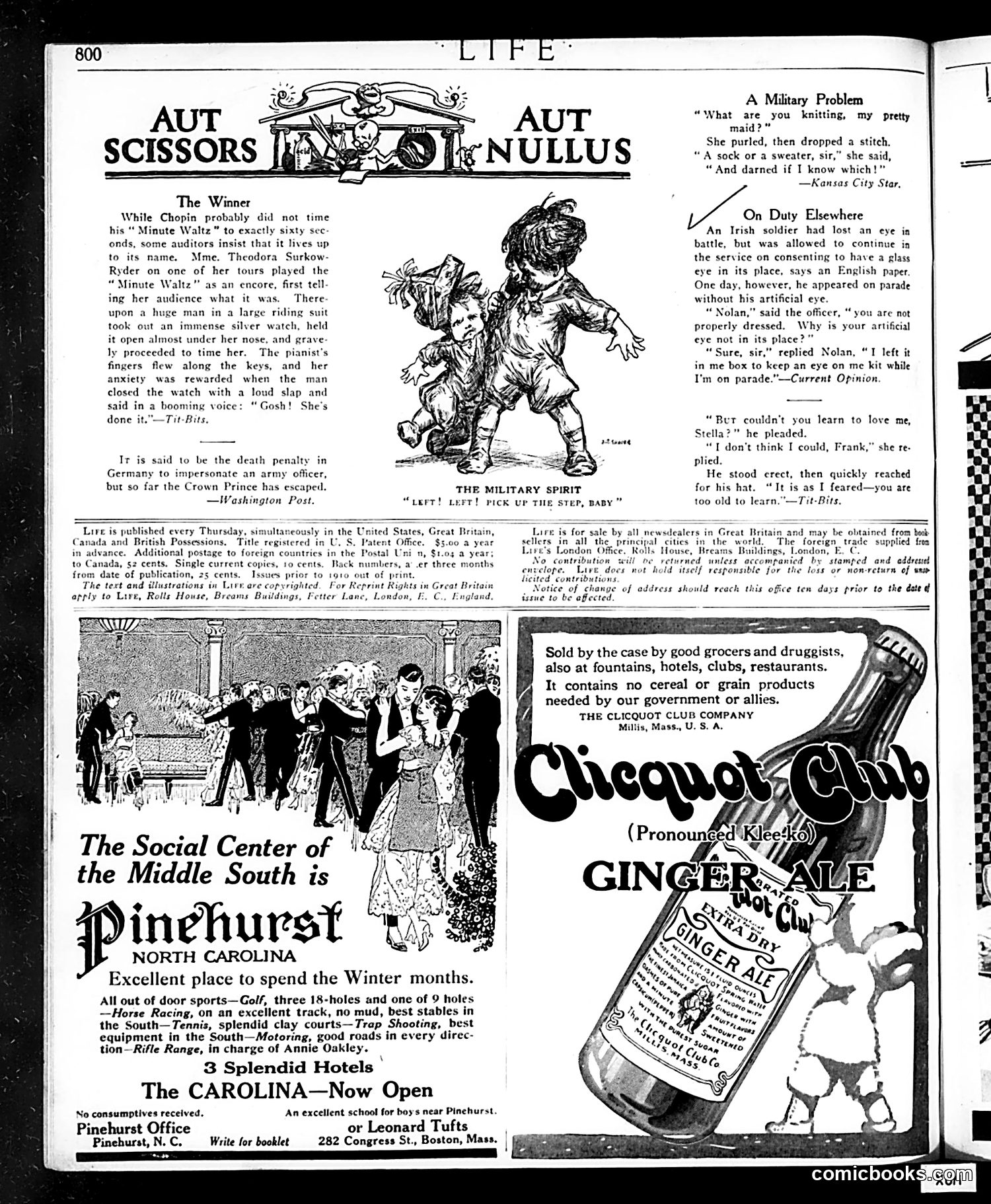
This page from *Life* contains several short humorous pieces and advertisements typical of the magazine's satirical format. **"The Winner"** mocks a pianist's claim that her performance of Chopin's "Minute Waltz" took exactly one minute. A large man in riding clothes times her with a stopwatch held directly in front of her face—the humor lies in the absurd literalism and the pianist's anxiety over this ridiculous scrutiny. **"The Military Spirit"** cartoon depicts a soldier being drilled, likely satirizing military discipline and obedience. **The brief jokes** below cover typical early-20th-century humor: a German political jab at the Crown Prince; an Irish soldier's malapropism about his glass eye; and romantic rejection. The advertisements promote Pinehurst, North Carolina (a resort destination) and Clicquot Club ginger ale, which the advertiser emphasizes contains no grain products—likely a WWI-era marketing point, as grain was rationed for military/allied needs. The overall tone reflects *Life*'s genteel satirical humor aimed at educated, middle-class readers.
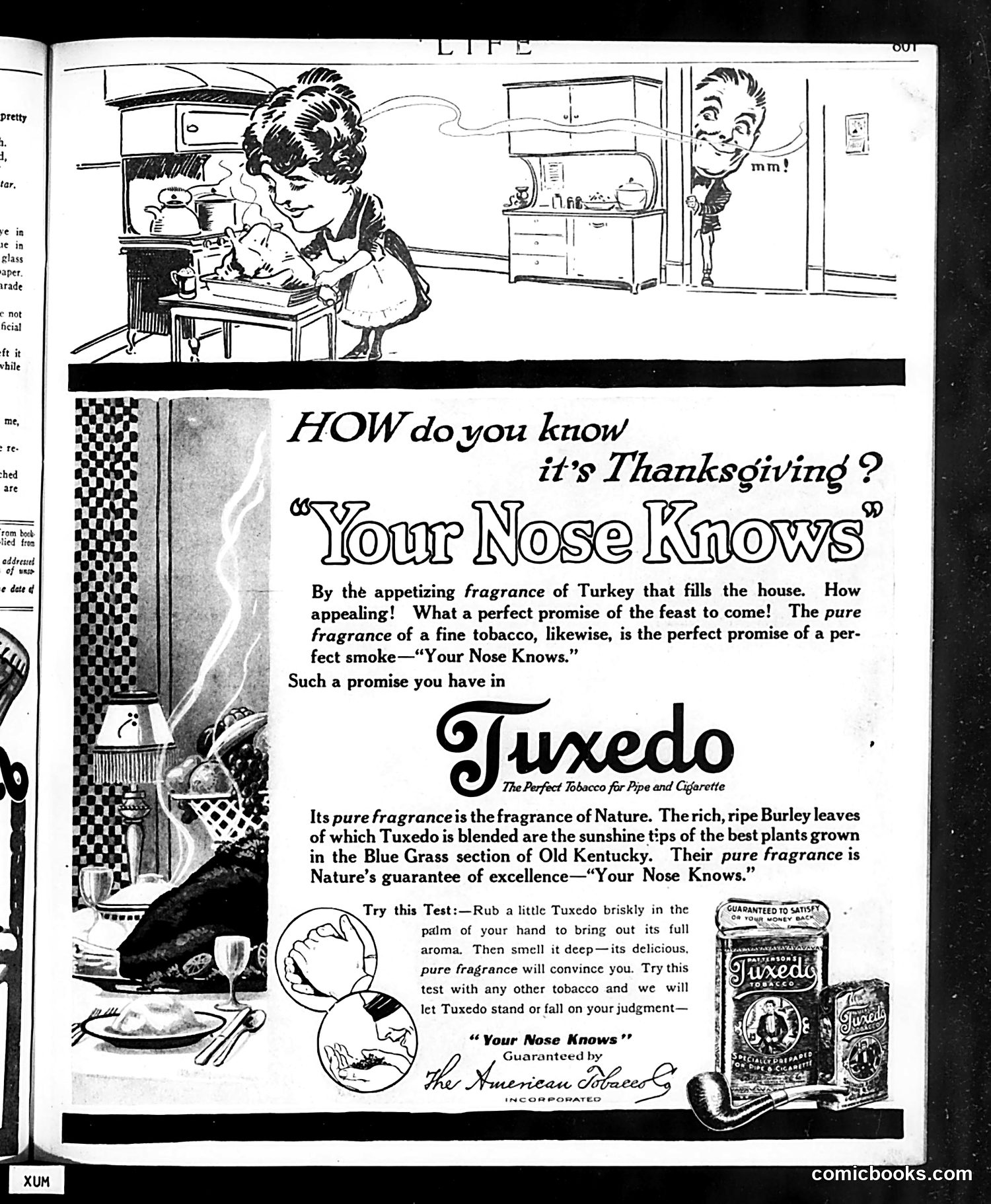
This is primarily a **Tuxedo tobacco advertisement**, not political satire. The cartoon at the top shows a domestic scene: a woman cooking in a kitchen while a man peeks in, saying "mm!"—establishing an appetizing Thanksgiving setting. The ad's central conceit is the slogan **"Your Nose Knows,"** comparing the aroma of roasting turkey to the fragrance of Tuxedo tobacco as a promise of quality. It positions tobacco smell as a reliable indicator of excellence, much like cooking aromas signal a good meal. The ad includes a "test" encouraging readers to rub tobacco in their palm to release its scent and compare it favorably to competitors. This was typical early-20th-century advertising rhetoric—appealing to sensory experience and implicit confidence in the product's superiority. The page reflects an era when tobacco advertising in mainstream magazines was standard and uncontroversial.
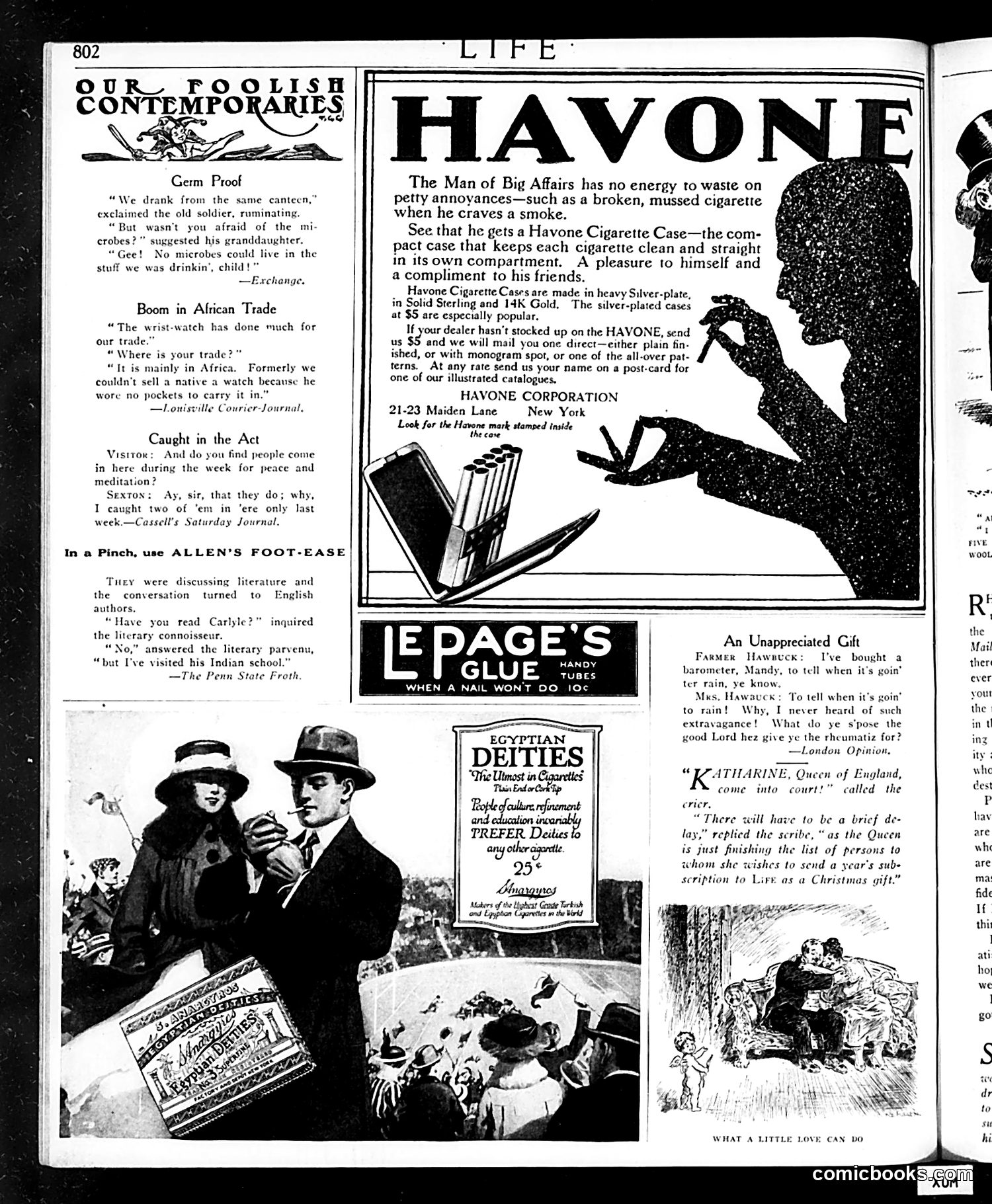
This page consists primarily of **advertisements and brief humor columns** rather than political cartoons. The main content includes: **Advertisements:** Havone Cigarette Cases (luxury goods for businessmen), Page's Glue, Egyptian Deities cigarettes, and Allen's Foot-Ease. **"Our Foolish Contemporaries"** section: Four short humor pieces satirizing modern life: - Soldiers' nostalgia about drinking from shared canteens without concern for germs - African trade booming due to selling wristwatches to natives who now have pockets - Church visitors "caught" meditating (implying it's unusual) - A literary snob claiming to have visited Carlyle's "Indian school" rather than reading his work **Right-side content:** Brief anecdotes about a farmer's impractical barometer and Queen Katherine's Christmas gift subscriptions to *Life*. The satire targets contemporary affectations—excessive hygiene concerns, consumerism in colonized regions, superficial cultural pretension—typical of early 20th-century American magazine humor. The overall tone is gentle mockery of middle-class pretensions.
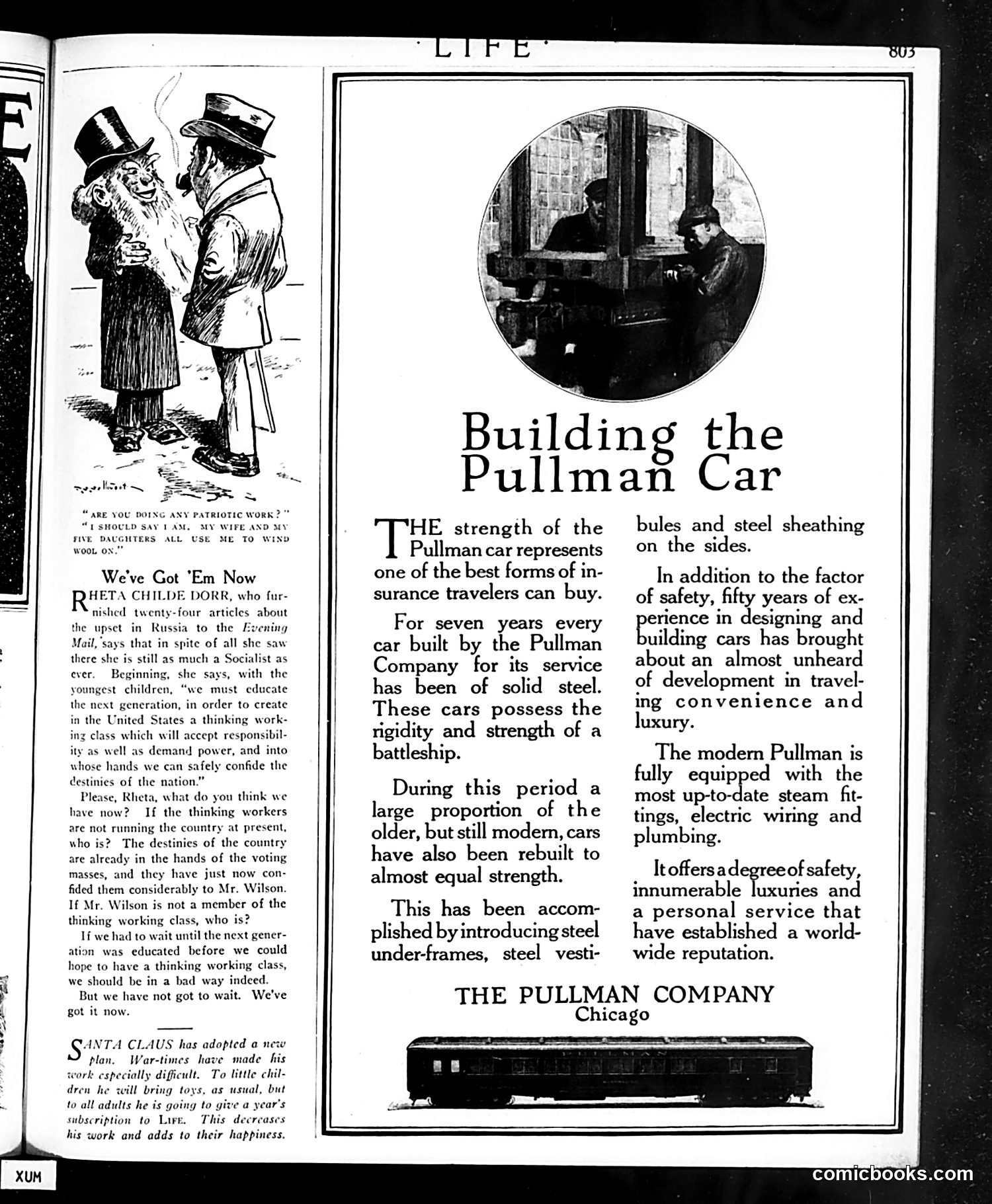
**Left cartoon ("We've Got 'Em Now"):** A man in formal dress speaks with an older bearded gentleman (likely representing a socialist or radical), asking if he's doing "patriotic work." The man replies he uses his wife and five daughters to wind wool—a joke suggesting domestic labor as patriotic contribution during wartime (likely WWI era). **Editorial commentary** beneath mocks radical activist Rheta Childe Dorr's calls to educate the "next generation" in socialist thinking. The writer sarcastically argues: thinking workers already run the country via voting and Mr. Wilson (President Woodrow Wilson); waiting for future generations is unnecessary. The piece ridicules progressive educational idealism as impractical. **Right side:** A full-page Pullman railway car advertisement emphasizing steel construction, safety, and luxury—standard corporate promotion, not satirical content. **Overall context:** The page reflects post-WWI American anxieties about socialism and radical reform, mocking progressive activists while celebrating capitalist enterprise.
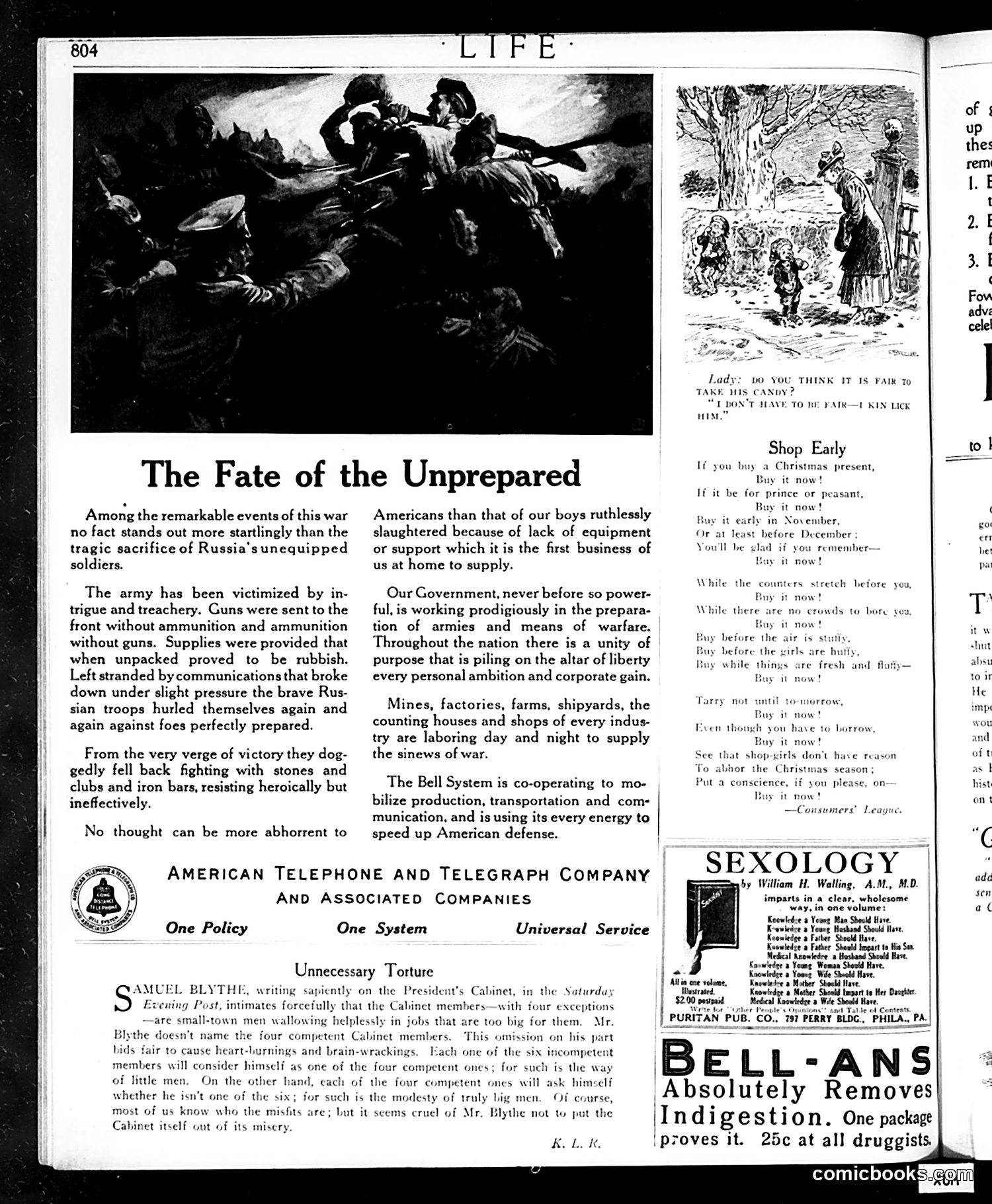
This page contains a wartime propaganda article (likely WWI-era, given references to Russia's military struggles) warning against American unpreparedness. The dramatic illustration depicts Russian soldiers in desperate combat, illustrating the article's central argument: Russian troops were sacrificed due to poor equipment, broken supply chains, and failed communications—fighting with "stones and clubs" against prepared enemies. The piece uses Russia's tragedy as a cautionary tale, urging Americans to ensure their own soldiers receive proper support. It frames military preparation as a patriotic duty, calling on industries and citizens to mobilize resources. The AT&T advertisement that follows co-opts this messaging, positioning the Bell System as essential to national defense mobilization. The implicit message: failure to prepare means needless American deaths—a stark warning to readers during wartime.
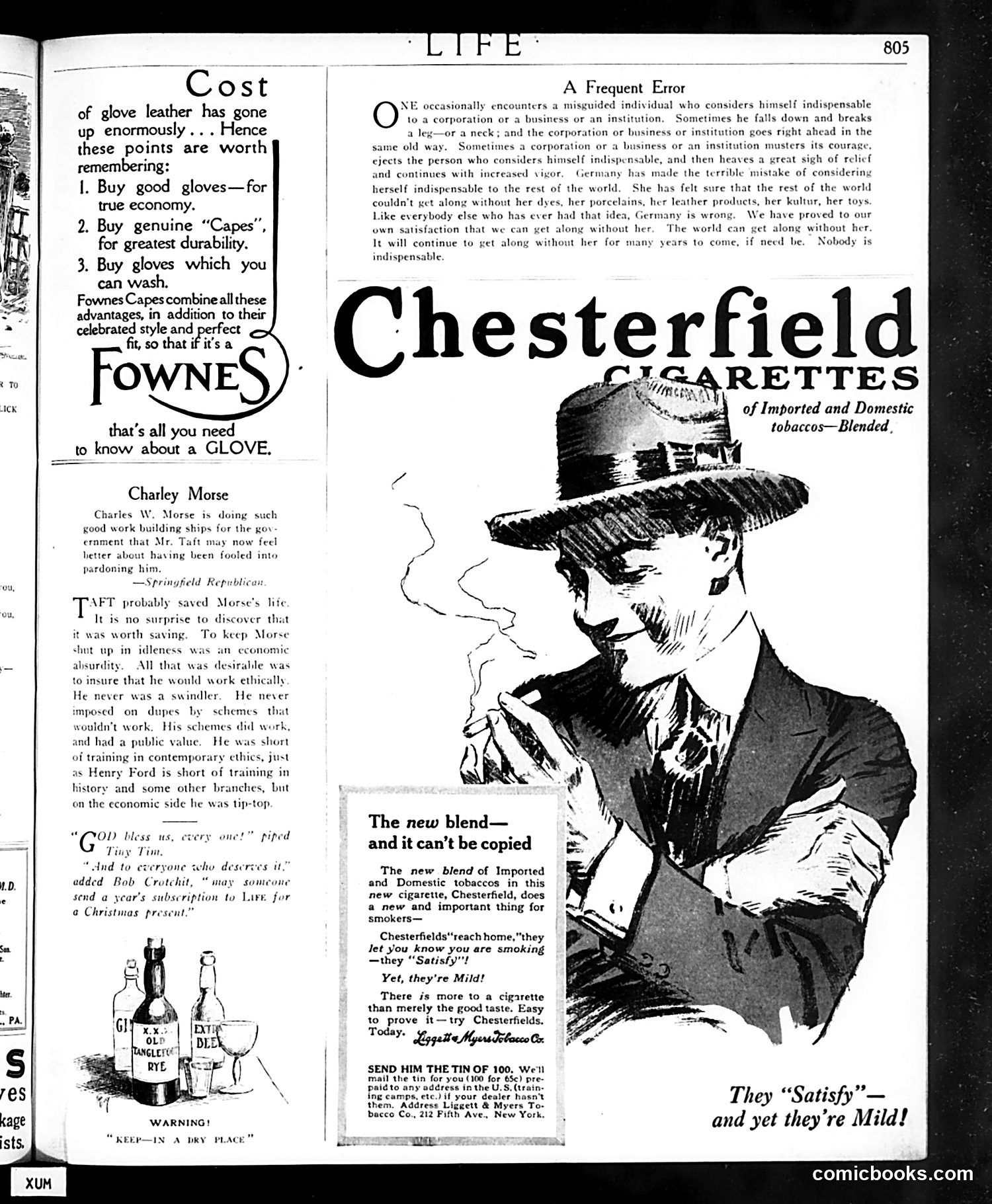
This page combines **advertising with satirical editorial content** typical of early 20th-century Life magazine. **Left side**: A Fownes gloves advertisement and editorial note about **Charles W. Morse**, a financier President Taft pardoned from prison. The piece sarcastically praises Morse's "economic value" despite his criminal past, suggesting Taft was "fooled" into the pardon but that Morse's work building ships during wartime justifies keeping him productive rather than imprisoned. **Center**: "A Frequent Error" uses **Germany as an extended metaphor**—comparing the nation's belief in its indispensability (dyes, porcelain, leather, "kultur") to any individual who overestimates their importance. The piece argues post-WWI that the world has proven it can function without Germany, establishing a political point about German arrogance. **Right side**: A **Chesterfield cigarette advertisement** featuring a man smoking, claiming a "new blend" that both "satisfies" and remains "mild"—marketing language targeting smokers concerned about health. The page reflects wartime anxieties and American triumphalism circa 1917-1918.
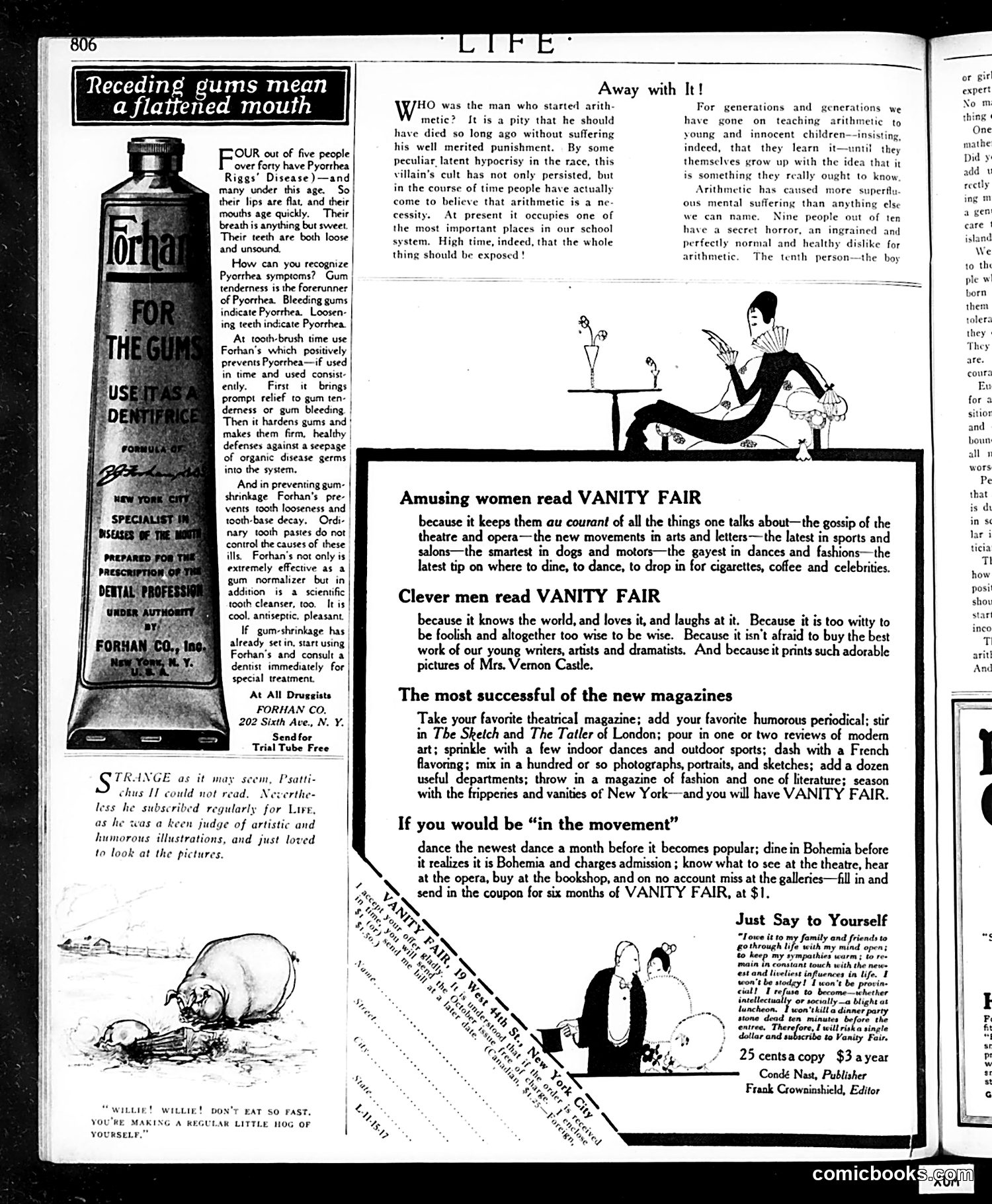
This page contains two distinct elements: **Left side:** A Forhan's toothpaste advertisement addressing "Pyorrhea" (gum disease), using medical terminology to market their product as a preventative. The ad warns that receding gums and loose teeth indicate disease, positioning Forhan's as a scientific solution. This reflects early 20th-century advertising's use of health anxiety to drive sales. **Right side:** A Vanity Fair magazine advertisement that satirizes different reader demographics. It positions the magazine as essential for "amusing women" interested in theater gossip and fashion, while "clever men" read it for wit and sophistication. The humor lies in gently mocking both audiences' pretensions—women for caring about trivial social matters, men for considering themselves intellectually superior while reading the same frivolous content. Below this is a humorous piece attacking arithmetic education, arguing it causes unnecessary psychological suffering and should be "exposed" as unnecessary. The page exemplifies Life's satirical approach: using advertisements and editorial content to poke fun at contemporary consumer culture and social pretension.
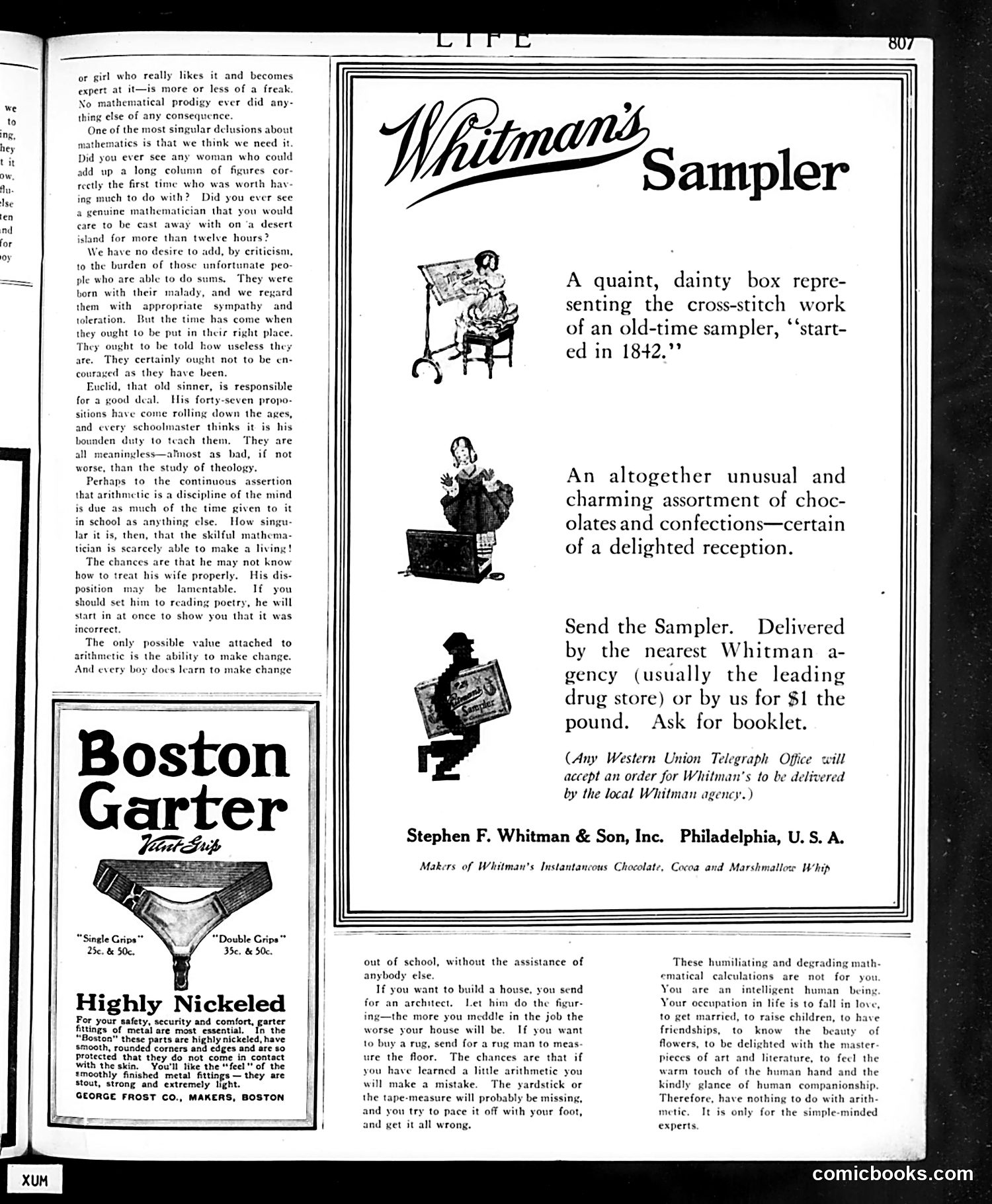
This page contains **satirical editorial content** alongside period advertisements, not political cartoons. The main article (left column) **mocks mathematics education**, arguing that mathematical skill is useless for practical life and that mathematicians are socially inadequate—claiming they can't manage households or appreciate poetry. The author suggests arithmetic's only value is making change, and that people should abandon mathematical study to focus on romance, art, and human connection instead. This represents **early 20th-century anti-intellectualism**—a common Life magazine stance mocking academic pretension. The satire targets educational establishment figures like Euclid and schoolmasters who promoted math instruction. The right side features **advertisements** for Whitman's Sampler chocolates and Boston Garter hosiery—typical commercial content of the era, unrelated to the editorial satire.
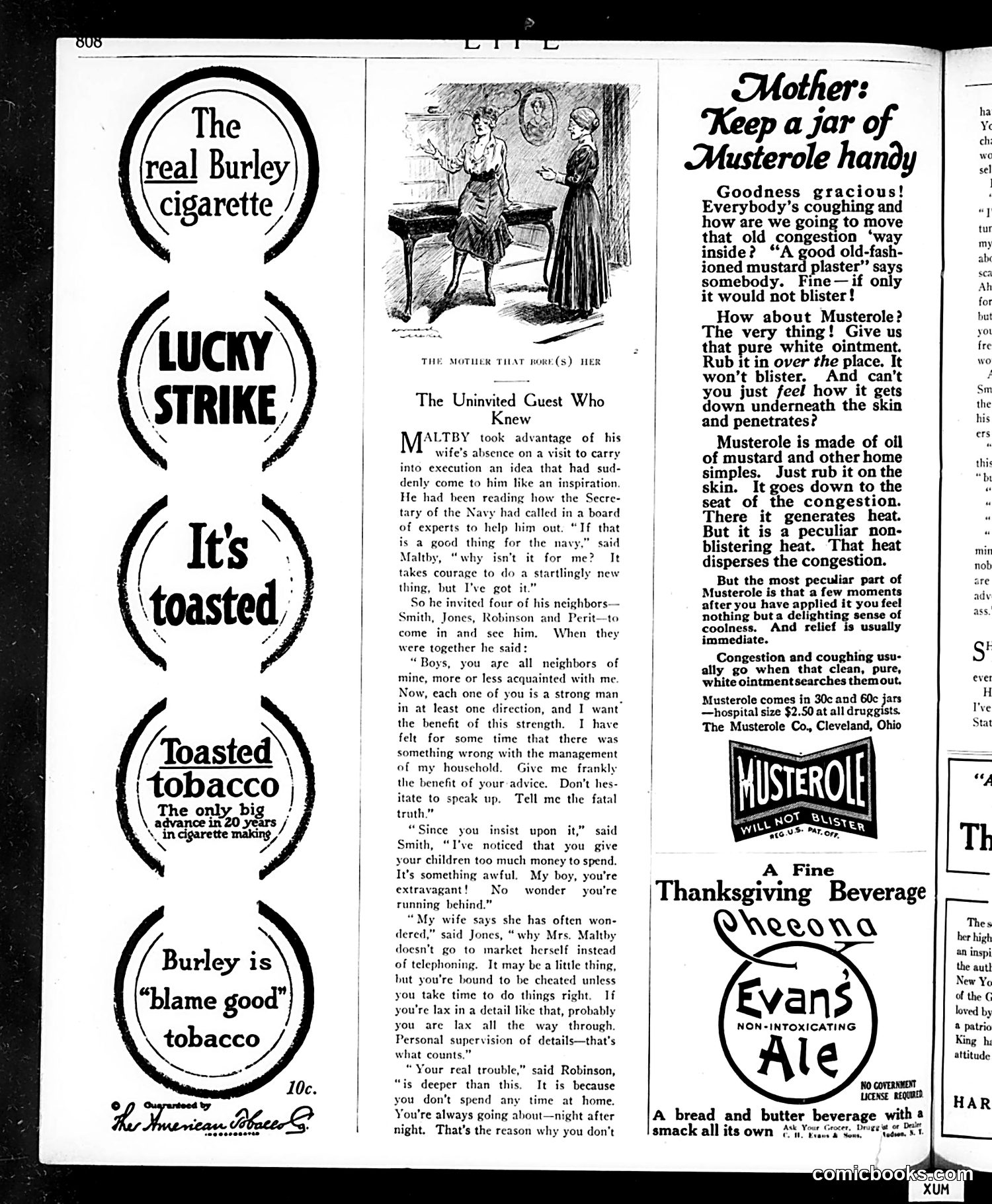
This page contains a short story ("The Uninvited Guest Who Knew") alongside period advertisements. The narrative depicts a man named Maltby who, inspired by the Navy Secretary's practice of consulting experts, invites four neighbors to critique his household management. Each neighbor identifies a different failing: excessive allowances to children, the wife not shopping in person (risking merchant cheating), and Maltby's constant absence from home. The story satirizes early 20th-century management trends and self-help culture by showing how absurd it is to seek outside "expert" advice on intimate family matters. It gently mocks both Maltby's gullibility and the era's fascination with systematizing domestic life. The advertisements—for Lucky Strike cigarettes, Musterole (a mustard-based chest rub for congestion), and Evans' non-intoxicating ale—reflect period consumer products and marketing approaches, including health claims now considered dubious.
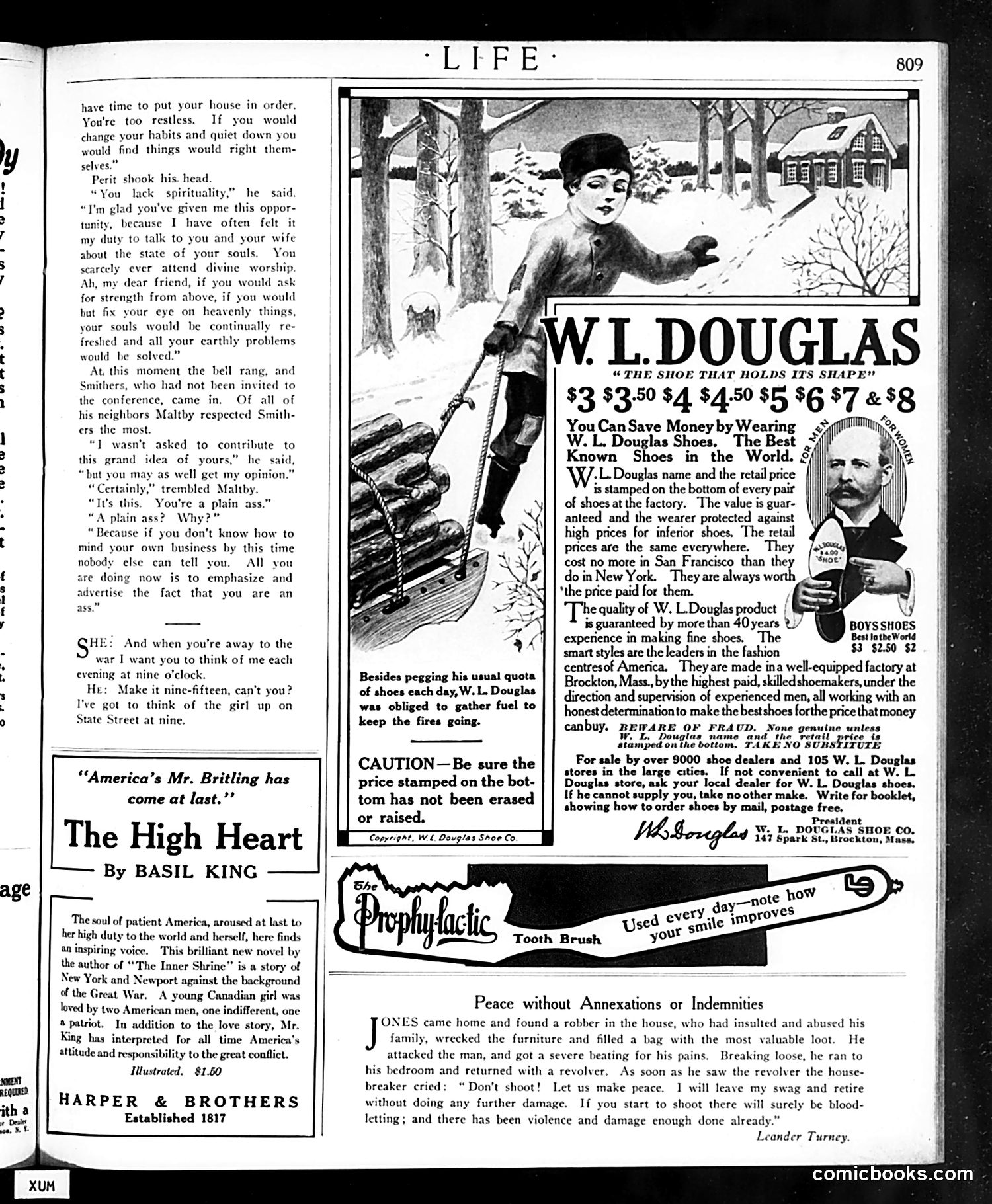
This page is primarily **advertising and serialized fiction**, not political satire. **Main Elements:** 1. **"The High Heart" by Basil King** — A serialized novel advertisement promoting a book about WWI-era America. The ad emphasizes the novel's patriotic themes during the Great War, featuring a Canadian girl loved by two American men (one patriotic, one indifferent). 2. **W.L. Douglas Shoe Advertisement** — A major commercial ad featuring the company founder, emphasizing affordable quality shoes ($3-$8) with prices stamped on the sole to prevent fraud. The ad highlights over 40 years of manufacturing experience in Brockton, Massachusetts. 3. **Conversational Dialogue** — Brief humorous exchanges about spirituality and marital infidelity, unrelated to the advertisements. 4. **Prophylactic Toothbrush Ad** — A minor dental product advertisement. **Historical Context:** This reflects early 20th-century American consumer culture and WWI patriotic messaging, but contains no political cartoon or satire requiring historical interpretation.
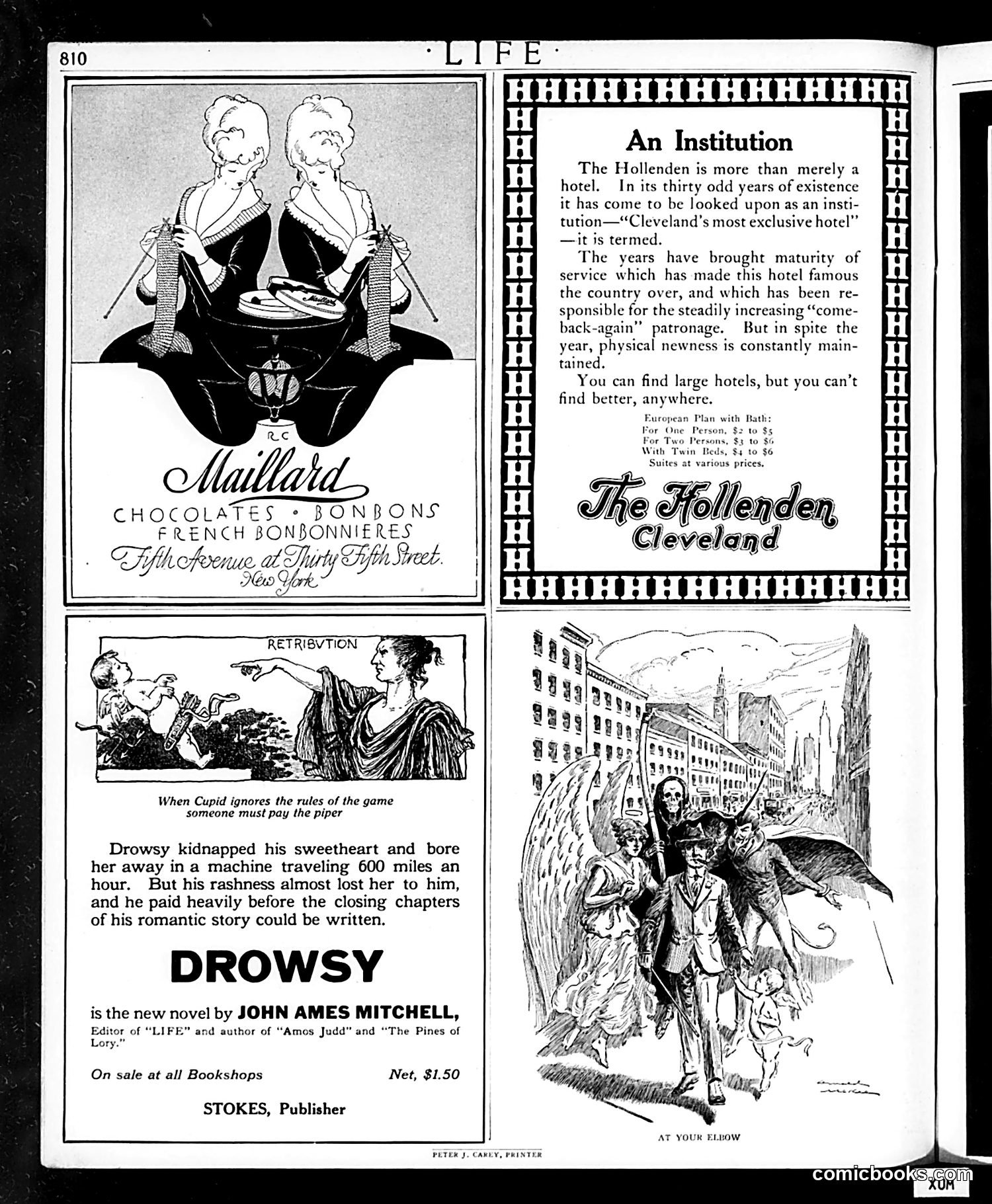
This page consists primarily of **advertisements** rather than editorial content or political satire. The ads include: 1. **Maillard Chocolates** (top left): A decorative Art Deco-style illustration of two women, promoting French bonbons from a Fifth Avenue New York shop. 2. **The Hollenden Hotel** (top right): An advertisement for Cleveland's "most exclusive hotel," emphasizing its thirty-year reputation and consistent service. 3. **"Drowsy" novel advertisement** (bottom left): Promotes a new novel by John James Mitchell (identified as Life's editor), about a man who kidnaps his sweetheart in a high-speed car. The accompanying illustration labeled "Retribution" shows Cupid with a piper, suggesting consequences for romantic rule-breaking—a common moralizing theme in early 20th-century fiction. 4. **Illustration** (bottom right): An unclear street scene, possibly related to the novel promotion. The page reflects 1920s consumer culture and literary marketing rather than satire or political commentary.
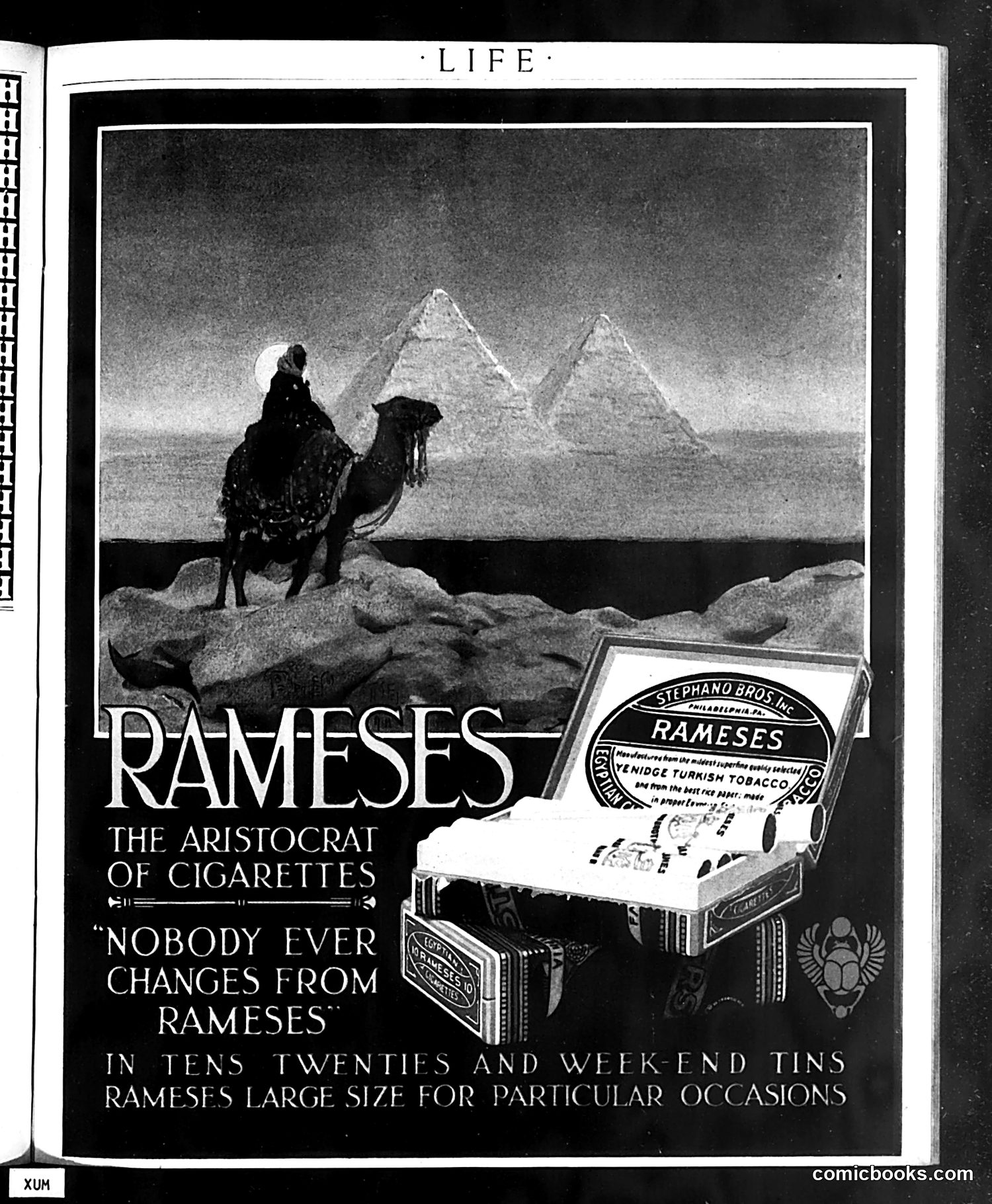
This is a **cigarette advertisement**, not political satire. The page promotes Rameses brand cigarettes, manufactured by Stephano Bros. Inc. of Philadelphia. The image depicts a figure in silhouette riding a camel in an Egyptian desert setting, with pyramids visible in the background. This exotic imagery connects the product name "Rameses" (the Egyptian pharaoh) to luxury and prestige. The advertising copy claims Rameses are "the aristocrat of cigarettes" and uses the slogan "Nobody ever changes from Rameses"—implying brand loyalty and superiority. The ad notes packaging options: tens, twenties, week-end tins, and large sizes for special occasions. For modern readers, this represents early-to-mid 20th century cigarette marketing that freely emphasized luxury, sophistication, and exotic appeal—messaging now heavily restricted due to health regulations.
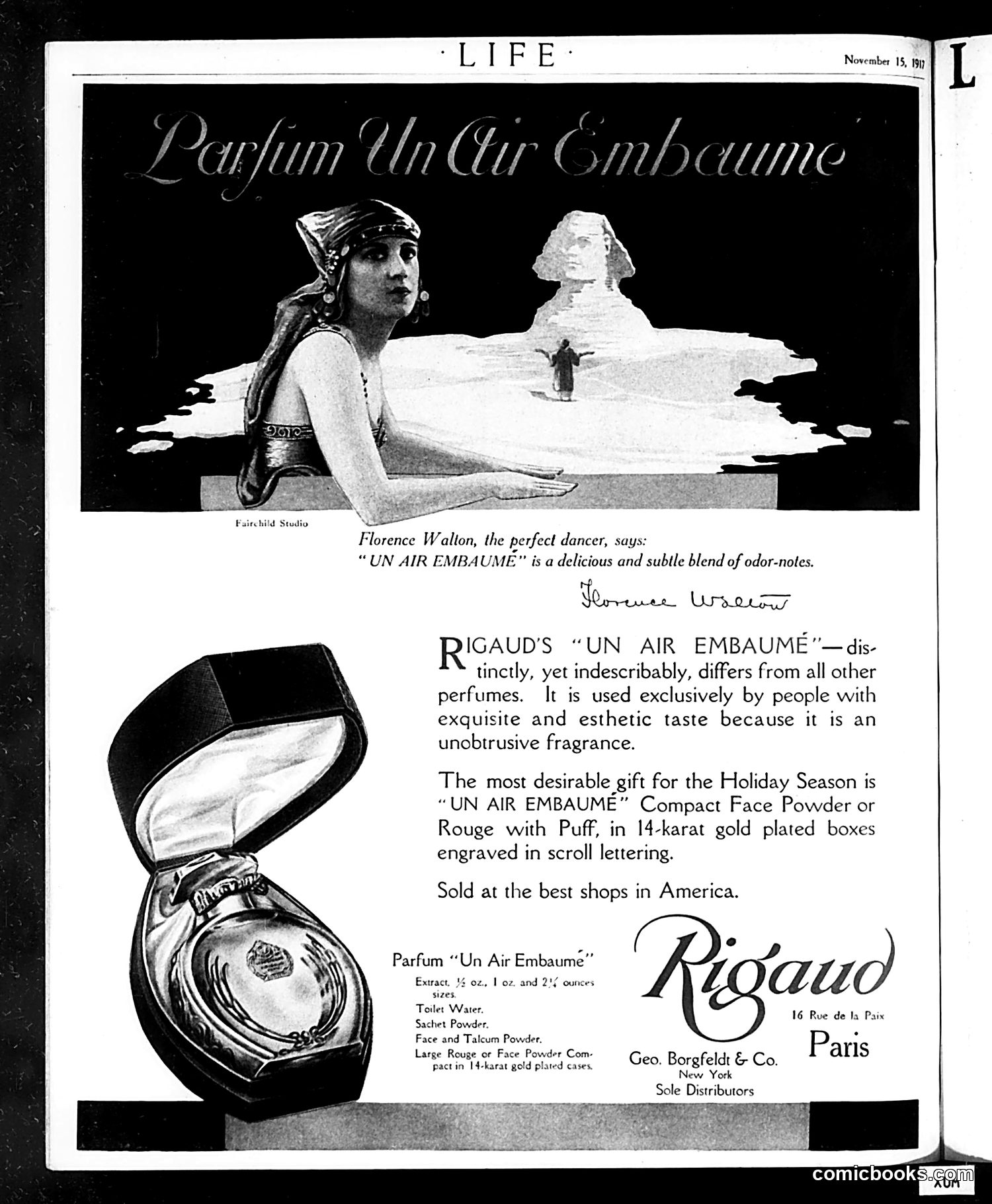
This is a **perfume advertisement**, not political satire or a cartoon. It promotes Rigaud's "Un Air Embaumé" fragrance from Paris, distributed in America by Geo. Borgfeldt & Co. The page features **Florence Walton**, a famous dancer of the 1910s-1920s era, as a celebrity endorser. Her image—dressed in Egyptian-style costume with the Sphinx behind her—creates an exotic, glamorous association for the product. The endorsement claims the perfume is "delicious and subtle" and appeals to people with "exquisite and esthetic taste." The advertisement emphasizes luxury: the fragrance is "used exclusively" by refined people, comes in 14-karat gold-plated boxes, and is "sold at the best shops in America." For modern readers, this reflects how early 20th-century luxury marketing used celebrity endorsements and appeals to exclusivity and taste—tactics still common today, though the specific reference to Walton is now obscure.