
Life, 1917-11-15 · page 26 of 40
Life — November 15, 1917 — page 26: what you’re looking at
What you’re looking at
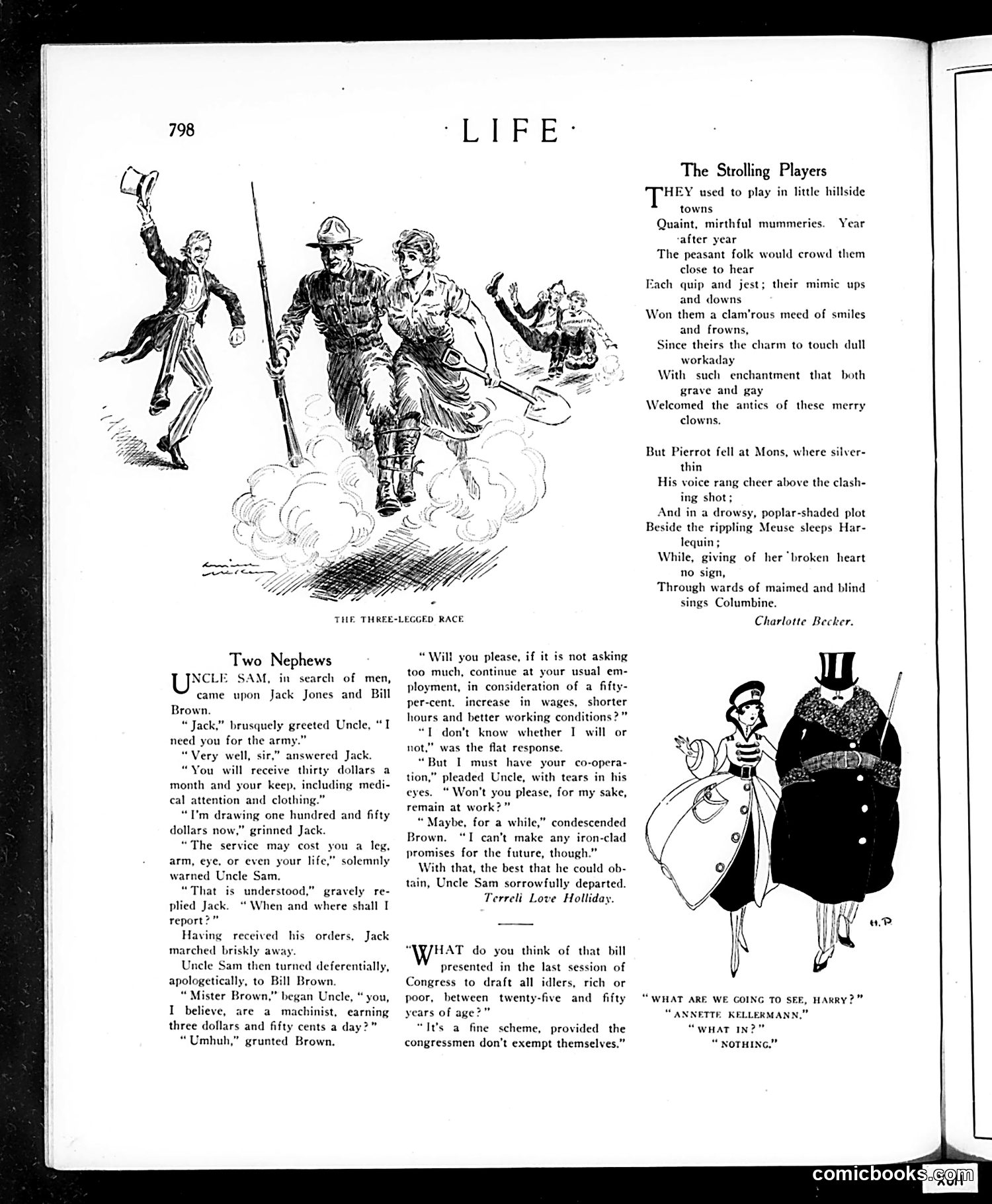
## "Two Nephews" (Main Cartoon) This satirical piece contrasts how Uncle Sam recruits for military service. When approaching Jack, a working man, Uncle Sam frankly warns of death or dismemberment—yet Jack eagerly enlists despite earning $150/month. When approaching Bill Brown, a machinist earning only $3.50/day, Uncle Sam *begs* and pleads, offering a 50% wage increase, shorter hours, and better conditions. Brown reluctantly agrees "for a while." **The satire's point**: The cartoon mocks the unequal treatment of rich versus poor during wartime recruitment. The wealthy/privileged are wooed with incentives, while the poor are expected to sacrifice without compensation. It critiques how industrial workers held bargaining power and were treated as more valuable than ordinary soldiers. ## Secondary Content A poem about traveling theater performers, referencing casualties of World War I (the Battle of Mons, 1914). A brief joke about actress Annette Kellermann appearing in "nothing" (likely a swimwear-heavy film), playing on contemporary scandal around her bathing costumes.
📄 Transcribed text from this page (OCR, searchable)
Machine-transcribed from the original scan — historical spelling and the odd misread are preserved.
THE THRE! Two Nephews SAM, in search of men, k Jones and Bill UN ibs came upon Brown. “Jack,” brusquely greeted Uncle, “1 need you for the army.” “Very well, sir,” answered Jack. “You will receive thirty dollars a month and your keep, including medi- cal attention and clothing.’ “I'm drawing one hundred and fifty dollars now,” grinned Jack. “The service may cost you a leg, arm, eye. or even your life,” solemnly warned Uncle Sam. “That is understood,” gravely re- plied Jack. “When and where shall I report? Having received marched briskly away Uncle Sam then turned deferentially, apologetically, to Bill Brown. “ Mister Brown,” began Uncle, “ you, I believe, are a machinist, earning three dollars and fifty cents a da: “Umhuh,” grunted Brown. his orders, Jack LEGGED RACE “Will you please, if it is not asking too much, continue at your usual em- ployment, in consideration of a fifty- per-cent. increase in wages, shorter hours and better working conditions?” “T don’t know whether I will or not,” was the flat response. “But I must have your co-opera- tion,” pleaded Uncle, with tears in his eyes. “ Won't you please, for my sake, remain at work?” “Maybe, for a while,” condescended Brown. “I can’t make any iron-clad promises for the future, though.” With that, the best that he could ob- tain, Uncle Sam sorrowfully departed. Terreli Love Holliday. Wat do you think of that bill presented in the last session of Congress to draft all idlers, rich or poor, between twenty-five and fifty years of age?” “It’s a fine scheme, provided the congressmen don’t exempt themselves.” The Strolling Players THEY used to play in little hillside towns Quaint, mirthful mummeries. cafter year The peasant folk would crowd them close to hear Each quip and jest; their mimic ups and downs Won them a clam'rous meed of smiles and frowns, Since theirs the charm to touch dull workaday With such enchantment that grave and gay Welcomed the antics of these merry clowns. Year both But Pierrot fell at Mons, where silver- thin His voice rang cheer above the clash- ing shot; And in a drowsy, poplar-shaded plot Beside the rippling Meuse sleeps Har- lequin While, giving of her “broken heart no sign, Through wards of maimed and blind sings Columbine. Charlotte Becker. “WHAT ARE WE GOING TO SEE, HARRY?” “ANNETTE KELLERMANN,” “WHAT IN?” “ NOTHING.” comicbooksegia]