
Life, 1917-11-15 · page 22 of 40
Life — November 15, 1917 — page 22: what you’re looking at
What you’re looking at
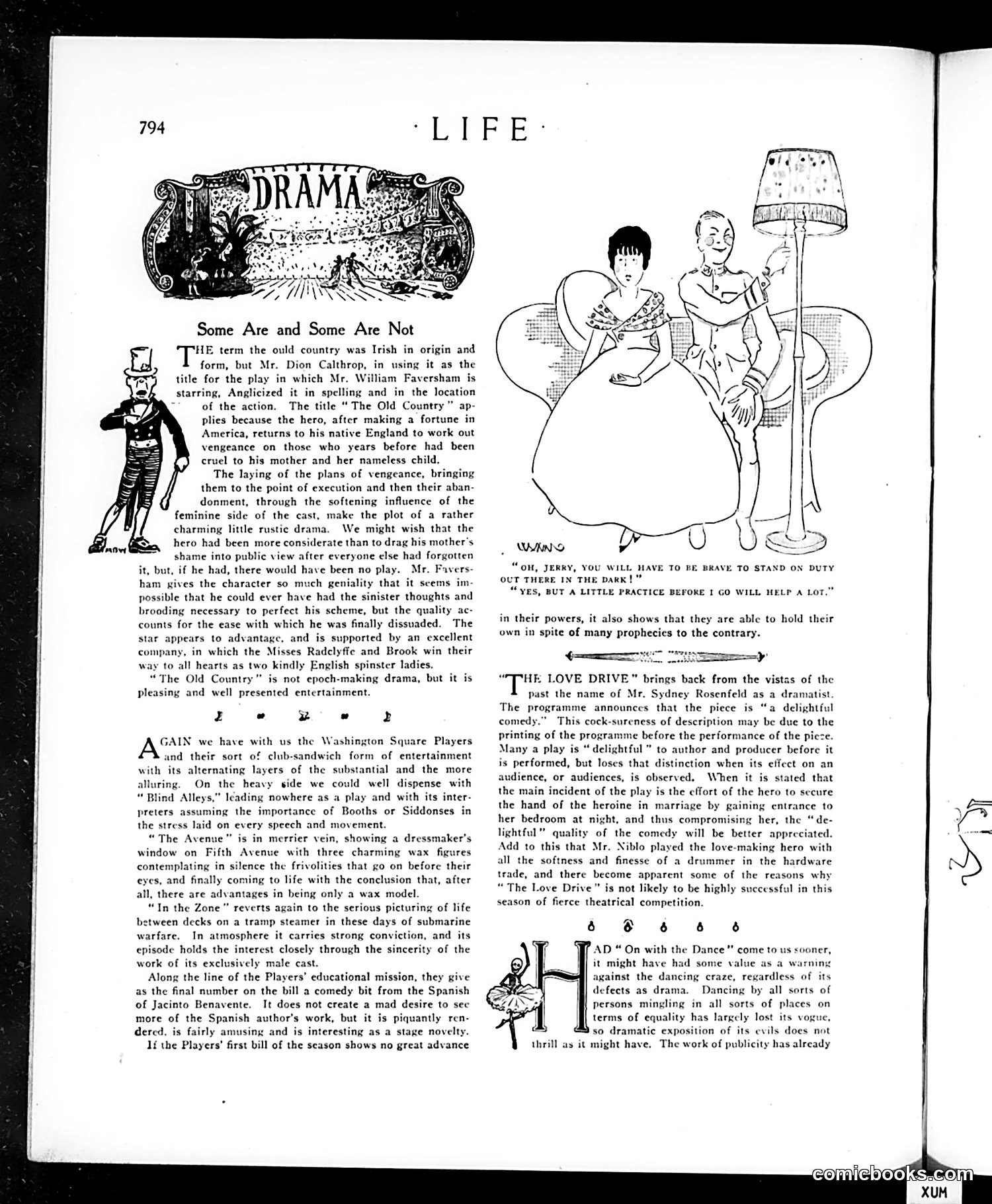
This page contains drama reviews from *Life* magazine, a satirical publication. The content includes: **"Some Are and Some Are Not"** reviews a stage production of "The Old Country" starring William Faversham. The play concerns an Englishman returning from America seeking revenge on those who wronged his mother, but ultimately abandoning his plan through romantic influence. The reviewer finds it pleasant but unremarkable entertainment. **The cartoon** (by Wang) depicts two figures in what appears to be a wartime domestic scene—a woman holding what looks like a rifle, instructing a man ("Jerry") about duty "in the dark." This likely references World War I home-front preparation or civilian defense training, a relevant concern when this magazine was published. **Additional reviews** discuss the Washington Square Players' theatrical productions, critiquing their experimental work with varying degrees of enthusiasm. The page represents typical early 20th-century theatrical criticism blended with satirical social commentary characteristic of *Life* magazine's editorial approach.
📄 Transcribed text from this page (OCR, searchable)
Machine-transcribed from the original scan — historical spelling and the odd misread are preserved.
Some Are and Some Are Not HE term the ould country was Irish in origin and form, but Mr. Dion Calthrop, in using it as the title for the play in which Mr. William Faversham is starring, Anglicized it in spelling and in the location a of the action. The title “ The Old Country” ap- plies because the hero, after making a fortune in America, returns to his native England to work out vengeance on those who years before had been cruel to his mother and her nameless child, The laying of the plans of vengeance, bringing them to the point of execution and then their aban- donment, through the softening influence of the feminine side of the cast, make the plot of a rather charming little rustic drama. We might wish that the hero had been more considerate than to drag his mother's shame into public view after everyone else had forgotten it, but, if he had, there would have been no play. Mr. Favers- ham gives the character so much geniality that it scems im possible that he could ever have had the sinister thoughts and brooding necessary to perfect his scheme, but the quality ac- counts for the ease with which he was finally dissuaded. The star appears to advantage, and is supported by an excellent company, in which the Misses Radclyffe and Brook win their way to all hearts as two kindly English spinster ladies. “The Old Country” is not epoch-making drama, but it is pleasing and well presented entertainment. z ° zB ” 2 As IN we have with us the Washington Square Players and their sort of club-sandwich form of entertainment with its alternating layers of the substantial and the more On the heavy side we could well dispense with “ Blind Alleys,” leading nowhere as a play and with its inter- alluring. preters assuming the importance of Booths or Siddonses in the stress laid on every speech and movement. “The Avenue” is in merrier vein, showing a dressmaker’s window on Fifth Avenue with three charming wax figures contemplating in silence the frivolities that go on before their eyes, and finally coming to life with the conclusion that, after all, there are advantages in being only a wax model. “In the Zone” reverts again to the serious picturing of life between decks on a tramp steamer in these days of submarine warfare. In atmosphere it carries strong conviction, and its episode holds the interest closely through the sincerity of the work of its exclusively male cast. Along the line of the Players’ educational mission, they give as the final number on the bill a comedy bit from the Spanish of Jacinto Benavente. It does not create a mad desire to sec more of the Spanish author's work, but it is piquantly ren- dercd, is fairly amusing and is interesting as a stage novelty. 1f the Players’ first bill of the season shows no great advance AWANND “OM, JERRY, YOU WILL HAVE TO BE BRAVE TO STAND ON DUTY OUT THERE IN THE DARK!” “YES, BUT A LITTLE PRACTICE BEFORE I GO WILL HELP A Lor.” in their powers, it also shows that they are able to hold their own in spite of many prophecies to the contrary. —== “CHE LOVE DRIVE” brings back from the vistas of the past the name of Mr. Sydney Rosenfeld as a dramatist The programme announces that the piece is “a delightful comedy.” This cock-sureness of description may be due to the printing of the programme before the performance of the picze. Many a play is “delightful” to author and producer before it is performed, but loses that distinction when its effect on an audience, or audiences, is observed. When it is stated that the main incident of the play is the effort of the hero to secure the hand of the heroine in marriage by gaining entrance to her bedroom at night, and thus compromising her, the “de- lightful” quality of the comedy will be better appreciated. Add to this that Mr. Niblo played the love-making hero with all the softness and finesse of a drummer in the hardware trade, and there become apparent some of the reasons why “The Love Drive” is not likely to be highly successful in this season of fierce theatrical competition. ar) é é AD “ On with the Dance" come to us sooner, it might have had some value as a warning against the dancing craze, regardless of its defects as drama. Dancing by all sorts of persons mingling in all sorts of places on terms of equality has largely lost its vogue, so dramatic exposition of its evils does not thrill as it might have. The work of publicity has already