
Life, 1917-11-15 · page 23 of 40
Life — November 15, 1917 — page 23: what you’re looking at
What you’re looking at
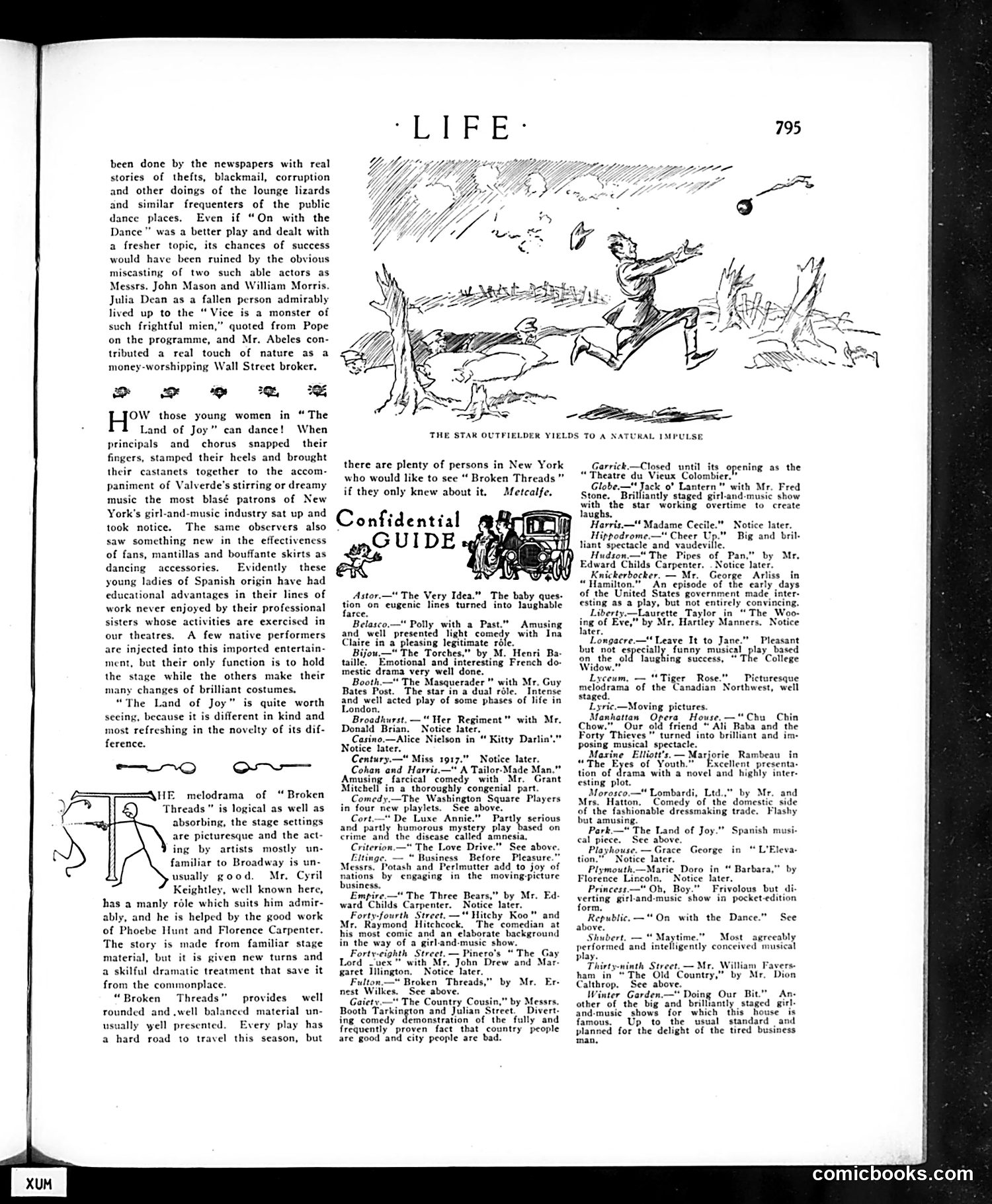
This page from *Life* magazine contains theater reviews and a single cartoon titled "The Star Outfielder Yields to a Natural Impulse." **The Cartoon:** The illustration depicts a baseball player executing an exaggerated diving or leaping motion, apparently chasing a ball. The humor lies in the caption's suggestion that the player is responding to an instinctive "natural impulse"—the visual exaggeration implies the player is overreacting or behaving in an absurdly physical manner to catch the ball. This appears to be gentle sports satire poking fun at athletic intensity or perhaps the theatrical nature of professional baseball performance. **The Text:** The bulk of the page consists of brief theater reviews under a "Confidential Guide" header, evaluating Broadway productions including "Polly with a Past," "The Masquerader," and "The Land of Joy." The reviews offer commentary on performances, casting choices, and plot quality for New York theatergoers. The tone is critical but generally encouraging toward attending these shows. The page reflects early 20th-century entertainment journalism mixing sports and theatrical criticism for an educated urban audience.
📄 Transcribed text from this page (OCR, searchable)
Machine-transcribed from the original scan — historical spelling and the odd misread are preserved.
been done by the newspapers with real stories of thefts, blackmail, corruption and other doings of the lounge lizards and similar frequenters of the public dance places, Even if “On with the Dance” was a better play and dealt with a fresher topic, its chances of success would have been ruined by the obvious miscasting of two such able actors as Messrs. John Mason and William Morris. Julia Dean as a fallen person admirably lived up to the “Vice is a monster of such frightful mien,” quoted from Pope on the programme, and Mr. Abeles con- tributed a real touch of nature as a money-worshipping Wall Street broker. ‘OW those young women in “The Land of Joy” can dance! When principals and chorus snapped their fingers, stamped their heels and brought their castanets together to the accom- paniment of Valverde’s stirring or dreamy music the most blasé patrons of New York's girl-and-music industry sat up and took notice. The same observers also saw something new in the effectiveness of fans, mantillas and bouffante skirts as dancing accessories. Evidently these young ladies of Spanish origin have had educational advantages in their lines of work never enjoyed by their professional sisters whose activities are exercised in our theatres. A few native performers are injected into this imported entertain- ment, but their only function is to hold the stage while the others make th many changes of brilliant costumes. “The Land of Joy” is quite worth seeing, because it is different in kind and most refreshing in the novelty of its dif- ference. —-O OO HE melodrama of “Broken Threads" is logical as well as absorbing, the stage settings are picturesque and the act- ing by artists mostly un- familiar to Broadway is un- usually good. Mr. Cyril Keightley, well known here, has a manly rdle which suits him admir- ably, and he is helped by the good work of Phoebe Hunt and Florence Carpenter. The story is made from familiar stage material, but it is given new turns and a skilful dramatic treatment that save it from the commonplace. “Broken Threads” provides well rounded and.well balanced material un- usually yell presented. Every play has a hard road to travel this season, but THE STAR OUTFIELDER YIELDS TO A NATURAL IMPULSE there are plenty of persons in New York who would like to see “ Broken Threads” if they only knew about it. Metcalfe. Confidential G ac _ Astor.—" The Very Idea.” The baby ques- tion on’ eugenic lines turned into laughable farce. Belasco.—" Polly with a Past.” Amusing and. well’ presented light comedy with Ina Claire’ in a’ pleasing legitimate rote. ijou.—" The Torches,” by M. Henri Ba- taille. Emotional and interesting French do- mestic drama very well done. Booth.—" The Masquerader" with Mr. Guy Bates Post. The star in a dual réle. Intense and well acted play of some phases of life in London. Broadhurst. —" Her Regiment" with Mr. Donald Brian, Notice later. Casino.—Alice Nielson in “ Kitty Darlin’. Notice later. Century.—" Miss 1917." _Notice later. Cohan and Harris.— A Tailor-Made Man, Amusing farcical comedy with Mr. Grant Mitchell in a thoroughly congenial part. Comedy.—The Washington Square Players in four new playlets. See above. Cort.—" De Luxe Annie.” Partly serious and partly humorous mystery play based on crime and the disease called amnesia, Criterion. —" The Love Drive.” See above. Eltinge, — “ Business Before, Pleasure.” Messrs. Potash and Perlmutter add to joy of nations by engaging in the moving-picture business. Empire —" The Three Bears,” by Mr. Ei ward Childs Carpenter. Notice later. Forty-fourth Street, —“* Hitehy Koo" and Mr. Raymond Hitchcock. The comedian at his’ most comic and an elaborate background in the way of a girland-music show. Fortv-eighth Street. — Pinero’s “ The Gay Lord Juex” with Mr. John Drew and Mar garet Illington, Notice later. Fulton.—" Broken Threads,” nest Wilkes. See above. Gaicty.— The Country Cousin,” by Messrs. Booth Tarkington and Julian Street. Divert- ing comedy demonstration of the fully and frequently proven fact that country people are good and city people are bad. by Mr. Er Garrick.—Closed until its opening as the “Theatre du Vieux Colombier.” Globe.—"* Jack o° Lantern" Mr. Fred Stone. “Brilliantly staged girl-and-music show with ‘the star working overtime to create laughs. Harris.—* Madame Cecile.” Notice later. Hippodrome.—" Cheer Up." Big and br liant spectacle and vaudeville. Hudson—" The Pipes of Pan," by Edward Childs Carpenter. . Notice later. Knickerbocker. — Mr. George Arliss in “Hamilton.” An episode of the early days of the United States government made inter- esting as a play, but not entirely convincing. Liberty.—Laurette Taylor in “The Woo- ing of Eve,” by Mr. Hartley Manners, Notice later. Longacre.—" Leave It to Jane.” Pleasant but not especially. funny musical, play. based fon the old laughing success, “The College Widow.” Lyceum, — “Tiger Rose." Picturesque melodrama of the Canadian Northwest, well staged. Lyric.—Moving pictures. Manhattan Opera House. —" Chu Chin Chow.” Our old friend " Ali Baba and the Forty’ Thieves” turned into brilliant and im- posing musical spectacle. Maxine Elliott's. — Marjorie Rambeau in “The Eyes of Youth.” Excellent presenta: tion of drama with a novel and highly inter- esting plot. Morosco.—" Lombardi, Ltd.,” by Mr. and Mrs, Hatton, Comedy ‘of ‘the domestic side of the fashionable dressmaking trade. Flashy but amusing. Park.—" The Land of Joy.” cal piece. See above. Playhouse. —Grace George in tion.” Notice later. Plymouth.—Marie Doro in “ Barbara,” by Florence Lincoln, Notice later. Princess—" Oh, Boy.” Frivolous but di- verting girl-and-music show in pocket-edition form. Republic. =" On with the Dance.” above. Shubert, — Most axree performed and intelligently conceived n play Thirt ham in "The Old Country,” by Mr. Calthrop. See above. Winter Garden.—" Doing Our Bit." An- other of the big and brilliantly staged girl- and-music shor for which this house is famous, Up. to. the usual standard and planned for the delight of the tired business man, Mr. Spanish musi- “ L'Eleva- See inth Street, — Mr. William Favers- Dion comicbooks.com