
A complete issue · 40 pages · 1917
Life — September 27, 1917
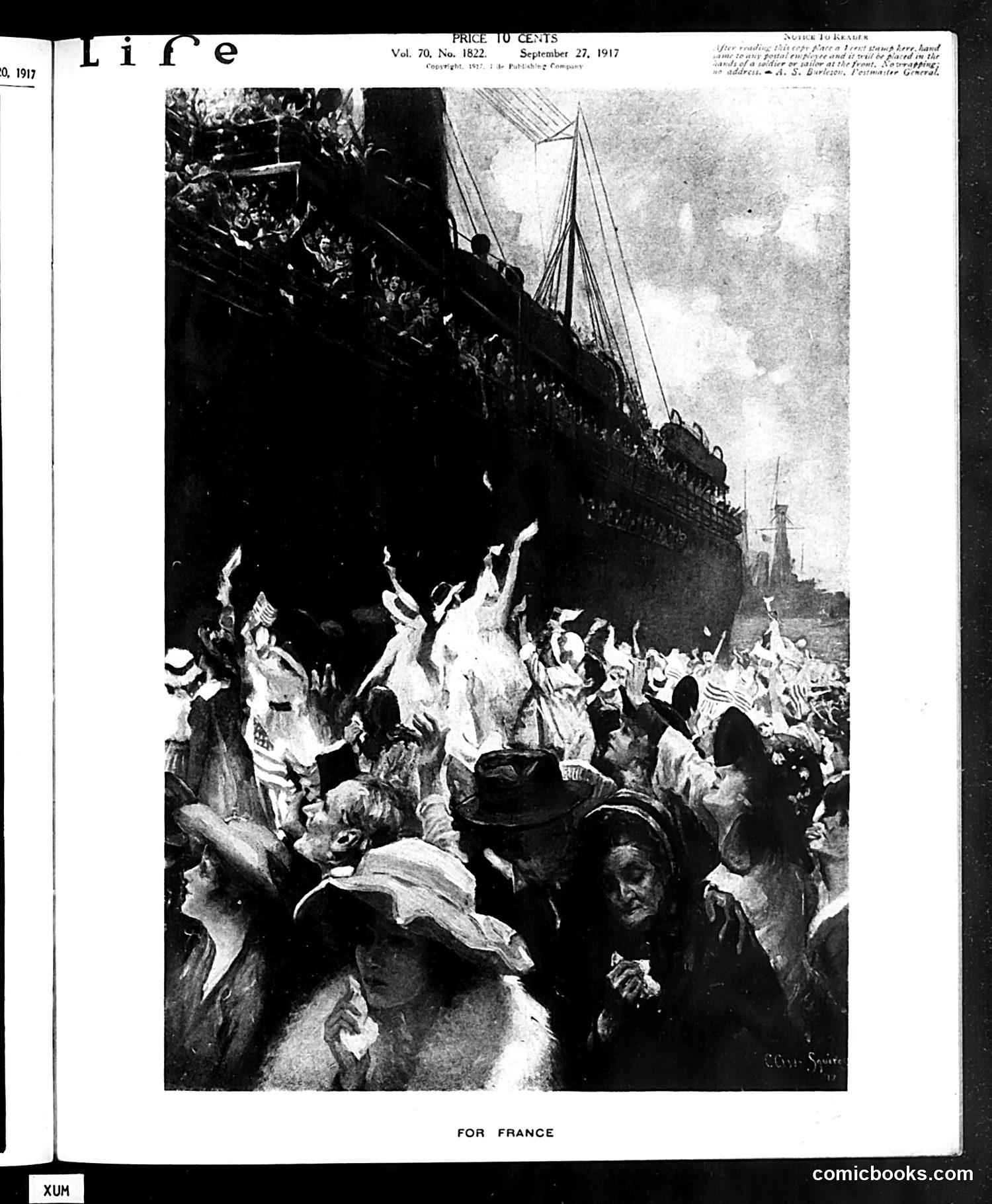
This photograph depicts a massive crowd of civilians and soldiers enthusiastically greeting a large military transport ship. Given the 1917 date and caption "For France," this likely documents American troops departing for World War I service in France, or possibly French forces arriving in America. The photograph captures public enthusiasm for U.S. involvement in WWI, which had begun months earlier in April 1917. The raised flags and celebratory atmosphere reflect wartime patriotic fervor. The crowded dock scene shows widespread public support for military deployment, common during the war's early American phase before casualty counts mounted significantly. The image serves as documentary evidence of American mobilization and public sentiment during the Great War.
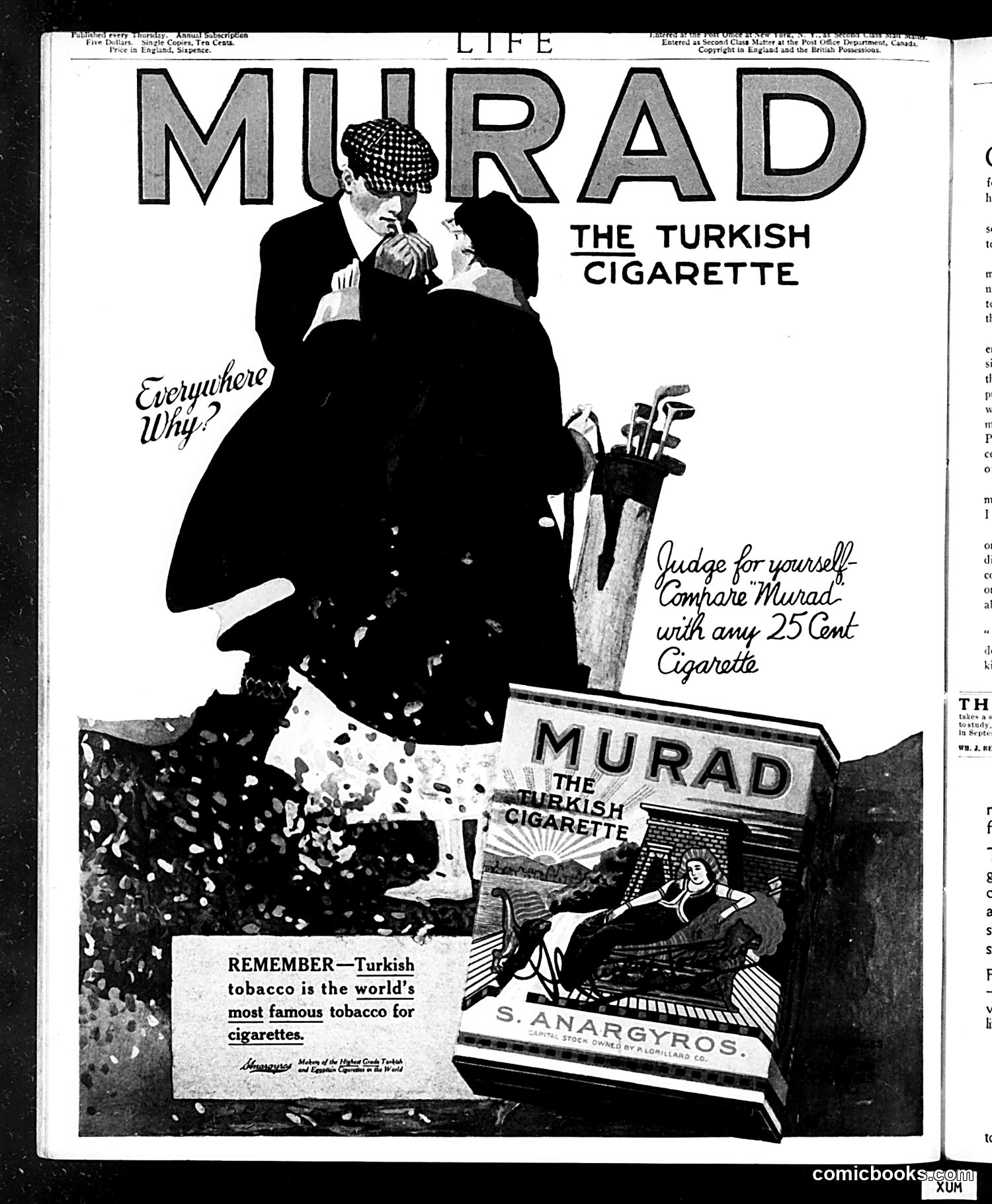
This is a **cigarette advertisement**, not political satire. The page promotes Murad Turkish cigarettes using a scene of two well-dressed men in conversation, with text asking "Everywhere Why?" The ad's appeal rests on **Turkish tobacco's prestige**—the text states Turkish tobacco is "the world's most famous tobacco for cigarettes." The imagery suggests sophistication and refined taste among gentlemen. The phrase "Judge for Yourself: Compare Murad with any 25 Cent Cigarette" positions Murad as premium product worth comparing against cheaper alternatives. The packet visible in the lower right shows S. Anargyros as the distributor. This reflects early 20th-century advertising strategies emphasizing social status and quality through masculine elegance rather than health claims.
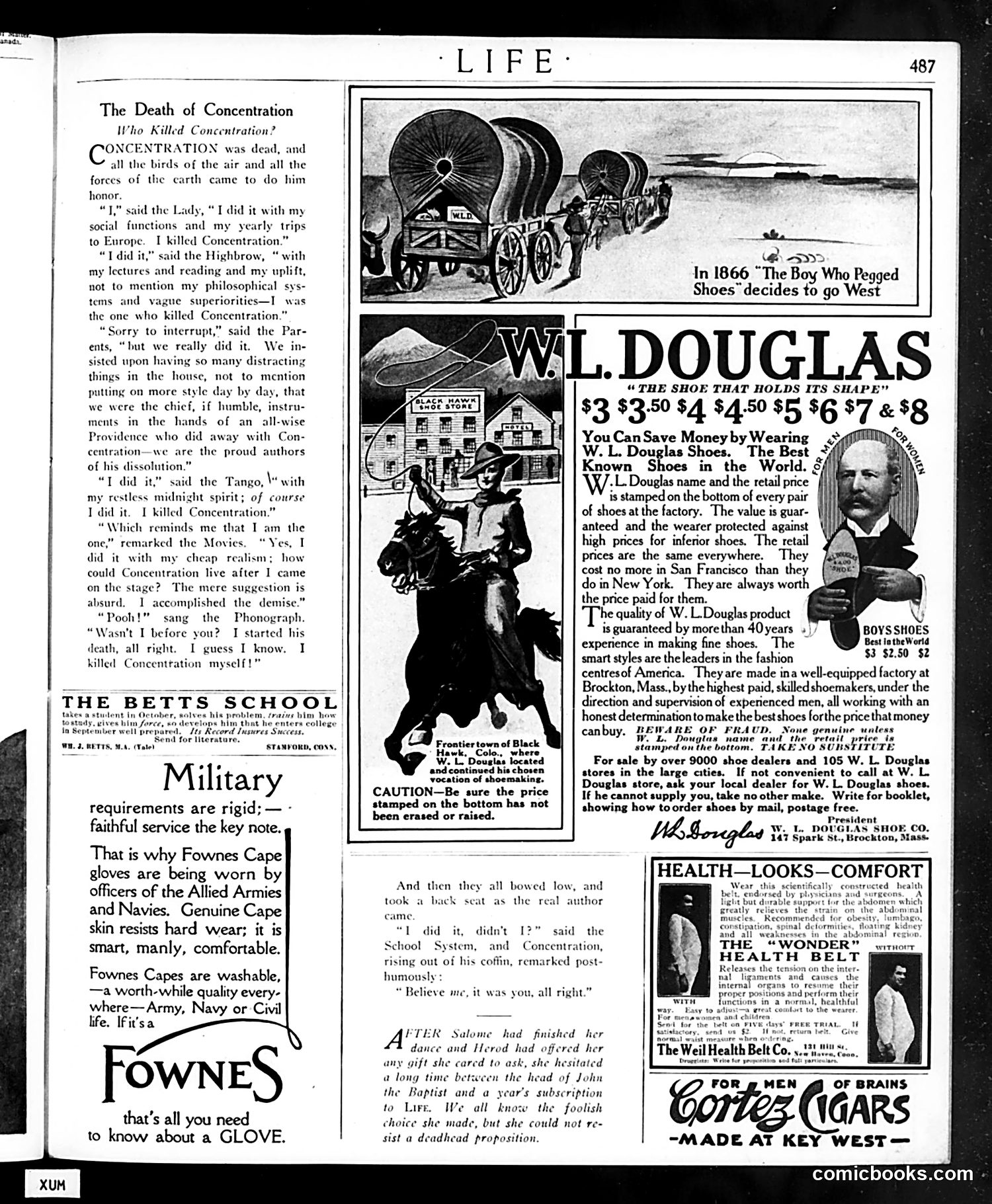
This page is primarily **advertising** rather than political satire. The dominant content features a W.L. Douglas shoe advertisement with pricing ($3, $2.50, $4, $4.50, $5, $6, $7, $8) and a portrait of W.L. Douglas himself. The ad emphasizes value and factory-direct pricing. The left side contains a short humorous piece titled "The Death of Concentration" featuring fictional characters (the Lady, Highbrow, Tango, Movies, Phonograph, School Sister) claiming credit for killing "Concentration" through various distractions. This appears to be gentle social satire about modern life's diversions. Additional advertisements occupy the remainder: Fownes gloves (military-themed), The Wondrous Health Belt, and Cortez Cigars. The top illustration shows a covered wagon labeled "In 1866—The Boy Who Pegged Shoes decides to go West," apparently Douglas's origin story.
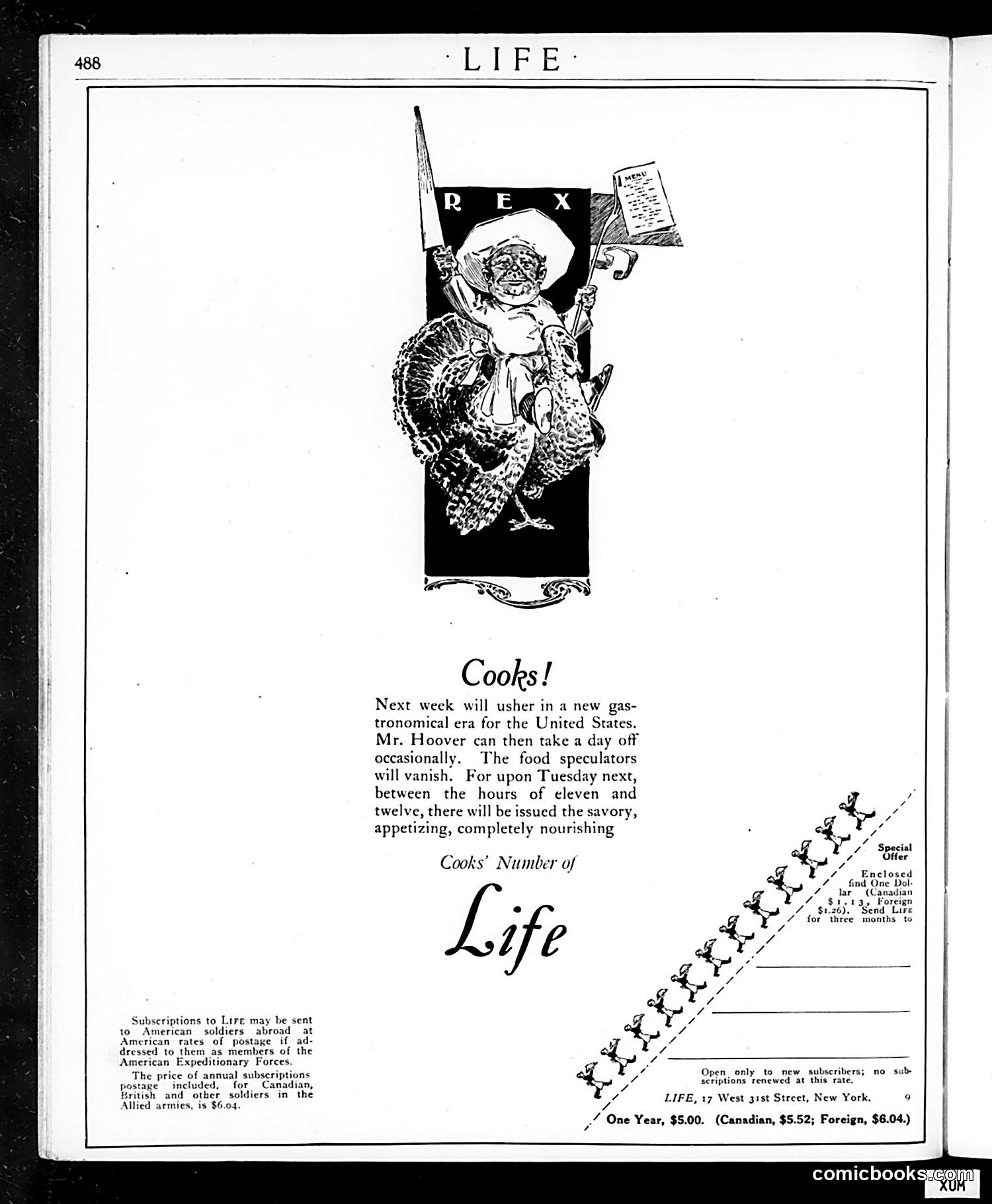
This page is primarily **advertising for Life magazine subscriptions**, not political satire. The main illustration shows a cartoonish character labeled "REX" (likely representing a chef or cook) wielding a sword and holding a menu, standing over what appears to be turkeys or poultry. The accompanying text references "Cooks!" and mentions that "next week will usher in a new gastronomical era for the United States," with Mr. Hoover able to "take a day off occasionally." The reference to **President Hoover** and "food speculators" suggests this was published during the **Great Depression era**, when food scarcity and economic hardship were pressing concerns. The cartoon appears to satirize optimistic promises about improving food availability, though the exact context is unclear without additional historical detail. The page concludes with subscription information and pricing.
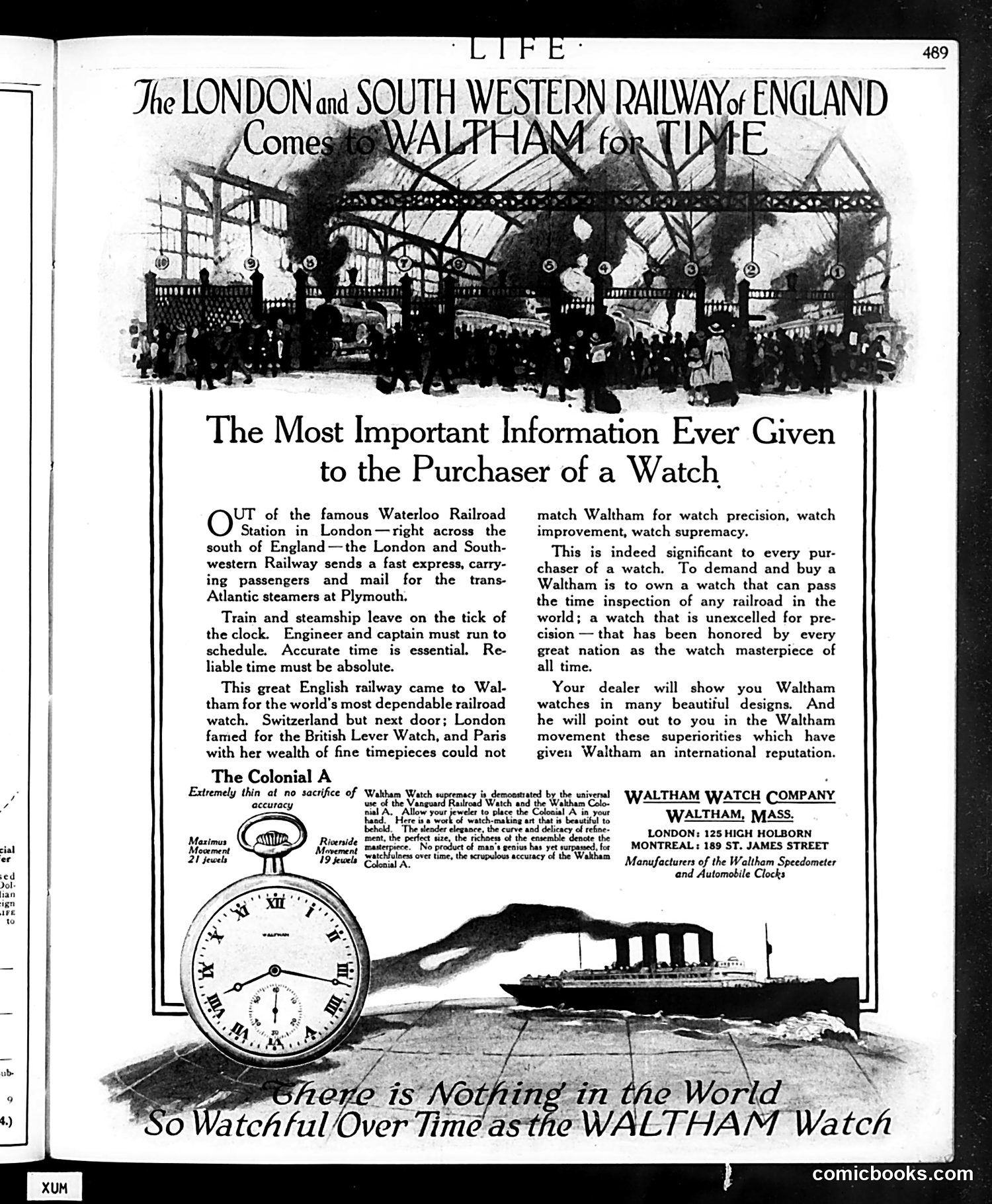
This is primarily a **commercial advertisement**, not satire or political commentary. The page promotes Waltham watches by linking them to the London and South Western Railway's reliability and punctuality. The ad uses the railway's famous Waterloo Station as a backdrop, emphasizing that accurate timekeeping is essential for rail operations serving transatlantic steamers. It argues that if the railway trusts Waltham watches for such critical scheduling, consumers should too. The steamship imagery and references to Atlantic travel underscore the watch's international reputation. The final slogan—"There is Nothing in the World So Watchful Over Time as the WALTHAM Watch"—is a straightforward commercial claim rather than satire, using Victorian-era advertising rhetoric to establish product credibility through association with prestigious institutions.
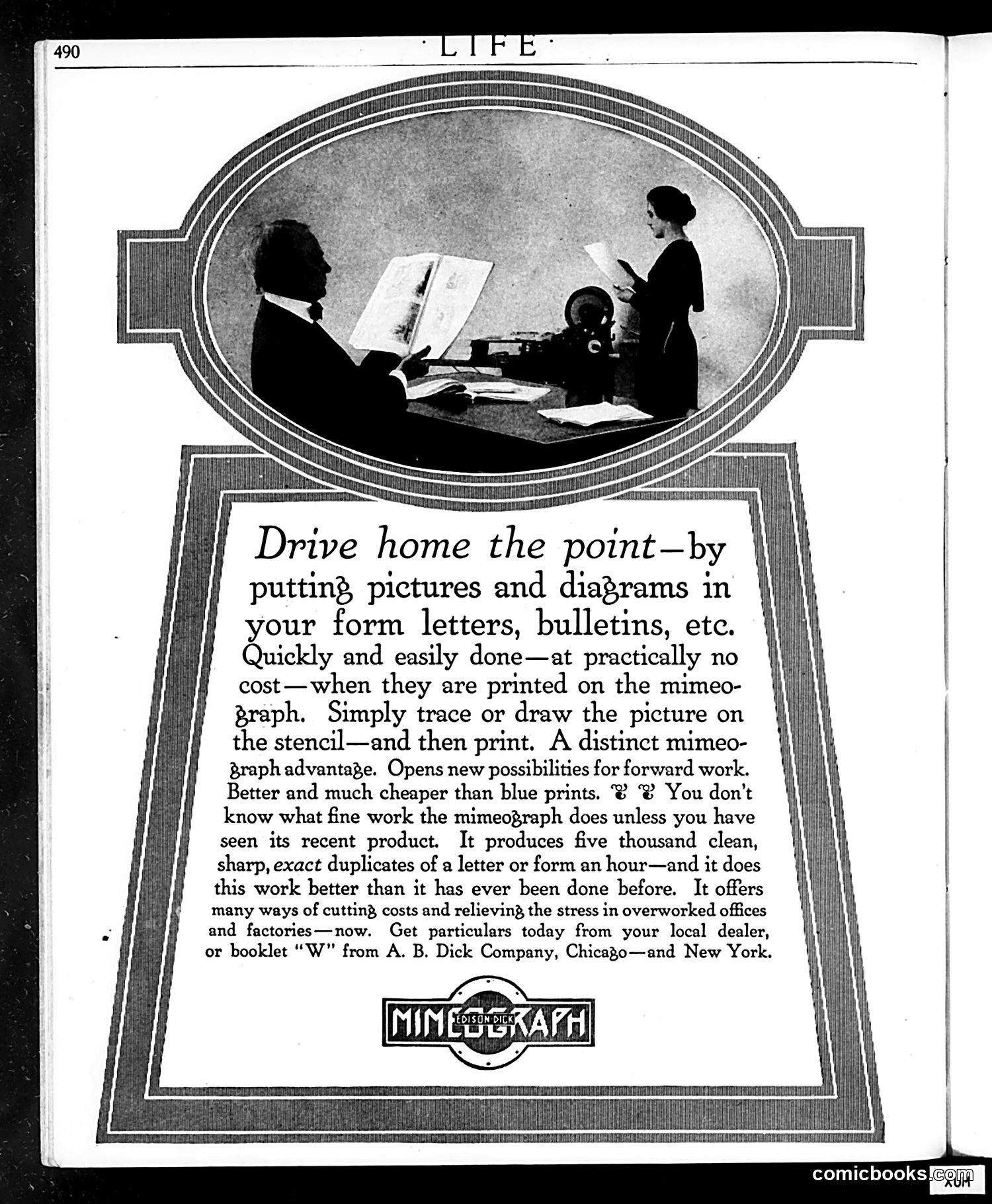
This page is primarily **advertising, not satire or political commentary**. It's a vintage advertisement for the Mimeograph machine, made by A.B. Dick Company (Chicago and New York). The image shows two office workers—a man seated at a desk examining documents and a woman standing beside him holding papers. The ad promotes the mimeograph as a cost-effective copying technology that could reproduce documents, diagrams, and illustrations quickly by tracing designs onto stencils. The sales pitch emphasizes efficiency: producing "five thousand clean, sharp, exact duplicates of a letter or form an hour," supposedly cheaper and faster than blueprint technology. The ad targets businesses seeking to reduce overhead in "overworked offices and factories." This represents early 20th-century office automation technology, predating photocopiers.
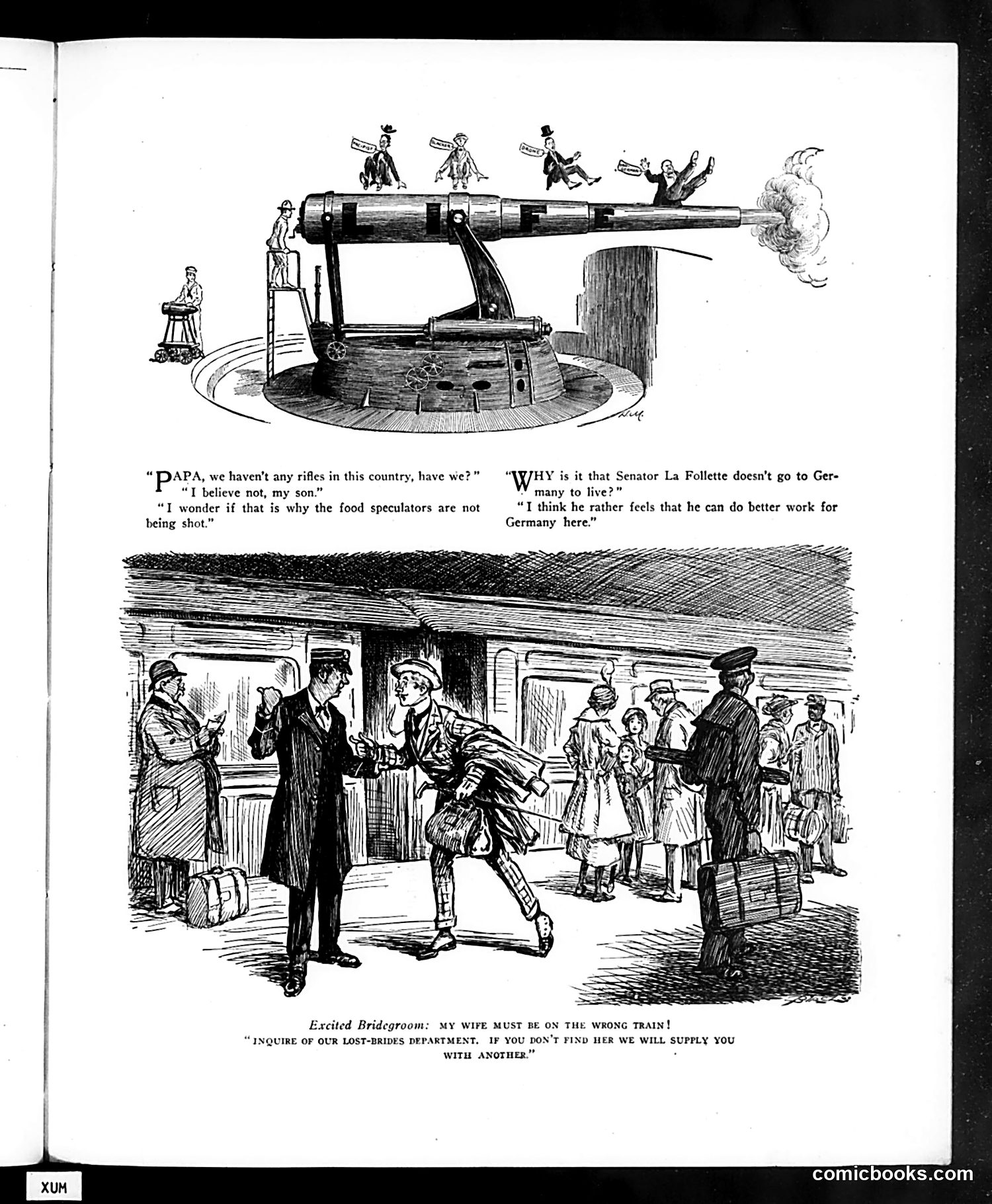
This page contains two satirical cartoons from *Life* magazine, likely from World War I era. **Top cartoon:** Shows a large cannon with figures operating it. The dialogue criticizes America's military preparedness—a father notes the country lacks rifles, wondering why food speculators aren't being shot. This satirizes both inadequate armament and profiteering during wartime. **Bottom cartoon:** Titled "Excited Bridegroom," depicts a military officer at a train station searching for his bride, apparently on the wrong train. The "Lost-Brides Department" offers to supply a replacement wife. This is absurdist humor about wartime chaos and hasty military marriages, mocking the disruption war caused to civilian life and domestic arrangements. Both cartoons use exaggeration to critique war-related social and economic problems.
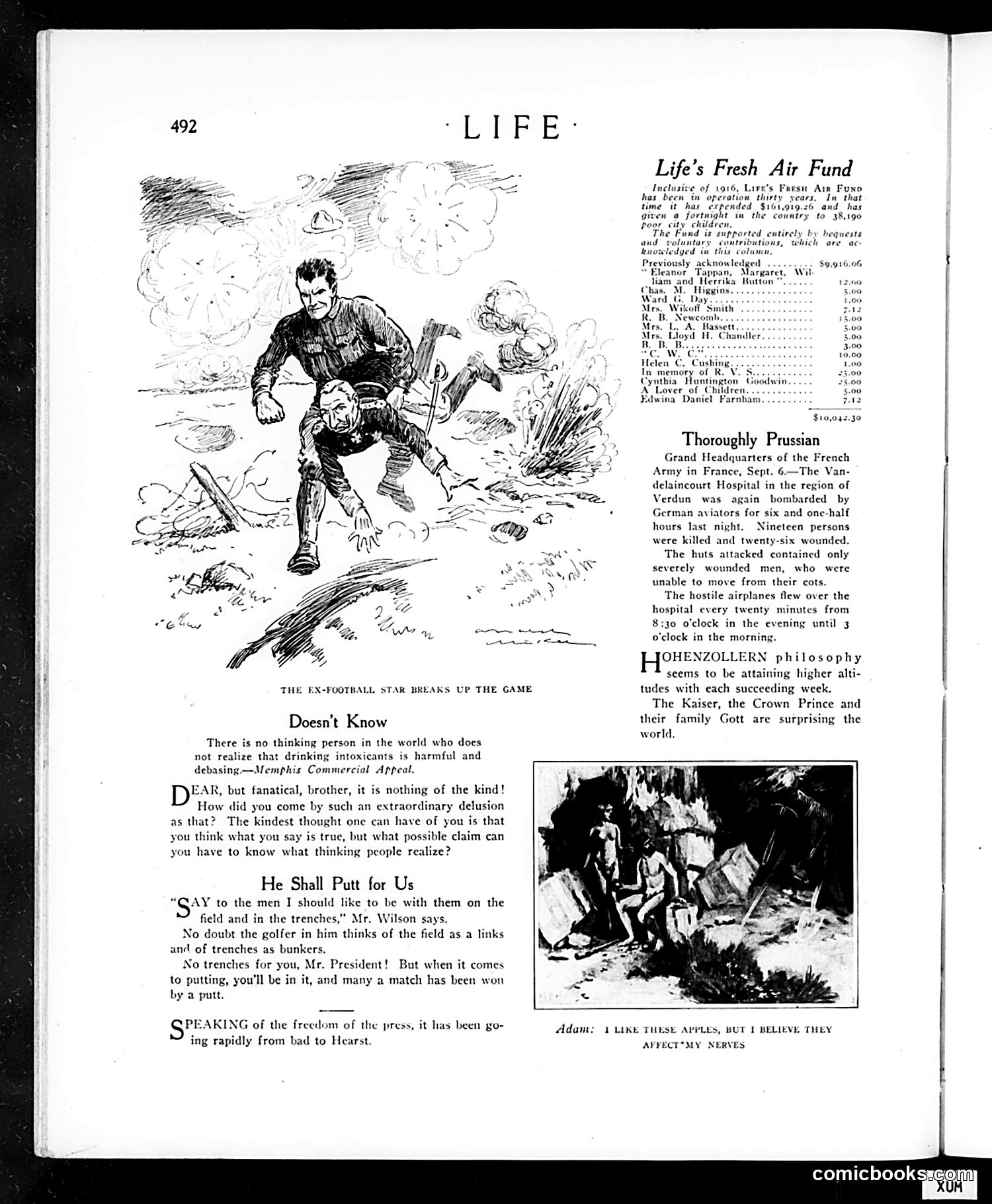
This cartoon depicts a man in military uniform breaking up a football game, with the caption referencing an "ex-football star." The image likely satirizes how World War I military service interrupted American civilian life and sports. The surrounding text addresses serious wartime topics: "Life's Fresh Air Fund" lists donations for relief efforts, "Thoroughly Prussian" describes German aerial bombardment of a French hospital, and "Doesn't Know" critiques those unaware of alcohol's dangers—a reference to Prohibition-era debates. The "He Shall Putt for Us" section appears to joke about golf and President Wilson, while commentary on press freedom suggests wartime censorship concerns. The overall page reflects 1916-1918 anxieties about America's military involvement and social disruption.
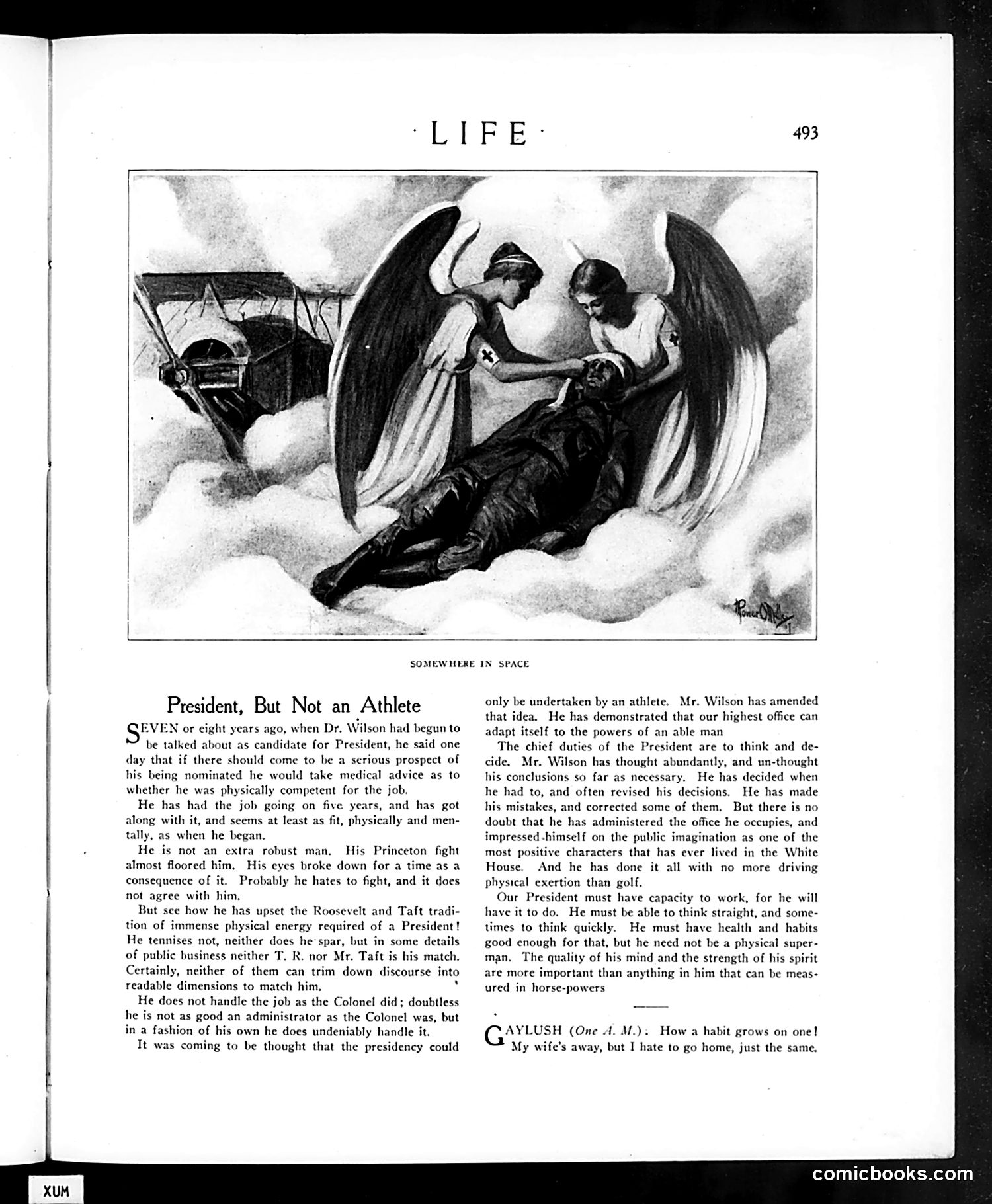
**The Cartoon "Somewhere in Space"** depicts two angels attending to an unconscious or deceased military officer amid clouds. This appears to be a WWI-era commentary on military casualties—specifically, the article "President, But Not an Athlete" discusses whether President Wilson (referenced in the text) possessed sufficient physical vigor for the job. **The Article's Point:** The author argues that while Wilson lacks the athletic robustness of predecessors like Roosevelt and Taft, a President needs mental capacity and decision-making ability more than physical strength. Wilson's administrative competence matters more than his "horse-powers." **The Cartoon's Irony:** It juxtaposes this debate about presidential fitness with the grim reality of soldiers dying in actual combat—suggesting the philosophical question becomes moot amid wartime casualties.
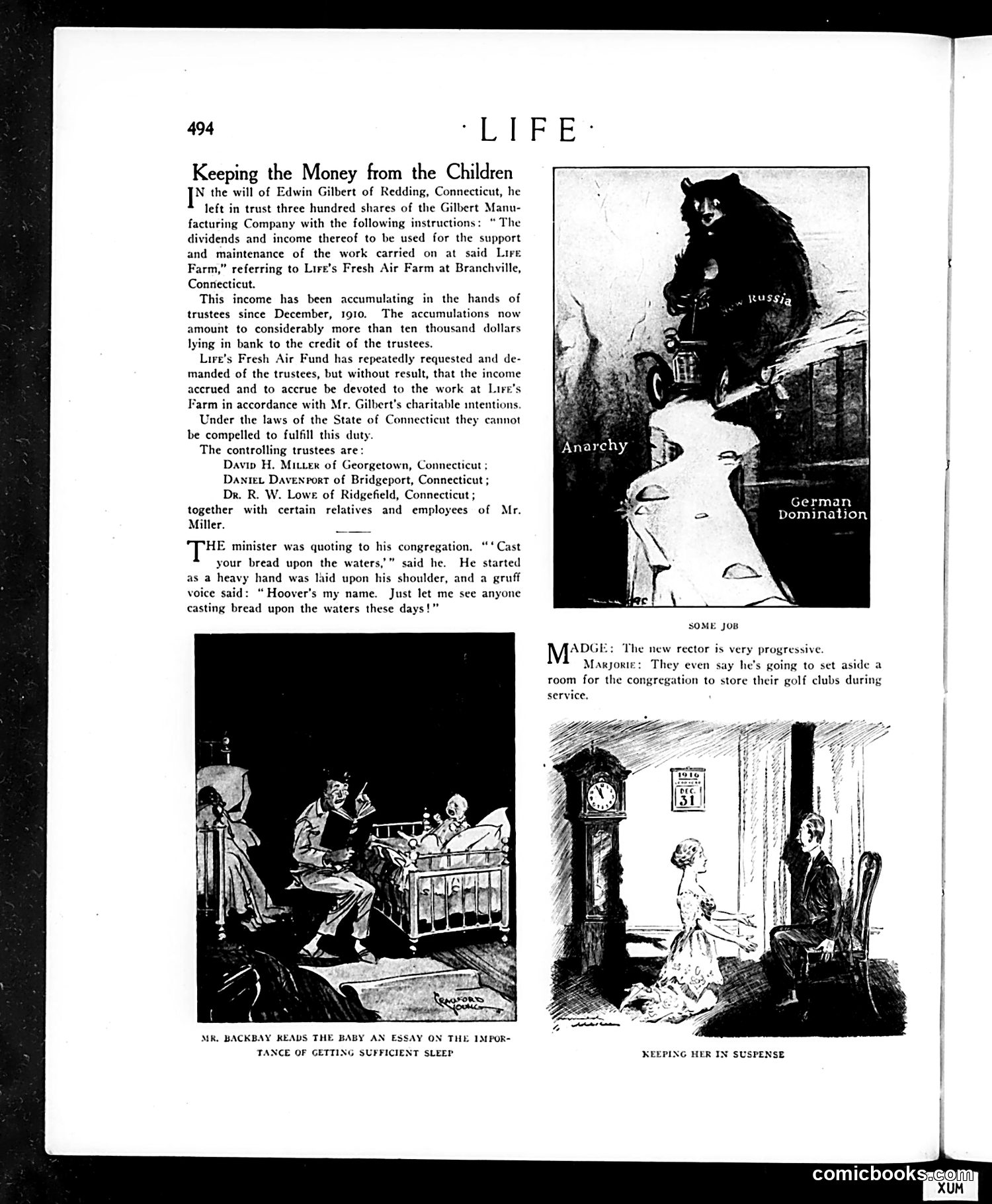
**Top Section - "Keeping the Money from the Children":** This article discusses Edward Gilbert of Roddis, Connecticut, who left Gilbert Manufacturing Company shares in trust for Life's Fresh Air Farm. Income has accumulated since 1910 but remains unspent. Life's Farm repeatedly requested trustees release funds for charitable purposes, but Connecticut law prevents them from doing so. The controlling trustees are named: David Micks, Daniel Davenport, and Dr. R.W. Lowe. **Anecdote Section:** A minister quotes "Cast your bread upon the waters" while a man named Hoover interrupts, claiming he'll see anyone literally casting bread on water—satirizing misunderstanding of biblical metaphor. **Cartoons:** Two illustrations satirize domestic life: one shows a man reading an essay on infant sleep to a baby; another depicts a woman keeping her guest in suspense (likely about social gossip or news).
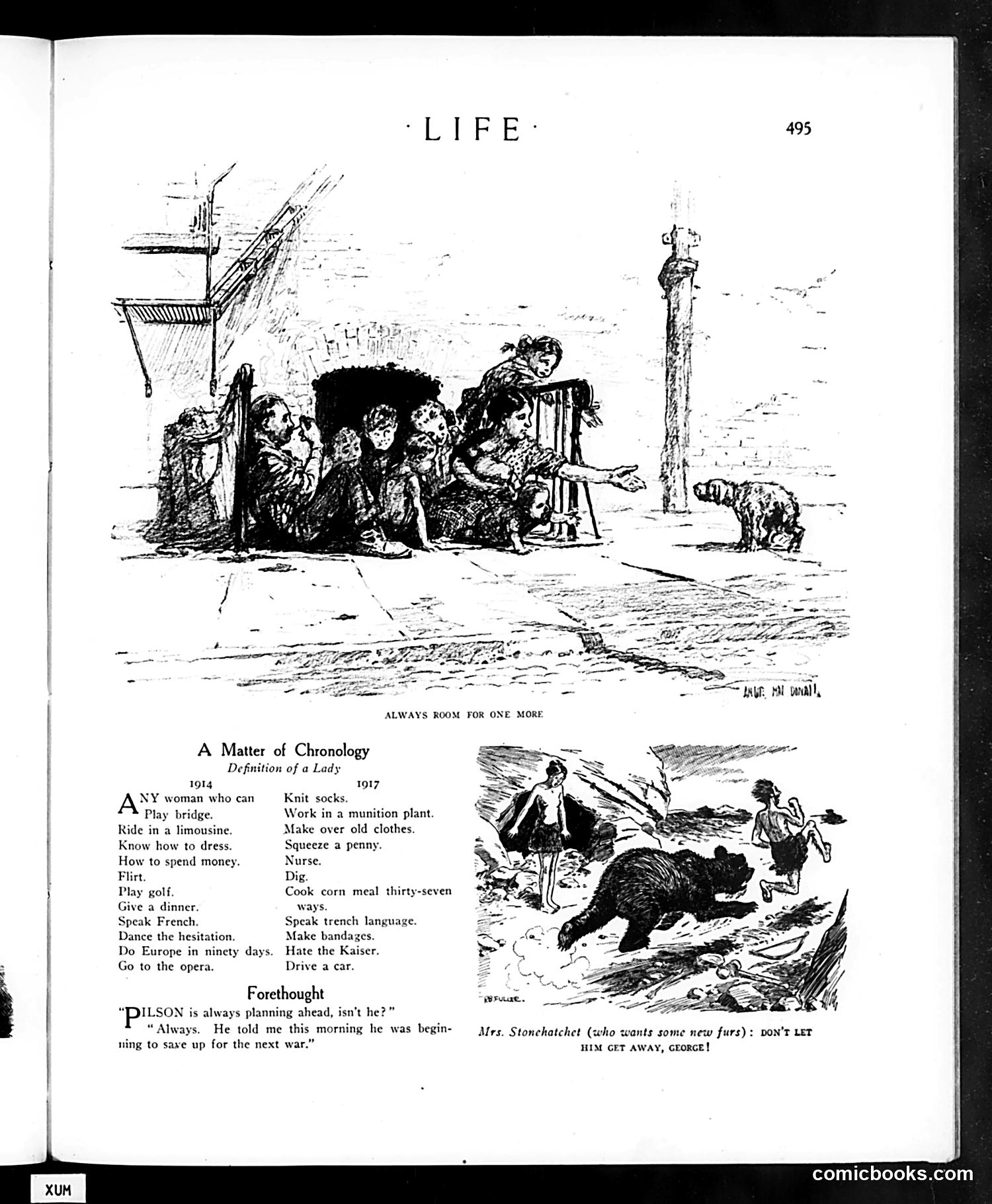
This page contains two satirical pieces from WWI-era Life magazine: **Top cartoon ("Always Room for One More"):** Depicts overcrowded tenement housing with impoverished families squeezed together, while a well-fed landlord or property owner stands apart. The satire critiques urban housing exploitation and overpopulation. **"A Master of Chronology":** Lists contrasting expectations for women between 1914 (pre-war: leisure activities like bridge, flirting, opera) and 1917 (wartime: factory work, nursing, bandage-making). This satirizes how women's roles rapidly changed during WWI, shifting from leisured domesticity to war-effort labor. **"Forethought":** A brief joke about someone always planning ahead for the next war, reflecting dark wartime humor about endless conflict. **Bottom cartoon:** Shows a woman trying to prevent a pig from escaping, with the caption "don't let him get away, George"—likely satirizing food rationing or agricultural concerns during the war.
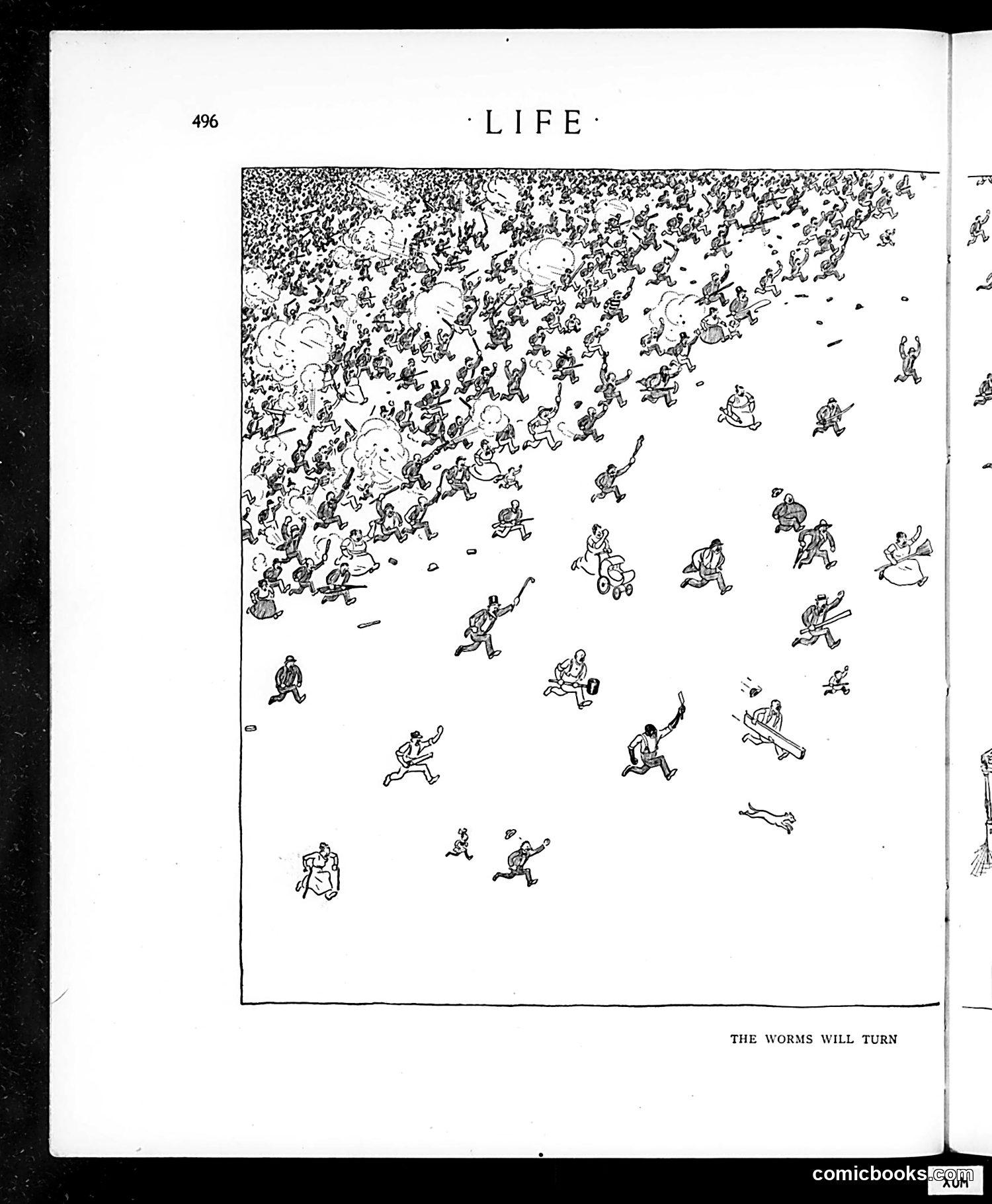
This satirical cartoon depicts a massive crowd of small figures (the "worms") on the left side, with scattered individuals on the right appearing to flee or resist. The title "The Worms Will Turn" references the proverb that even the most oppressed will eventually rebel. The image uses scale and density to satirize class conflict—the densely packed multitude representing common people or the working class, contrasted against isolated figures fleeing before them. This likely comments on labor unrest, social upheaval, or revolution, suggesting that the downtrodden masses will eventually rise against those in power. The cartoon's exact historical context is unclear without additional publication information, but it appears to address anxieties about popular uprising or class revolution during a period of social tension.
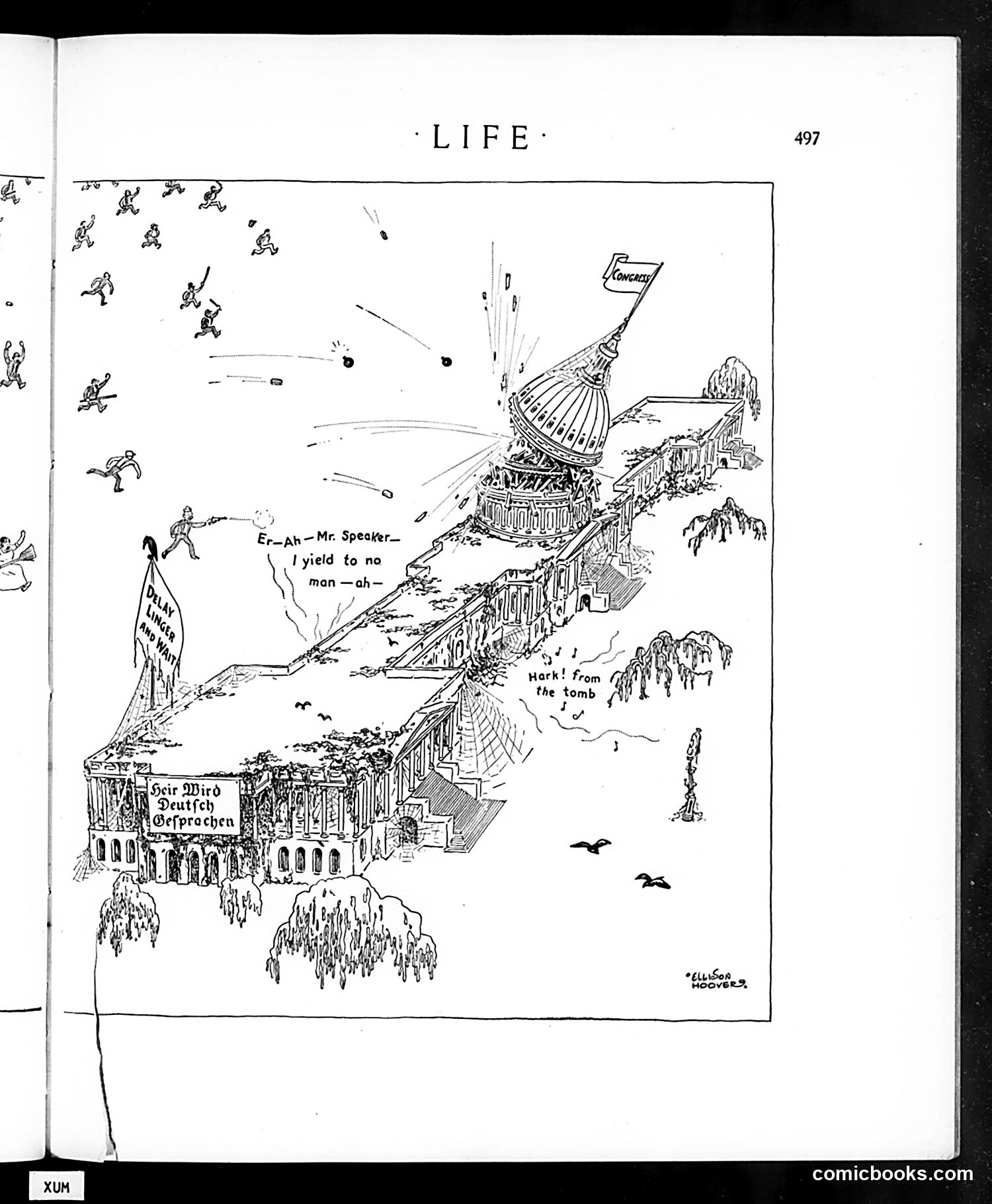
This Life magazine cartoon satirizes German militarism and expansionism, likely from the early 20th century. The central image depicts a massive domed structure (representing German imperial power and the Reichstag) atop a fortified building labeled "Acht Wird Deutsch Gesprochen" ("German is Spoken Here"). A figure labeled "Der Macht" (The Power) stands defiantly, declaring "Er-Ah-Mr. Speaker—I yield to no man—ah—" to a speaker on the left holding a sign reading "Blunders and Bungles." The cartoon mocks German imperial arrogance and refusal to acknowledge criticism or accountability. Surrounding figures appear to be fleeing or reacting with alarm. The overall message critiques German resistance to democratic accountability and peaceful resolution of international disputes.
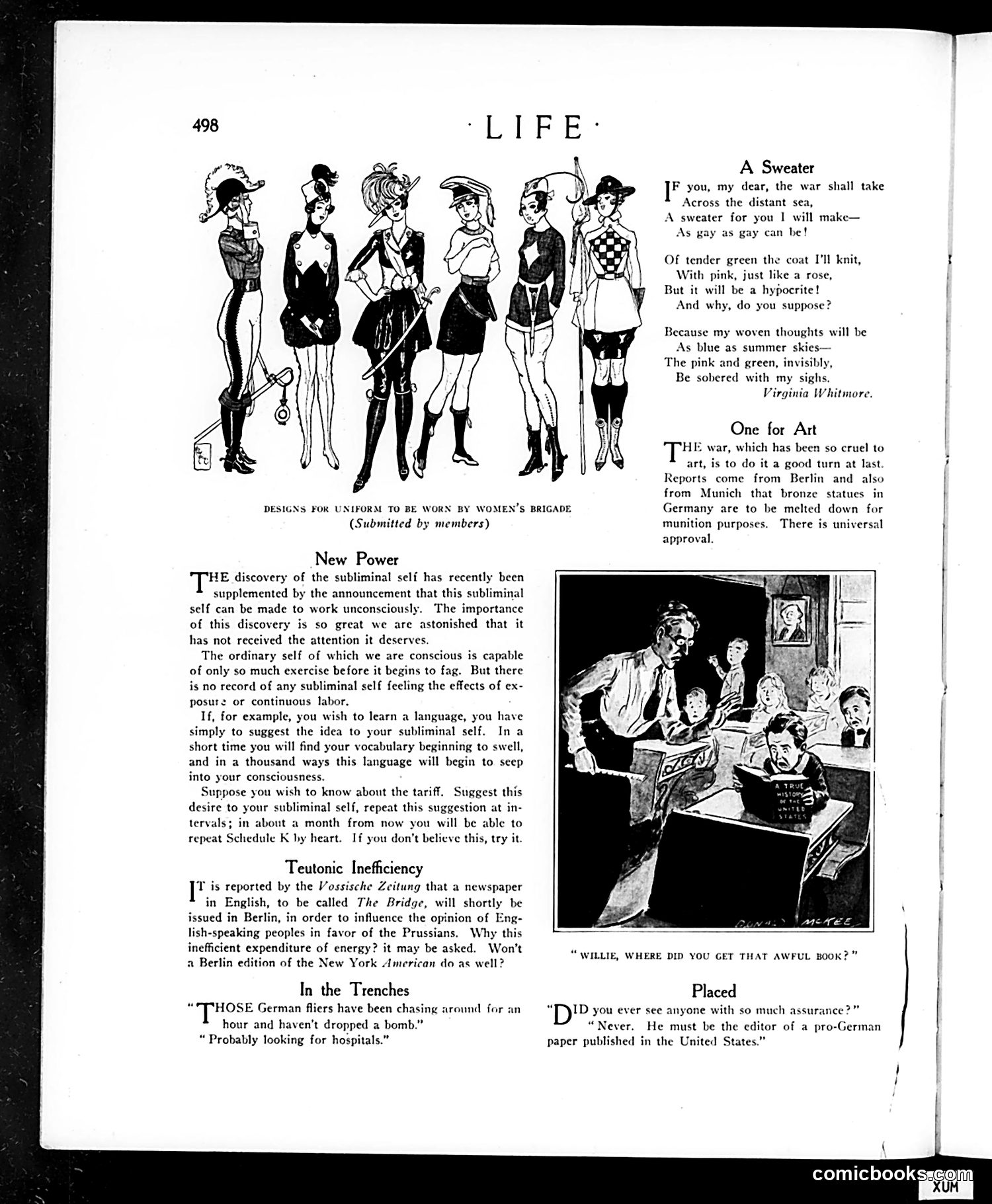
This page from *Life* magazine contains several wartime satirical pieces from World War I. **Top illustration**: Shows six women's military uniform designs submitted by members of a women's brigade. The satire concerns fashionable women adopting military dress—the accompanying poem mocks the contradiction between genuine wartime service and women treating uniforms as fashionable accessories. **"One for Art"**: Satirizes Germany's decision to melt down bronze statues for munition purposes, presented as unexpectedly beneficial to art. **"In the Trenches"**: A brief joke about German pilots dropping bombs near hospitals rather than military targets. **"Placed"**: A quip suggesting German-sympathetic newspaper editors lack the professional standards of American editors. The overall tone mocks both German inefficiency and American pro-German sentiment during the war.
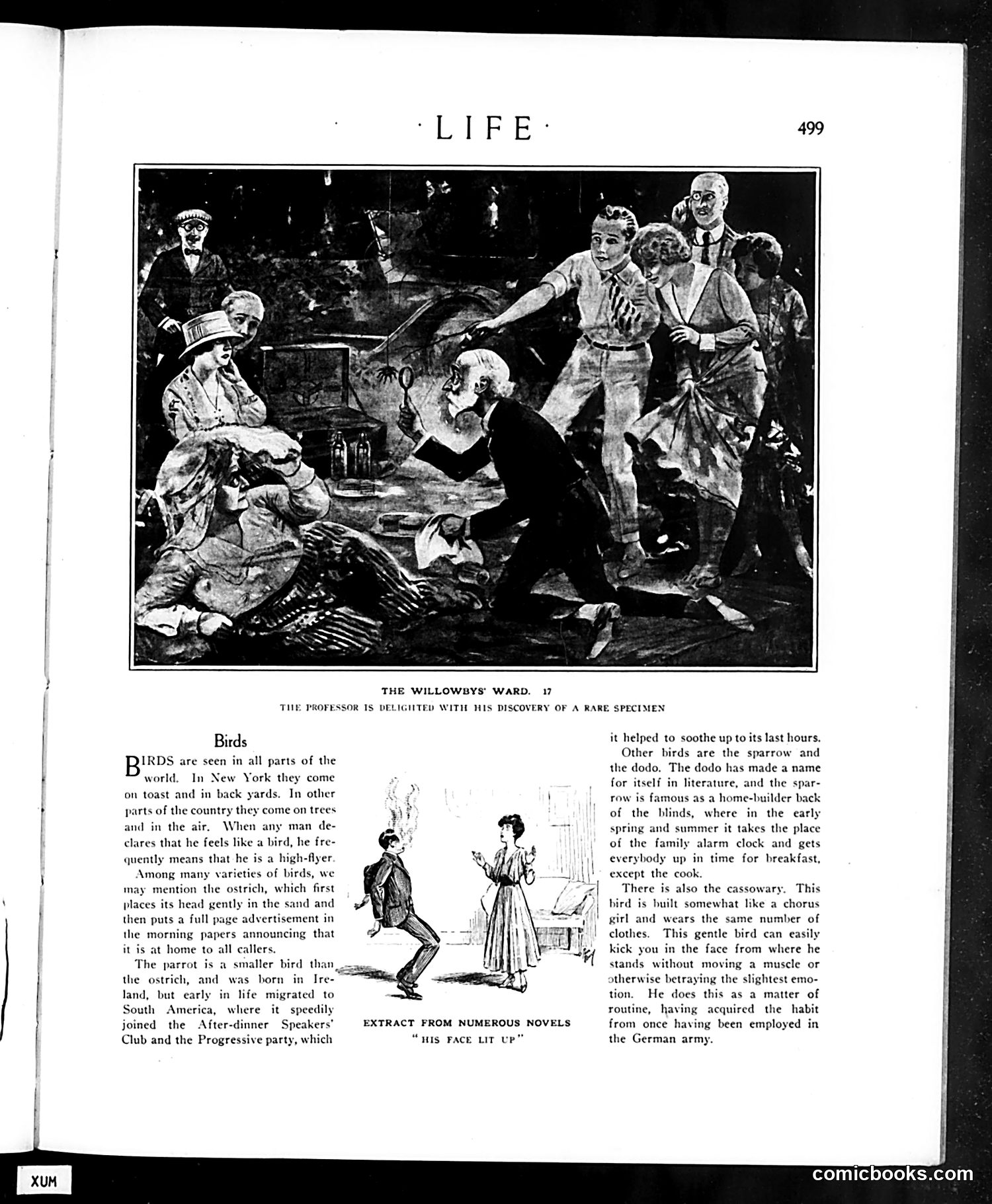
This Life magazine page features two distinct sections: **Top image:** "The Willowbys' Ward" — a scene depicting a professor delighted by discovering a rare bird specimen. Multiple figures observe the professor's excitement in what appears to be a domestic or institutional setting. **Bottom section:** An article on "Birds" discussing their presence worldwide, particularly mentioning the ostrich and parrot. The text notes the parrot was born in Ireland but "early in life migrated to South America" and joined "the After-dinner Speakers' Club and the Progressive party." **The satire:** The parrot's biography appears to mockingly equate the bird's migration and club memberships with human political involvement, likely satirizing progressive politics or specific political figures of the era. The accompanying illustration shows a man and woman in period dress, suggesting romantic or domestic comedy. The humor relies on anthropomorphizing the parrot as a political actor.
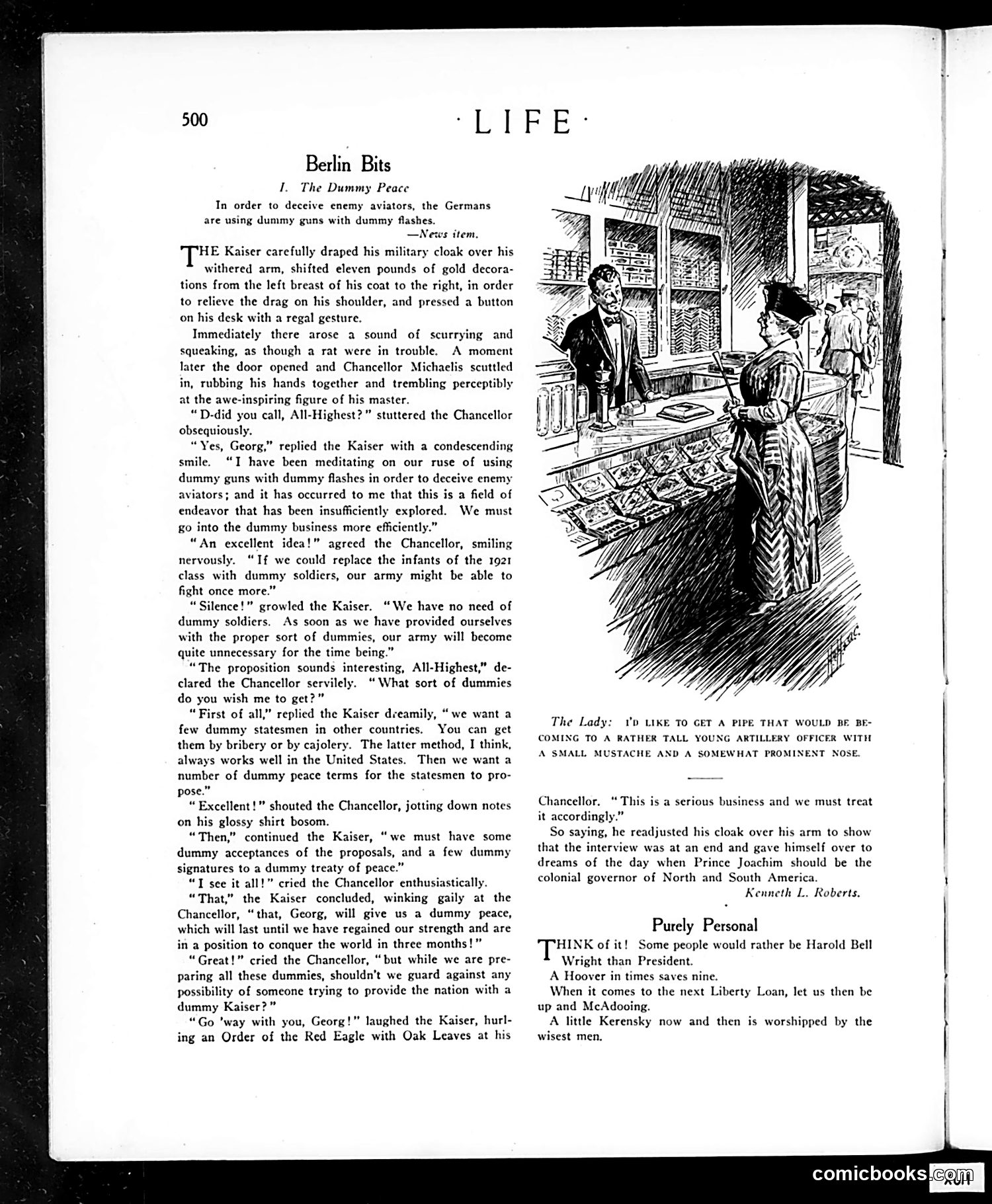
This satirical piece mocks German peace negotiations after World War I. The Kaiser and Chancellor Michaelis discuss manufacturing "dummy" peace terms—fake proposals and false treaty signatures—as a delaying tactic to buy time for Germany to rearm and resume conquest. The satire's target: Germany's perceived insincerity in post-war peace discussions. Life suggests German leadership views peace negotiations as mere theater, not genuine diplomacy. The joke escalates absurdly—dummy guns, dummy soldiers, dummy statesmen—culminating in the Chancellor's jab about a "dummy Kaiser," implying the current leadership itself is fraudulent. The illustration shows the obsequious Chancellor trembling before the Kaiser's imposing figure, emphasizing the power dynamic and the Chancellor's complicity in deception. This reflects American skepticism about German intentions during the Treaty of Versailles period (circa 1918-1919), when Life's readers questioned whether Germany would honor peace agreements.
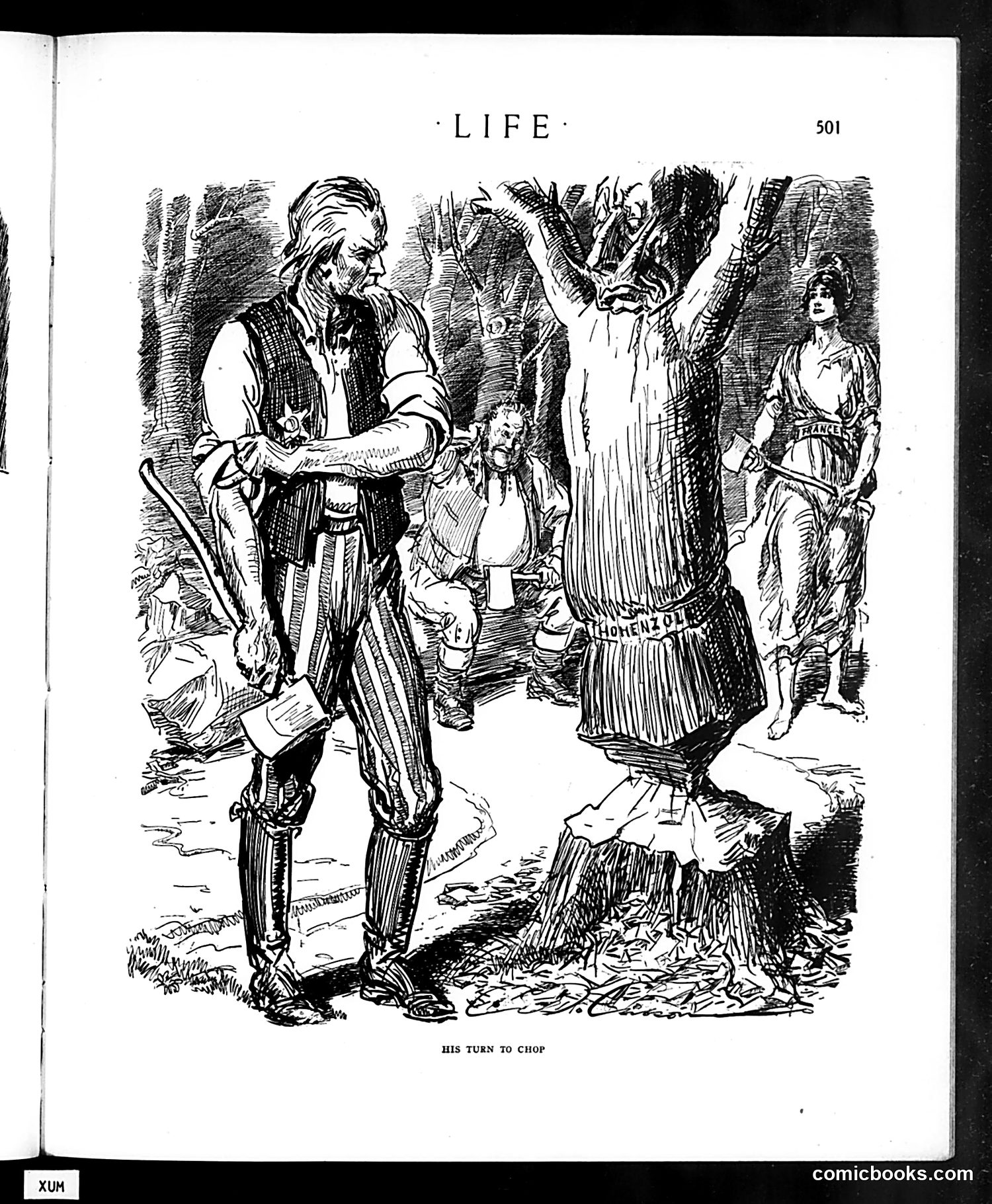
This is a satirical woodcut-style illustration showing what appears to be a lumberjack or woodsman with an axe facing a large tree. The caption "His Turn to Chop" suggests role reversal—the tree is depicted as an anthropomorphic figure with a face, appearing to wear clothing (text on the garment reads "HOMEN" or similar, though unclear). The satire likely comments on labor relations or class conflict: the working man with his axe confronting someone/something of higher status. The surrounding figures in period dress suggest this references a specific historical or contemporary labor dispute, though without additional context, the precise target and date remain unclear. The style and "LIFE" publication masthead indicate this is from the 19th or early 20th century.
This page contains editorial commentary on German war crimes and the problem of justice after World War I. The article discusses Dr. Harry Stuermer, a German correspondent who witnessed Armenian massacres committed by German forces in Turkey, became disillusioned with the German General Staff, and escaped to Switzerland to publish his account. The central satirical point: The author argues that while Germany's military leadership bears responsibility for horrific atrocities against Belgian, French, and Armenian civilians, the practical problem of punishment is intractable. Killing German soldiers in continued warfare kills ordinary conscripts rather than the guilty officers and officials who orchestrated these crimes. The Germans themselves, the author suggests ironically, are "slackers" for not executing their own war criminals. The small cartoon in the left margin appears to mock the concept of virtue or justification in war. The piece advocates that the Allies must continue fighting to victory, accepting the cost, since justice cannot be achieved any other way.
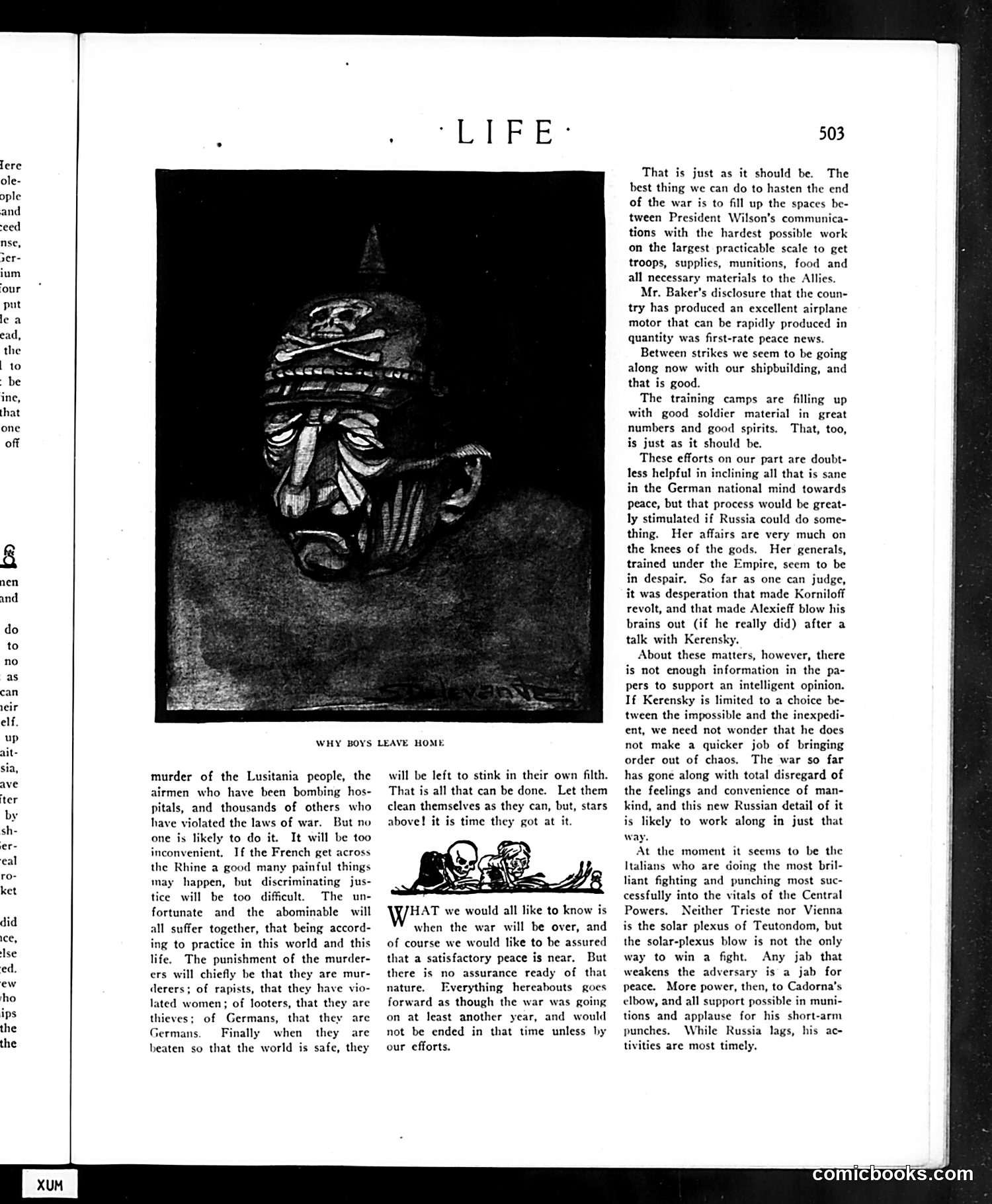
The cartoon titled "Why Boys Leave Home" depicts a grotesque German military figure—likely representing German militarism or Kaiser Wilhelm II's regime. The exaggerated, skull-like face with aggressive features caricatures the brutality associated with German conduct in World War I. The accompanying text discusses German war crimes: the Lusitania sinking, bombing of hospitals, and violations of international law. The author argues that while these perpetrators deserve punishment, practical justice will be impossible after the war ends—they'll simply "stink in their own filth" amid general chaos. The editorial then pivots to encouraging American industrial effort (airplane motors, shipbuilding, troop supplies) to support the Allies and hasten war's end. It also comments on Russian instability under Kerensky and praises Italian military advances as the war's most effective current fighting. The "boys leaving home" title likely suggests German atrocities drive young men to enlist against Germany.
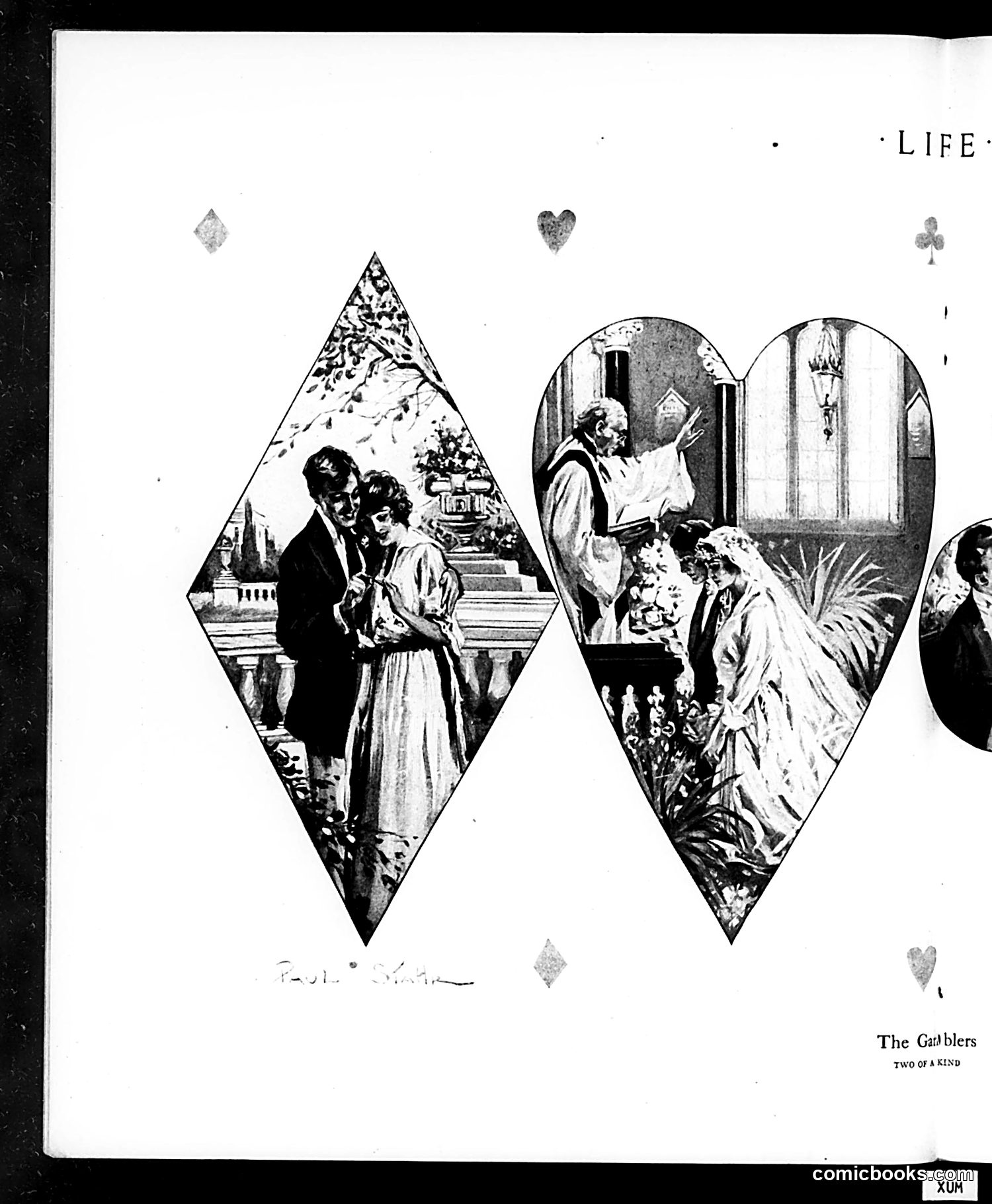
This page from *Life* magazine presents two vignette illustrations arranged as playing card suits (diamond and heart shapes), suggesting a comparison between two scenarios. The left diamond depicts a couple in an interior setting with religious imagery, appearing to show a romantic or courtship scene. The right heart shows what appears to be a religious or church setting with multiple figures. The title "The Gamblers: Two of a Kind" implies both scenes represent people "gambling"—likely a satirical commentary on taking romantic or spiritual risks. The playing card suit framing suggests these are parallel "games" or gambles people undertake. Without clearer context or visible artist attribution, the specific social commentary remains somewhat unclear, though the piece appears to mock either romantic foolhardiness or religious hypocrisy by presenting them as equivalent "gambles."
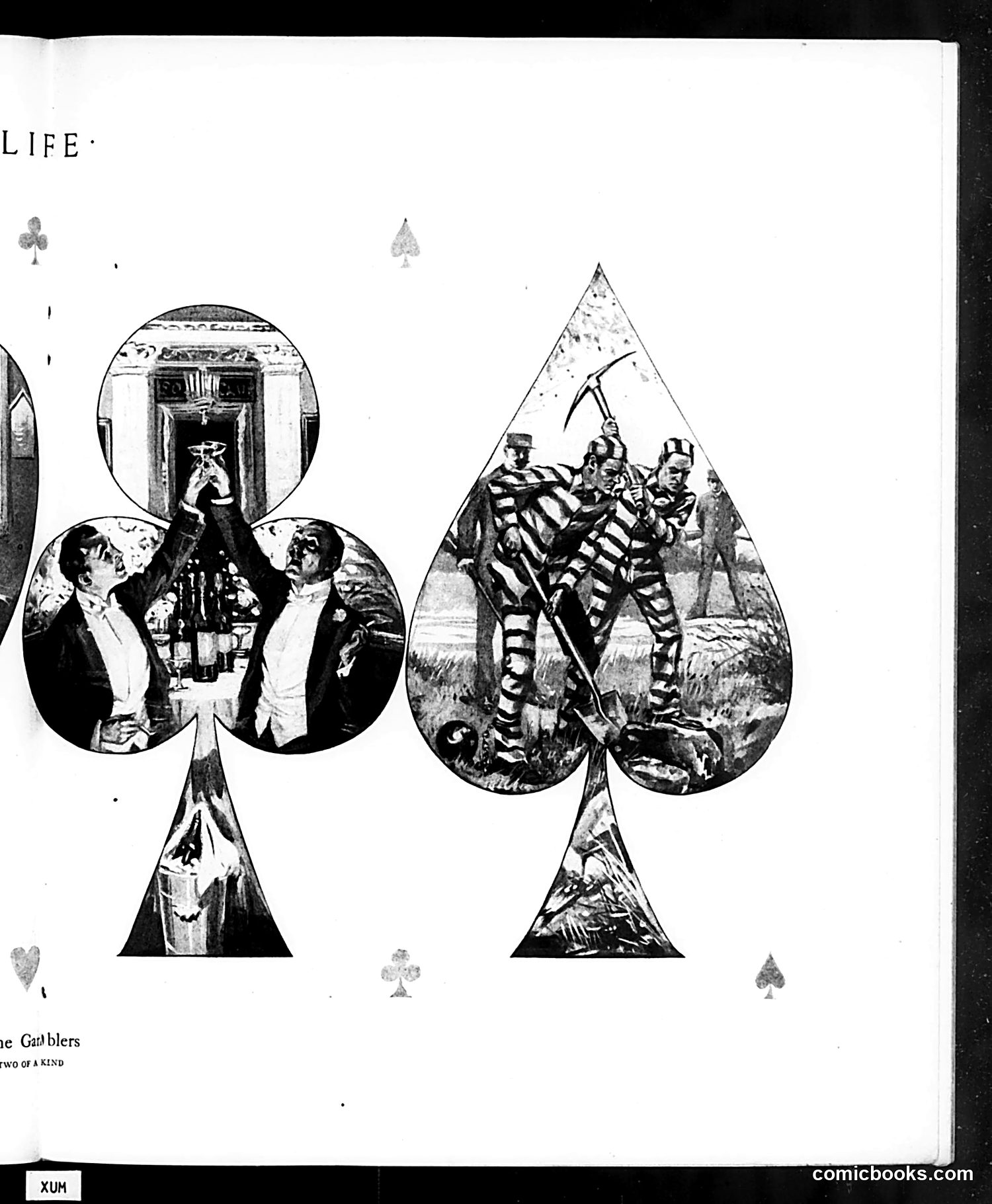
This page from *Life* magazine presents a playing-card design satirizing gamblers. The title "The Gamblers: Two of a Kind" uses the card suit structure to make its point. The **Club suit** (left) shows two well-dressed men in formal attire inside an elegant interior, appearing to toast or celebrate together—likely depicting wealthy or elite gamblers in refined settings. The **Spade suit** (right) depicts figures in striped prison uniforms with tools, suggesting convicts or laborers—a stark contrast showing gambling's consequences. The visual joke equates respectable gamblers with criminals: both are "two of a kind," morally equivalent despite their different social stations. The satire critiques how society tolerates gambling among the wealthy while condemning it (or its outcomes) among lower classes, suggesting hypocrisy about vice and morality based on social status.
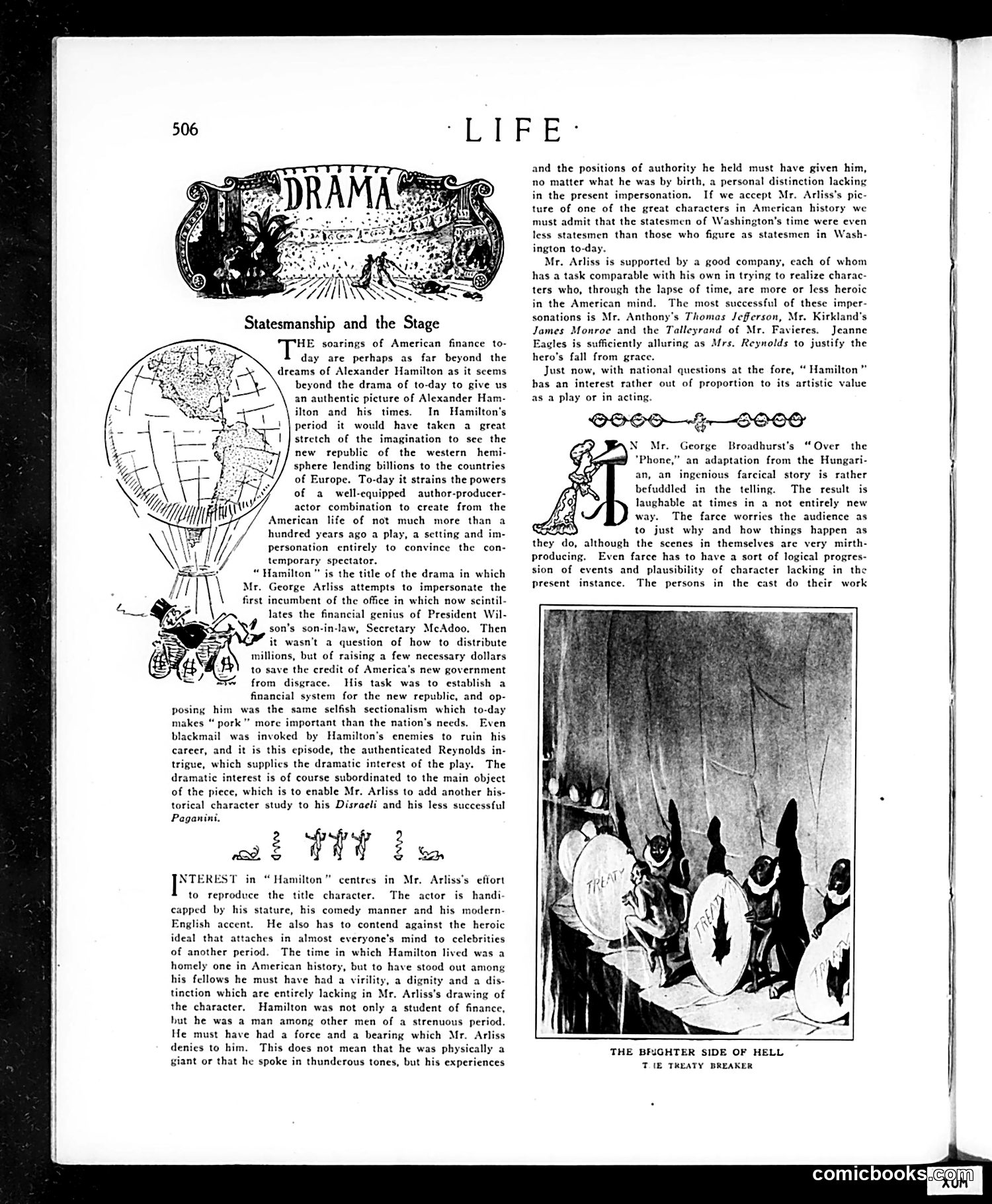
This page reviews a theatrical production of "Hamilton" starring British actor George Arliss. The criticism contrasts Hamilton's historical significance—establishing America's financial system during the nation's founding—with Arliss's inadequate portrayal. The reviewer argues Arliss lacks the "virility, dignity and distinction" necessary to embody Hamilton as a serious statesman. Instead of commanding presence, Arliss delivers a comedic performance undermined by his slight stature, modern English accent, and light manner. The critique contains topical 1917 references: it compares Hamilton's era financial challenges to contemporary times under Secretary of the Treasury McAdoo (President Wilson's son-in-law), suggesting modern statesmen are equally compromised by "selfish sectionalism." The play exploits the "Reynolds intrigue" (Hamilton's documented affair) for dramatic interest rather than genuine character study—implying theatrical spectacle overshadows substantive political meaning.
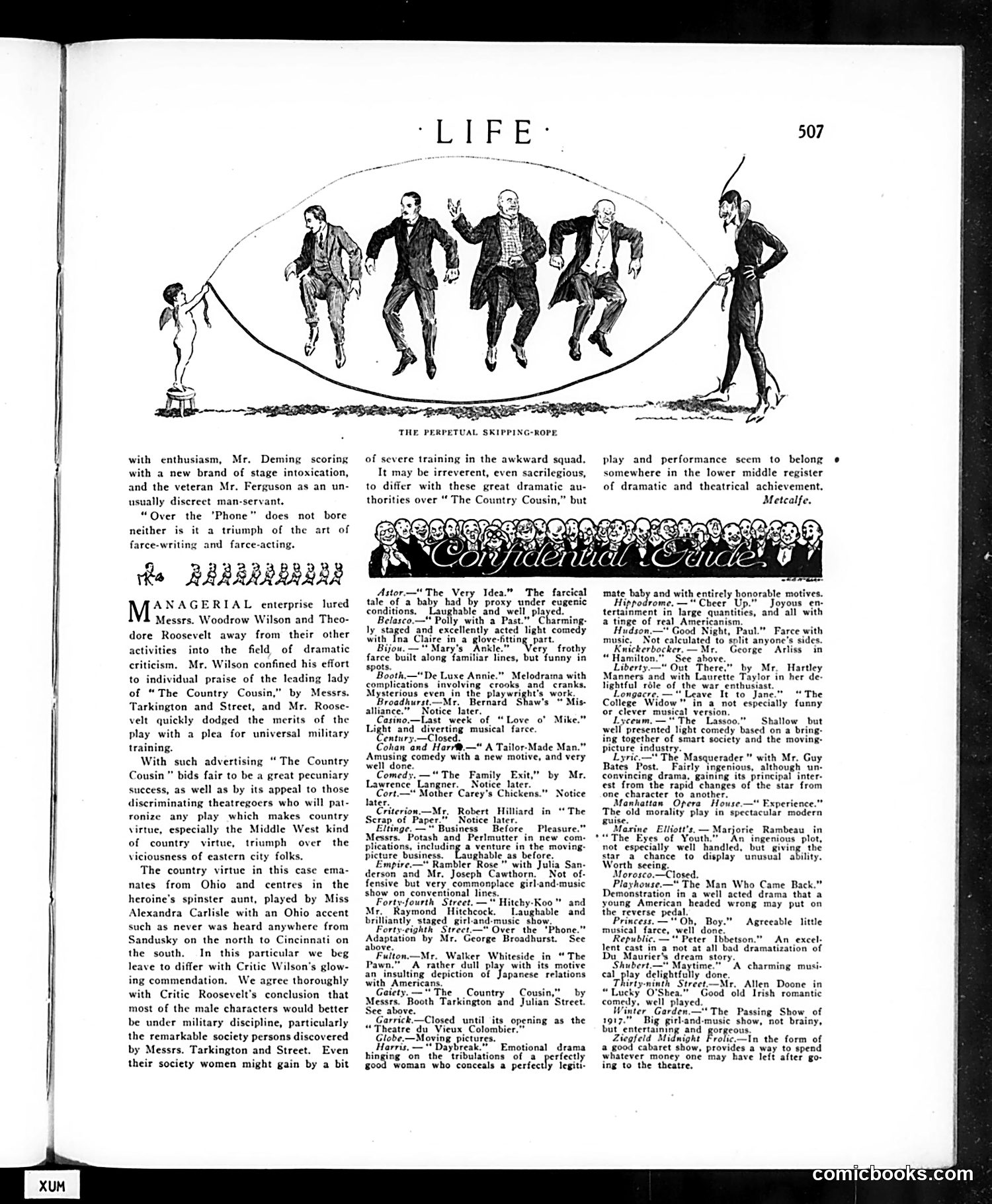
This satirical cartoon mocks the involvement of Presidents **Woodrow Wilson** and **Theodore Roosevelt** in theatrical criticism. The image depicts them as figures operating a skipping rope, with male actors jumping in the middle while a woman controls each end—a visual metaphor suggesting these political giants are being manipulated by theatrical interests or are trivializing themselves through show-business involvement. The accompanying text criticizes their conflicting opinions on "The Country Cousin": Wilson praised the lead actress, while Roosevelt ignored the play's merits to advocate for military training instead. The satire suggests that having U.S. Presidents endorse a play—especially one celebrating "country virtue" over urban sophistication—is absurd performance rather than legitimate criticism. The cartoon ridicules both the politicization of entertainment and the presidents' apparent distraction from serious governance.
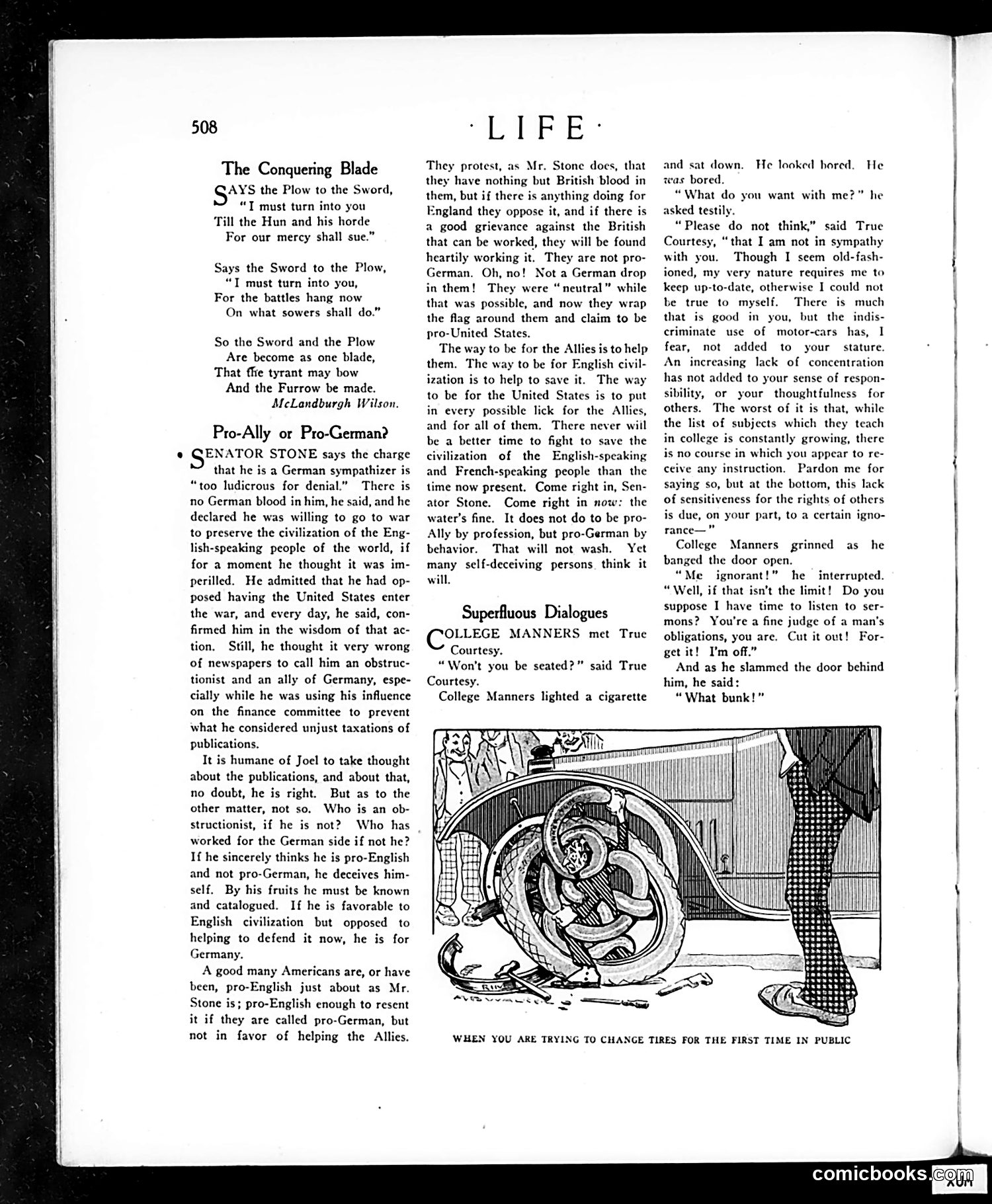
This page contains WWI-era political satire attacking Senator Thomas Stone's opposition to U.S. entry into the war. **The Main Article "Pro-Ally or Pro-German?"** argues that Stone—who claimed to have no German sympathies and opposed the war only on principle—was effectively pro-German through his *actions*. The piece sarcastically notes Stone used his finance committee influence to block "unjust taxations of publications," suggesting he prioritized protecting German-sympathetic newspapers over supporting the Allies. The satire's point: professing English heritage while obstructing U.S. aid to Britain equals being pro-German, regardless of one's claims. **The cartoon below** (captioned "When You Are Trying to Change Tires for the First Time in Public") depicts an embarrassed figure struggling with an automobile tire—likely satirizing the awkwardness of appearing incompetent. It appears thematically unrelated to the Stone article but may commentarily suggest similar public embarrassment for those caught between stated principles and actual behavior. **"Superfluous Dialogues"** presents a brief, separate satirical sketch on declining modern manners and civility.
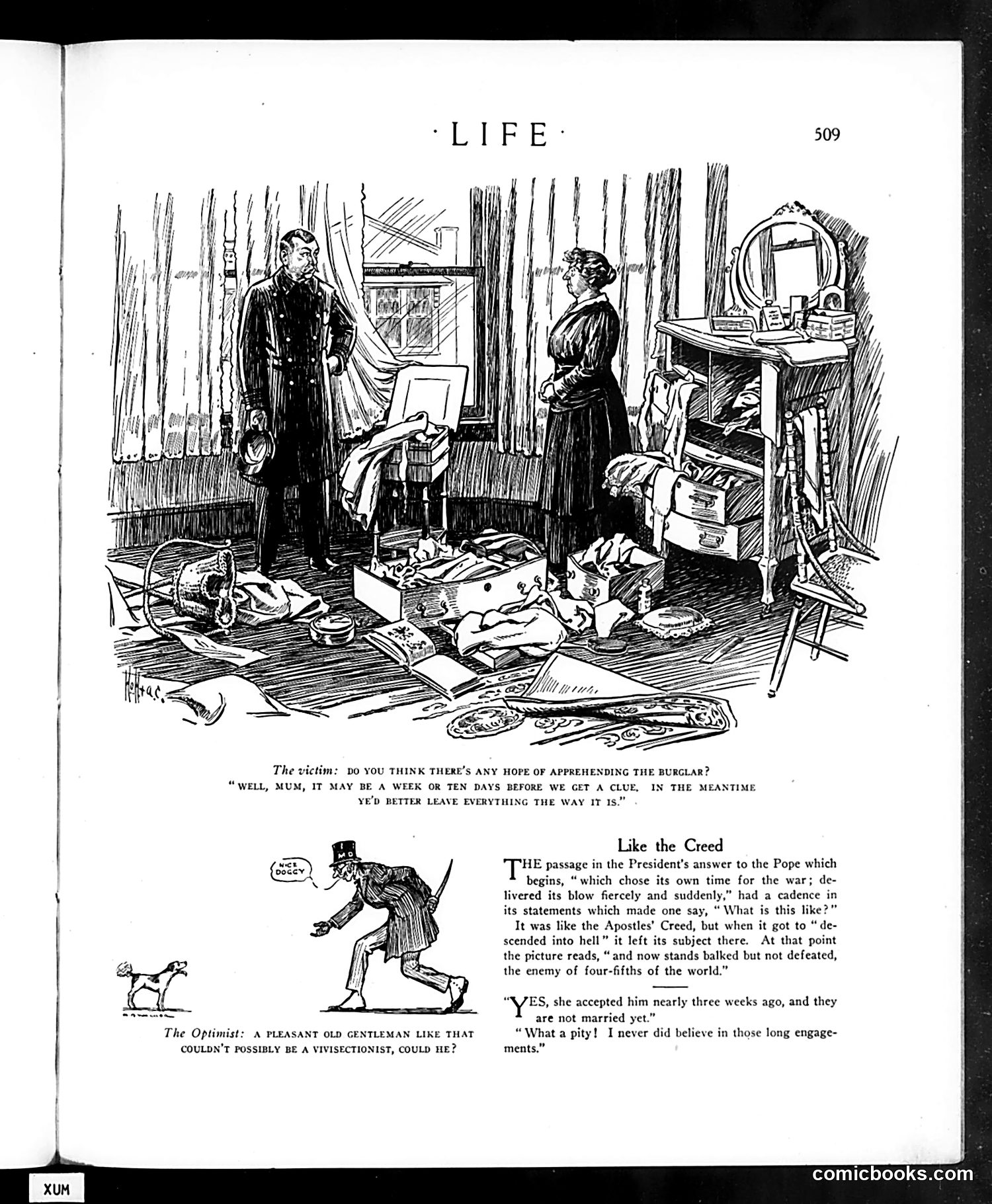
This page contains two separate satirical pieces: **Top cartoon**: A domestic burglary scene where a police inspector tells a robbery victim to leave everything undisturbed for a week or ten days before investigating. The joke mocks police incompetence—the ironic suggestion that crime scenes should remain untouched indefinitely. **Bottom section**: Commentary on a Presidential response to the Pope, comparing its rhetorical structure to the Apostles' Creed. The satire notes that while the President's statement mimics religious language about conflict ("chose its own time for war; delivered its blow fiercely"), it awkwardly leaves "the enemy" defeated but standing—an incomplete theological parallel that undermines the statement's gravity. **Small cartoon**: An "optimist" argues a pleasant gentleman couldn't be a vivisectionist (animal experimenter), mocking naive character judgments. **Final anecdote**: Criticism of lengthy engagements—a social commentary on prolonged betrothals before marriage. The page reflects early 20th-century American satirical humor targeting bureaucratic inefficiency, political rhetoric, and social conventions.
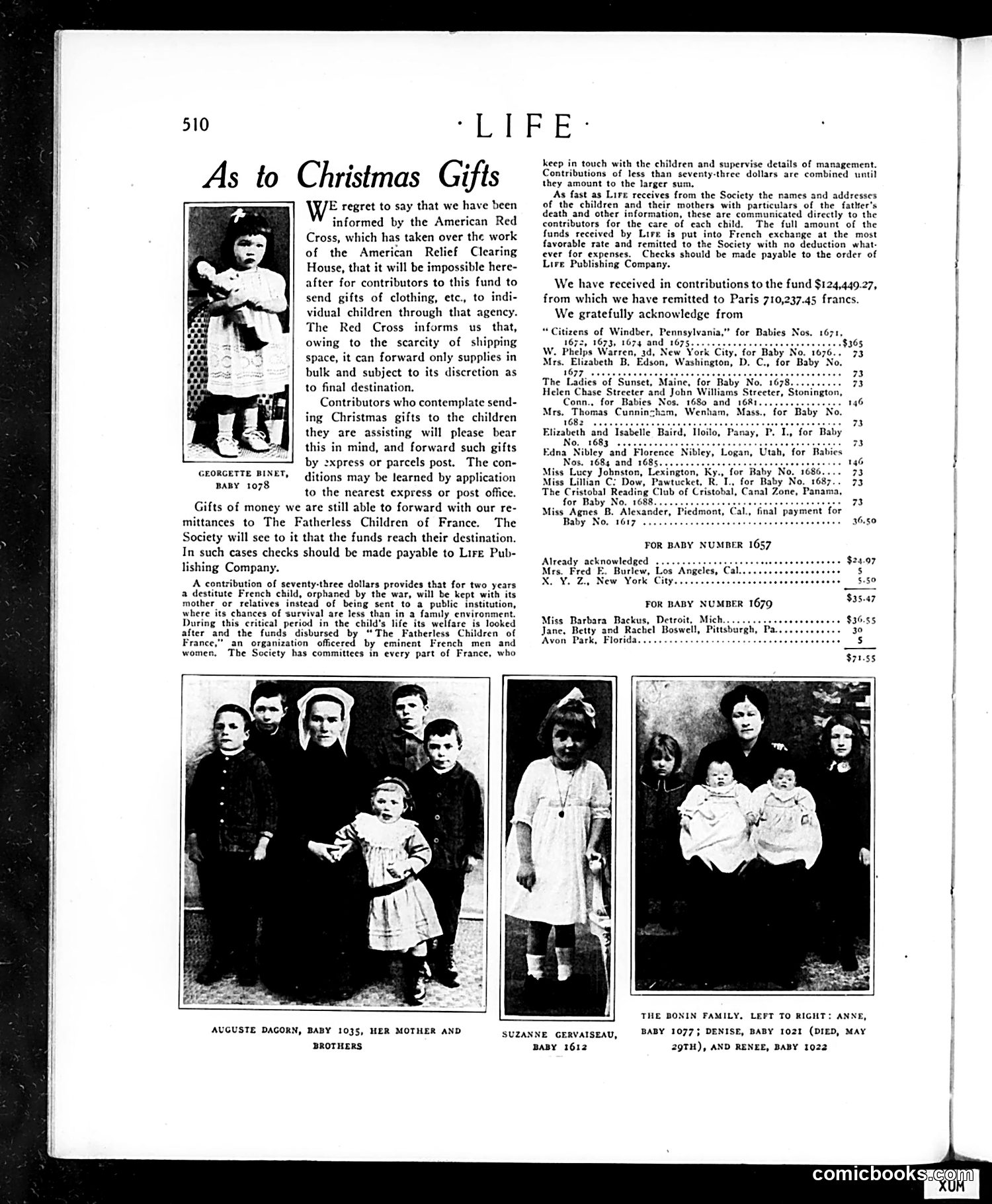
This is not a cartoon or satire, but rather a charitable fundraising appeal from *Life* magazine during World War I. The page solicits donations to support **French war orphans** and fatherless children through "The Fatherless Children of France" organization. It explains that the American Red Cross can no longer forward individual gifts due to wartime shipping constraints, so donors should instead send money ($73 supports a child for two years) through *Life* Publishing Company, which converts funds to French exchange. The page displays photographs of actual French children being assisted—Auguste Dagorn, Suzanne Gervaiseau, and the Bonin family—along with a list of American donors and their contributions. This was common wartime charitable messaging: using real children's images and detailed donor acknowledgments to encourage further contributions to a humanitarian cause affected by the war.
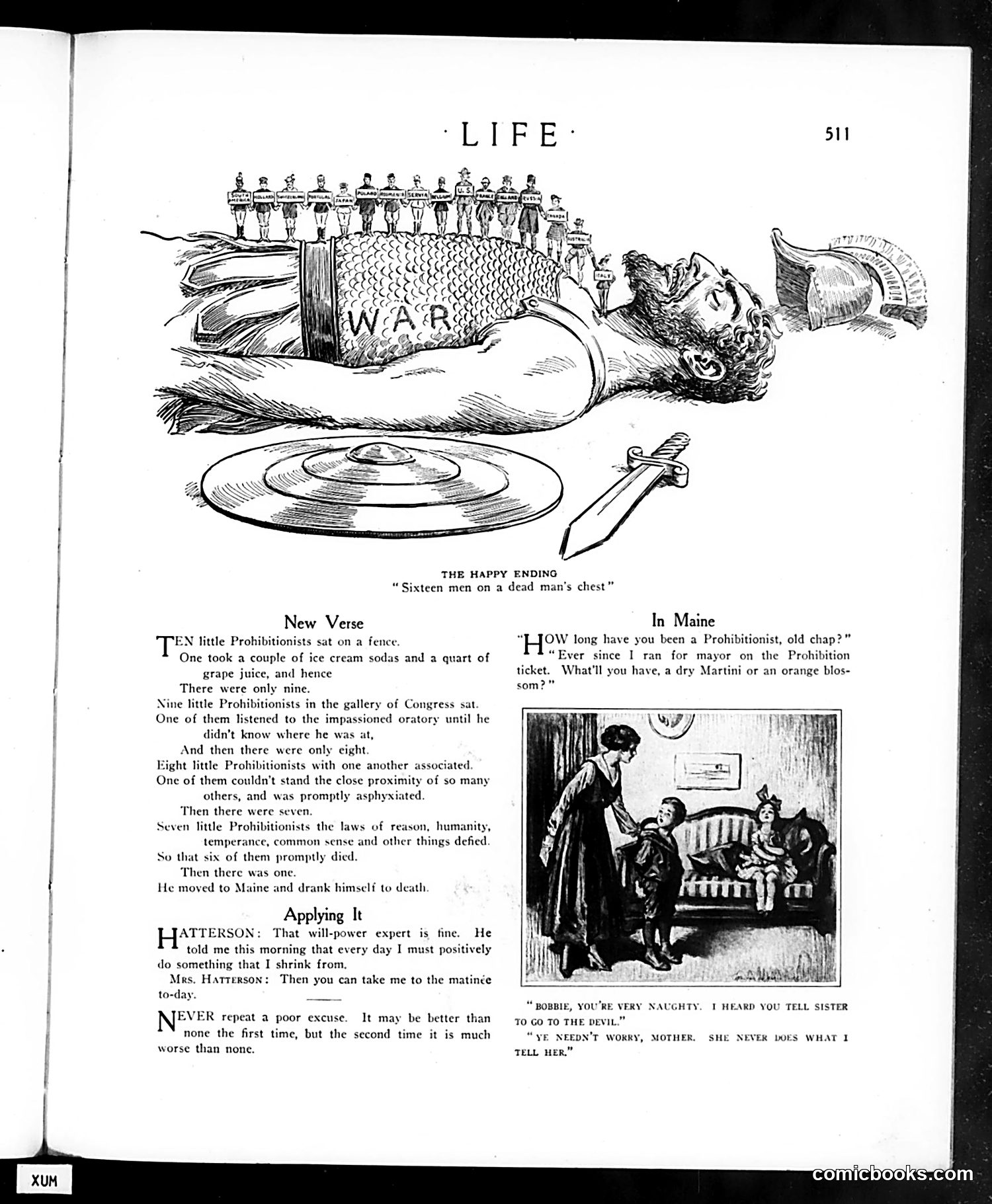
This Life magazine page satirizes American Prohibition—the ban on alcohol (1920-1933). The main cartoon depicts a dead fish labeled "WAR" with soldiers standing on its body, titled "Sixteen Men on a Dead Man's Chest" (a pirate reference). This likely comments on World War I's devastation. The "New Verse" mocks Prohibitionists through dark humor: ten Prohibitionists gradually die through increasingly absurd causes, until the last one moves to Maine and "drank himself to death"—the punchline being that even strict Prohibitionists secretly drank. The "In Maine" dialogue reinforces this hypocrisy: a self-proclaimed Prohibitionist, who became one after running on a Prohibition ticket, now openly drinks cocktails. The other brief jokes ("Applying It," the mother-child exchange) are unrelated humor. The overall message: Prohibition was widely ignored and hypocritically violated by its own advocates.
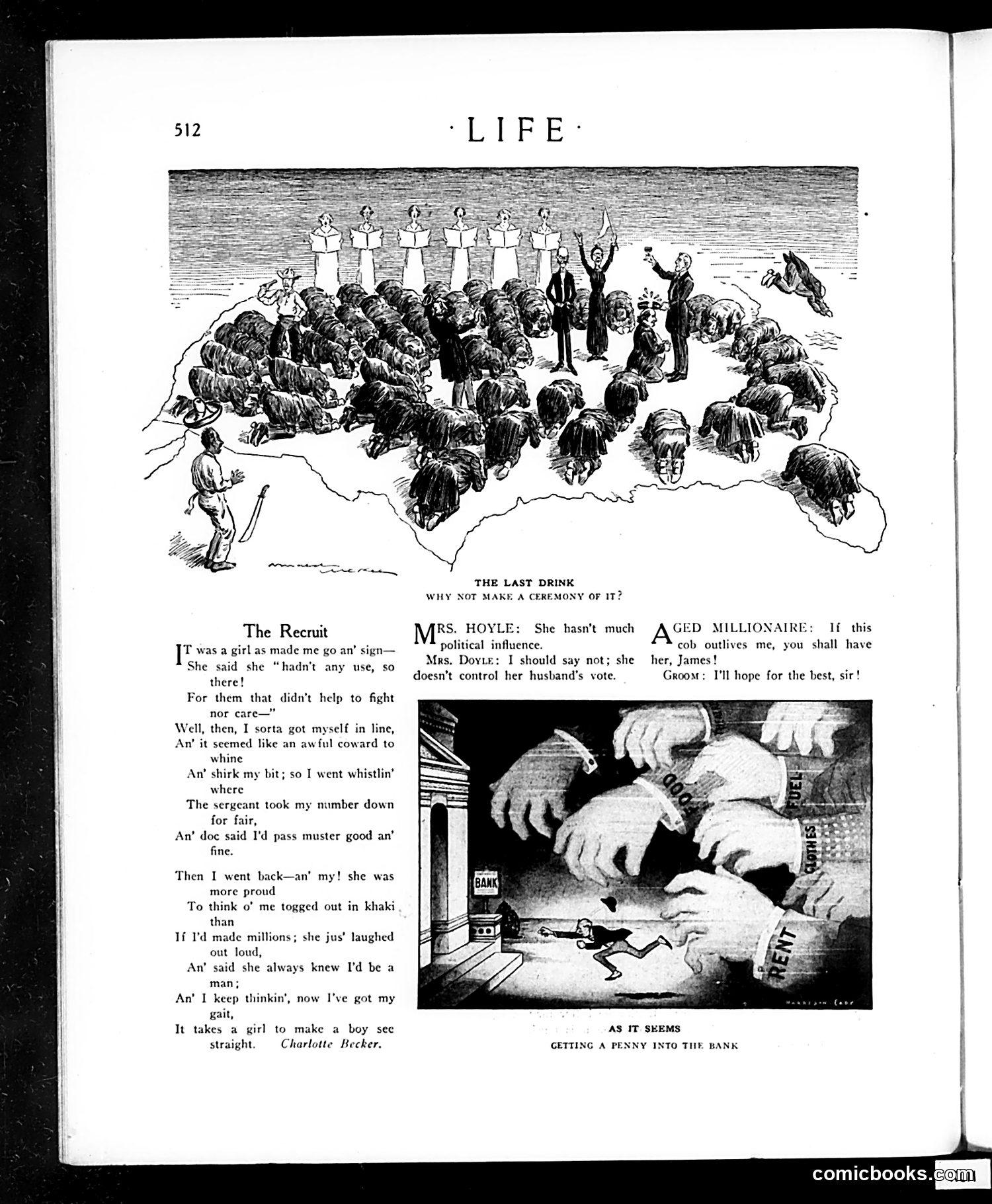
This page contains three distinct satirical pieces: **"The Last Drink"** (top cartoon): Shows a crowd of figures gathered around what appears to be a military or state ceremony, with skeletal/death imagery suggested. The caption questions making ceremony of "the last drink"—likely referencing Prohibition-era concerns or wartime rationing. **"The Recruit"** (poem, left): A soldier's monologue about enlisting despite initial reluctance. The satire targets working-class men who felt social pressure to fight in WWI, noting how their sacrifice impressed women more than wealth. **"As It Seems" dialogues** (right): Three brief exchanges mocking wealthy women's lack of political power. They discuss a wife's inability to influence her husband's vote and a groom's mercenary hopes—satirizing both women's disenfranchisement and wealthy men's materialism. **"Getting a Penny into the Bank"** (bottom photo): Appears to satirize banking or savings practices, though context is unclear. Overall, the page mixes WWI recruitment sentiment with class commentary and critiques of women's political powerlessness during this era.
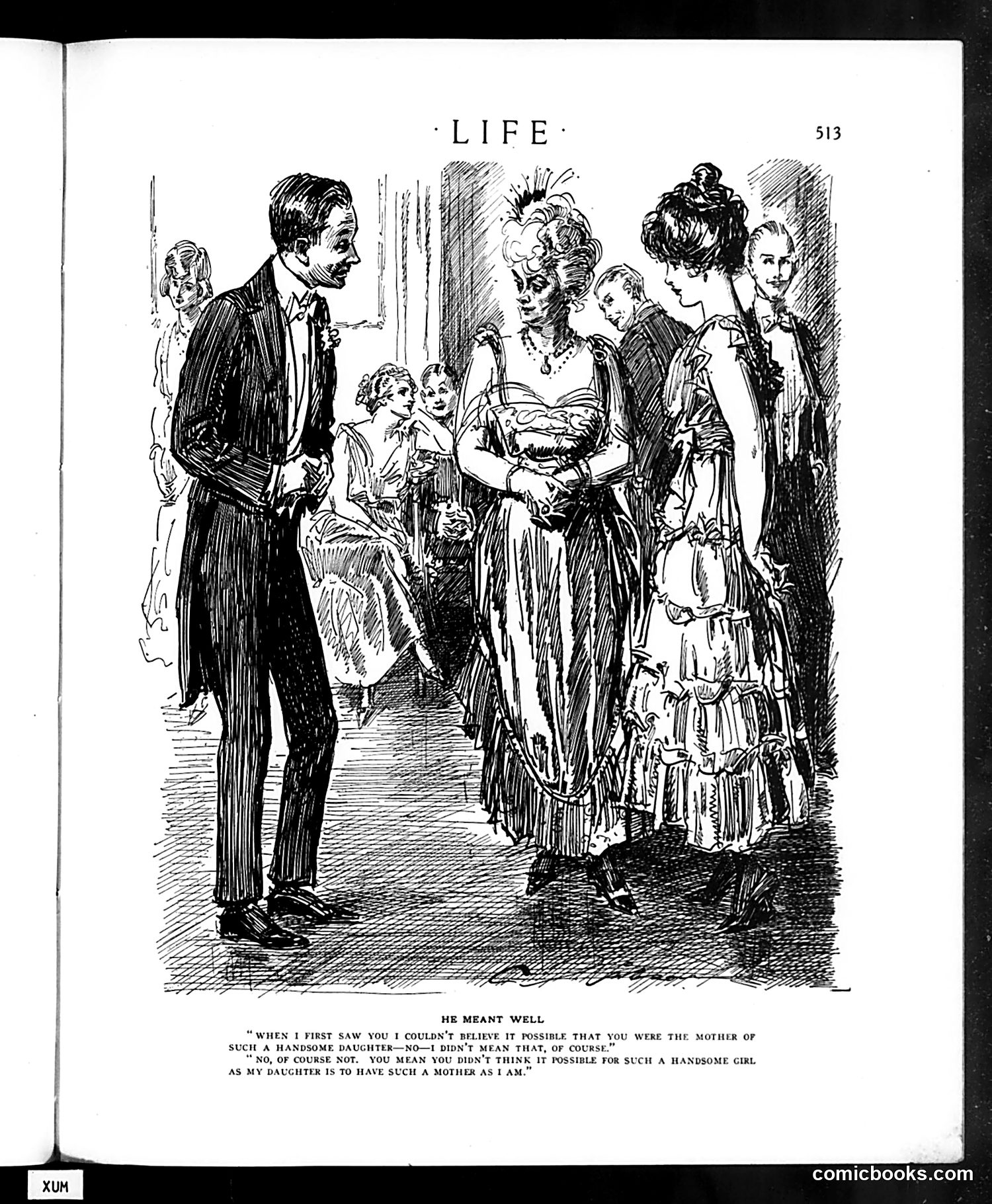
This single-panel domestic comedy illustrates a classic social embarrassment: a man's clumsy compliment backfires. He attempts to flatter a young woman by expressing surprise her mother is so plain, accidentally insulting the mother instead. The satire targets male social ineptitude and the performative politeness of upper-class gatherings (suggested by the formal evening dress and parlor setting). The mother's response—her witty, cutting restatement of what he "meant"—exposes how his backpedaling only worsens the offense by making the insult explicit. The humor relies on the timeless awkwardness of social missteps and the verbal dexterity required to navigate compliments without causing offense—themes remaining relevant today.
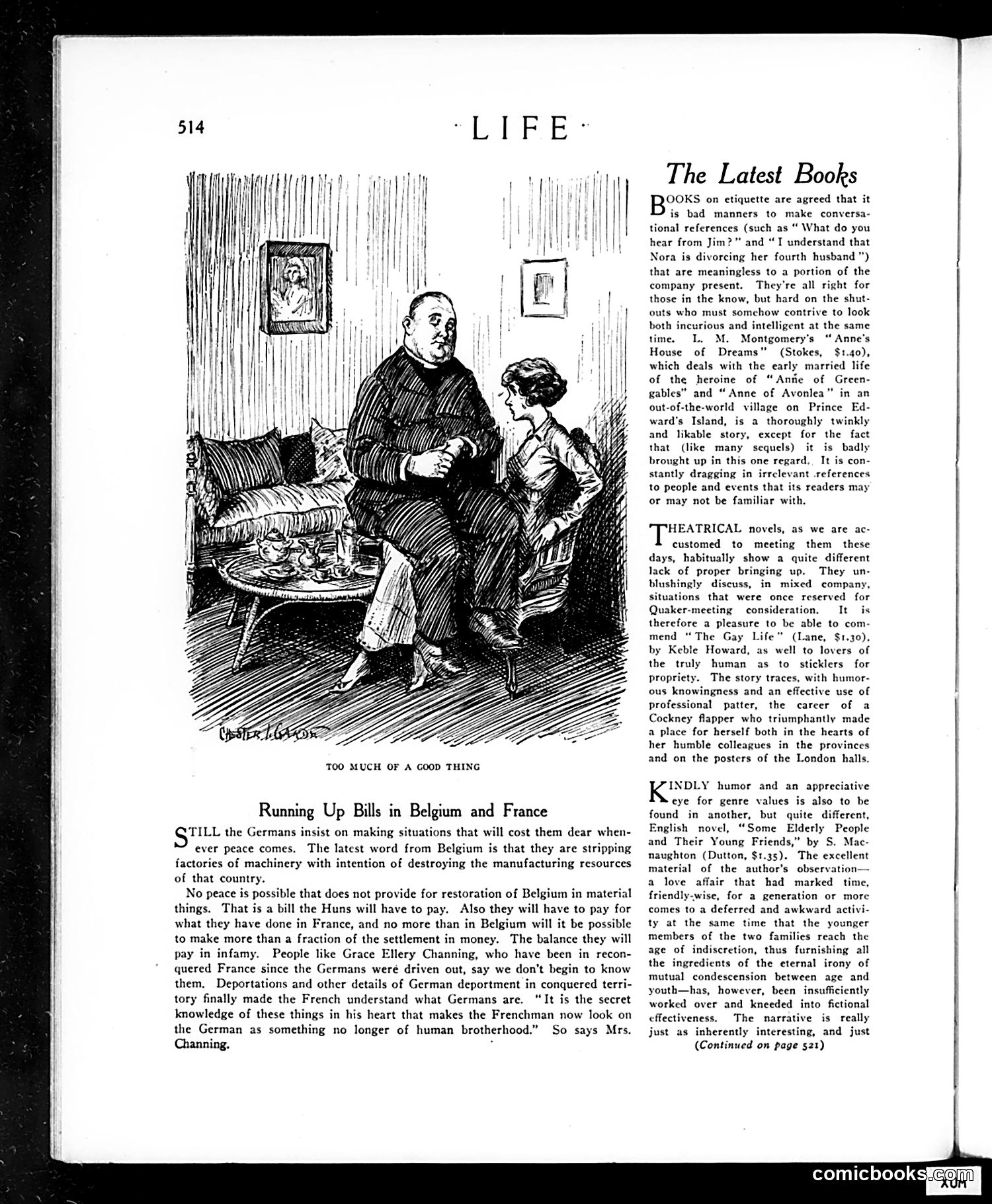
The cartoon depicts a domestic scene captioned "TOO MUCH OF A GOOD THING," illustrating the accompanying article about Germany's war reparations obligations. **The Satire:** The image shows a portly man (representing Germany) sitting with a woman, surrounded by empty dishes and bottles—suggesting excessive consumption or indulgence. The caption's title plays on the phrase to mock Germany's wartime destruction in Belgium and France. **The Context:** Written during or shortly after World War I, the article argues that Germany must pay massive financial reparations for stripping factories and destroying infrastructure in occupied territories. The author quotes Grace Ellery Channing, who witnessed German conduct in reconquered France, emphasizing that monetary payment alone cannot compensate for such destruction—Germany will also "pay in infamy." **The Point:** The cartoon sarcastically illustrates Germany's excessive wartime plundering as gluttonous overindulgence, suggesting the nation has gorged itself on stolen resources and must now face consequences. The visual metaphor equates military aggression with moral excess.
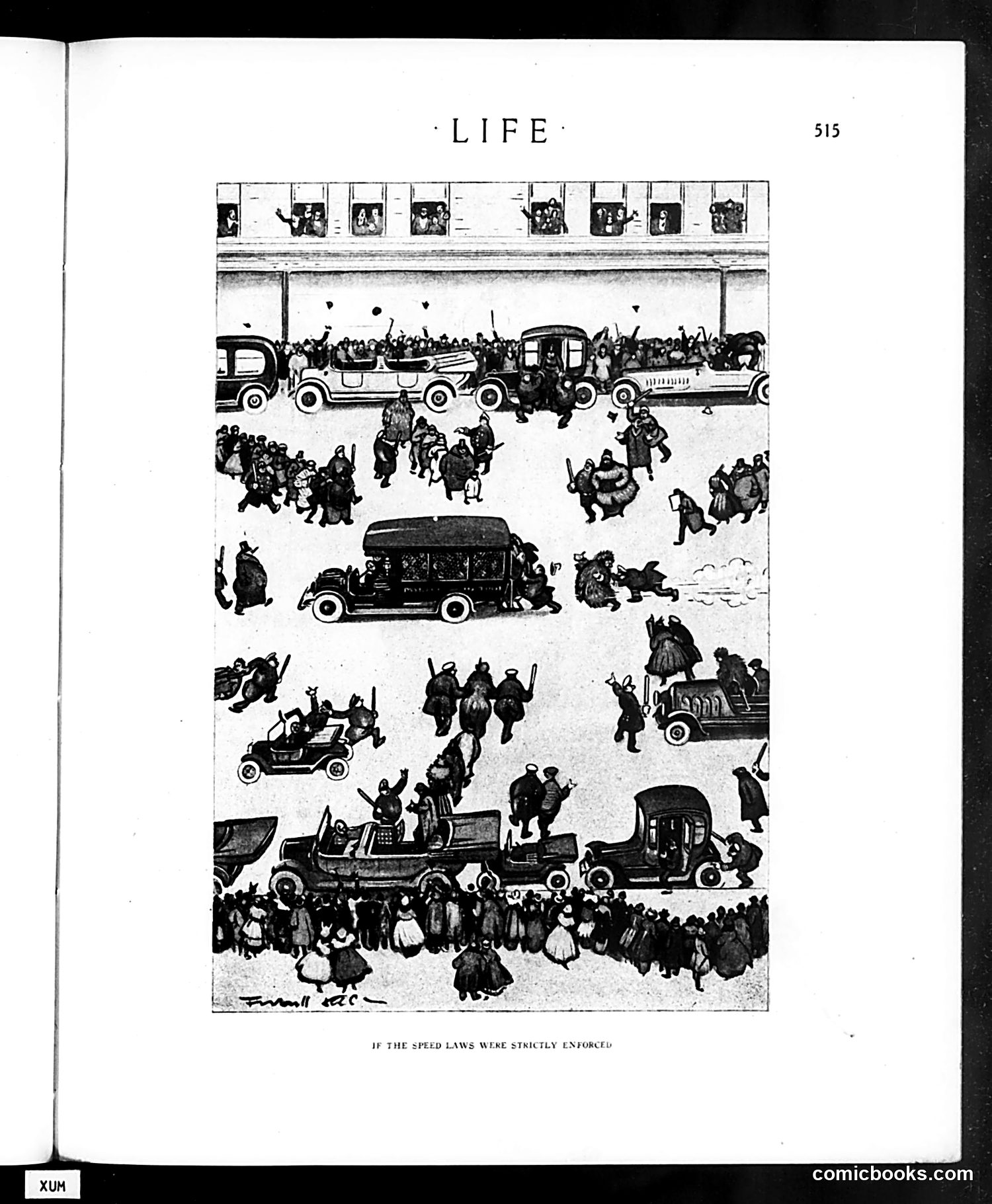
This is a satirical cartoon titled "If the Speed Laws Were Strictly Enforced," depicting a chaotic street scene where traffic laws are being rigidly enforced. The image shows numerous automobiles and pedestrians in apparent conflict—vehicles appear stopped or blocked, with people gesturing and seemingly arguing with police or enforcement officials scattered throughout the scene. The satire suggests that strict speed law enforcement would create gridlock, confusion, and social disorder rather than improving safety. The cartoon critiques either overzealous law enforcement or the impracticality of rigid traffic regulation in urban settings. This likely reflects early 20th-century debates about automobile regulation and police authority. The packed, frenzied composition emphasizes the cartoon's point: strict enforcement creates chaos rather than order.
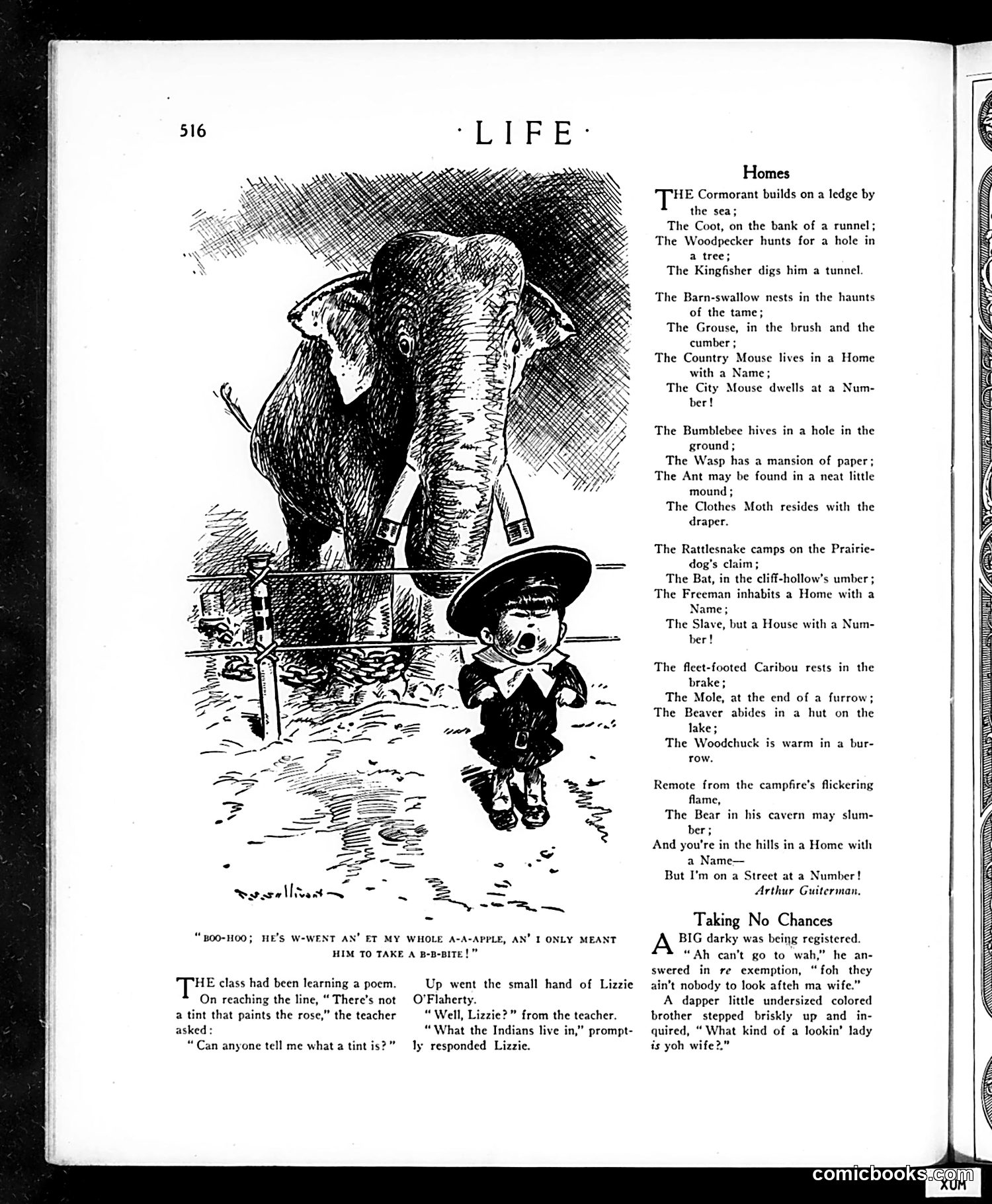
This page contains two distinct pieces: **The Main Cartoon** depicts a small child crying after an elephant ate her apple when she only meant for it to take a bite. The humor relies on the child's literal interpretation of "take a bite"—the elephant complied by consuming the entire fruit. **"Homes" Poem** by Arthur Guiterman uses animal habitats as metaphor for class inequality. It contrasts creatures with natural "homes" (nests, dens, burrows) against humans divided by wealth: "The Freeman inhabits a Home with a Name" versus "The Slave, but a House with a Number." This references enslaved people identified by number rather than recognized personhood. **"Taking No Chances"** is a racist dialect joke. A Black draftee claims exemption from WWI service by saying no one can care for his wife. Another man immediately volunteers to do so—the "joke" implying sexual predation. This reflects the casual racism of the era, using stereotypical dialect and crude innuendo. The page mixes innocent children's humor with deeply offensive racial content typical of early 20th-century American magazines.
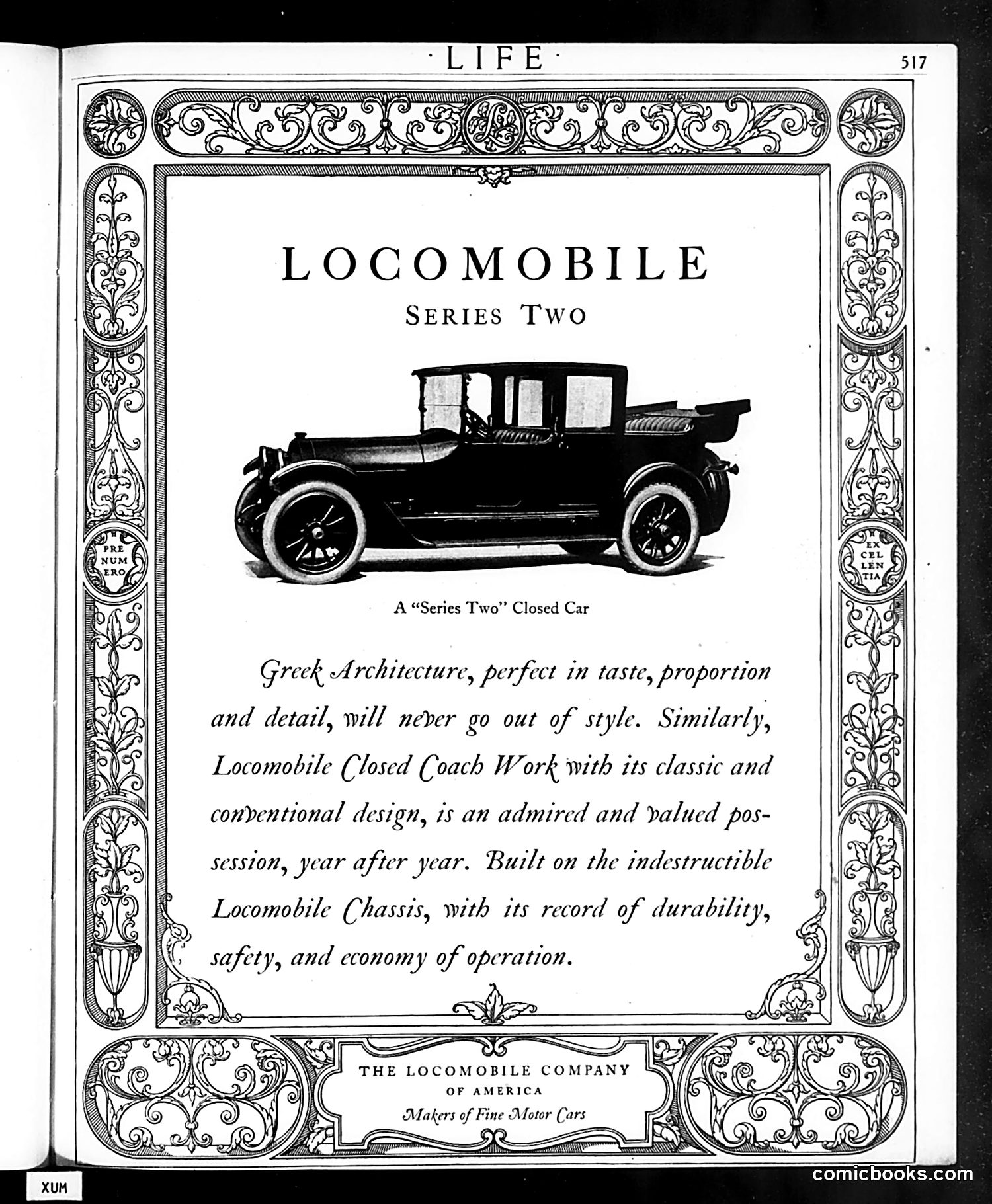
This is **not a cartoon or satire**—it's a full-page **automobile advertisement** from Life magazine (page 517). The Locomobile Company of America is marketing their "Series Two" closed car by drawing an analogy to classical Greek architecture. The ad argues that just as Greek design principles remain eternally tasteful, the Locomobile's "classic and conventional design" will similarly never go out of style and retain value over time. The vehicle shown is a boxy, enclosed sedan typical of early 20th-century automobiles. The advertisement emphasizes the car's durability, safety, and economy of operation, built on what they claim is an "indestructible" chassis. This represents typical early automotive advertising strategy: associating a consumer product with timeless aesthetic principles to justify its cost and appeal to aspirational buyers concerned with maintaining social status through tasteful purchases.
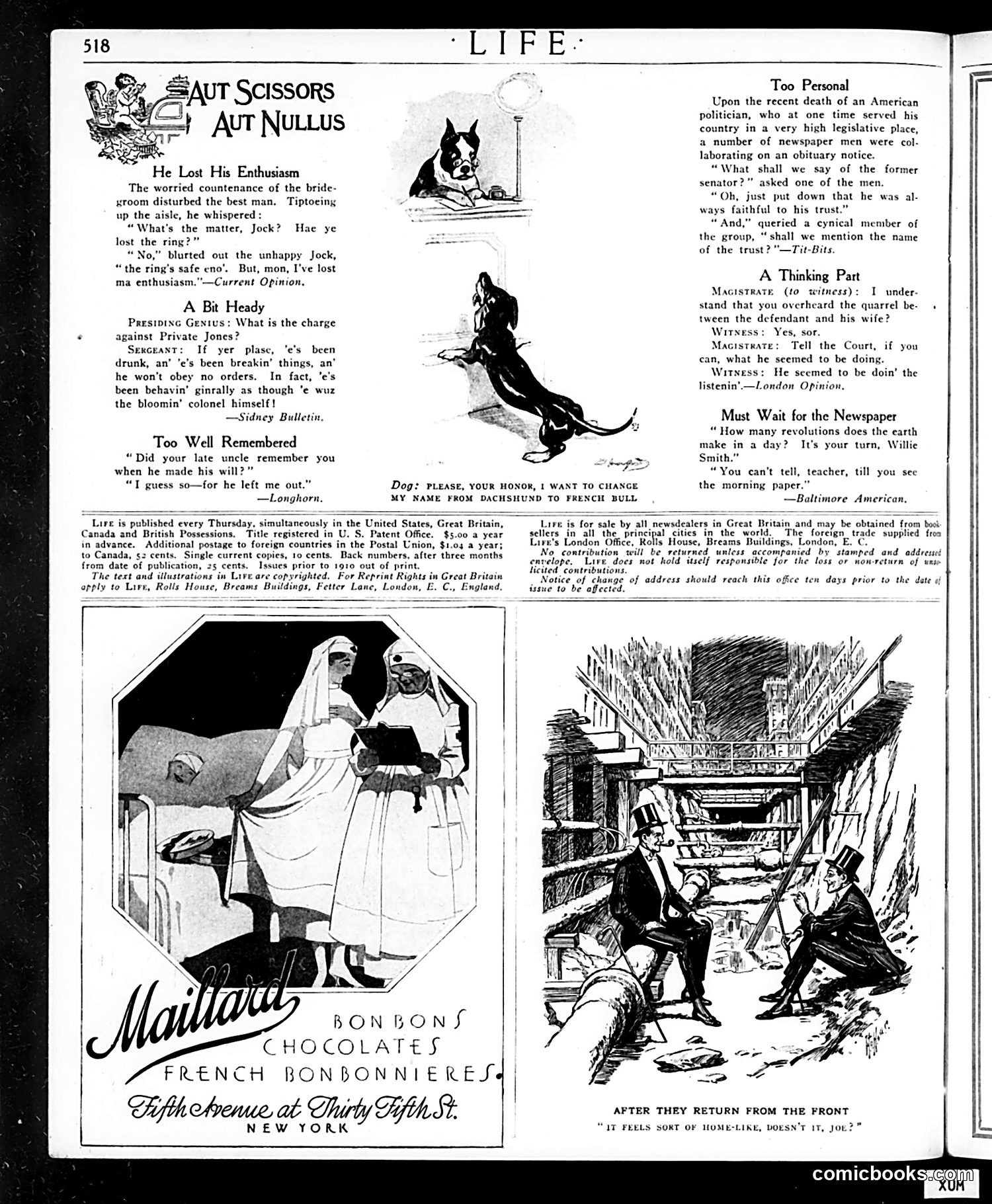
This page contains several brief satirical jokes typical of Life's humor section, plus advertisements: **The cartoons/jokes:** 1. **"He Lost His Enthusiasm"** — A Scottish bridegroom loses his wedding-day excitement, establishing the period's taste for ethnic dialect humor. 2. **"A Bit Heady"** — A soldier behaves so wildly while drunk that he acts like a colonel, satirizing military hierarchy and discipline breakdown. 3. **"Too Well Remembered"** — Dark humor about an uncle's will deliberately excluding the narrator. 4. **"Too Personal"** — A cynical jab at a deceased American politician: newspapers praise his "faithful trust" while a journalist quips they should name which corrupt trust he served. References political corruption and trusts (monopolies). 5. **"A Thinking Part"** — A witness in court "seemed to be doin' the listenin'"—mocking spousal arguments where one partner stays silent. 6. **"Must Wait for the Newspaper"** — A schoolboy can't answer how many daily Earth rotations occur until reading tomorrow's paper, mocking journalistic sensationalism. The page also advertises Maillard French chocolates and shows a WWI-era cartoon of soldiers returning home.
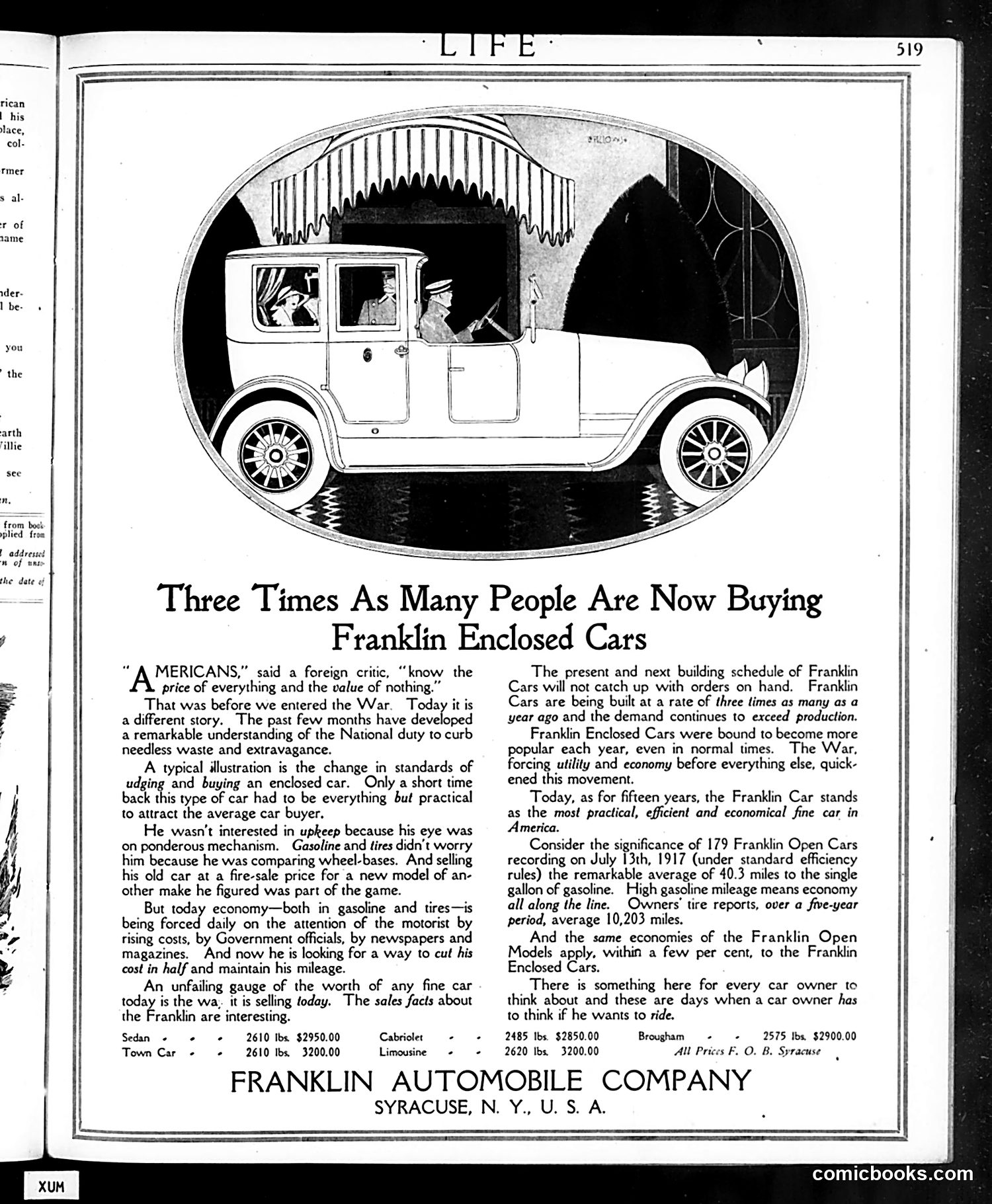
This is primarily a **car advertisement**, not a political cartoon. It's a 1917 Franklin Automobile Company ad capitalizing on **World War I-era patriotism and resource conservation**. The ad argues that Americans have shifted from valuing ostentation ("price of everything and value of nothing") to prioritizing **practical economy**—framed as a patriotic duty during wartime. The illustration shows a modest enclosed sedan rather than flashy open-air models. The sales pitch emphasizes fuel efficiency (40.3 miles per gallon) and tire durability as evidence that Franklin cars align with wartime conservation efforts. The claim that Franklin sales tripled reflects how wartime messaging repositioned "economy" as both morally virtuous and patriotic, appealing to consumers' sense of national duty. For modern readers: this represents how companies used **patriotic framing** to market products during WWI, suggesting that buying practical, efficient cars was equivalent to supporting the war effort.
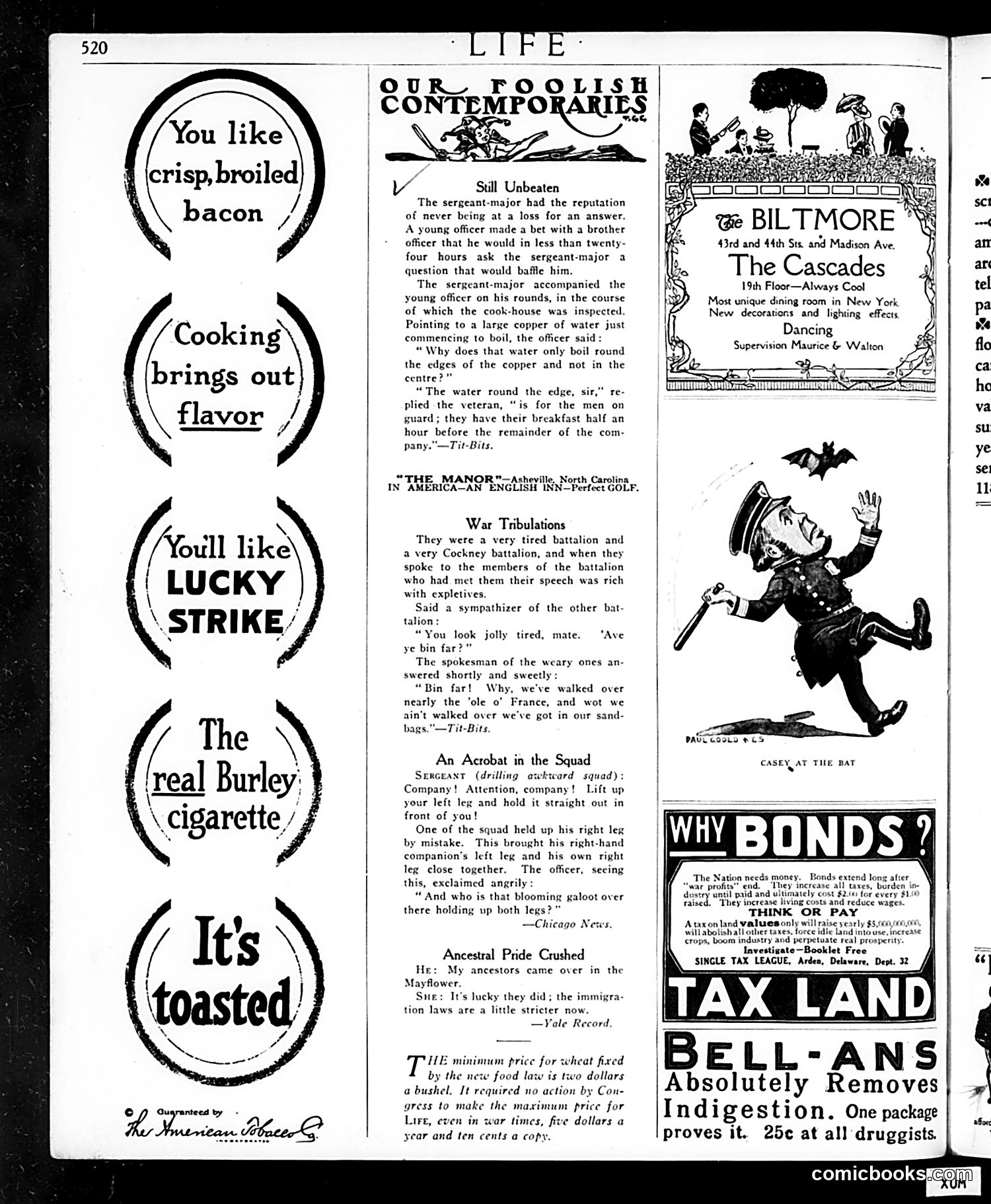
This page mixes **humorous anecdotes** with **advertisements** typical of WWI-era Life magazine. **The Cartoons/Humor:** The left side features cigarette advertising disguised as endorsements ("You like crisp, broiled bacon...It's toasted"). The center contains three military-themed jokes: 1. "Still Unbeaten"—a sergeant-major outsmarts an officer with absurd logic about boiling water 2. "War Tribulations"—Cockney soldiers describe marching across France and filling sandbags with the terrain 3. "An Acrobat in the Squad"—a drill mishap where confused soldiers tangle their legs These gentle jokes mock military life and British accents, reflecting WWI home-front humor. **The Advertisements:** The right side advertises the Biltmore Hotel's "Cascades" dining room, a "Why Bonds?" war bond campaign, "Tax Land" political messaging, and Bell-Ans antacid. **Context:** This represents typical early-20th-century magazine layout—mixing satirical commentary with commercial messaging, targeting middle-class readers during wartime.
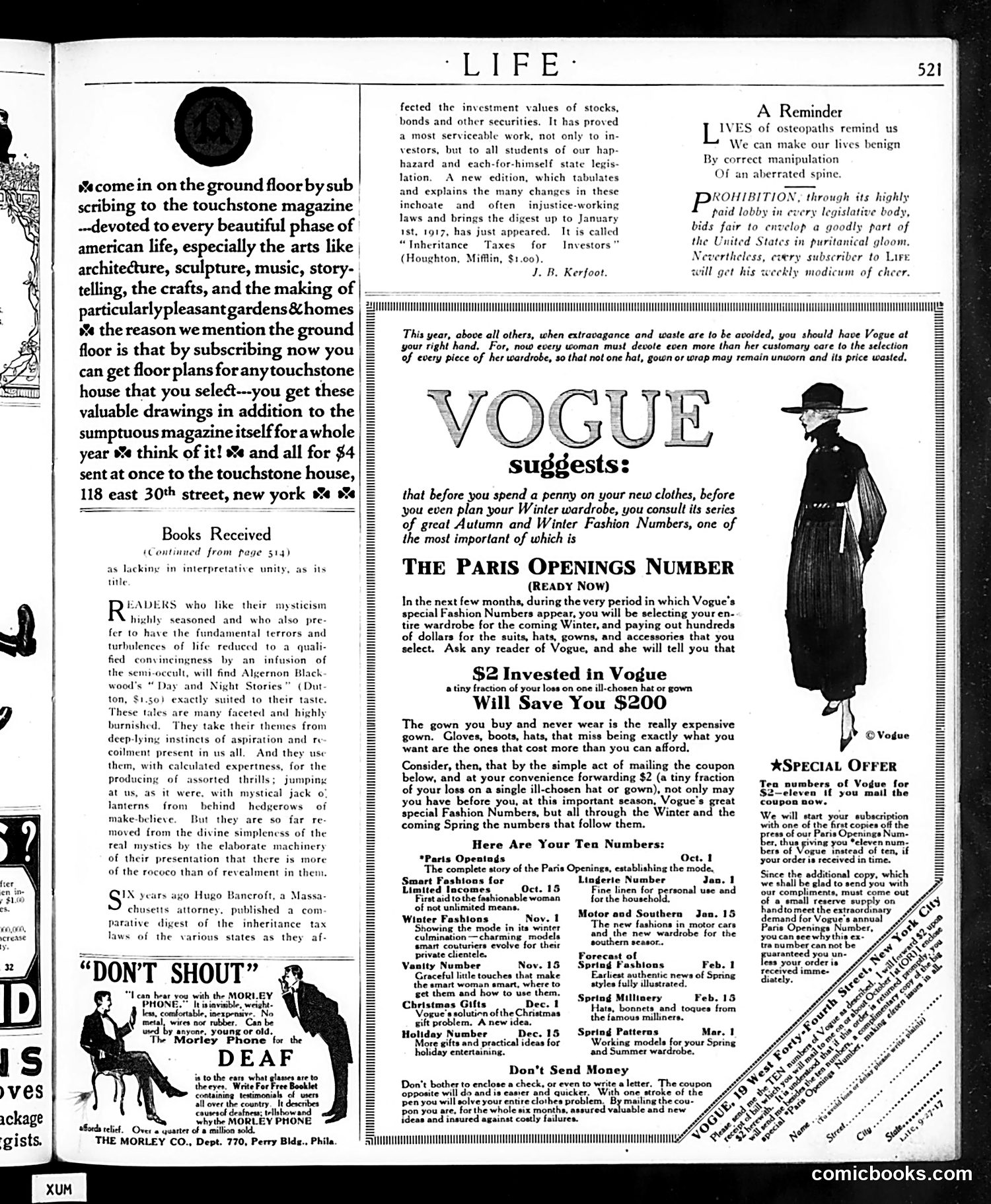
This page mixes editorial content with advertising—primarily a Vogue magazine promotion disguised as consumer advice. **The Context:** The page is dated around 1917 (referenced in the inheritance tax book notice). The Vogue advertisement explicitly frames fashion consultation as a **wartime economy measure**—"this year, above all others, when extravagance and waste are to be avoided." America had entered World War I in April 1917. **The Pitch:** Vogue suggests that spending $2 on their "Paris Openings Number" will help women avoid wasting money on ill-chosen clothes, ultimately "saving" $200. This is straightforward marketing wrapped in patriotic frugality rhetoric—claiming that consulting fashion experts prevents waste rather than encourages spending. **Other Content:** The page includes book reviews and an advertisement for the "Morley Phone for the Deaf," a hearing device marketed as equally useful as eyeglasses. The satire (if any) is implicit: *Life* magazine's juxtaposition of wartime conservation messaging with luxury fashion advertising subtly mocks the contradiction, though this wasn't *Life's* primary intent.
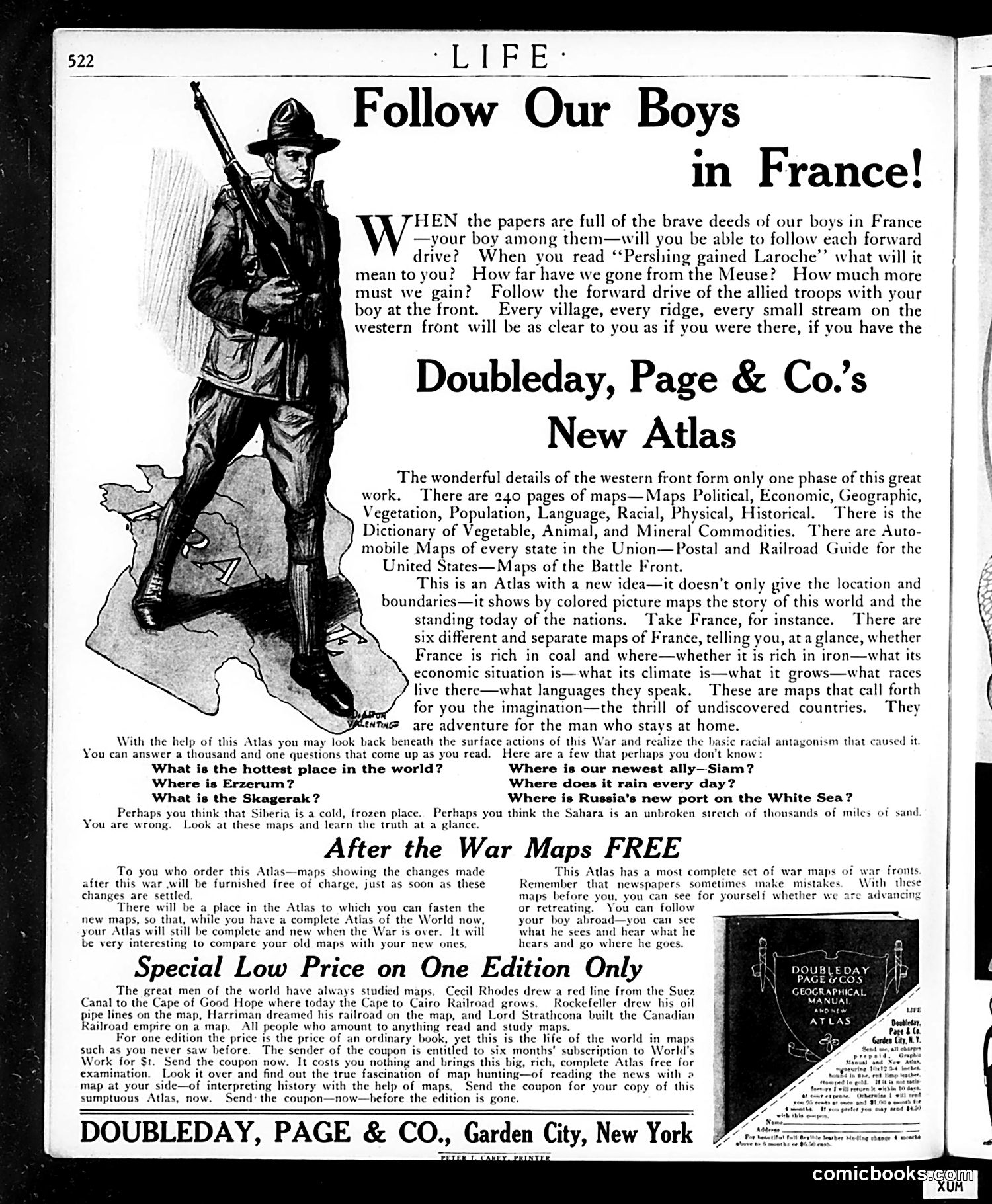
This is **wartime advertising**, not satire. Published during World War I (references to "Pershing" and the western front date this to 1917-1918), it uses patriotic messaging to sell an atlas. The illustration shows a soldier in WWI military gear—the distinctive campaign hat, rifle, and uniform mark him as an American Expeditionary Force soldier fighting in France. **The pitch**: Families with sons fighting abroad should buy this atlas so they can follow troop movements they read about in newspapers. References like "Pershing gained Laroche" and "the Meuse" are actual battle locations. The ad promises readers can visualize where "your boy" is fighting. **Secondary appeal**: The atlas also answers geographical trivia ("hottest place in the world?") and includes economic/resource maps of nations—useful information for understanding the war's causes and stakes. **The sales hook**: Free updated war maps will be provided after the war ends. This is earnest patriotic marketing, exploiting parental anxiety and national pride to sell reference books—no satire intended.
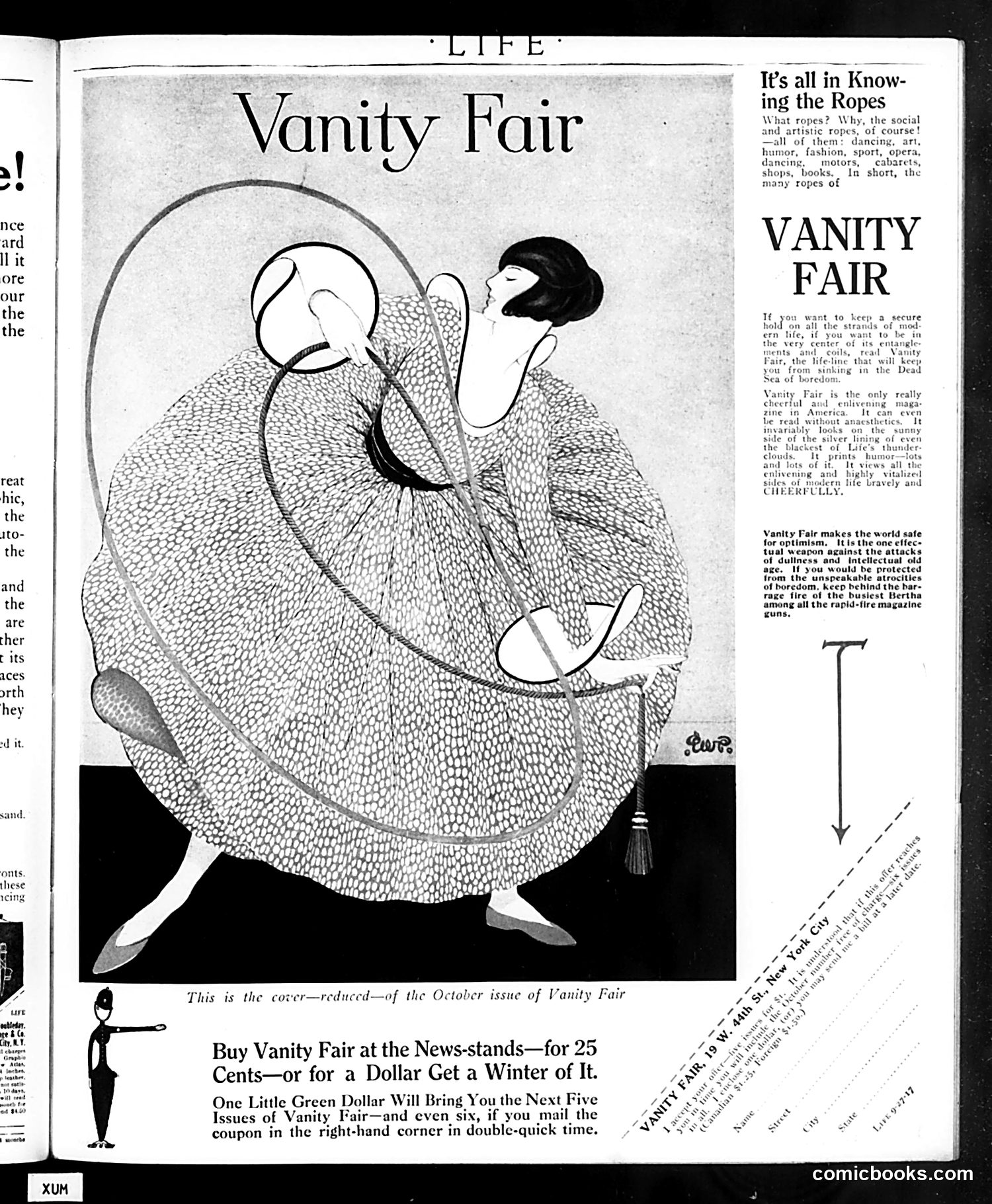
This is primarily **advertising and promotional content** for Vanity Fair magazine itself, not political satire. The cover illustration shows a stylized, art deco-era woman in an elaborate, textured dress and bob haircut—typical 1920s fashion imagery. The figure appears to represent the modern, sophisticated woman the magazine appeals to. The accompanying text pitches Vanity Fair as protection against "boredom" and "dullness," offering readers access to "social and artistic ropes"—meaning inside knowledge of fashion, sports, theater, cabarets, and culture. The promotional copy uses militaristic language ("rage fire," "Bertha"), comparing the magazine's wit to wartime firepower—likely referencing World War I, which was recent when this was published. **The pitch**: For 25 cents at newsstands or a dollar for a winter subscription, readers gain entry to sophisticated cultural commentary. The tone assumes readers want to appear knowledgeable and fashionable, positioning Vanity Fair as essential to that identity.
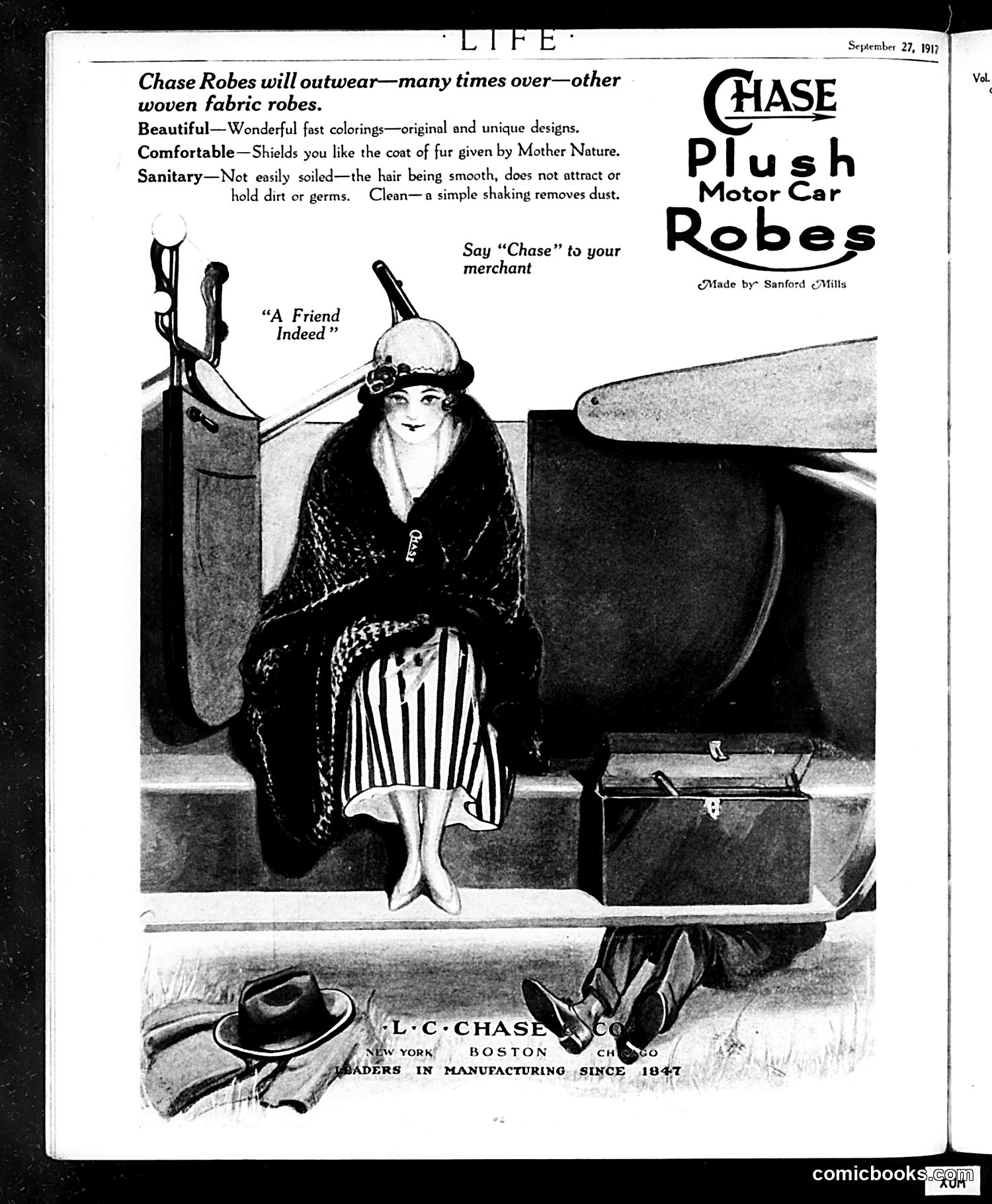
This is a **1917 advertisement**, not political satire. It promotes Chase brand robes—specifically plush robes designed for automobile travel, made by Sanford Mills. The illustration shows a fashionably dressed woman seated in a motor car, wrapped in an elaborate plush robe and wearing a decorative hat. The caption reads "A Friend Indeed," positioning the robe as a practical companion for early automotive travel. The ad emphasizes practical benefits relevant to 1917 motorists: durability, comfort ("like the coat of fur"), and sanitary properties (the smooth plush hair supposedly resists dirt and germs). The phrase "Say 'Chase' to your merchant" was standard advertising copy directing consumers to request the brand by name. This reflects the era when motoring was still a luxury activity requiring special protective clothing.