
Life, 1917-09-27 · page 22 of 40
Life — September 27, 1917 — page 22: what you’re looking at
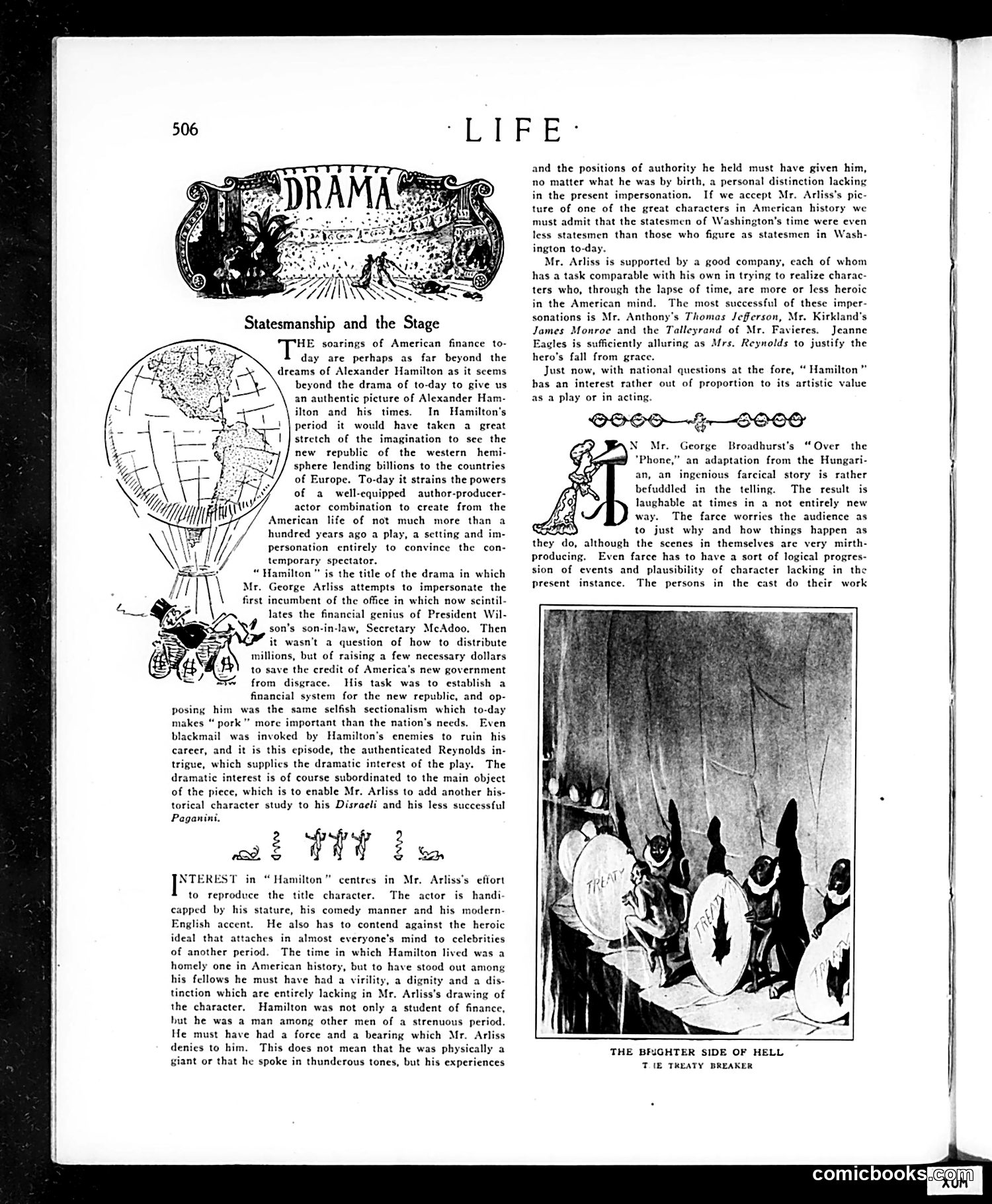
What you’re looking at
This page reviews a theatrical production of "Hamilton" starring British actor George Arliss. The criticism contrasts Hamilton's historical significance—establishing America's financial system during the nation's founding—with Arliss's inadequate portrayal. The reviewer argues Arliss lacks the "virility, dignity and distinction" necessary to embody Hamilton as a serious statesman. Instead of commanding presence, Arliss delivers a comedic performance undermined by his slight stature, modern English accent, and light manner. The critique contains topical 1917 references: it compares Hamilton's era financial challenges to contemporary times under Secretary of the Treasury McAdoo (President Wilson's son-in-law), suggesting modern statesmen are equally compromised by "selfish sectionalism." The play exploits the "Reynolds intrigue" (Hamilton's documented affair) for dramatic interest rather than genuine character study—implying theatrical spectacle overshadows substantive political meaning.
📄 Transcribed text from this page (OCR, searchable)
Machine-transcribed from the original scan — historical spelling and the odd misread are preserved.
Statesmanship and the Stage HE soarings of American finance to- day are perhaps as far beyond the dreams of Alexander Hamilton as it seems beyond the drama of to-day to give us an authentic picture of Alexander Ham- ilton and his times. In Hamilton's period it would have taken a great stretch of the imagination to see the new republic of the western hemi- sphere lending billions to the countries of Europe. To-day it strains the powers of a well-equipped author-producer- actor combination to create from the American life of not much more tl a hundred years ago a play, a setting and im- personation entirely to convince the con- temporary spectator. “Hamilton " is the title of the drama in which Mr. George Arliss attempts to impersonate the first incumbent of the office in which now scintil- lates the financial genius of President Wil- son’s son-in-law, Secretary McAdoo. Then it wasn’t a question of how to distribute millions, but of raising a few necessary dollars to save the credit of America’s new government from disgrace. His task was to establish a financial system for the new republic, and op- posing him was the same selfish sectionalism which to-day makes “ pork” more important than the nation’s needs. Even blackmail was invoked by Hamilton's enemies to ruin his career, and it is this episode, the authenticated Reynolds in- trigue, which supplics the dramatic interest of the play. The dramatic interest is of course subordinated to the main object of the piece, which is to enable Mr. Arliss to add another his- torical character study to his Disraeli and his less successful wi THY Es NTEREST in “Hamilton” centres in Mr. Arliss's effort to reproduce the title character. The actor is handi- capped by his stature, his comedy manner and his modern- English accent. He also has to contend against the heroic ideal that attaches in almost everyone's mind to celebrities of another period. The time in which Hamilton lived was a homely one in American history, but to have stood out among his fellows he must have had a virility, a dignity and a dis- tinction which are entirely lacking in Mr. Arliss's drawing of the character. Hamilton was not only a student of finance, hut he was a man among other men of a strenuous period. He must have had a force and a bearing which Mr. Arliss denies to him. This does not mean that he was physically a giant or that he spoke in thunderous tones, but his experiences “LIFE: and the positions of authority he held must have given him, no matter what he was by th, a personal distinction lacking in the present impersonation. If we accept Mr. Arliss’s pic- ture of one of the great characters in American history we must admit that the statesmen of Washington's time were even less statesmen than those who figure as statesmen in Wash- ington to-day. Mr. Arliss is supported by a good company, each of whom has a task comparable with his own in trying to realize charac- ters who, through the lapse of time, are more or less heroic in the American mind. The most successful of these imper- sonations is Mr. Anthony's Thomas Jefferson, Mr. Kirkland’s James Monroe and the Talleyrand of Mr. Favieres. Jeanne Eagles is sufficiently alluring as Mrs. Reynolds to justify the hero's fall from grace. Just now, with national questions at the fore, “ Hamilton” bas an interest rather out of proportion to its artistic value as a play or in acting. OVCO—fj- SOO N Mr. George Broadburst's “Over the "Phone,” an adaptation from the Hungari- an, an ingenious farcical story is rather befuddled in the telling. The result is laughable at times in a not entirely new wa The farce worries the audience as to just why and how things happen as they do, although the scenes in themselves are very mirth- producing. Even farce has to have a sort of logical progres- sion of events and plausibility of character lacking in the present instance. The persons in the cast do their work THE BRIGHTER SIDE OF HELL TIE TREATY BREAKER comicbooksfeona