
Life, 1917-09-27 · page 30 of 40
Life — September 27, 1917 — page 30: what you’re looking at
What you’re looking at
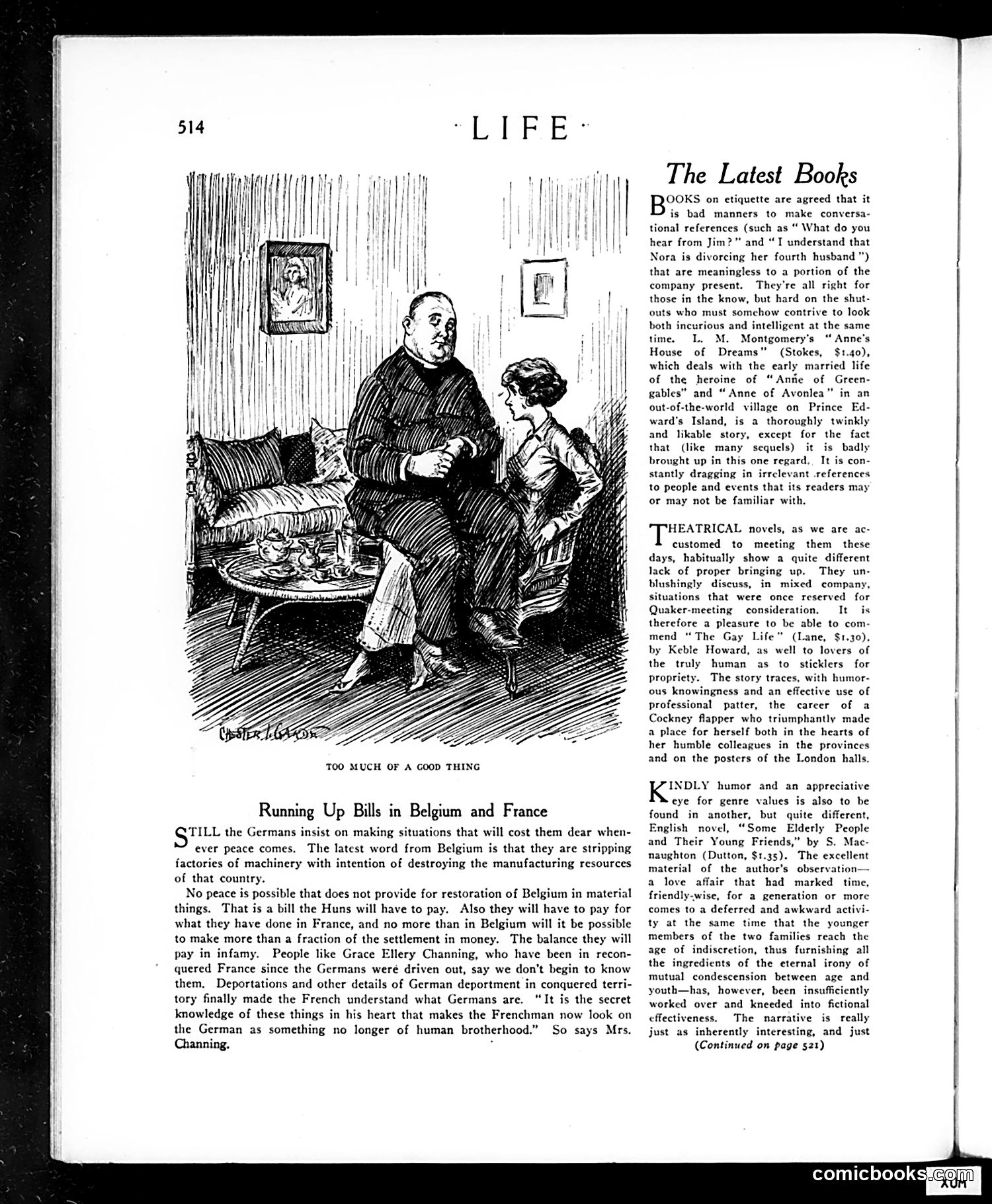
The cartoon depicts a domestic scene captioned "TOO MUCH OF A GOOD THING," illustrating the accompanying article about Germany's war reparations obligations. **The Satire:** The image shows a portly man (representing Germany) sitting with a woman, surrounded by empty dishes and bottles—suggesting excessive consumption or indulgence. The caption's title plays on the phrase to mock Germany's wartime destruction in Belgium and France. **The Context:** Written during or shortly after World War I, the article argues that Germany must pay massive financial reparations for stripping factories and destroying infrastructure in occupied territories. The author quotes Grace Ellery Channing, who witnessed German conduct in reconquered France, emphasizing that monetary payment alone cannot compensate for such destruction—Germany will also "pay in infamy." **The Point:** The cartoon sarcastically illustrates Germany's excessive wartime plundering as gluttonous overindulgence, suggesting the nation has gorged itself on stolen resources and must now face consequences. The visual metaphor equates military aggression with moral excess.
📄 Transcribed text from this page (OCR, searchable)
Machine-transcribed from the original scan — historical spelling and the odd misread are preserved.
YS TOO MUCH OF A GOOD THING Running Up Bills in Belgium and France STILL the Germans insist on making situations that will cost them dear when- ever peace comes. The latest word from Belgium is that they are stripping factories of machinery with intention of destroying the manufacturing resources of that country. No peace is possible that does not provide for restoration of Belgium in material things. That is a bill the Huns will have to pay. Also they will have to pay for what they have done in France, and no more than in Belgium will it be possible to make more than a fraction of the settlement in money. The balance they will pay in infamy. People like Grace Ellery Channing, who have been in recon- quered France since the Germans weré driven out, say we don’t begin to know them, Deportations and other details of German deportment in conquered ter tory finally made the French understand what Germans are. “It is the secret knowledge of these things in his heart that makes the Frenchman now look on the German as something no longer of human brotherhood.” So says Mrs. Channing. = The Latest Books OOKS on etiquette are agreed that it is bad manners to make conversa- tional references (such as “ What do you hear from Jim?” and “T understand that Nora is divorcing her fourth husband") that are meaningless to a portion of the company present. They're all right for those in the know, but hard on the shut- outs who must somchow contrive to look both incurious and intelligent at the same time, L. M. Montgomery’s “Anne's House of Dreams” (Stokes, $1.40), which deals with the early married life of the heroine of “Anfie of Green- gables” and “Anne of Avonlea” in an out-of-the-world village on Prince Ed- ward's Island, is a thoroughly twinkly and likable story, except for the fact that (like many sequels) it is badly brought up in this one regard. It is con- stantly dragging in irrclevant .references to people and events that its readers may or may not be familiar with. 'HEATRICAL novels, as we are ac- customed to meeting them these days, habitually show a quite different lack of proper bringing up. They un- blushingly discuss, in mixed company, situations that were once reserved for Quaker-meeting consideration. It is therefore a pleasure to be able to com- mend “The Gay Life" (Lane, $1.30), by Keble Howard, as well to lovers of the truly human as to sticklers for propriety. The story traces, with humor- ous knowingness and an effective use of professional patter, the career of a Cockney flapper who triumphantly made a place for herself both in the hearts of her humble colleagues in the provinces and on the posters of the London halls. INDLY humor and an appreciative eye for genre values is also to be found in another, but quite different, glish novel, “Some Elderly People and Their Young Friends,” by S. Mac- naughton (Dutton, $1.35). The excellent material of the author’s observation— a love affair that had marked time, friendly-wise, for a generation or more comes to a deferred and awkward activi- ty at the same time that the younger members of the two families reach the age of indiscretion, thus furnishing all the ingredients of the eternal irony of mutual condescension between age and youth—has, however, been insufficiently worked over and kneeded into fictional effectiveness. The narrative is really just as inherently interesting, and just (Continued on page 521) comicbooksieemiy