
Life, 1917-09-27 · page 35 of 40
Life — September 27, 1917 — page 35: what you’re looking at
What you’re looking at
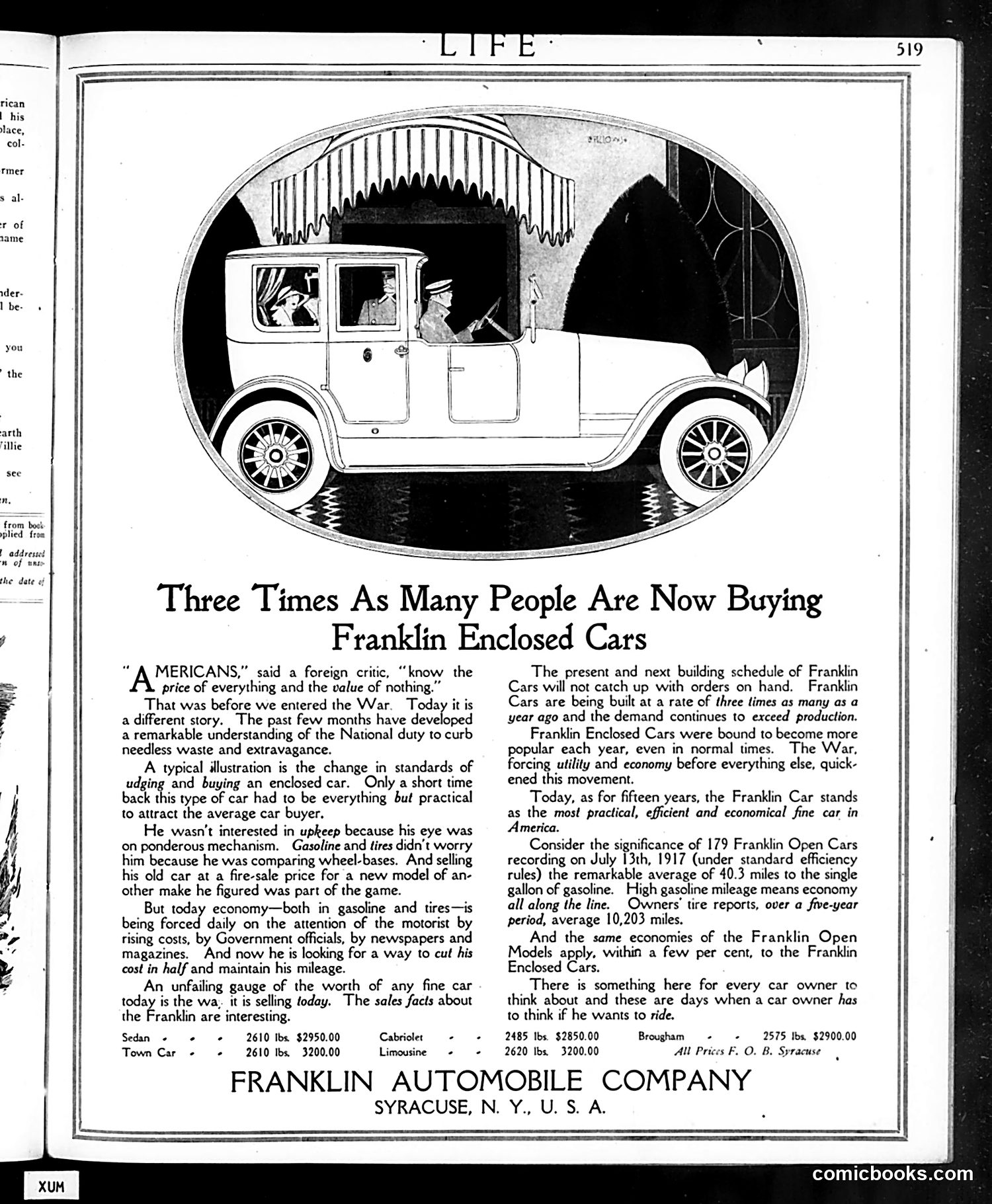
This is primarily a **car advertisement**, not a political cartoon. It's a 1917 Franklin Automobile Company ad capitalizing on **World War I-era patriotism and resource conservation**. The ad argues that Americans have shifted from valuing ostentation ("price of everything and value of nothing") to prioritizing **practical economy**—framed as a patriotic duty during wartime. The illustration shows a modest enclosed sedan rather than flashy open-air models. The sales pitch emphasizes fuel efficiency (40.3 miles per gallon) and tire durability as evidence that Franklin cars align with wartime conservation efforts. The claim that Franklin sales tripled reflects how wartime messaging repositioned "economy" as both morally virtuous and patriotic, appealing to consumers' sense of national duty. For modern readers: this represents how companies used **patriotic framing** to market products during WWI, suggesting that buying practical, efficient cars was equivalent to supporting the war effort.
📄 Transcribed text from this page (OCR, searchable)
Machine-transcribed from the original scan — historical spelling and the odd misread are preserved.
Tr of rame ider- lbe- you "the arth ‘illie from boek plied from | addressed m of une the date i | LVRS Three Times As Many People Are Now Buying Franklin Enclosed Cars “ A MERICANS,” said a foreign critic, “know the price of everything and the value of nothing.” That was before we entered the War. Today it is a different story. The past few months have devekaped a remarkable understanding of the National duty to curb needless waste and extravagance. A typical illustration is the change in standards of udging and buying an enclosed car. Only a short time back this type of car had to be everything but practical to attract the average car buyer. He wasn’t interested in upkeep because his eye was on ponderous mechanism. Gasoline and tires didn’t worry him because he was comparing wheel-bases. And selling his old car at a fire-sale price for a new model of an- other make he figured was part of the game. But today economy—both in gasoline and tires—is being forced daily on the attention of the motorist by rising costs, by Government officials, by newspapers and magazines. And now he is looking for a way to cut his cost in half and maintain his mileage. An unfailing gauge of the worth of any fine car today is the wa. it is selling today. The sales facts about the Franklin are interesting. Sedan - - - 2610 Ibs. $2950.00 Cabriolet - - Town Car + + 2610 Ibs. 3200.00 Limousine - + FRANKLIN AUTO The present and next building schedule of Franklin Cars will not catch up with orders on hand. Franklin Cars are being built at a rate of three times as many as a year ago and the demand continues to exceed production. Franklin Enclosed Cars were bound to become more popular each year, even in normal times. The War, forcing ulility and economy before everything else, quick- ened this movement. Today, as for fifteen years, the Franklin Car stands as the most practical, efficient and economical fine car in America. Consider the significance of 179 Franklin Open Cars recording on July 13th, 1917 (under standard efficiency rules) the remarkable average of 40.3 miles to the single gallon of gasoline. High gasoline mileage means economy all along the line. Owners’ tire reports, over a five-year period, average 10,203 miles. And the same economies of the Franklin Open Models apply, within a few per cent, to the Franklin Enclosed Cars. There is something here for every car owner to think about and these are days when a car owner has to think if he wants to ride, 2485 Ibs. $2850.00 Brougham - - 2575 Ibs. $2900.00 2620 Ibs. 3200.00 All Prices F. O. B. Syracuse OBILE COMPANY SYRACUSE, N. Y., U.S. A. comicbooks.com