
Life, 1917-09-27 · page 23 of 40
Life — September 27, 1917 — page 23: what you’re looking at
What you’re looking at
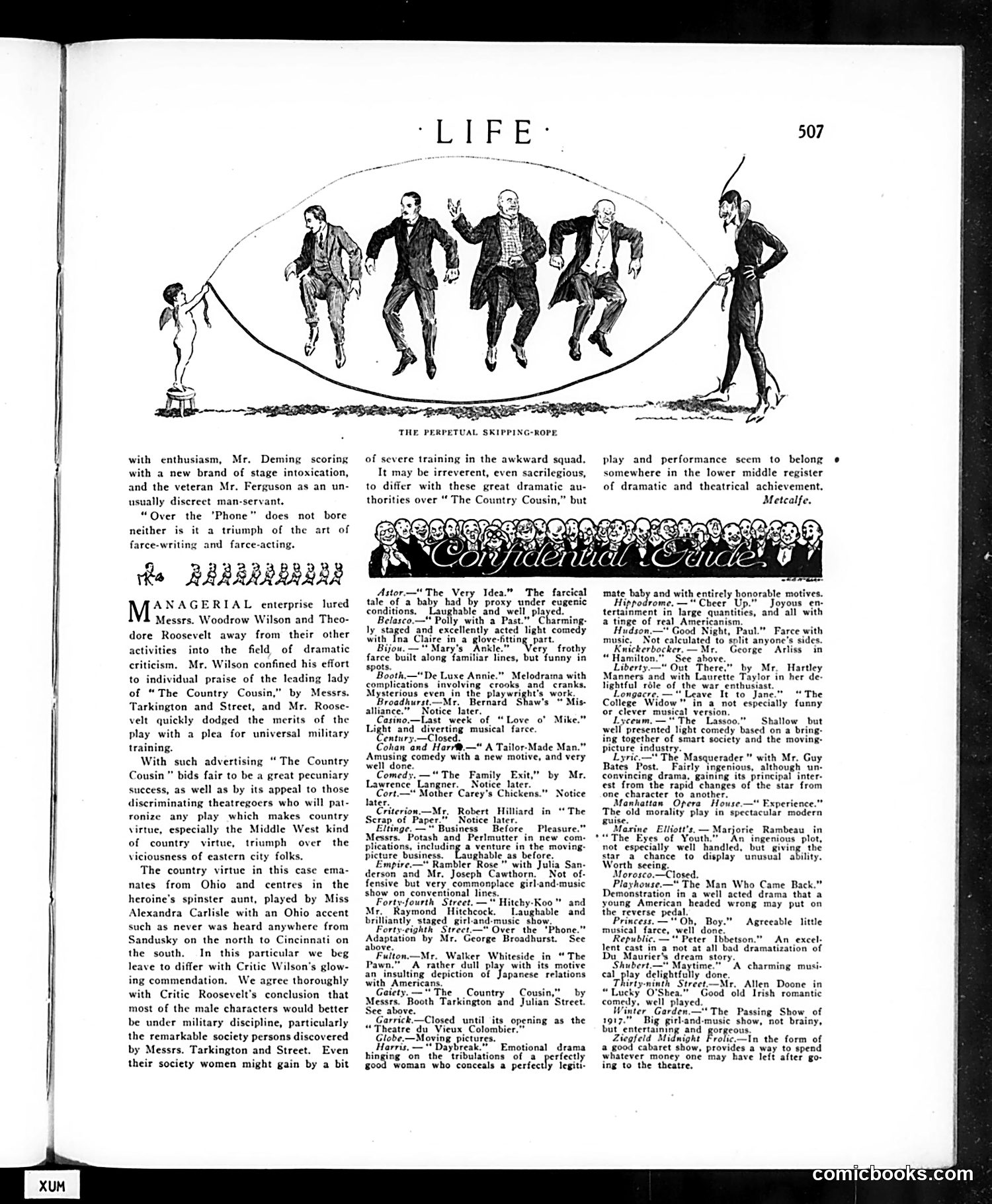
This satirical cartoon mocks the involvement of Presidents **Woodrow Wilson** and **Theodore Roosevelt** in theatrical criticism. The image depicts them as figures operating a skipping rope, with male actors jumping in the middle while a woman controls each end—a visual metaphor suggesting these political giants are being manipulated by theatrical interests or are trivializing themselves through show-business involvement. The accompanying text criticizes their conflicting opinions on "The Country Cousin": Wilson praised the lead actress, while Roosevelt ignored the play's merits to advocate for military training instead. The satire suggests that having U.S. Presidents endorse a play—especially one celebrating "country virtue" over urban sophistication—is absurd performance rather than legitimate criticism. The cartoon ridicules both the politicization of entertainment and the presidents' apparent distraction from serious governance.
📄 Transcribed text from this page (OCR, searchable)
Machine-transcribed from the original scan — historical spelling and the odd misread are preserved.
with enthusiasm, Mr. Deming scoring with a new brand of stage intoxication, and the veteran Mr. Ferguson as an un- usually discreet man-servant. “Over the 'Phone” does not bore neither is it a triumph of the art of farce-writing and farce-acting. the RARBRREHARS ANAGERIAL enterprise lured Messrs. Woodrow Wilson and Theo- dore Roosevelt away from their other activities into the field of dramatic criticism. Mr. Wilson confined his effort to individual praise of the leading lady of “The Country Cousin,” by Messrs. Tarkington and Street, and Mr. Roose- velt quickly dodged the merits of the play with a plea for universal military training. With such advertising “The Country Cousin" bids fair to be a great pecuniary success, as well as by its appeal to those discriminating theatregoers who will pat- ronize any play which makes country Virtue, especially the Middle West kind of country virtue, triumph over the viciousness of eastern city folks. The country virtue in this case ema- nates from Ohio and centres in the heroine's spinster aunt, played by Miss Alexandra Carlisle with an Ohio accent such as never was heard anywhere from Sandusky on the north to Cincinnati on the south, In this particular we beg leave to differ with Critic Wilson's glow- ing commendation. We agree thoroughly with Critic Roosevelt's conclusion that most of the male characters would better be under military discipline, particularly the remarkable society persons discovered by Messrs. Tarkington and Street. Even their society women might gain by a bit of severe training in the awkward squad. It may be irreverent, even sacrilegious, to differ with these great dramatic au- thorities over “ The Country Cousin,” but oe eS: Astor.—" The Very Idea.” The farcical tale of a baby had by proxy under eugenic conditions. Laughable and well, played. Belasco.—" Polly with a Past.” Charming- ly staged and excellently acted light comedy with Ina Claire in, a glove-itting part. Bijou. —" Mary's Ankle.” Very | frothy farce built along familiar lines, but funny in spots. Booth.—"De Luxe Annie.” Melodrarna complications involving crooks and cranks. Mysterious even in the playwright’s work. Broadhurst—Mr. Bernard Shaw's“ Mis- alliance.” Notice later. Casino.—Last_ week of “Love o’ Mike.” Light and diverting musical farce. ‘entury.—Closed. Cohan and Harrf.—" A Tailor-Made Man.” Amusing comedy with a new motive, and very well done. Comedy.—“ The Family Exit,” by Mr. Lawrence Langner. _ Notice later. 1aiGort—" Mother Carey's Chickens." Notice ater. Criterion.—Mr, Robert Hilliard in “The Scrap of Paper." Notice later. Eltinge. —" Business. Before Pleasure. Messrs. Potash and Perlmutter in new com: plications, including a venture in the movin, Picture business. Laughable as before. Empire—" Rambier Rose” with Julia San- derson and Mr. Joseph Cawthorn, Not of- fensive but very commonplace girl-and-music show on conventional lines. Forty-fourth Street, —" Hitehy-Koo" and Mr. Raymond Hitchcock. Laughable and brilliantly, staged girl-and-music show. Forty-eighth. Strect—" Over the “Phone.” Adaptation by Mr. George Broadhurst. See above. Fulton.—Mr. Walker Whiteside in “ The Pawn.” "A rather dull play with its motive an ‘insulting depiction of Japanese relations with Americans. Gaiety.—" The Country Cousin," by Messrs. Booth Tarkington and Julian ‘Street. See above. Garrick.—Closed until its opening as the “Theatre du Vieux. Colombier.” Globe—Moving pictures, Harris. —** Daybreak.” | Emotional drama hinging on the tribulations of a perfectly good woman who conceals a perfectly legit FOTeNO caster nee: HUTA 507 play and performance scem to belong ¢ somewhere in the lower middle register of dramatic and theatrical achievement. Metcalfe. mate baby and with entirely honorable motives. Hippodrome. —“* Cheer Up.” Joyous en- tertainment in large quantities, and all with a tinge of real Americanism. Hudson.—* Good Night, Paul.” Farce with music, Not calculated to split anyone’s sides. Knickerbocker. — Mr. George Arliss in “Hamilton.” See above. Liberty.“ Out There,” by Mr, Hartley Manners and with Laurette Taylor in her de- lightful réle of the war enthusiast. Longacre. —“Leave It to Jane.” “The College Widow "in a not especially funny or clever musical version. Lyceum. —"" The Lassoo.” Shallow but well presented light comedy based on a bring- ing together of smart society and the moving- picture industry. Lyric.—" The Masquerader " with Mr, Guy Bates Post. Fairly ingenious, although un- convincing drama, gaining its principal inter- est from the rapid changes of the star from one character to another. Manhattan Opera House— Experience. The old morality play in spectacular modern Eliot's, — Marjorie Rambeau in yes of Youth.” An ingenious plot, not especially well handled, but giving. the star a chance to display unusual ability, Worth seeing. Morosco.—Closed. Playhouse —" The Man Who Came Back.” Demonstration in a well acted drama that a young American headed wrong may put on the reverse pedal. Princess. —" Ob, Boy.” musical farce, well’ done. Republic. —"* Peter Ibbetson.” An excel: lent cast in a not at all bad dramatization of Du_ Maurier’ dream story. Shubert" Maytime.” “A charming musi cai play delightfully done Thirty-ninth Street.—Mr, Allen Doone in “Lucky O'Shea.” Good old Irish romantic comedy, well played. Winter Garden.—* The Passing Show of 1917." Big girland-music show, not brainy, but’ entertaining and gorgeous. Ziegfeld Midnight Frolic.—in the form of a good cabaret show, provides a way to spend whatever money one may have left after go- ing to the theatre, Agreeable little