
Life, 1917-09-27 · page 19 of 40
Life — September 27, 1917 — page 19: what you’re looking at
What you’re looking at
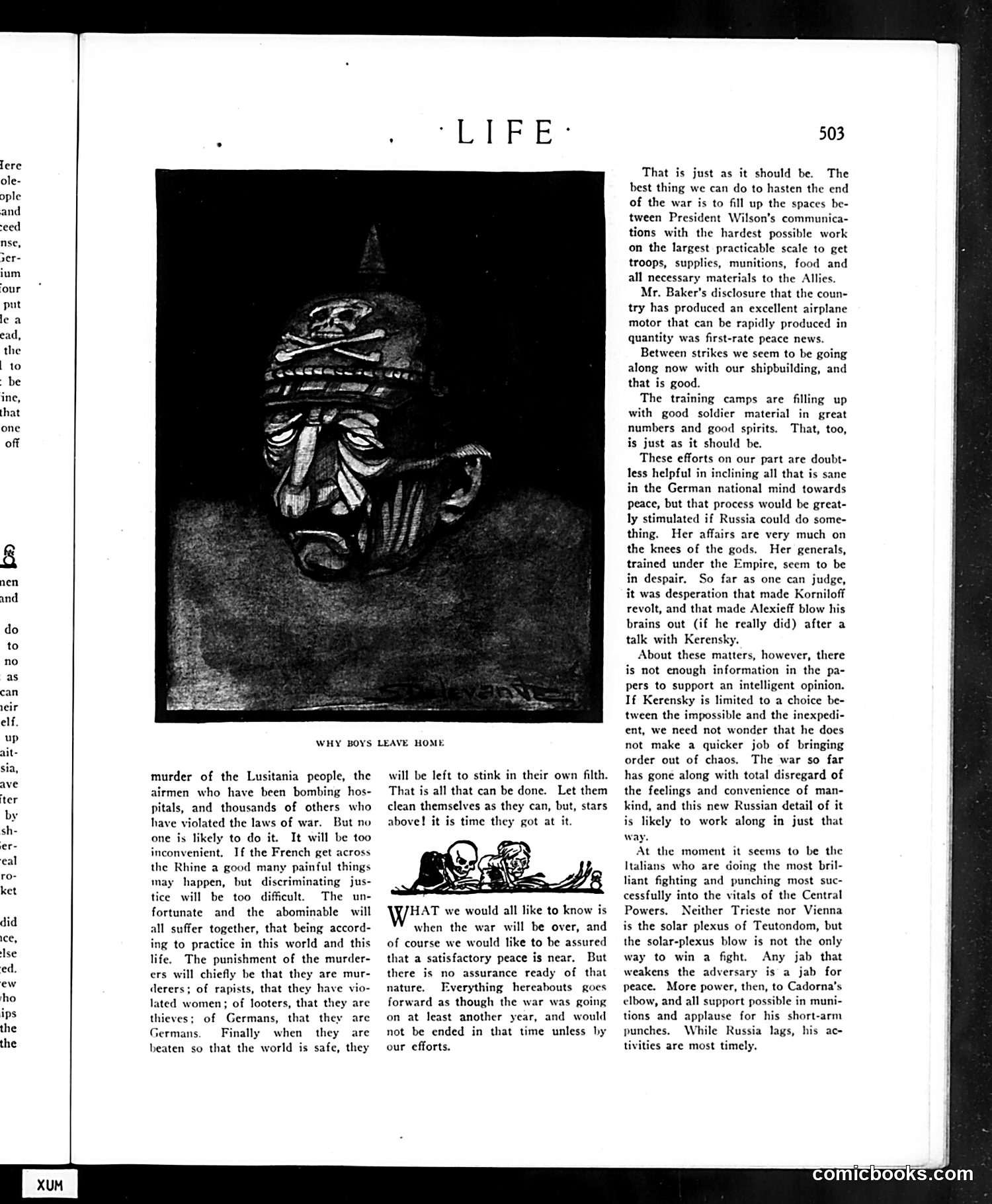
The cartoon titled "Why Boys Leave Home" depicts a grotesque German military figure—likely representing German militarism or Kaiser Wilhelm II's regime. The exaggerated, skull-like face with aggressive features caricatures the brutality associated with German conduct in World War I. The accompanying text discusses German war crimes: the Lusitania sinking, bombing of hospitals, and violations of international law. The author argues that while these perpetrators deserve punishment, practical justice will be impossible after the war ends—they'll simply "stink in their own filth" amid general chaos. The editorial then pivots to encouraging American industrial effort (airplane motors, shipbuilding, troop supplies) to support the Allies and hasten war's end. It also comments on Russian instability under Kerensky and praises Italian military advances as the war's most effective current fighting. The "boys leaving home" title likely suggests German atrocities drive young men to enlist against Germany.
📄 Transcribed text from this page (OCR, searchable)
Machine-transcribed from the original scan — historical spelling and the odd misread are preserved.
lere ole- ople and eed nse, 3er- ium our put le a ead, the | to : be ine, that one nen and , LIFE: Se SSSmcr sen aye, ff (a ED WHY BOYS LEAVE HOME murder of the Lusitania people, the airmen who have been bombing hos- pitals, and thousands of others who have violated the laws of war. But no one is likely to do it. It will be too inconvenient, If the French get across the Rhine a good many painful things may happen, but discriminating jus- tice will be too difficult. The un- fortunate and the abominable will all suffer together, that being accord- ing to practice in this world and this life. The punishment of the murder- ers will chiefly be that they are mur- derers; of rapists, that they have vio- lated women; of looters, that they are thieves; of Germans, that they are Germans. Finally when they are beaten so that the world is safe, they will be left to stink in their own filth. That is all that can be done. Let them clean themselves as they can, but, stars above! it is time they got at it. HAT we would all like to know is when the war will be over, and of course we would like to be assured that a satisfactory peace is near, But there is no assurance ready of that nature, Everything hereabouts goes forward as though the war was going on at least another year, and would not be ended in that time unless by our efforts. 503 That is just as it should be. The best thing we can do to hasten the end of the war is to fill up the spaces be- tween President Wilson’s communica- tions with the hardest possible work on the largest practicable scale to get troops, supplies, munitions, food and all necessary materials to the Allies. Mr. Baker's disclosure that the coun- try has produced an excellent airplane motor that can be rapidly produced in quantity was first-rate peace news. Between strikes we seem to be going along now with our shipbuilding, and that is good. The training camps are filling up with good soldier material in great numbers and good spirits. That, too, is just as it should be. These efforts on our part are doubt- less helpful in inclining all that is sane in the German national mind towards peace, but that process would be great- ly stimulated if Russia could do some- thing. Her affairs are very much on the knees of the gods. Her generals, trained under the Empire, seem to be in despair, So far as one can judge, it was desperation that made Korniloff revolt, and that made Alexieff blow his brains out (if he really did) after a talk with Kerensky. About these matters, however, there is not enough information in the pa- pers to support an intelligent opinion. If Kerensky is limited to a choice be- tween the impossible and the inexpedi- ent, we need not wonder that he does not make a quicker job of bringing order out of chaos, The war so far has gone along with total disregard of the feelings and convenience of man- kind, and this new Russian detail of it is likely to work along in just that way. At the moment it seems to be the Italians who are doing the most bril- liant fighting and punching most suc- cessfully into the vitals of the Central Powers. Neither Trieste nor Vienna is the solar plexus of Teutondom, but the solar-plexus blow is not the only way to win a fight. Any jab that weakens the adversary is a jab for peace. More power, then, to Cadorna’s elbow, and all support possible in muni- tions and applause for his short-arm punches. While Russia lags, his ac- tivities are most timely.