
A complete issue · 40 pages · 1917
Life — August 16, 1917
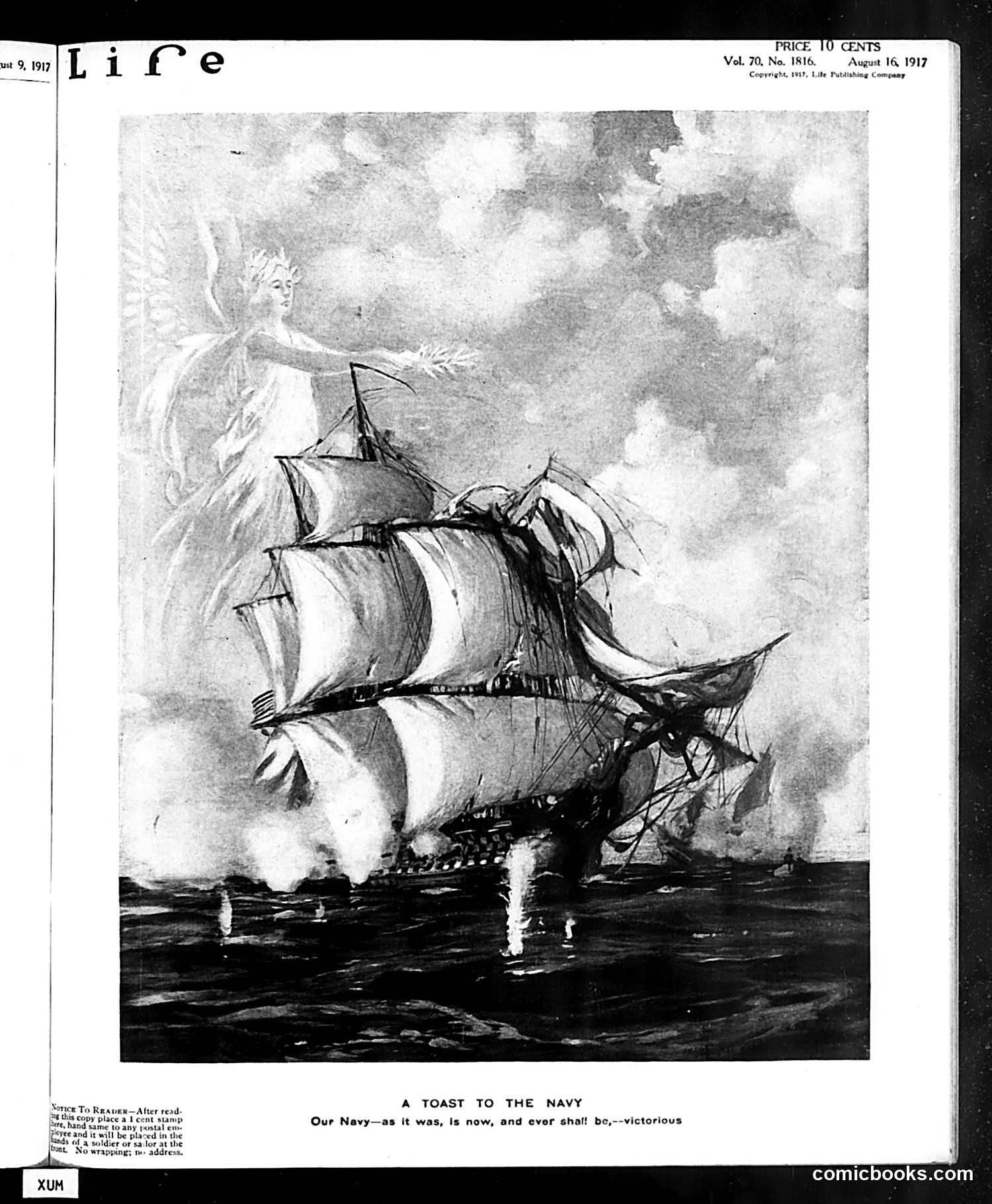
This is a patriotic illustration titled "A Toast to the Navy," published August 16, 1917—during America's involvement in World War I. The image shows a tall ship with full sails engaged in naval combat, with cannon fire visible and smoke billowing across the water. A winged female figure (representing Liberty or Victory) gestures approvingly from above the scene. The caption reads: "Our Navy—as it was, is now, and ever shall be,—victorious." This is not satire but rather patriotic propaganda meant to boost American naval pride and morale during wartime. The allegorical female figure sanctifies the Navy's power, while the dramatic naval engagement symbolizes American military strength and inevitable victory. The artwork celebrates naval tradition and contemporary military prowess.
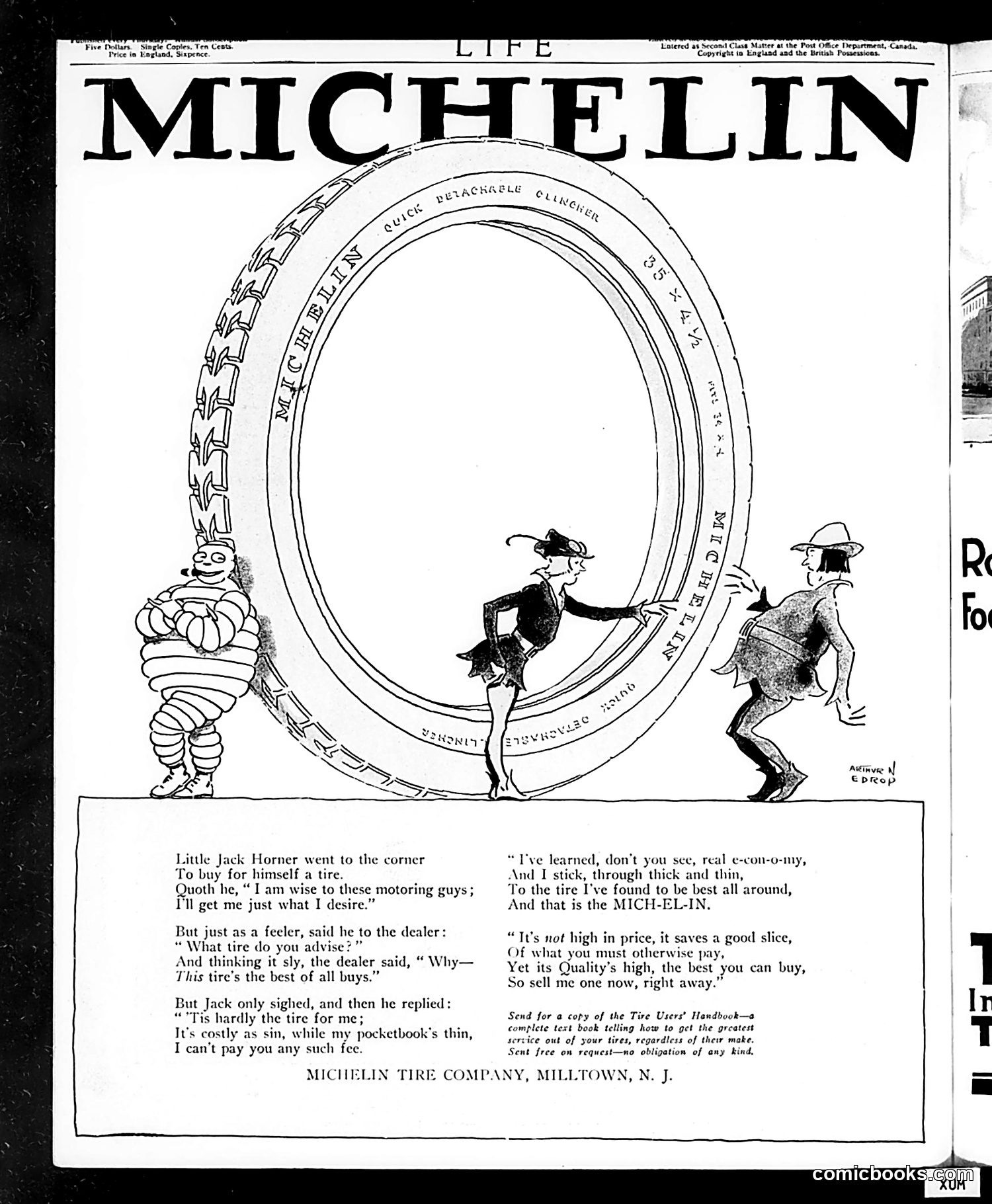
This is a Michelin Tire Company advertisement disguised as humorous verse. The cartoon shows "Little Jack Horner" (a nursery rhyme reference) at a tire shop, seeking economical advice. The satire targets budget-conscious consumers: Jack initially seeks the cheapest tire but is educated by the dealer that Michelin offers superior value. The figures—the rotund Michelin Man (left), a well-dressed dealer (center), and a customer (right)—frame an economic lesson wrapped in playful doggerel. The joke hinges on conventional consumer wisdom: people often equate "low price" with smart purchasing, but the ad argues quality justifies cost. The Michelin Man's iconic mascot presence reinforces brand identity while the verse form makes the sales pitch feel entertaining rather than purely commercial—a common advertising strategy of the era.
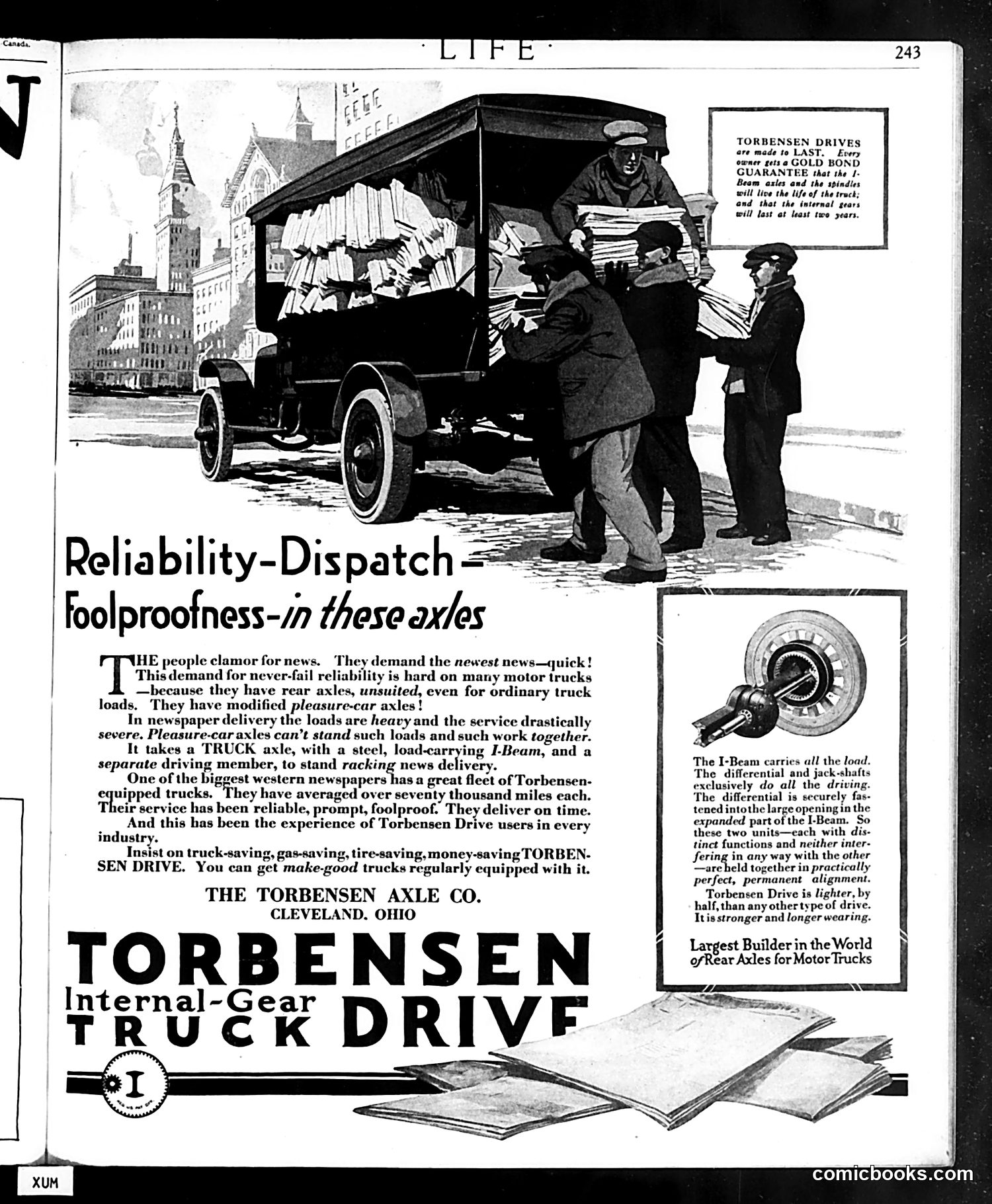
This page is primarily **advertising, not satire or political commentary**. It's a full-page advertisement for the Torbensen Axle Company of Cleveland, Ohio, promoting their "Internal-Gear Truck Drive" for commercial delivery vehicles. The illustration shows a newspaper delivery truck loaded with papers, with three men conducting business—depicting reliability in news distribution. The ad emphasizes that newspapers demand "the newest news—quick," requiring trucks with dependable axles that can handle heavy loads without failure. The accompanying technical diagram and text explain the I-Beam differential's superior engineering. This is straightforward commercial marketing targeting fleet operators, not satirical content. The "Life" magazine platform simply provided advertising space to industrial manufacturers of the era.
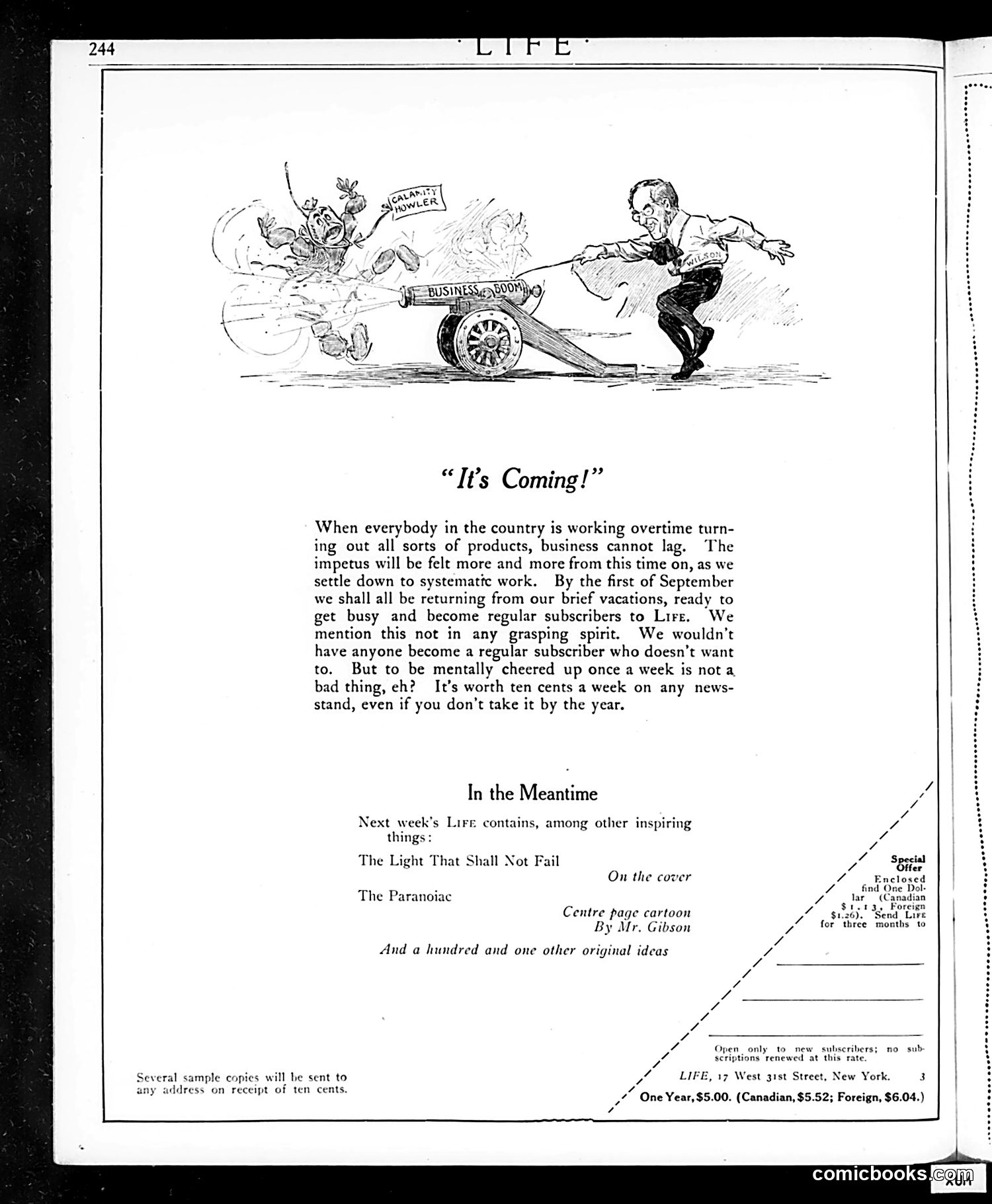
This page contains a promotional cartoon titled "It's Coming!" depicting a man frantically pulling back on a cannon labeled "Business Boom," which is firing explosives labeled "Humbler" at chaotic figures fleeing in the background. The accompanying text references the post-vacation return to systematic work in September, positioning Life magazine as mental refreshment—worth ten cents weekly at newsstands. The cartoon likely satirizes the intense business activity and economic frenzy expected during the fall work season following summer vacations. The "business boom" being weaponized suggests both the explosive nature of commercial activity and perhaps anxiety about its potential chaos or consequences. The page is primarily promotional material encouraging subscriptions.
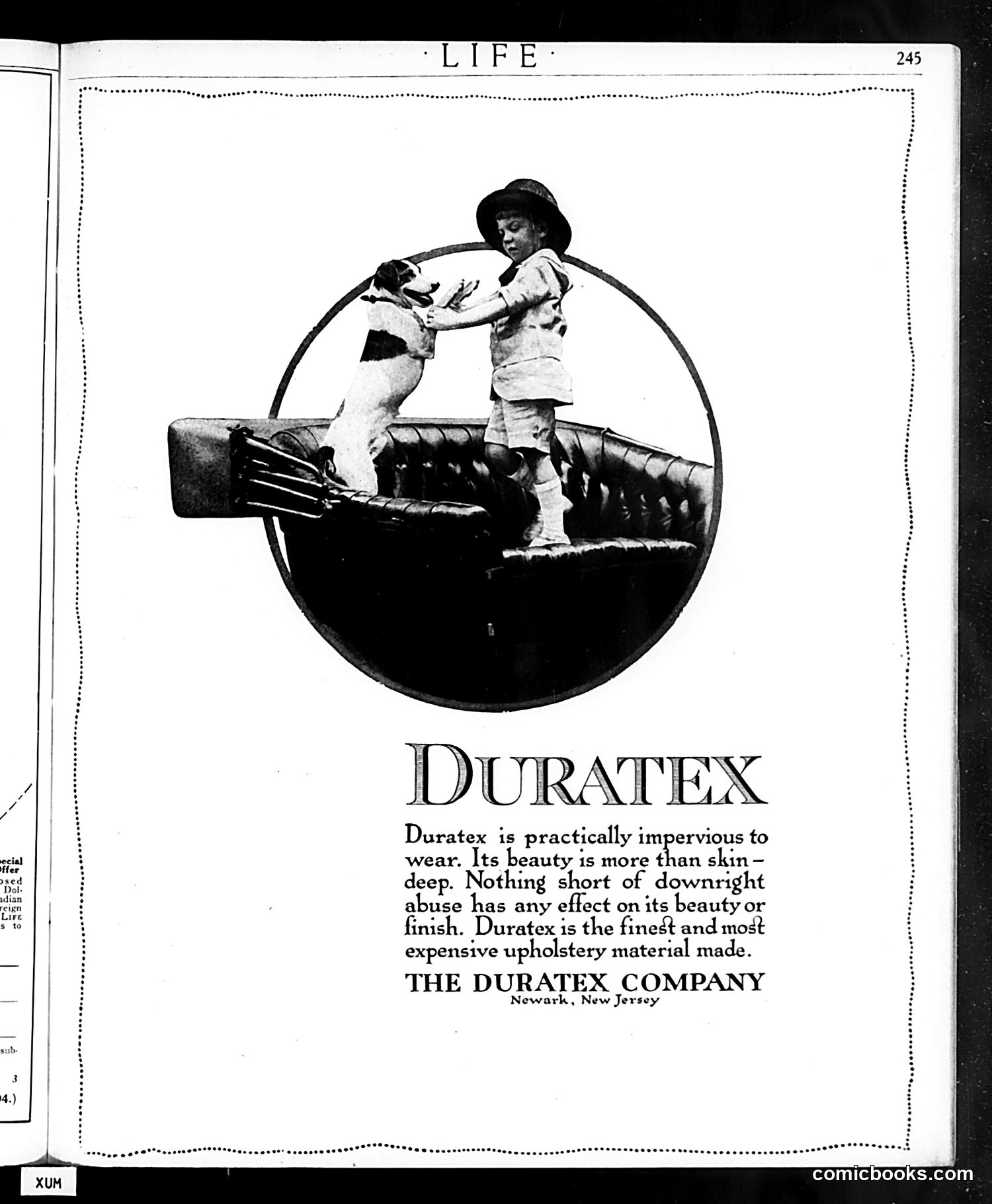
This is **not a cartoon or satire** — it's a **product advertisement** for Duratex upholstery fabric, appearing in Life magazine (page 245). The image shows a young child and dog playing on an upholstered sofa within a circular frame, demonstrating the product's durability. The accompanying text claims Duratex is "practically impervious to wear," with beauty "more than skin-deep," and can withstand rough use without damage to its finish. The advertisement uses the child-and-pet scenario as visual proof of the fabric's resilience — a common marketing strategy of the era. The Duratex Company, based in Newark, New Jersey, positioned their product as "the finest and most expensive upholstery material made," targeting affluent consumers concerned about furniture longevity.
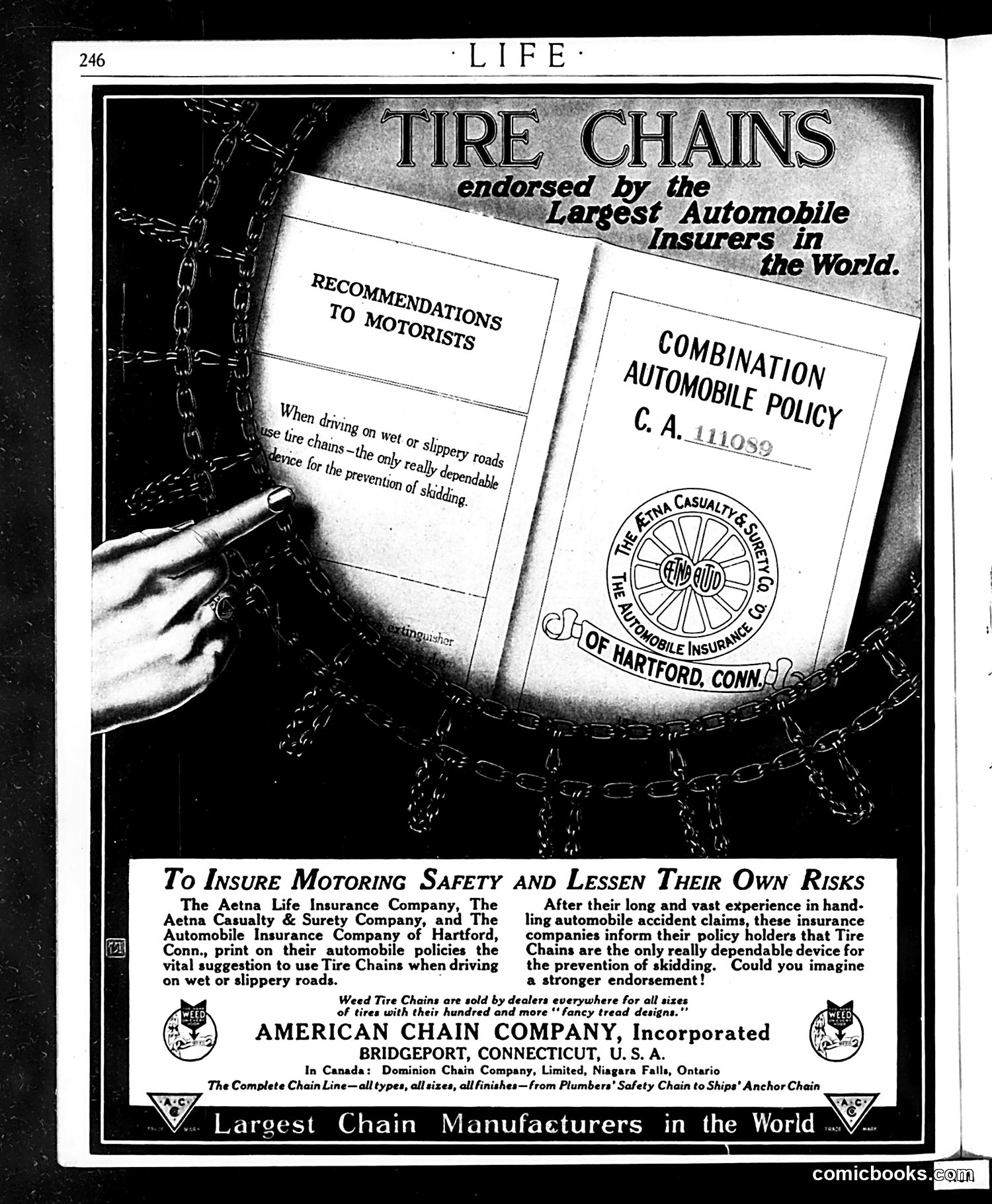
This is **not a cartoon or satire**—it's a straightforward advertisement for tire chains manufactured by the American Chain Company of Bridgeport, Connecticut. The ad promotes tire chains for winter driving safety, endorsed by major automobile insurers (Aetna Life Insurance Company and others). The imagery shows a hand installing chains on a tire, with insurance policy documents displayed to emphasize legitimacy. The key selling point: insurance companies officially recommend tire chains as "the only really dependable device for the prevention of skidding" on wet or slippery roads. This endorsement from insurance providers—who have financial incentive to reduce accidents—serves as the advertisement's primary credibility marker for modern readers unfamiliar with early automotive winter equipment.
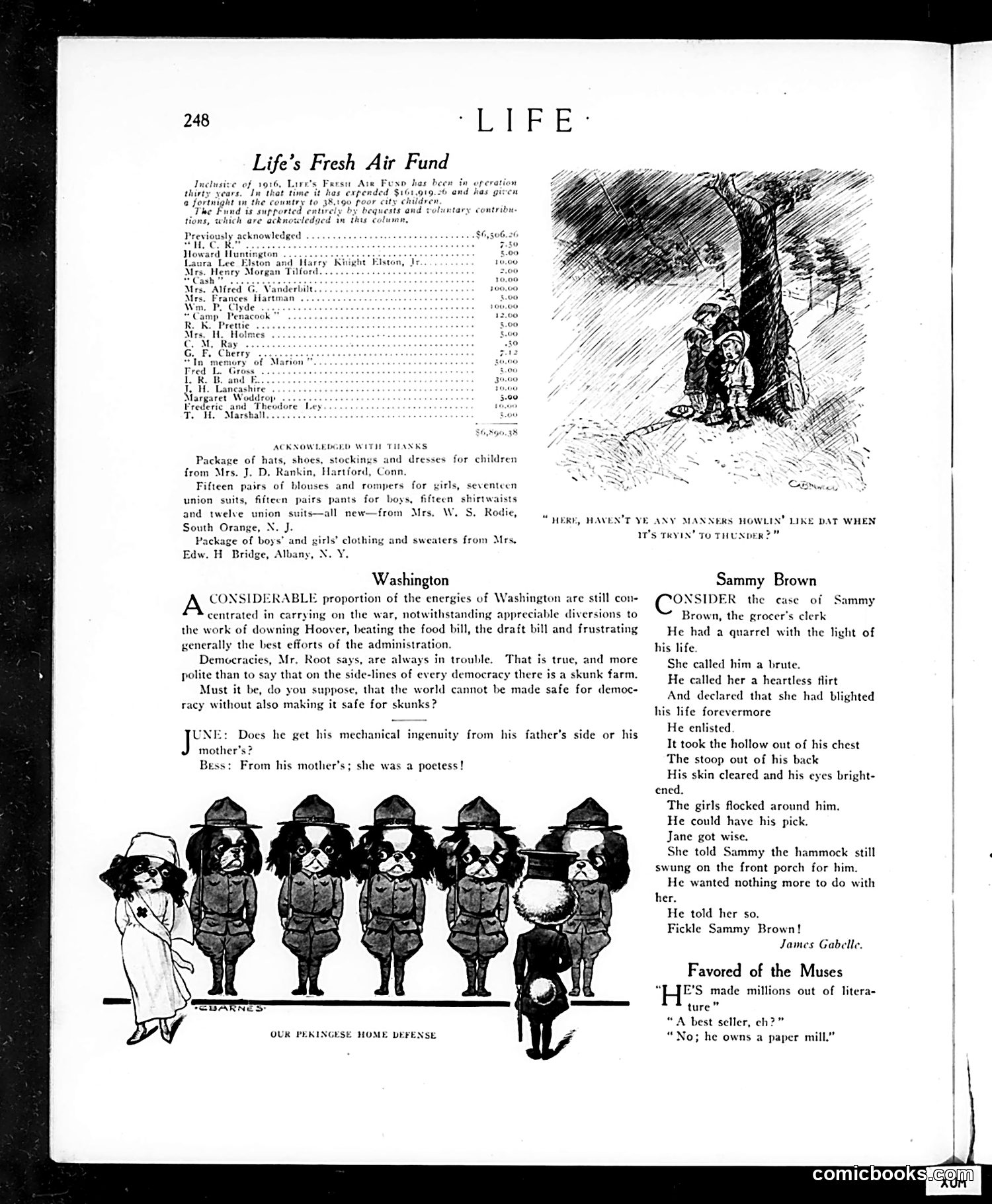
This page contains three distinct pieces: **"Life's Fresh Air Fund"** (top left): A fundraising list for sending city children to the countryside for health and recreation. **"Our Pekinese Home Defense"** (center cartoon): A satirical illustration showing a woman and five soldiers in military gear alongside a small Pekinese dog. The caption suggests absurdist humor about home defense during wartime—the tiny ornamental dog is presented as part of the nation's defense strategy. This likely mocks both overblown civilian "home defense" preparations and the contrast between serious military efforts and domestic, civilian responses to war. **"Sammy Brown"** and **"Favored of the Muses"** (right): Brief literary pieces—a poem about a grocer's clerk and a satirical exchange about literature versus commerce. The page reflects WWI-era American concerns about civilian participation in the war effort.
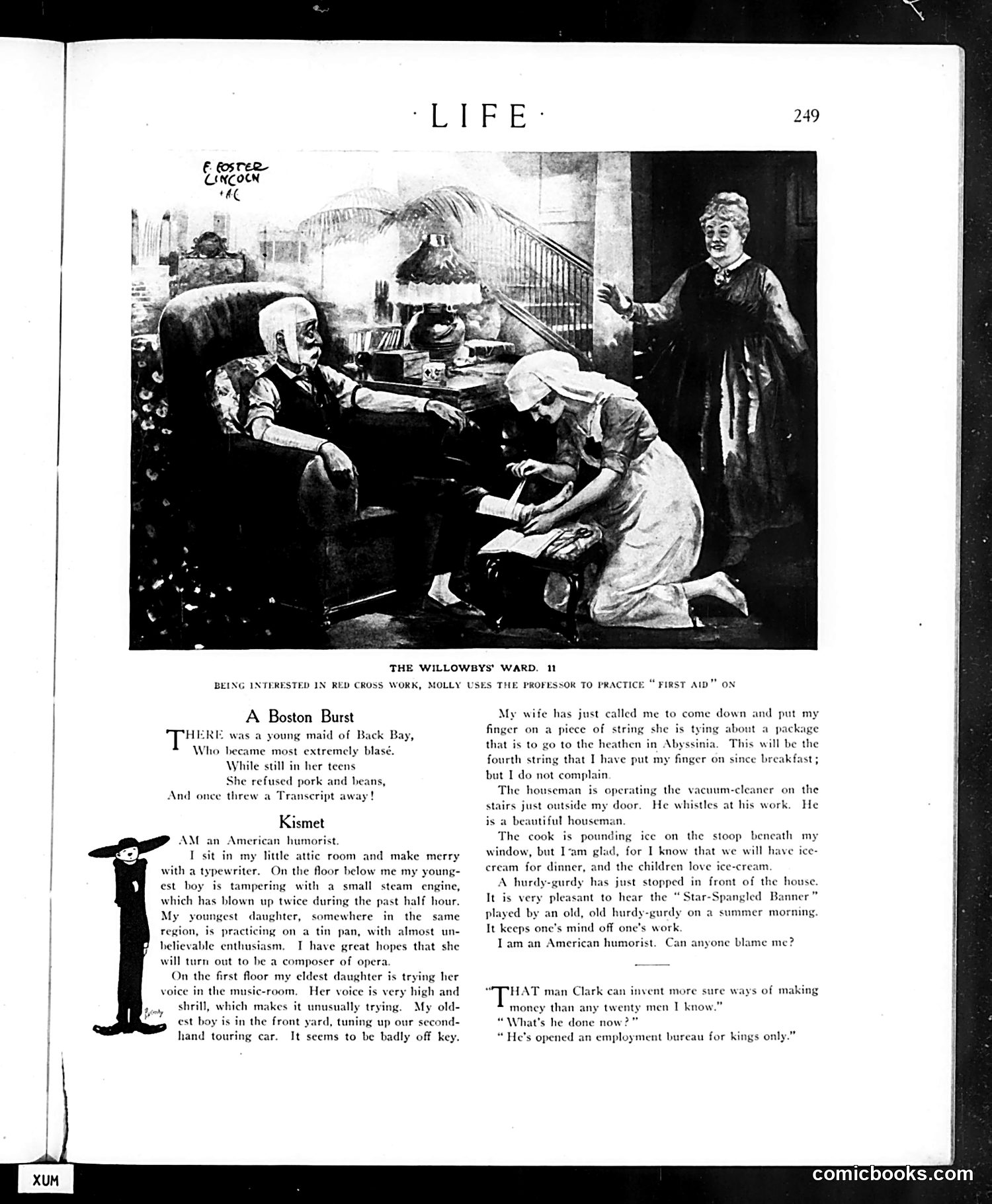
The page contains two separate humor pieces: **"The Willowbys' Ward II"** (photograph/illustration at top): Shows a Red Cross nursing lesson where a young woman practices "first aid" on a professor, demonstrating the magazine's satirical treatment of amateur medical training and class dynamics of charitable work. **"A Boston Burst"** and **"Kismet"** (text pieces below): These are brief humorous anecdotes about domestic life. "A Boston Burst" describes a maid's incompetence and household chaos. "Kismet" is bylined by an American humorist complaining about noise from children's activities and his daughter's musical aspirations—satirizing middle-class family life and parental frustrations with modern domestic disorder. The humor relies on relatable domestic situations rather than political commentary.
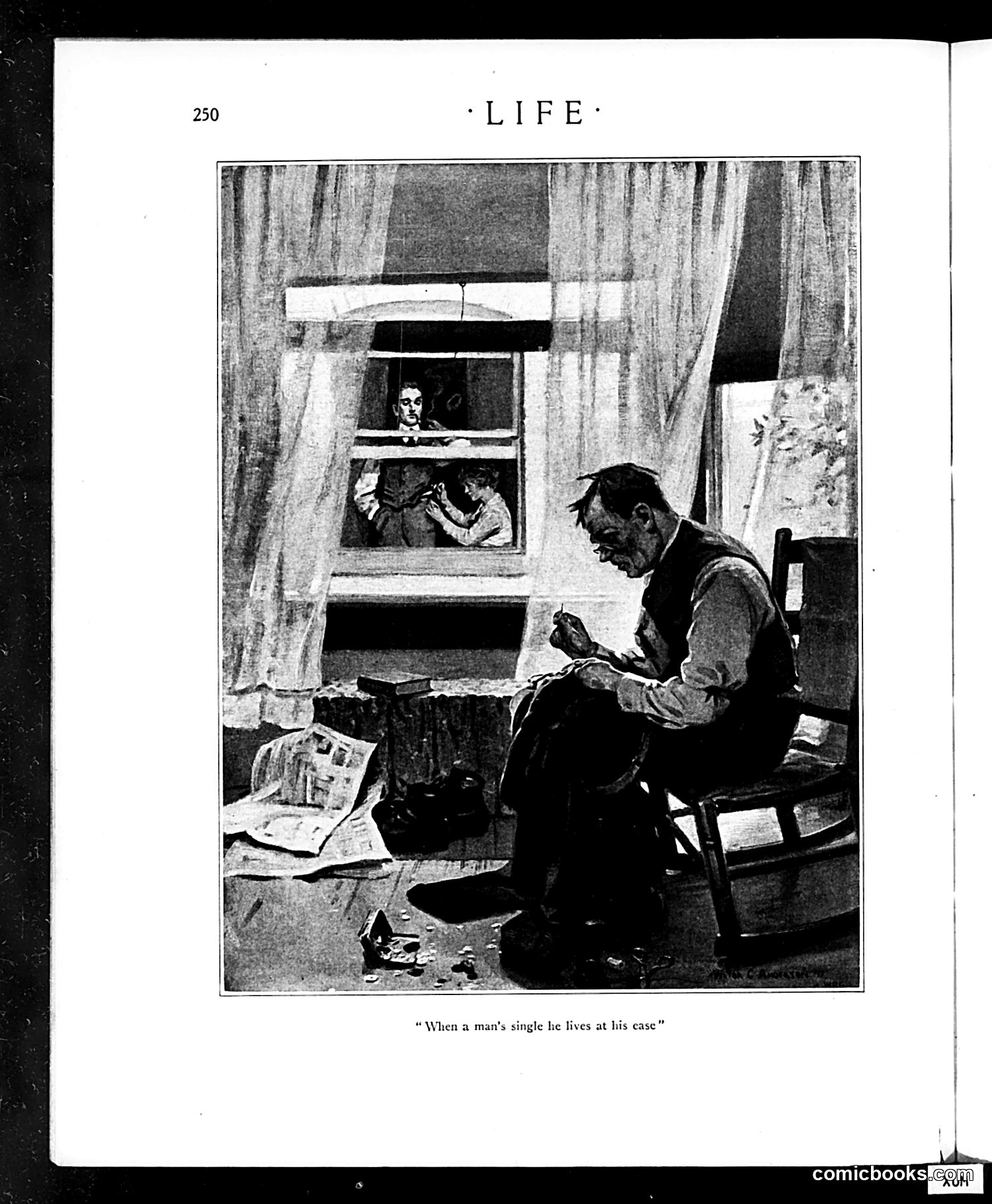
This is a black and white photograph rather than a cartoon. It depicts a man sitting indoors, working on what appears to be a bird or small animal, with newspapers scattered nearby. Two figures observe from a window above. The caption reads: "When a man's single lie lives at his ease" The image appears to be satirizing bachelor life—specifically, a solitary man engaged in what looks like taxidermy or similar solitary domestic activity, while observers watch from outside. The satire likely comments on the perceived idleness or peculiarity of unmarried men living alone, a common social theme in early 20th-century American humor. The "ease" referenced in the caption suggests criticism of bachelor independence, implying such men lack proper domestic management or purpose that marriage would provide. This reflects period attitudes about masculine responsibility and social convention.
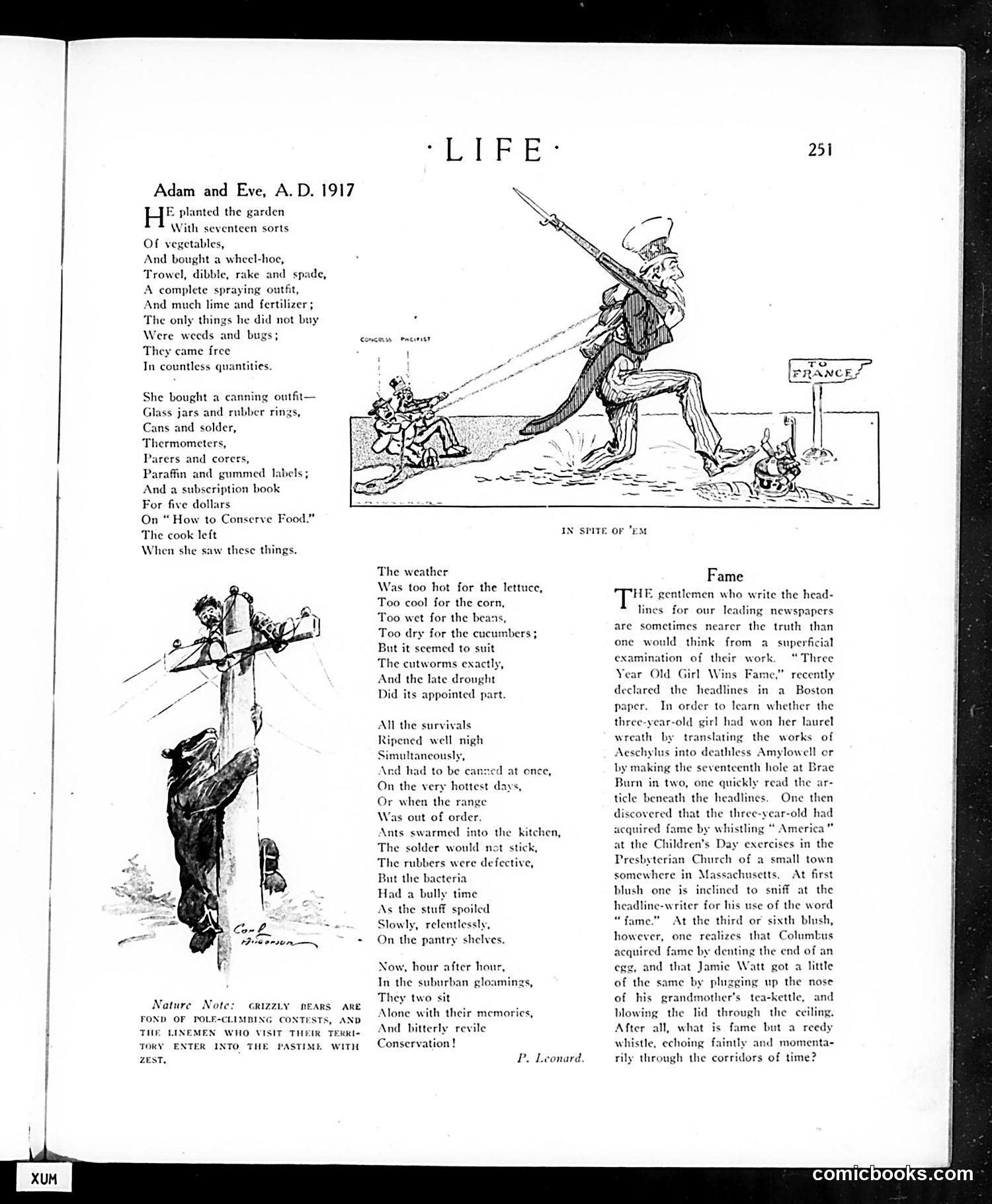
**Top Cartoon ("In Spite of 'Em"):** This depicts a tall, skeletal figure labeled "France" being pulled backward by a much smaller figure (appears to be a caricatured Allied soldier or politician). The satire critiques the difficulty France faced in World War I despite Allied support—suggesting external forces were hindering rather than helping French war efforts or reconstruction. **Lower Cartoon ("Ants"):** Shows soldiers on a utility pole dealing with ants invading military supplies. This is wartime humor about logistical frustrations—pests spoiling provisions during military operations, a relatable complaint for soldiers facing supply-line problems. Both cartoons use exaggeration and anthropomorphism to mock wartime difficulties and absurdities in a satirical magazine style typical of WWI-era American humor.
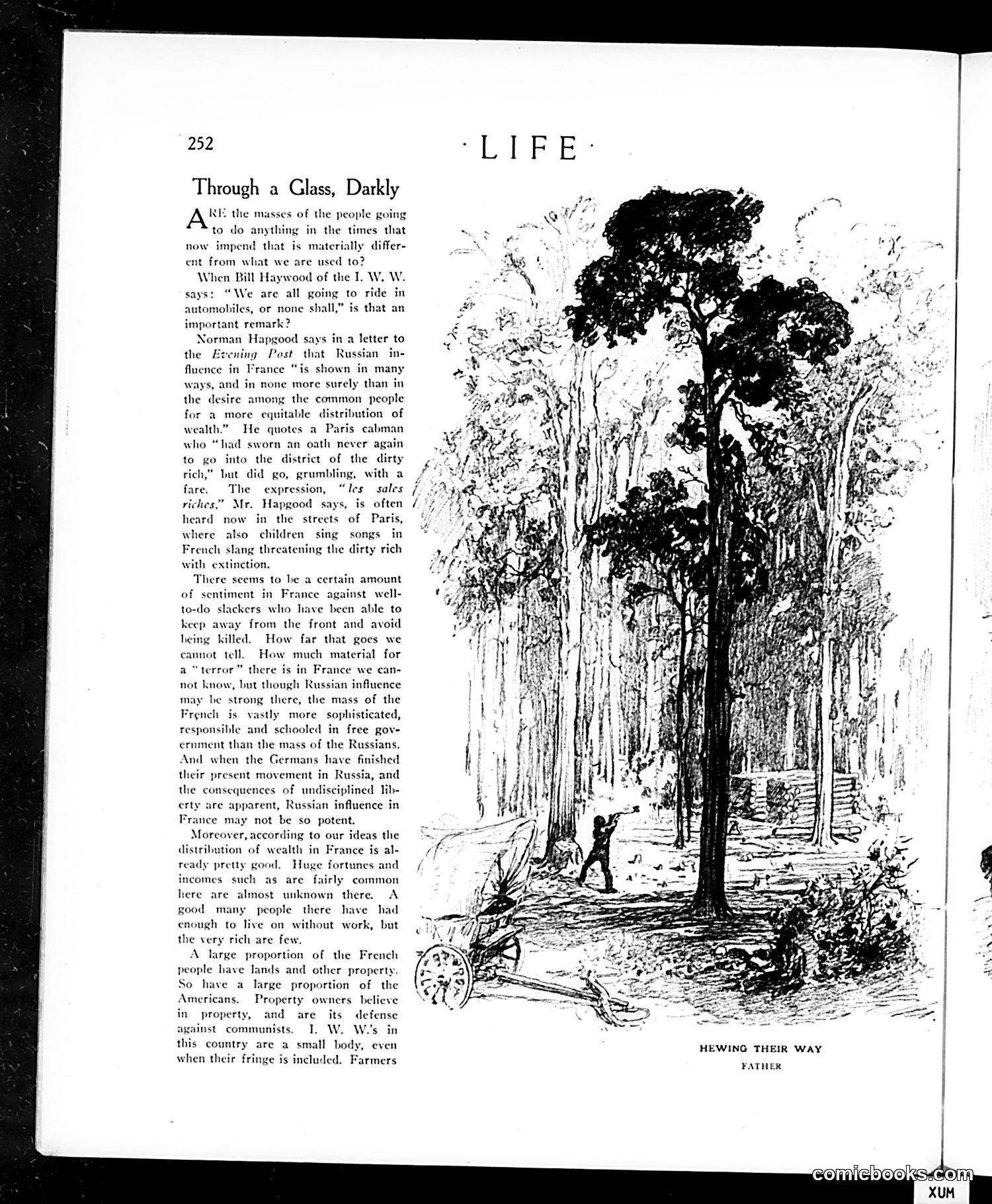
This illustration depicts a figure with an axe clearing tall trees in a forest, titled "Hewing Their Way Farther." The accompanying article discusses French sentiment regarding wealth distribution and property ownership. The text references Bill Haywood (I.W.W. leader) and compares French and Russian attitudes toward socialism and communism. It argues that French property owners—like Americans—view property ownership as defense "against communists." The cartoon likely represents the metaphorical "clearing of obstacles" or forward progress, possibly suggesting either the labor movement's advancement or, conversely, the clearing away of communist/socialist influence in France. The manual labor depicted may reference working-class struggle or the effort required to maintain capitalist property systems against socialist pressure.
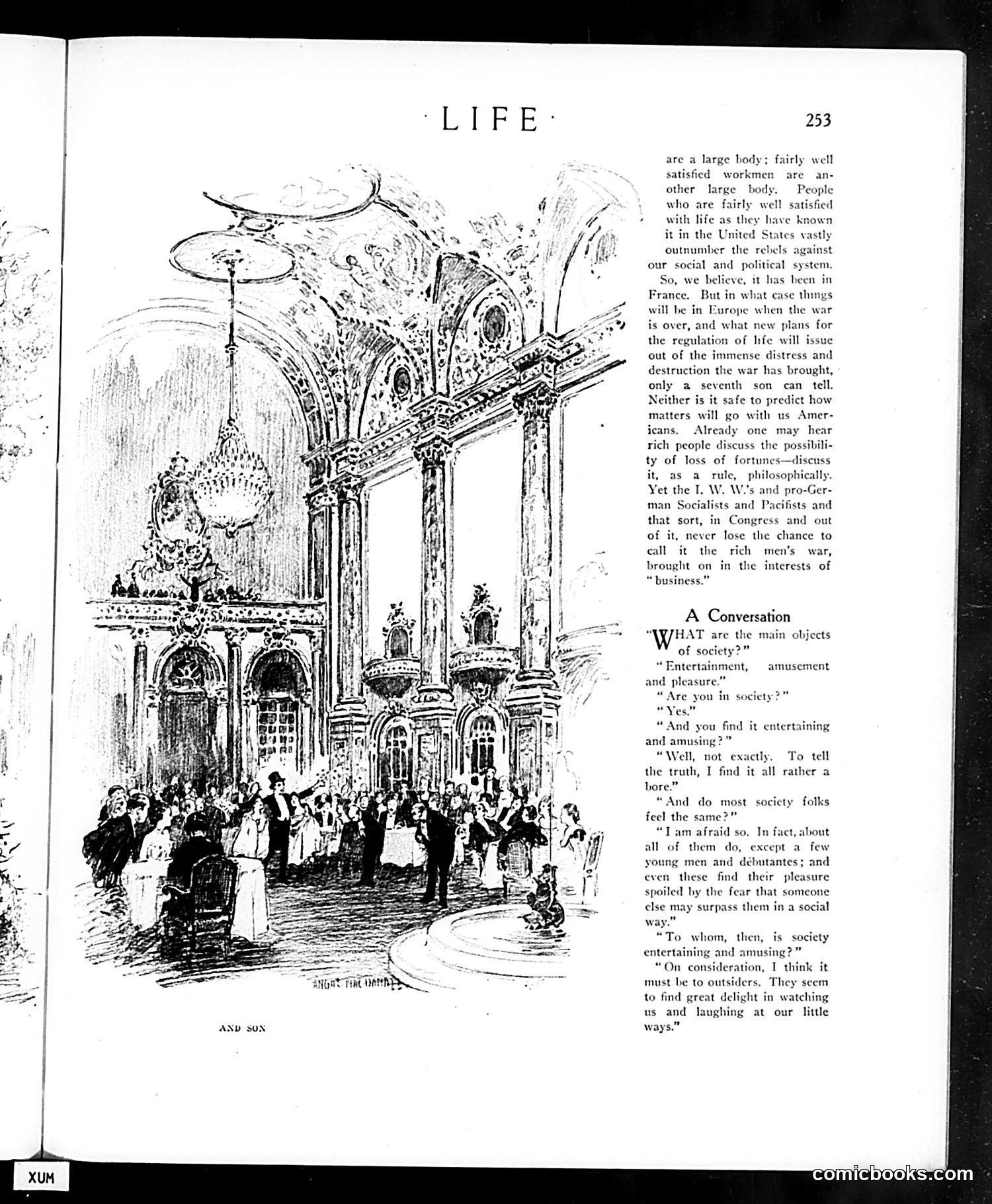
This page contains a satirical conversation about society's entertainment value. The illustration shows an ornate church or cathedral interior filled with elegantly dressed people—depicting high society. The dialogue mocks wealthy society members who find themselves boring. One speaker claims society provides "amusement and pleasure," but another counters that it's actually "rather a bore." The conversation concludes that society is only entertaining to *outsiders*—the poor and working classes who find amusement in "watching us and laughing at our little ways." The satire targets the self-awareness of the idle rich: they recognize their own social world lacks genuine substance or entertainment value, existing primarily as an object of fascination (and mockery) for those outside their privileged circle.
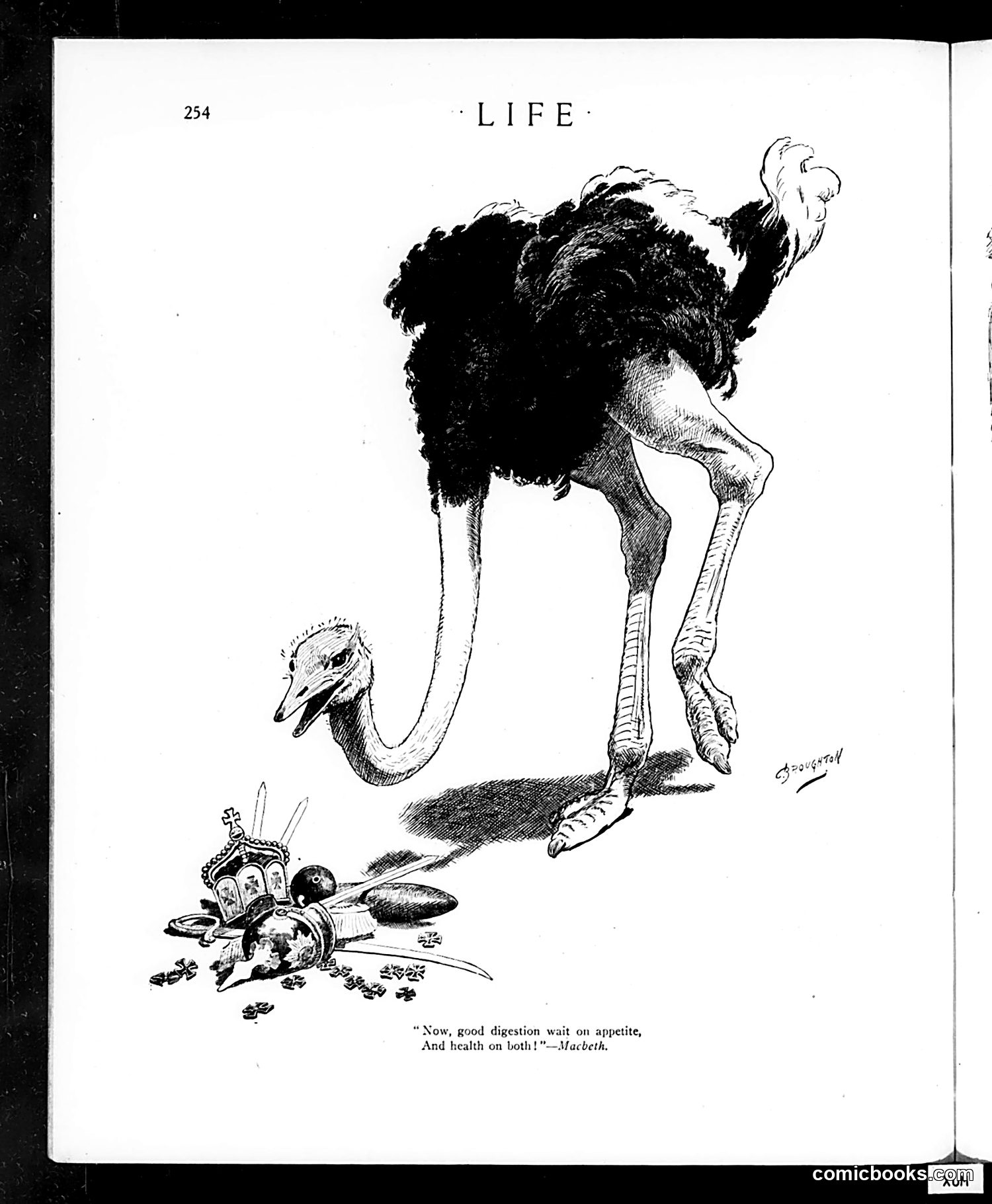
This satirical cartoon depicts an ostrich—a bird famously associated with the metaphor of burying its head in sand to avoid problems—standing over scattered symbols of power and authority (a crown, orb, and scepter). The quote from *Macbeth* ("Now, good digestion wait on appetite, / And health on both!") suggests themes of consumption and consequences. The cartoon likely critiques political or social leaders who ignore serious problems or refuse to acknowledge uncomfortable truths, using the ostrich as a visual pun for willful ignorance. The discarded regalia suggests that power and authority mean nothing if wielded by those who ignore reality. The specific political target remains unclear without additional context about Life magazine's publication date.
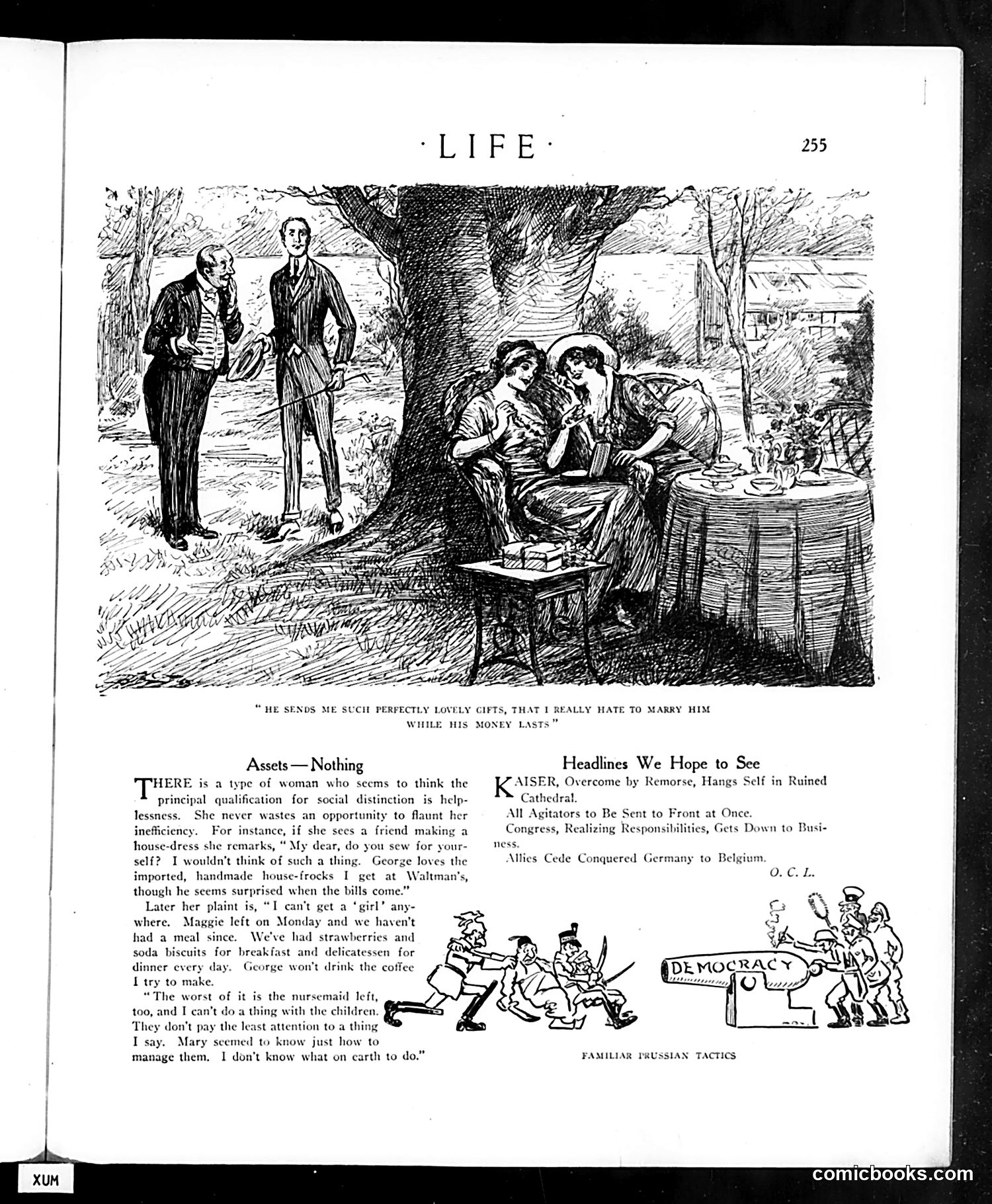
The main illustration depicts a social scene where a woman complains about a suitor's courtship gifts—she resents being showered with expensive presents while remaining unmarried. The accompanying article "Assets—Nothing" criticizes a particular type of woman who uses displays of affluence and domestic competence (sewn goods, imported housewares) to attract wealthy husbands, yet proves helpless managing actual household duties once married. The two smaller political cartoons address World War I era themes: one depicts "Familiar Prussian Tactics" showing German militarism, while another references democracy under pressure, likely commenting on wartime governance challenges. The page satirizes both domestic gender dynamics and contemporary war politics, typical of Life magazine's early 20th-century social commentary.
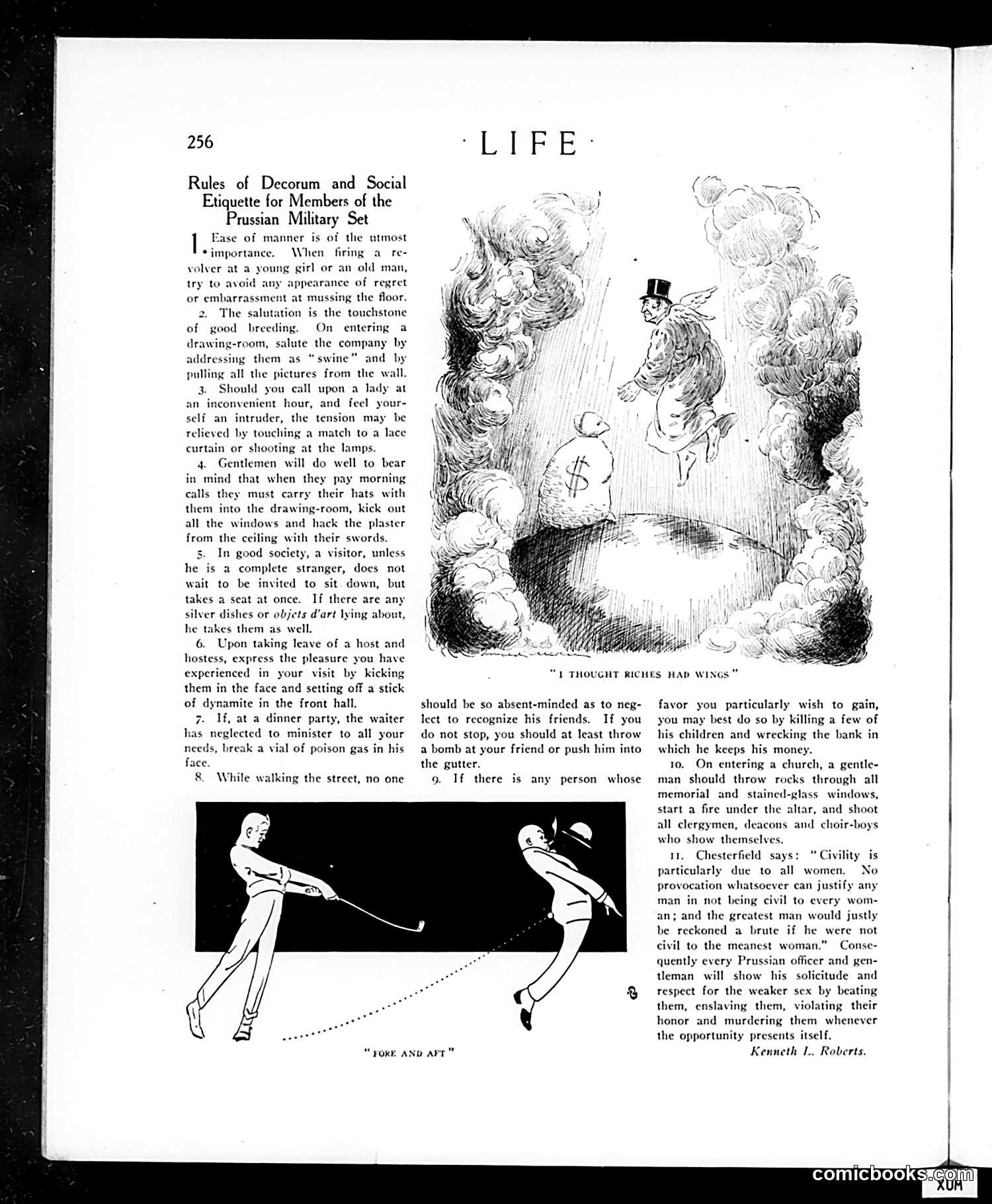
This page satirizes Prussian military brutality and misconduct, likely responding to German atrocities during World War I. The "Rules of Decorum" mockingly present violent, destructive behavior—murder, poisoning, bombing, theft, desecration—as proper etiquette for Prussian officers. The cartoons illustrate this absurdist humor: one shows figures engaged in swordplay or fencing, while another depicts a wealthy man with a dollar sign amid clouds (titled "I Thought Riches Had Wings"), likely mocking wealth destruction mentioned in the text. The final numbered rule about civility toward women is particularly bitter, quoting Chesterfield before subverting it: the "proper" Prussian response to civility is beating and violating women. Authored by Kenneth L. Roberts, this reflects American anti-German sentiment and shock at documented war crimes, using extreme satire to condemn what the author presents as Prussian military culture's fundamental depravity and disregard for civilian life.
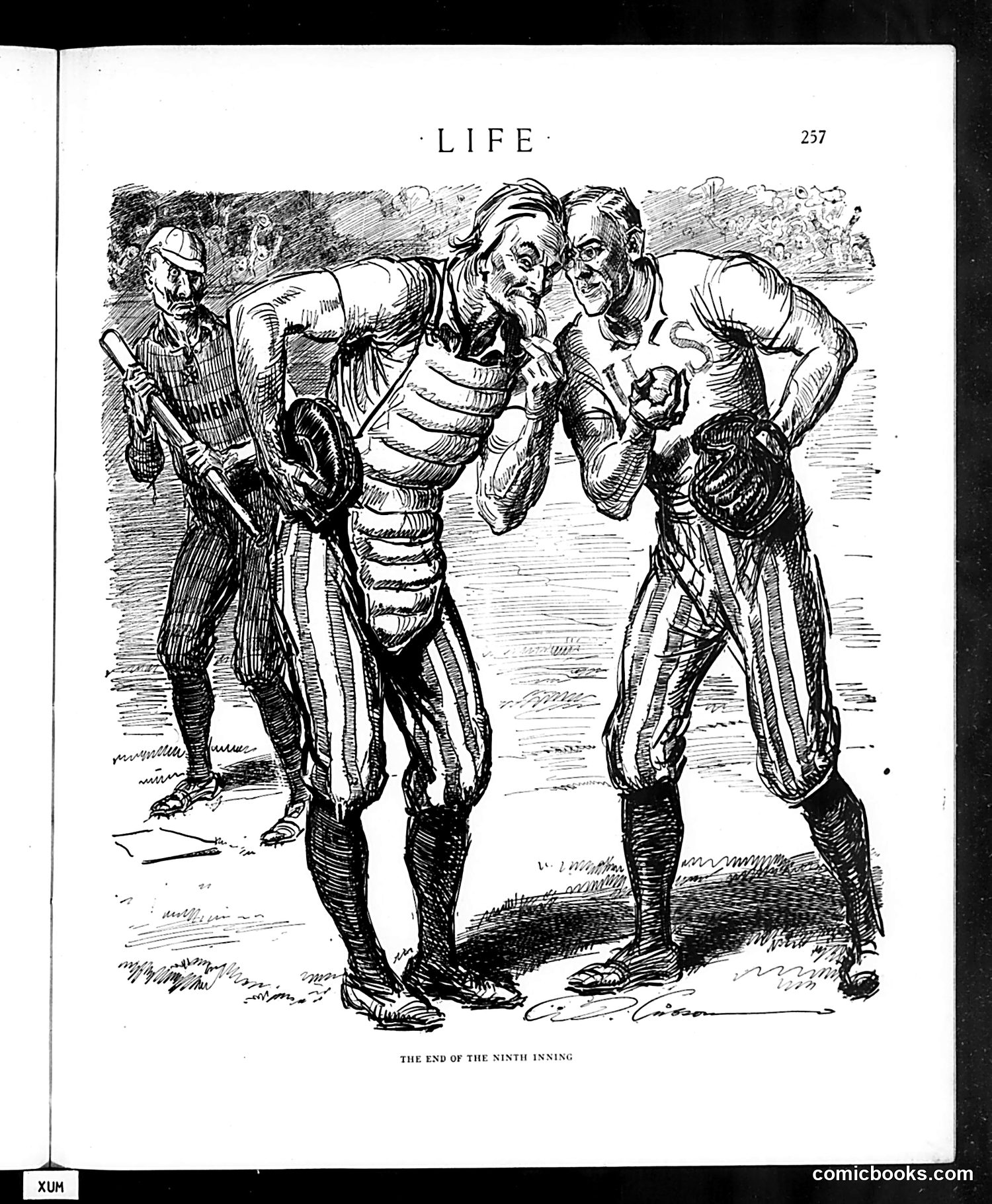
This is a baseball-themed political cartoon showing four men in period military uniforms engaged in what appears to be a confrontation or heated discussion on a baseball field. The title "The End of the Ninth Inning" uses baseball terminology metaphorically to suggest the conclusion of some conflict or competition. Without additional context about Life magazine's publication date or the specific political figures depicted, I cannot definitively identify who these caricatured military figures represent. The exaggerated facial features and body language suggest satire of political or military leadership during a particular historical moment, likely related to an international conflict or diplomatic crisis. The cartoon's meaning requires knowledge of the specific historical period and figures involved.
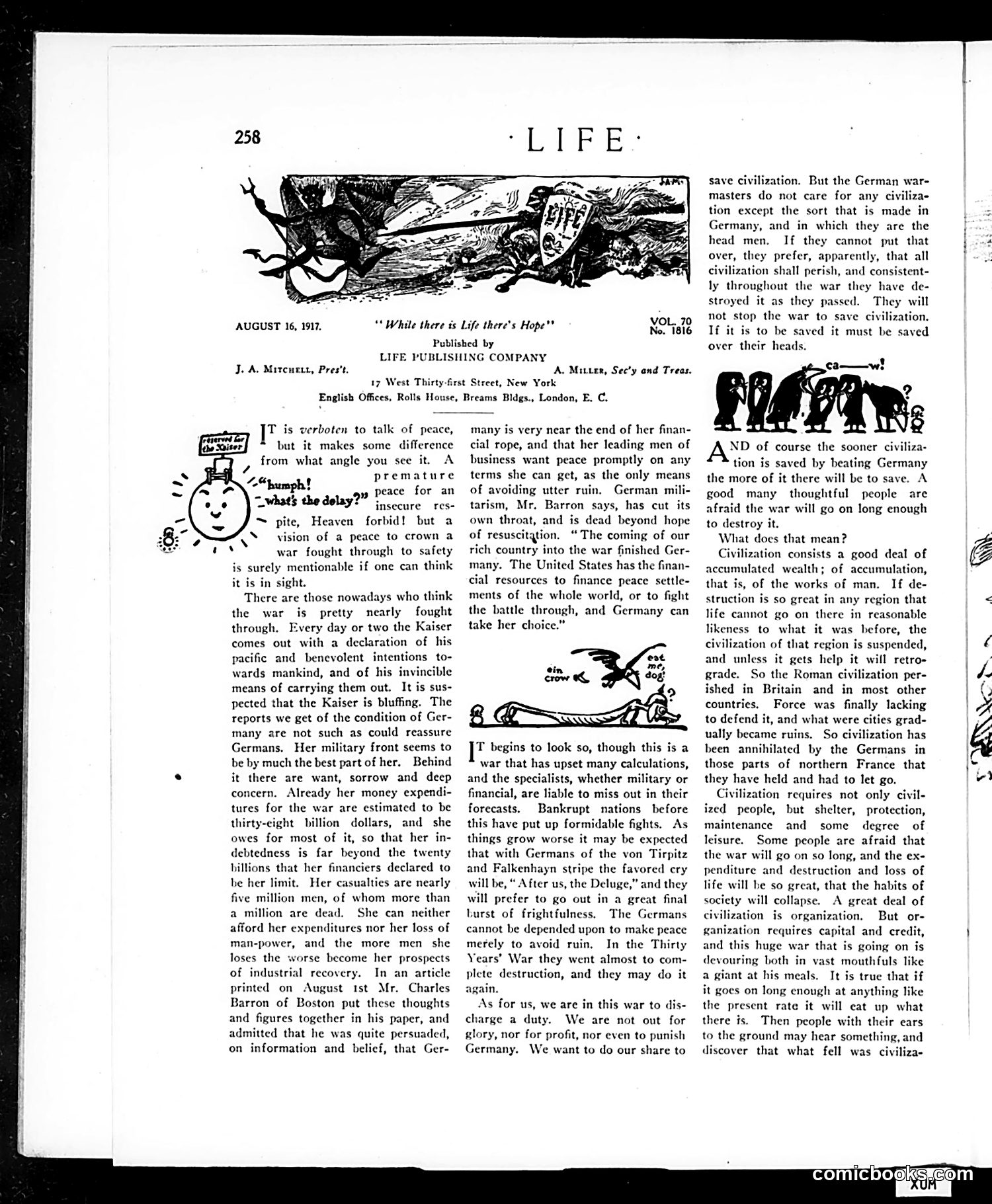
This editorial page addresses American war aims following the U.S. entry into World War I (April 1917). The cartoons and text argue against premature peace negotiations with Germany. **The cartoons** depict the Kaiser appearing to seek peace while Germany's domestic situation deteriorates—a visual representation of German bluffing. The "crow" and "dog" sketches appear to illustrate Germany's desperation. **The main argument**: Germany's military leadership (referenced figures like von Tirpitz and Falkenhayn) would prefer total destruction to accepting defeat, citing historical precedent (the Thirty Years' War). The text asserts Germany has exhausted its finances ($38 billion spent, over 1 million dead) and cannot sustain prolonged conflict. **The satire**: Germans claim peaceful intentions ("verboten to talk of peace") while actually pursuing destruction. The phrase "After us, the Deluge" captures their apparent nihilistic philosophy. **Conclusion**: America's financial superiority ensures German defeat if the war continues. Peace must be imposed through military victory, "over their heads," not negotiation—otherwise German militarism will destroy civilization itself.
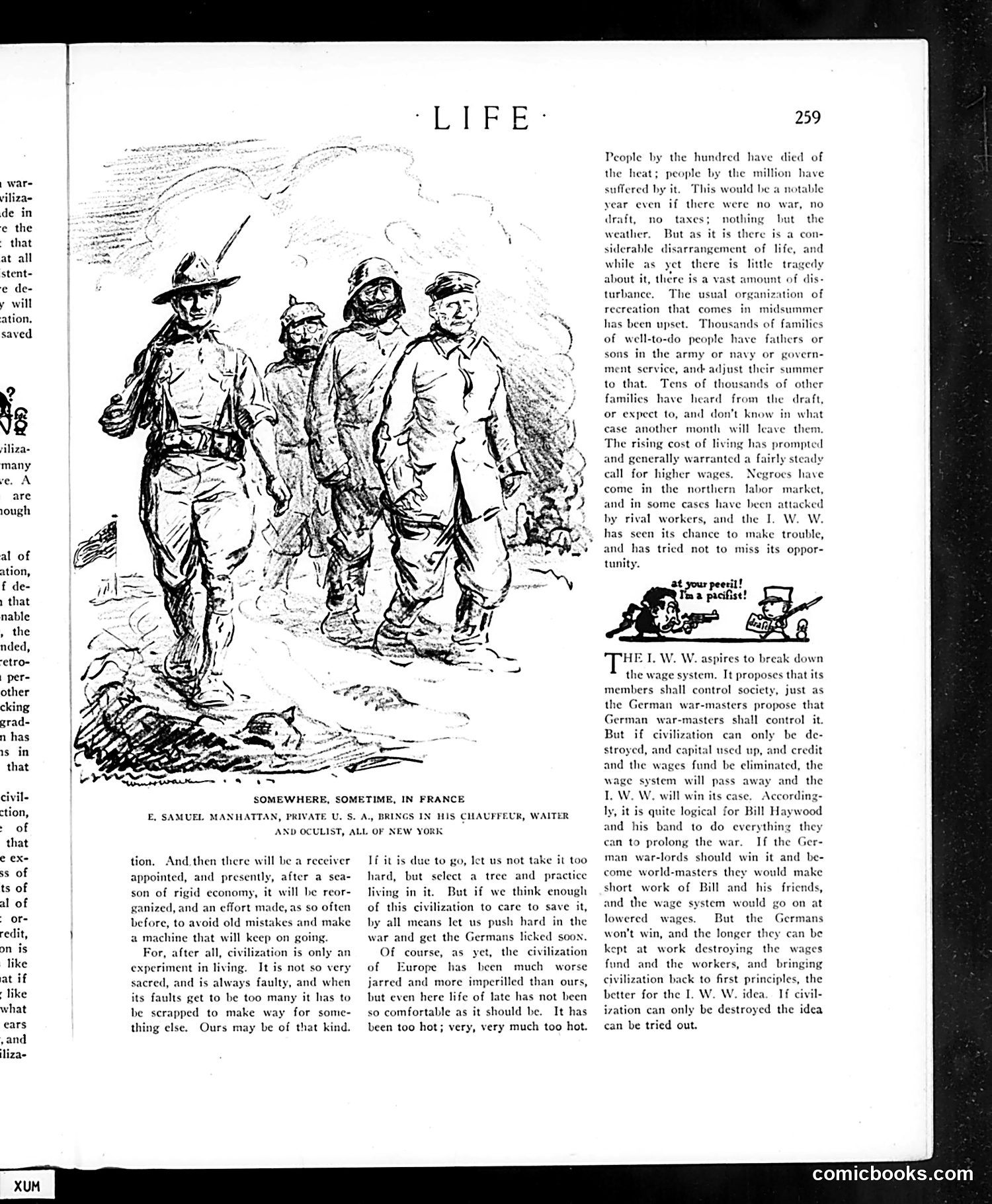
This page combines a WWI-era illustration with commentary on American social upheaval during the war effort. **The Illustration:** Shows four American soldiers (one labeled as "Private U.S.A." named Samuel Manhattan, a New York chauffeur and oculist) trudging through France. The caption's casual tone ("Somewhere, Sometime, in France") reflects Life's satirical voice about the war experience. **The Text's Main Arguments:** The article discusses how American civilization faces strain from multiple pressures: draft notices disrupting families, wartime inflation driving wage demands, and racial tensions as Black workers migrate north seeking jobs. **The Satire's Target:** The I.W.W. (Industrial Workers of the World—a radical labor union). The author argues the I.W.W., led by Bill Haywood, logically benefits from prolonging the war because chaos weakens the capitalist wage system they oppose. The satire suggests this makes their pacifism cynically self-interested rather than principled. **For Modern Readers:** This reflects 1910s anxieties about labor radicalism, racism, and whether social disruption during wartime served revolutionary agendas—themes still debated but with very different contexts today.
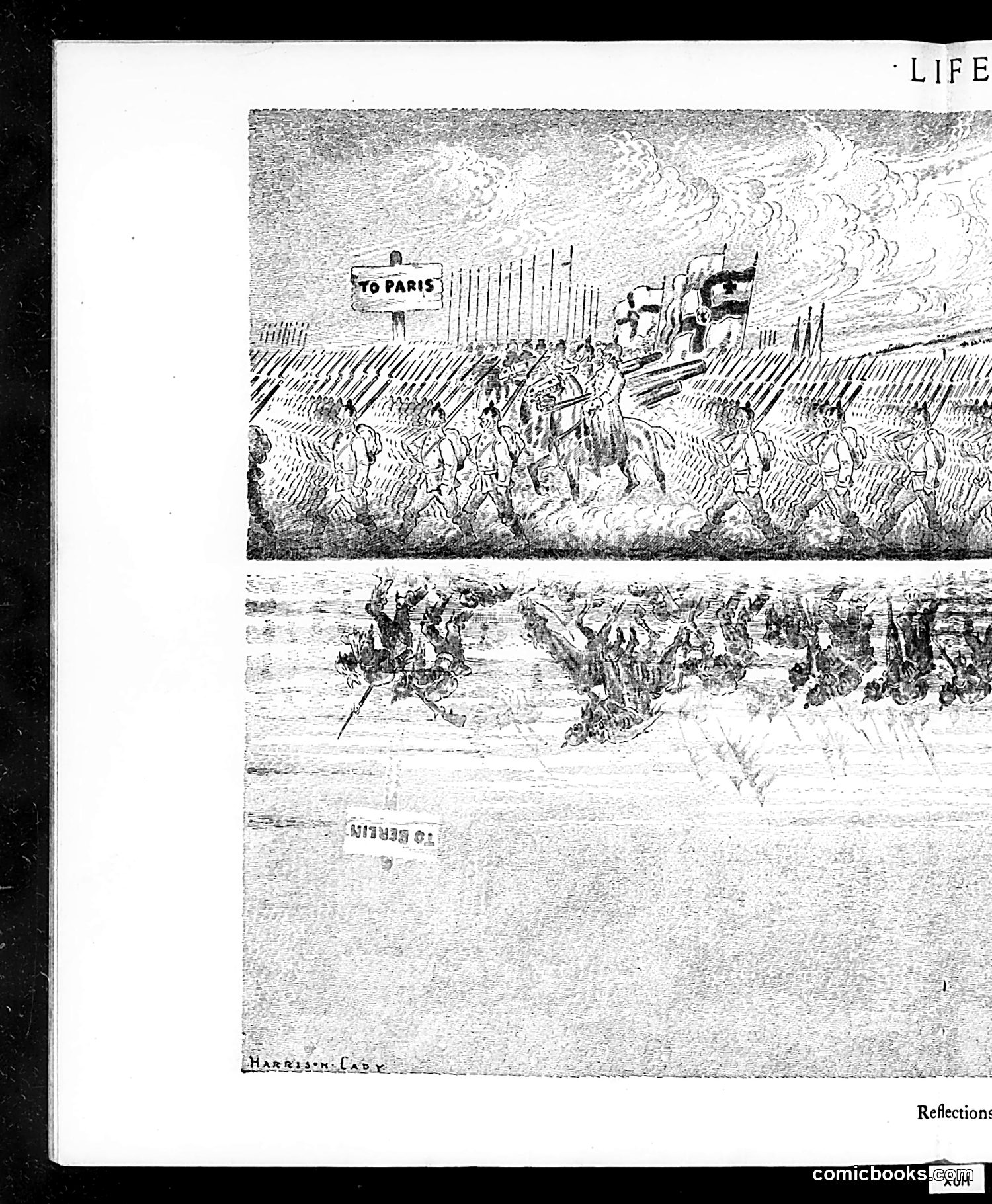
This cartoon depicts soldiers marching toward Paris, indicated by the "TO PARIS" signpost. The top panel shows marching troops in formation moving toward the French capital, while the bottom panel appears to show the aftermath or consequence of this military advance, with figures scattered across what looks like a battlefield or devastated landscape. The satire likely comments on military invasion or conquest of France, though without clear dating or attribution visible on this page, the specific historical moment is unclear—it could reference various conflicts involving France. The contrast between organized military movement and the chaotic scene below suggests commentary on the human cost of warfare or the destruction resulting from military campaigns. The cartoonist's name appears to be Harrison Cady.
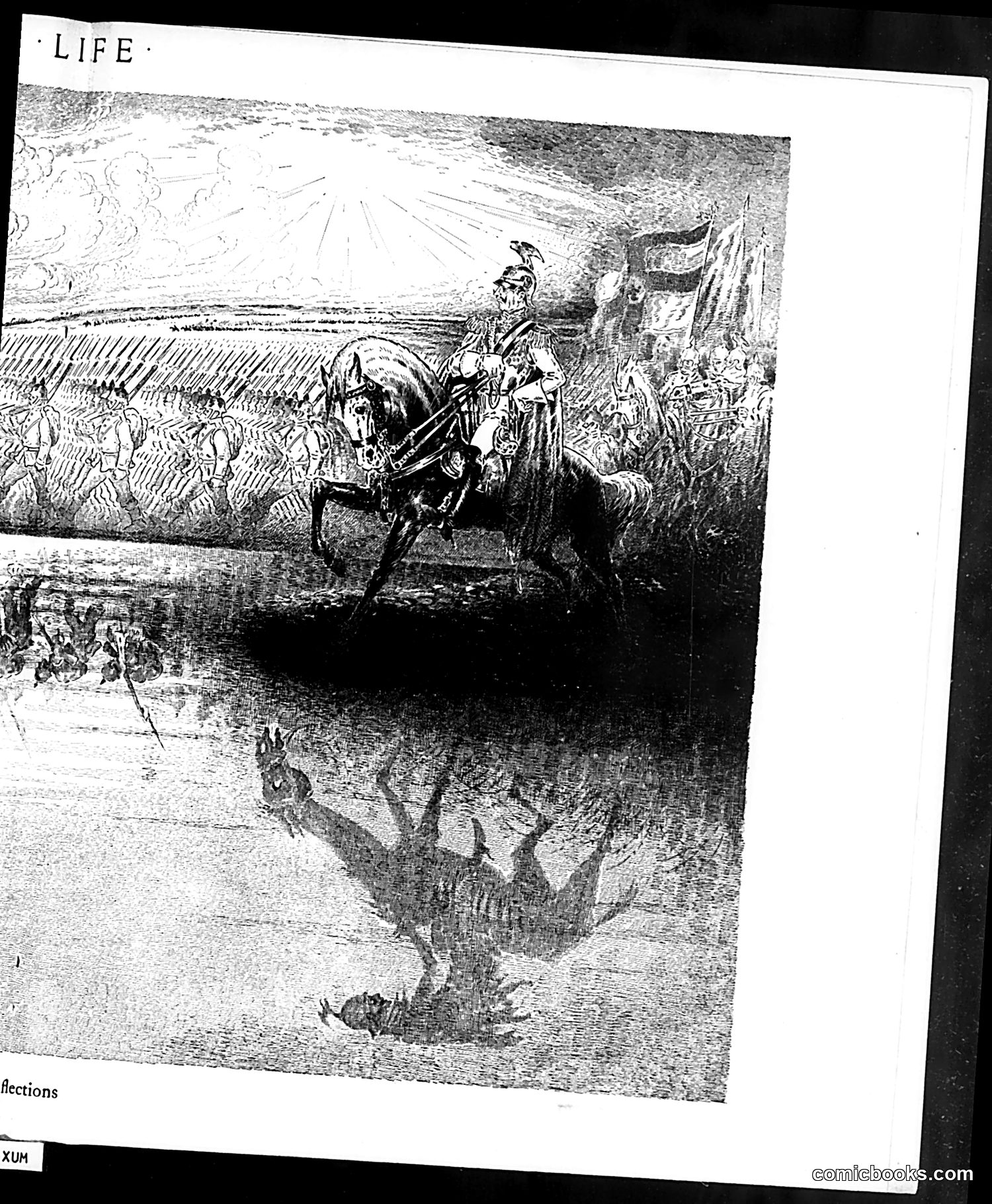
This engraving from *Life* magazine depicts a military commander on horseback surveying a vast army arranged in formation across a landscape. The scene employs classical artistic composition with radiating sunlight and dramatic perspective to emphasize the grandeur and scale of military power. Without clearer text or identifying details visible in the image, I cannot definitively name the specific historical figure or military campaign depicted. The style suggests late 19th-century American satirical commentary on military expansion or imperial ambitions. The artist's technique—using dramatic lighting and formal composition—appears designed to either celebrate or ironically critique the display of military might. The page heading "flections" (possibly "reflections") suggests this offers commentary on contemporary military or political matters.
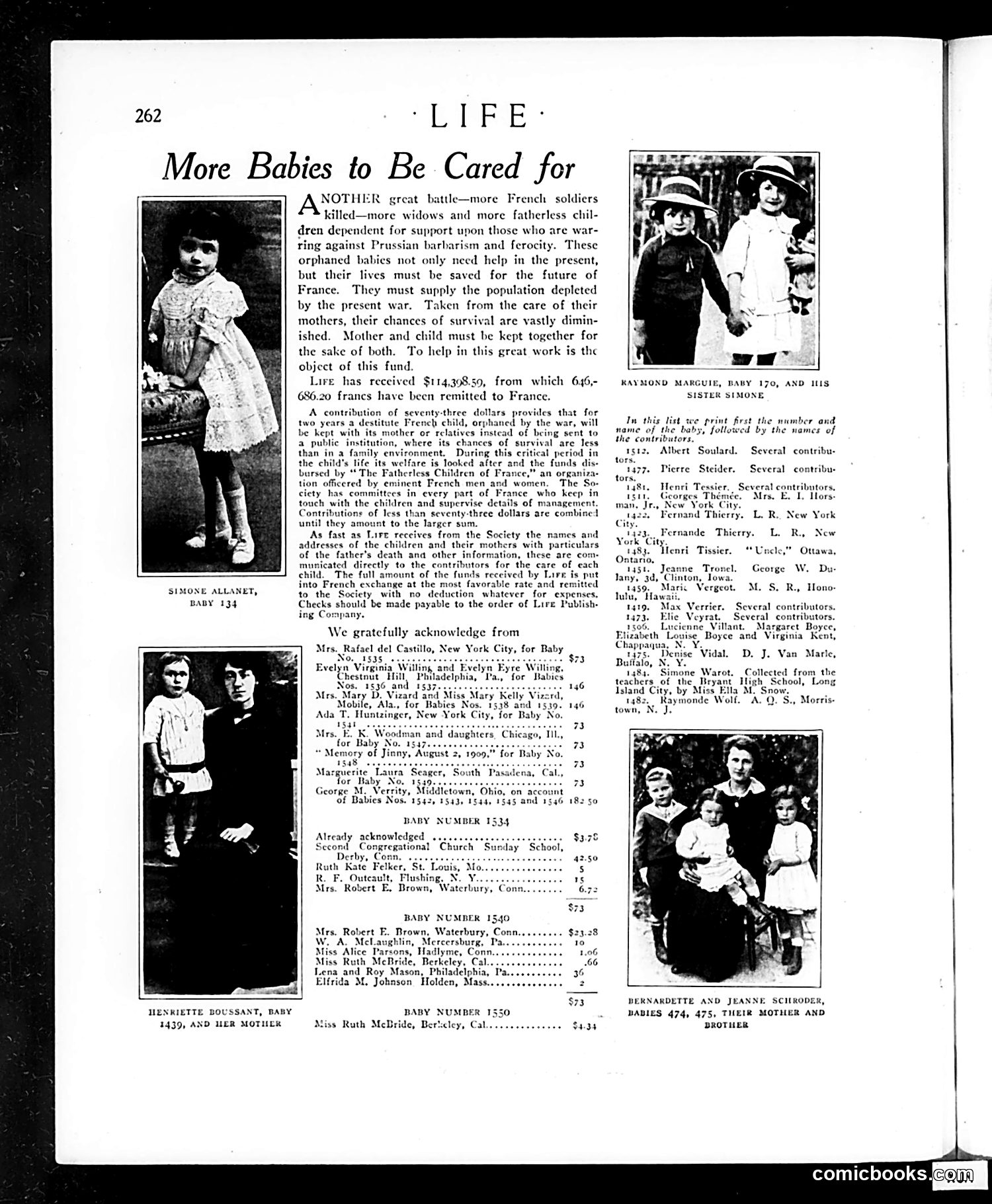
This is not a cartoon but a charitable fundraising appeal, published during World War I. The page documents the "Fatherless Children of France" fund administered by *Life* magazine, which provided financial support to French children orphaned by the war. The accompanying photographs show actual beneficiary children (identified by number and name) whose care was funded through reader contributions. The text explains that $73 supports one orphaned child for two years, keeping them with mothers or relatives rather than institutions. The appeal references "Prussian barbarism" — standard WWI propaganda framing Germany as the aggressor — to motivate American donors to support France's war effort indirectly through child welfare. Lists of contributors and named beneficiaries (with amounts donated) served as both acknowledgment and social proof to encourage additional giving. This represents early-20th-century magazine fundraising merged with wartime patriotic sentiment.
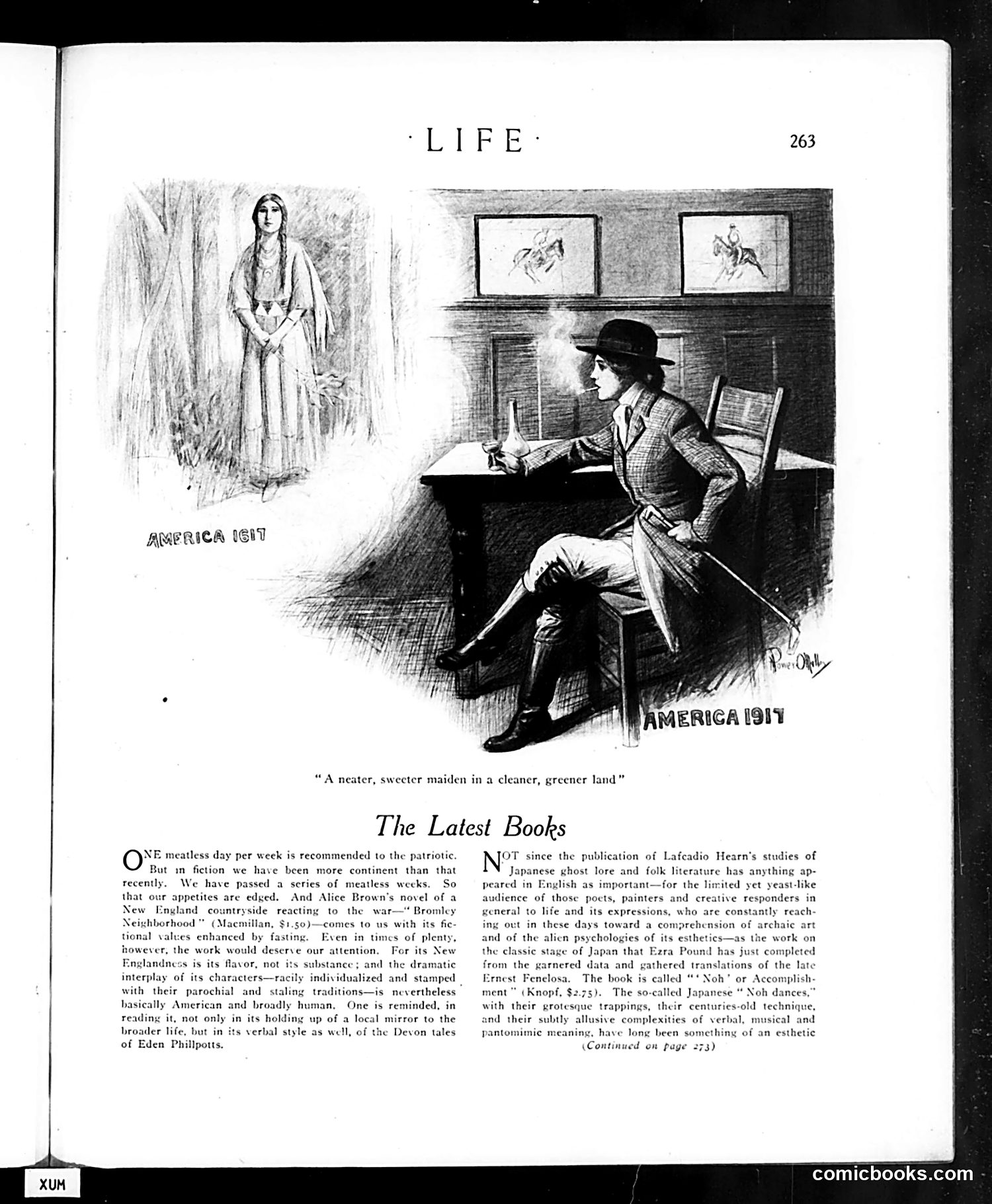
This page presents two satirical cartoons dated "America 1917," likely commenting on American life during World War I. **Left cartoon:** Shows a woman in traditional dress labeled "Africa 1917," appearing to represent exotic or "uncivilized" lands. **Right cartoon:** Depicts a man at a desk in modern dress, labeled "America 1917," working or writing. **The satire:** The contrasting caption—"A neater, sweeter maiden in a cleaner, greener land"—likely inverts expectations: it sarcastically suggests that America (represented by the industrialized, desk-bound figure) is somehow "cleaner" and more civilized than Africa, while the juxtaposition questions American superiority claims. During WWI, this may critique American attitudes toward other cultures or imperialism. The page's "Latest Books" section discusses wartime patriotism ("meatless days"), suggesting the cartoons fit within broader cultural commentary on American identity during the war period.
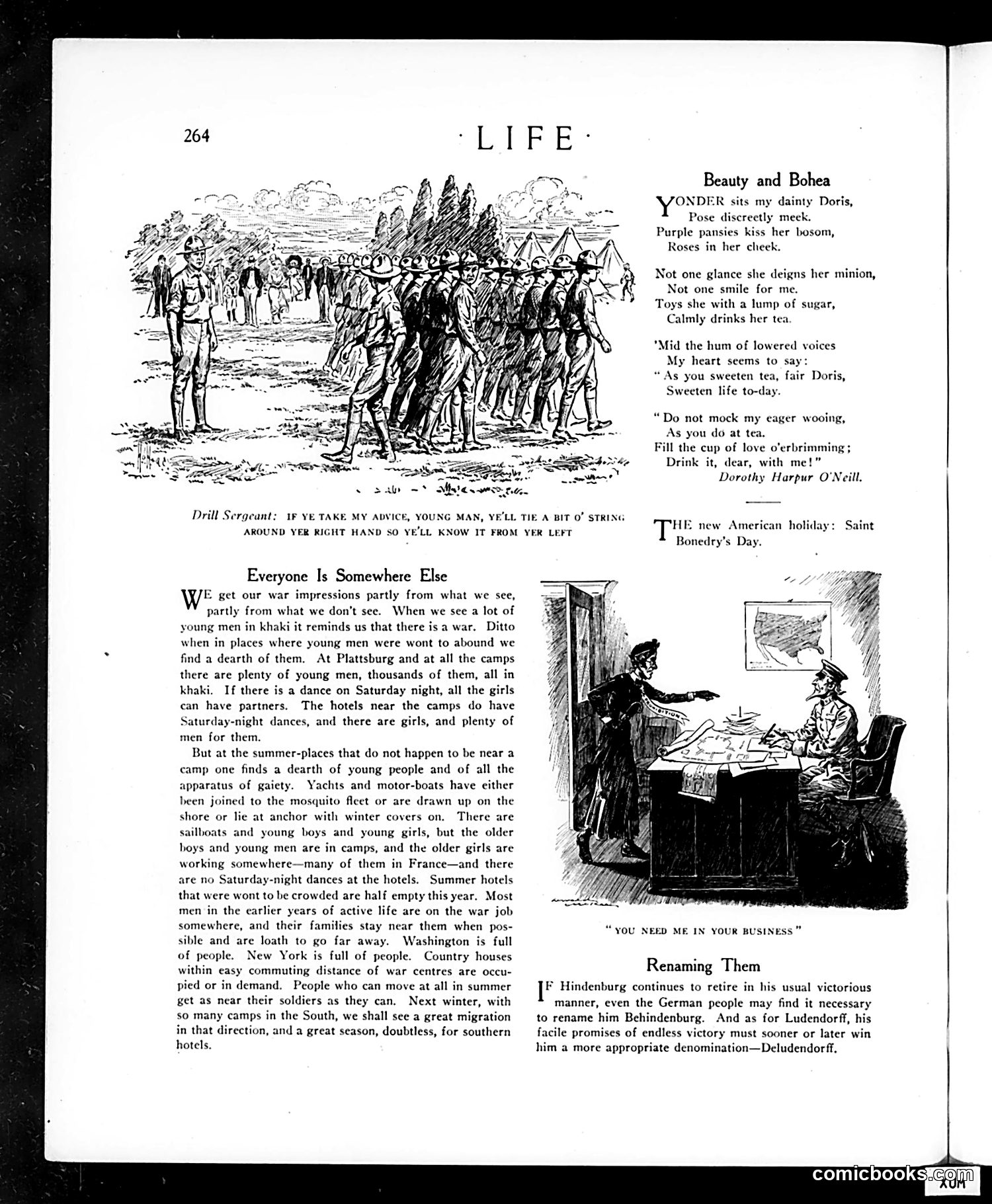
This page reflects American life during World War I, likely 1917-1918. **Main Article ("Everyone Is Somewhere Else"):** Describes how the war's presence is felt differently across America. Military training camps (like Plattsburg) are crowded with young men in khaki uniforms, creating social opportunities. But traditional summer resort towns far from camps are depressed—emptied of eligible young men and working-age women (many serving "in France"). The piece observes that families cluster near war centers like Washington and New York to stay close to servicemen. **Cartoons/Jokes:** - The drill sergeant cartoon (top) is a standard military humor bit about training recruits. - "Beauty and Bohea" is a sentimental romantic poem about courting a woman over tea—contrasting civilian romance with the wartime disruption described above. - **"Saint Bonedry's Day"** and the "Renaming Them" section mock German military leaders. The wordplay ("Behindenburg," "Deludendorff") jokes that General Hindenburg's strategic retreats and Ludendorff's failed promises should earn them appropriately ironic names. The page captures how WWI reshaped American social geography and civilian morale.
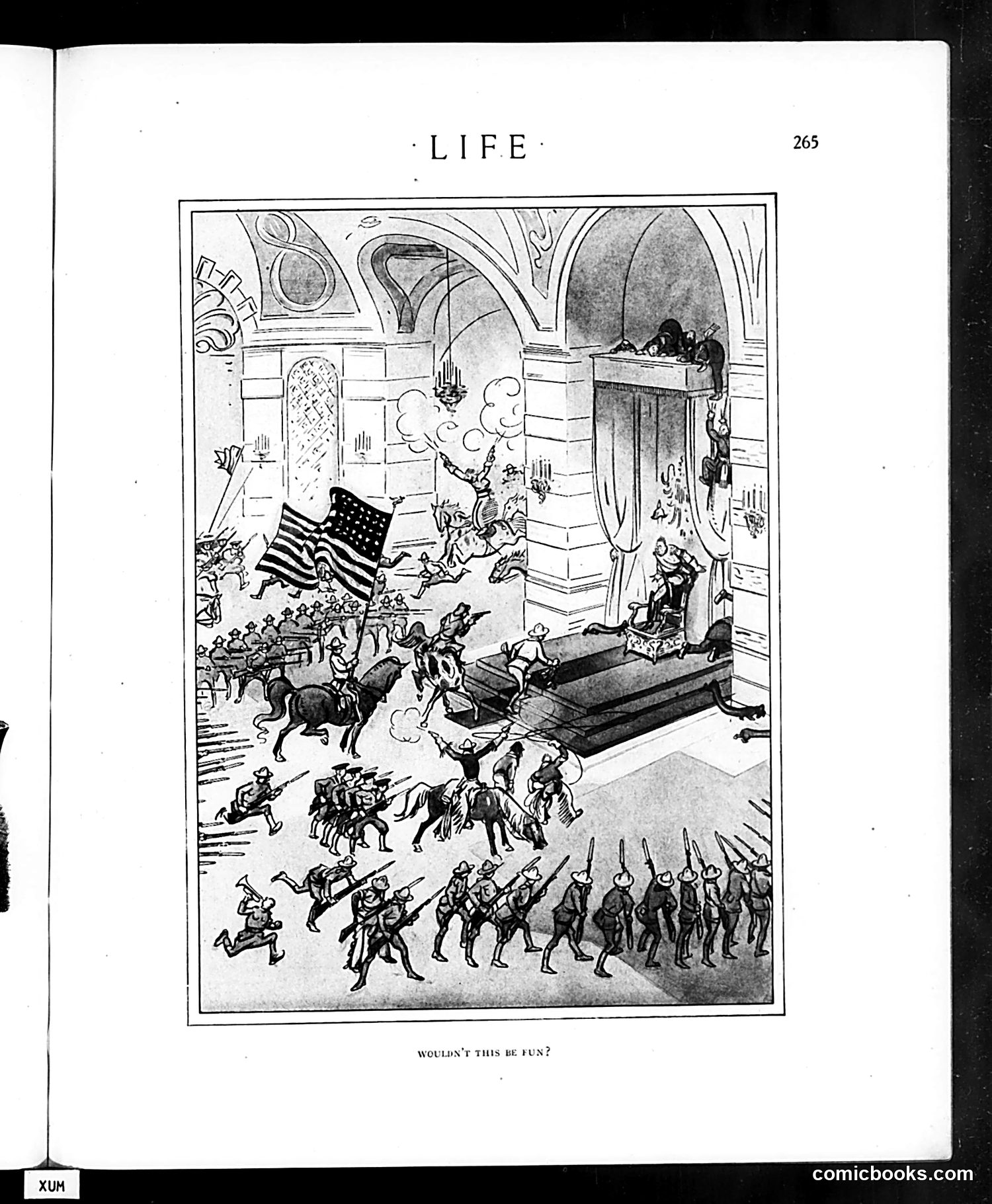
This satirical cartoon depicts a chaotic invasion or military conquest of what appears to be a grand government building (possibly a capitol or palace). An American flag waves prominently among the chaos. Soldiers with bayonets march in formation at the bottom, while mounted cavalry and armed figures swarm throughout the ornate interior. Officials or dignitaries appear to observe from elevated positions. The caption's rhetorical question suggests the cartoonist is mocking or critiquing the scenario depicted—likely satirizing either militarism, authoritarian government takeover, or political instability. Without the publication date, the specific historical context remains unclear, but the image appears to critique violent political upheaval or military intervention in civilian governance as something presented as "fun" but clearly portrayed as destructive chaos.
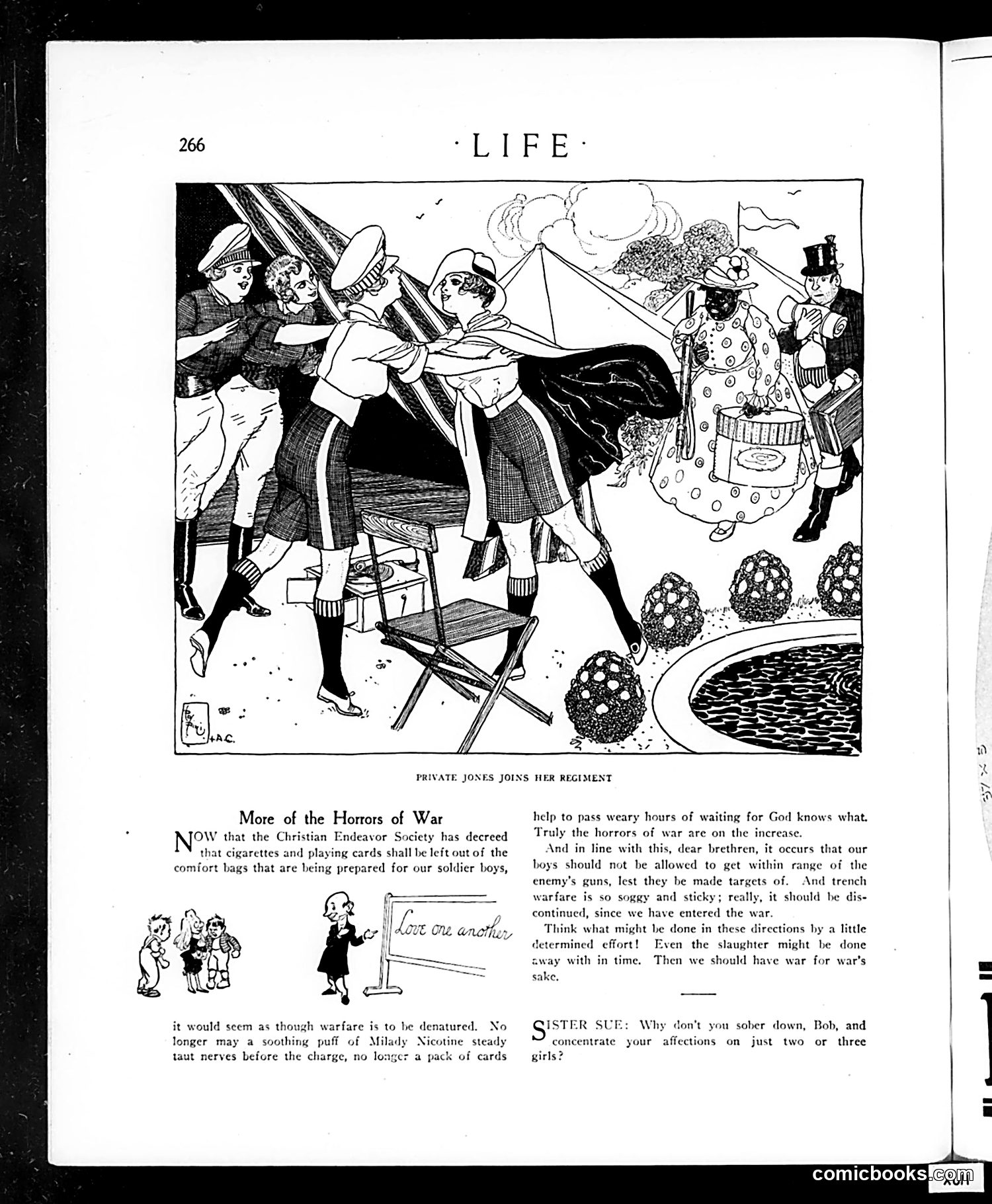
This page satirizes the Christian Endeavor Society's campaign to exclude cigarettes and playing cards from "comfort bags" sent to American soldiers during World War I. The society believed these items were morally corrupting. The satire is heavy-handed: the text ironically endorses the society's logic, then extends it absurdly—suggesting soldiers shouldn't be allowed near enemy guns (lest they be targets) and that trench warfare should be discontinued because it's "soggy and sticky." The cartoon depicts "Private Jones" joining female soldiers at what appears to be a military encampment, sarcastically illustrating how removing "vices" misses the actual horrors of war. The sidebar joke from "Sister Sue" mocks a character named Bob for spreading romantic attention across multiple girls, suggesting he should focus on fewer—a lighthearted jab at wartime romantic entanglements. The core message: removing minor comforts from soldiers while ignoring war's genuine dangers is foolish moralizing.
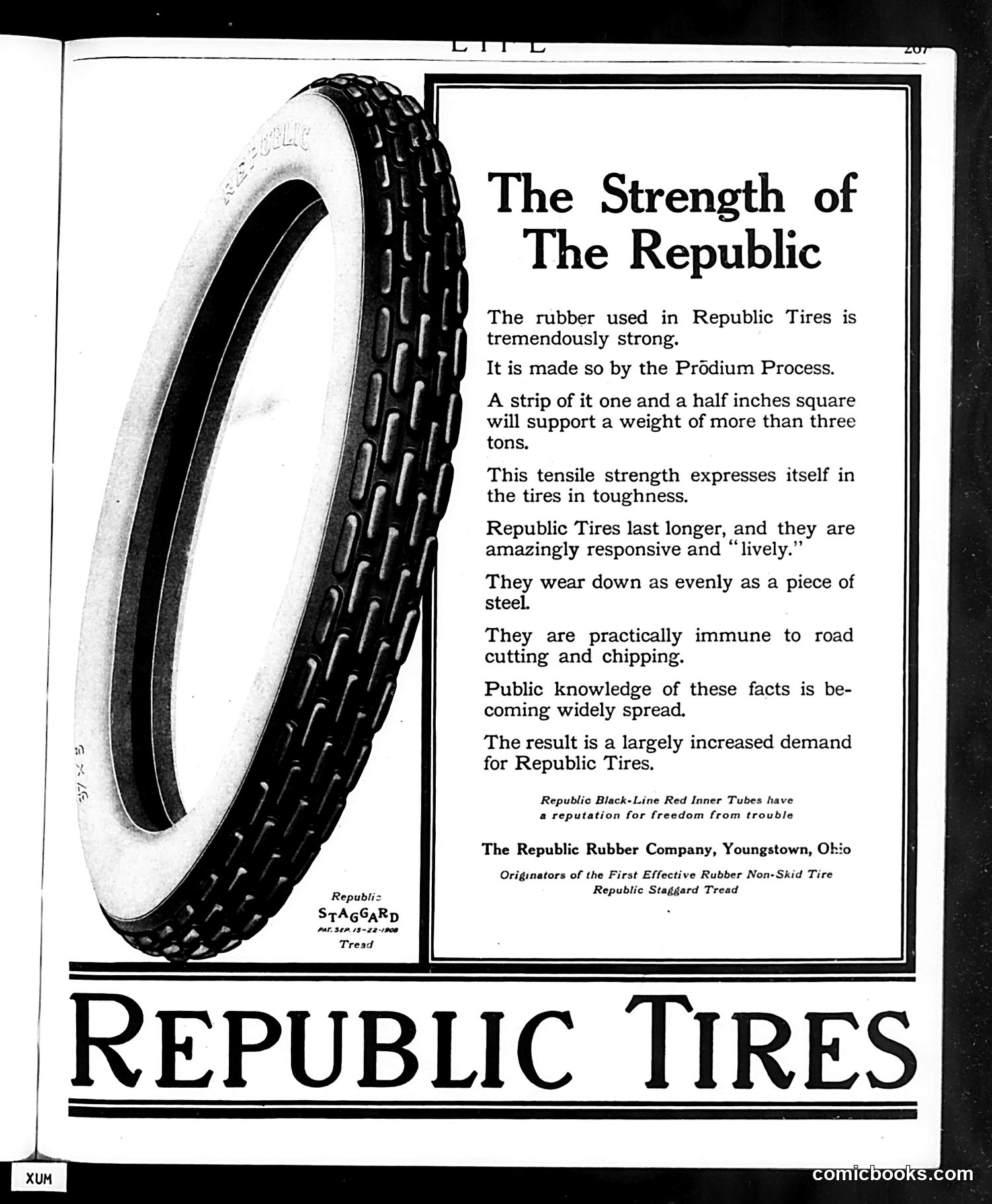
This is a **straightforward advertisement**, not a political cartoon or satire. It appears in *Life* magazine's advertising section (page 207). The page promotes Republic Tires through a product advertisement highlighting the "Staggered Tread" tire model. The visual shows a white-wall tire photographed from an angle to display both the light sidewall and dark tread pattern. The text emphasizes technical superiority: the rubber's strength (made via "Prodium Process"), durability, even wear, and resistance to road damage. The phrase "The Strength of The Republic" is a patriotic pun playing on the company name, common in early-20th-century advertising. The company, based in Youngstown, Ohio, claims to have invented "the First Effective Rubber Non-Skid Tire." This is a product-focused marketing pitch targeting automobile owners concerned with tire reliability and longevity—practical consumer concerns of the era. There is no satire or political commentary present.
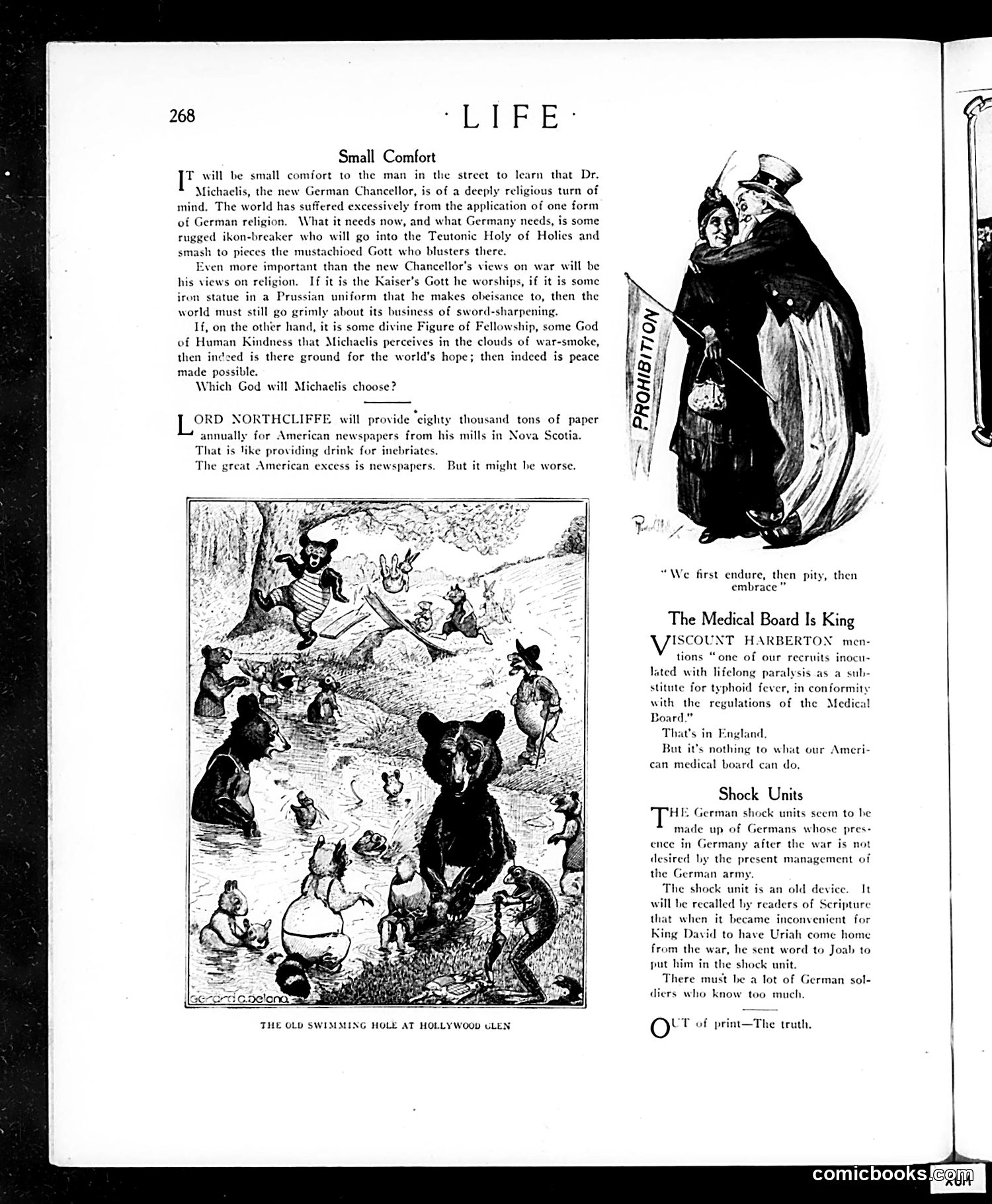
This page from *Life* offers satirical commentary on post-war Germany, specifically targeting the new Chancellor Michaelis (appointed 1917). The main text "Small Comfort" argues that Michaelis's personal religiosity is irrelevant—what matters is whether he worships the "mustachioed Gott" (clearly referencing the Kaiser and German militarism) or a more peaceful deity. The satire questions whether real change is possible under German leadership. The illustrated cartoon "The Old Swimming Hole at Hollywood Glen" uses animals (bears, monkeys) in a pastoral scene—likely satirizing either American excess or German disorder, though the specific reference is unclear without more context. Additional items mock: Lord Northcliffe's paper provision to American newspapers as enabling addiction; British medical board incompetence; and German "shock units" as disposable soldiers—comparing them to King David's biblical tactic of eliminating inconvenient soldiers. The overall tone is skeptical that substantive change will follow Germany's military defeat.
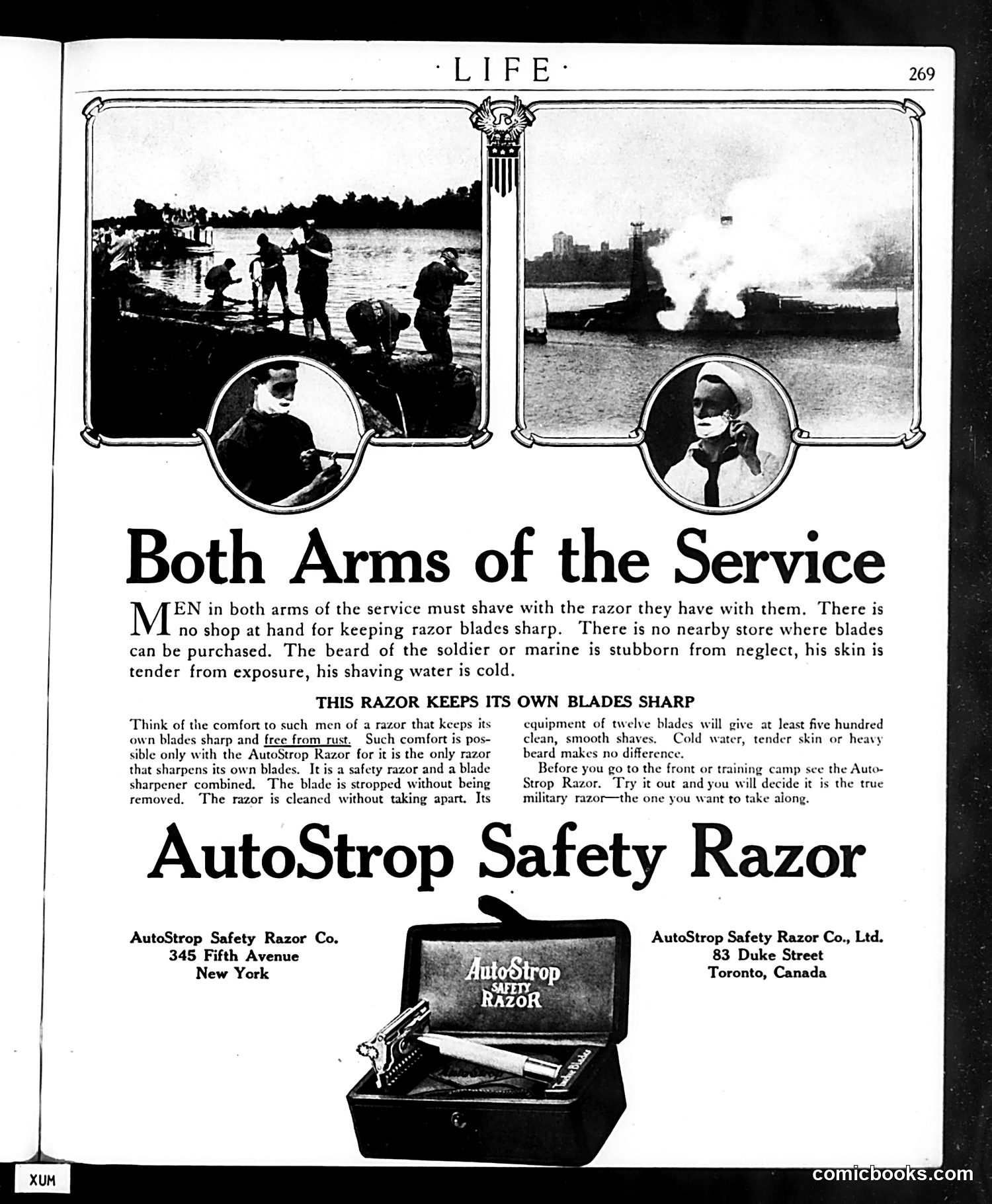
This is primarily **advertising, not satire or political commentary**. The page markets the AutoStrop Safety Razor to military servicemen during what appears to be World War I or the interwar period. The two photographs show soldiers and sailors in field conditions—one group at a riverside, another near naval vessels. These images establish the practical problem the ad addresses: military personnel lack access to blade sharpening supplies and must shave in harsh conditions (cold water, tender skin from exposure). The advertisement's pitch is straightforward: the AutoStrop razor's built-in stropping mechanism allows soldiers to maintain sharp blades without external shops or supplies. The circular inset portraits likely show satisfied servicemen, though specific identities are unclear. This represents period marketing that leveraged patriotic appeals and military lifestyle imagery to sell consumer goods to troops and those preparing for service.
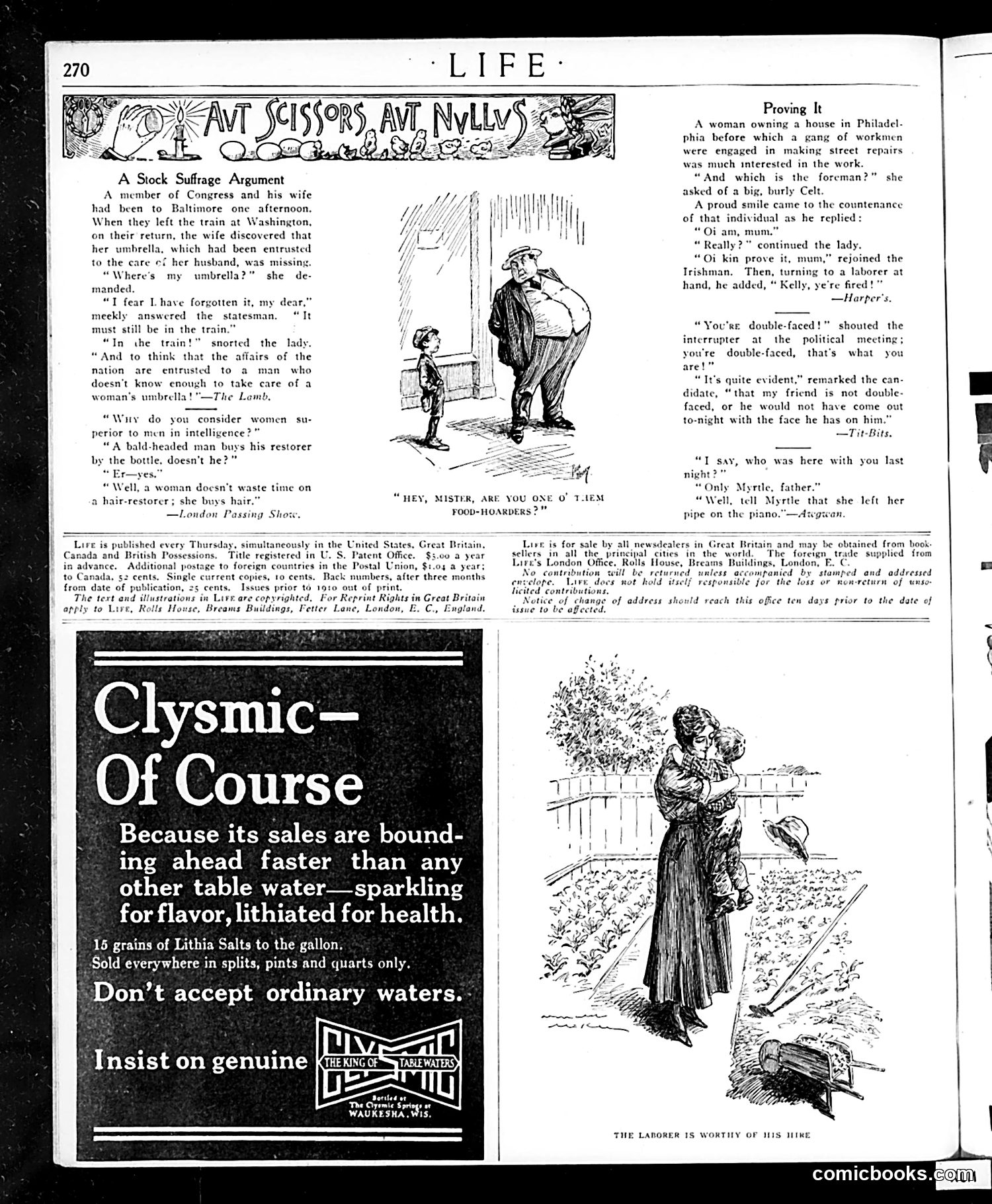
This page contains several brief satirical anecdotes typical of Life's humor style: **"A Stock Suffrage Argument"** mocks a congresswoman's complaint that her husband lost her umbrella, arguing men are incompetent. The punchline: women waste time on hair-restorers while men at least buy theirs efficiently. It's satire on feminist arguments about male capability—Life's position appears dismissive of women's suffrage claims. **"Hey, Mister, Are You One of Them Food-Hoarders?"** shows a small boy confronting an adult, likely referencing WWI-era food rationing concerns and black-market profiteering accusations. **"Proving It"** depicts an Irish foreman demonstrating his authority by firing a worker—ethnic stereotype humor common to the era. **"You're Double-Faced"** presents a heckler at a political meeting; the candidate deflects by insulting the interrupter's appearance. The remaining anecdotes are brief wordplay jokes. A large **Clysmic mineral water advertisement** dominates the lower left—typical period magazine advertising. The illustrations are standard period cartoons accompanying these jokes.
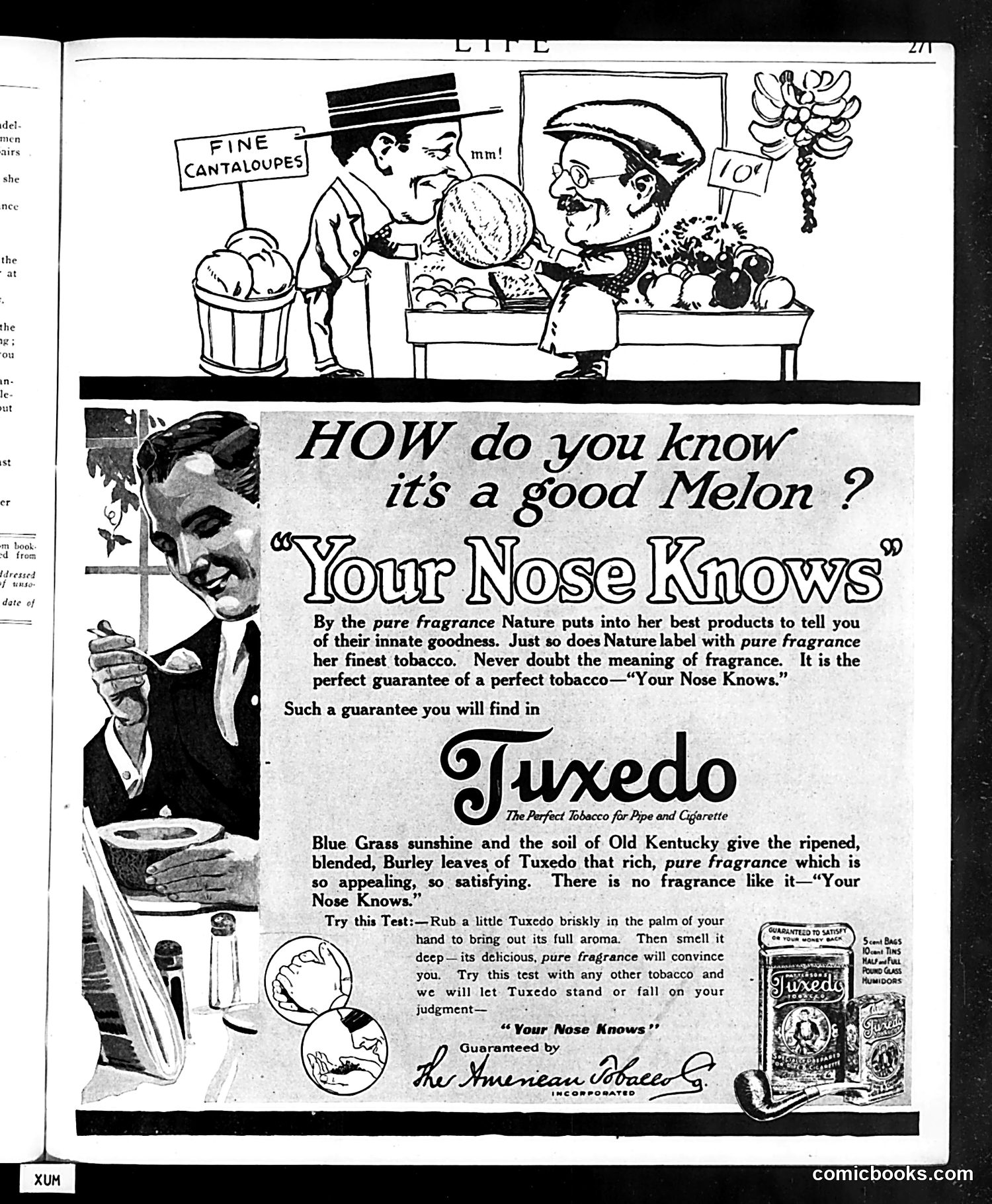
This page contains two distinct elements: **Top Cartoon:** A satirical street market scene showing a vendor selling cantaloupes and other produce to a customer. The humor appears to depict typical haggling or quality-assessment at a produce stand, though the specific joke is unclear from the image alone. **Main Content:** A full-page advertisement for Tuxedo tobacco (pipe and cigarette), not political satire. The ad features a caricatured man in formal dress promoting the product's "pure fragrance" as a quality guarantee—playing on the slogan "Your Nose Knows." The advertisement uses metaphorical language comparing tobacco quality to selecting ripe melons by smell, encouraging consumers to test Tuxedo's aroma. **Historical Note:** This represents early 20th-century advertising before tobacco health warnings. The casual promotion of smoking as a sensory pleasure reflects attitudes drastically different from modern understanding of tobacco's dangers. The page is primarily commercial content rather than political commentary.
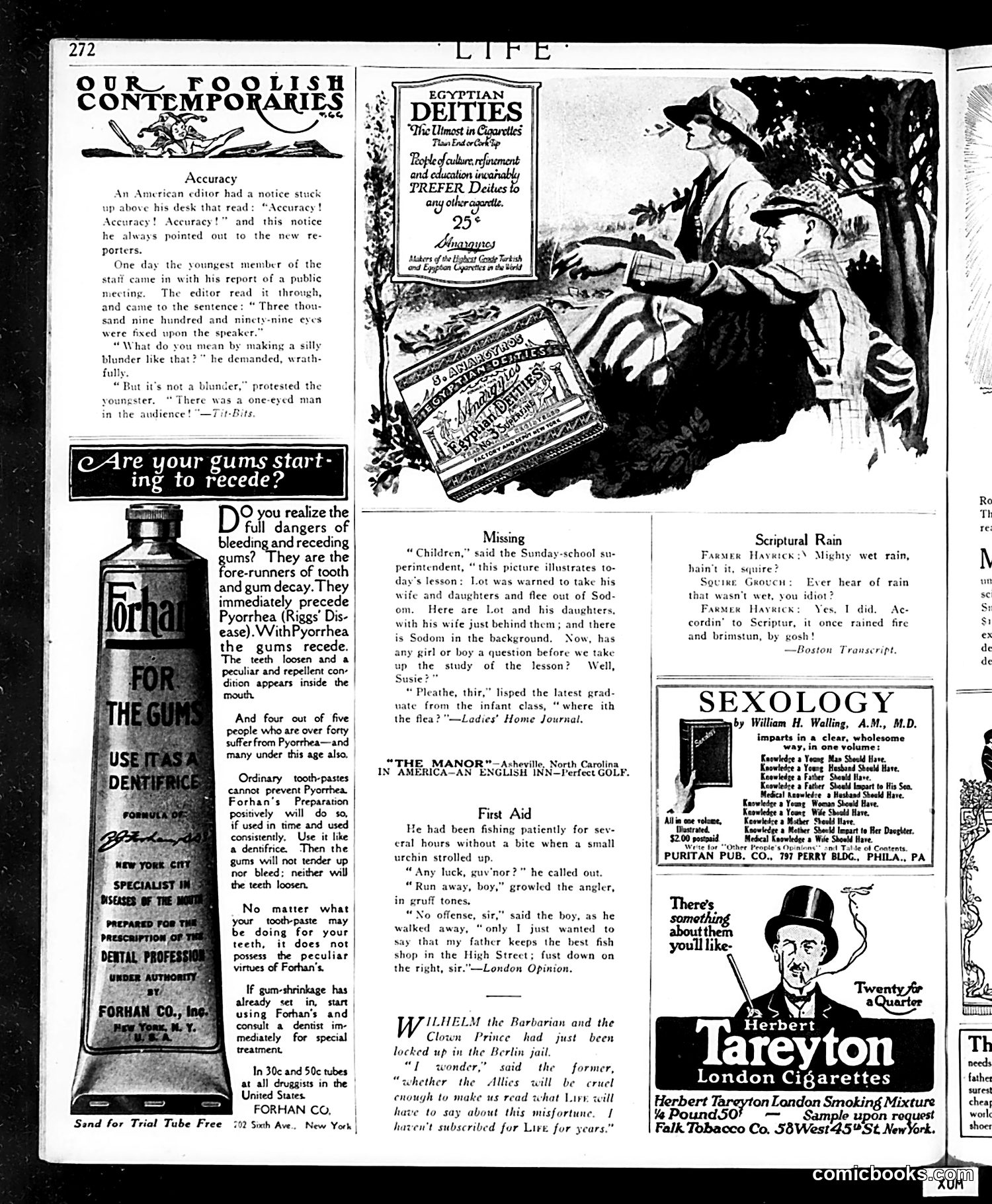
This page contains primarily **advertisements and humorous anecdotes** rather than political cartoons. The main content includes: **"Accuracy" anecdote**: A joke about a newspaper editor obsessed with accuracy who misses an obvious error—a reporter writes of "one-eyed man in the audience" when describing those present. The humor lies in the irony that obsessive focus on correctness can blind one to actual mistakes. **Other brief humor pieces**: Include jokes about fishing, biblical lessons, and wartime references (Wilhelm the Barbarian and the Clown Prince "locked up in Berlin jail," likely referencing German leaders during WWI era). **Advertisements dominate**: Forhan's toothpaste (for pyorrhea/gum disease), Egyptian cigarettes, a "Sexology" book, and Herbert Tareyton cigarettes. These ads reflect period health anxieties and consumer products typical of early 20th-century magazines. The page is primarily **commercial content**, not satirical commentary on political events.
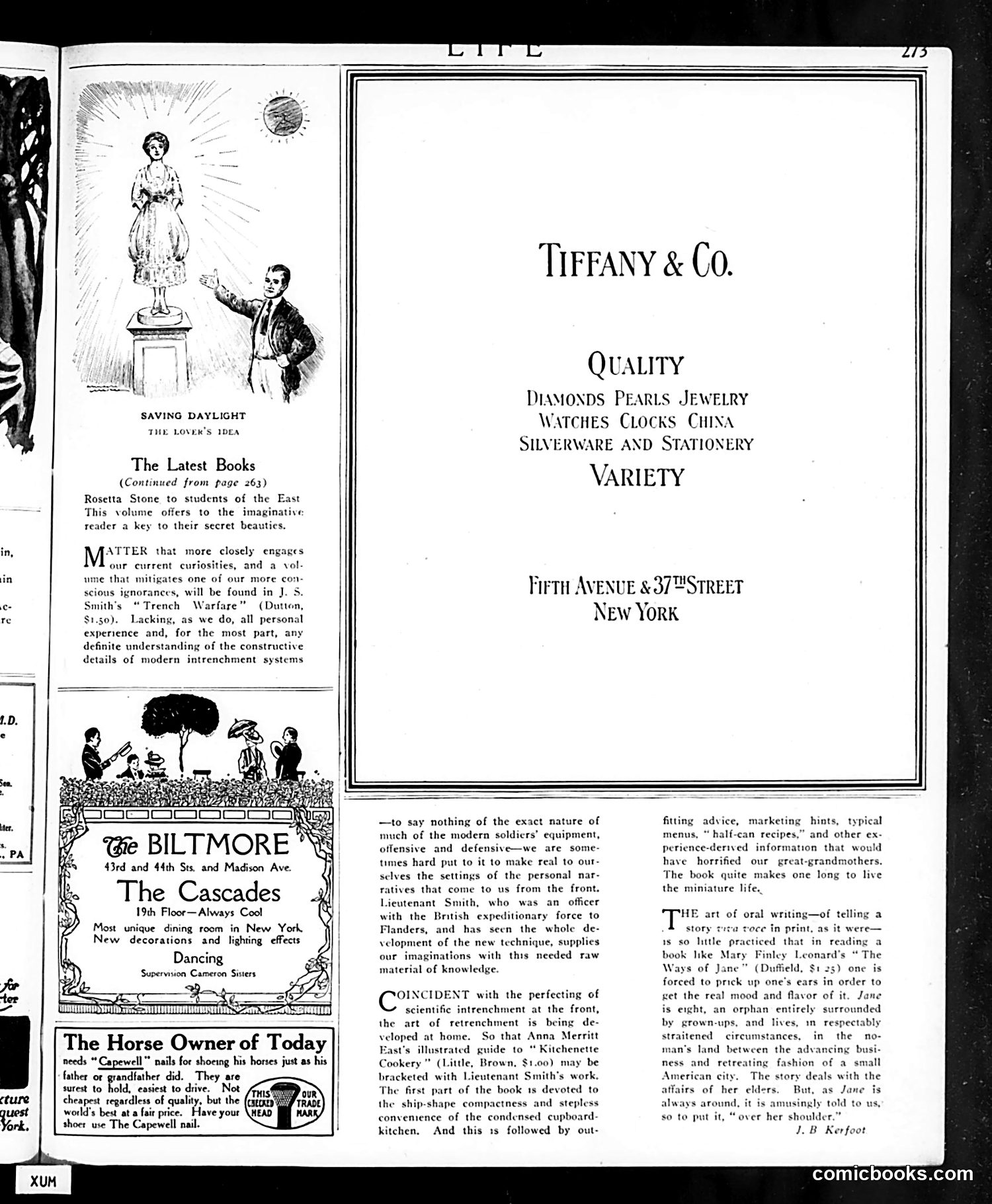
This cartoon satirizes **daylight saving time**, likely referring to proposals during World War I to conserve fuel. The sketch shows a couple: a woman glowing radiantly on a pedestal with sunburst rays, and a man gesturing toward her with approval. The joke plays on the phrase "saving daylight"—the man's romantic "idea" is that extending daylight hours gives him more time to court his beloved in natural light, rather than the policy's actual purpose of energy conservation for the war effort. The cartoon mocks how civilians might reinterpret serious wartime measures through a sentimental or self-interested lens. It's gentle satire of romance-minded optimism amid practical governmental concerns.
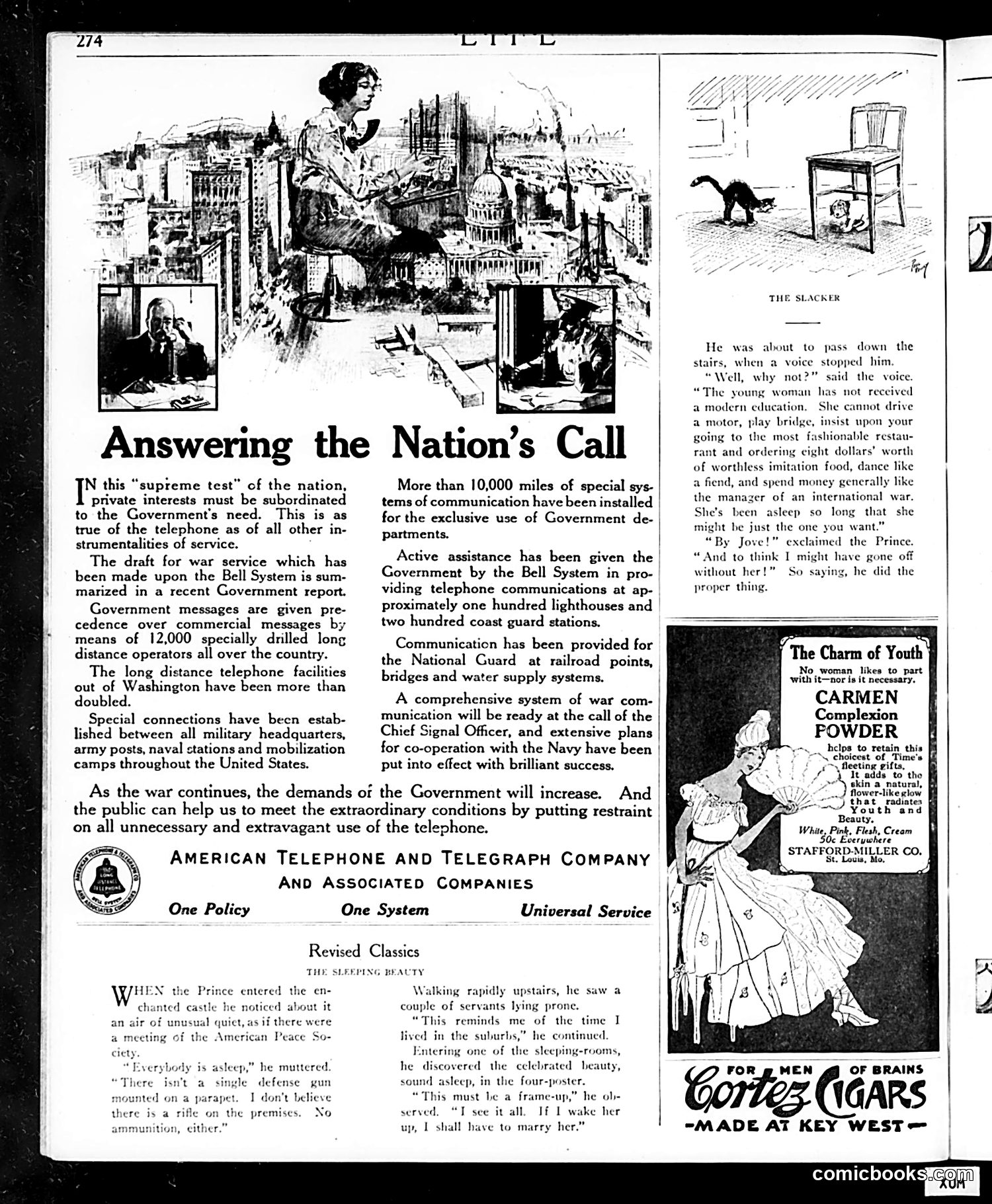
This page contains a **Bell System corporate advertisement** masquerading as patriotic messaging, alongside period fiction and ads. **Main Content:** The large advertisement claims the telephone company is sacrificing commercial interests to serve government needs during wartime (appears to be WWI era based on military references). It boasts of installing 10,000+ miles of exclusive government communication lines and dedicating 12,000 operators to military messages—framing corporate mobilization as patriotic duty. **"The Slacker" story** (right column): A satirical fairy tale retelling where a Prince discovers Sleeping Beauty has remained beautifully useless—unable to drive, play bridge, or spend money extravagantly like "modern" women. The joke targets both women's education and consumerism, while the title "slacker" refers to those avoiding war service. **The satire:** Both elements mock perceived social failures. The ad presents telephone monopoly as essential patriotism; the story mocks women who haven't adopted contemporary consumer habits and leisure activities. The page reflects early 20th-century anxieties about modernization, gender roles, and corporate-government alignment during wartime.
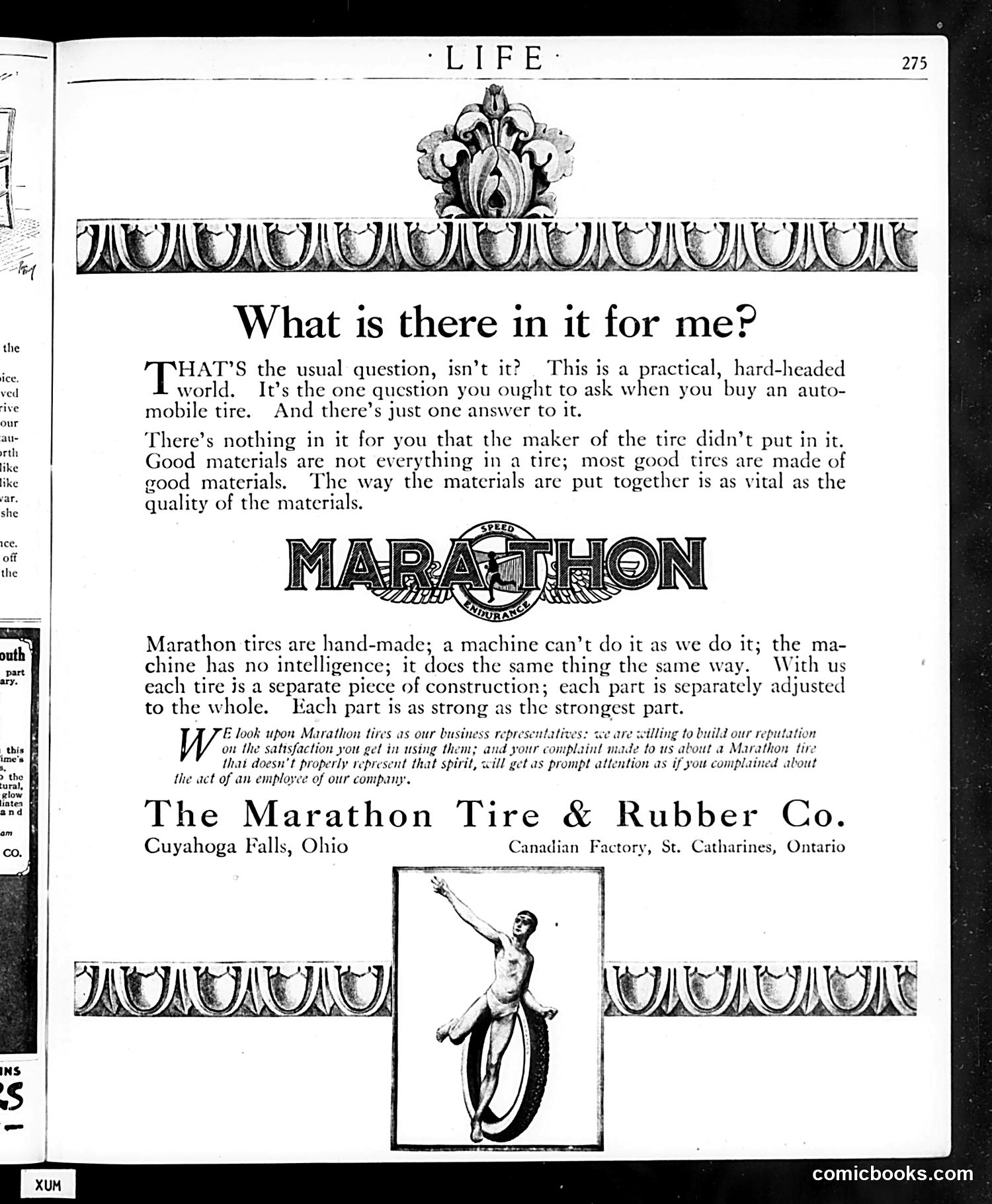
This is primarily a **tire advertisement**, not satire. The page appears in *Life* magazine (page 275) and promotes Marathon Tire & Rubber Co., based in Ohio with a Canadian factory. The ad employs a rhetorical strategy: it opens with the skeptical consumer's self-interested question—"What is there in it for me?"—then answers by emphasizing quality craftsmanship. The key claim is that Marathon tires are **hand-made**, not machine-made, allowing individual adjustment of each component. This was a significant selling point in the early automotive era, suggesting superior quality over mass production. The illustration shows a classical female figure (likely representing quality or victory) holding up a tire, a common advertising trope of the period. The advertisement's tone—addressing reader skepticism directly—reflects early 20th-century marketing that emphasized brand integrity and personal attention, values that would appeal to prosperous automobile owners.
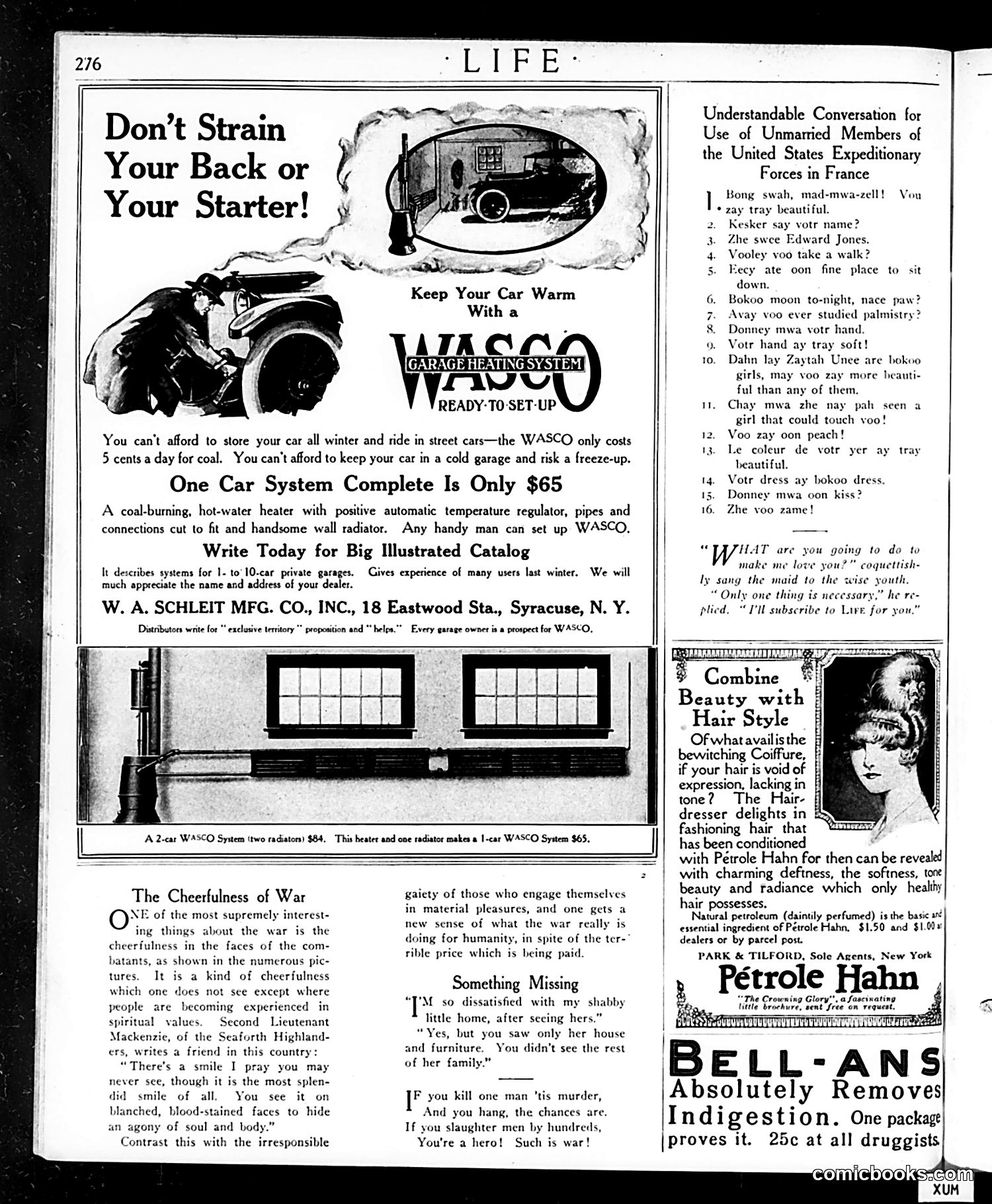
This page is primarily **advertising** with satirical content interspersed. The main satirical pieces are: **"The Cheerfulness of War"**: A commentary on soldiers' forced cheerfulness during WWI. It quotes a Scottish officer describing soldiers smiling on "blanched, blood-stained faces" to hide spiritual anguish—contrasting this with the "irresponsible gaiety" of civilians enjoying material pleasures. The piece critiques the war's human cost. **"Something Missing"**: A brief joke about a woman envying another's house without seeing "the rest of her family"—likely a subtle dig at materialism or hidden domestic troubles. **War Morality Verse**: A cynical quatrain contrasting murder (punishable by hanging) with mass killing in war (celebrated as heroism)—satirizing war's moral contradictions. **French Phrasebook**: A humorous guide for American soldiers in France, offering crude pickup lines in broken French—mocking both soldier behavior and language barriers. The remaining content comprises period advertisements for car heaters, hair products, and digestive aids—typical of the era.
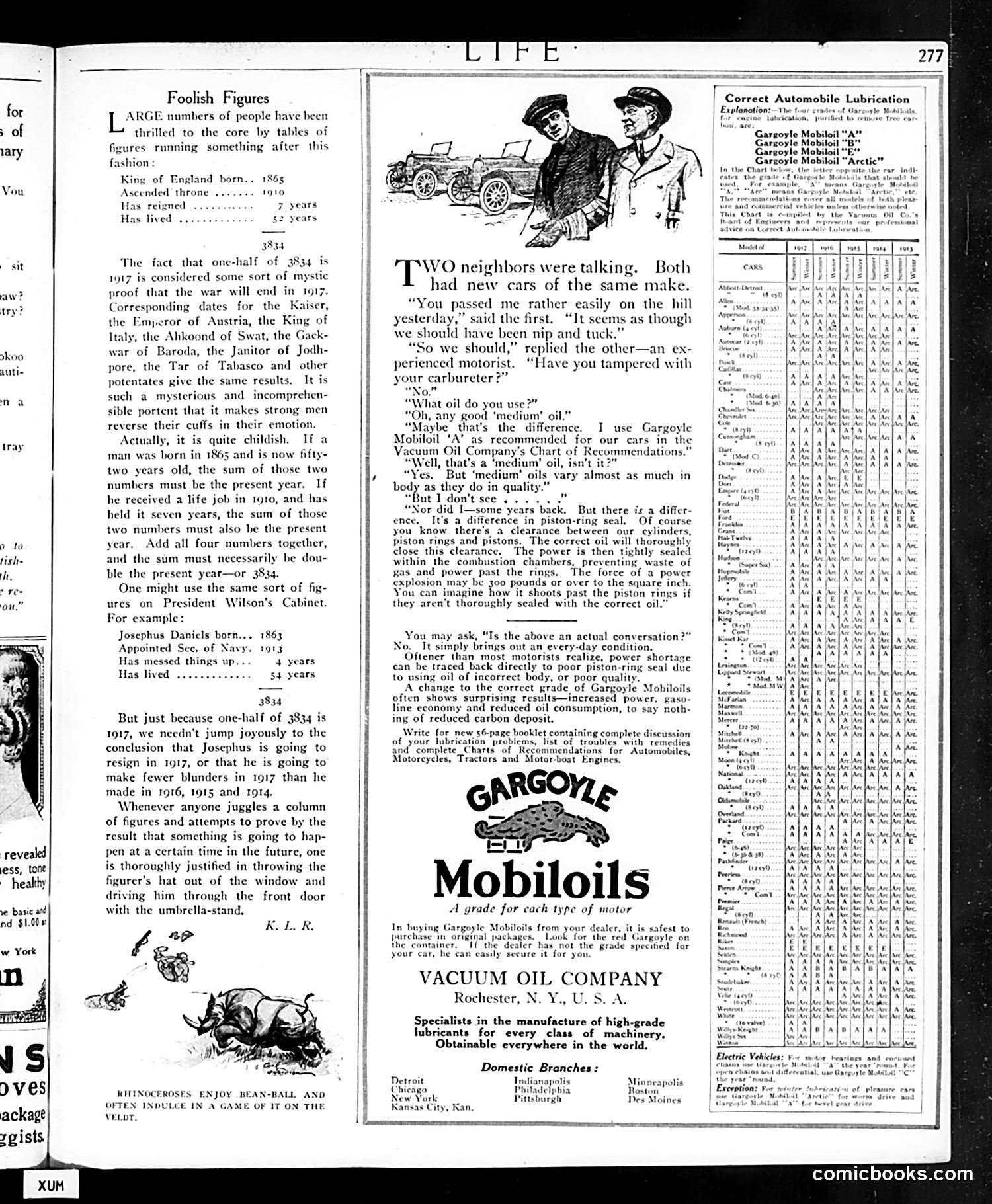
**Left Column - "Foolish Figures":** This is satire mocking numerological superstitions popular during World War I. The author ridicules people who perform arithmetic tricks with birth years and dates—such as adding the King of England's birth year (1865) to his reign length to "prove" the war will end in 1917. The piece uses Josephus Daniels (Wilson's Secretary of the Navy) as an example of this absurd reasoning, arguing that such mathematical coincidences prove nothing about future events. The satirist concludes by suggesting readers should literally throw such predictors out the window with their umbrella-stand—mocking the desperate superstition of wartime audiences seeking mystical reassurance. **Right Side - Advertisement:** A Gargoyle Mobiloils advertisement disguised as editorial content, featuring neighbors discussing why one car outperforms the other on a hill. The "experienced motorist" attributes the difference to using the correct grade of motor oil, which maintains proper piston-ring seal. This is earnest product promotion, not satire.
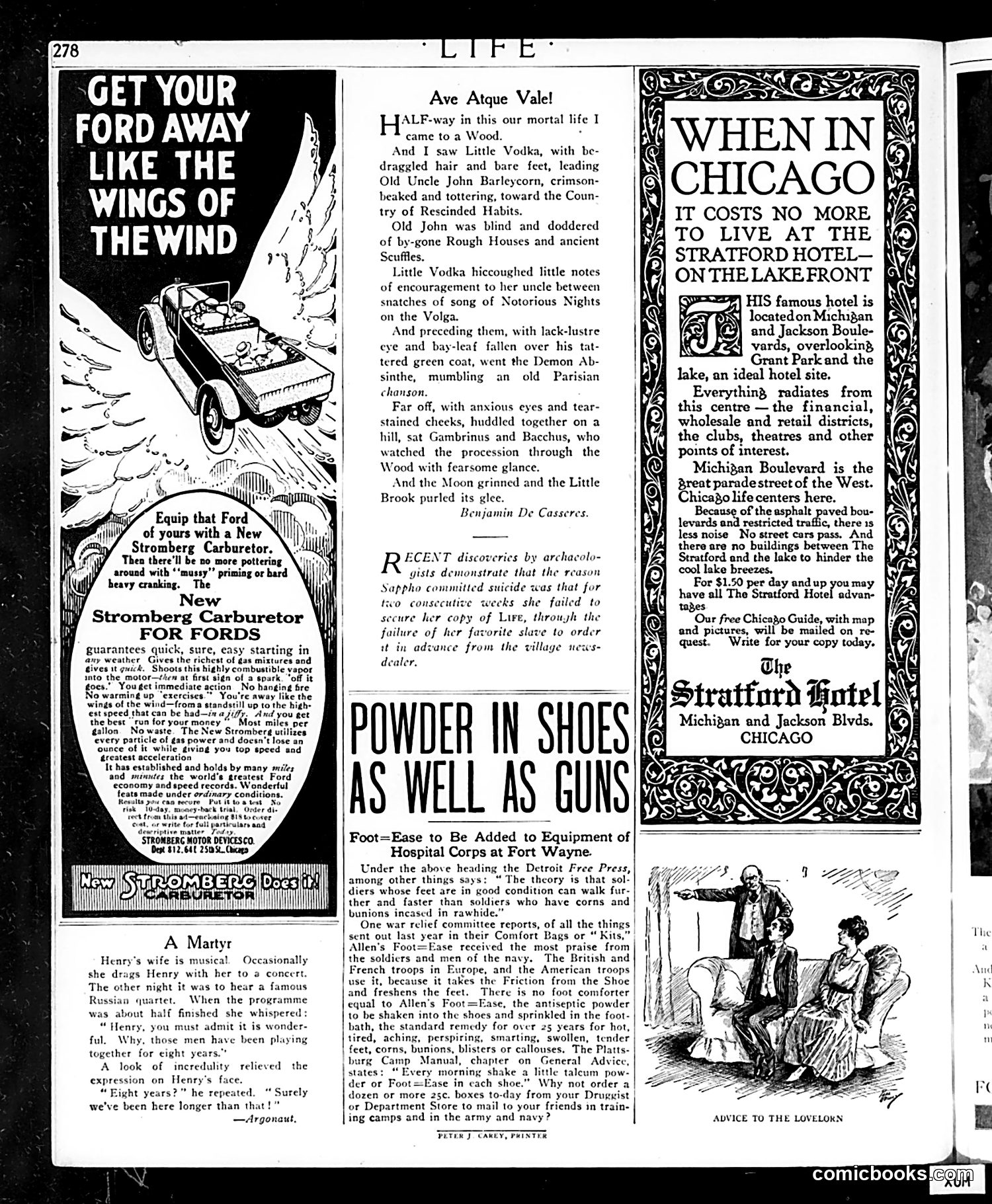
This page contains three main advertisements and literary content from an early 20th-century Life magazine. **Left side:** A Ford automobile ad promoting the Stromberg Carburetor as a performance upgrade, using poetic language ("like the wings of the wind") to market faster acceleration and easier starting to Ford owners. **Center:** Two pieces of content—a literary poem titled "Ave Atque Vale" by Benjamin De Casseres personifying alcoholic drinks (Vodka, Barleycorn, Absinthe) as figures heading toward "the Country of Rescinded Habits" (Prohibition), and below it, a news item about "Powder in Shoes as Well as Guns," reporting that Allen's Foot-Ease powder is being added to soldiers' comfort kits during WWI because healthy feet improve military performance. **Right side:** An advertisement for the Stratford Hotel in Chicago, emphasizing its lakefront location and central position for accessing the city's attractions. The page reflects wartime conditions and Pre-Prohibition anxieties alongside consumer culture.
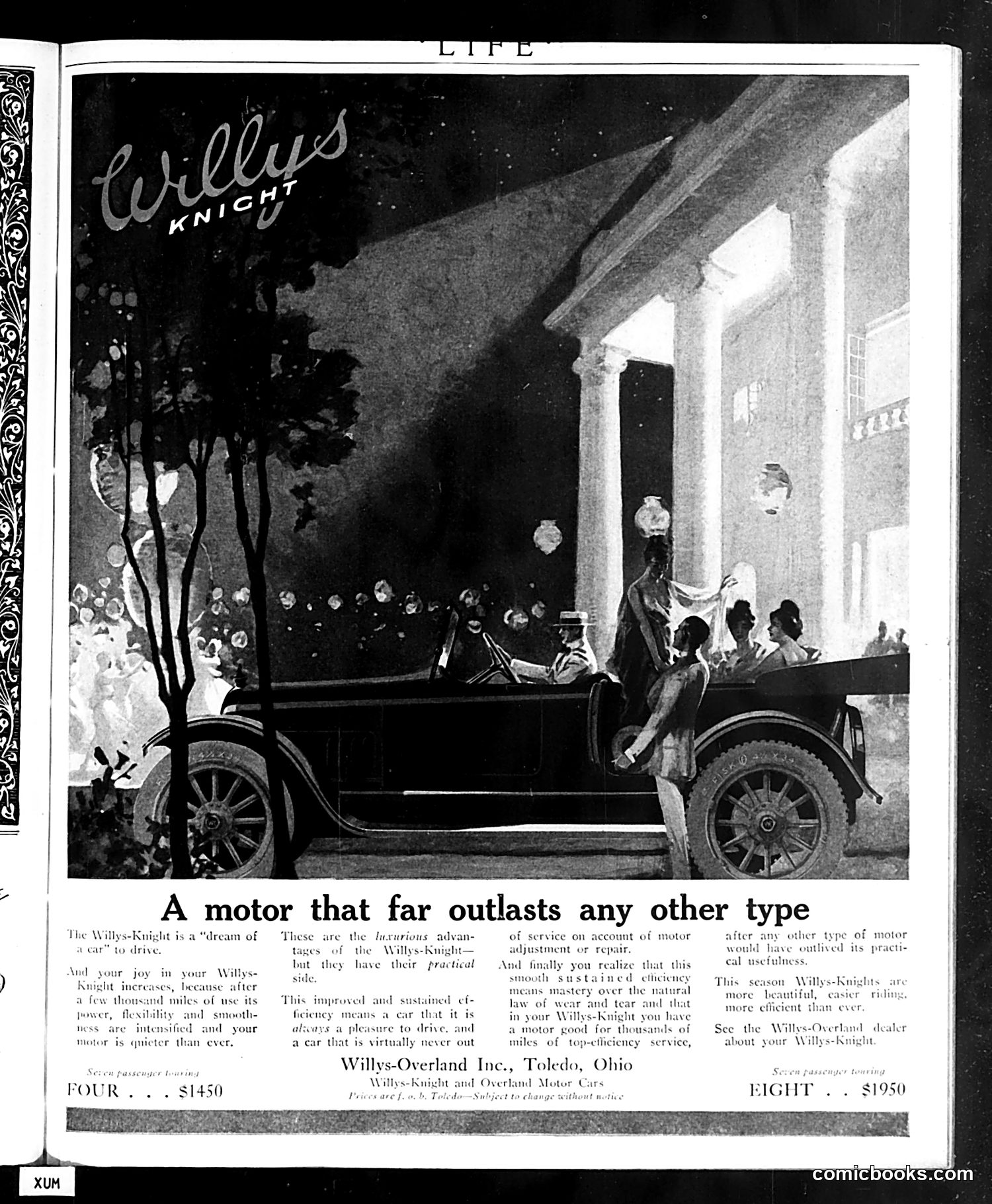
This is primarily an **automobile advertisement**, not political satire. It's a Willys-Knight motor car ad from Willys-Overland Inc. (Toledo, Ohio). The illustration depicts a nighttime social scene: well-dressed people in an open automobile parked outside an elegant columned building, with formally dressed attendees visible in the background. The image conveys luxury and sophistication. The advertisement's messaging emphasizes the Willys-Knight's reliability and durability—it "outlasts any other type" and provides superior "service" and "efficiency." The tagline promises the car is "a pleasure to drive" with a "quieter" motor than competitors. Pricing shown: Four-passenger model at $1,450 and Eight-passenger at $1,950. **For modern readers:** This is straightforward product marketing targeting affluent buyers, using an aspirational lifestyle scene to sell automotive durability and refined performance—a common advertising strategy then and now.
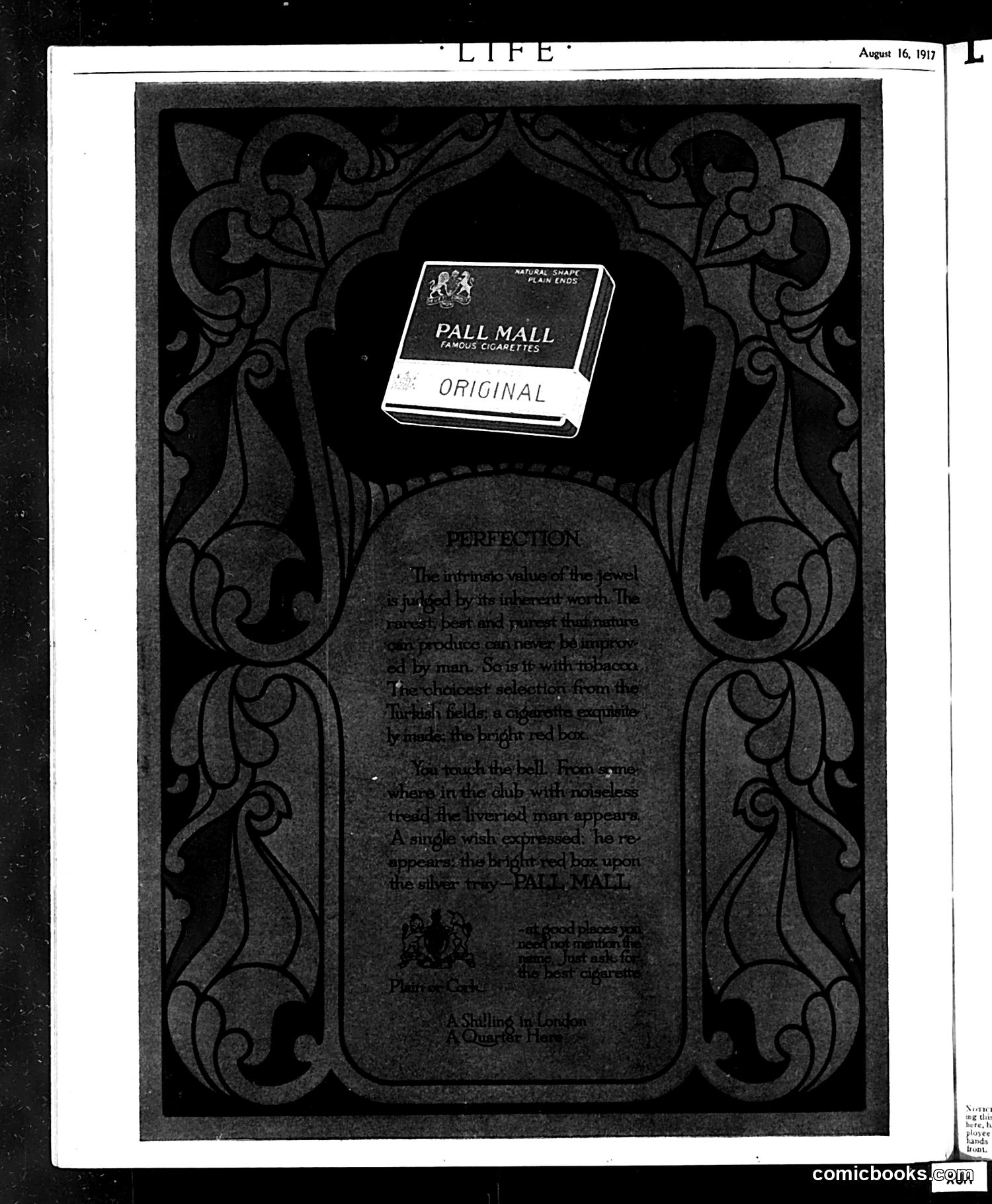
This is a **cigarette advertisement**, not political satire. The page shows a Pall Mall cigarettes box prominently displayed within an ornate, decorative art nouveau frame. The ad's text section titled "PERFECTION" uses flowery language to market the cigarettes as a luxurious product, referencing "the intrinsic value of the jewel" and claiming these are the "choicest addiction from the Turkish fields." The copy emphasizes quality and craftsmanship, concluding with "PALL MALL" and noting it's "A Shilling in London / A Quarter Here." This represents typical early 20th-century tobacco marketing—before health warnings—when cigarettes were advertised as sophisticated, refined consumer goods. The elaborate framing and poetic language were standard advertising techniques of the 1917 era.