
Life, 1917-08-16 · page 11 of 40
Life — August 16, 1917 — page 11: what you’re looking at
What you’re looking at
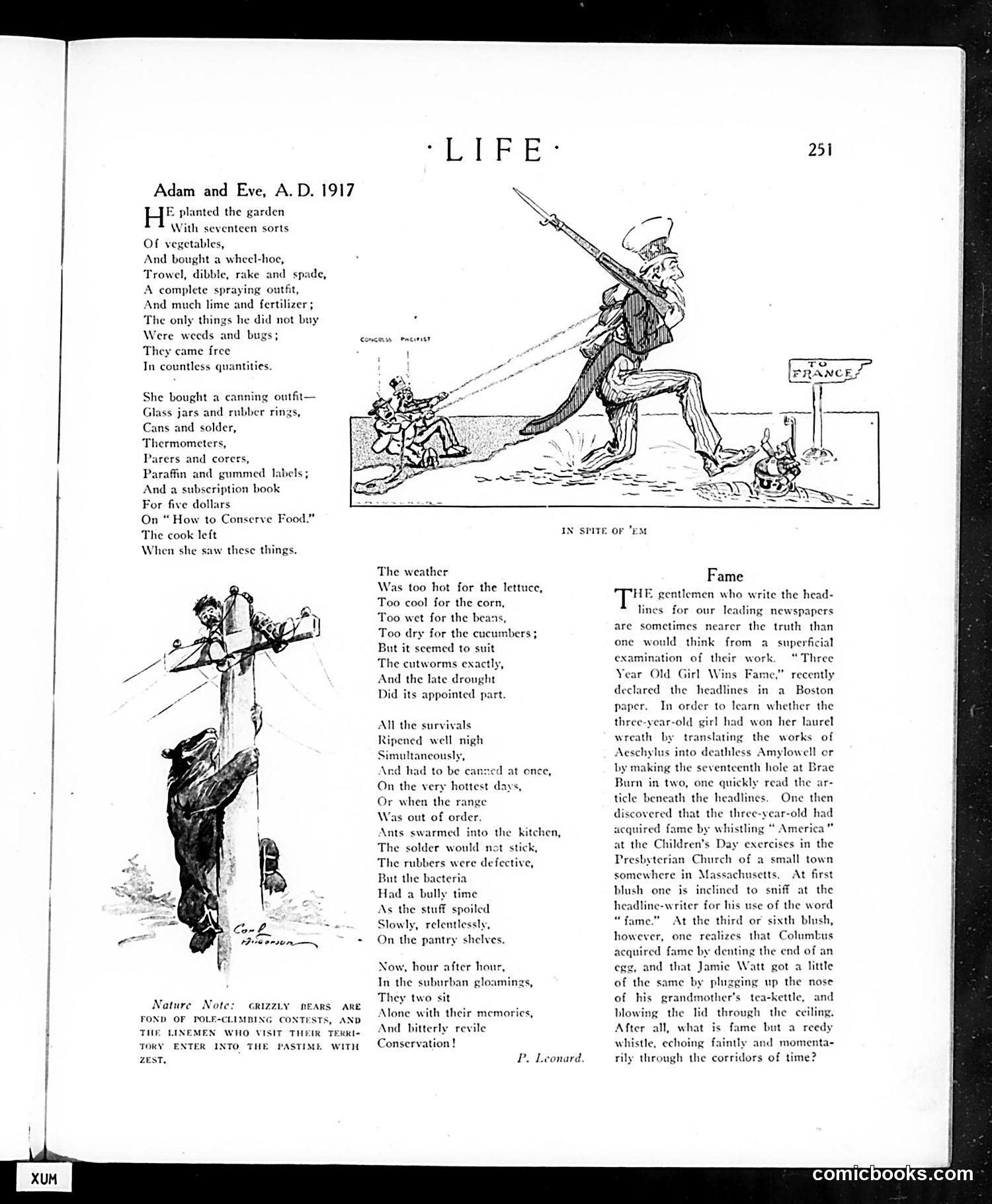
**Top Cartoon ("In Spite of 'Em"):** This depicts a tall, skeletal figure labeled "France" being pulled backward by a much smaller figure (appears to be a caricatured Allied soldier or politician). The satire critiques the difficulty France faced in World War I despite Allied support—suggesting external forces were hindering rather than helping French war efforts or reconstruction. **Lower Cartoon ("Ants"):** Shows soldiers on a utility pole dealing with ants invading military supplies. This is wartime humor about logistical frustrations—pests spoiling provisions during military operations, a relatable complaint for soldiers facing supply-line problems. Both cartoons use exaggeration and anthropomorphism to mock wartime difficulties and absurdities in a satirical magazine style typical of WWI-era American humor.
📄 Transcribed text from this page (OCR, searchable)
Machine-transcribed from the original scan — historical spelling and the odd misread are preserved.
Adam and Eve, A. D. 1917 HE planted the garden With seventeen sorts Of vegetables, And bought a wheel-hoe, Trowel, dibble, r: and spade, A complete spraying outfit, And much lime and fertilizer; The only thi he did not buy Were weeds and bugs; They came free In countless quantities. She bought a canning outfit— Glass jars and rubber rings, Cans and solder, Thermometers, Parers and corers, Paraffin and gummed lab And a subscription book For five dollars On “ How to Conserve Food.” The cook left When she saw these things. Note: Nature GRIZZLY MEARS ARE FOND OF POLE-CLIMBING CONTESTS, AND THE LINEMEN WHO VISIT THEIR: TERRI- TORY ENTER INTO THE PASTIME WITH ZEST. 251 IN SPITE OF 'EM The weather Was too hot for the lettuce, Too cool for the corn, Too wet for the beans, Too dry for the cucumbers ; But it seemed to suit The cutworms exactly, And the late drought Did its appointed part. All the survivals Ripened well nigh Simultaneously, And had to be canned at once, On the very hottest days, Or when the range Was out of order. Ants swarmed into the kitchen, The solder would not sti The rubbers were defective, But the bacteria Had a bully time As the stuff spoiled Slowly, relentlessly, On the pantry shelves, Now, hour after hour, In the suburban gloamings, They two sit Alone with their memorics, And bitterly revile Conservation! P. Leonard. Fame HE gentlemen who write the head- lines for our leading newspapers are sometimes nearer the truth than one would think from a superficial examination of their work. “Thr Year Old 1 Wins ic," recently declared the headlines in a Boston rn whether the paper. In order to le: three-year-old girl had won her laurel ting the works of wreath by trans! Aeschylus into deathle: by making the seventeenth hole at Brae Burn in two, one quickly read the ar- ticle beneath the headlines. One then discovered that the three-year-old had acquired fame by whistling “ America” at the Children’s Day exercises in the Presbyterian Church of a small town somewhere in Massachusetts. At first blush one is inclined to sniff at the headline-writer for his use of the word “fame.” At the third or sixth blush, however, one realizes that Columbus acquired fame by denting the end of an egg, and that Jamie Watt got a little of the same by plugging up the nose of his grandmother's tea-kettle, and Dlowing the lid through the ceiling. After all, what is fame but a reedy whistle, echoing faintly and momenta- rily through the corridors of time? Amylowell or comicbooks.com