
Life, 1917-08-16 · page 23 of 40
Life — August 16, 1917 — page 23: what you’re looking at
What you’re looking at
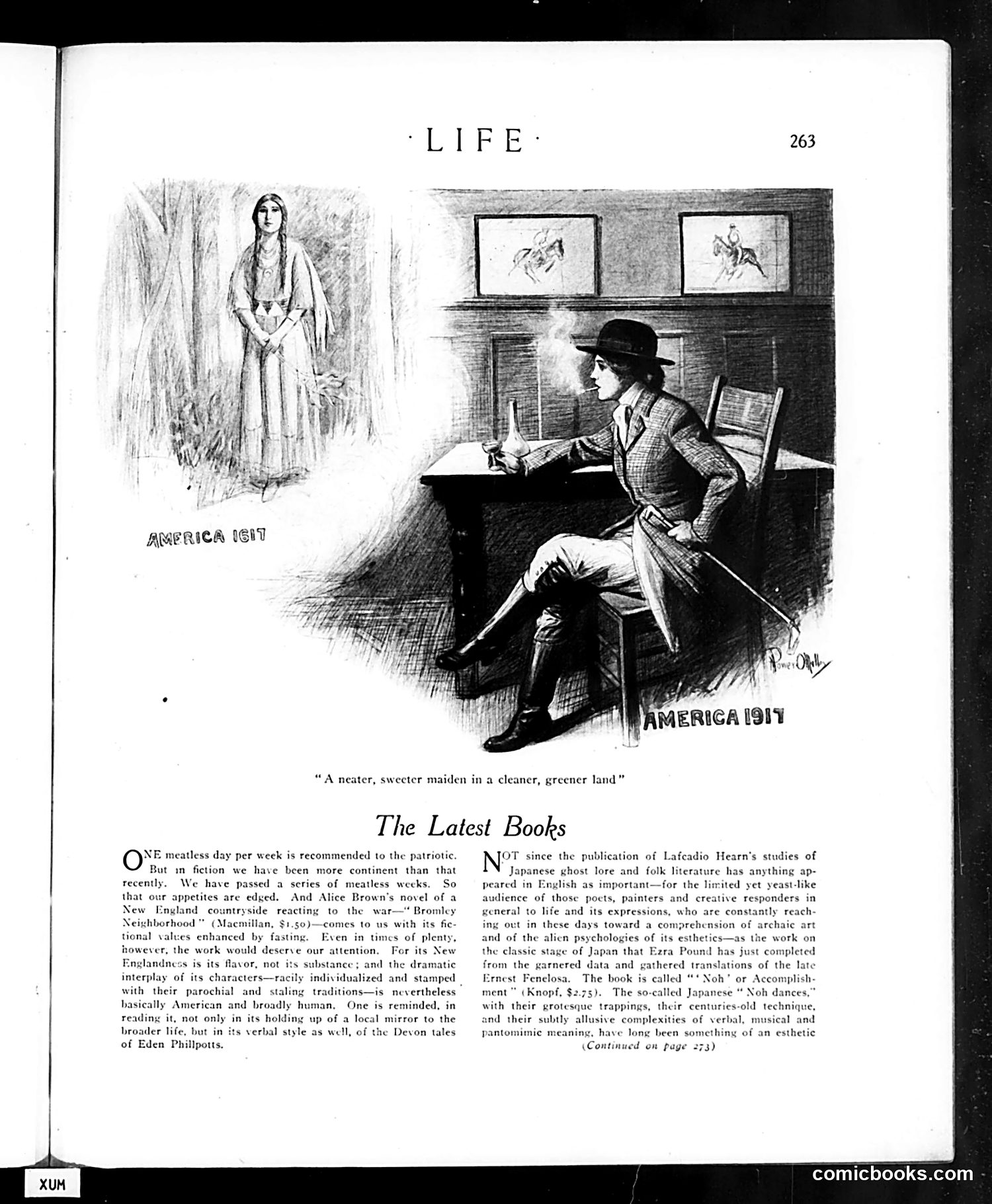
This page presents two satirical cartoons dated "America 1917," likely commenting on American life during World War I. **Left cartoon:** Shows a woman in traditional dress labeled "Africa 1917," appearing to represent exotic or "uncivilized" lands. **Right cartoon:** Depicts a man at a desk in modern dress, labeled "America 1917," working or writing. **The satire:** The contrasting caption—"A neater, sweeter maiden in a cleaner, greener land"—likely inverts expectations: it sarcastically suggests that America (represented by the industrialized, desk-bound figure) is somehow "cleaner" and more civilized than Africa, while the juxtaposition questions American superiority claims. During WWI, this may critique American attitudes toward other cultures or imperialism. The page's "Latest Books" section discusses wartime patriotism ("meatless days"), suggesting the cartoons fit within broader cultural commentary on American identity during the war period.
📄 Transcribed text from this page (OCR, searchable)
Machine-transcribed from the original scan — historical spelling and the odd misread are preserved.
feZ MERIGA 1917 “A neater, sweeter maiden in a cleaner, greener land” The Latest Books NE meatless day per week is recommended to the patriotic. But in fiction we have been more continent than that We have passed a series of meatless weeks. So appetites are edged. And Alice Brown's novel of a countryside reacting to the war— Bromley ighborhood " (M an, $1.50)—comes to us with its fic- pal values enhanced by fasting. Even in times of plenty, however, the work would deserve our attention. For its New Englandness is its favor, not its substance; and the dramatic interplay of its characters—racily individualized and stamped with their parochial and staling traditions—is nevertheless basically American and broadly human, One is reminded, in reading it, not only in its holding up of a local mirror to the broader life, but in its verbal style as well, of the Devon tales of Eden Phillpot N°" since the publication of Lafcadio Hearn’s studies of Japanese ghost lore and folk literature has anything ap- slish as important—for the limited yet yeast-like peared in audience of those poets, painters and creative responders in general to life and its expressions, who are constantly reach- ing out in these days toward a comprehension of archaic art and of the alien psychologies of its esthetics—as the work on the classic stage of Japan that Ezra Pound has just completed anslations of the late Ernest Fenel The book is ¢: ‘oh’ or Accomplish- ment" (Knopf, $ The so-c * Noh dances,” with their grotesque trappings, their centuries-old technic and their subtly allusive complexities of verbal, musical and aning, have long been something of an esthetic (Continued on page 273) from the garnered data and anese pantomimie comicbooks.com