
Life, 1917-08-16 · page 33 of 40
Life — August 16, 1917 — page 33: what you’re looking at
What you’re looking at
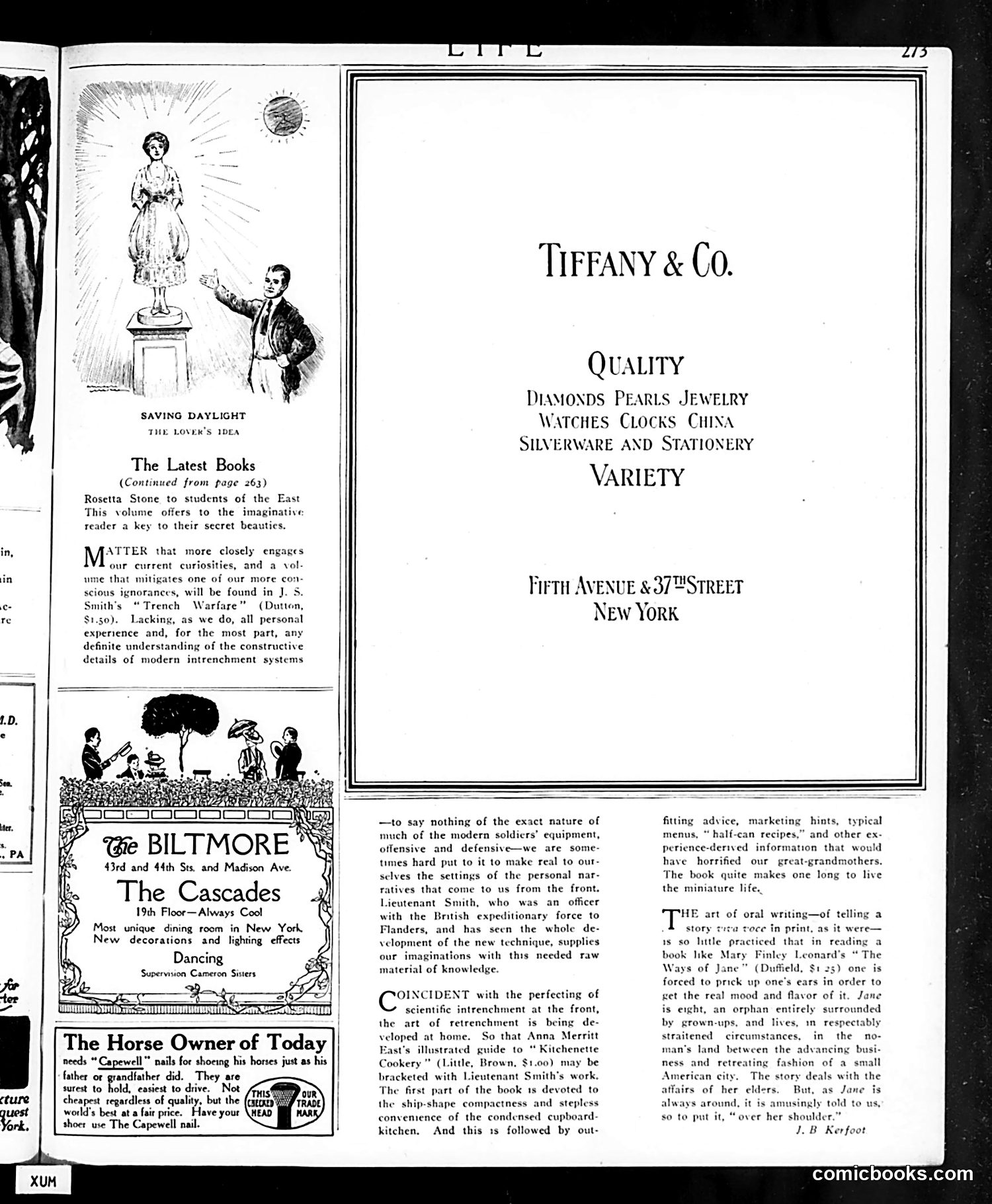
This cartoon satirizes **daylight saving time**, likely referring to proposals during World War I to conserve fuel. The sketch shows a couple: a woman glowing radiantly on a pedestal with sunburst rays, and a man gesturing toward her with approval. The joke plays on the phrase "saving daylight"—the man's romantic "idea" is that extending daylight hours gives him more time to court his beloved in natural light, rather than the policy's actual purpose of energy conservation for the war effort. The cartoon mocks how civilians might reinterpret serious wartime measures through a sentimental or self-interested lens. It's gentle satire of romance-minded optimism amid practical governmental concerns.
📄 Transcribed text from this page (OCR, searchable)
Machine-transcribed from the original scan — historical spelling and the odd misread are preserved.
‘in co SAVING DAYLIGHT THE LOVER'S IDEA The Latest Books (Continued from page 263) Rosetta Stone to students of the This volume offers to the imaginative reader a key to their secret beauties. ATTER that more closely engages our current curiosities, and a vol ume that mitigates one of our more con- scious ignorances, will be found in J. 5. Smith's “Trench Warfare” (Dutton, $1.30). Lacking, as we do, all personal experience and, for the most part, any definite understanding of the constructive details of modern intrenchment systems Ge BILTMORE 43rd and 44th Sts, and Madison Ave. The Cascades 19th Floor—Always Cool Most unique dining room in New York New decorations and lighting effects Dancing Supervision Cameron Sisters The Horse Owner of Today needs “Capewell” nails for shoeing his horses just as his father or grandfather did. They are surest to hold, easiest to drive. Not cheapest regardless of quality, but the world’s best at a fair price. Have your thoer use The Capewell nail. TIFFANY & CO. QUALITY DIAMONDS PEARLS JEWELRY WATCHES CLOCKS CHINA SILVERWARE AND STATIONERY VARIETY Firty AVENUE &372'STREET New YORK —to say nothing of the exact nature of much of the modern soldiers’ equipment, offensive and defensive—we are some- times hard put to it to make real to our- selves the settings of the personal nar- ratives that come to us from the front. Lieutenant Smith, who was an officer with the British expeditionary force to Flanders, and has seen the whole de- velopment of the new technique, supplies our imaginations with this needed raw material of knowledge. OINCIDENT with the perfecting of scientific intrenchment at the front, the art of retrenchment is being de- veloped at home. So that Anna Merritt t's illustrated guide to “ Kitchenette Cookery” (Little, Brown, $1.00) may be bracketed with Lieutenant Smith's work. The first part of the book 1s devoted to the ship-shape compactness and stepless convenience of the condensed cupboard. kitchen, And this 1s followed by out- fitting advice, marketing hints, typical menus, “ half-can recipes,” and other ex- perience-derived information that would have horrified our great-grandmothers. The book quite makes one long to live the miniature life. HE art of oral writing—of telling a story ¢ 1s so litle practiced that in reading a book like Mary Finley Leonard's “ The Ways of Jane” (Duffield, $125) one is forced to prick up one’s ears in order to get the real mood and flavor of it. Jane is eight, an orphan entirely. surrounded by grown-ups, and lives, in respectably ce in print, as it were— a straitened circumstances, in the no- man’s land between the advancing busi- ness and retreating fashion of a small American city. The story deals with the affairs of her elders. But, as Jane is always around, it is amusingly told to us, over her shoulder.” J.B Kerfoot so to put it, comicbooks.com