
Life, 1917-08-16 · page 19 of 40
Life — August 16, 1917 — page 19: what you’re looking at
What you’re looking at
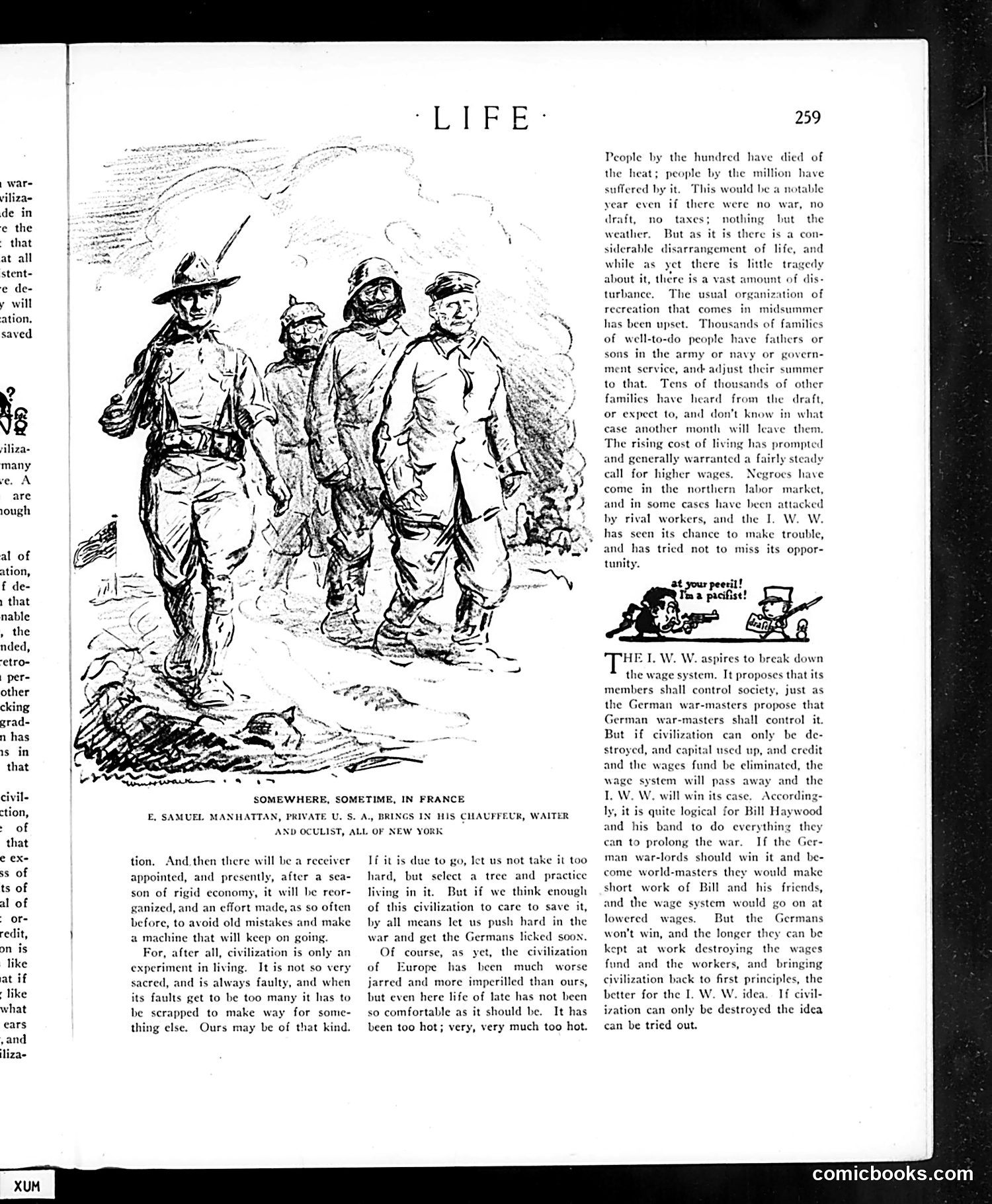
This page combines a WWI-era illustration with commentary on American social upheaval during the war effort. **The Illustration:** Shows four American soldiers (one labeled as "Private U.S.A." named Samuel Manhattan, a New York chauffeur and oculist) trudging through France. The caption's casual tone ("Somewhere, Sometime, in France") reflects Life's satirical voice about the war experience. **The Text's Main Arguments:** The article discusses how American civilization faces strain from multiple pressures: draft notices disrupting families, wartime inflation driving wage demands, and racial tensions as Black workers migrate north seeking jobs. **The Satire's Target:** The I.W.W. (Industrial Workers of the World—a radical labor union). The author argues the I.W.W., led by Bill Haywood, logically benefits from prolonging the war because chaos weakens the capitalist wage system they oppose. The satire suggests this makes their pacifism cynically self-interested rather than principled. **For Modern Readers:** This reflects 1910s anxieties about labor radicalism, racism, and whether social disruption during wartime served revolutionary agendas—themes still debated but with very different contexts today.
📄 Transcribed text from this page (OCR, searchable)
Machine-transcribed from the original scan — historical spelling and the odd misread are preserved.
de in ¢ the | that at all stent- de- y will ation, saved many re A are ough al of ation, f de- ) that nable , the nded, ‘etro- | per= other cking grad- n has is in that XUM SOMEWHERE, SOME: E, SAMUEL MANHATTAN, PRIVATE U. S. A., BRING! AND OCULIST, ALI tion. And. then there will be a receiver appointed, and presently, after a sea- son of rigid economy, it will be reor- ganized, and an effort made, as so often Lefore, to avoid old mistakes and make a machine that will keep on going. For, after all, civilization is only an experiment in living. It is not so very sacred, and is always faulty, and when its faults get to be too many it has to be scrapped to make way for some- thing else. Ours may be of that kind. TIME, IN FRANCE IN HIS CHAUFFEUR, WAITER |. OF NEW YORK If it is due to go, Iet us not take it too hard, but select a tree and_ practi living in it. But if we think enough of this civilization to care to save it, hy all means let us push hard in the war and get the Germans licked soon. Of course, yet, the civilization of Europe has been much worse jarred and more imperilled than ours, but even here life of late has not been so comfortable as it should be. It has been too hot; very, very much too hot. c 259 People by the hundred have died of the he ; people by the million have suffered by it. This would be a notable year even if there were no war, no draft, no taxes; nothing but the weather. But as it is there is a con- siderable disarrangement of life, an) yet there is little t f about it, there is a vast amount of dis- while as turbance. The usual organization of recreation that comes in_ midsummer has been upset. Thousands of families of well-to-do people have fathers or sons in the arm y or navy or govern- ment service, anc adjust their summer to that. Tens of thousands of other families have heard from the draft, or expect to, and don't know in w case another month will leave them. The rising cost of living has prompted and generally warranted a fairly steady call for higher wages. Negroes have come in the northern labor market, and in some cases have been attacked by rival workers, and the I. W. W. has seen its chance to make trouble, and has tried not to miss its oppor- tunity. at your peeril! a pacifist! HE I. W. W. aspires to the wage system. It proposes that its members shall control society, just as eak down the German war-masters propose that German war-masters shall control it. But if civilization can only be de- stroyed, and capital used up, and credit and the wages fund be eliminated, the wage system will pass away and the 1, W. W, will win its case. According- ly, it is quite logical for Bill Haywood and his band to do everything the: can to prolong the war. If the Ger- man war-lords should win it and be- come world-masters they would make short work of Bill and his friends, and the wage system would go on at lowered wages. But the Germans won't win, and the longer they be kept at work destroying the wages fund and the workers, and bringing civilization back to first principles, the better for the I. W. W. idea. If civil- ization can only be destroyed the idea can be tried out. comicbooks.com