
Life, 1917-08-16 · page 18 of 40
Life — August 16, 1917 — page 18: what you’re looking at
What you’re looking at
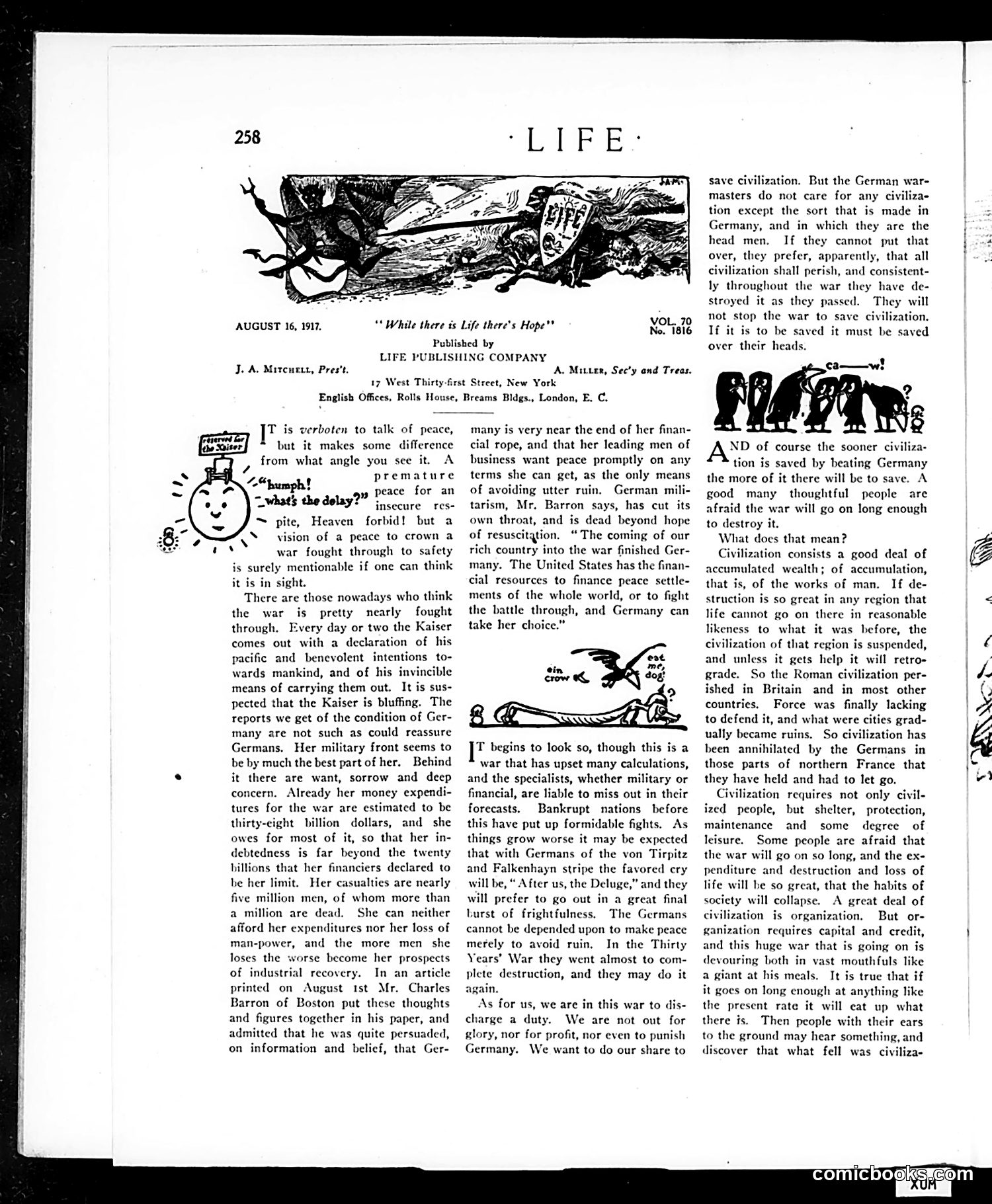
This editorial page addresses American war aims following the U.S. entry into World War I (April 1917). The cartoons and text argue against premature peace negotiations with Germany. **The cartoons** depict the Kaiser appearing to seek peace while Germany's domestic situation deteriorates—a visual representation of German bluffing. The "crow" and "dog" sketches appear to illustrate Germany's desperation. **The main argument**: Germany's military leadership (referenced figures like von Tirpitz and Falkenhayn) would prefer total destruction to accepting defeat, citing historical precedent (the Thirty Years' War). The text asserts Germany has exhausted its finances ($38 billion spent, over 1 million dead) and cannot sustain prolonged conflict. **The satire**: Germans claim peaceful intentions ("verboten to talk of peace") while actually pursuing destruction. The phrase "After us, the Deluge" captures their apparent nihilistic philosophy. **Conclusion**: America's financial superiority ensures German defeat if the war continues. Peace must be imposed through military victory, "over their heads," not negotiation—otherwise German militarism will destroy civilization itself.
📄 Transcribed text from this page (OCR, searchable)
Machine-transcribed from the original scan — historical spelling and the odd misread are preserved.
AUGUST 16, 1917. VOL. 70 “While there is Life there's Hope"* Nol ge Published by LIFE PUBLISHING COMPANY J. A. Mitcurtt, Pres’t. A. Mittre, Sec’y and Treas. 17 West Thirty-first Street, New York English Offices, Rolls House, Breams Bldgs., London, E. C. T is verboten to talk of peace, but it makes some difference from what angle you see it. A premature “bumps ay peace for an ~whats the delay?” insecure res- ™ pite, Heaven forbid! but a ‘vision of a peace to crown a war fought through to safety is surely mentionable if one can think it is in sight. There are those nowadays who think the war is pretty nearly fought through. Every day or two the Kaiser comes out with a declaration of hi pacific and benevolent intentions to- wards mankind, and of his invincible means of carrying them out. It is sus- pected that the Kaiser is bluffing. The reports we get of the condition of Ger- many are not such as could reassure Germans. Her military front seems to be by much the best part of her. Behind it there are want, sorrow and deep concern. Already her money expendi- tures for the war are estimated to be thirty-eight billion dollars, and she owes for most of it, so that her in- debtedness is far beyond the twenty billions that her financiers declared to he her limit. Her casualties are nearly five million men, of whom more than a million are dead. She can neither afford her expenditures nor her loss of man-power, and the more men she loses the worse become her prospects of industrial recovery. In an article printed on August Ist Mr. Charles Barron of Boston put these thoughts and figures together in his paper, and admitted that he was quite persuaded, on information and belief, that Ger- many is very near the end of her finan- cial rope, and that her leading men of business want peace promptly on any terms she can get, as the only means of avoiding utter ruin. German mili- tarism, Mr, Barron says, has cut its own throat, and is dead beyond hope of resuscitation. “The coming of our rich country into the war finished Ger- many. The United States has the finan- cial resources to finance peace settle- ments of the whole world, or to fight the battle through, and Germany can take her choice. eis mt, Crow dog e) T begins to look so, though this is a war that has upset many calculations, and the specialists, whether military or financial, are liable to miss out in their forecasts. Bankrupt nations before this have put up formidable fights. As things grow worse it may be expected that with Germans of the von Tirpitz and Falkenhayn stripe the favored cry will be, “ After us, the Deluge,” and they will prefer to go out in a great final burst of frightfulness, The Germans cannot be depended upon to make peace merely to avoid ruin, In the Thirty Years’ War they went almost to com- plete destruction, and they may do it As for us, we are in this war to dis- charge a duty. We are not out for glory, nor for profit, nor even to punish Germany. We want to do our share to zation. But the German war- liza save civili: masters do not care for any civ tion except the sort that is made in Germany, and in which they are the head men. If they cannot put that over, they prefer, apparently, that all civilization shall perish, and consistent- ly throughout the war they have de- stroyed it as they passed. They will not stop the war to save civilization. If it is to be saved it must be saved over their heads. ND of course the sooner civiliza- tion is saved by beating Germany the more of it there will be to save. A good many thoughtful people are afraid the war will go on long enough to destroy it. What does that mean? Civilization consists a good deal of accumulated wealth; of accumulation, that is, of the works of man. If de- struction is so great in any region that life cannot go on there in reasonable likeness to what it was before, the civilization of that region is suspended, and unless it gets help it will retro- grade. So the Roman civilization per- ished in Britain and in most other countries. Force was finally lacking to defend it, and what were cities grad- ually became ruins. So civilization has been annihilated by the Germans in those parts of northern France that they have held and had to let go. Civilization requires not only civil- ized people, but shelter, protection, maintenance and some degree of leisure. Some people are afraid that the war will go on so long, and the ex- penditure and destruction and loss of life will he so great, that the habits of society will collapse. A great deal of civilization is organization. But or- ganization requires capital and credit, and this huge war that is going on is devouring both in vast mouthfuls like a giant at his meals. It is true that if it goes on long enough at anything like the present rate it will eat up what there is. Then people with their ears to the ground may hear something, and discover that what fell was ci comicbo: