
Life, 1917-08-16 · page 24 of 40
Life — August 16, 1917 — page 24: what you’re looking at
What you’re looking at
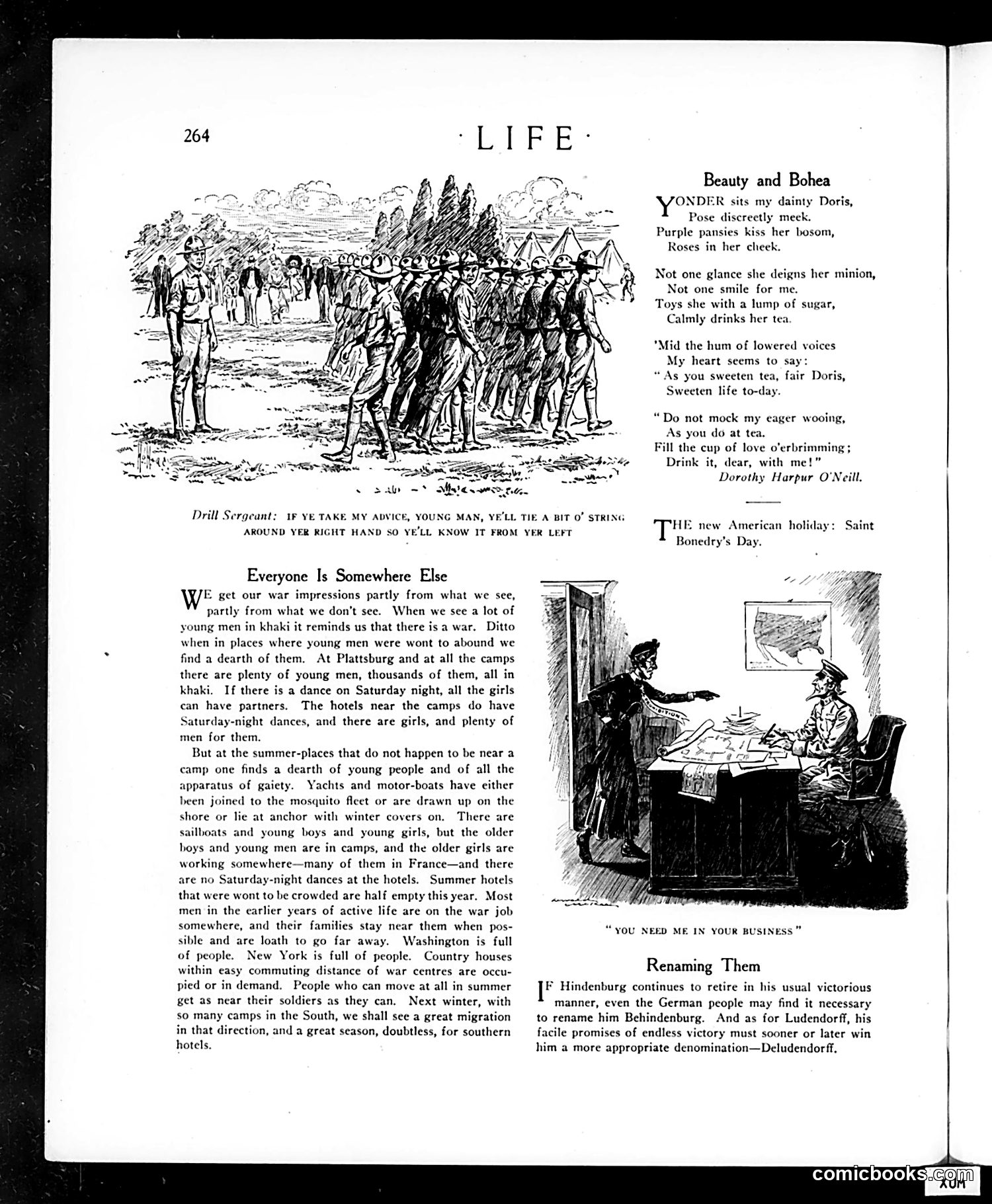
This page reflects American life during World War I, likely 1917-1918. **Main Article ("Everyone Is Somewhere Else"):** Describes how the war's presence is felt differently across America. Military training camps (like Plattsburg) are crowded with young men in khaki uniforms, creating social opportunities. But traditional summer resort towns far from camps are depressed—emptied of eligible young men and working-age women (many serving "in France"). The piece observes that families cluster near war centers like Washington and New York to stay close to servicemen. **Cartoons/Jokes:** - The drill sergeant cartoon (top) is a standard military humor bit about training recruits. - "Beauty and Bohea" is a sentimental romantic poem about courting a woman over tea—contrasting civilian romance with the wartime disruption described above. - **"Saint Bonedry's Day"** and the "Renaming Them" section mock German military leaders. The wordplay ("Behindenburg," "Deludendorff") jokes that General Hindenburg's strategic retreats and Ludendorff's failed promises should earn them appropriately ironic names. The page captures how WWI reshaped American social geography and civilian morale.
📄 Transcribed text from this page (OCR, searchable)
Machine-transcribed from the original scan — historical spelling and the odd misread are preserved.
Drill Sergeant: iF Ye TAKE MY ADVICE, YOU: AROUND YER RIGHT HAND SO YE'LL K Everyone Is Somewhere Else W = get our war impressions partly from what we see, partly from what we don't see. When we see a lot of young men in khaki it reminds us that there is a war. Ditto when in places where young men were wont to abound we find a dearth of them, At Plattsburg and at all the camps there are plenty of young men, thousands of them, all in khaki. If there is a dance on Saturday night, all the girls can have partners. The hotels near the camps do have Saturday-night dances, and there are girls, and plenty of men for them. But at the summer-places that do not happen to be near a camp one finds a dearth of young people and of all the apparatus of gaiety. Yachts and motor-boats have either been joined to the mosquito fleet or are drawn up on the shore or lie at anchor with winter covers on. There are sailboats and young boys and young girls, but the older hoys and young men are in camps, and the older girls are working somewhere—many of them in France—and there are no Saturday-night dances at the hotels. Summer hotels that were wont to be crowded are half empty this year. Most men in the earlier years of active life are on the war job somewhere, and their families stay near them when pos- sible and are loath to go far away. Washington is full of people. New York is full of people. Country houses within easy commuting distance of war centres are occu- pied or in demand. People who can move at all in summer get as near their soldiers as they can. Next winter, with so many camps in the South, we shall see a great migration in that direction, and a great season, doubtless, for southern hotels. OW IT FROM Beauty and Bohea ‘ONDER sits my dainty Doris, Pose discreetly meek. Purple pansies kiss her bosom, Roses in her cheek. Not one glance she deigns her minion, Not one smile for me. Toys she with a lump of sugar, Calmly drinks her tea, "Mid the hum of lowered voices My heart seems to say: “As you sweeten tea, fair Doris, Sweeten life to-day. “Do not mock my eager wooing, As you do at tea. Fill the cup of love o'erbrimming ; Drink it, dear, with me!” Dorothy Harpur O'Neill. BIT 0” STRING tae HE new American holiday: Saint Bonedry’s Day. Renaming Them F Hindenburg continues to retire in his usual victorious manner, even the German people may find it necessary to rename him Behindenburg. And as for Ludendorff, his facile promises of endless victory must sooner or later win him a more appropriate denomination—Deludendorff. comicbook