
A complete issue · 40 pages · 1917
Life — August 2, 1917
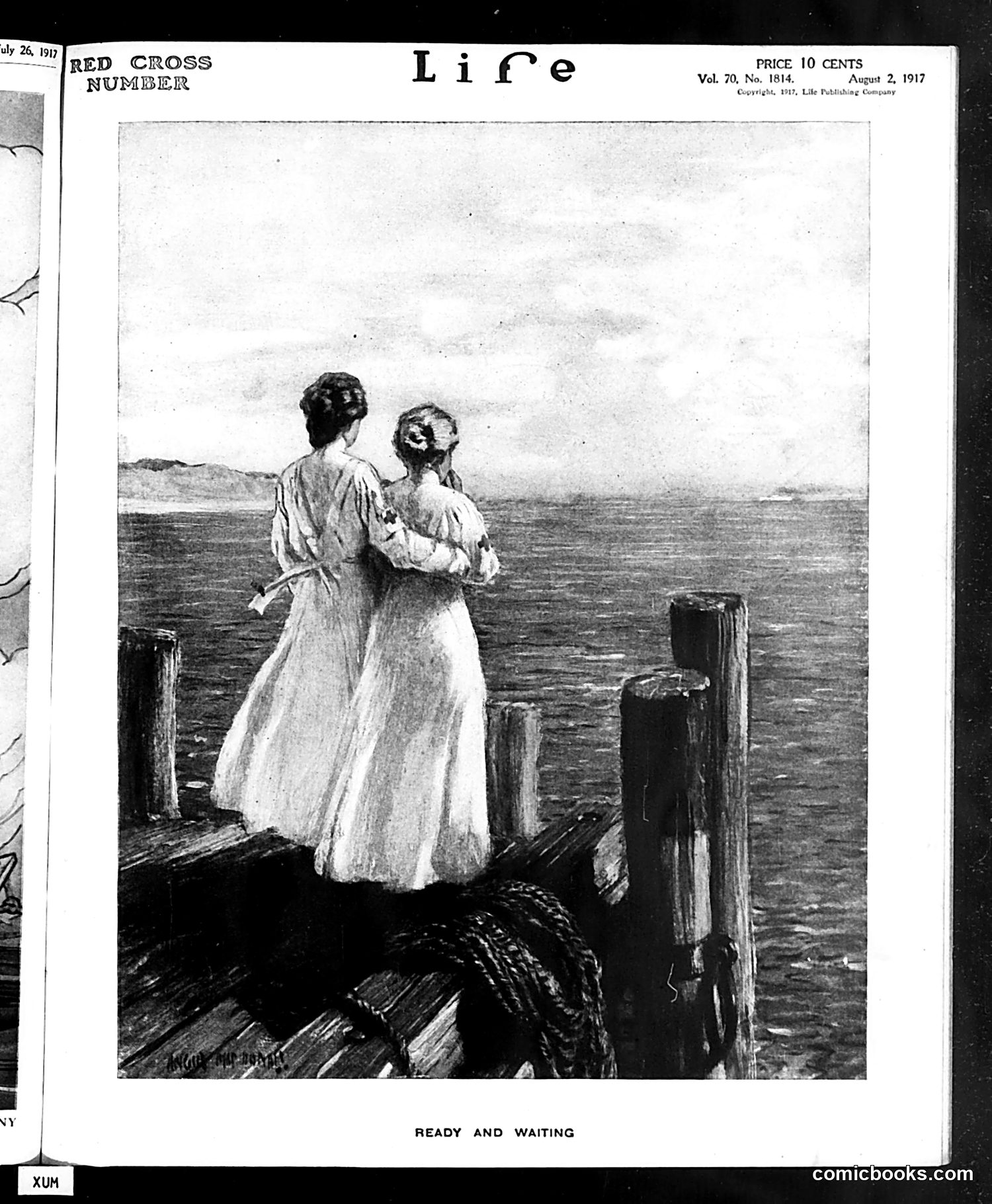
This is the cover image from *Life* magazine's Red Cross Number (August 2, 1917), published during America's involvement in World War I. The image shows two women in light dresses standing on a wooden dock, gazing out at the sea. The title "Ready and Waiting" suggests anticipation—likely for ships or returning soldiers. Given the Red Cross context, this appears to be patriotic imagery celebrating women's readiness to serve the war effort, either through nursing, volunteer work, or supporting soldiers. The romantic, sentimental composition reflects how WWI-era media portrayed women's contributions to the war—emphasizing emotional support and service rather than combat roles. The ocean vista suggests waiting for naval activity or the return of servicemen, positioning women as patient supporters of the military cause.
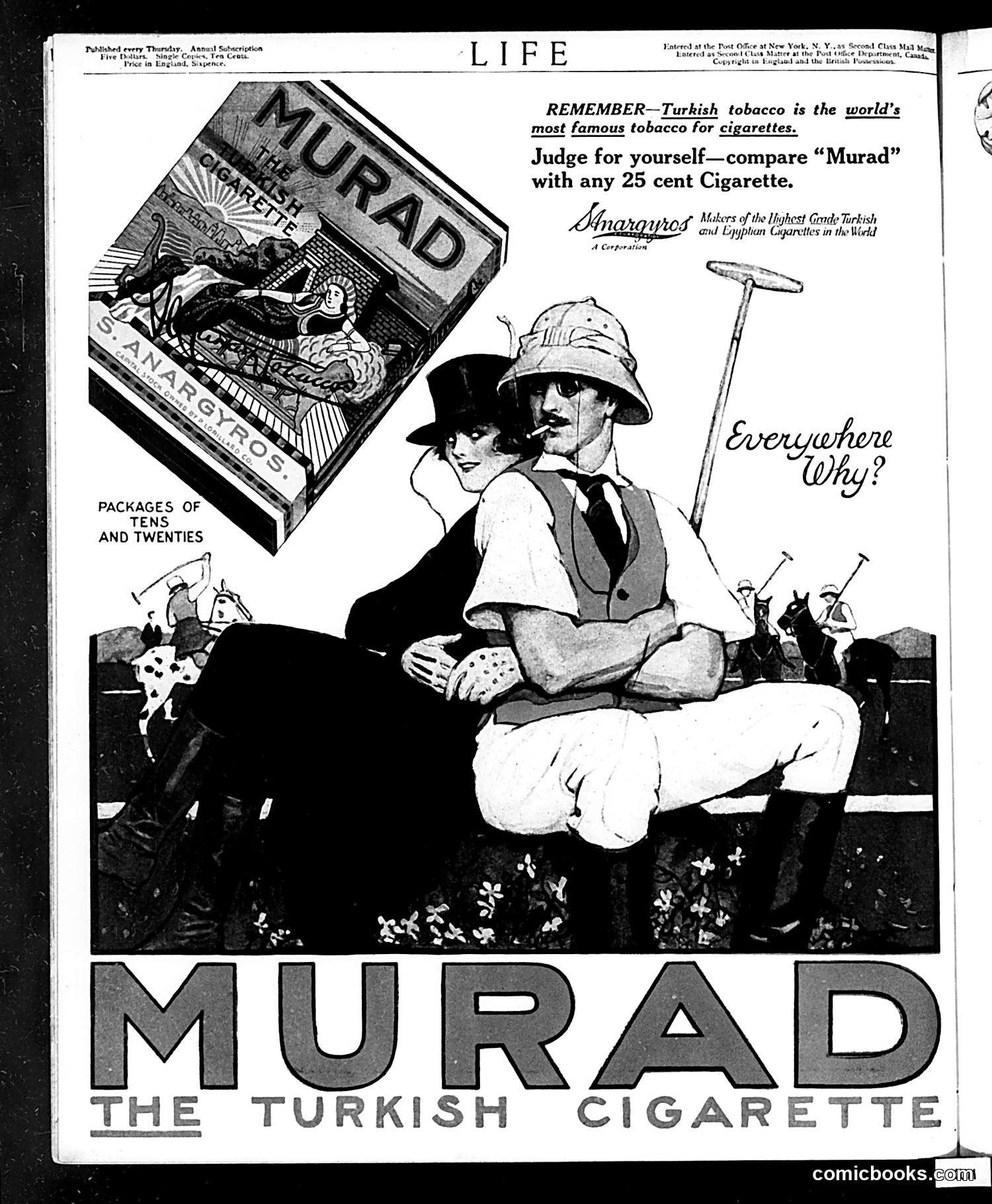
This is primarily a **cigarette advertisement** rather than political satire. It promotes "Murad," a Turkish cigarette brand made by Anargyros, positioned as the world's finest tobacco. The ad uses an **orientalist theme** popular in early 20th-century marketing: a couple in exotic dress (resembling colonial-era polo players or adventurers) relaxing in an idealized landscape, with polo players visible in the background. The tagline "Everywhere Why?" suggests these cigarettes are universally desirable. The advertisement appeals to cosmopolitan sophistication and aspirational leisure—linking Turkish tobacco to worldly travel and romance. The call to "Judge for yourself" and compare with 25-cent cigarettes positions Murad as a premium product. This reflects pre-regulation advertising practices when cigarette promotions could freely appear in mainstream publications.
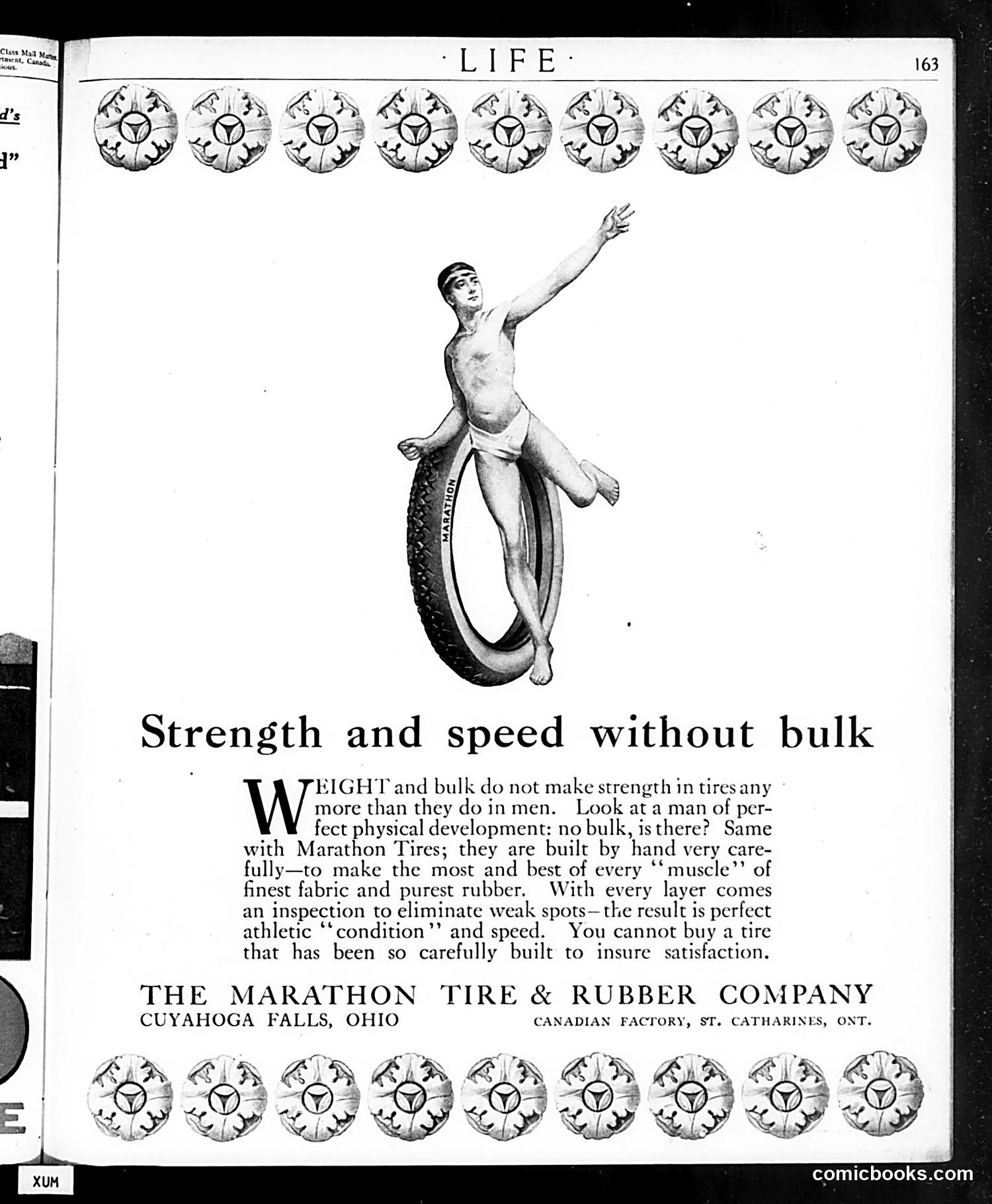
This is primarily a **Marathon Tire advertisement**, not political satire. The page shows a classical male figure holding a tire, illustrating the company's marketing message. The central image depicts an idealized athletic man in a contrapposto pose, reminiscent of classical sculpture. He's holding a Marathon Tire to emphasize the product's qualities. **The pitch:** The text argues that strength and speed in tires—like in humans—don't require bulk or excess weight. Marathon Tires are hand-built to maximize performance through careful construction rather than size. The comparison to "a man of perfect physical development" suggests the tire achieves athletic efficiency. The decorative tire cross-sections framing the page reinforce the product branding. This represents early 20th-century advertising rhetoric connecting consumer products to idealized physical fitness and modern athleticism.
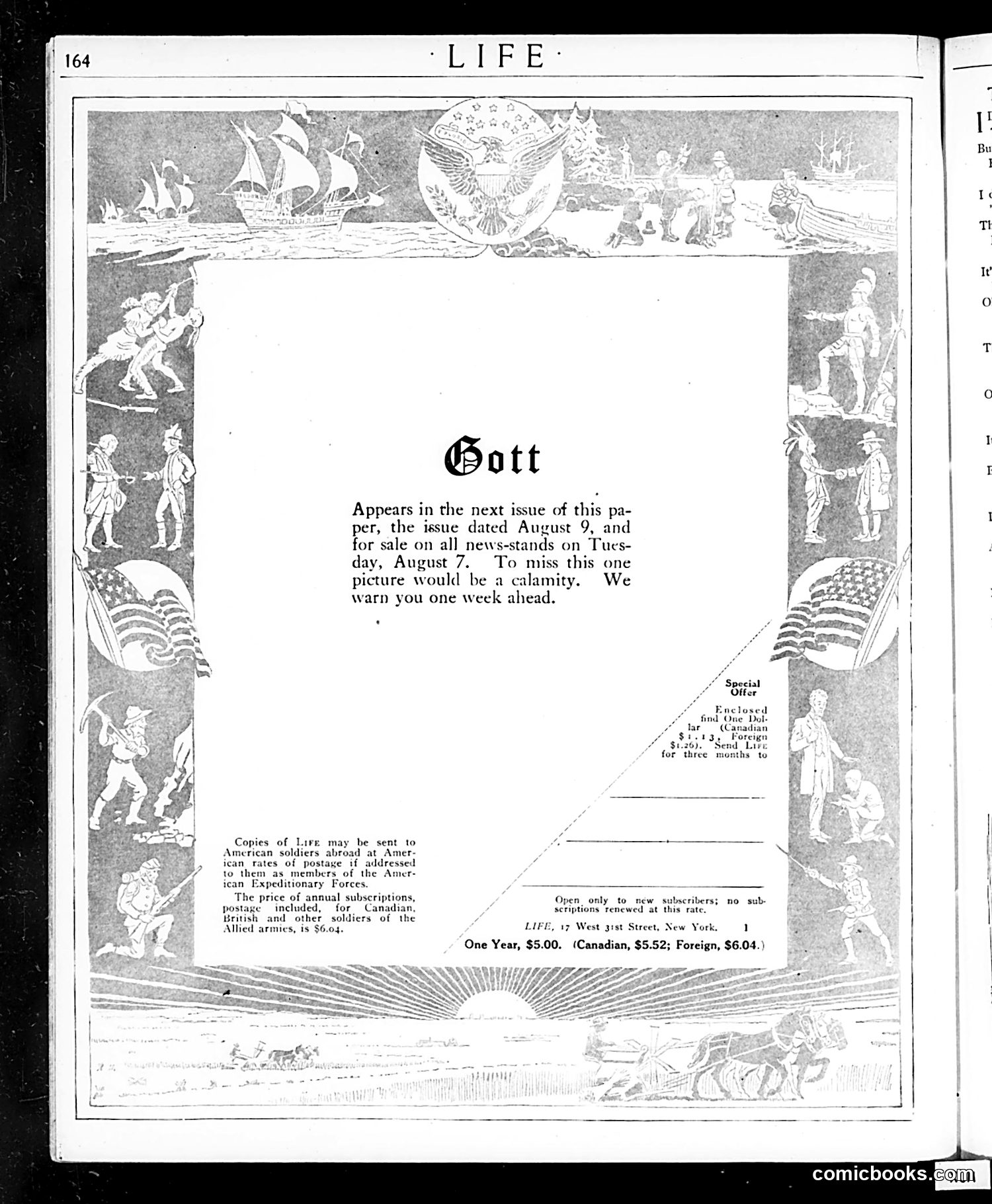
This page is primarily an **advertisement for LIFE magazine itself**, not a political cartoon. The decorative border features classical and patriotic imagery—colonial soldiers, ships, an eagle seal, and American flags—creating an ornamental frame around promotional text. The ad announces that "Gott" (likely a notable artwork or feature) will appear in the next issue, dated August 9, available August 7. It warns readers not to miss this picture, framing it as a "calamity" to do so. Below, subscription information is listed, including pricing ($5.00 annually domestically; $5.52 Canadian; $6.04 foreign) and a special offer for new subscribers. The patriotic design suggests this advertisement ran during wartime, emphasizing American values and military service through its visual elements.
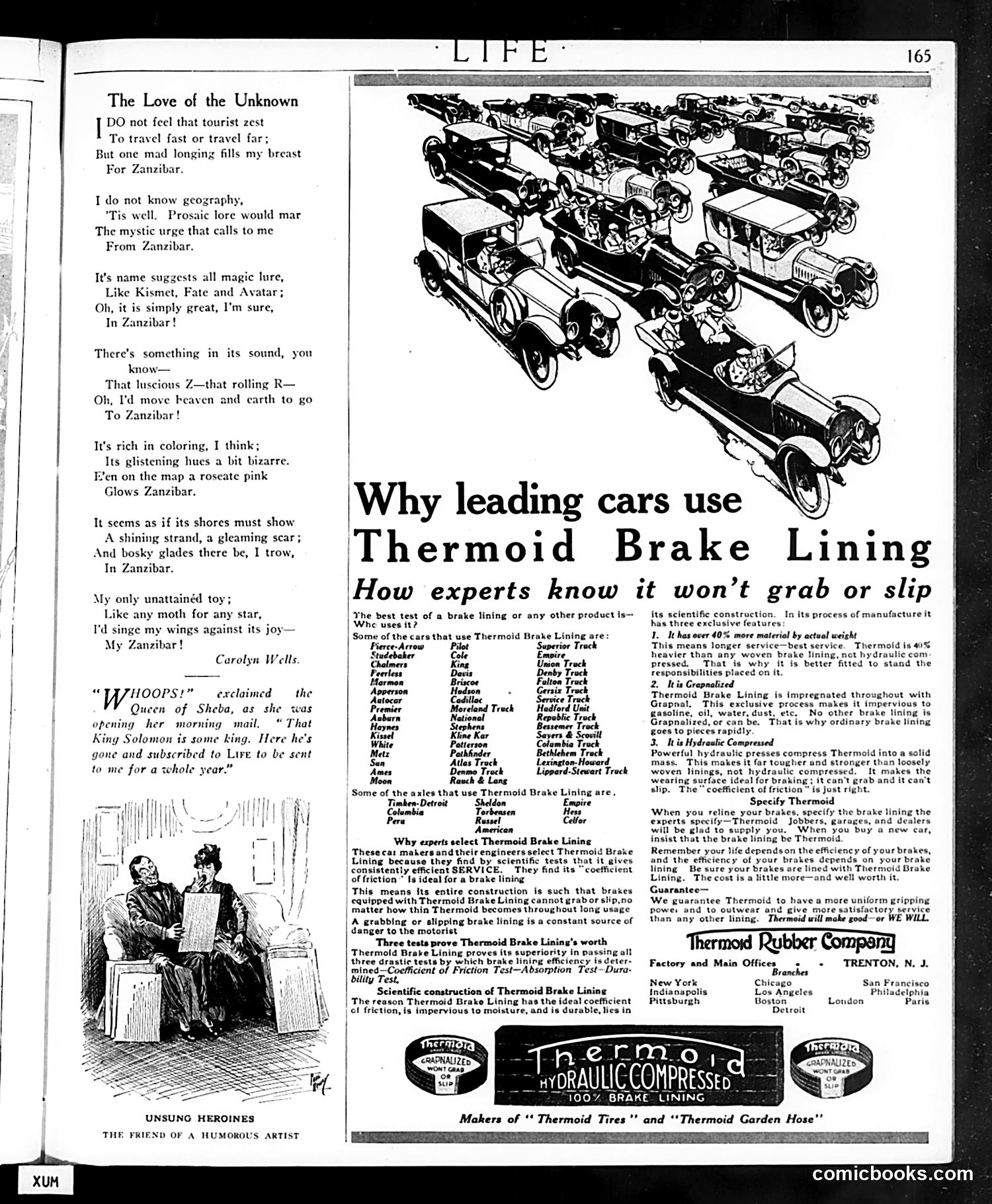
This page is primarily **advertising for Thermoid Brake Lining**, occupying roughly two-thirds of the space with product testimonials and technical specifications. The left side contains a poem titled **"The Love of the Unknown"** by Carolyn Wells, romanticizing travel to Zanzibar. Below it is a small cartoon captioned **"Unsung Heroines: The Friend of a Humorous Artist,"** showing two figures in what appears to be a domestic scene—likely a gentle joke about the patient spouse or companion supporting an artist's creative work. The page reflects early 20th-century magazine layout: editorial content mixed with substantial advertising. The Zanzibar poem suggests this *Life* issue emphasized exotic travel fantasies—common leisure aspirations of the era.
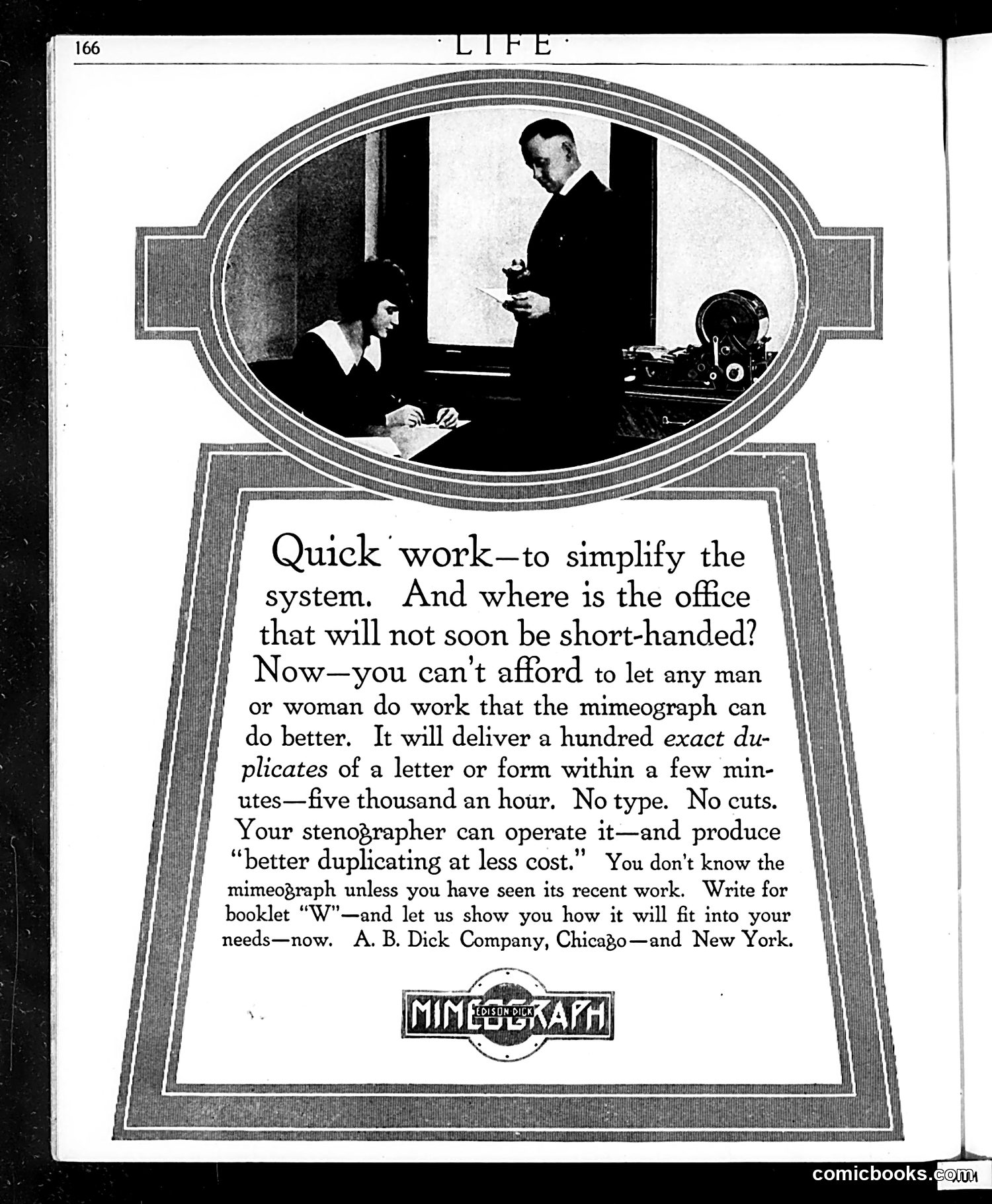
This page is primarily an **advertisement for the Mimeograph machine** by A.B. Dick Company (Chicago and New York), not political satire. The ad targets business efficiency concerns of its era. It depicts an office scene where a manager directs a stenographer to use the mimeograph rather than hiring additional clerical staff. The sales pitch emphasizes labor cost-reduction: the machine can produce "five thousand an hour" of duplicate documents "better" and "at less cost" than manual copying or hiring workers. The implicit message reflects early 20th-century office modernization anxieties—replacing human labor with technology. For modern readers, this foreshadows ongoing automation debates about job displacement, though framed here as pure efficiency gain without acknowledging the unemployment consequences.
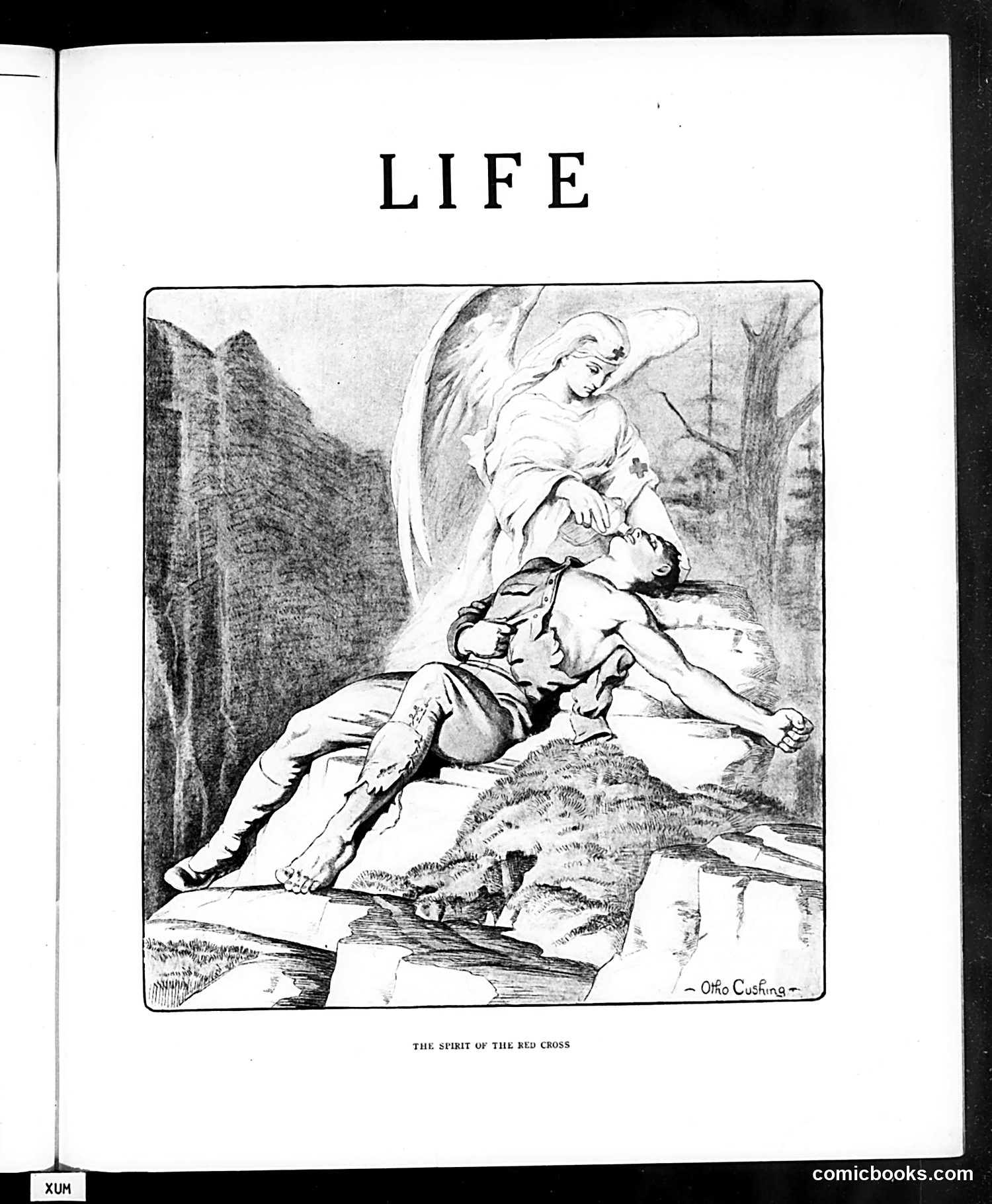
This is a title page for the magazine *Life*, featuring an illustration by Otto Cushing labeled "The Spirit of the Red Cross." The image depicts an angelic female figure (personifying the Red Cross) attending to a wounded soldier lying on the ground. The soldier appears injured or dying, with the angel cradling or comforting him. The setting includes rocky terrain and architectural ruins, suggesting a battlefield or war zone. This appears to be **wartime propaganda or charitable appeal imagery**, likely from either World War I or II era, promoting the Red Cross organization's humanitarian mission to aid wounded soldiers. The allegorical representation—using an angelic figure to embody the Red Cross's compassionate spirit—was common in early-to-mid 20th century American periodicals to encourage support for relief organizations and military causes.
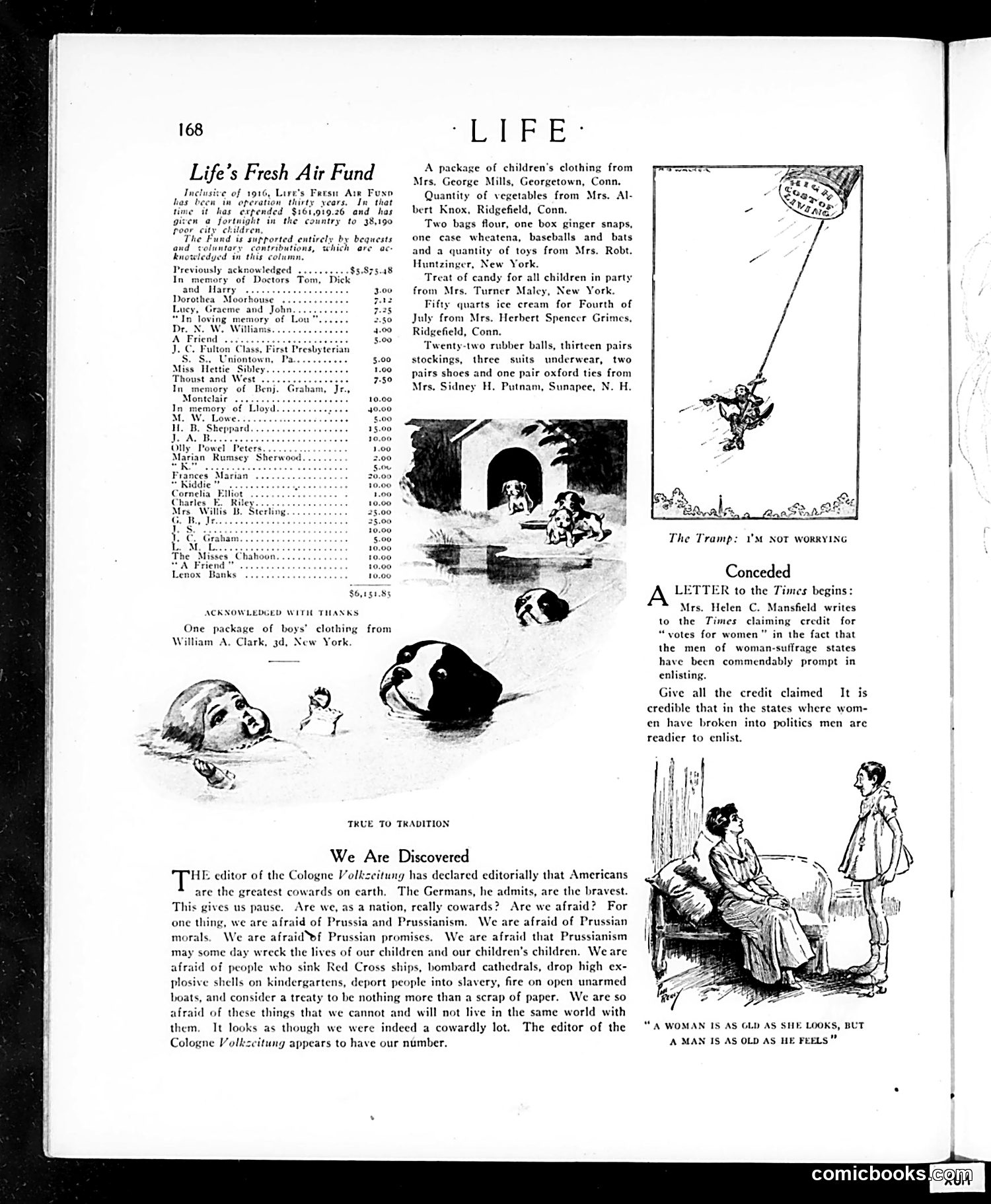
This page contains three distinct sections: **"Life's Fresh Air Fund"** (left): A charitable giving list documenting donations for children's relief—clothing, food, toys, and supplies from various donors. **"The Tramp: I'm Not Worrying"** (top right): A cartoon showing a vagrant on a swing, appearing carefree despite hardship—likely satirizing either naive optimism during economic hardship or commentary on class indifference. **"We Are Discovered"** (main article): Editorial commentary claiming Americans are "the bravest cowards on earth" compared to Germans. It expresses anxiety about Prussian militarism, suggesting Americans fear Prussian threats to civilization and children, yet consider negotiating peace treaties cowardly. This appears Cold War-era political commentary on American military resolve and moral character regarding European threats.
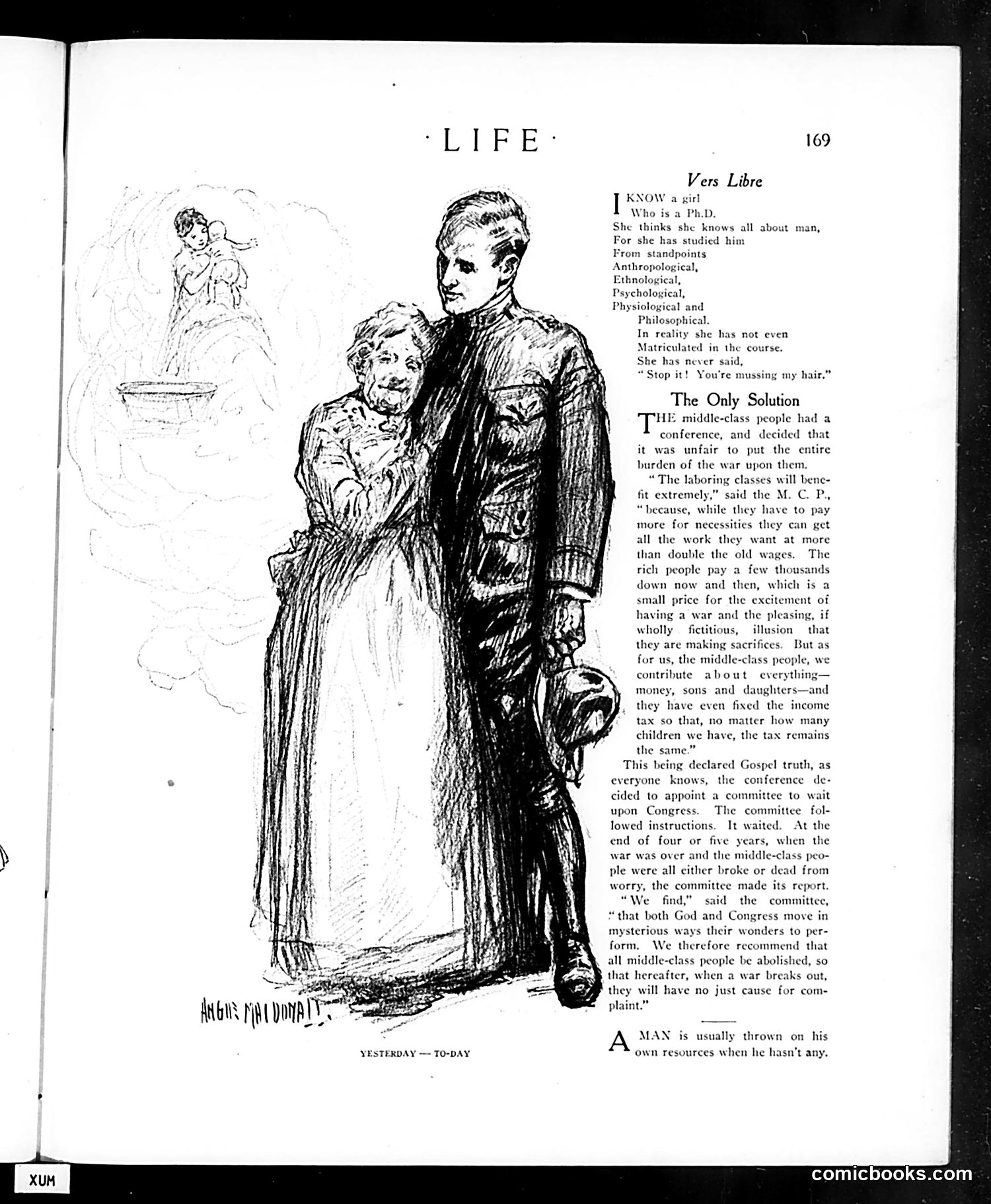
This page satirizes educated women and class anxiety during World War I. The poem "Vers Libre" mocks a woman with a Ph.D. who claims expertise in multiple academic fields ("Anthropological, Ethnological, Psychological") yet lacks practical knowledge—the joke being her pretension exceeds her actual understanding. "The Only Solution" presents a middle-class conference advocating the abolition of the middle class itself to solve war burdens. The committee's absurd logic—that eliminating middle-class people would prevent future complaints—satirizes how middle-class citizens bore financial and human costs of war while wealthy people profited. The sketch "Yesterday—To-day" (artist: Angus MacDonall) shows a couple, likely contrasting prewar and wartime circumstances, though specific figures are unclear from the image alone.
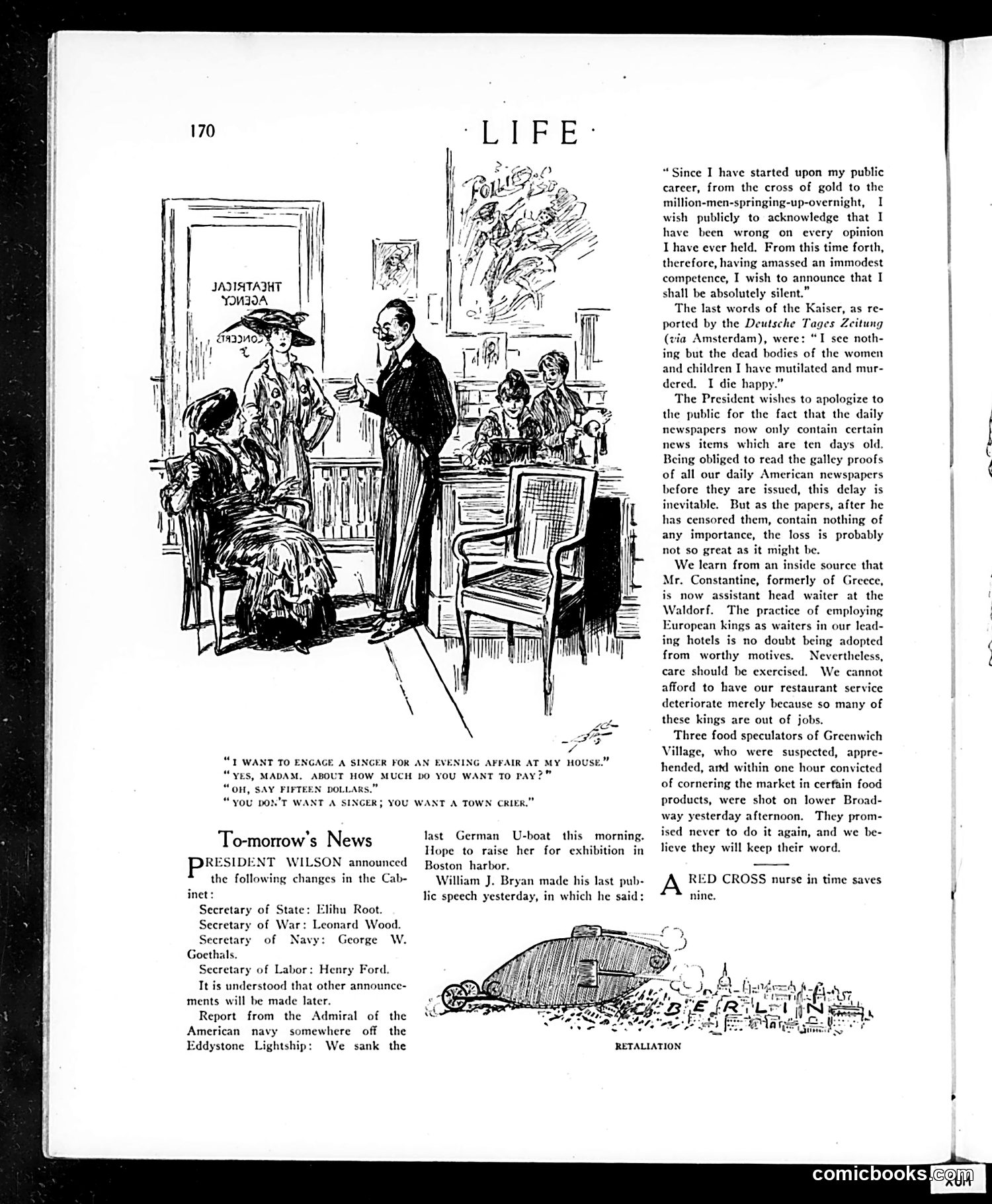
The main cartoon depicts a social scene where a wealthy woman (seated) is hiring entertainment, negotiating with a man about engaging "a singer for an evening affair." The dialogue reveals class commentary: when she asks the price, he suggests "fifteen dollars," but she responds "You don't want a singer; you want a town crier"—mocking the absurdly low offer. The satire targets wealthy socialites' penny-pinching despite their obvious affluence, exposing the contradiction between their social status and stingy treatment of working performers. The page also contains "To-morrow's News," listing Cabinet appointments, and brief news items about German U-boats and food speculators—typical wartime content, likely from WWI era based on the references.
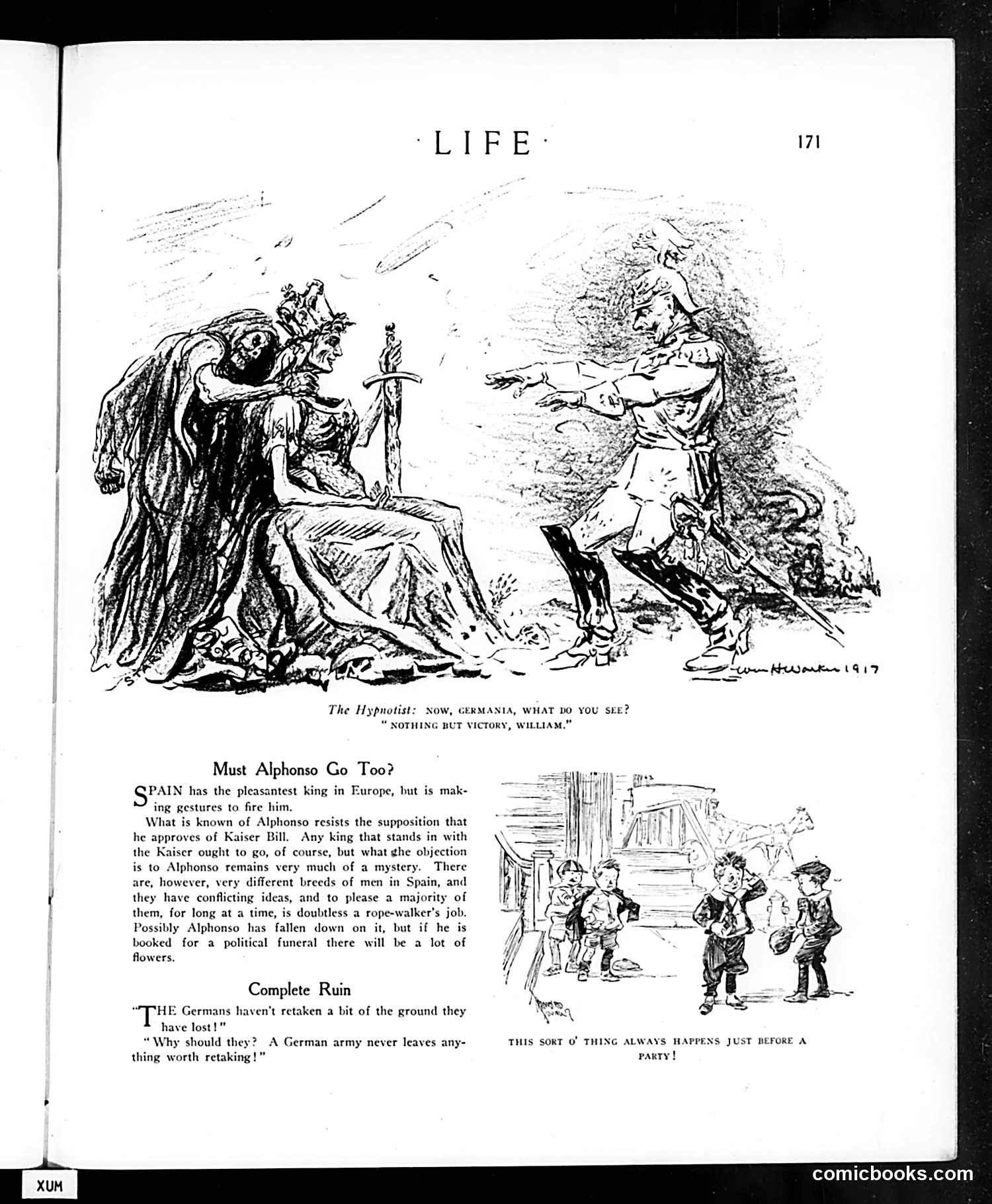
**Top Cartoon:** Depicts a hypnotist (seated, left) apparently influencing "Germania" (personified Germany, right). The caption reads: "Now, Germania, what do you see? 'Nothing but victory, William.'" This satirizes Germany's alleged blind obedience to Kaiser Wilhelm II's war aims during World War I. **Middle Section:** "Must Alphonso Go Too?" discusses Spain's King Alfonso XIII and whether he should follow the Kaiser's fate (presumably exile or defeat). The piece notes conflicting Spanish political factions and suggests Alfonso may face a "political funeral." **Bottom Cartoon:** Shows civilians before a party, captioned "This sort o' thing always happens just before a party!"—a satirical commentary on social disruption during wartime. All content reflects 1917 WWI-era concerns.
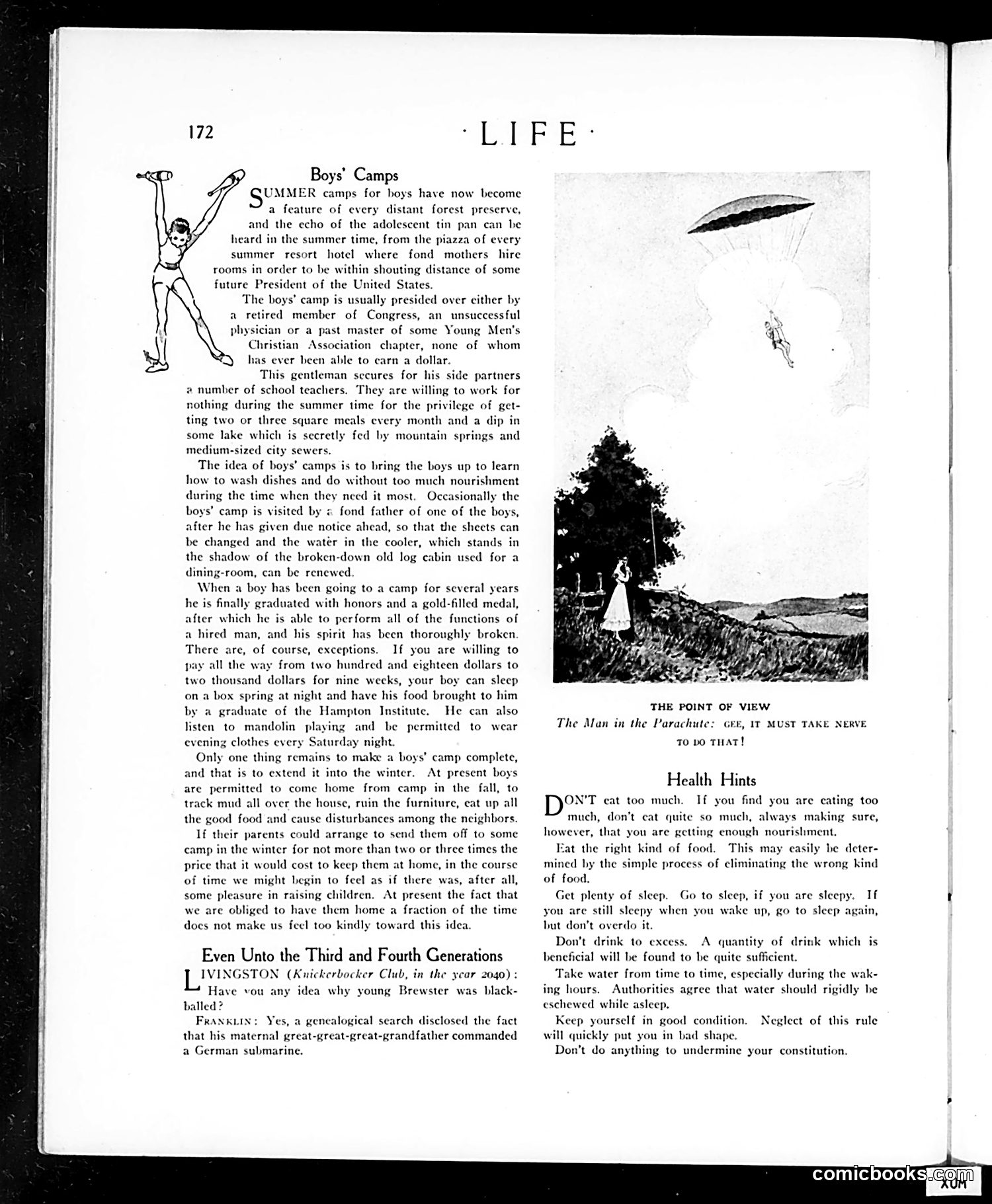
This page satirizes **boys' summer camps**, a growing trend where wealthy families sent sons away. The satire targets the camps' pretentious leadership—"retired members of Congress, unsuccessful physicians or past masters of some Young Men's Christian Association chapter"—and their meager compensation ("none of whom has ever been able to earn a dollar"). The humor mocks the camps' claimed educational mission (teaching boys self-sufficiency) while describing inadequate food and conditions secretly supplemented by "mountain springs and medium-sized city sewers." The accompanying illustration titled "The Point of View" shows a man in a parachute, captioned "The Man in the Parachute: 'See, it must take nerve to do that!'"—likely satirizing how camp directors present hardship as character-building adventure. The "Health Hints" section appears unrelated filler content.
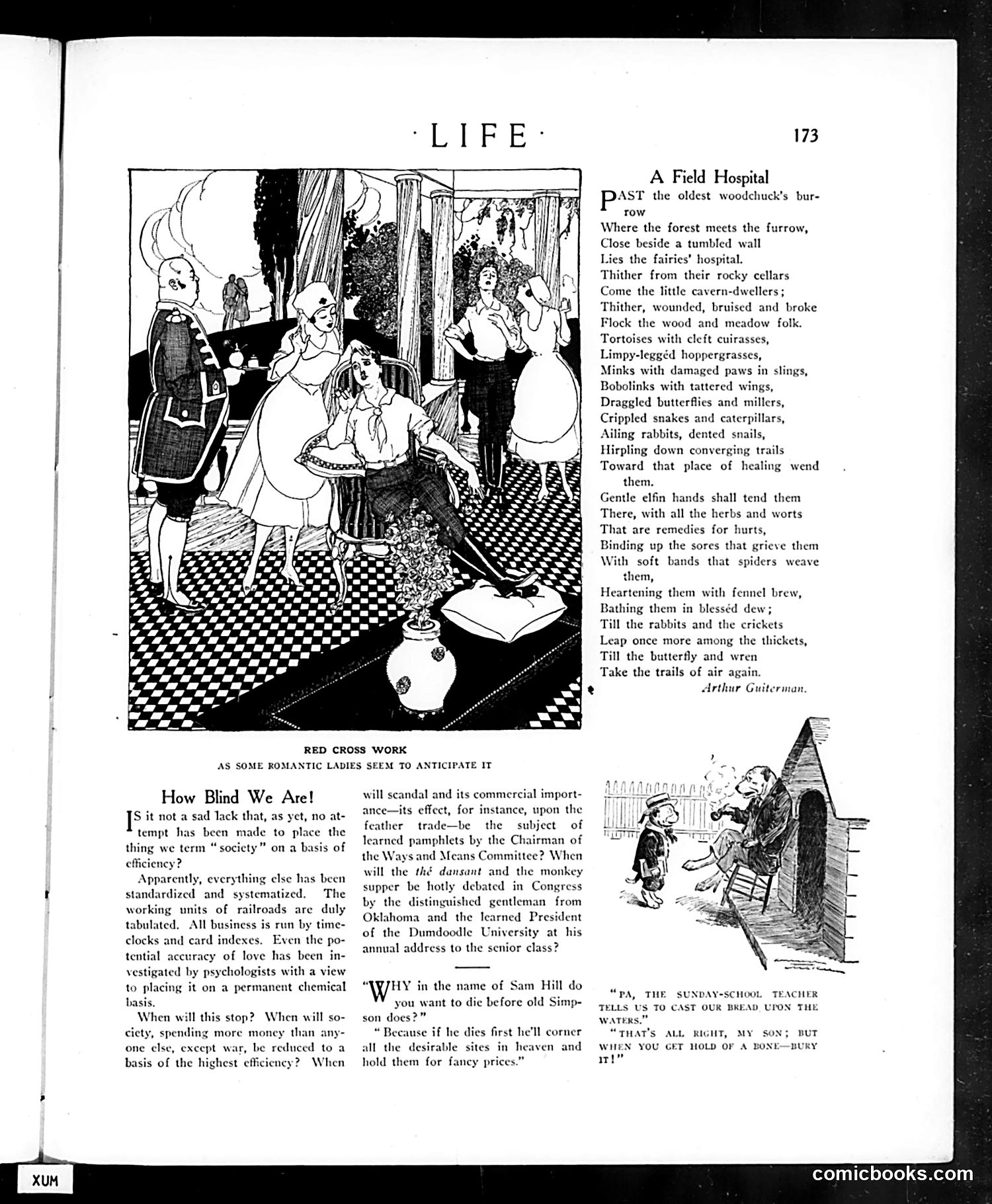
The main illustration depicts a whimsical fairy hospital treating wounded forest creatures—tortoises, butterflies, snakes, rabbits—with gentle elf care. This is Arthur Guiterman's poetic vision of compassionate medical treatment. Below, "How Blind We Are!" satirizes American society's standardization and efficiency obsession. The author criticizes how "society" has become systematized like business operations, with even love subjected to psychological analysis and "permanent chemical basis." The piece mocks contemporary social trends, particularly the era's fascination with scientific management and rationalization of human experience. The small cartoon below shows a Sunday-school teacher telling children to "cast our bread upon the waters"—a biblical reference—suggesting ironic contrast between spiritual wisdom and modern materialistic efficiency culture.
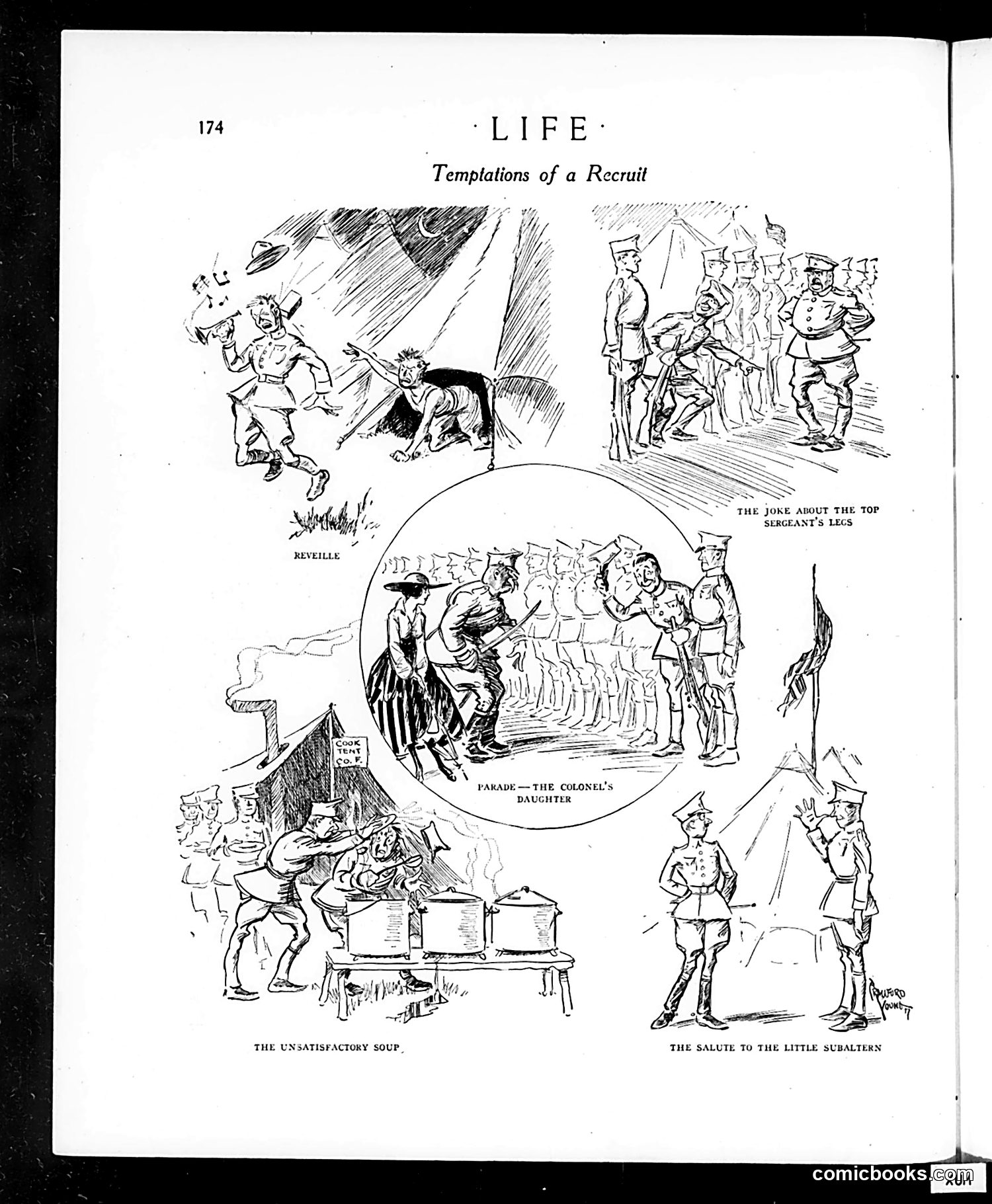
This page presents six cartoon vignettes showing the humorous challenges facing a new military recruit. The titled scenes depict: **"Reveille"** — A soldier struggling to wake up early **"The Joke About the Top Sergeant's Legs"** — Recruits laughing at a superior officer **"Parade — The Colonel's Daughter"** — A distraction during formal military proceedings **"The Unsatisfactory Soup"** — Poor camp food causing complaint **"The Salute to the Little Subaltern"** — Protocol confusion with junior officers The satire mocks the discomforts and absurdities of military training: exhaustion, hierarchical absurdities, romantic distractions, bad food, and confusing regulations. It's gentle humor about the universal recruit experience—the gap between military discipline and human weakness—rather than serious critique.
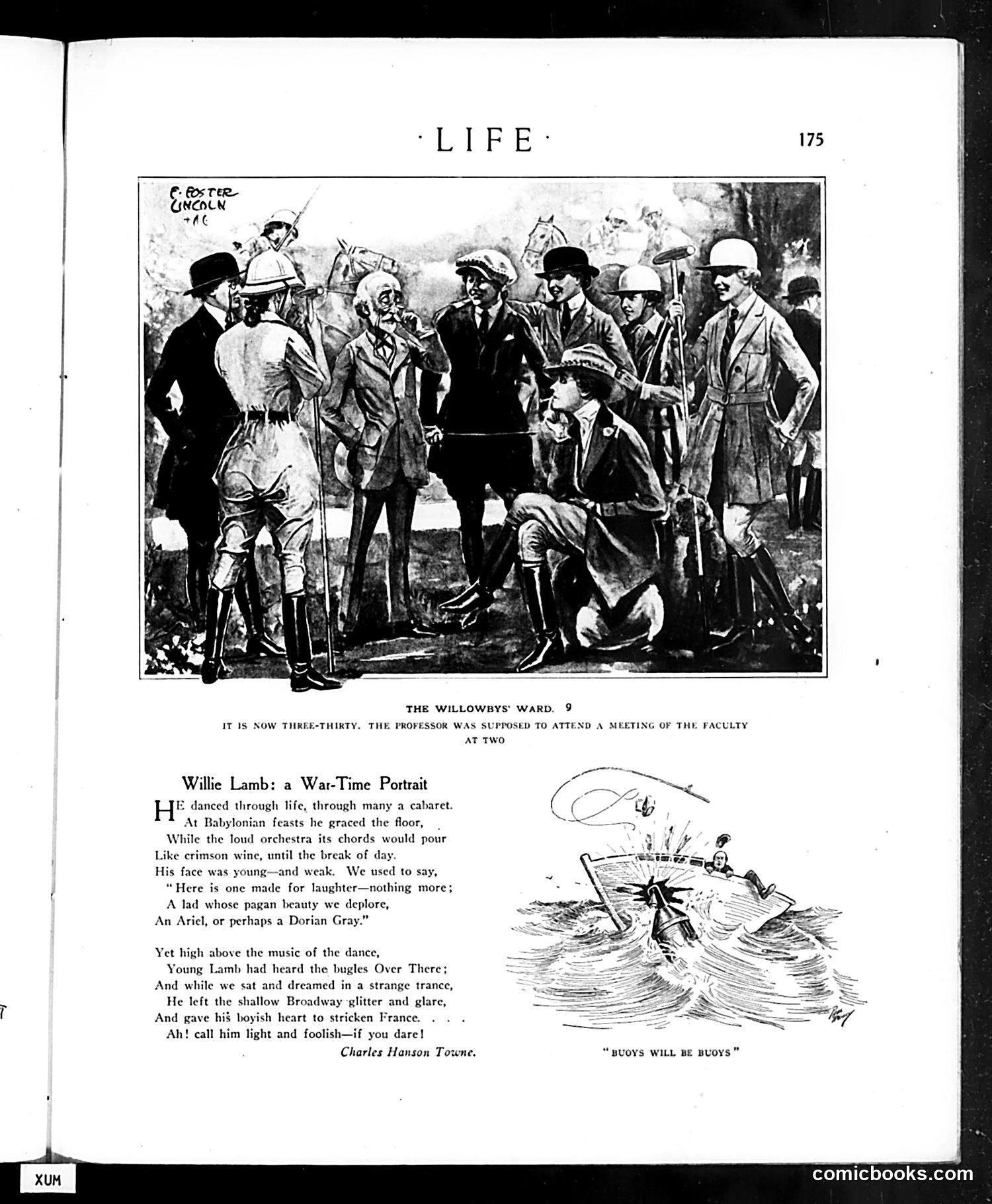
The top illustration, labeled "The Willowbys' Ward," depicts a military or official gathering, though the specific historical context isn't clear from the image alone. Below this is a poem titled "Willie Lamb: a War-Time Portrait" by Charles Hanson Towne. The poem describes Willie Lamb as a frivolous young man—beautiful but weak, compared to mythological figures like Ariel or Dorian Gray. The satire suggests that despite his shallow nature and love of Broadway entertainment, Lamb patriotically left to fight in France during wartime. The accompanying illustration shows a sailor or soldier figure in water, captioned "Buoys WILL BE BUOYS"—a pun on the phrase "boys will be boys," mocking Lamb's transformation from entertainer to soldier. The overall piece appears to satirize young men who abandon shallow peacetime pursuits for military service.
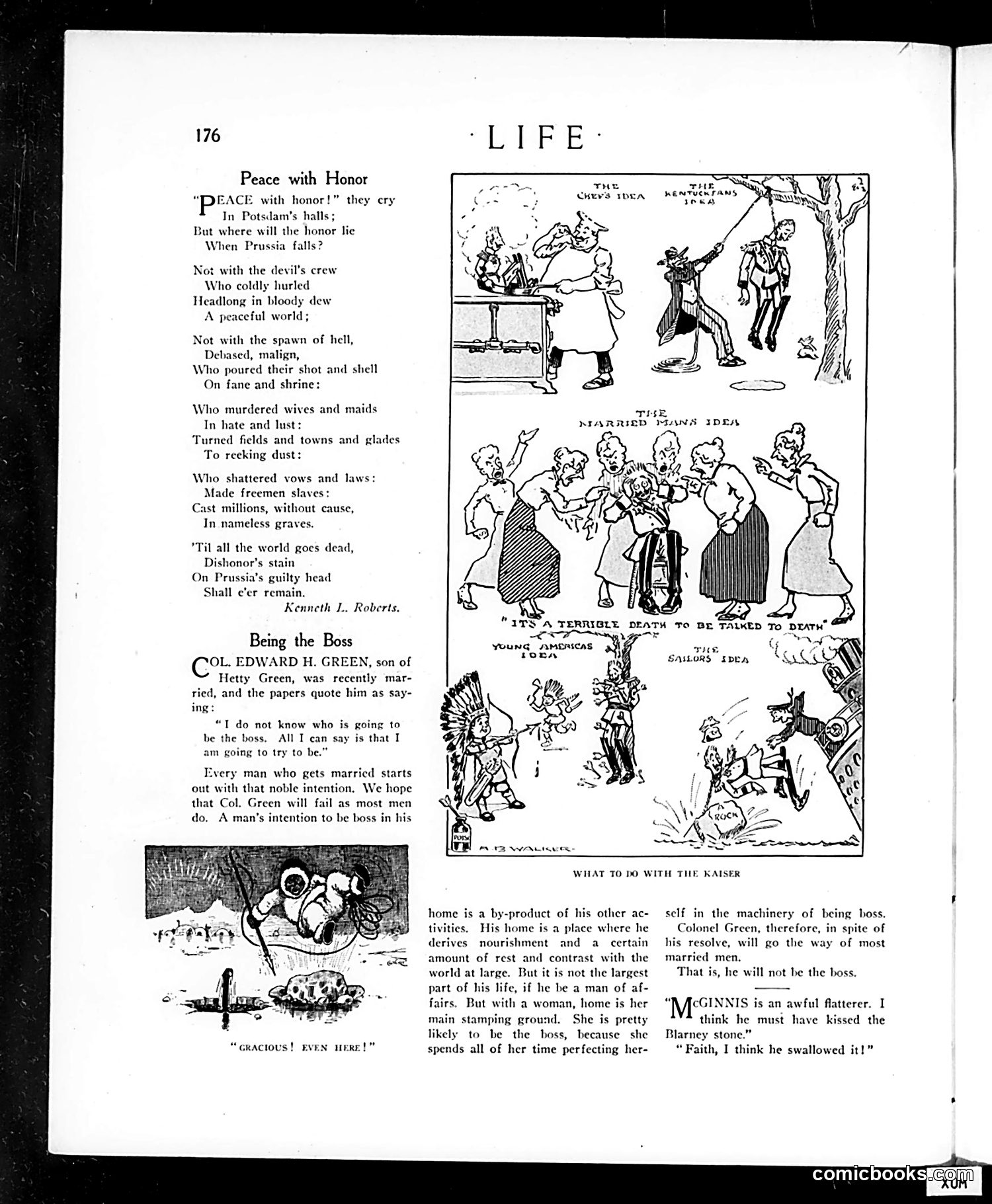
This page contains two distinct pieces of WWI-era satire: **"Peace with Honor"** is a poem condemning Prussia/Germany's conduct in World War I. It argues that any peace treaty cannot restore honor to Germany because of their alleged atrocities: killing civilians, destroying towns, murdering women and children, and enslaving populations. The poem insists Germany's "dishonor's stain" will remain permanent. **"Being the Boss"** satirizes newlywed Colonel Edward H. Green (son of the wealthy "Hetty Green"), who claimed he'd be "the boss" in his marriage. The piece humorously predicts he'll fail like most men, noting that while home is merely one part of a man's life, it's a woman's primary domain—so wives typically end up in control despite men's intentions. The cartoon panel "What to Do with the Kaiser" shows various satirical proposals for dealing with the German leader through humorous punishments, reflecting widespread anti-German sentiment of the period.
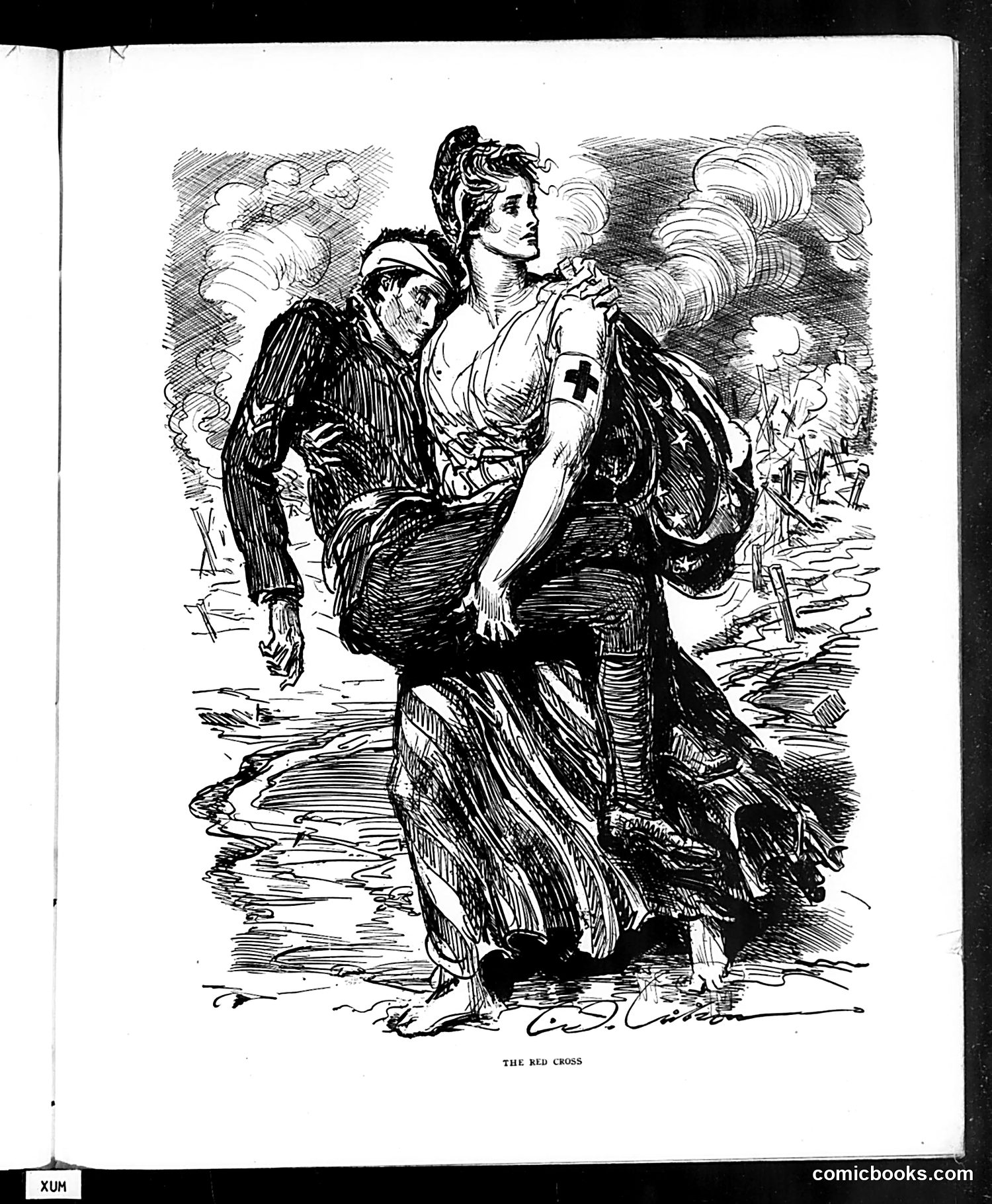
This illustration depicts a female figure representing the Red Cross organization, identifiable by the cross armband on her sleeve. She carries a wounded or suffering soldier, suggesting the organization's role in providing medical aid to military casualties. A male figure (appearing to be a soldier or military man) stands beside her, seemingly in support or observation. The artwork appears to celebrate the Red Cross's humanitarian mission during wartime—likely referencing World War I, given Life magazine's active period and the style of military dress shown. The satire likely comments on the Red Cross's public prominence and charitable efforts, though the specific satirical angle remains unclear from the image alone. The sketch style and composition emphasize the organization's noble purpose of caring for the wounded.
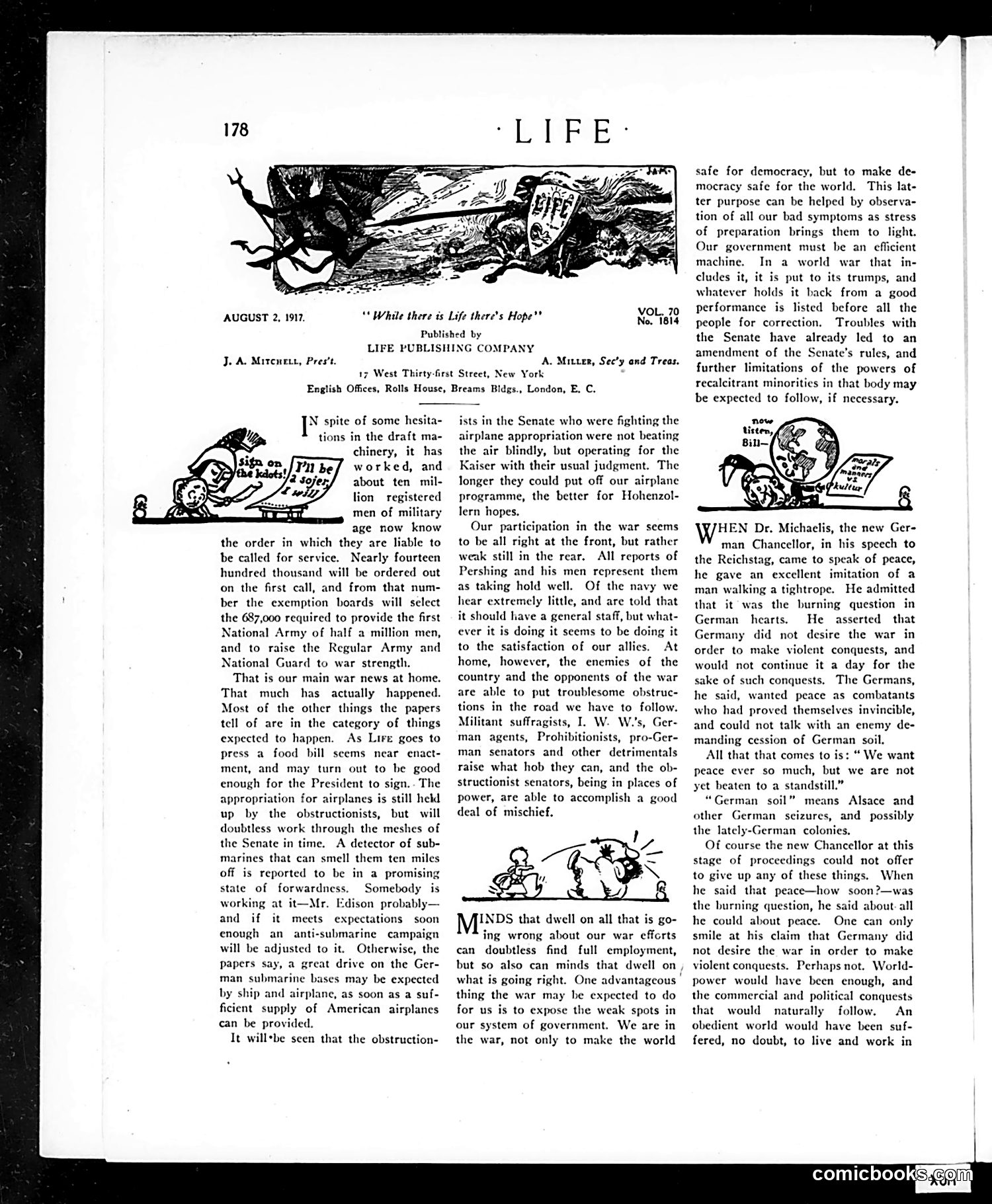
This page analyzes American obstacles to the war effort following U.S. entry into World War I (April 1917). The main cartoon depicts a figure labeled "I'll be a safer" (unclear exact reference, possibly mocking a pacifist or obstructionist). The editorial identifies domestic "enemies of the country" hindering the war: militant suffragists, IWW members (radical labor), German agents, Prohibitionists, and pro-German senators. It argues these "obstructionists" deliberately delay critical resources like airplane appropriations to benefit Germany and the Kaiser. Life frames this positively—that wartime stress will expose governmental weaknesses and force democratic reforms. The piece mentions General Pershing's front-line success contrasting with rear-area political obstruction, and celebrates the draft machinery's initial success, mobilizing approximately 687,000 men for the National Army. The satire targets domestic political opponents of full war mobilization as effectively sabotaging American military capacity.
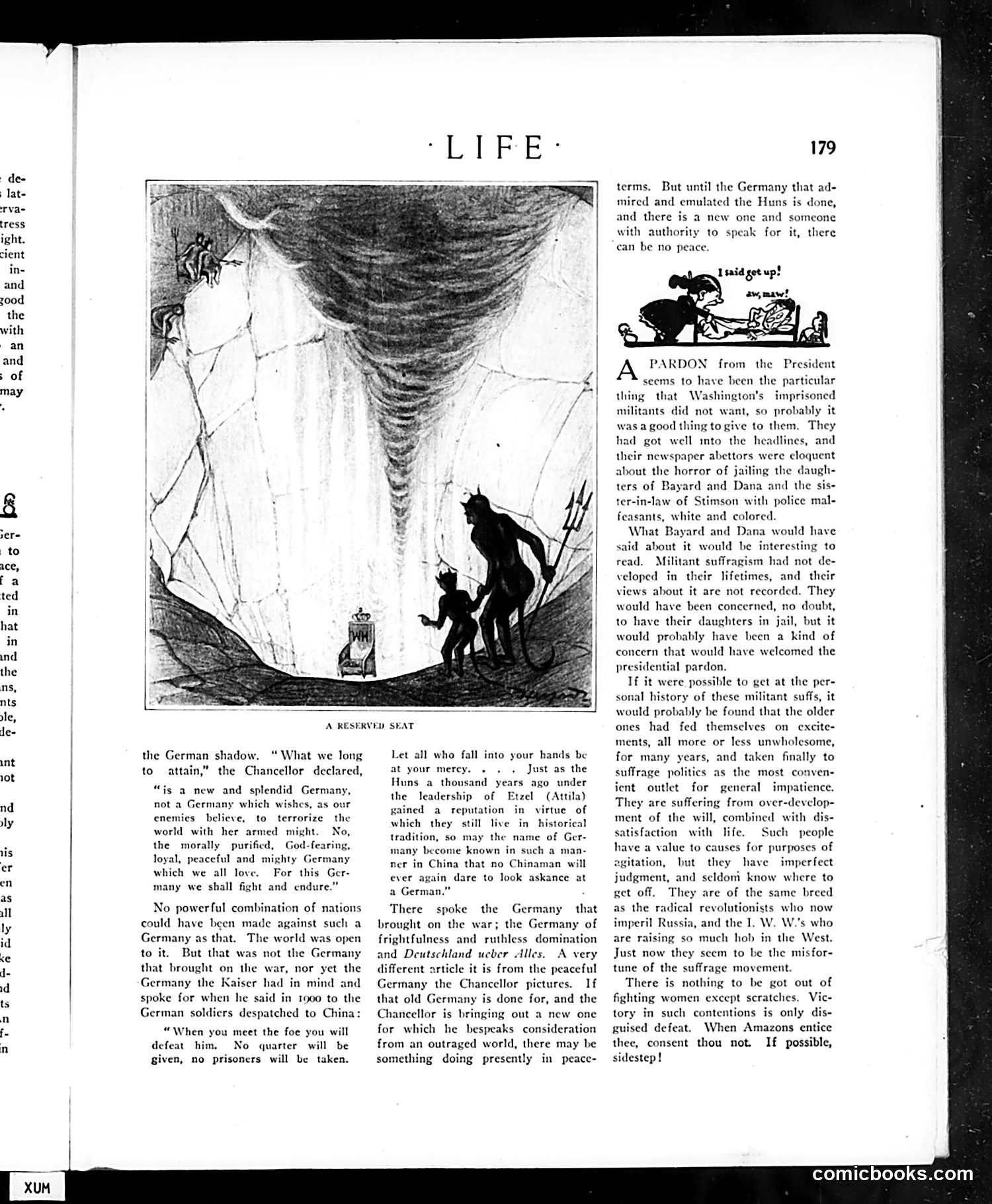
The main cartoon depicts figures (appearing to represent German leadership or the German state) sitting in a reserved theater seat beneath a towering, menacing silhouette—likely representing the legacy of Hun brutality and German militarism looming over Germany's claimed "reformation." **Political Context:** This is WWI-era satire. The accompanying text contrasts the German Chancellor's 1918 promises of a "new and splendid, peaceful Germany" against historical evidence: the Kaiser's brutal 1900 orders to German troops in China ("Just as the Huns...gained a reputation...so may the name of Germany become known"). **The Point:** Life's editors argue Germany cannot credibly claim transformation while the old militaristic Germany—the one that started the war—remains. The "reserved seat" suggests this violent past is permanently reserved for Germany; it cannot escape its shadow simply through rhetoric about peace. The secondary text criticizes imprisoned women suffragists receiving presidential pardons, comparing militant feminists unfavorably to radical revolutionaries.
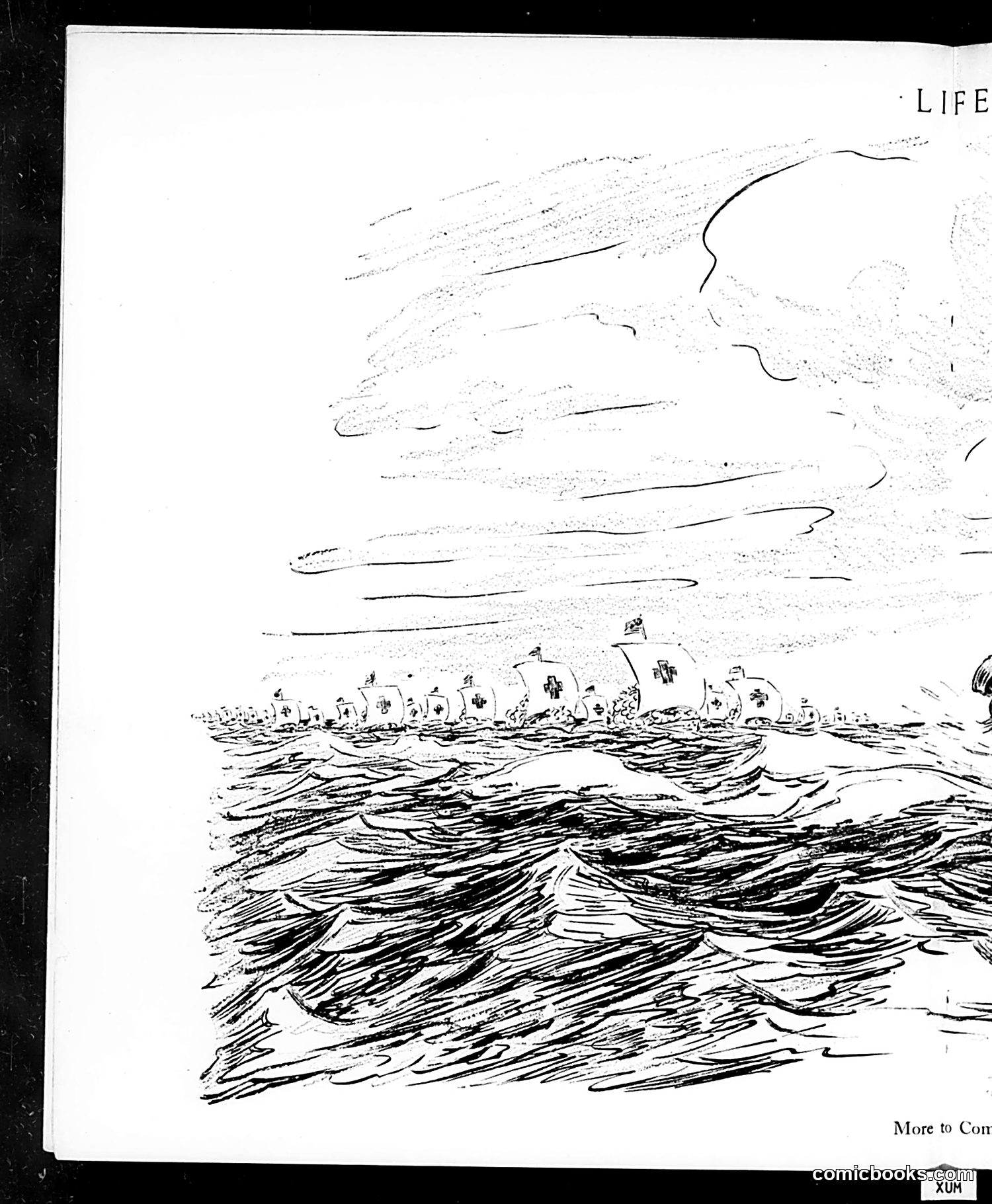
This page shows a satirical maritime scene. A fleet of small sailing vessels with crosses on their sails appears on the horizon, depicted in detailed pen-and-ink style. The crosses suggest religious or crusading imagery. Below, turbulent ocean waves dominate the lower portion of the composition. The title "LIFE" appears in the top right corner, with partial text "More to Con[tinue]" at the bottom, indicating this is part of a larger narrative or series. The specific historical or political reference is unclear without additional context or caption text that may be obscured or cut off in this reproduction. The crusading vessel imagery could reference various historical religious or military campaigns, but identifying the precise satirical target requires information not visible in this image alone.
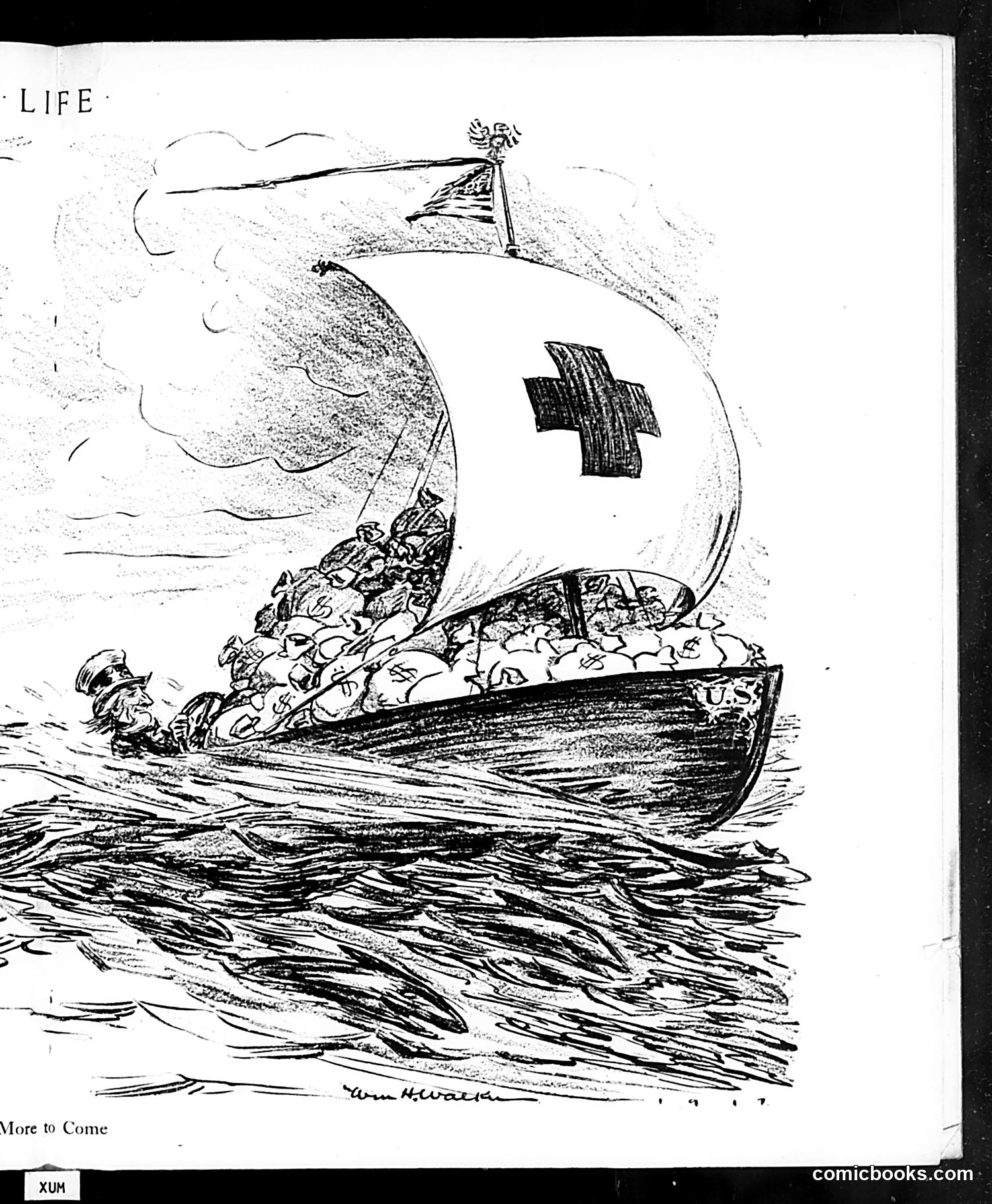
This editorial cartoon from *Life* magazine depicts a boat marked "U.S." carrying what appears to be wounded or dead figures, with a Red Cross symbol on the sail. The vessel is navigating turbulent waters amid storm clouds. The image appears to be **WWI-era propaganda or commentary** about American military casualties or involvement in the war. The Red Cross symbol suggests medical/humanitarian concerns, while the stormy seas and struggling boat represent dangerous conditions soldiers face. The phrase "More to Come" (bottom left) indicates the cartoonist is predicting continued American losses or military engagement ahead. Without a visible date or artist signature being clearly legible, precise dating is difficult, but the artistic style and maritime symbolism are consistent with early 20th-century American political cartooning.
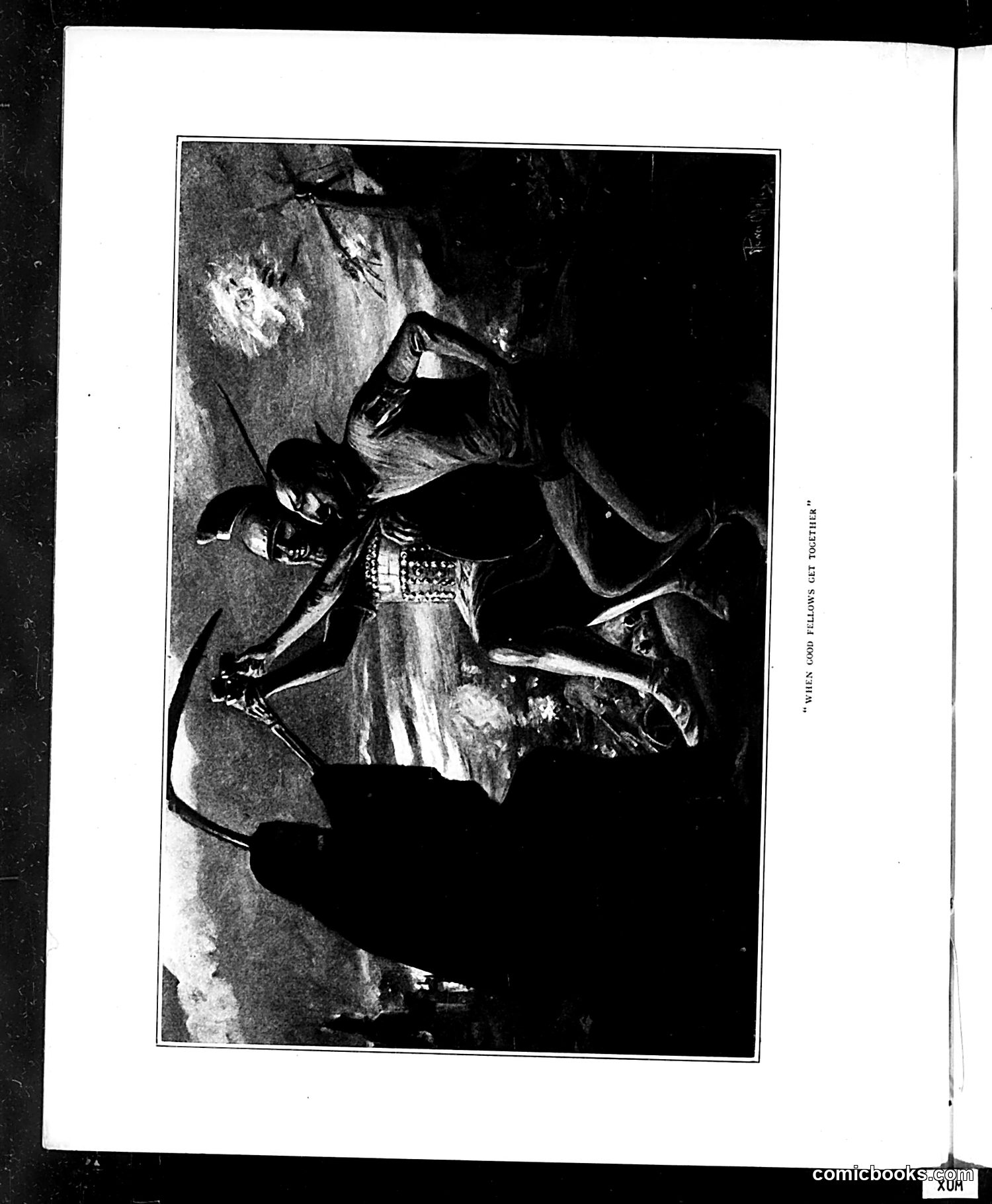
This black and white photograph appears to show a figure in elaborate theatrical or ceremonial costume, featuring ornate clothing with detailed embroidery or beading and flowing fabric. The figure is positioned dramatically against a textured background. The caption reads "WHEN LORD FELLOWS MET ELIZABETH" (or similar—OCR uncertain), suggesting this depicts a historical or theatrical scene involving a meeting between notable figures. However, **I cannot definitively identify the specific individuals, historical event, or satirical point** from the image alone. The theatrical presentation and Life magazine's satirical nature suggest this may be mocking a historical moment, but without clearer caption text or additional context, I cannot accurately explain what political or social commentary is intended for a modern reader.
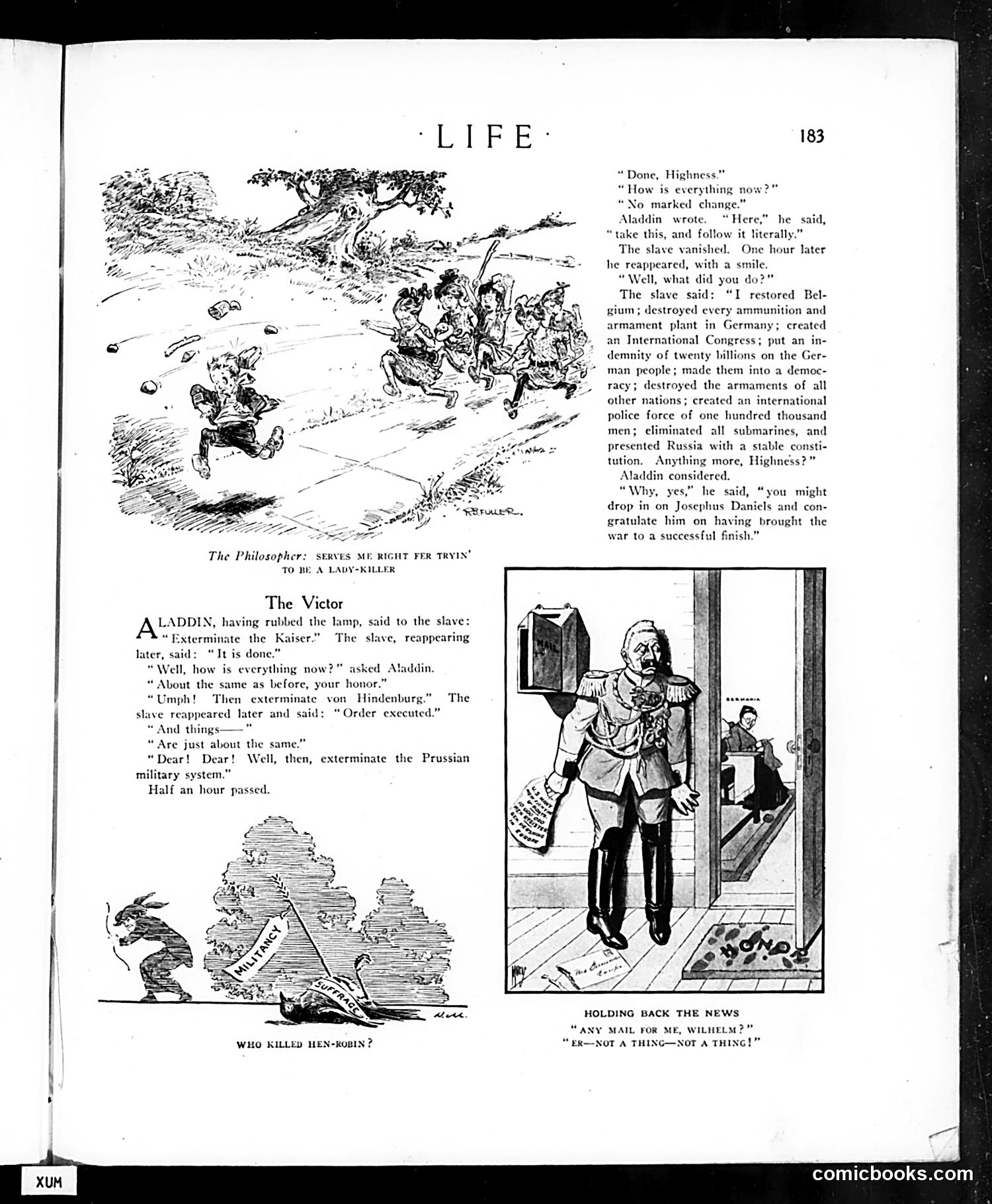
This is a satirical story using the Aladdin magic-lamp framework to critique post-WWI peace efforts. Aladdin orders a genie-slave to eliminate the Kaiser, then von Hindenburg, then the Prussian military system—each time conditions remain "about the same," mocking the idea that removing individual leaders solves fundamental problems. When finally ordered to accomplish *real* peace, the slave lists impossibly idealistic reforms: restoring Belgium, destroying all weapons worldwide, creating international governance, establishing democracy in Germany, forming an international police force, and stabilizing Russia. The final joke targets **Josephus Daniels** (U.S. Secretary of the Navy during WWI), sarcastically congratulating him for ending the war—implying that despite grand political gestures and military victory, the actual conditions for lasting peace remained unachieved. The satire suggests that winning a war militarily doesn't automatically create the political/social transformation necessary for genuine peace.
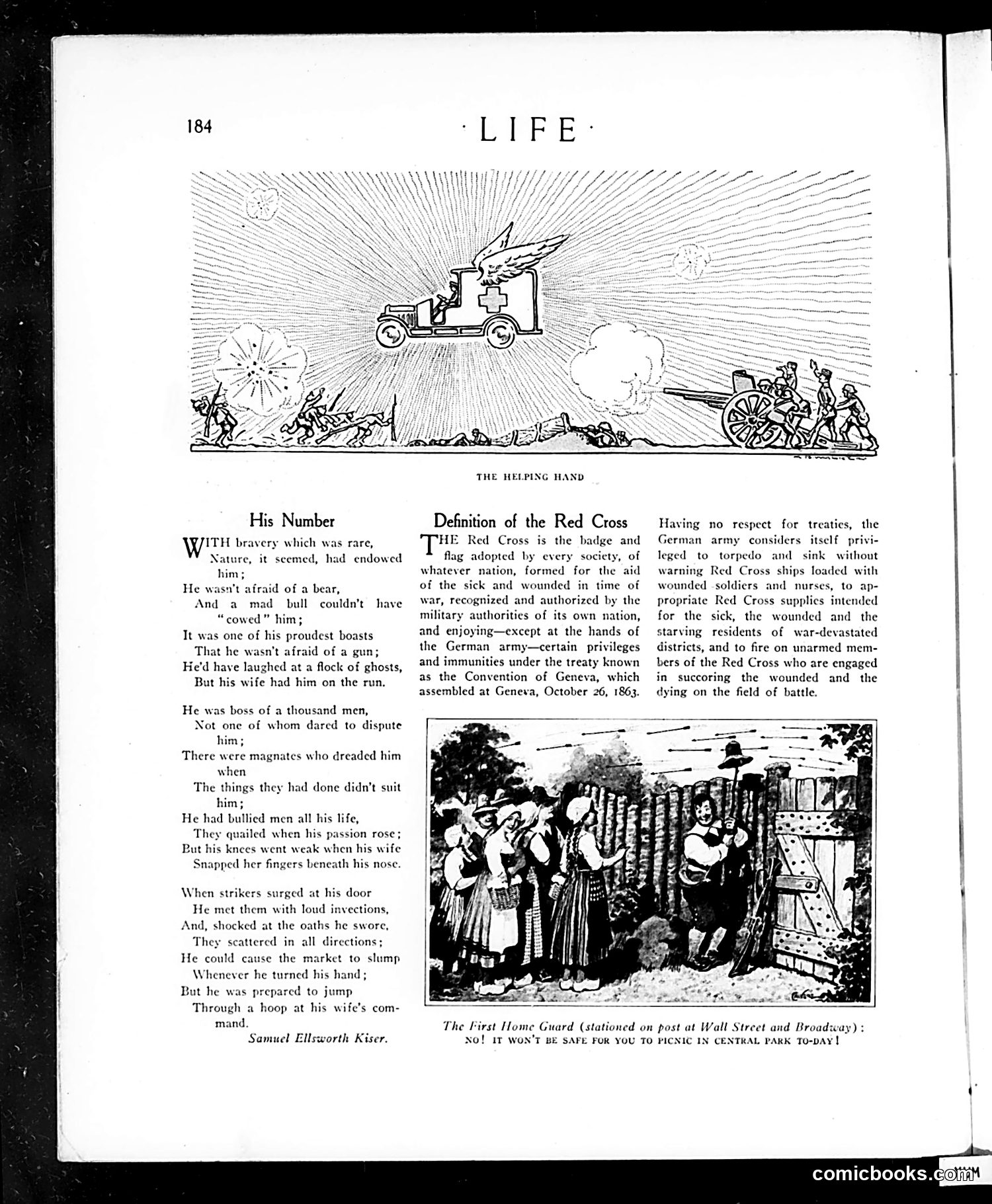
**"His Number"** (poem by Samuel Ellsworth Kiser): A satirical poem about masculine authority and domestic power dynamics. The subject is a powerful businessman—a bully to his thousand employees, market manipulator, and strike-breaker—yet completely dominated by his wife. The humor derives from the ironic reversal: this tyrant "jumps through hoops" at her command. It's social commentary on how domestic relationships can humble even the most domineering men. **"The Helping Hand"** section critiques German military conduct during World War I. The definition of the Red Cross is immediately undercut by accusations that Germany violates its protections—torpedoing Red Cross ships, stealing medical supplies, and firing on unarmed Red Cross workers. This appears designed to generate outrage at German disregard for humanitarian law. **Bottom cartoon**: Shows armed soldiers guarding Wall Street/Broadway, warning civilians against Central Park picnics due to safety concerns—likely referencing wartime security anxieties or recent violence in New York.
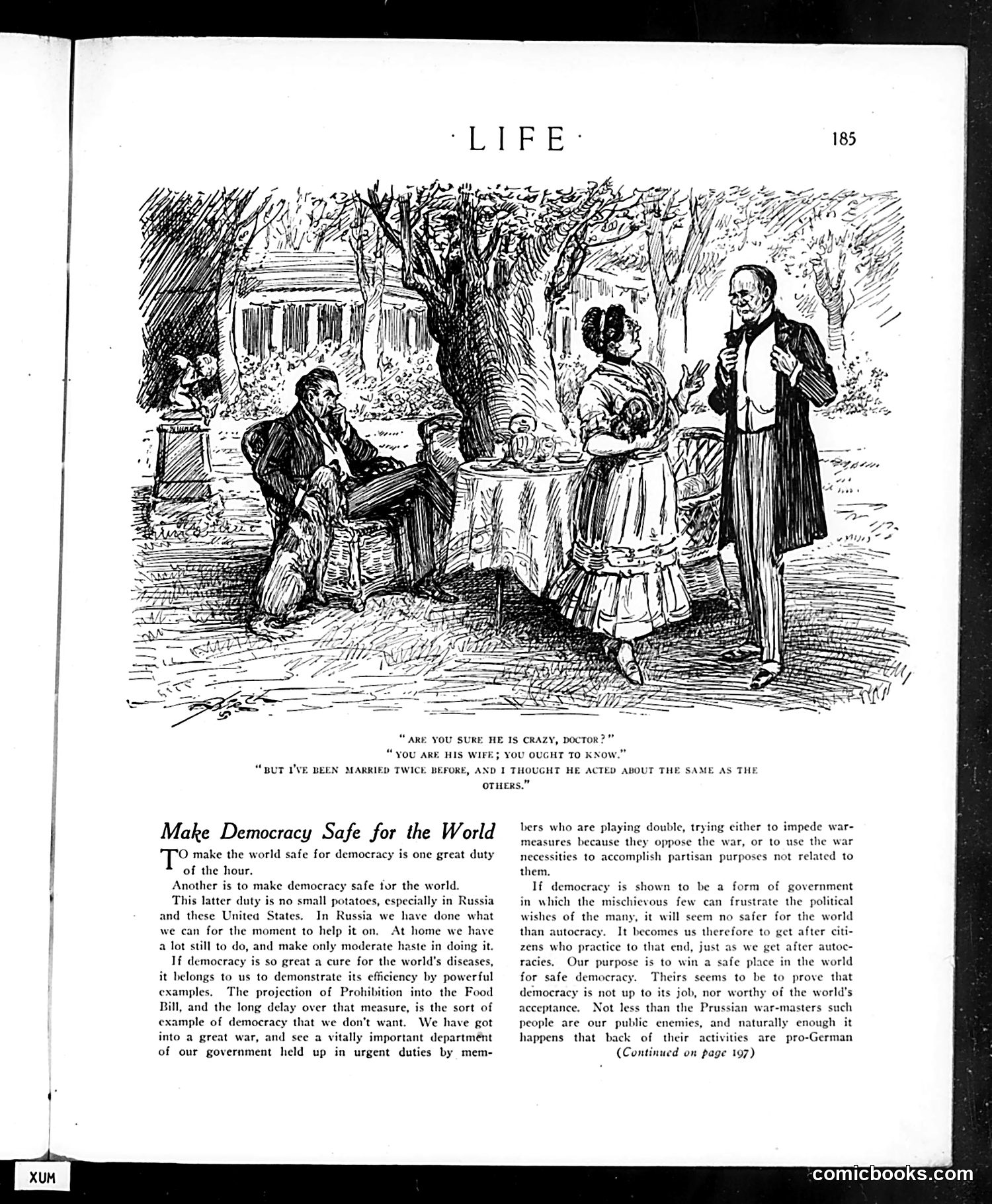
**The Cartoon:** The sketch depicts a domestic scene where a doctor is questioned about a husband's sanity. The wife responds that she's been married twice before and her current husband "acted about the same as the others"—a joke suggesting that male behavior (implied to be foolish or unreasonable) is universally consistent across husbands, so she cannot determine if this one is uniquely "crazy." **The Article: "Make Democracy Safe for the World"** Written during WWI (references to "great war" and Russia), this piece argues Americans must demonstrate democracy's competence at home to justify promoting it globally. The author criticizes Congress members who obstruct war legislation—specifically mentioning Prohibition riders attached to a Food Bill—as undermining democracy's credibility. He equates such obstruction with enemy activity, claiming some opposition is "pro-German." The piece calls for eliminating internal political obstacles to war effort success, framing partisan politics as a threat to democratic legitimacy itself. **The Satire:** Life uses both jest and serious argument to pressure compliance with wartime governance.
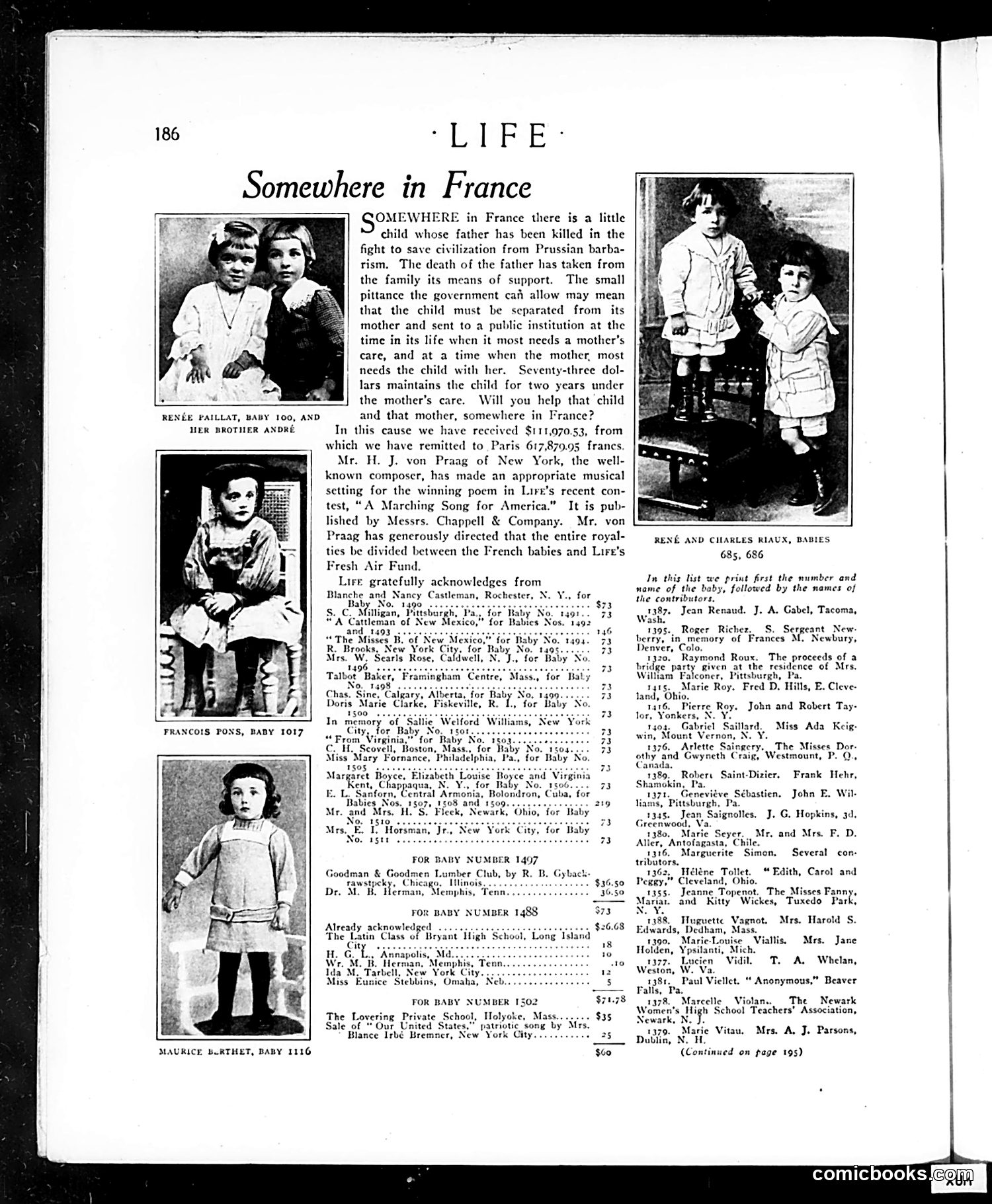
This page is a **fundraising appeal**, not satire. Life magazine is soliciting donations to support French war orphans and widows whose fathers/husbands died in World War I fighting against Germany ("Prussian barbarism"). The photographs show actual French children maintained under the program: the orphans are identified by number (e.g., "Baby 100," "Baby 1116"). The text explains that $73 supports a child for two years under maternal care—the alternative being institutional placement. The bulk of the page lists **donor acknowledgments** with contribution amounts, showing how Life solicits and tracks charitable giving. Composer H. J. von Praag donated royalties from his musical setting of a patriotic poem. This reflects American sympathy for France during WWI and the era's reliance on private charitable organizations rather than government welfare. The emotional appeal ("when it most needs a mother's care") targets readers' sentiment to encourage donations for a cause presented as humanitarian necessity.
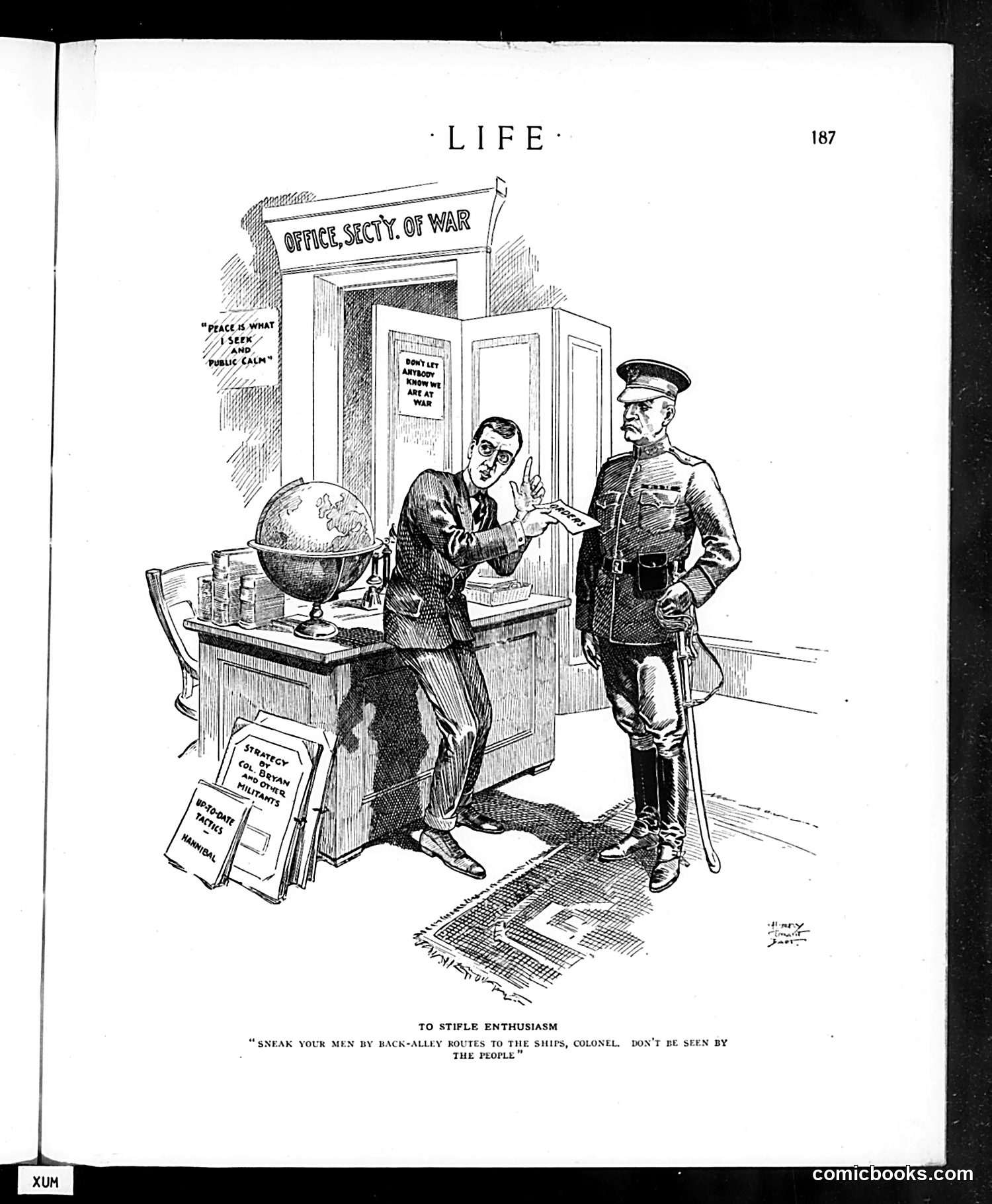
This WWI-era satire depicts an official at the War Department office instructing a military colonel to secretly move troops to ships, avoiding public view. The caption's irony critiques government attempts to suppress civilian war enthusiasm and public knowledge of military operations. The cartoon mocks the contradiction inherent in the directive: authorities claiming to seek public support for the war while simultaneously hiding troop movements from citizens. The globe, maps, and official documents visible in the office underscore the bureaucratic nature of this concealment strategy. The satire suggests that keeping military operations secret from the American public undermines genuine democratic support for the war effort. By depicting this as absurdly counterintuitive policy, the cartoonist ridicules wartime government secrecy and information control.
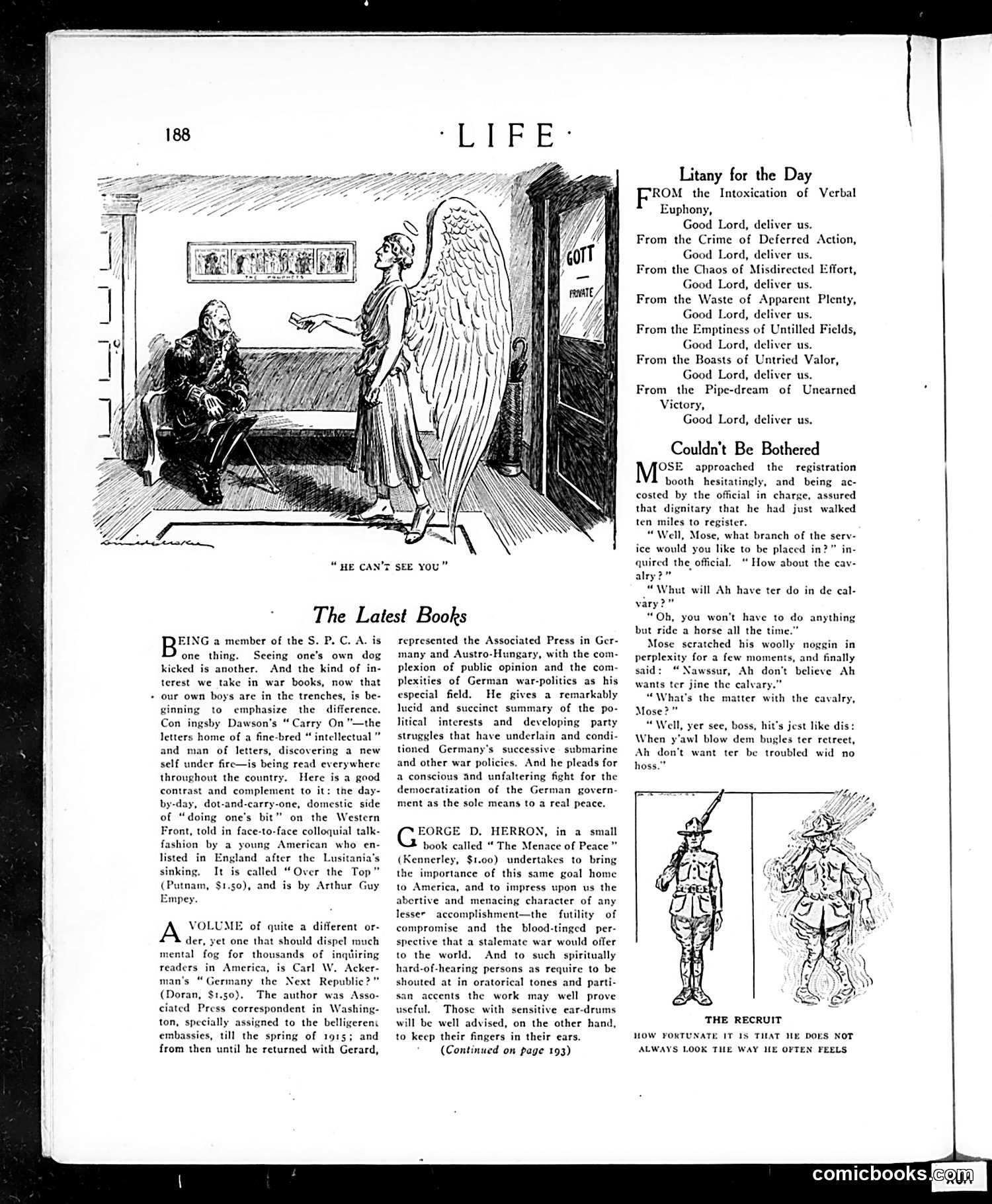
**"He Can't See You"** (top cartoon): An angel appears to a man at a registration desk, invisible to the official. The caption suggests divine intervention or fate—the man cannot escape his duty, as an unseen force (representing destiny or moral obligation) witnesses even what authorities cannot. **"Litany for the Day"** (right column): A mock-religious prayer reflecting anxieties about American entry into World War I. It satirizes empty patriotic rhetoric ("Verbal Euphony"), delayed action, and false confidence in victory—criticizing both government and public for moral complacency while young men fight overseas. **"Couldn't Be Bothered"** (bottom): A humorous dialect piece where a Black recruit named Mose registers for military service but declines cavalry duty. His reasoning—fear of horses during retreat bugles—mocks both military bureaucracy and the absurdity of conscription, likely written for comedic effect typical of the era's casual racial humor. **Context**: Published during America's WWI involvement, the page reflects tension between patriotic duty and public reluctance.
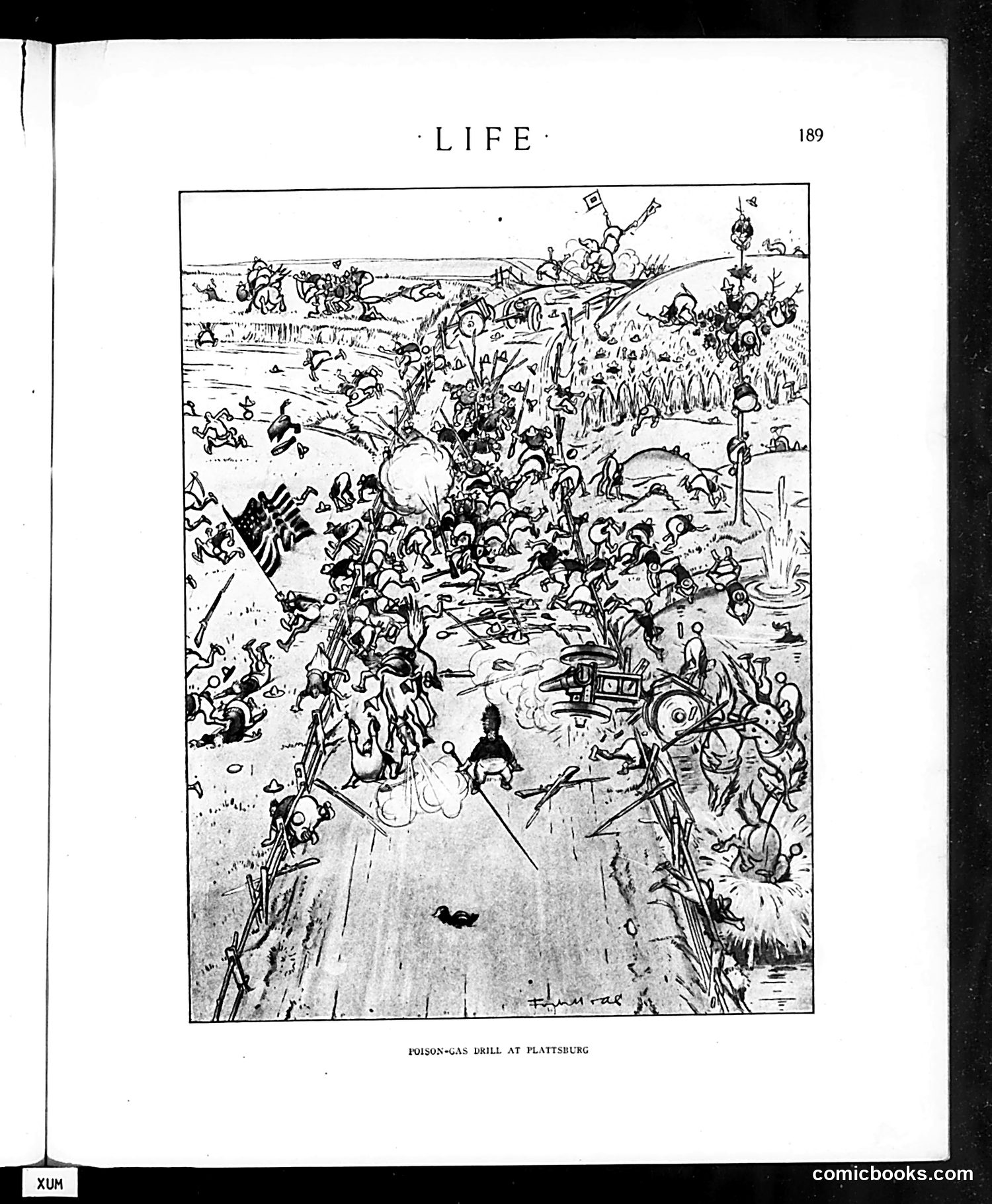
This satirical cartoon depicts a chaotic military training exercise at Plattsburg (likely Plattsburg Barracks in New York), showing soldiers conducting a poison-gas drill during World War I era preparedness training. The image is crowded with exaggerated, panicked figures in various states of confusion—some fleeing, others collapsing, with soldiers and equipment scattered haphazardly across the landscape. The satire mocks the perceived incompetence and disorder of American military readiness, portraying the drill as a bumbling, comedic disaster rather than an organized defense measure. The dense, frenzied composition emphasizes the confusion and lack of coordination, suggesting the cartoon critiques either the military's preparation methods or American unpreparedness for potential chemical warfare threats. The visual chaos serves as pointed commentary on military efficiency.
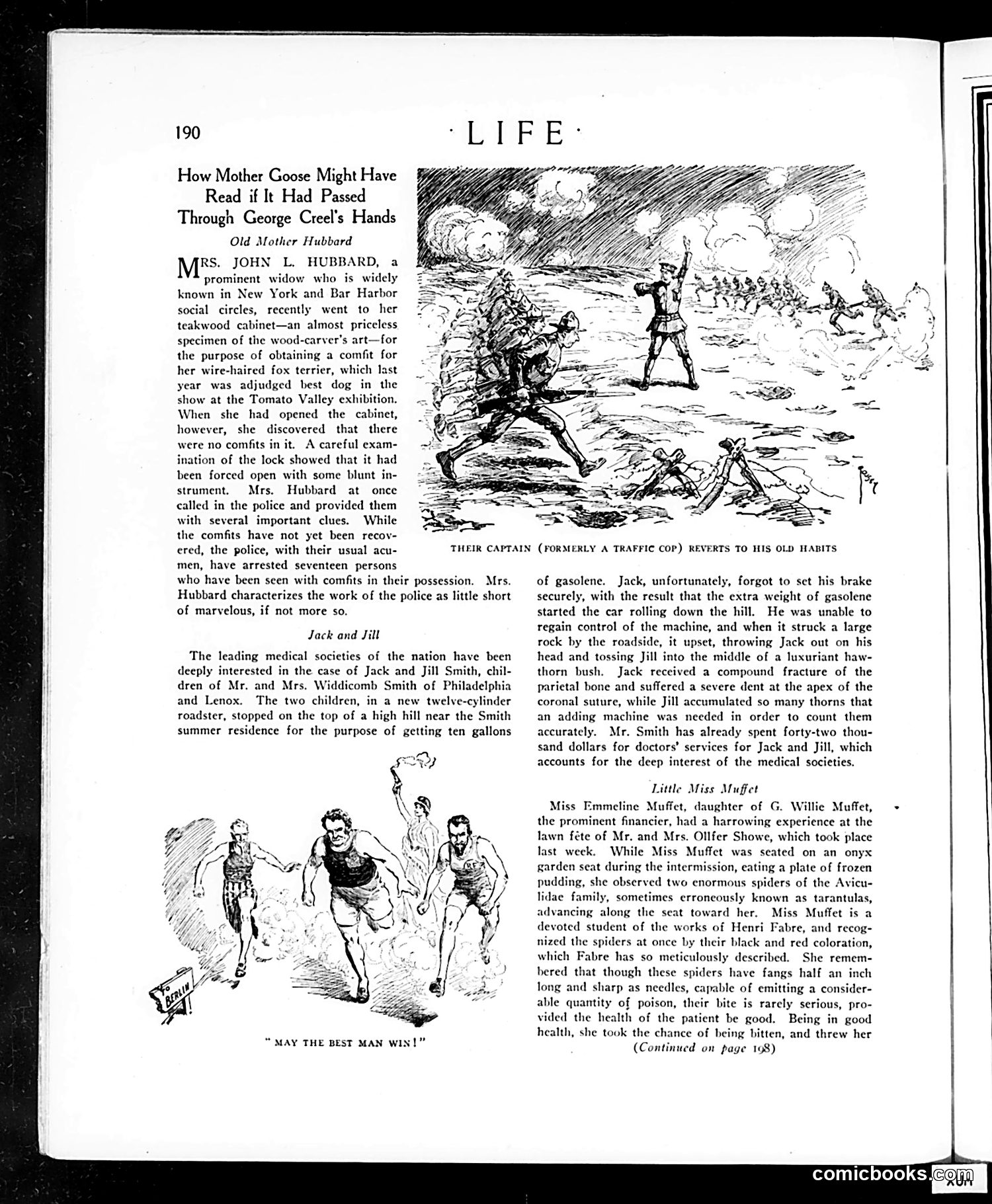
This page satirizes George Creel's wartime propaganda efforts by reimagining nursery rhymes as bureaucratic, jargon-filled absurdities. Creel headed the Committee on Public Information during WWI, controlling official narratives. The satire parodies how government propaganda inflates trivial events into important tales: a wealthy widow's stolen candies becomes a police mystery with seventeen arrests; children's minor car accident generates enormous medical bills and scientific interest; a woman encountering spiders becomes a learned entomological case study. By rendering familiar nursery rhymes through "Creel's hands," the cartoonist mocks how propaganda transforms simple stories into complex, self-important narratives serving particular interests—here, police competence, medical societies' prestige, and scientific authority. The humor lies in the absurd inflation of mundane upper-class domestic life into matters of apparent national significance.
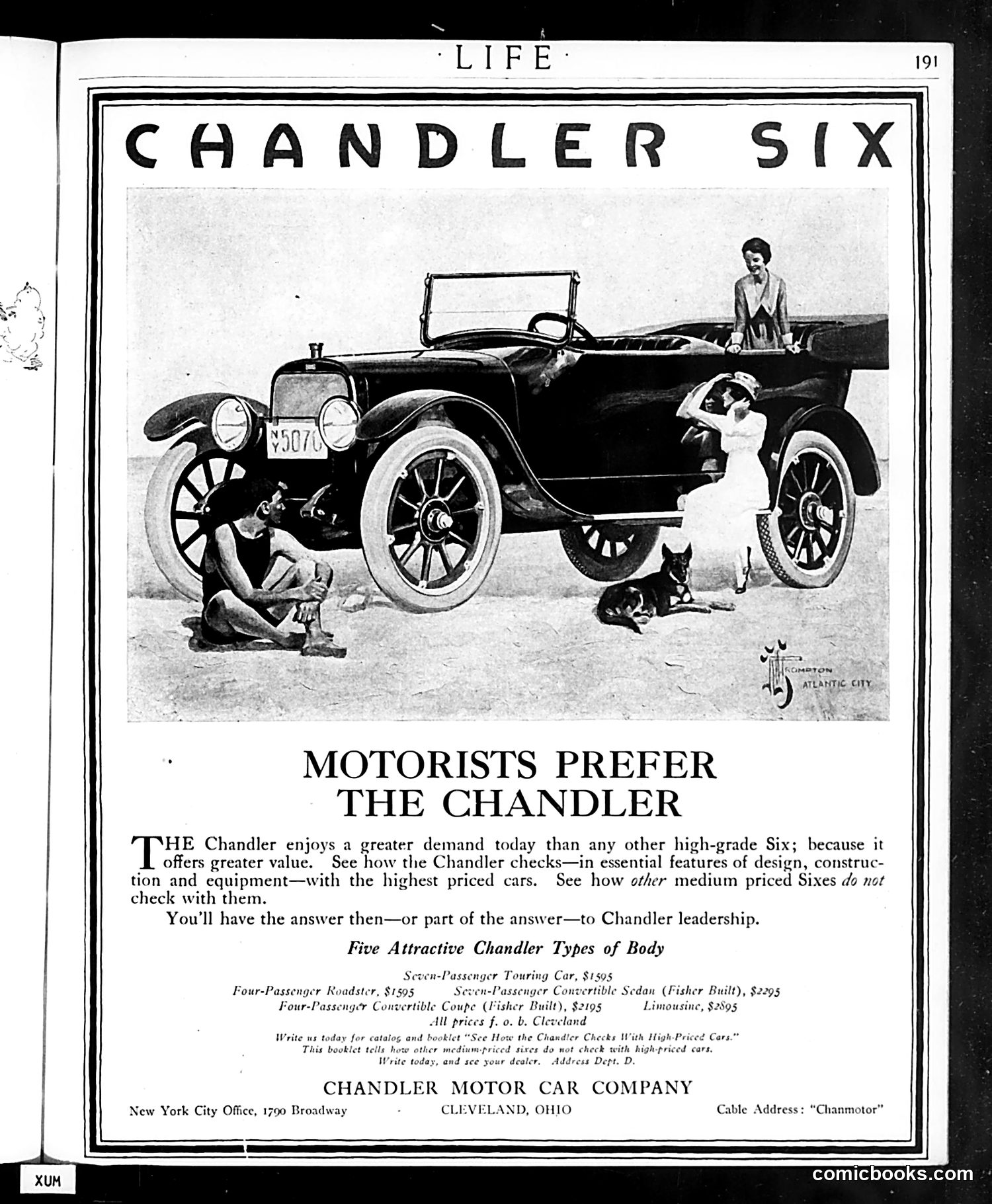
This is primarily a **car advertisement**, not political satire. The page shows a Chandler Motor Car Company ad from *Life* magazine (page 191). The image depicts a 1920s automobile with two women and a man positioned around it—likely representing potential customers or demonstrating the car's appeal. The ad's message is straightforward commercial: the Chandler Six offers superior value compared to other medium-priced cars while matching features of higher-priced vehicles. The "joke" or selling point is that motorists prefer the Chandler because it provides "greater value"—you get luxury-car features at a mid-range price. The advertisement lists five body styles with prices ranging from $1,595 to $2,595. There is no political or social satire evident here; this is standard automotive marketing from the early automobile era, emphasizing quality and affordability as competitive advantages.
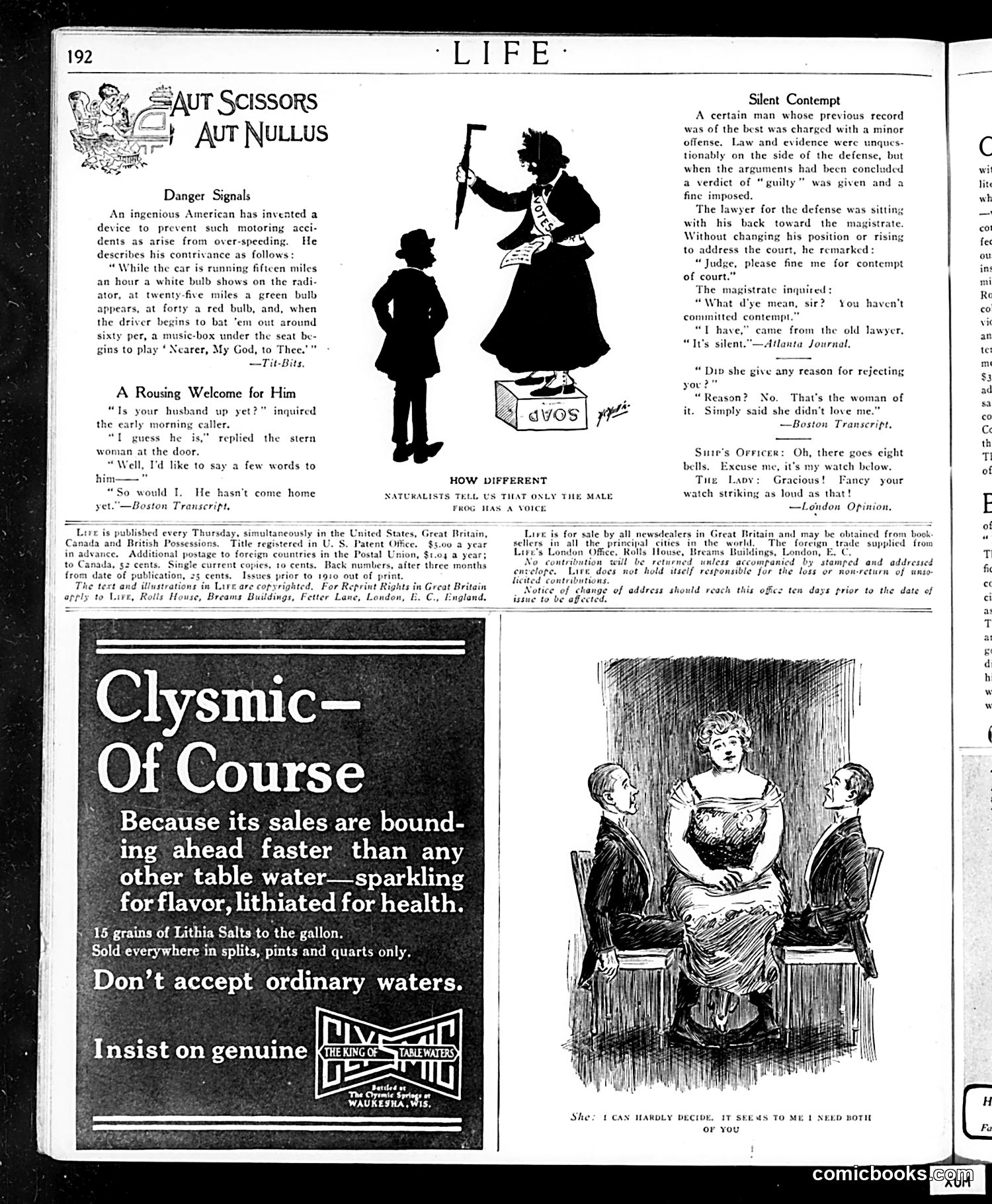
This page contains several brief humor pieces typical of early 20th-century satirical magazines: **"Danger Signals"** describes an automotive safety device using colored bulbs and a musical alarm to warn of speeding—a joke about early car safety innovations. **"A Rousing Welcome for Him"** is a short domestic joke playing on misunderstanding: a caller wants to speak to the husband, but the wife's terse reply suggests marital discord. **"Silent Contempt"** satirizes courtroom dignity: a defendant convicted despite evidence finds a clever way to show contempt (by remaining silent) while avoiding formal charges. **"How Different"** presents a naturalist's observation that only male frogs vocalize—accompanying a cartoon showing a woman speaking while a man sits silent, implying women talk more than men. **"Ship's Officer"** is a brief naval humor piece about a watch alarm sounding like ship's bells. The page is mostly **advertising** for Clysmic table water (lithiated sparkling water). The final cartoon shows a woman unable to choose between two men, saying she needs "both." These represent typical magazine humor: mild observations about gender, technology, and social situations.
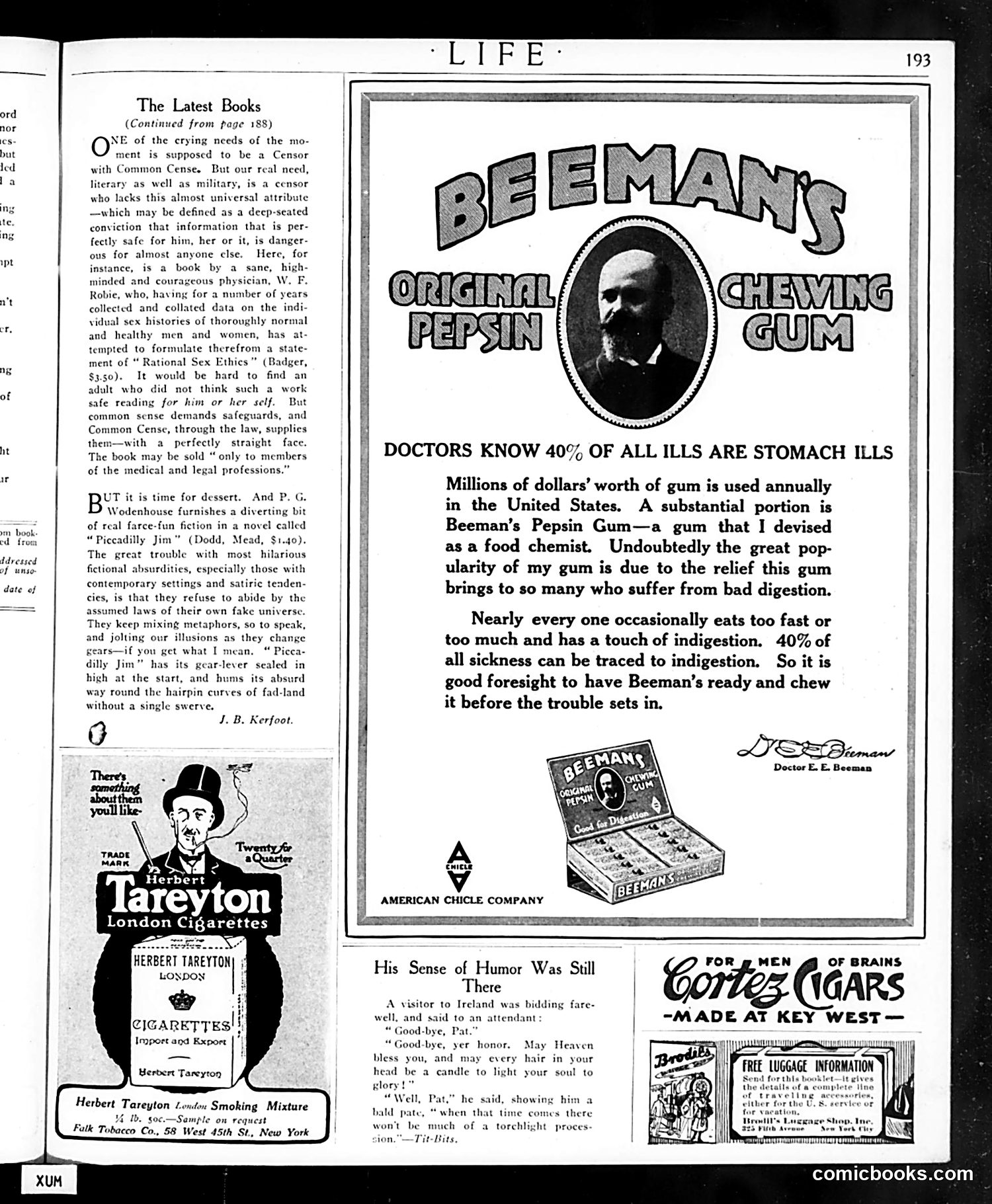
This page is primarily **advertising** interspersed with literary reviews and a brief humorous anecdote. **Main Advertisement (Beeman's Pepsin Gum):** A large endorsement claiming that 40% of all illnesses are stomach-related, positioning chewing gum as a digestive aid. Signed by "Doctor E. E. Beeman," it presents the product as a preventative remedy for indigestion. This reflects early 20th-century medicine's credulous approach to proprietary remedies and the era's loose advertising standards. **Book Review Section:** Discusses a censorship controversy around Dr. W. F. Robie's "Rational Sex Ethics"—a medical text about human sexuality restricted to medical/legal professionals, which the reviewer satirizes as absurdly overcautious. **Humor Section:** A brief Irish anecdote about wordplay regarding baldness and candlelight—typical period comedic fare. **Side Advertisements:** Include Herbert Tareyton cigarettes and Cortes cigars—examples of ubiquitous tobacco advertising then considered unremarkable. The page reflects 1920s advertising's unregulated claims about health products and casual tobacco promotion.
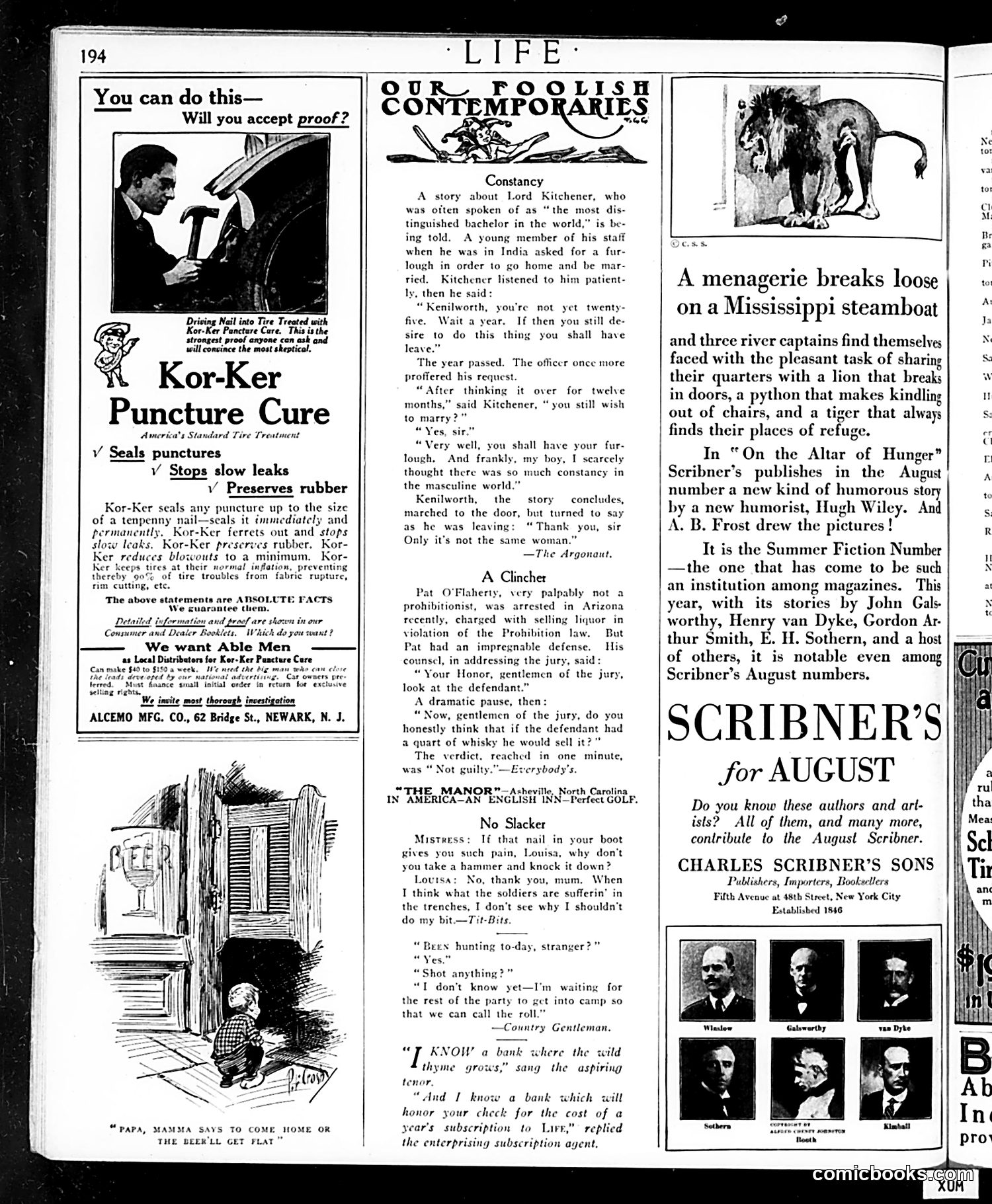
This page mixes **advertising** with **humor columns** typical of Life magazine's satirical format. The **Kor-Ker Puncture Cure ad** (left) promotes a tire sealant with a dramatic demonstration: driving a nail through a treated tire. This reflects early 1900s automotive culture when flat tires were common and tire reliability was a major selling point. The **"Our Foolish Contemporaries"** section contains reprinted jokes and anecdotes: - A story about Lord Kitchener (British military figure) testing a young officer's commitment to marriage - A defense lawyer's clever argument about a Prohibition-era liquor charge - References to WWI trench suffering ("No Slacker") and American rural life The **right column** advertises Scribner's August fiction issue, listing contributing authors with photographs. The overall tone reflects **early 20th-century humor**—gentle satire about relationships, wartime sacrifice, and legal wit—aimed at educated, middle-class readers. The page is primarily **commercial content masquerading as editorial**.
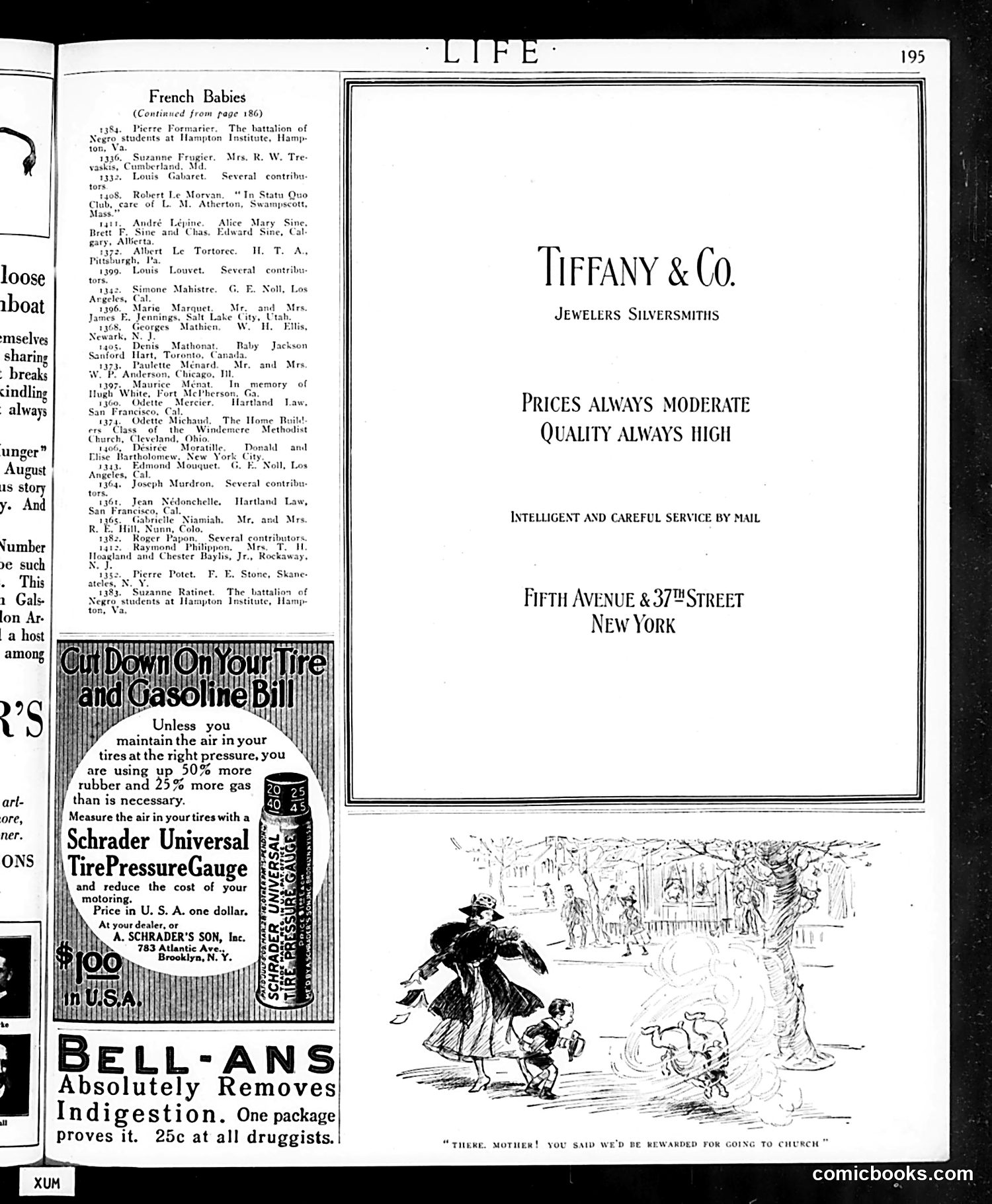
This page is primarily **advertising and announcements**, not satire or political commentary. The top half contains a continuation of "French Babies"—apparently a list of contributors or donors, likely for a charity or relief effort supporting French children. The main content includes luxury advertisements (Tiffany & Co. jewelry) and period product ads (Schrader tire gauges, Bell-Ans indigestion remedy). **The cartoon** at bottom shows a mother and child exiting a church. The child says: "THERE, MOTHER! YOU SAID WE'D BE REWARDED FOR GOING TO CHURCH." The humor is gentle and domestic—the child apparently expected a material reward (possibly candy or a treat) for attending services, humorously misinterpreting the mother's promise of spiritual reward. This reflects early-20th-century family life and the common parental practice of using incentives for children's good behavior.
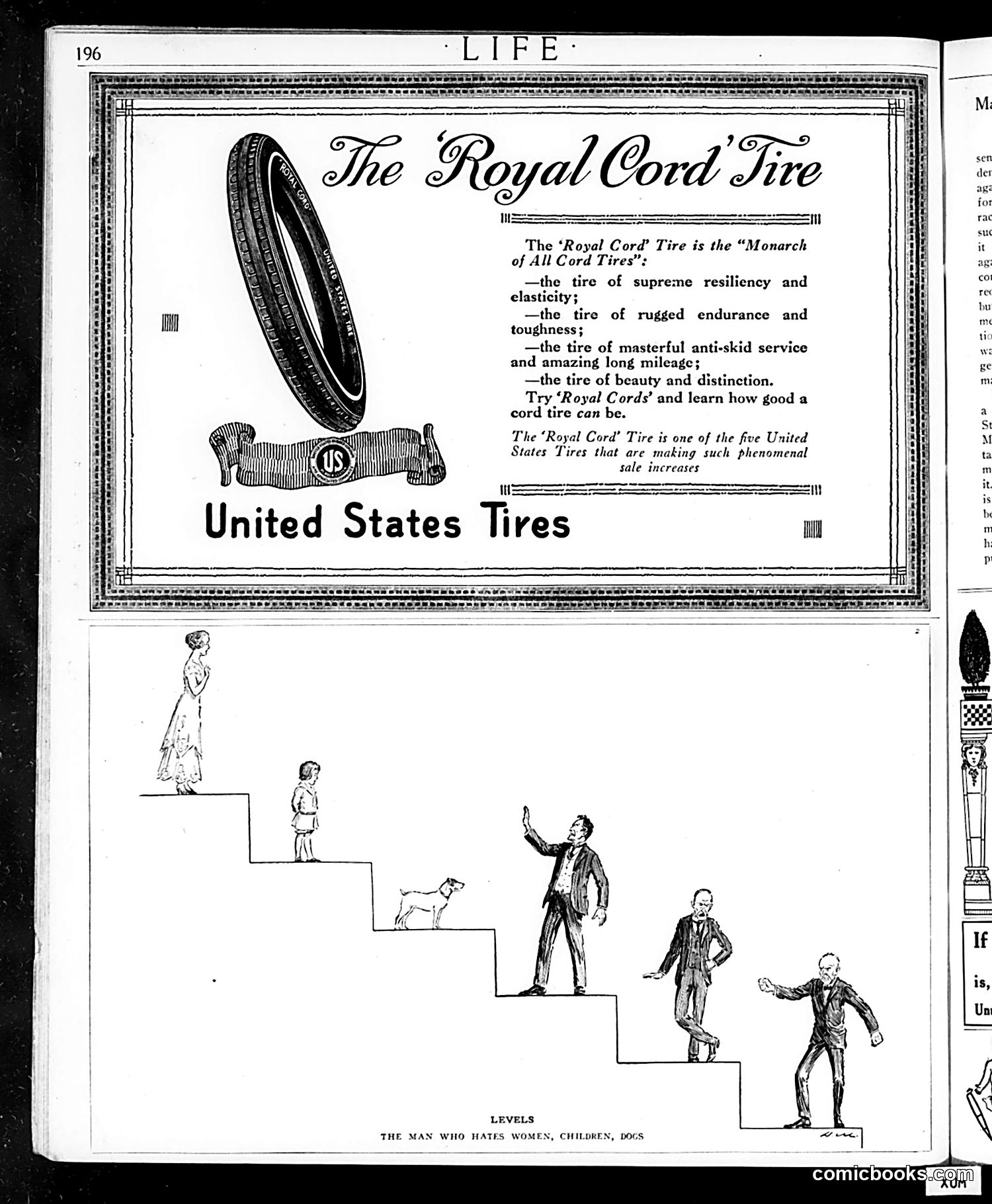
This page combines a **tire advertisement** (top) with a **satirical cartoon** (bottom). The **ad** promotes United States Tires' "Royal Cord" brand with typical marketing language about durability and quality. The **cartoon** below is the satirical content. Titled "Levels: The Man Who Hates Women, Children, Dogs," it depicts a staircase showing progressively lower figures descending in order: a woman, a child, a dog, a man (appearing angry or gesturing), another man, and finally a man at the bottom. The satire appears to mock misogyny by literally ranking women, children, and animals as superior to—positioned above—men who hate them. It's a biting critique suggesting such a man occupies the lowest social rung, less worthy than those he despises. This reflects early-20th-century *Life* magazine's frequent satirical attacks on hypocrisy and social vices, using visual hierarchy to make its moral point.
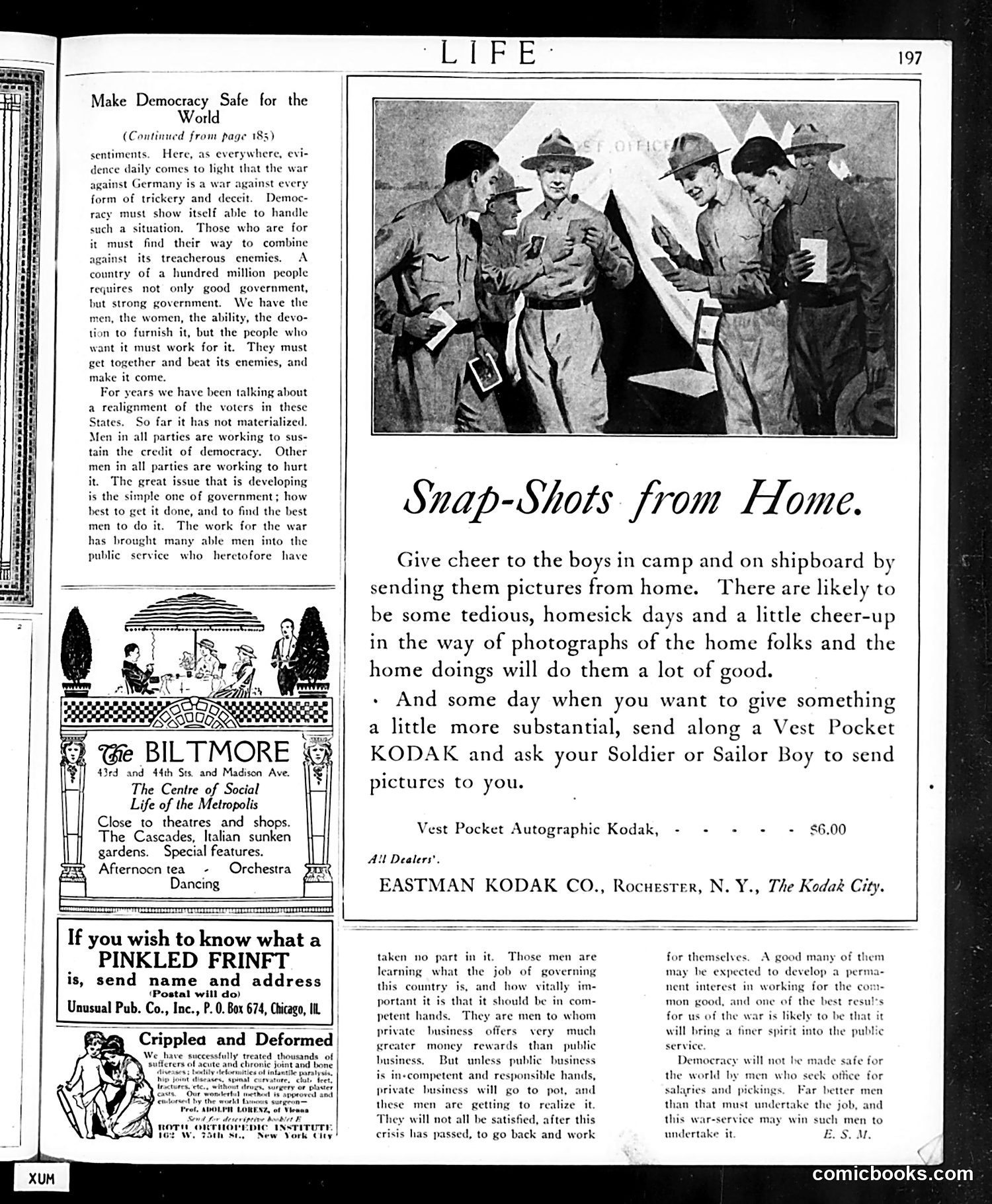
This WWI-era editorial argues that democracy requires strong, competent government to defeat Germany's "trickery and deceit." The piece urges citizens to unite behind capable leaders—particularly men drawn into public service by the war effort. The advertisement "Snap-Shots from Home" reflects wartime morale concerns: soldiers in camps and ships need photographs from home to combat homesickness. Kodak's Vest Pocket camera ($6.00) is marketed as a patriotic gift, encouraging soldiers to photograph and send images back home. The broader message: democracy's survival depends not on politicians seeking office "for salaries and pickings," but on idealistic men willing to undertake war-service. The implication is that true patriots serve the country's needs, not personal gain—a common WWI propaganda theme emphasizing sacrifice and civic duty during the conflict.
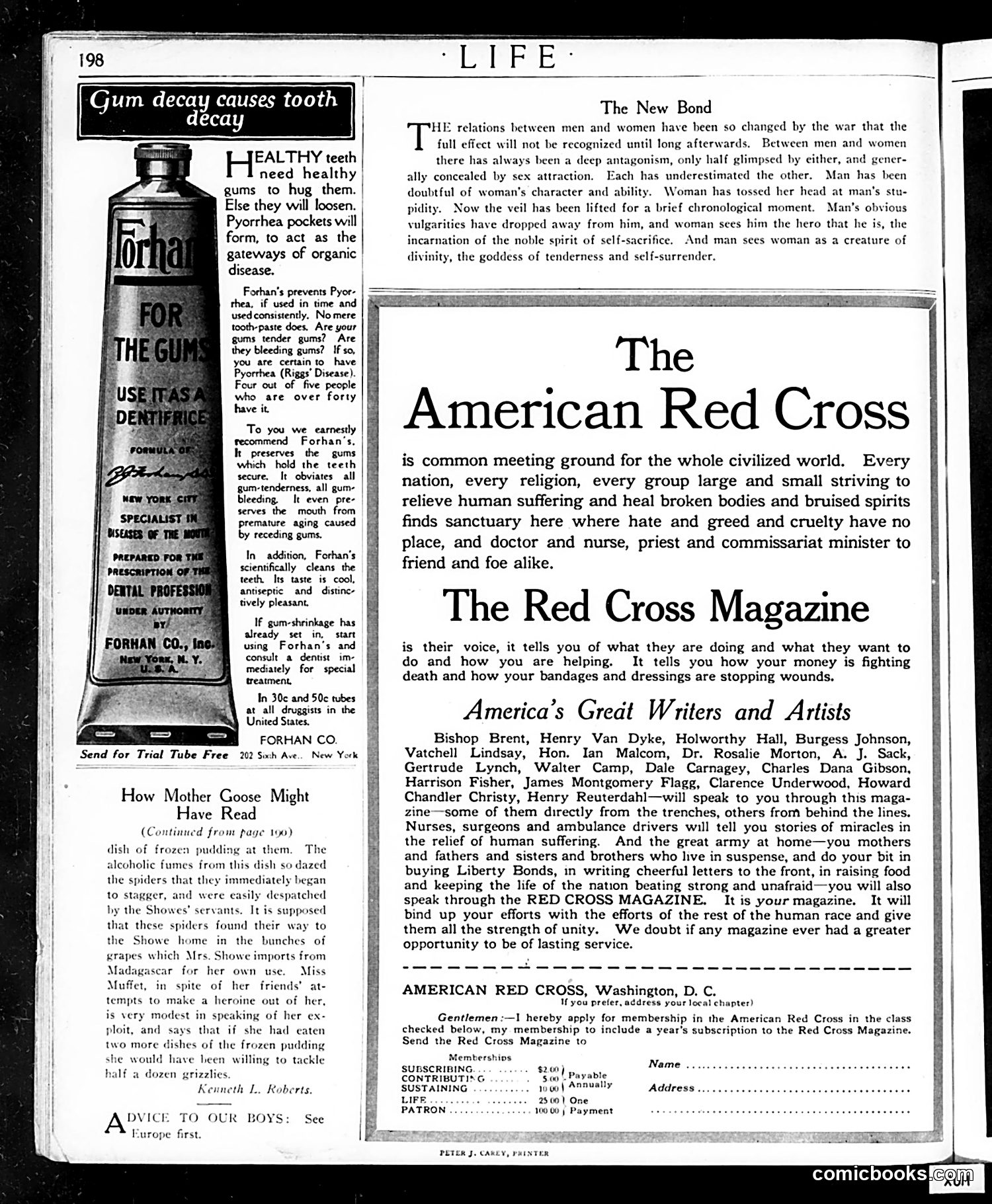
This page primarily contains **advertisements and promotional content** rather than satire or political cartoons. **Left side:** A Forhan's toothpaste ad warns about gum disease (pyorrhea), a genuine health concern of the era, using fear-based marketing typical of early 20th-century patent medicine advertising. **Center/Right:** The bulk of the page promotes the **American Red Cross Magazine**, emphasizing the organization's role as a neutral humanitarian force during World War I. The text celebrates how the war has temporarily transformed gender relations—men appearing as heroic self-sacrificers, women as divine and tender—and positions the Red Cross as a meeting ground where "hate and greed and cruelty have no place." **Notable detail:** The page lists famous American writers and artists (Henry Van Dyke, James Montgomery Flagg, etc.) who allegedly contribute to Red Cross Magazine to boost the publication's prestige and fundraising appeal during wartime. The page reflects wartime propaganda rather than satirical commentary.
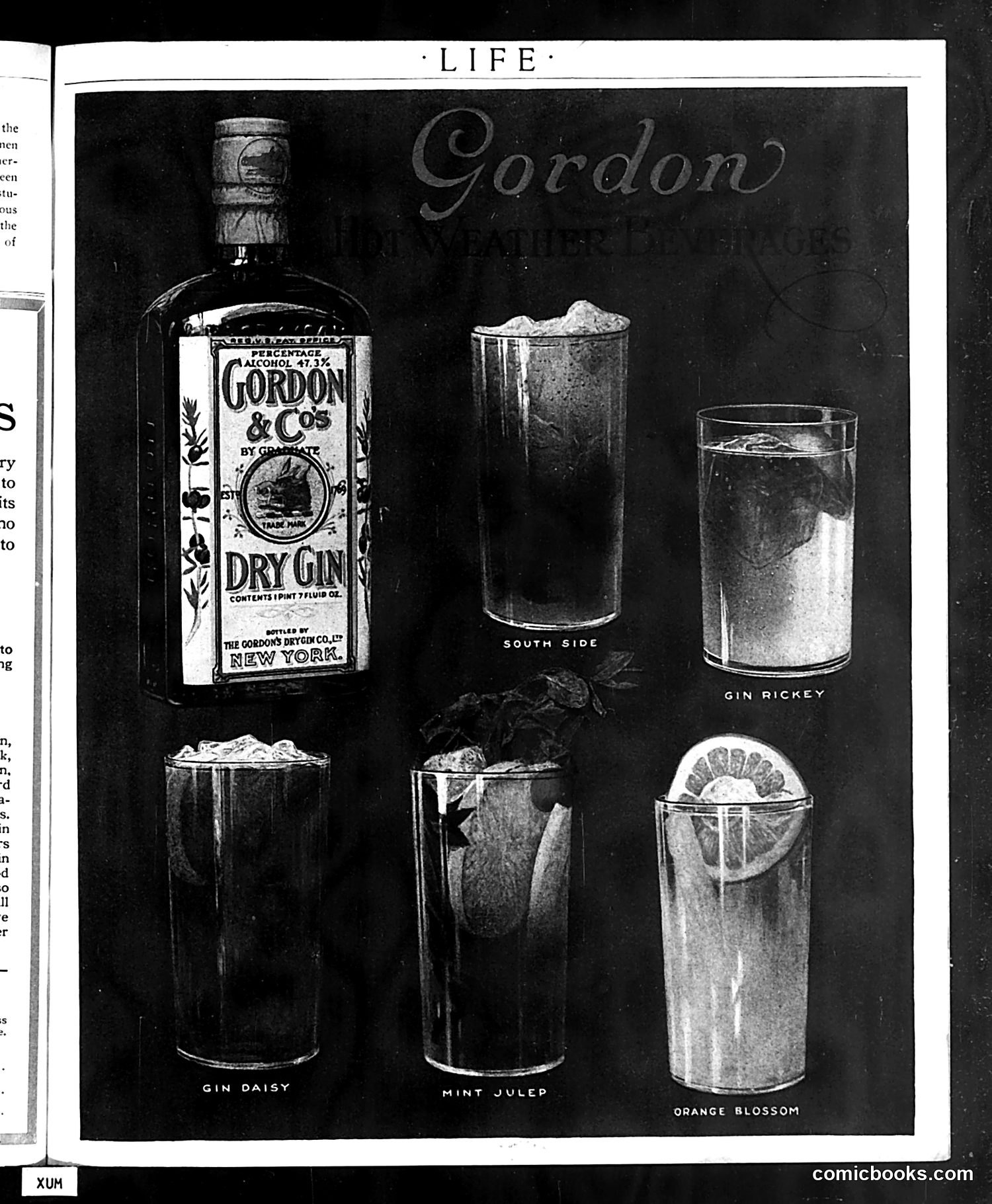
This is a Gordon's Dry Gin advertisement from Life magazine, not political satire. It displays the bottle alongside five cocktail recipes popular during the Prohibition era (indicated by the "ALCOHOL 47.3%" label emphasizing potency). The drinks shown—South Side, Gin Rickey, Gin Daisy, Mint Julep, and Orange Blossom—represent cocktails Americans could make at home with gin during Prohibition (1920-1933), when legal alcohol sales were banned. The advertisement implicitly promotes circumventing Prohibition laws by suggesting how to use the product. The page is primarily commercial rather than satirical content.
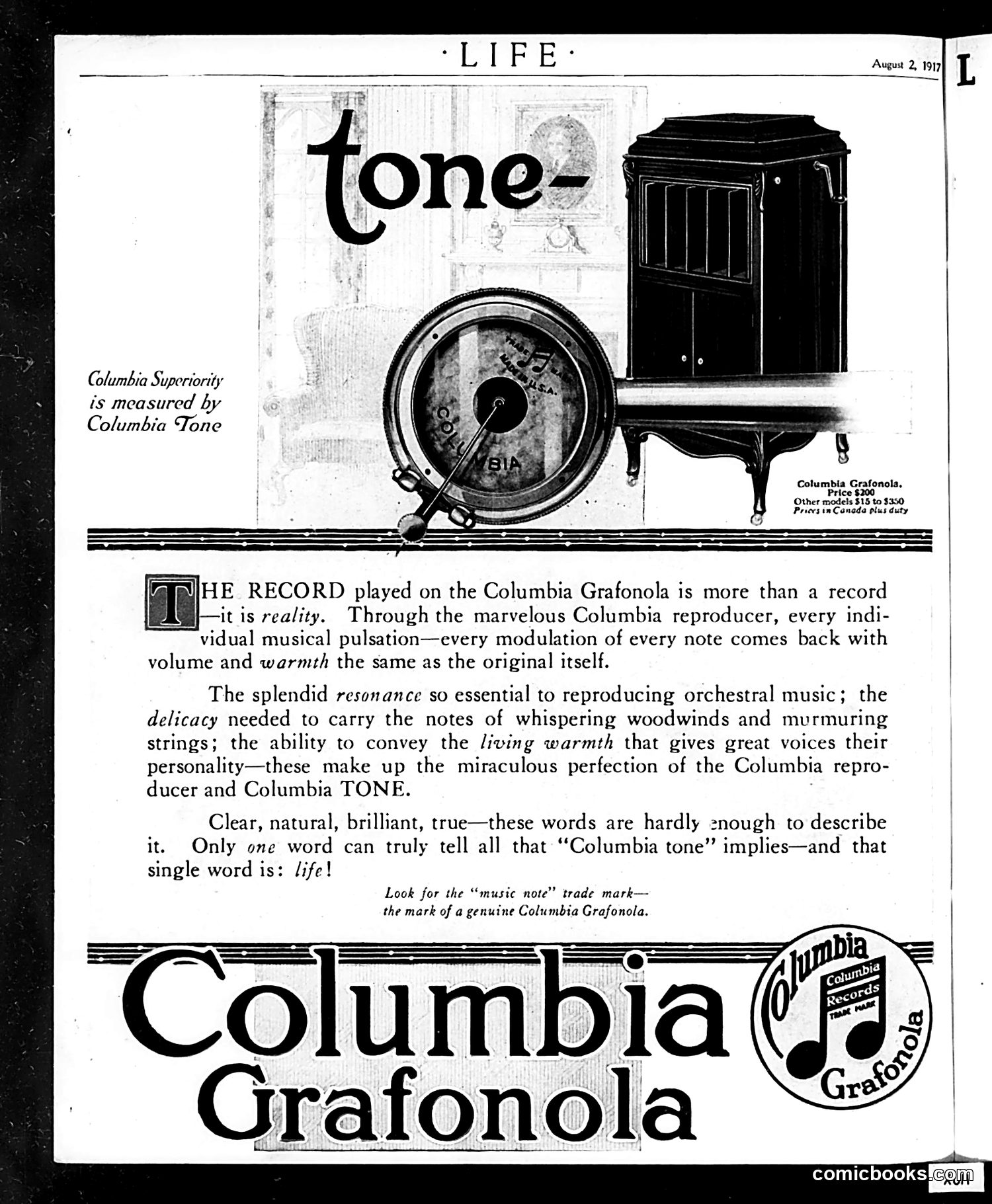
This is **not a political cartoon or satire**—it's a straightforward product advertisement for the Columbia Grafonola phonograph, published in *Life* magazine on August 2, 1917. The ad promotes Columbia's gramophone and record player, emphasizing superior sound quality through claims about "tone" and "life-like" reproduction. It features images of the device itself and highlights technical qualities: resonance, delicacy in reproducing orchestral and vocal music, and "living warmth." The central rhetorical strategy is the claim that one word—"life"—captures what "Columbia tone" truly means, playing on the magazine's own title for branding effect. Prices ranged from $15 to $350 (higher in Canada with duty), indicating a product marketed across multiple economic classes during World War I. The "music note" trademark served as authentication for genuine Columbia products, a consumer concern in an era of competing phonograph manufacturers.