
Life, 1917-08-02 · page 30 of 40
Life — August 2, 1917 — page 30: what you’re looking at
What you’re looking at
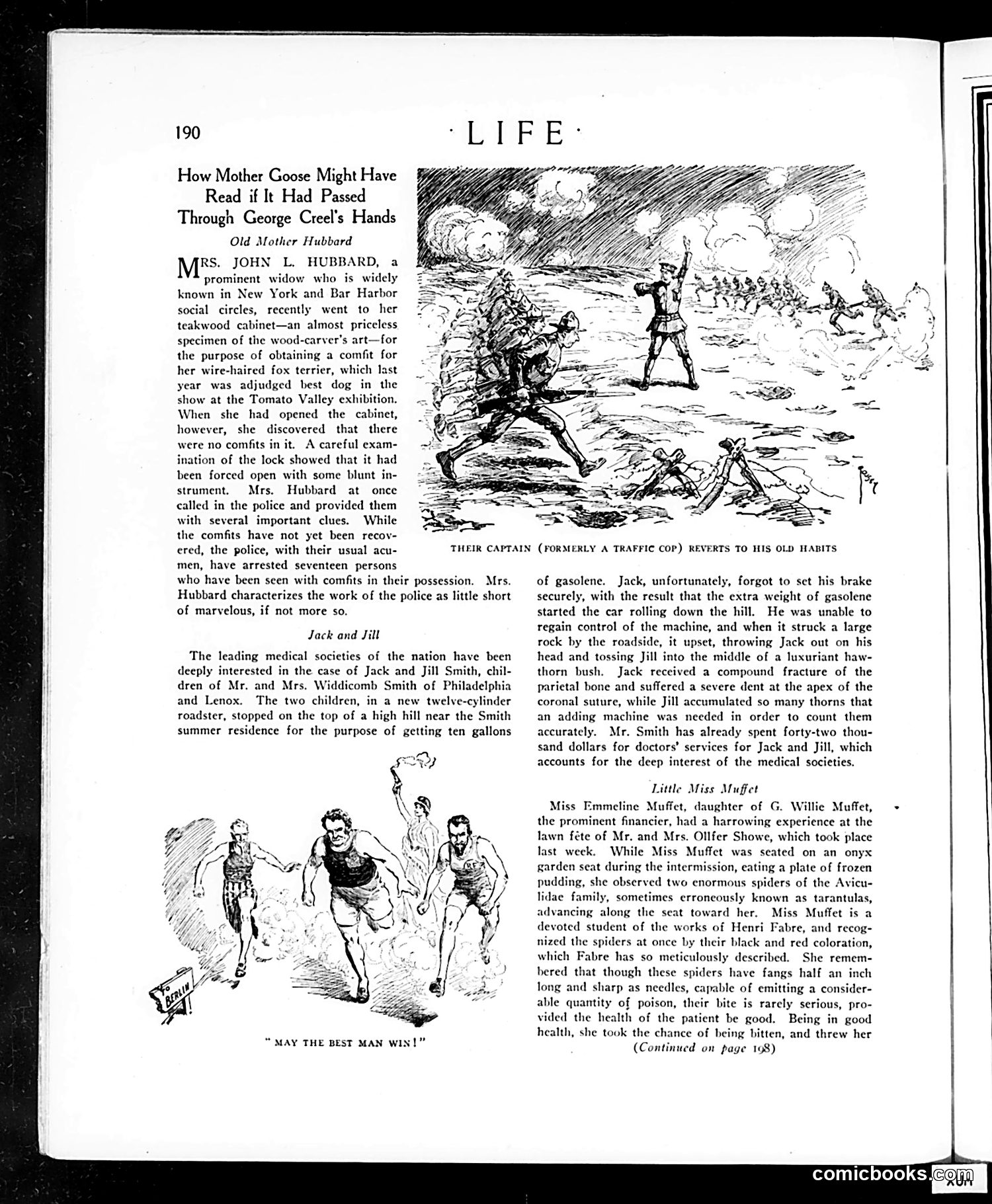
This page satirizes George Creel's wartime propaganda efforts by reimagining nursery rhymes as bureaucratic, jargon-filled absurdities. Creel headed the Committee on Public Information during WWI, controlling official narratives. The satire parodies how government propaganda inflates trivial events into important tales: a wealthy widow's stolen candies becomes a police mystery with seventeen arrests; children's minor car accident generates enormous medical bills and scientific interest; a woman encountering spiders becomes a learned entomological case study. By rendering familiar nursery rhymes through "Creel's hands," the cartoonist mocks how propaganda transforms simple stories into complex, self-important narratives serving particular interests—here, police competence, medical societies' prestige, and scientific authority. The humor lies in the absurd inflation of mundane upper-class domestic life into matters of apparent national significance.
📄 Transcribed text from this page (OCR, searchable)
Machine-transcribed from the original scan — historical spelling and the odd misread are preserved.
190 How Mother Goose Might Have Read if It Had Passed Through George Creel’s Hands Old Mother Hubbard RS. JOHN L, HUBBARD, a prominent widow who is widely known in New York and Bar Harbor social circles, recently went to her teakwood cabinet—an almost priceless specimen of the wood-carver's art—for the purpose of obtaining a comfit for her wire-haired fox terrier, which last year was adjudged best dog in the show at the Tomato Valley exhibition. When she had opened the cabinet, however, she discovered that there were no comfits in it. A careful exam- ination of the lock showed that it had been forced open with some blunt in- strument. Mrs. Hubbard at once called in the police and provided them with several important clues. While the comfits have not yet been recov- ered, the police, with their usual acu- men, have arrested seventeen persons who have been seen with comfits in their possession. Mrs. Hubbard characterizes the work of the police as little short of marvelous, if not more so. Jack and Jill The leading medical societies of the nation have been deeply interested in the case of Jack and Jill Smith, chil- dren of Mr. and Mrs. Widdicomb Smith of Philadelphia and Lenox. The two children, in a new twelve-cylinder roadster, stopped on the top of a high hill near the Smith summer residence for the purpose of getting ten gallons “ MAY THE BEST MAN WIN!” THEIR CAPTAIN (FORMERLY A TRAFFIC COP) REVERTS TO HIS OLD HABITS of gasolene. Jack, unfortunately, forgot to set his brake securely, with the result that the extra weight of gasolene started the car rolling down the hill. He was unable to regain control of the machine, and when it struck a large rock by the roadside, it upset, throwing Jack out on his head and tossing Jill into the middle of a luxuriant haw- thorn bush. Jack received a compound fracture of the parietal bone and suffered a severe dent at the apex of the coronal suture, while Jill accumulated so many thorns that an adding machine was needed in order to count them accurately. Mr. Smith has already spent forty-two thou- sand dollars for doctors’ services for Jack and Jill, which accounts for the deep interest of the medical societies. Little Miss Muffet Miss Emmeline Muffet, daughter of G. Willie Muffet, the prominent financier, had a harrowing experience at the lawn féte of Mr. and Mrs. Ollfer Showe, which took place last week. While Miss Muffet was seated on an onyx garden seat during the intermission, eating a plate of frozen pudding, she observed two enormous spiders of the Avicu- lidae family, sometimes erroneously known as tarantulas, advancing along the seat toward her. Miss Muffet is a devoted student of the works of Henri Fabre, and recog- nized the spiders at once by their black and red coloration, which Fabre has so meticulously described. She remem- bered that though these spiders have fangs half an inch long and sharp as needles, capable of emitting a consider- able quantity of poison, their bite is rarely serious, pro- vided the health of the patient be good. Being in good health, she took the chance of being bitten, and threw her (Continued on page 108) comicbooks