
Life, 1917-08-02 · page 18 of 40
Life — August 2, 1917 — page 18: what you’re looking at
What you’re looking at
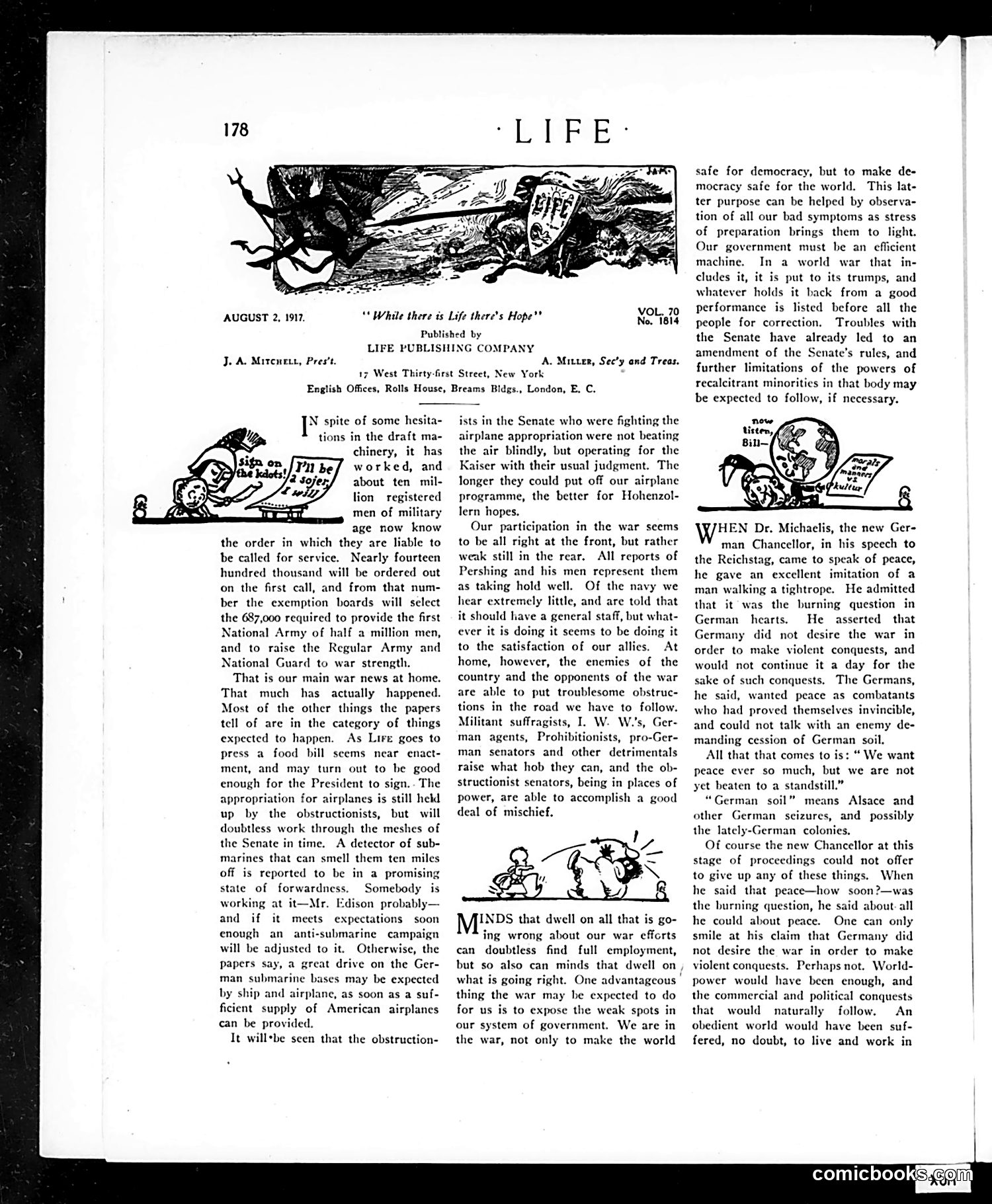
This page analyzes American obstacles to the war effort following U.S. entry into World War I (April 1917). The main cartoon depicts a figure labeled "I'll be a safer" (unclear exact reference, possibly mocking a pacifist or obstructionist). The editorial identifies domestic "enemies of the country" hindering the war: militant suffragists, IWW members (radical labor), German agents, Prohibitionists, and pro-German senators. It argues these "obstructionists" deliberately delay critical resources like airplane appropriations to benefit Germany and the Kaiser. Life frames this positively—that wartime stress will expose governmental weaknesses and force democratic reforms. The piece mentions General Pershing's front-line success contrasting with rear-area political obstruction, and celebrates the draft machinery's initial success, mobilizing approximately 687,000 men for the National Army. The satire targets domestic political opponents of full war mobilization as effectively sabotaging American military capacity.
📄 Transcribed text from this page (OCR, searchable)
Machine-transcribed from the original scan — historical spelling and the odd misread are preserved.
AUGUST 2, 1917. “While there is Life there's Hope” VOL. 70 No, 1614 Published by LIFE PUBLISHING COMPANY J. A. Mitcnent, Pres’t. A. Minter, Sec’y and Treas. 17 West Thirty-first Street, New York English Offices, Rolls House, Breams Bldgs., London, E. C. N spite of some hesita- tions in the draft ma- chinery, it has worked, and about ten mil- lion fered men of military age now know the order in which they are liable to be called for service. Nearly fourteen hundred thousand will be ordered out on the first call, and from that num- ber the exemption boards will select the 687,000 required to provide the first National Army of half a million men, and to raise the Regular Army and National Guard to war strength. That is our main war news at home. That much has actually happened. Most of the other things the papers tell of are in the category of things expected to happen. As Lire goes to press a food bill seems near enact- ment, and may turn out to be good enough for the President to sign.. The appropriation for airplanes is still held up by the obstructionists, but will doubtless work through the meshes of the Senate in time. A detector of sub- marines that can smell them ten miles off is reported to be in a promising state of forwardness. Somebody is working at it—Mr. on probably— and if it mects expectations soon enough an anti-submarine campaign will be adjusted to it. Otherwise, the papers say, a great drive on the Ger- man submarine bases may be expected by ship and airplane, as soon as a suf- ficient supply of American airplanes can be provided. It will*be seen that the obstruction- ists in the Senate who were fighting the airplane appropriation were not beating the air blindly, but operating for the Kaiser with their usual judgment. The longer they could put off our airplane programme, the better for Hohenzol- lern hopes. Our participation in the war seems to be all right at the front, but rather weak still in the rear. All reports of Pershing and his men represent them as taking hold well. Of the navy we hear extremely little, and are told that it should have a general staff, but what- ever it is doing it seems to be doing it to the satisfaction of our allies. At home, however, the enemies of the country and the opponents of the war are able to put troublesome obstruc- tions in the road we have to follow. Militant suffragists, I. W. W Ger- man agents, Prohibitionists, pro-Ger- man senators and other detrimentals bs what hob they can, and the ob- structionist senators, being in places of power, are able to accomplish a good deal of mischief. vax e ys. y MBESPS that dwell on all that is go- ing wrong about our war efforts can doubtless find full employment, but so also can minds that dwell on, what is going right. One advantageous | thing the war may be expected to do for us is to expose the weak spots in our system of government. We are in the war, not only to make the world safe for democracy, but to make de- mocracy safe for the world. This lat- ter purpose can be helped by observa- tion of all our bad symptoms as stress of preparation brings them to light. Our government must be an efficient machine. In a world war that in- cludes it, it is put to its trumps, and whatever holds it back from a good performance is listed before all the people for correction. Troubles with the Senate have already led to an amendment of the Senate's rules, and further limitations of the powers of recalcitrant minorities in that body may be expected to follow, if necessary. HEN Dr. Michaelis, the new Ger- man Chancellor, in his speech to the Reichstag, came to speak of peace, he gave an excellent imitation of a man walking a tightrope. He admitted that it was the burning question in German hearts. He asserted that Germany did not desire the war in order to make violent conquests, and would not continue it a day for the sake of such conquests, The Germans, he said, wanted peace as combatants who had proved themselves invincible, and could not talk with an enemy de- manding cession of German soil. All that that comes to is: “ We want peace ever so much, but we are not yet beaten to a standstill.” “German soil” means Alsace and other German seizures, and possibly the lately-German colonies, Of course the new Chancellor at this stage of proceedings could not offer to give up any of these things, When he said that peace—how soon?—was the burning question, he said about. all he could about peace. One can only smile at his claim that Germany did not desire the war in order to make violent conquests. Perhaps not. World- power would have been enough, and the commercial and political conquests that would naturally follow. An obedient world would have been suf- fered, no doubt, to live and work in