
Life, 1917-08-02 · page 19 of 40
Life — August 2, 1917 — page 19: what you’re looking at
What you’re looking at
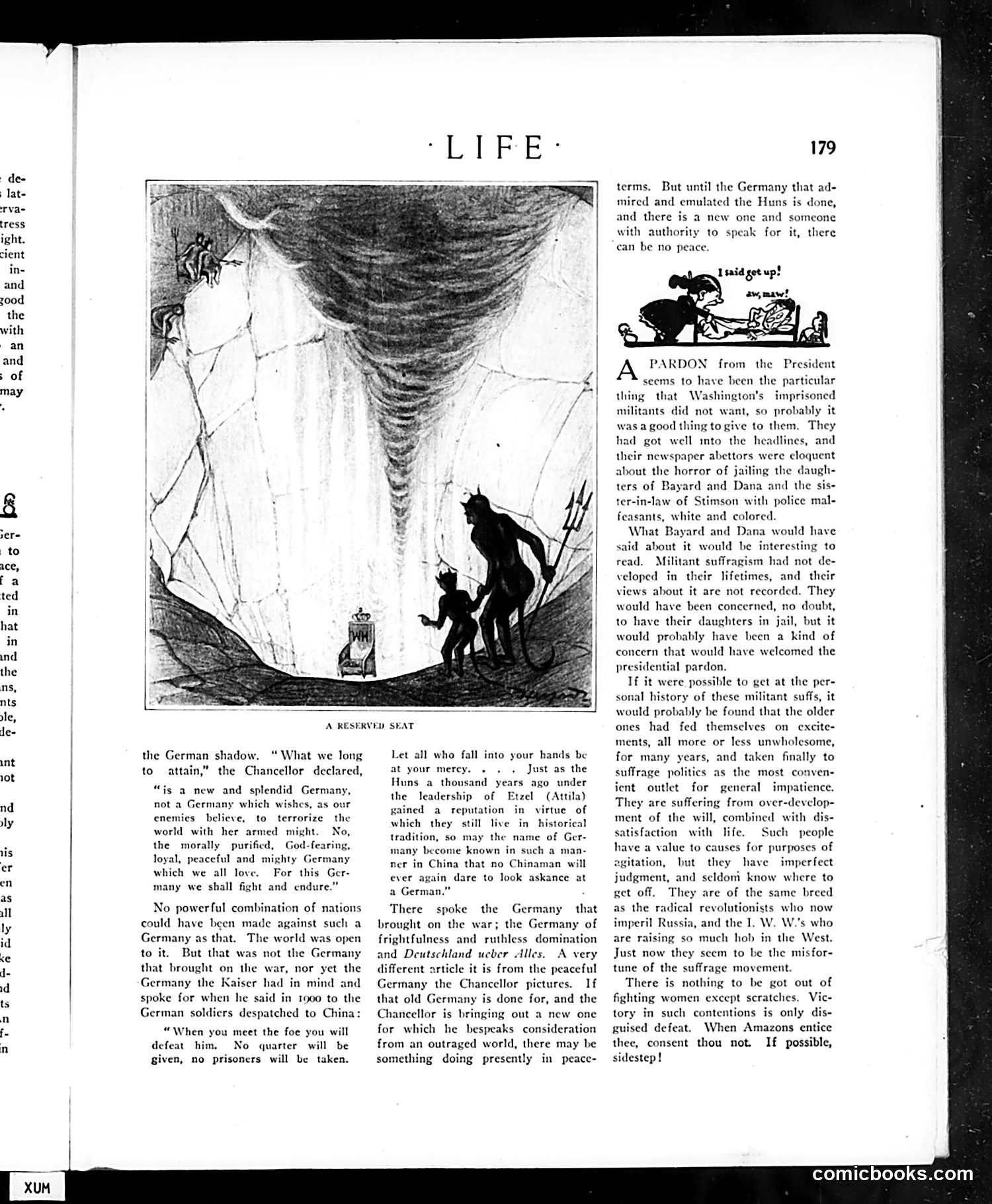
The main cartoon depicts figures (appearing to represent German leadership or the German state) sitting in a reserved theater seat beneath a towering, menacing silhouette—likely representing the legacy of Hun brutality and German militarism looming over Germany's claimed "reformation." **Political Context:** This is WWI-era satire. The accompanying text contrasts the German Chancellor's 1918 promises of a "new and splendid, peaceful Germany" against historical evidence: the Kaiser's brutal 1900 orders to German troops in China ("Just as the Huns...gained a reputation...so may the name of Germany become known"). **The Point:** Life's editors argue Germany cannot credibly claim transformation while the old militaristic Germany—the one that started the war—remains. The "reserved seat" suggests this violent past is permanently reserved for Germany; it cannot escape its shadow simply through rhetoric about peace. The secondary text criticizes imprisoned women suffragists receiving presidential pardons, comparing militant feminists unfavorably to radical revolutionaries.
📄 Transcribed text from this page (OCR, searchable)
Machine-transcribed from the original scan — historical spelling and the odd misread are preserved.
| de- ; lat- TVae tress ight. cient in- and zood the with an and ; of may er= to ace, ted in hat in ind the ns, nts ole, le- int 10t nd sly is en A RESERVED SEAT the German shadow. “ What we long to attain,” the Chancellor declared, “is a new and splendid Germany, not a Germany which wishes, as our enemies believe, to. terrorize the world with her armed might. the morally purified, God-fearing, loyal, peaceful and mighty Germany which we all love. For this Ger- many we shall fight and endure.” No powerful combination of nations could have been made against such a Germany as that. The world was open to it. But that was not the Germany that brought on the war, nor yet the Germany the Kaiser had in mind and spoke for when he said in 1900 to the German soldiers despatched to China: “When you meet the foe you will defeat him, No quarter will be given, no prisoners will be taken. Let all who fall into your hands be at your mercy. . . . Just as the Huns a thousand years ago under the leadership of Etzel (Attila) gained a reputation in virtue of which they still live in historical tradition, so may the name of Ger- many become known in such a man- ner in China that no Chinaman will ever again dare to look askance at a German.” There spoke the Germany that brought on the war; the Germany of frightfulness and ruthless domination and Deutschland ueber Alles. A very different article it is from the peaceful Germany the Chancellor pictures. If that old Germany is done for, and the Chancellor is bringing out a new one for which he bespeaks consideration from an outraged world, there may be something doing presently in peace- 179 terms. But until the Germany that ad- mired and emulated the Huns is done, and there is a new one and someone with authority to speak for it, there can be no peace. A PARDON from the President seems to have been the particular thing that Washington's imprisoned militants did not want, so probably it was a good thing to give to them, They had got well imto the headlines, and their newspaper abettors were eloquent about the horror of jailing the daugh- ters of Bayard and Dana and the sis- ter-in-law of Stimson with police mal- feasants, white and colored. What rd and Dana would have said about it would be interesting to read. Militant suffragism had not de- veloped in their lifetimes, and their views about it are not recorded. They would have been concerned, no doubt, to have their daughters in jail, but it would probably have been a kind of concern that would have welcomed the presidential pardon, If it were possible to get at the per- sonal history of these militant suffs, it would probably be found that the older ones had fed themselves on excite- ments, all more or less unwholesome, for many years, and taken finally to suffrage politics as the most c ient outlet for general impatience. They are suffering from over-devclop- ment of the will, combined with dis- satisfaction with life. Such people have a value to causes for purposes of gitation, but they have imperfect judgment, and seldom know where to get off. They are of the same breed as the radical revolutionists who now imperil Russia, and the I, W. W.’s who are raising so much hob in the West. Just now they seem to be the misfor- tune of the suffrage movement. There is nothing to be got out of fighting women except scratches. Vic- tory in such contentions is only dis- guised defeat. When Amazons entice thee, consent thou not. If possible, sidestep! comicbooks.com