
Life, 1917-08-02 · page 28 of 40
Life — August 2, 1917 — page 28: what you’re looking at
What you’re looking at
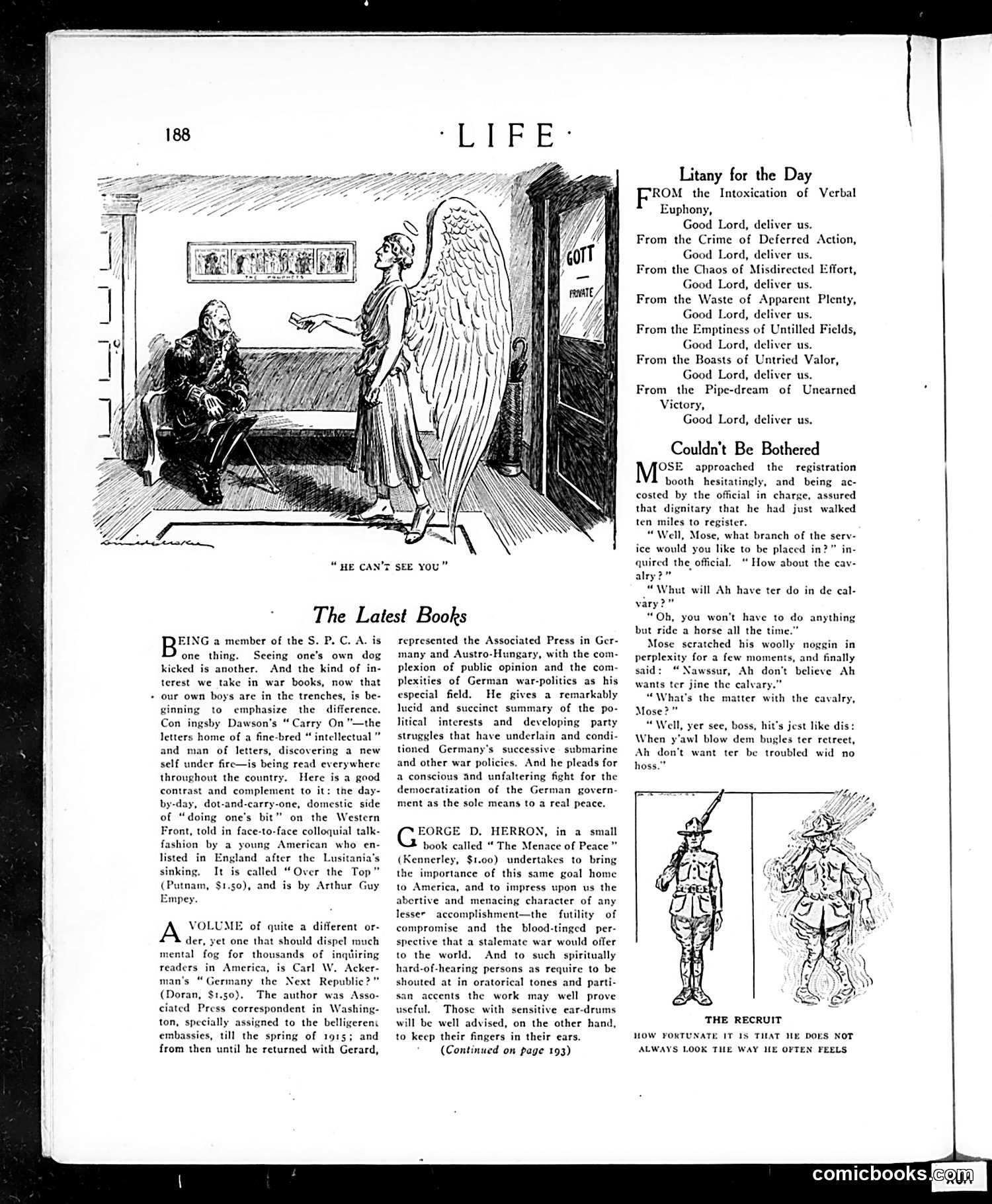
**"He Can't See You"** (top cartoon): An angel appears to a man at a registration desk, invisible to the official. The caption suggests divine intervention or fate—the man cannot escape his duty, as an unseen force (representing destiny or moral obligation) witnesses even what authorities cannot. **"Litany for the Day"** (right column): A mock-religious prayer reflecting anxieties about American entry into World War I. It satirizes empty patriotic rhetoric ("Verbal Euphony"), delayed action, and false confidence in victory—criticizing both government and public for moral complacency while young men fight overseas. **"Couldn't Be Bothered"** (bottom): A humorous dialect piece where a Black recruit named Mose registers for military service but declines cavalry duty. His reasoning—fear of horses during retreat bugles—mocks both military bureaucracy and the absurdity of conscription, likely written for comedic effect typical of the era's casual racial humor. **Context**: Published during America's WWI involvement, the page reflects tension between patriotic duty and public reluctance.
📄 Transcribed text from this page (OCR, searchable)
Machine-transcribed from the original scan — historical spelling and the odd misread are preserved.
“HE CAN'T SEE You” The Latest Books EING a member of the S. P. C. A. is one thing. Seeing one’s own dog kicked is another. And the kind of in- terest we take in war books, now that + our own boys are in the trenches, is be- ginning to emphasize the difference. Con ingsby Dawson's “Carry On"—the letters home of a fine-bred “ intellectual ” and man of letters, discovering a new self under firo—is being read everywhere throughout the country. Here is a good contrast and complement to it: the day- by-day, dot-and-carry-one, domestic side of “doing one’s bit” on the Western Front, told in face-to-face colloquial talk- fashion by a young American who en- listed in England after the Lusitania’s sinking. It is called “Over the Top” (Putnam, $1.50), and is by Arthur Guy Empey. VOLUME of quite a different or- der, yet one that should dispel much mental fog for thousands of inqtiring readers in America, is Carl W. Acker- man's “Germany the Next Republic?” (Doran, $1.50), The author was Asso- ciated Press correspondent in Washing- ton, specially assigned to the belligerent embassies, till the spring of 1915; and from then until he returned with Gerard, represented the Associated Press in Ger- many and Austro-Hungary, with the com- plexion of public opinion and the com- plexities of German war-politics as his especial field. He gives a remarkably lucid and succinct summary of the po- litical interests and developing party struggles that have underlain and condi- tioned Germany's successive submarine and other war policies. And he pleads for a conscious and unfaltering fight for the democratization of the German govern- ment as the sole means to a real peace. ORGE D. HERRON, in a small book called “ The Menace of Peace” (Kennerley, $1.00) undertakes to bring the importance of this same goal home to America, and to impress upon us the abertive and menacing character of any lesser accomplishment—the futility of compromise and the blood-tinged per- spective that a stalemate war would offer to the world, And to such spiritually hard-of-hearing persons as require to be shouted at in oratorical tones and parti- san accents the work may well prove useful. Those with sensitive eardrums will be well advised, on the other hand, to keep their fingers in their ears. (Continued on page 193) Litany for the Day ROM the Intoxication of Verbal Euphony, Good Lord, deliver us. From the Crime of Deferred Action, Good Lord, deliver us. From the Chaos of ected Effort, Good Lord, deliver us. From the Waste of Apparent Plenty, Good Lord, deliver us. From the Emptiness of Untilled Fields, Good Lord, deliver us. From the Boasts of Untried Valor, Good Lord, deliver us. From the Pipe-dream of Unearned Victory, Good Lord, deliver us. Couldn't Be Bothered OSE approached the registration booth hesitatingly, and being ac- costed by the official in charge, assured that dignitary that he had just walked ten miles to register. “Well, Mose, what branch of the serv- ice would you like to be placed in?” in- quired the official. “ How about the cav- alry?” * “Whut will Ah have ter do in de cal- vary?” “Ob, you won't have to do anything but ride a horse all the time.” Mose scratched his woolly noggin in perplexity for a few moments, and finally said: “N. Ah don't believe Ah wants ter jine the calvary.” “What's the matter with the cavalry, Mose?” “Well, yer see, boss, hit’s jest like dis: When y’awl blow dem bugles ter retreet, Ah don’t want ter be troubled wid no hoss.” awssur, THE RECRUIT MOW YORTUNATE IT 18 THAT ME DOES NOT ALWAYS LOOK THE WAY HE OFTEN FEELS comicbooks