
A complete issue · 40 pages · 1917
Life — July 5, 1917
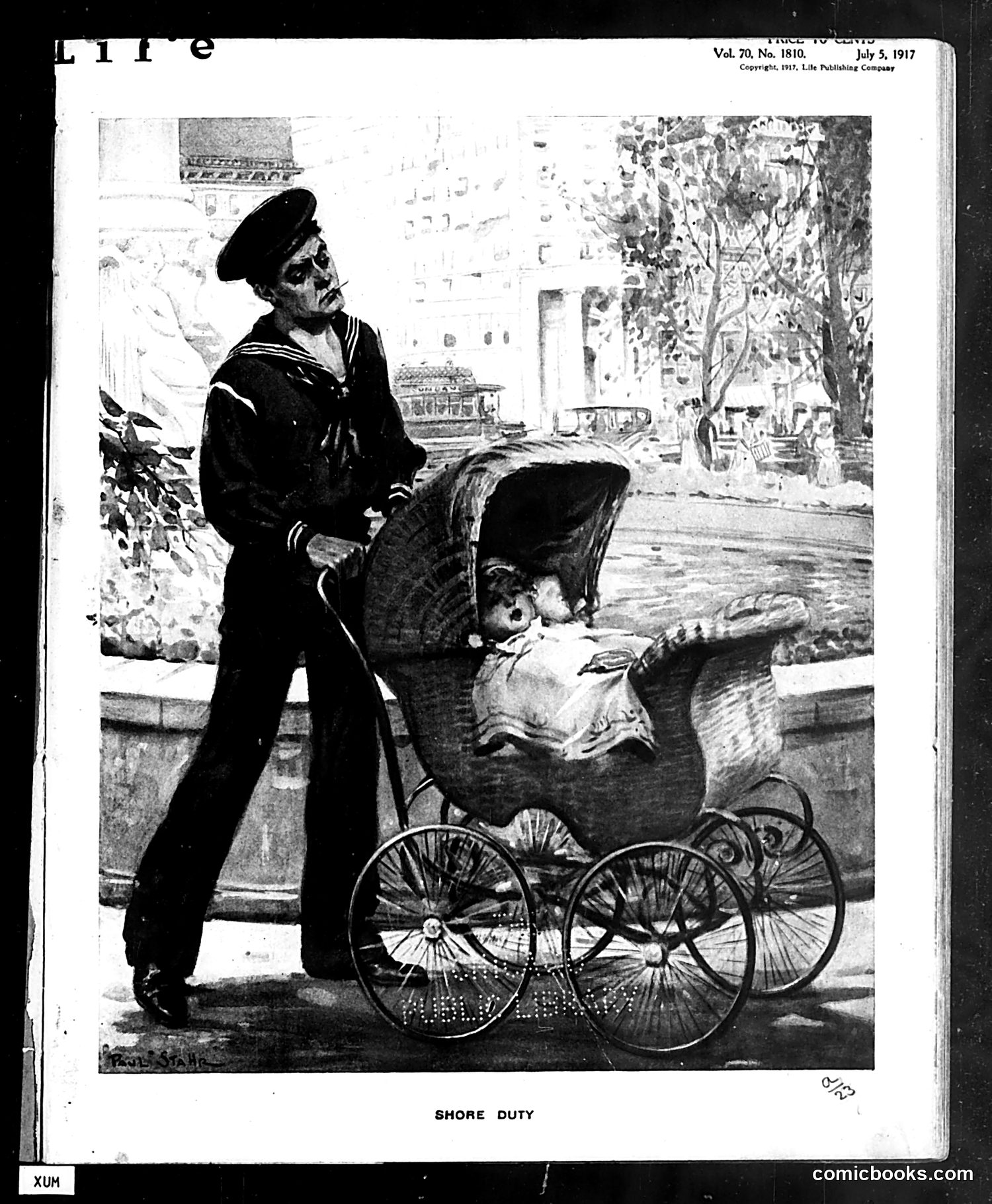
This illustration depicts a sailor standing beside a baby carriage, captioned "Shore Duty." The satire likely comments on the contrast between naval service and domestic life during World War I. The uniformed sailor—shown in full dress with distinctive sailor's collar—appears positioned awkwardly with the baby carriage, suggesting the incongruity of a military man assigned to stateside, peacetime duties. The joke plays on the phrase "shore duty" (assignment to land-based naval stations) as a mundane alternative to active combat service. During 1917, when America had recently entered WWI, the image humorously depicts how some servicemen were assigned domestic tasks rather than frontline action—a common source of military humor and satire in period publications.
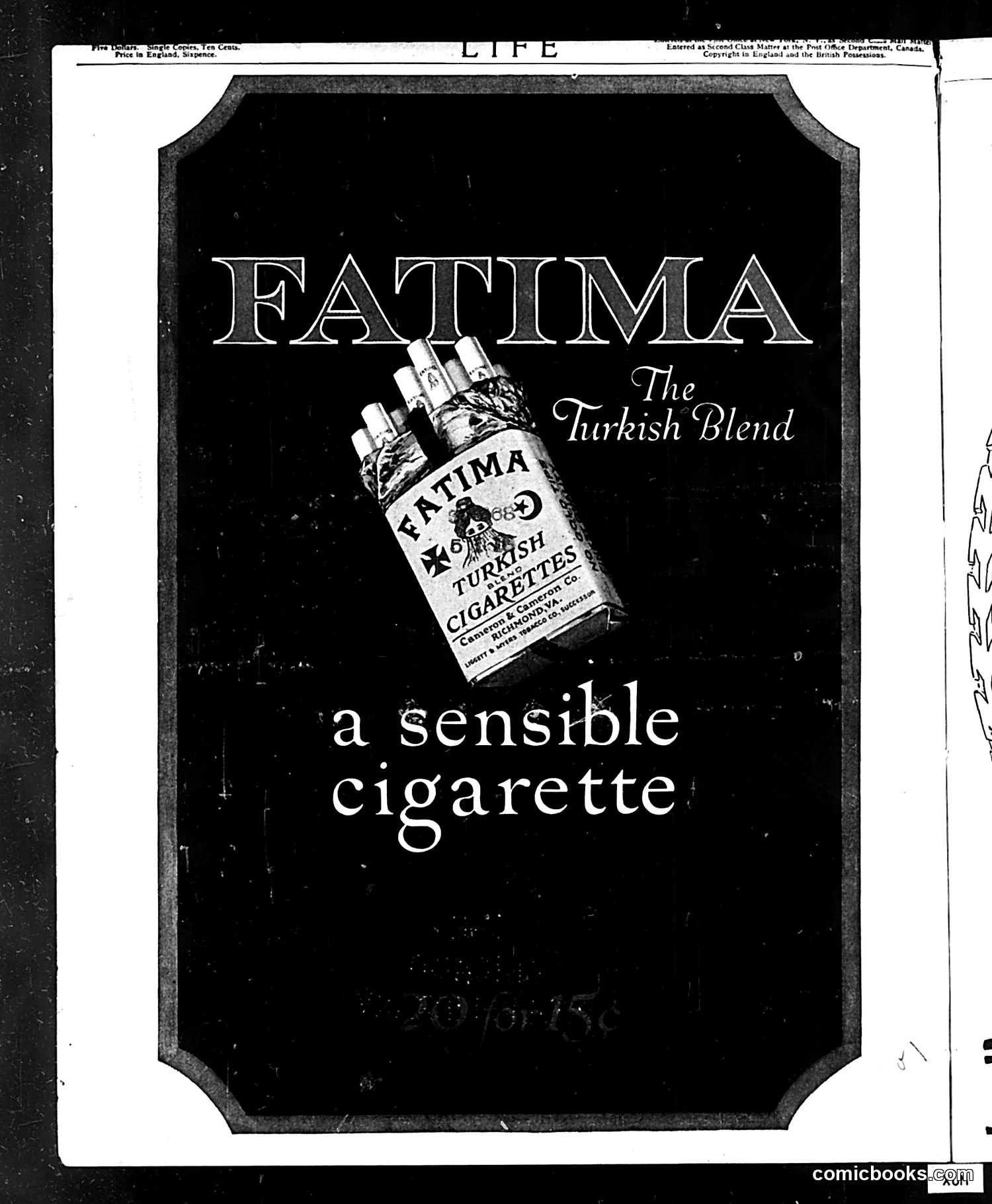
This page is a **cigarette advertisement**, not political satire. It promotes "Fatima: The Turkish Blend," describing the product as "a sensible cigarette." The ad features a pack of Turkish cigarettes with the Fatima brand visible. The language reflects early 20th-century marketing conventions, when tobacco companies marketed specific blends and origins as selling points. "Turkish blend" suggested exoticism and quality to American consumers of that era. The term "sensible cigarette" is notable to modern readers—it reflects a period before widespread understanding of cigarette health risks, when manufacturers could market cigarettes as reasonable consumer choices without legal restriction.
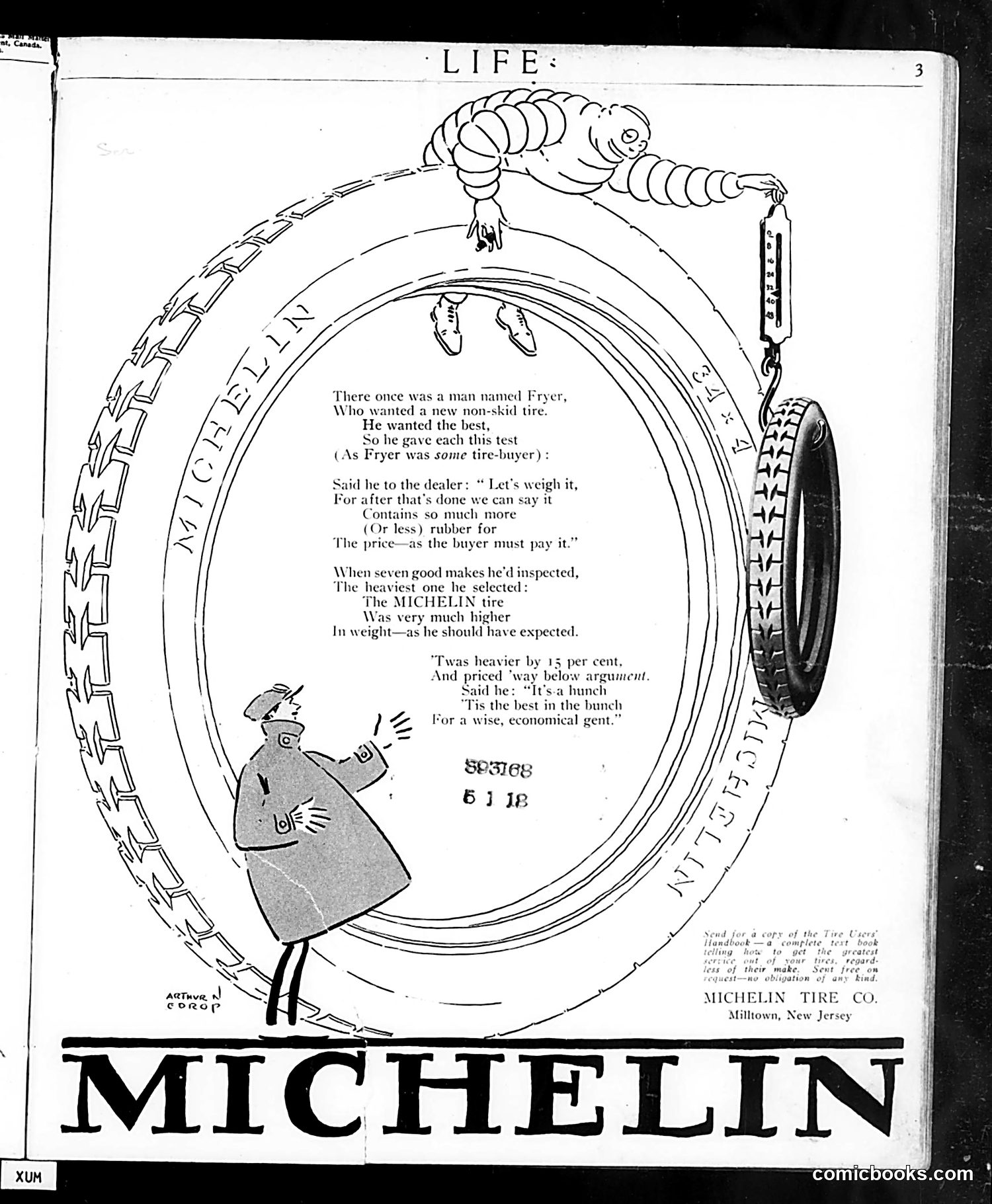
This is a Michelin Tire advertisement disguised as humorous editorial content. The poem tells of a man named Fryer seeking the best tire, who tests multiple brands and selects Michelin as "the best in the bunch / For a wise, economical gent" because it weighs more (contains more rubber) yet costs less. The cartoon depicts a whimsical figure (possibly representing Fryer) being held aloft by a large Michelin tire man, surrounded by concentric tire rings. The visual joke plays on Michelin's famous mascot—the rotund "Bibendum" character made of stacked tires. The advertisement's logic emphasizes weight-to-price value: more rubber equals durability and better economics, making Michelin superior to competitors. This is early-20th-century marketing using satirical verse and cartoon appeal to promote consumer purchasing decisions.
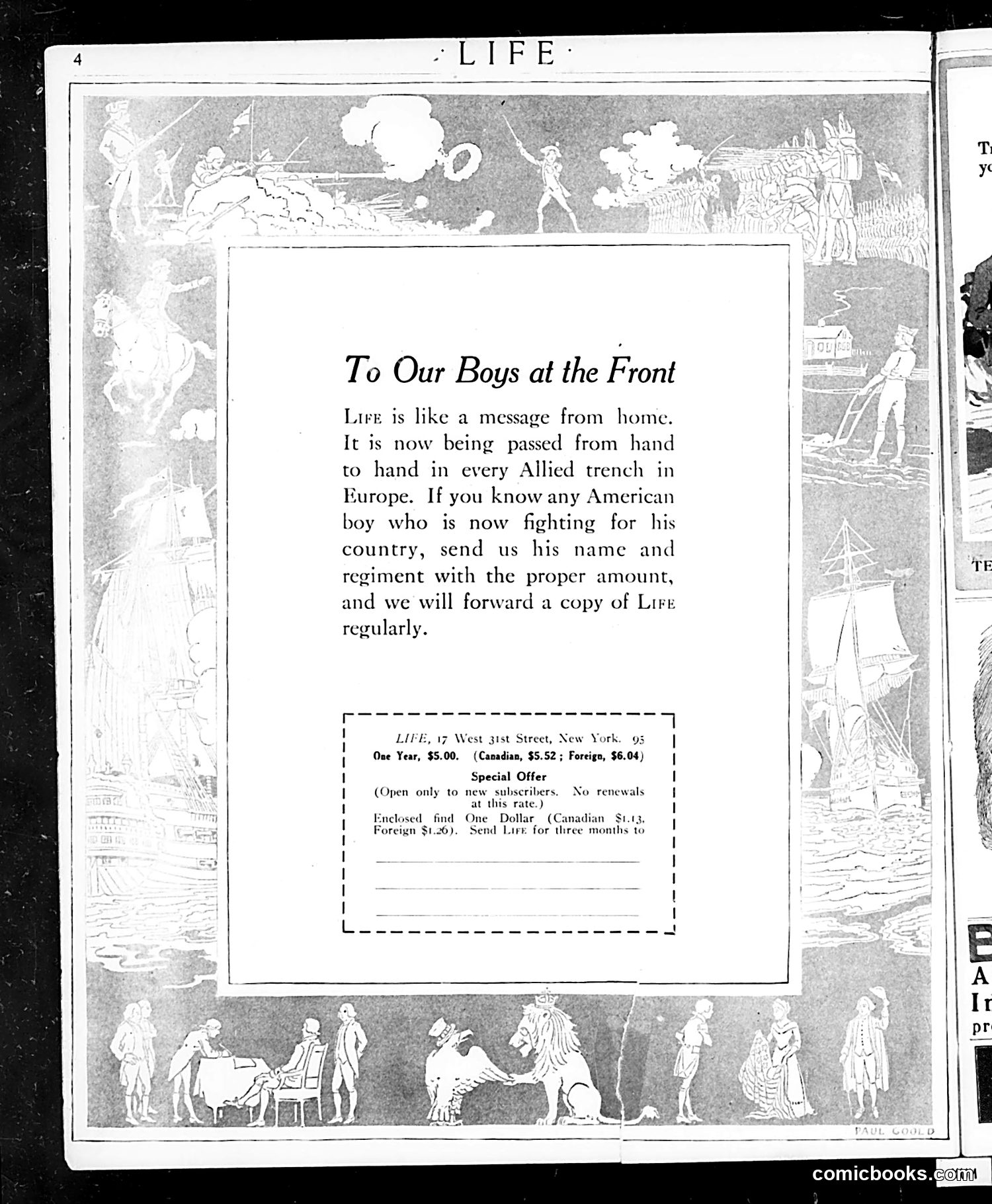
This page is primarily **advertising**, not satire or editorial content. The headline "To Our Boys at the Front" is a subscription offer from *Life* magazine to American soldiers fighting in World War I in France. The text explains that *Life* is being circulated among troops and invites American civilians to send subscriptions to soldiers they know. The offer includes pricing ($5.00 annually in the U.S., with higher rates for Canada and foreign addresses) and a special promotional rate of one dollar for a three-month trial subscription. The decorative border illustrations appear to be classical or allegorical figures rather than political commentary. This represents a patriotic marketing campaign capitalizing on wartime morale-boosting.
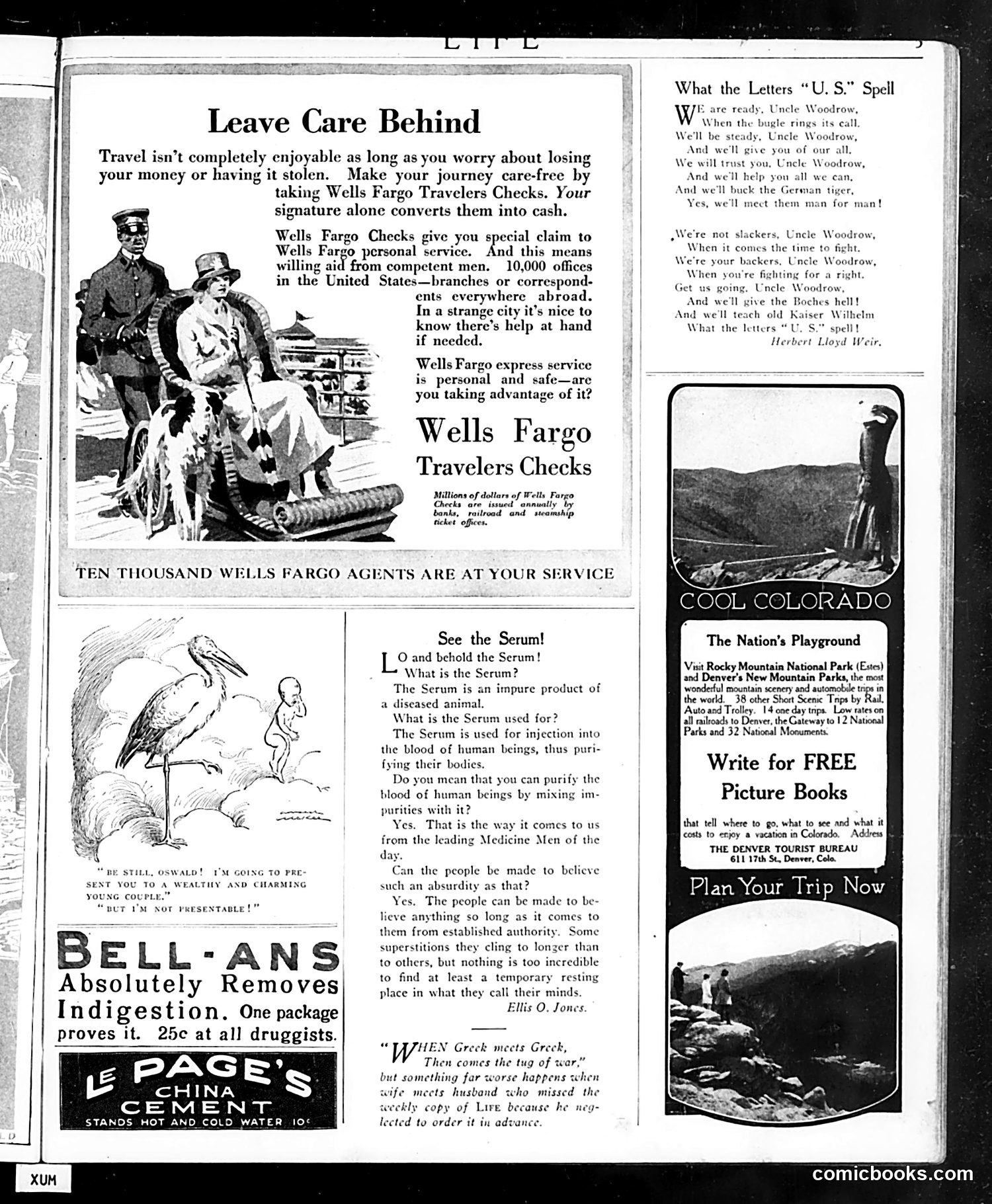
This page is primarily **advertising and editorial content** rather than political satire. The main cartoon depicts a stork carrying a baby, with a crude joke about preventing pregnancy ("I'm going to present you to a wealthy childless couple"). This appears to be period humor about adoption or family planning. The page includes advertisements for Wells Fargo Travelers Checks, Bell-Ans indigestion remedy, Le Page's China Cement, and Colorado tourism. There's also an educational piece titled "See the Serum!" explaining blood serum from diseased animals used for human injection—likely referencing early vaccine or therapeutic serum development. The Herbert Lloyd Weir poem about "U.S." appears patriotic, possibly WWI-era. Overall, this is a typical early 20th-century magazine page mixing light humor, practical information, and commercial messages.
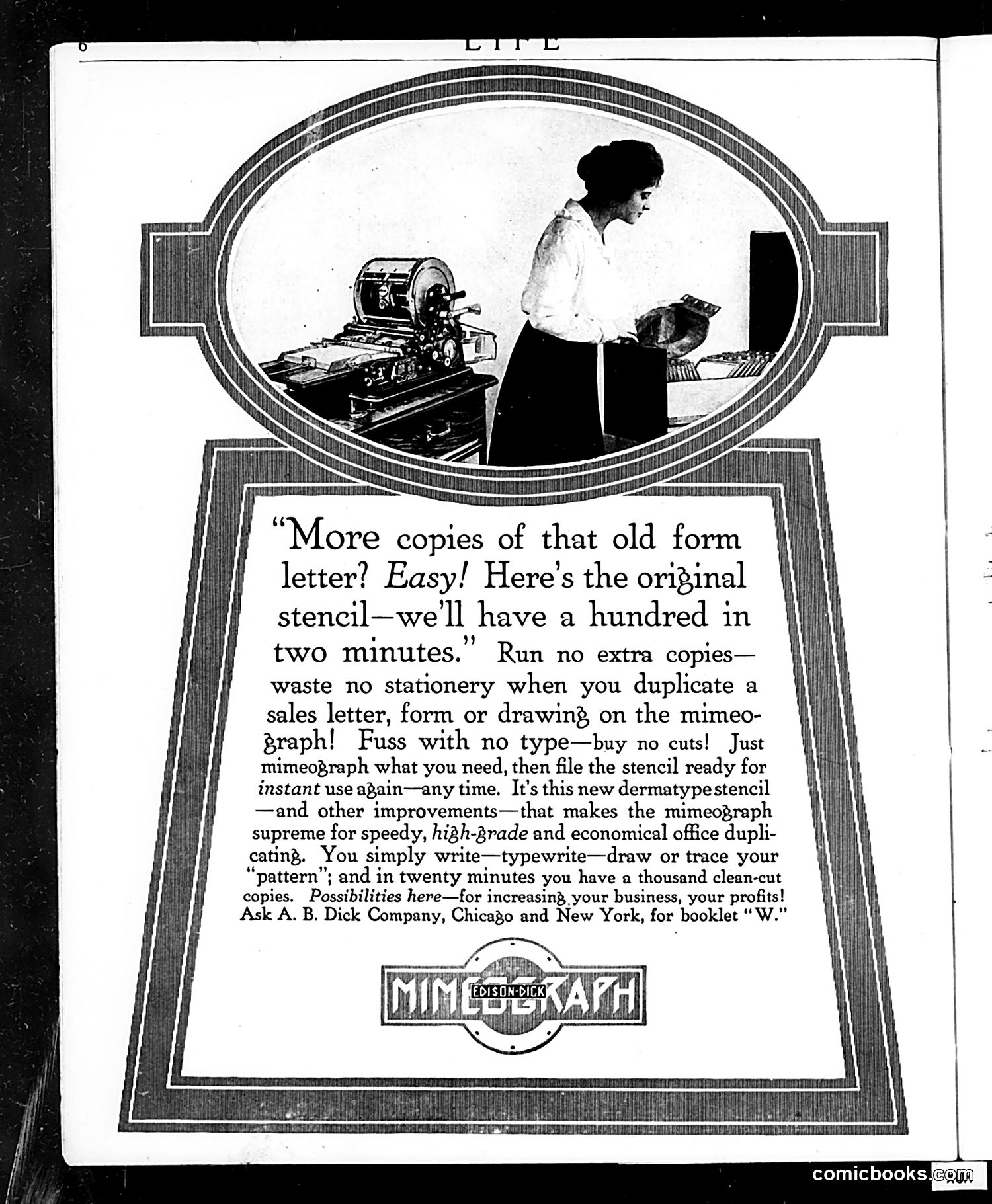
This is a **product advertisement**, not political satire. It promotes the mimeograph machine (marketed as "Mimeograph" by Edison-Dick Company) to early 20th-century office workers. The illustration shows a woman operating the device, duplicating a form letter. The ad's appeal is straightforward: businesses can save money and time by using mimeographs instead of handwritten or typeset copies. Key selling points include speed ("a hundred in two minutes"), cost savings ("waste no stationery"), and ease of use ("no type—buy no cuts"). The dermatype stencil technology mentioned represents a contemporary improvement. This is standard business advertising highlighting office efficiency—a major concern during the era's industrial expansion.
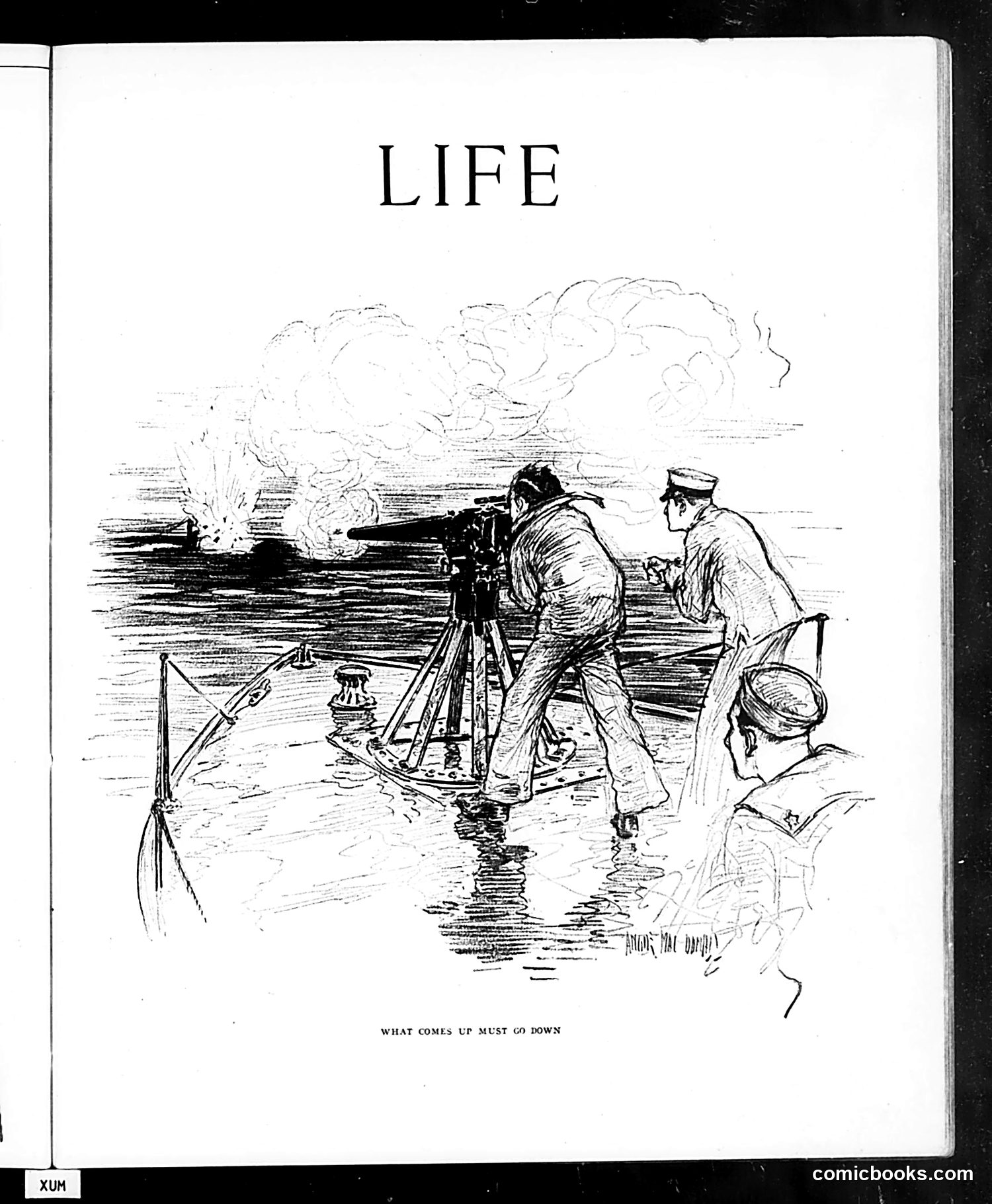
This is a title page for a "Life" magazine section titled "LIFE" with an illustration captioned "WHAT COMES UP MUST GO DOWN." The sketch depicts military personnel operating what appears to be artillery or a naval gun on a beach or shoreline, with explosions visible in the water. The drawing style and subject matter suggest this relates to World War I combat operations. The caption "WHAT COMES UP MUST GO DOWN" is a play on the physics principle (what goes up must come down), applied here to military projectiles. This appears to be satirical commentary on warfare—perhaps criticizing the futility or cyclical nature of combat, or the inevitable consequences of military action. Without additional context about the specific publication date, I cannot identify the precise historical event referenced, but the illustration clearly addresses military conflict and its destructive outcomes.
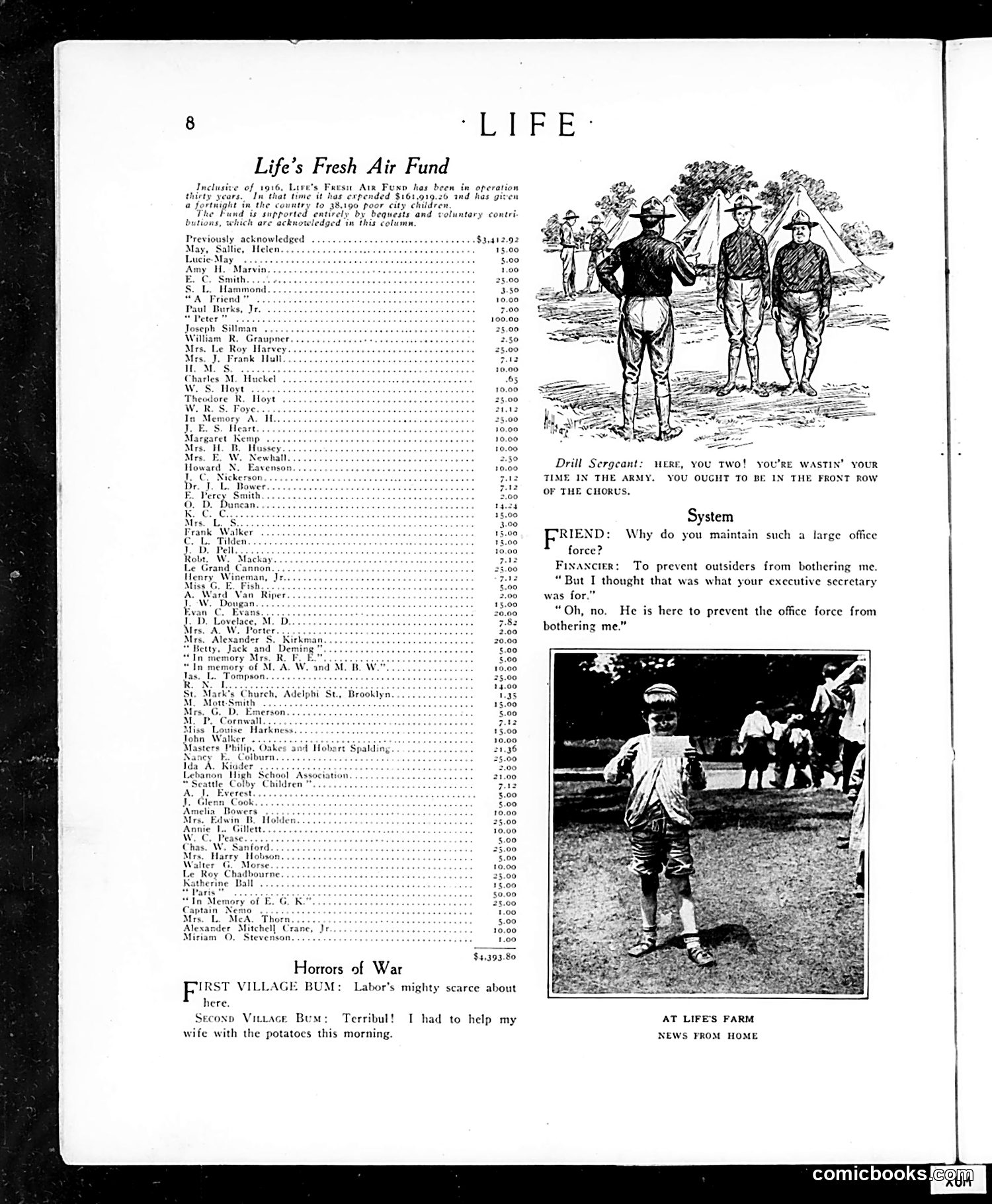
This page contains a fundraising list for "Life's Fresh Air Fund" (providing countryside experiences for poor urban children) and two satirical dialogues. The main cartoon depicts military drill sergeants confronting soldiers about choir participation—a joke about military priorities conflicting with cultural activities. Below, a "System" dialogue mocks business inefficiency: a financier explains maintaining a large office staff serves to "prevent outsiders from bothering me," while the executive's role is "to prevent the office force from bothering me." This satirizes corporate bureaucracy where layers of staff primarily create barriers rather than accomplish work—a timeless critique of organizational waste. The photograph labeled "At Life's Farm" shows children at a farm setting, illustrating the Fresh Air Fund's purpose.
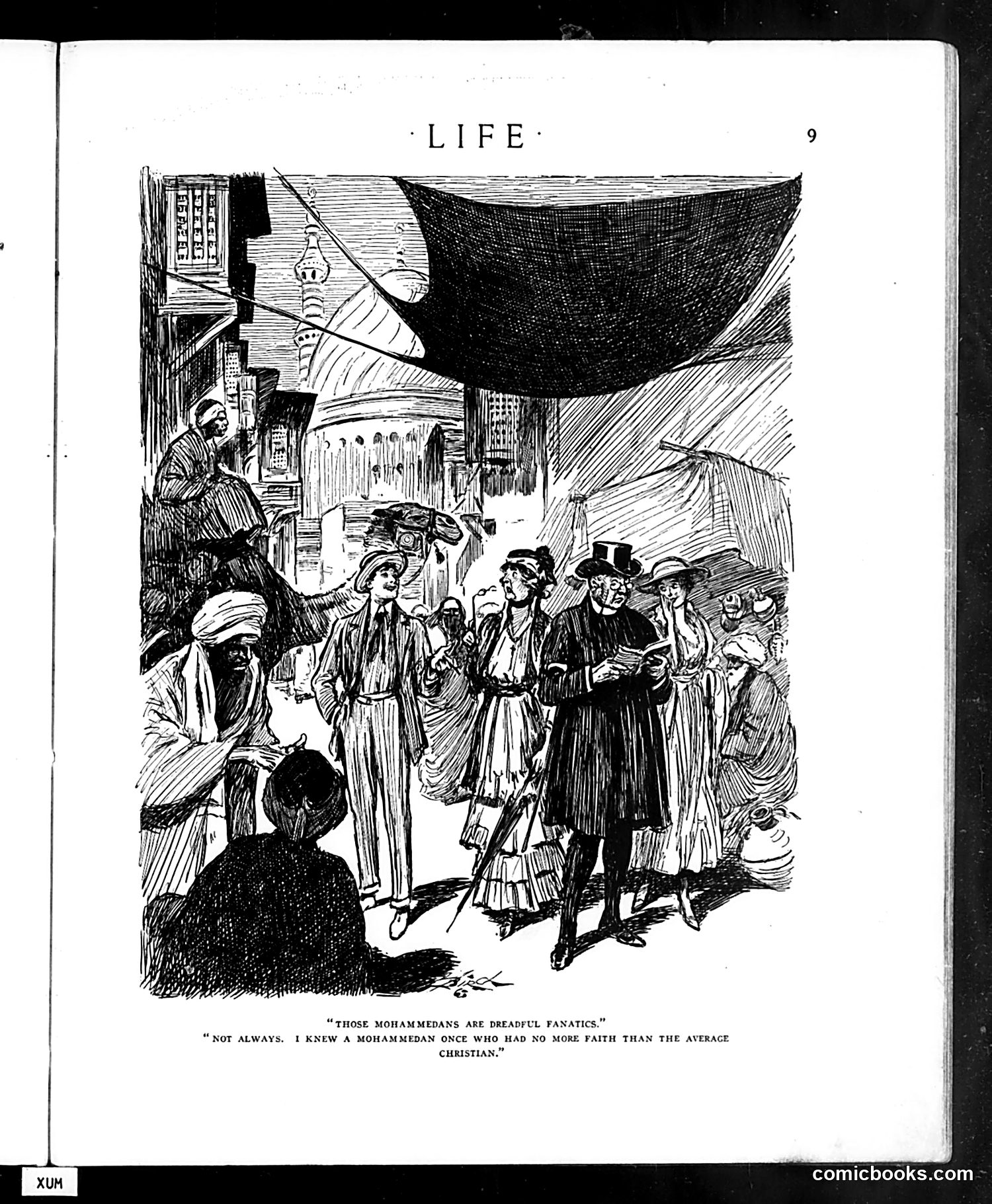
This page depicts a street scene in what appears to be a Middle Eastern marketplace or bazaar, with various figures in period dress gathered together. The dialogue indicates a conversation about Mohammedans (Muslims), with one speaker claiming they are "dreadful fanatics," while another responds by describing a Mohammedan they knew who had "no more faith than the average Christian." The satire critiques Western religious prejudice and stereotyping. Rather than accepting the blanket characterization of Muslims as inherently fanatical, the speaker offers a counterexample suggesting that individual variation exists within all religions—that secular skepticism appears equally among Muslims as among Christians. The cartoon argues against sweeping generalizations based on religious identity, a progressive stance for the era.
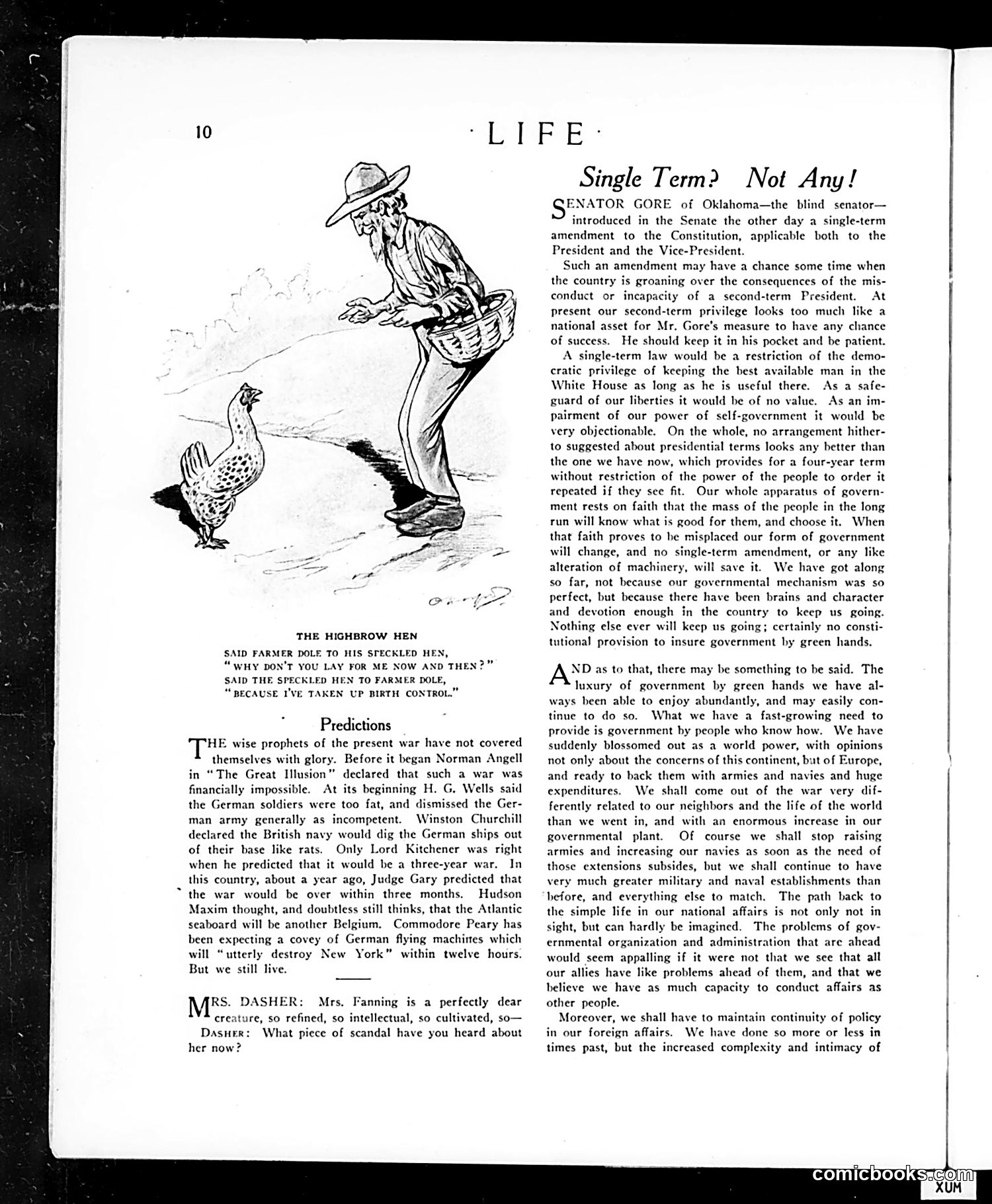
This cartoon satirizes Senator Thomas Gore of Oklahoma, who proposed a single-term amendment for the U.S. presidency. The image shows a farmer (representing common sense) confronting a speckled hen (representing Gore's proposal), with the caption: "Why don't you lay one egg a year instead of two?" The hen replies, "Because I've taken the best control." The joke mocks Gore's idea as impractical and counterintuitive—artificially restricting presidential terms would be foolish, like forcing a productive hen to lay fewer eggs. The accompanying article argues that single-term limits would restrict democratic choice and prevent capable leaders from continuing their work. The satire positions Gore's "highbrow" intellectual proposal as disconnected from practical governance.
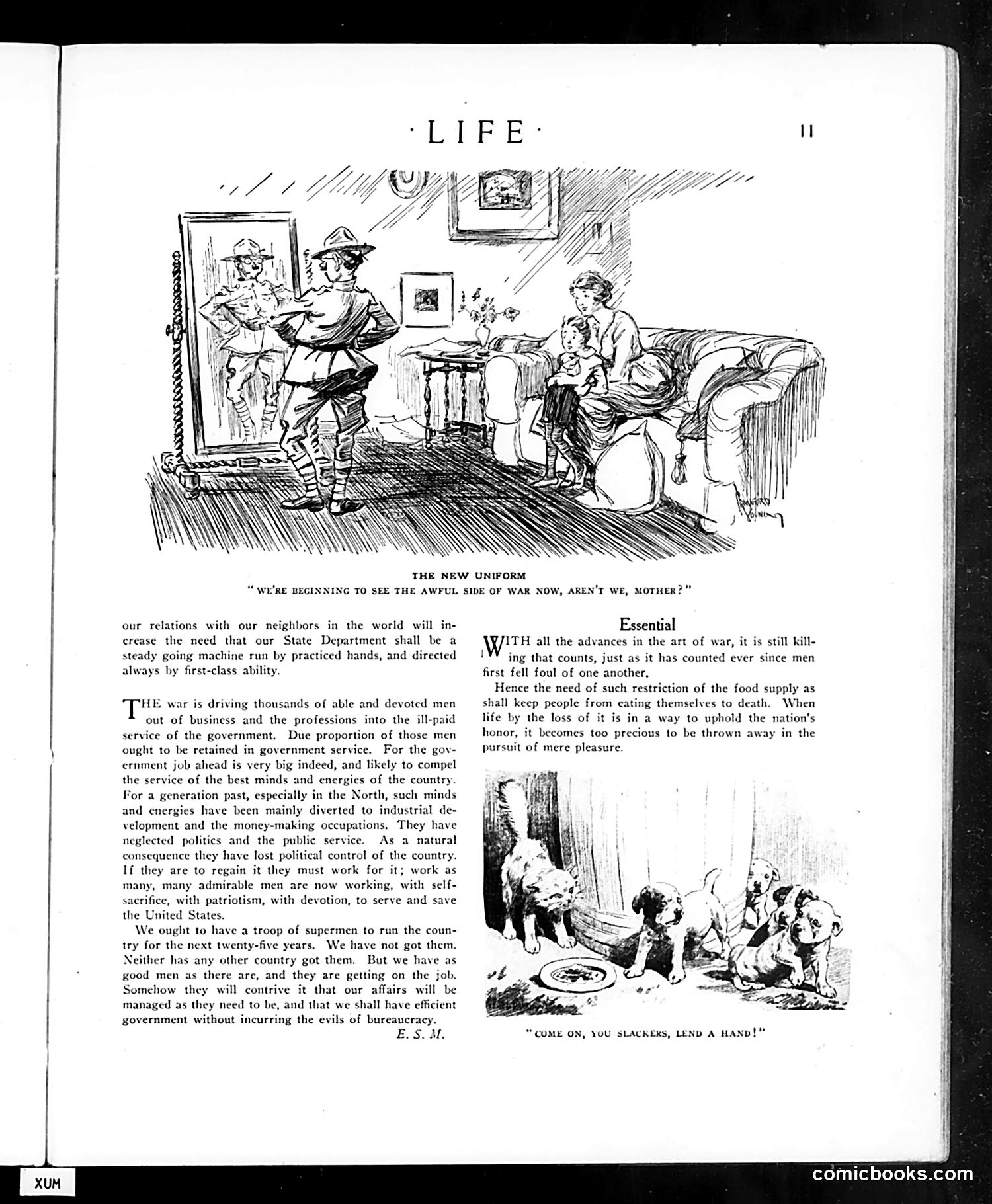
**Top Cartoon - "The New Uniform":** Two military officers in new uniforms show a woman and children a portrait, saying "We're beginning to see the awful side of war now, aren't we, Mother?" The satire appears to mock soldiers who, despite witnessing war's horrors, still romanticize military service or fail to grasp its brutality. The "new uniform" likely refers to updated military dress that masks the grim realities of combat. **Bottom Cartoon - "Come On, You Slackers, Lend a Hand!":** Depicts dogs attempting to help struggling soldiers or refugees. This satirizes those avoiding military service ("slackers") during wartime, shaming them for not contributing while even animals appear willing to help. Both cartoons use WWI-era themes about patriotic duty and public participation in the war effort.
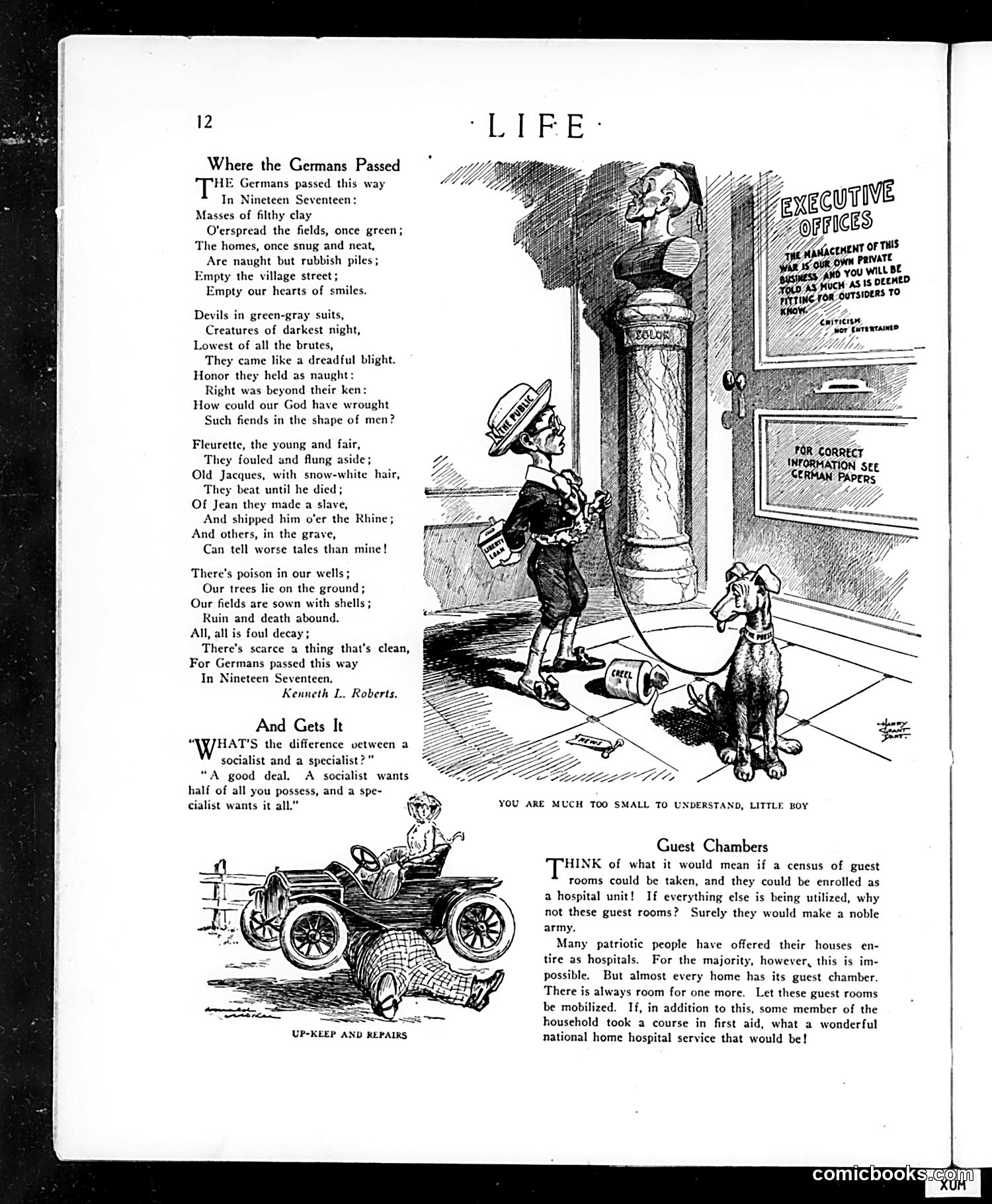
This Life magazine page contains WWI-era anti-German propaganda. The poem "Where the Germans Passed" (by Kenneth L. Roberts) describes devastation inflicted by German forces in 1917, depicting them as brutal destroyers of villages and crops. The main cartoon shows a German military figure at a desk labeled "Executive Offices," dismissively telling a small boy "You are much too small to understand, little boy"—satirizing German secrecy about war conduct and their dismissal of outside criticism. The "And Gets It" joke contrasts socialist and specialist ideologies humorously. The "Guest Chambers" section advocates mobilizing unused home space as hospital rooms for the war effort—practical wartime advocacy rather than satire. All content serves as pro-Allied propaganda justifying American involvement against Germany.
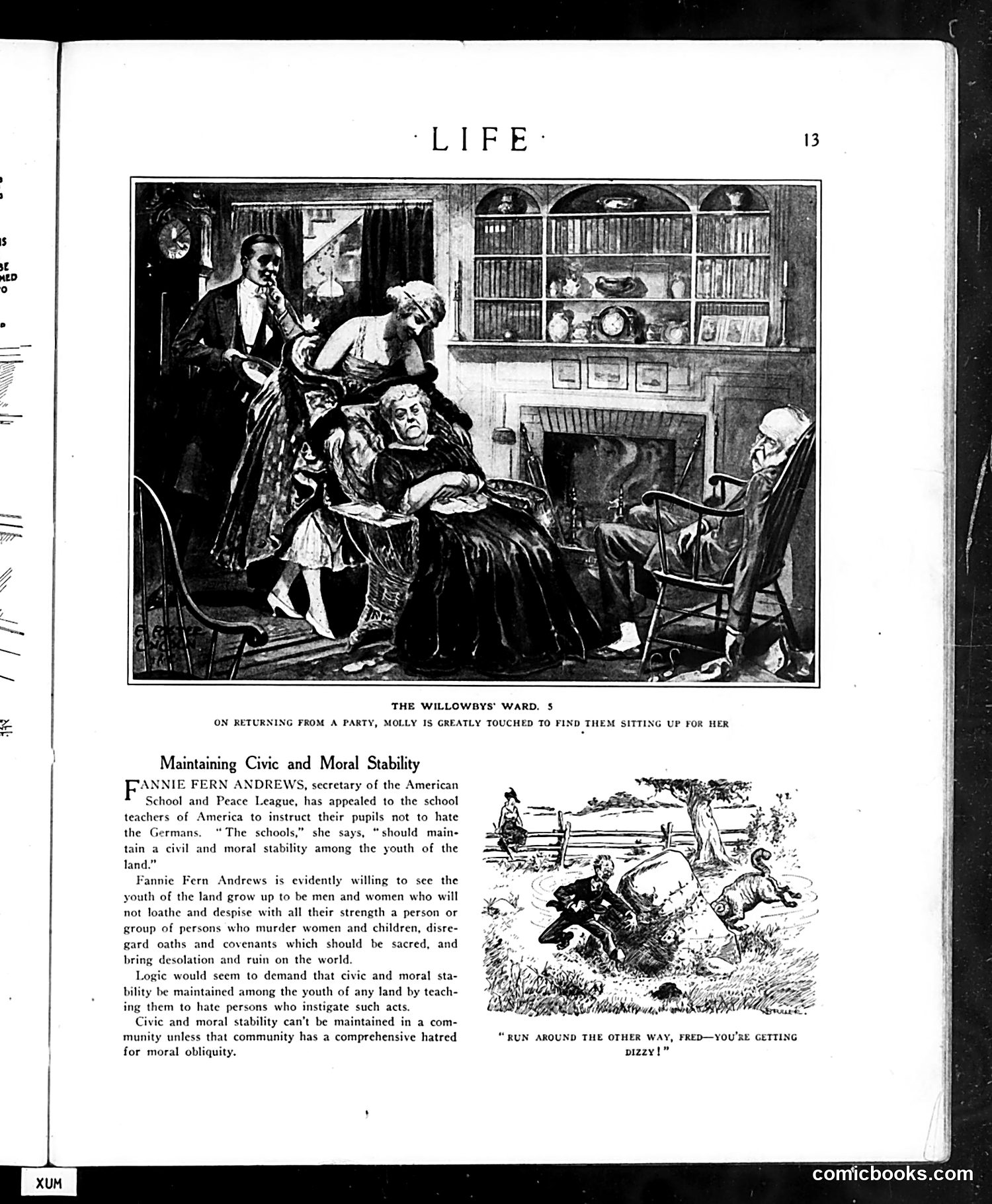
**Top Image:** "The Willowbys' Ward" depicts a domestic scene where a young woman (Molly) has returned from a party to find elderly relatives waiting up for her. The illustration satirizes middle-class domestic supervision—the relatives appear concerned or disapproving of her evening out, reflecting early 20th-century anxieties about young women's independence and nightlife. **Bottom Section:** An article by Fannie Fern Andrews argues for teaching American schoolchildren to hate Germans and those promoting violence, framing this as necessary for "civic and moral stability." This appears to reflect post-WWI sentiment. The accompanying illustration shows children playing outdoors. The page juxtaposes domestic propriety concerns with nationalist educational ideology—both addressing social order and proper behavior during a period of significant cultural anxiety.
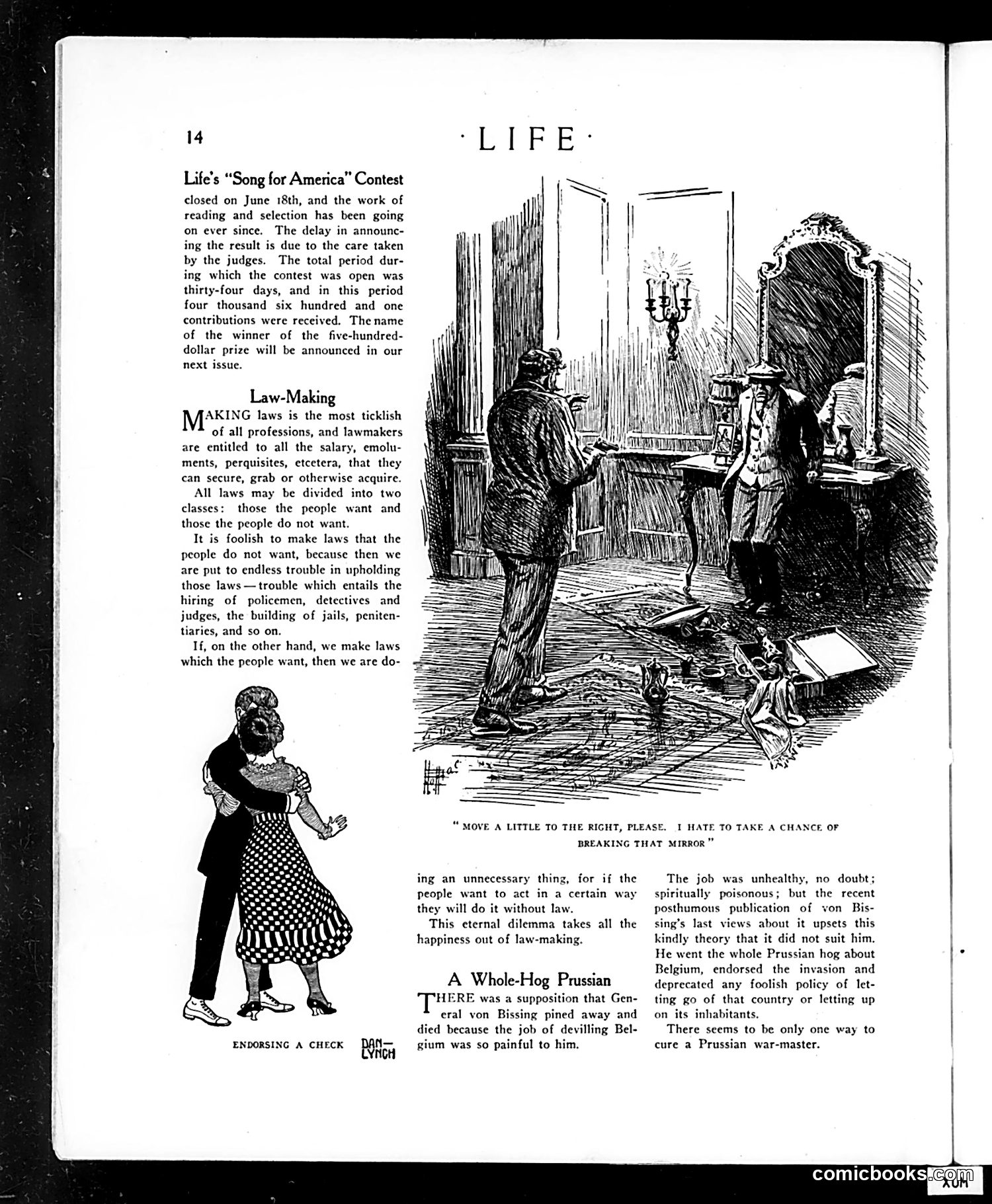
This page contains two distinct sections: **Upper illustration**: A domestic scene showing a man asking someone to move away from a mirror, fearing he'll break it—a visual joke playing on superstition about mirrors and bad luck. **"Law-Making" article**: A serious editorial discussing how laws should reflect what people actually want, rather than imposing unwanted restrictions. It argues that "foolish" laws requiring enforcement (police, jails, judges) waste resources. **"A Whole-Hog Prussian" section**: References General von Bissing, apparently a Prussian military figure whose job "despoiling Belgium was so painful to him." This appears to be WWI-era satire criticizing Prussian/German conduct in occupied Belgium—mocking the notion that destructive occupation caused the occupier distress rather than the occupied population. The page combines light domestic humor with sharp political commentary on military aggression.
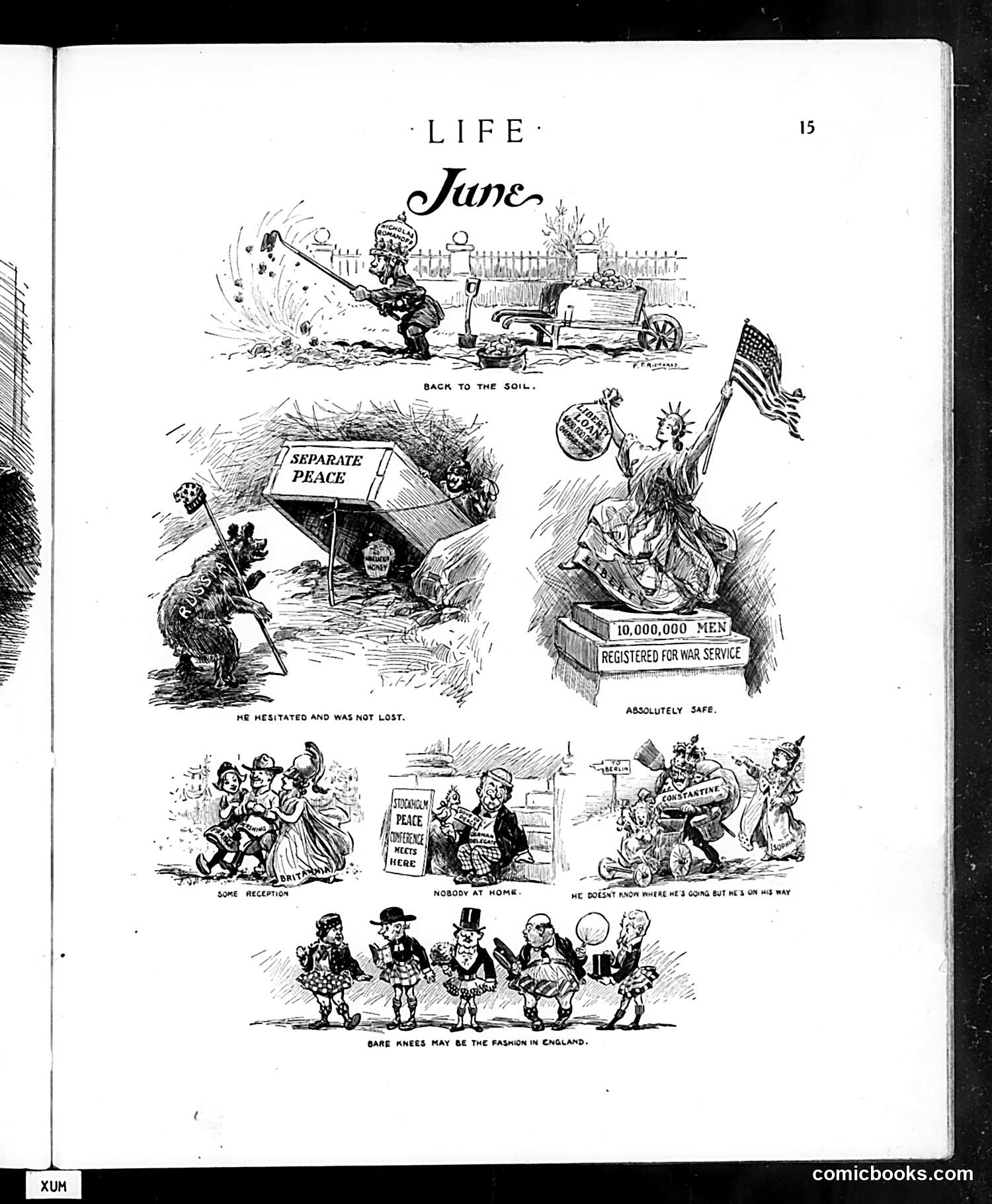
This page presents six separate cartoons satirizing post-World War I American politics and social issues: 1. **"Back to the Soil"** mocks returning to agrarian life 2. **"Separate Peace"** criticizes isolationist sentiment, showing someone retreating from global affairs 3. **"Absolutely Safe"** ironically comments on 10 million men registered for war service, suggesting their safety is illusory 4. **"Some Reception"** depicts Britannia greeting returning soldiers 5. **"Horror at Home"** references domestic peace negotiations 6. **"Bare Knees May Be the Fashion in England"** makes a social commentary on changing fashion standards The cartoons collectively address post-war disillusionment, the tension between isolationism and internationalism, soldier repatriation challenges, and shifting social norms. The satirical tone suggests skepticism toward optimistic claims about peacetime security and social stability.
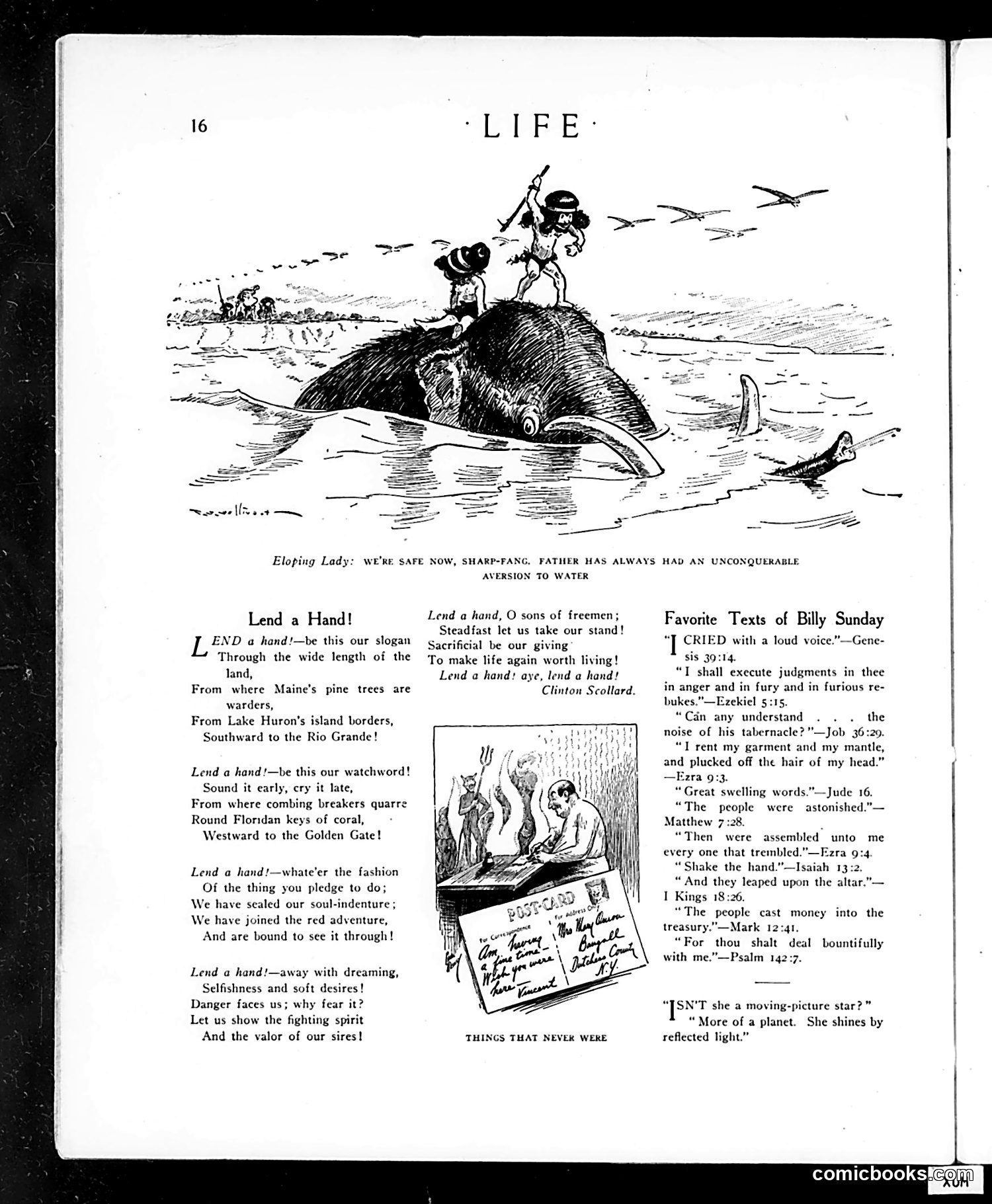
**Top Cartoon:** An "eloping lady" rides an elephant labeled "Sharp-Fang" across water while planes fly overhead. The caption jokes that they're "safe now" because her father has an "unconquerable aversion to water"—a humorous domestic scenario about escaping parental disapproval. **Main Content:** The page features a patriotic poem titled "Lend a Hand!" by Clinton Scollard, calling Americans to unite and contribute to a national cause ("the red adventure"). Given references to sacrifice and "fighting spirit," this appears WWI-era propaganda encouraging civic participation and military support. **Right Column:** "Favorite Texts of Billy Sunday" quotes scripture passages emphasizing judgment, emotion, and monetary giving. Billy Sunday was a famous early-20th-century evangelist known for fiery sermons; these quotes reflect his dramatic preaching style. **Bottom Cartoon:** A dialogue joke about a woman: "Isn't she a moving-picture star?" "More of a planet—she shines by reflected light." This mocks a woman (likely in entertainment) for lacking originality or substance.
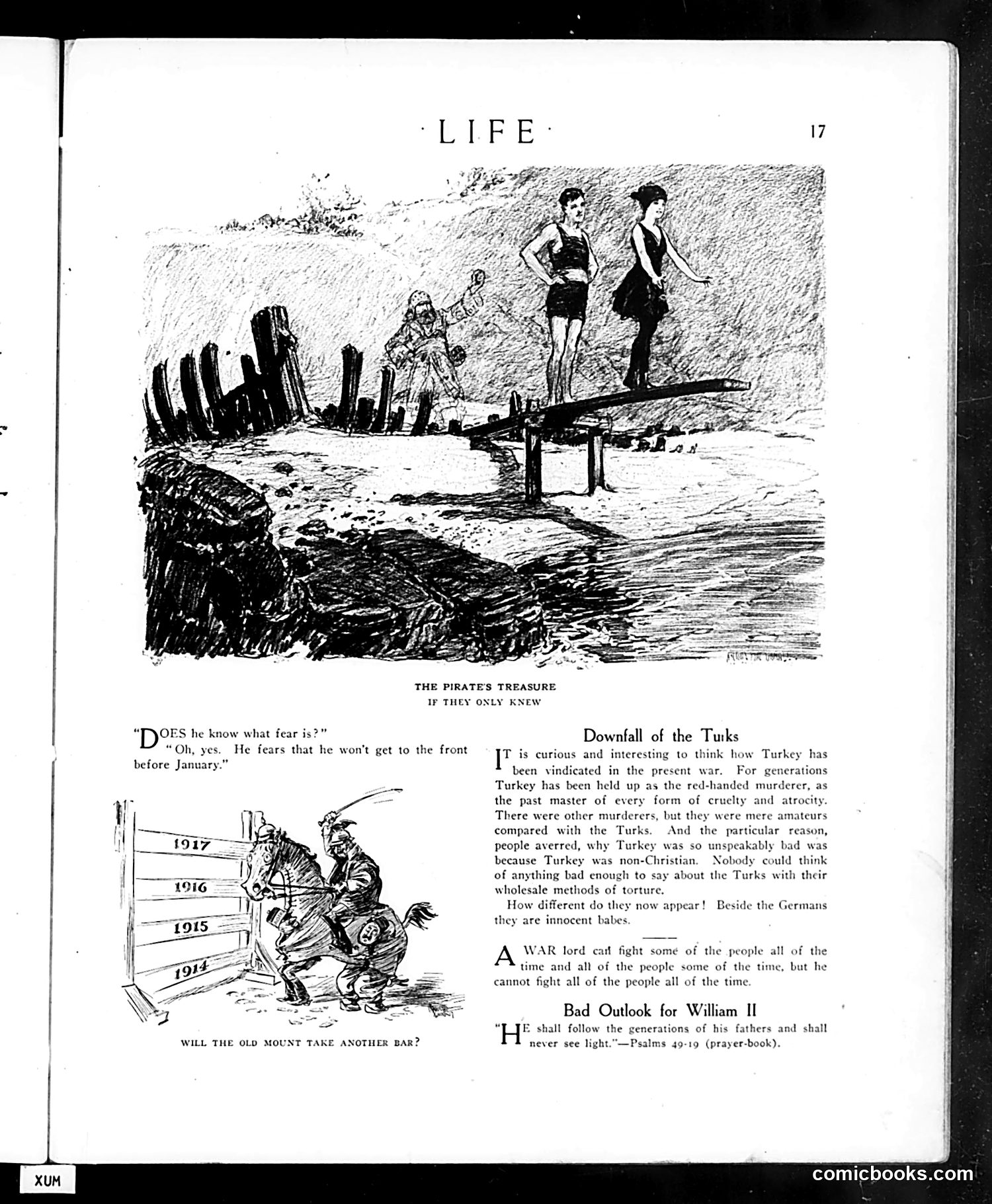
This WWI-era satirical page contains three distinct pieces: **"The Pirate's Treasure"** (top): Shows two young women in bathing suits on a beach, likely representing the "treasure" soldiers hope to enjoy if they survive the war—a common joke about soldiers' motivations during WWI. **"Will the Old Mount Take Another Bar?"** (bottom left): A caricatured mounted soldier (appears to be German, given the context) is depicted as an aging horse being asked to take on additional weight/burden. The timeline markers (1914-1917) suggest Germany's capacity is being tested after years of war—satirizing Germany's diminishing ability to sustain the war effort. **Text sections**: "Downfall of the Turks" reassesses Turkey's reputation, noting pre-war Western condemnation of Turkish cruelty now seems less severe compared to German atrocities. "Bad Outlook for William II" references Kaiser Wilhelm II, suggesting Germany's defeat is inevitable. The overall message: Germany's resources are exhausted, and historical moral judgments are being rewritten by WWI's horrors.
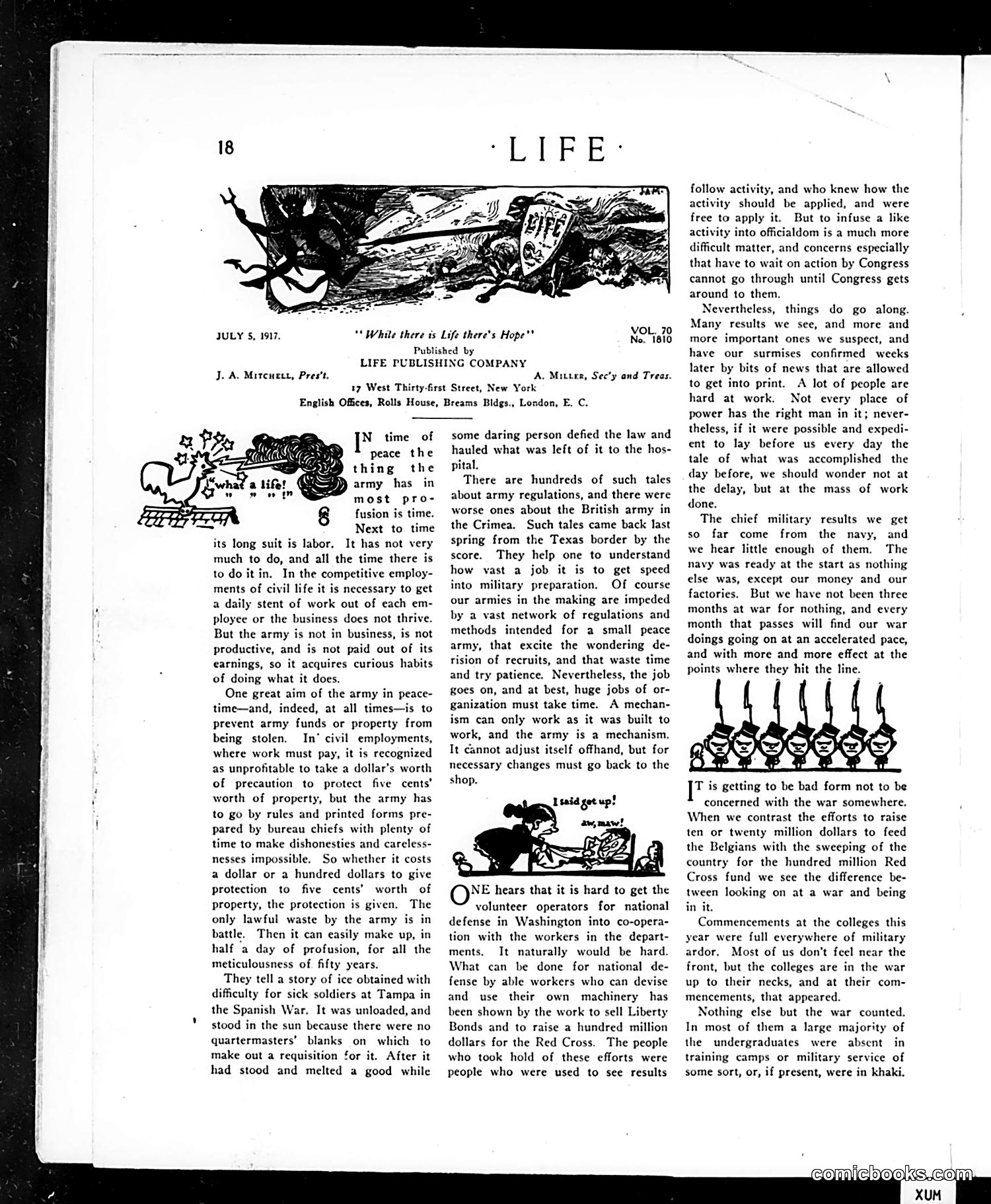
This page critiques **military bureaucratic inefficiency** during America's entry into World War I. The main article satirizes how peacetime army regulations—designed to prevent theft of minor property—create absurd delays in wartime mobilization. The central anecdote illustrates this: ice for sick soldiers in Tampa couldn't be distributed because there were no official requisition forms, so it melted unused. The author argues such rigid procedures waste time and impede military readiness, though he acknowledges that reorganizing an entire "mechanism" requires patience. The cartoon (bottom left) appears to show a soldier shouting "I said get up!"—likely mocking how soldiers waste energy on drill and formalities rather than productive work. The piece suggests that while military organization must function by rules, the tension between preventing small losses and enabling rapid wartime mobilization creates genuine problems for army efficiency.
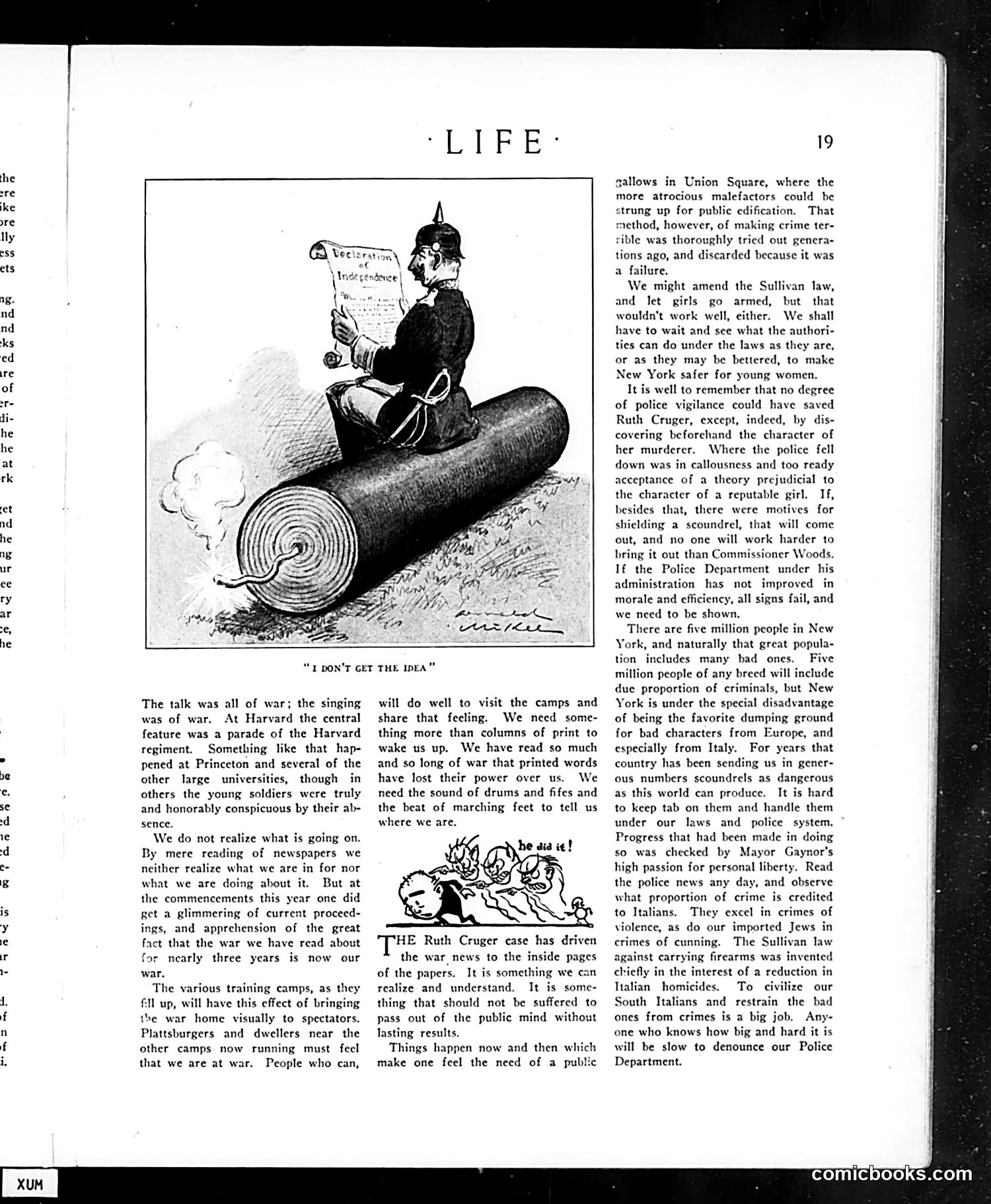
## The Cartoon The main cartoon titled "I Don't Get the Idea" depicts a figure (appears to be German military, based on the spiked helmet) sitting on a large log reading a document labeled "Declaration of Independence" or similar American founding document. The satire mocks German incomprehension of American democratic values—the joke being that authoritarian Germany cannot grasp the principles underlying American freedom. ## The Text Commentary The article addresses the **Ruth Cruger murder case**, a contemporary scandal where police bungled a missing persons investigation into a young woman's death. The author criticizes: - Police callousness and prejudicial assumptions about the victim's character - Ineffective law enforcement under Mayor Gaynor's "high passion for personal liberty" - Calls for improved police efficiency and morality The piece also contains **problematic ethnic stereotyping**, blaming Italian and Jewish immigrants for disproportionate crime rates—reflecting common prejudices of the WWI-era. The overall message: Americans need visual reminders (military camps) of war's reality, and the Cruger case demonstrates police department failures requiring reform.
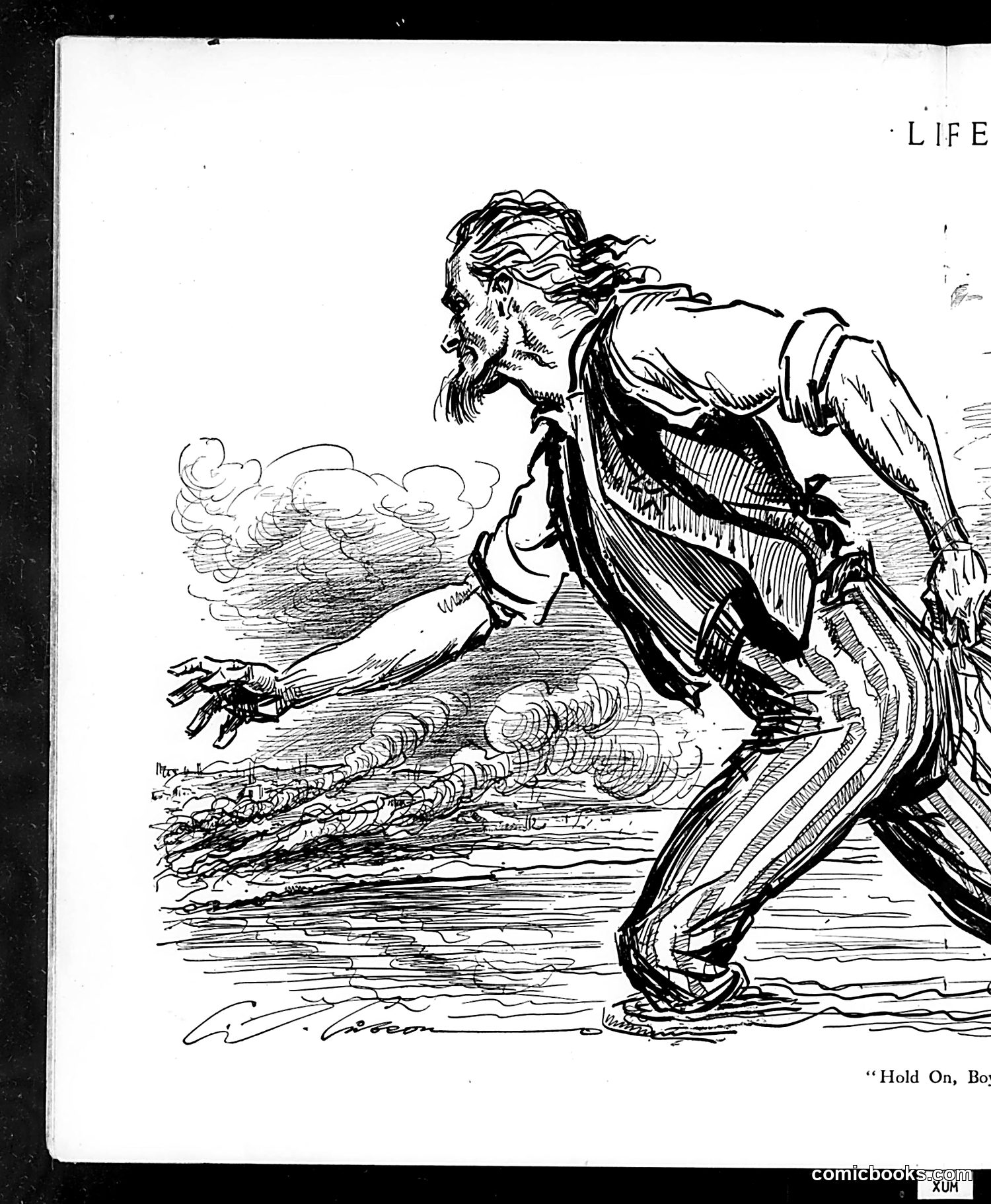
This appears to be a satirical cartoon from *Life* magazine showing a bearded man in formal attire leaning forward dramatically, with an outstretched arm gesturing toward a distant fire or explosion. The caption reads "Hold On, Boy" (partially visible). The cartoon likely satirizes a political figure's response to a crisis or disaster—the visual suggests urgency, desperation, or perhaps inadequate intervention. The man's exaggerated pose and expression convey alarm or struggle. Without knowing the specific publication date or clearer caption text, I cannot definitively identify the figure or the exact historical event referenced. However, the style and composition suggest this critiques political mismanagement or a failed attempt to control a dangerous situation during an early 20th-century American crisis.
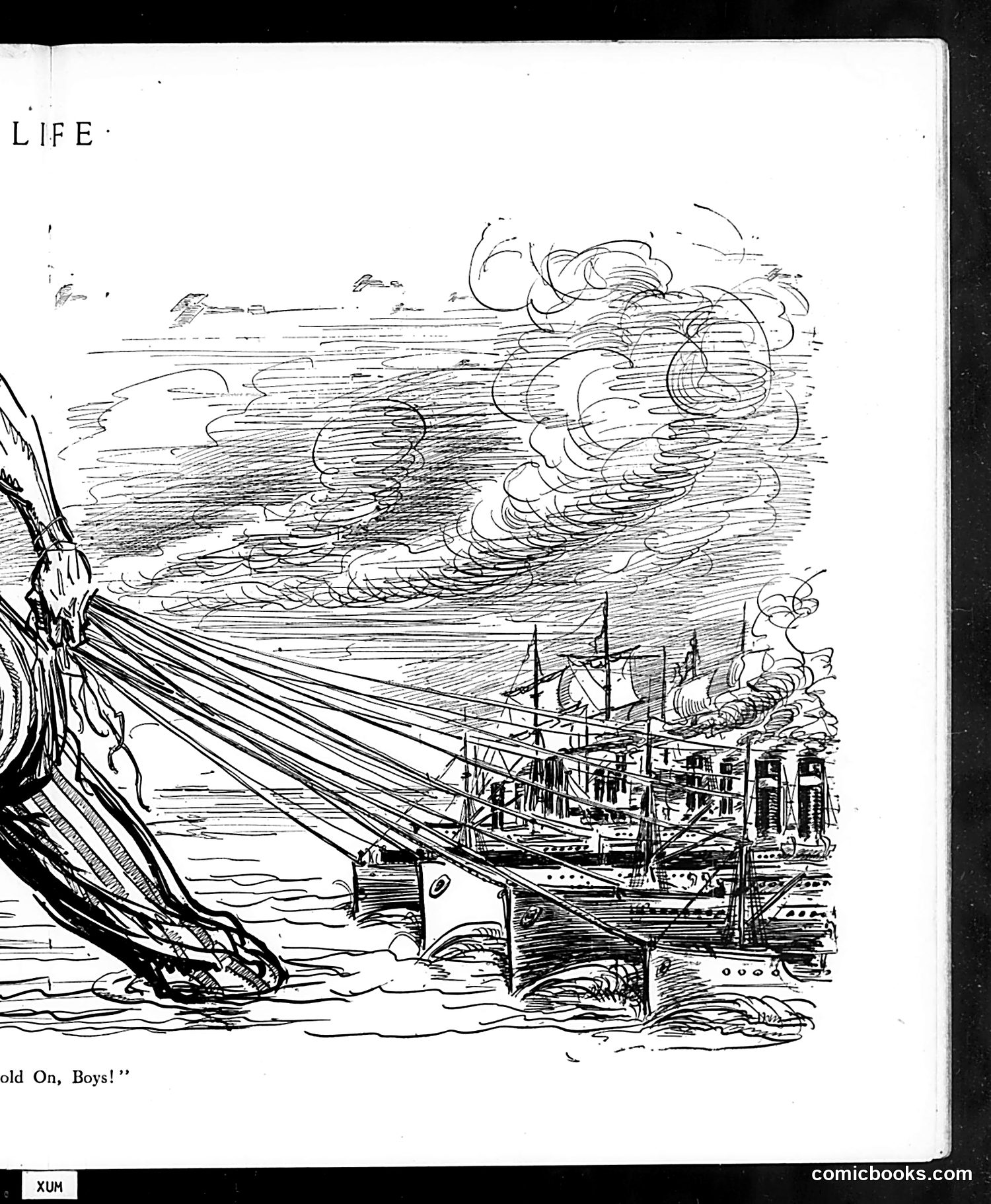
This appears to be a page from *Life* magazine featuring a maritime-themed illustration. The image shows a large sailing vessel with prominent rigging in the foreground (left), moored at what looks like an industrial port with multiple ships and smoking smokestacks visible in the background. The caption "old On, Boys!" (likely "Hold On, Boys!") suggests nautical or military context. The dramatic sky with billowing clouds and the detailed rendering of the harbor scene suggest this may be commentary on industrial or naval activity, possibly related to wartime shipping or maritime commerce. Without additional context or a visible date, the specific historical reference remains unclear. The image's style is consistent with early-to-mid 20th century satirical illustration.
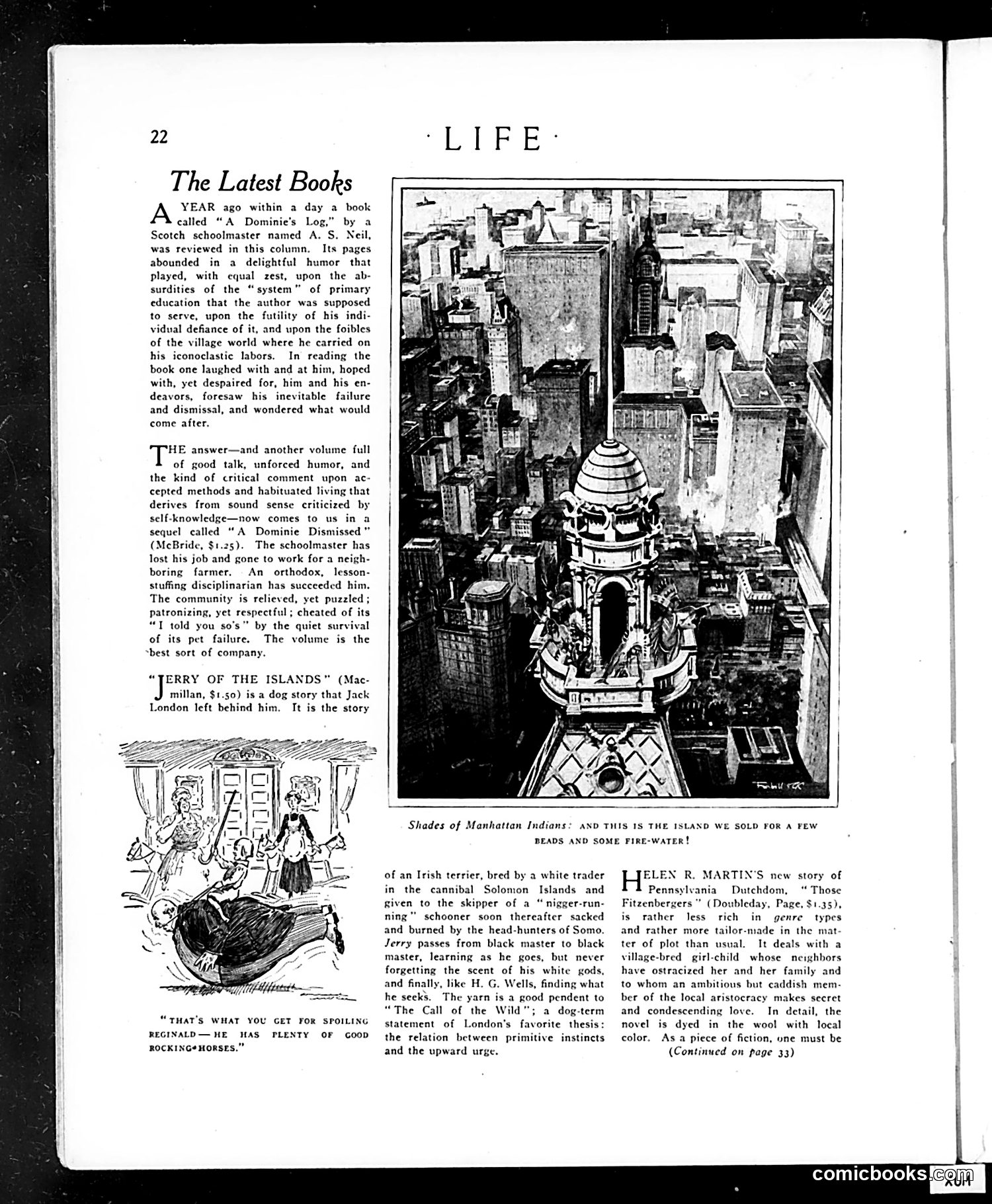
This page reviews three books, with one cartoon satirizing early 20th-century attitudes about Native Americans. The cartoon (captioned "Shades of Manhattan Indians") depicts a tall building viewed from above, comparing it to the historical sale of Manhattan Island. The caption reads: "AND THIS IS THE ISLAND WE SOLD FOR A FEW BEADS AND SOME FIRE-WATER!" **The satire:** This references the famous (likely apocryphal) story that Native Americans sold Manhattan to European settlers for worthless trinkets—specifically beads and alcohol. The cartoon sardonically suggests that modern real estate development represents a similarly exploitative or absurdly undervalued transaction. The joke relies on readers' familiarity with the stereotype of Native Americans as naive traders. It critiques either the original deal's unfairness or modern land speculation—though the cartoon's tone suggests it mocks Native Americans rather than sympathizing with their historical dispossession, reflecting the casual racism typical of 1910s-era American humor. The other content discusses books by A.S. Neill, Jack London, and Helen R. Martin.
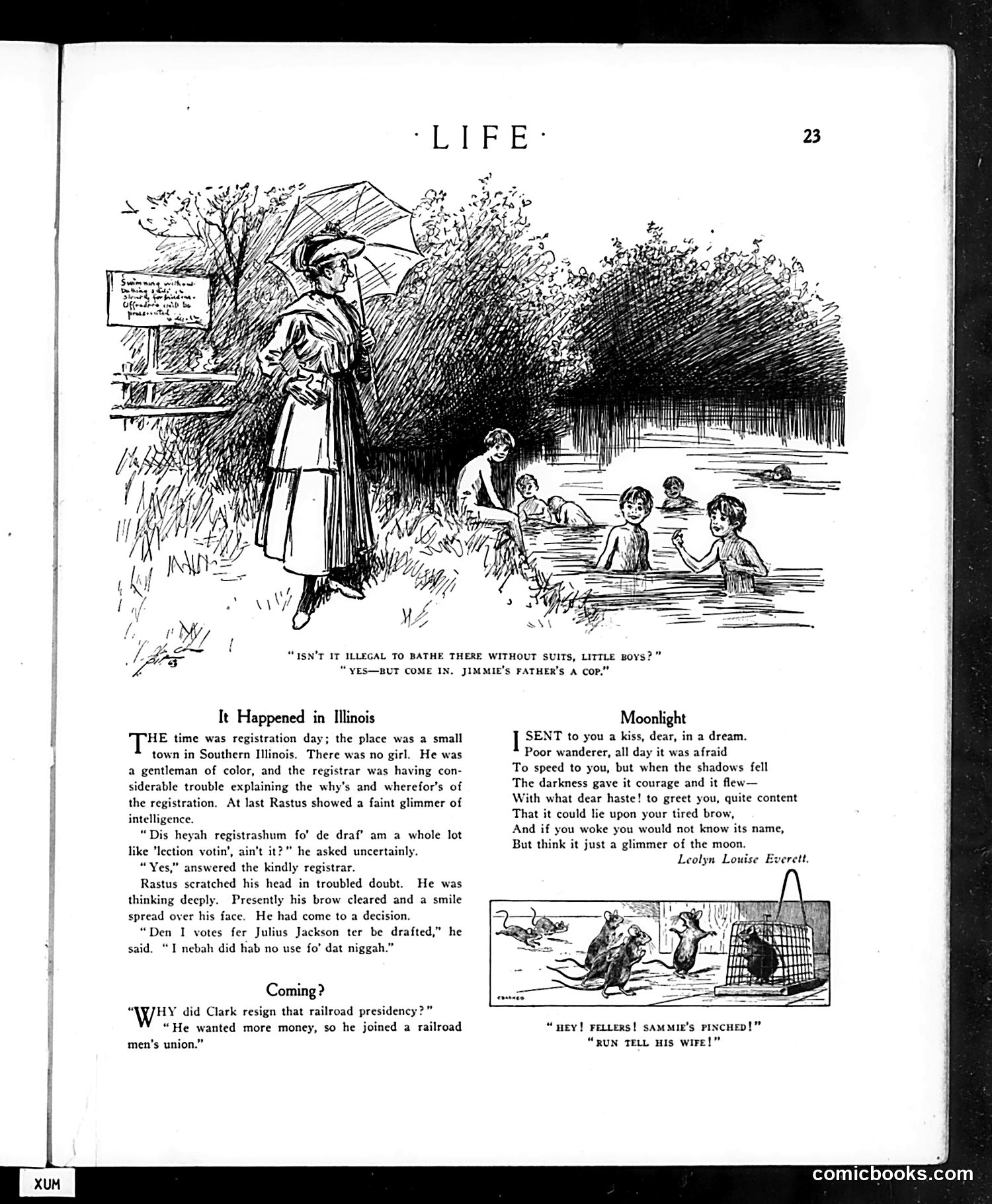
This page contains three distinct pieces reflecting early 20th-century American attitudes: **"It Happened in Illinois"**: A dialect-heavy joke about military draft registration. A Black man (drawn with period racist caricature) mistakenly equates draft registration with voting, then "votes" for another Black man to be drafted instead of himself, using a racial slur. The humor relies on stereotypical speech patterns and the racist premise that Black men would gladly sacrifice each other. **"Coming?"**: A brief economic joke about a railroad president joining a union for higher wages—straightforward labor commentary. **Top cartoon**: A woman supervises nude boys bathing in a river, asking if it's illegal. The punchline reveals her husband is a policeman, implying immunity from law enforcement. **"Moonlight"**: A romantic poem by Leolyn Louise Everett (attributed). **Bottom cartoon**: Appears to show someone being arrested ("pinched"), with bystanders telling his wife. The page reflects attitudes toward race, labor, and social hierarchy typical of the era, presented through satirical commentary and period humor.
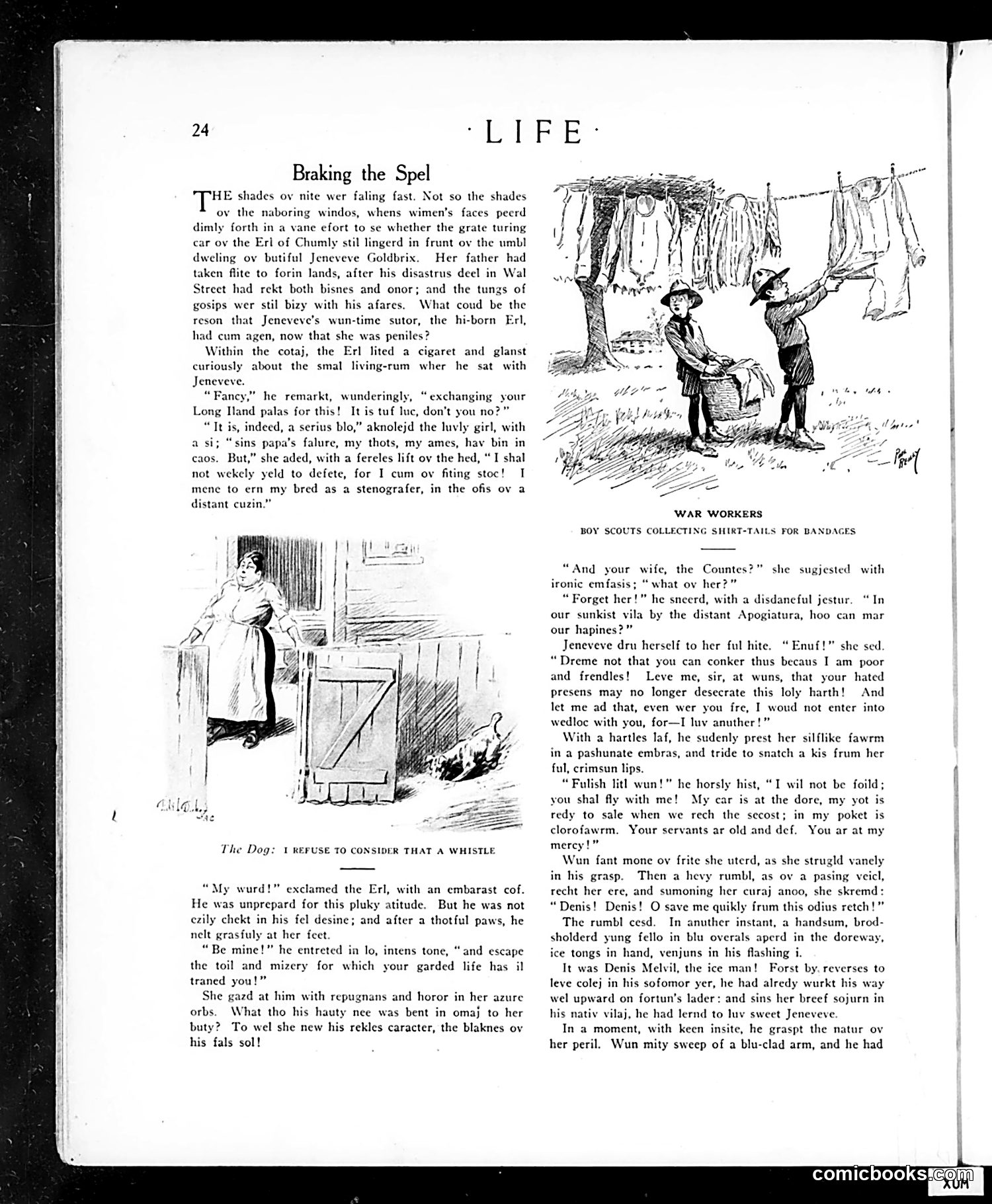
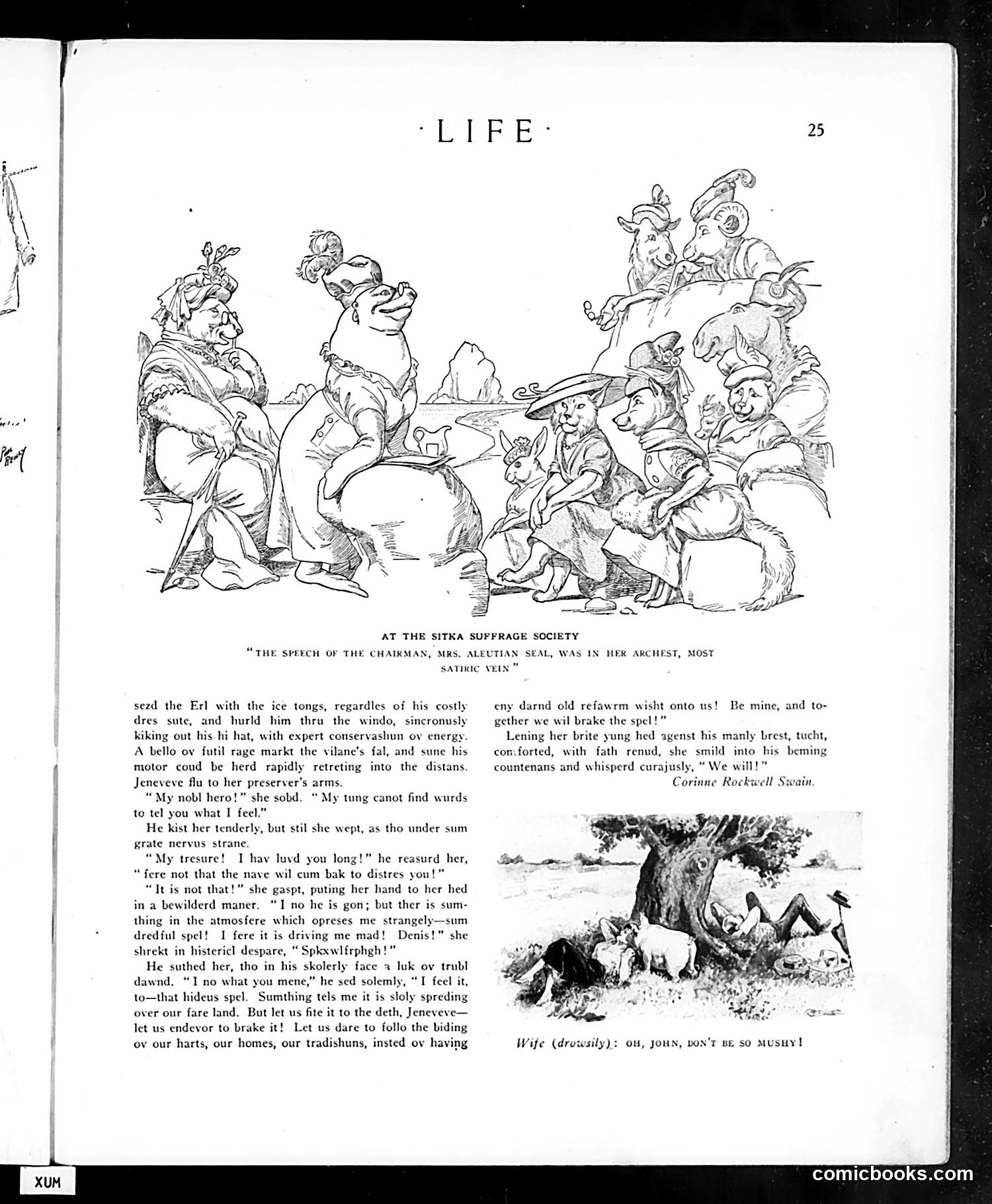
This page contains a melodramatic serialized story titled "Braking the Spel" (Breaking the Spell), illustrated with period sketches. The narrative depicts a classic Victorian romance: Jeneveve Goldbrix, now poor after her father's Wall Street failure, is visited by an aristocratic Earl she once knew. He proposes she escape her hardship by running away with him, despite his existing marriage. The satire appears directed at **deliberately misspelled text**—the OCR preserves intentional phonetic spelling throughout ("ov" for "of," "wer" for "were," "nite" for "night"). This mockery of poor spelling/education was a common Life magazine technique for satirizing lower-class characters and sentimental fiction. A sidebar titled "War Workers" shows Boy Scouts collecting shirt-tails for bandages, reflecting WWI-era home-front mobilization efforts. The story's melodramatic plot—virtue threatened, rescue by a working-class hero (the ice man Denis)—parodies penny-dreadful fiction popular with working-class readers.
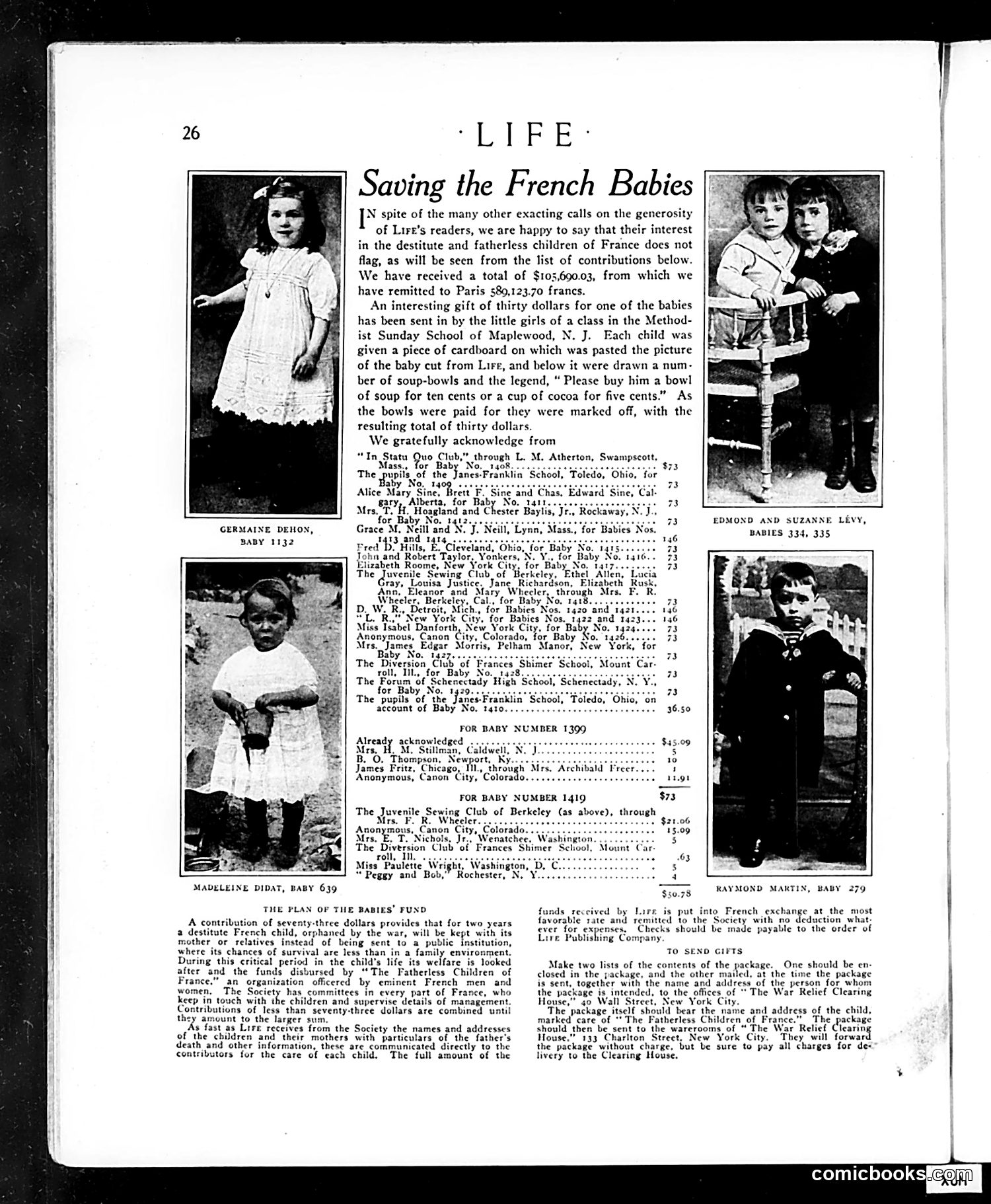
This page documents **Life magazine's charitable fundraising campaign for French war orphans** following World War I. Rather than a political cartoon, it's a humanitarian appeal. The page features photographs of actual French children (Germaine Dehon, Madeleine Didat, Edmond and Suzanne Lévy, Raymond Martin) being supported through reader donations. The text explains Life's "Fatherless Children of France" fund, which had raised over $103,000. A notable anecdote describes Methodist Sunday School girls in Maplewood, New Jersey, who raised $30 by drawing soup bowls on cardboard pictures of babies, asking donors to "buy" bowls of soup for ten cents or cocoa for five cents—gamifying charitable giving. The page lists donor names and amounts (typically $73 per child), demonstrating broad American public support for French war relief during the post-WWI period. This reflects American philanthropic efforts to address European humanitarian crises following the war's devastation.
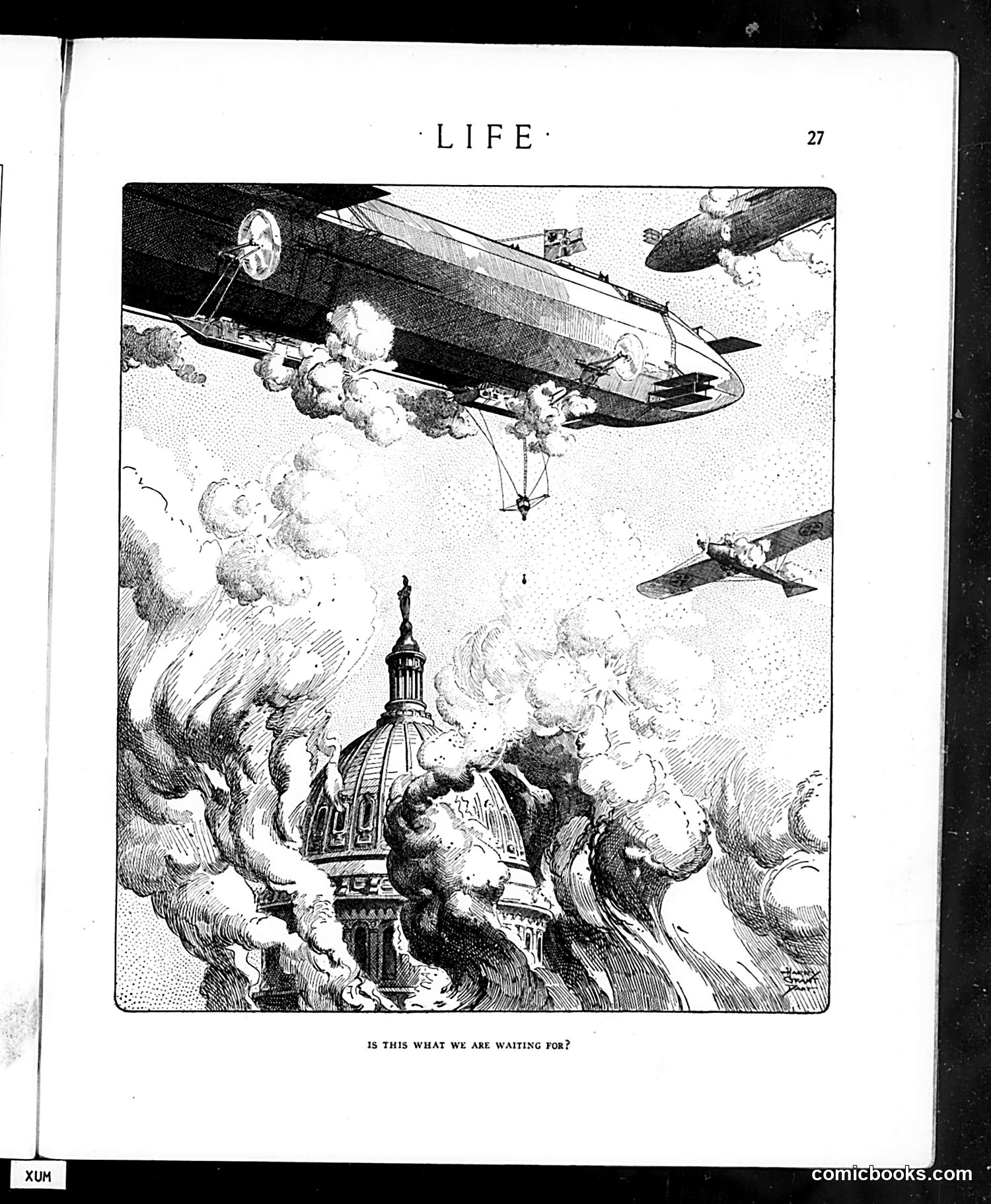
This is a satirical illustration from *Life* magazine depicting aerial bombardment of the U.S. Capitol building. The cartoon shows military aircraft dropping bombs that explode around the dome, with allegorical figures (appearing to represent destruction or chaos) emerging from the smoke below. The caption—"Is This What We Are Waiting For?"—poses a rhetorical question suggesting public anxiety or debate about potential air warfare threats to American institutions. Given the style and *Life*'s satirical nature, this likely comments on contemporary concerns about military aviation, aerial defense capabilities, or anxieties about war. The specific historical context (likely early-to-mid 20th century based on aircraft design) would determine whether this references WWI concerns, interwar anxieties, or WWII-era fears.
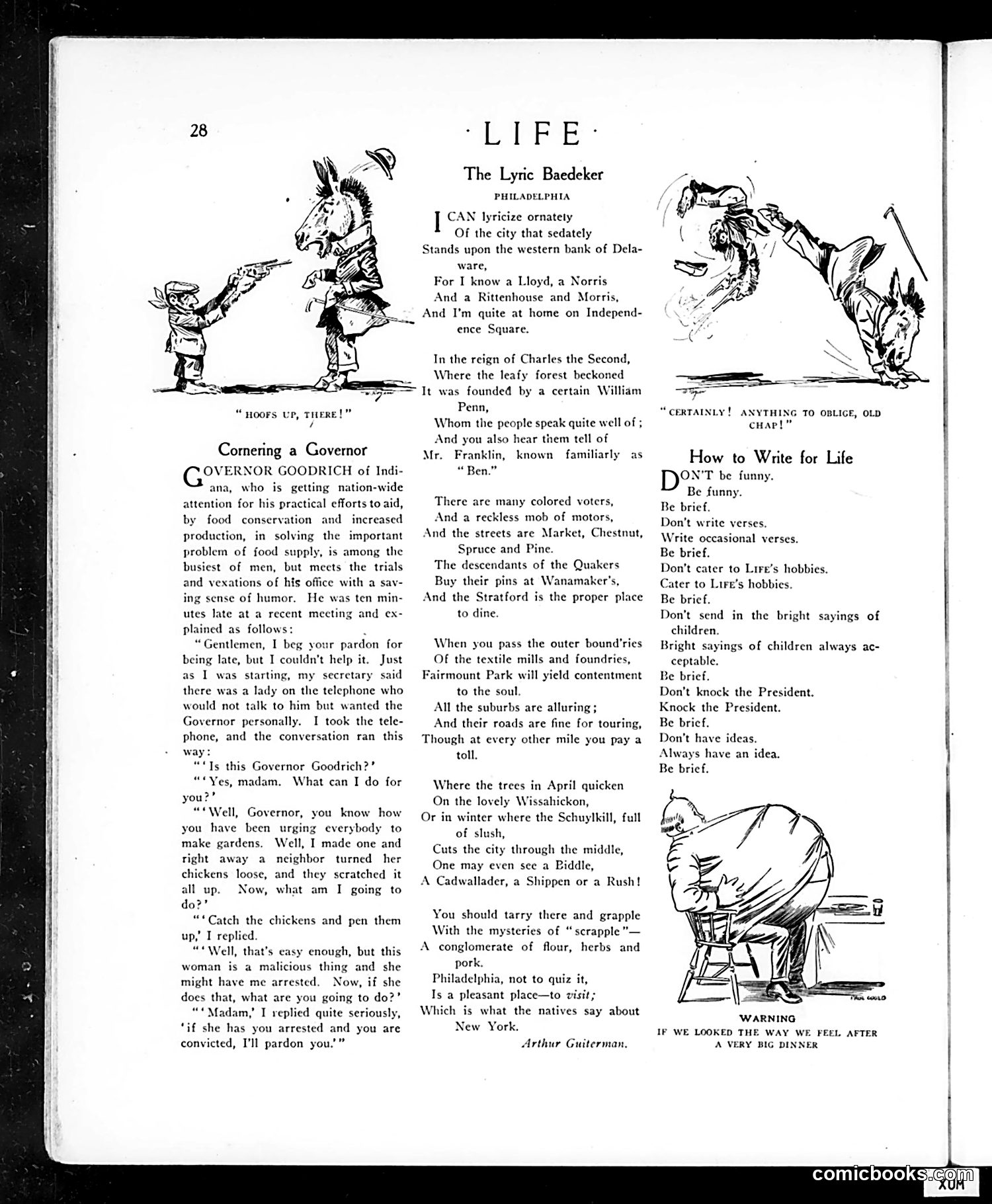
**"Cornering a Governor"** features Governor Goodrich of Indiana, who was gaining national attention for food conservation efforts during what appears to be WWI-era rationing. The cartoon illustrates a humorous anecdote: a woman calls demanding he solve her neighbor's loose chickens destroying her government-mandated victory garden. When she threatens arrest, Goodrich quips he'll pardon her—a joke about executive power and the absurdity of bureaucratic food-production campaigns. **"The Lyric Baedeker"** is a humorous travel poem about Philadelphia by Arthur Guiterman, referencing the city's Quaker heritage, William Penn's founding, and local landmarks (Independence Square, Wissahickon). It gently mocks Philadelphia's pretensions by noting natives claim it's merely "a pleasant place—to visit," implying they actually prefer New York. **"How to Write for Life"** offers contradictory submission advice as satire—each instruction immediately contradicted—mocking editorial inconsistency. The accompanying cartoon shows digestive discomfort after dining.
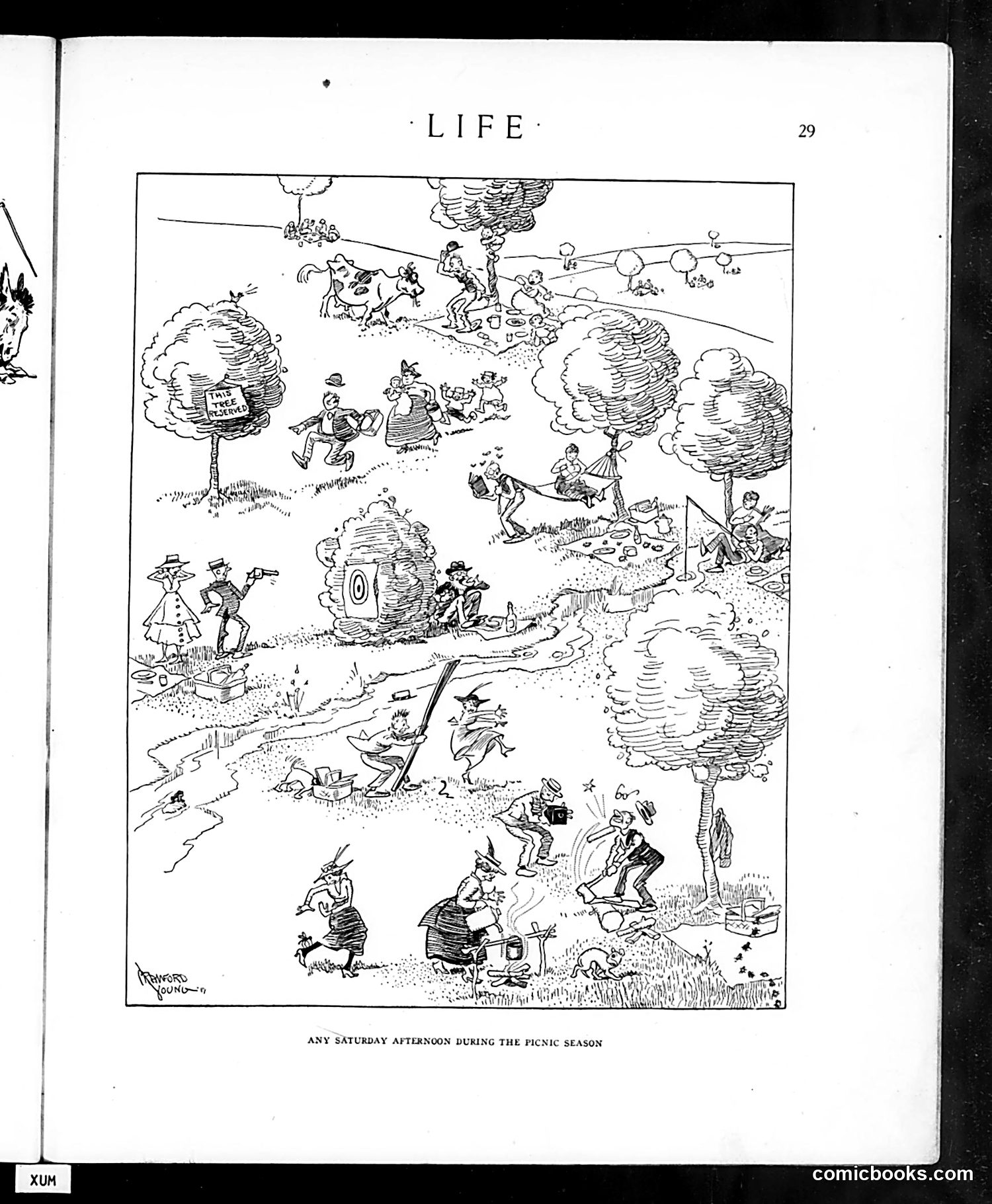
This is a satirical illustration titled "ANY SATURDAY AFTERNOON DURING THE PICNIC SEASON" from *Life* magazine (page 29). The cartoon depicts a chaotic picnic scene with numerous people engaged in various activities and mishaps scattered across a pastoral landscape with trees and a stream. The satire appears to mock the idealized notion of peaceful, orderly picnics. Instead, the image shows comical disasters: people fighting, food mishaps, children misbehaving, and general pandemonium. The juxtaposition of "picnic season" (typically associated with leisure and family harmony) against the depicted bedlam suggests the cartoon critiques the gap between the romantic ideal of outdoor recreation and messy reality. The cartoonist's signature appears in the lower left corner.
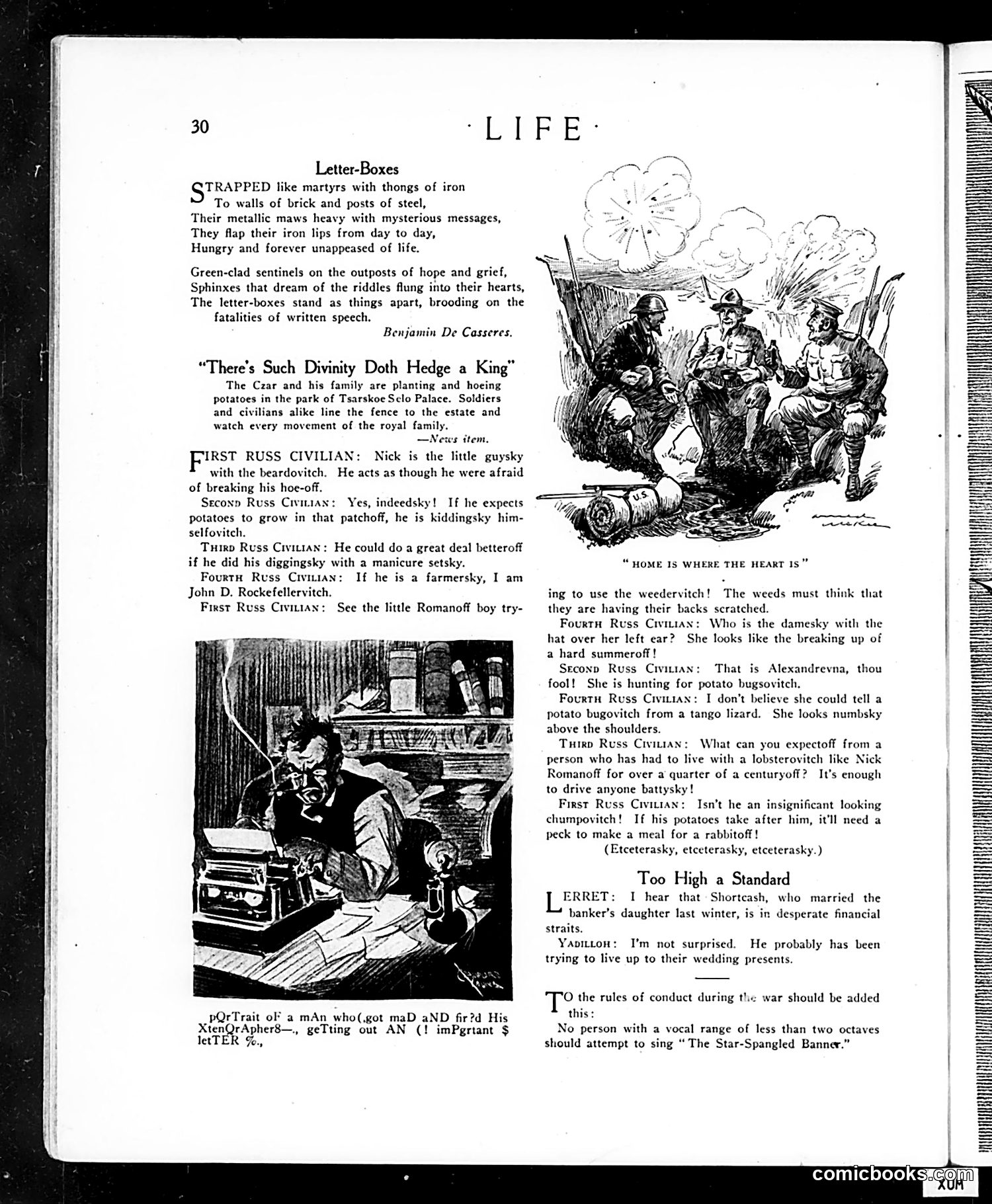
This page contains satirical commentary on Russian Imperial family conditions during the Russian Revolution era. **"There's Such Divinity Doth Hedge a King"** mocks Czar Nicholas II and his family, who were under increasing confinement at Tsarskoe Selo Palace. The cartoon depicts Russian civilians watching the royal family doing menial farm work—planting potatoes—a stark humiliation for autocrats. The accompanying dialogue, written in exaggerated Russian-accented English (adding "-sky," "-ovitch" suffixes), ridicules the family's incompetence and irrelevance. References to "Nick" (the Czar), "Alexandrevna" (likely Tsarina Alexandra), and the "little Romanoff boy" emphasize their vulnerability and loss of power. The other items on the page are unrelated lighter satire: a piece about wedding gift debt, and a joke about poor singers attempting "The Star-Spangled Banner." The overall effect is darkly comedic commentary on the Imperial family's downfall during revolutionary upheaval.
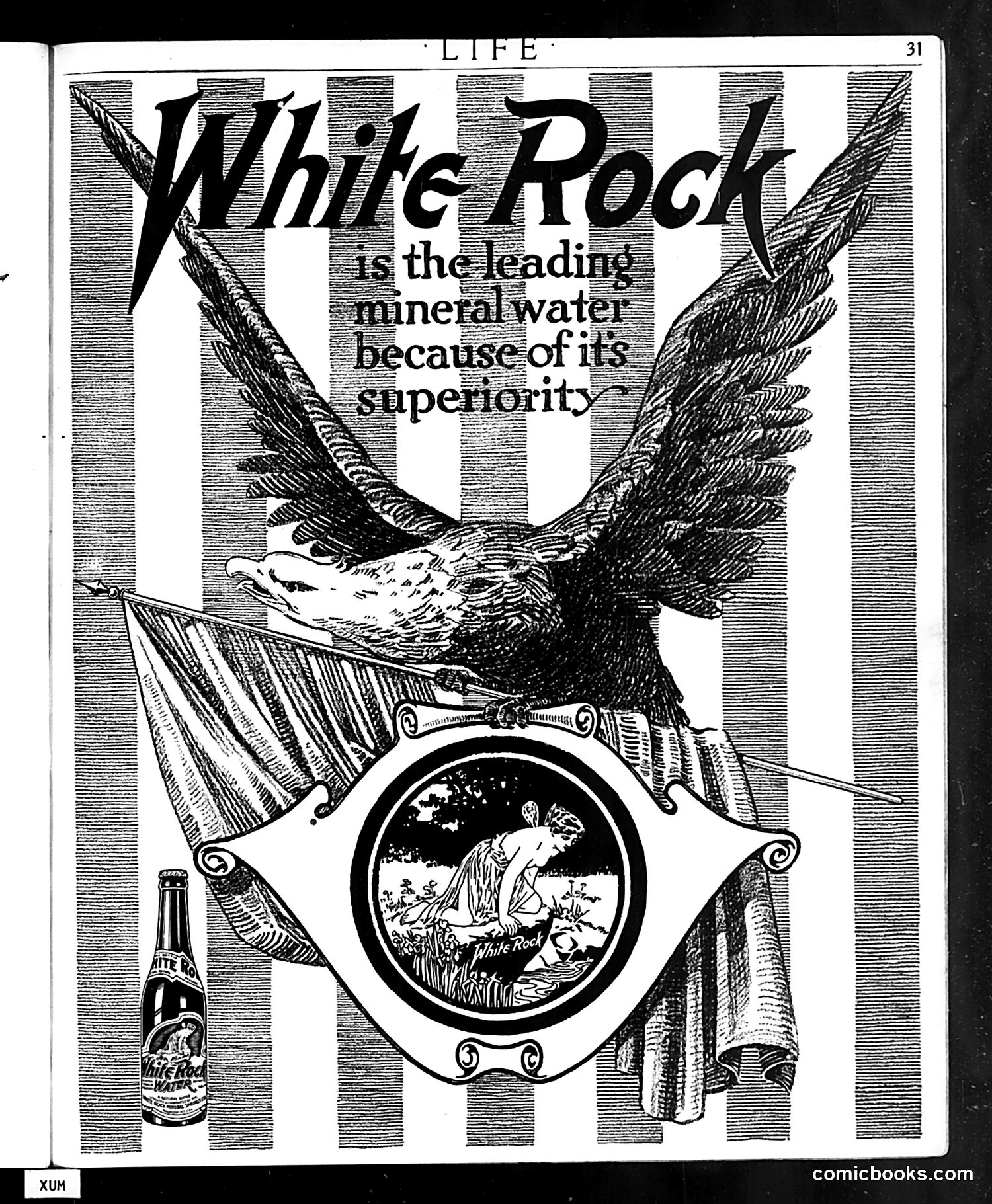
This is a vintage advertisement for White Rock mineral water, not political satire. The page features: **Visual elements:** An eagle with outstretched wings dominates the composition, holding a banner containing the product's circular logo. The logo depicts a woman in classical dress by water. A White Rock bottle appears lower left. **Text claim:** "White Rock is the leading mineral water because of its superiority" **Context for modern readers:** This appears to be early-to-mid 20th century advertising using patriotic American imagery (the eagle as national symbol) to market mineral water as a premium product. The classical female figure and ornate design reflect period aesthetic conventions for upscale beverages. The emphasis on "superiority" suggests competitive positioning against other mineral water brands popular at that time.
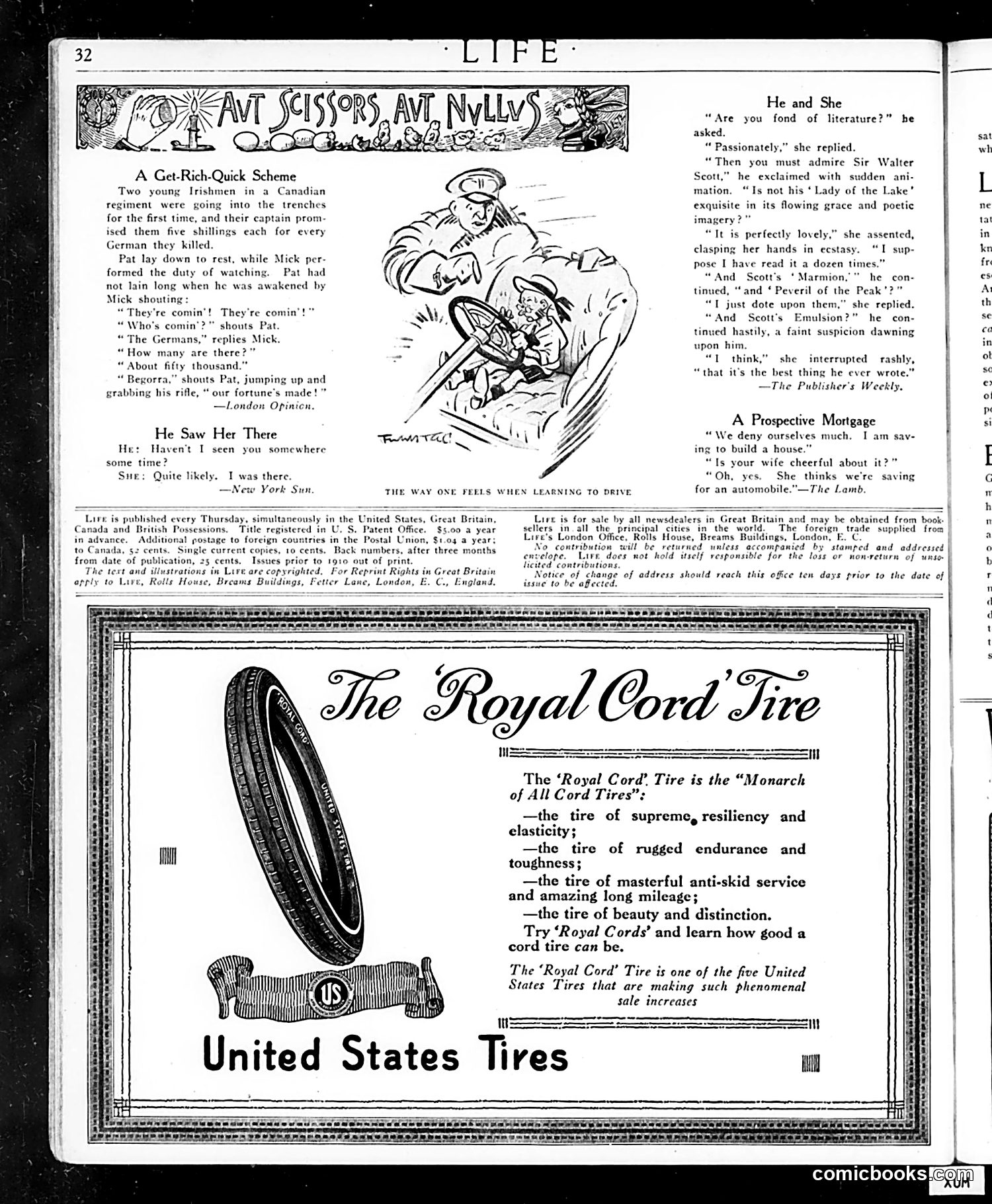
This page contains three brief humorous sketches typical of Life's satirical humor, plus advertising: **"A Get-Rich-Quick Scheme"**: Two Irish soldiers in WWI trenches are promised five shillings per German killed. One excitedly shouts "our fortune's made!" when told fifty thousand Germans are coming. The joke mocks naive optimism about war profiteering and the absurdity of viewing mass casualties as financial opportunity. **"He and She"**: A man tests a woman's literary knowledge by asking about Sir Walter Scott's works. She claims familiarity with *Lady of the Lake*, *Marmion*, and *Peveril of the Peak*—then reveals she thinks "Scott's Emulsion" (a patent medicine) is his best work. The satire targets superficial pretense about culture and gullibility toward advertising. **"He Saw Her There"**: A pick-up line joke where a man claims recognizing a woman; she replies she was definitely present—implying his forgetfulness. The page also advertises **United States Tires' "Royal Cord" brand**, emphasizing durability and performance qualities.
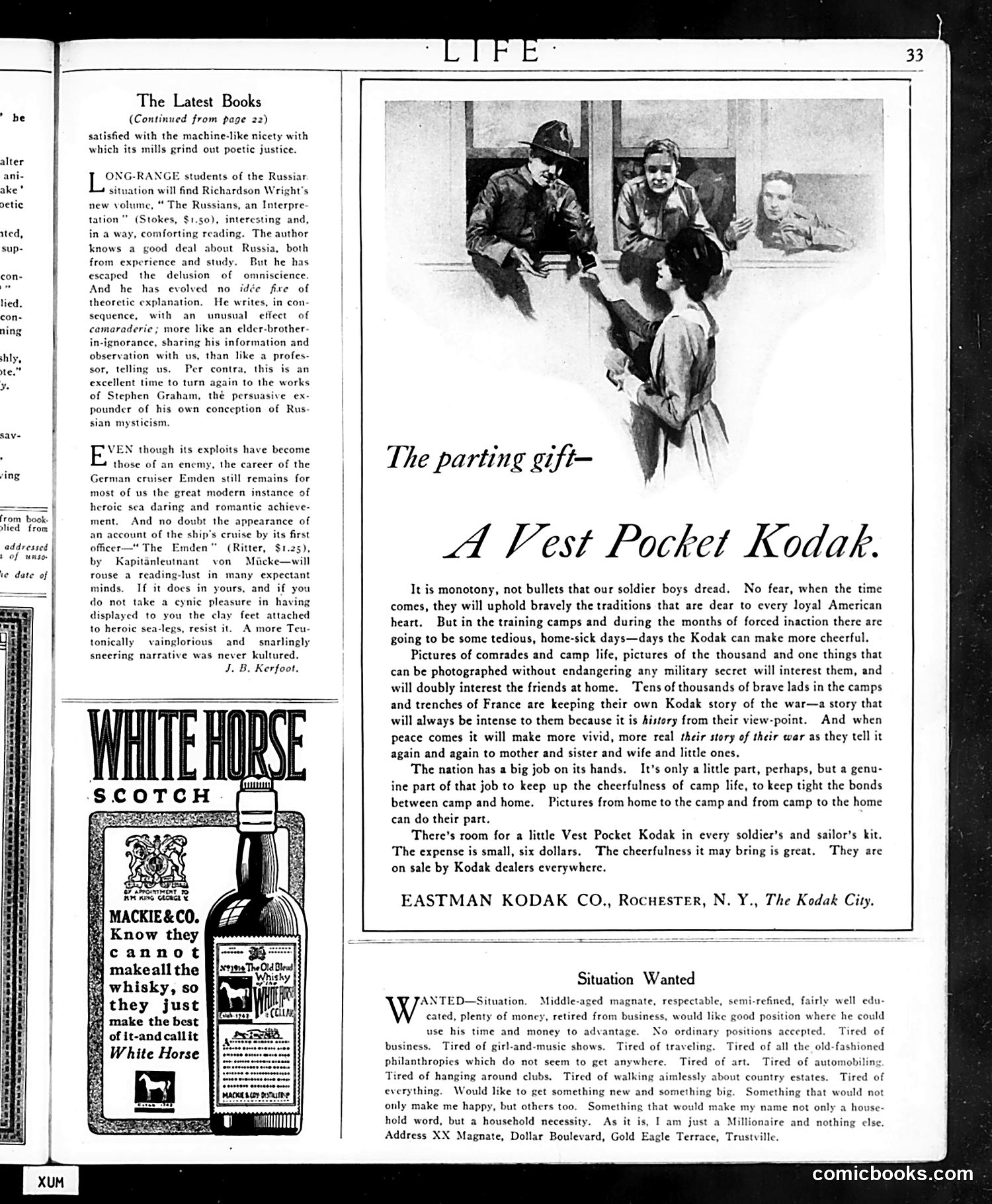
This page contains book reviews, advertisements, and a "Situation Wanted" classified ad—not political cartoons. The main content includes reviews of books about Russia and a German WWI cruiser, plus a **Kodak advertisement** framed as patriotic messaging to American soldiers. It urges families to send pocket cameras to troops in training camps and France, arguing cameras maintain morale and document "their story of the war." The ad cleverly positions consumer spending as patriotic duty during wartime. Below is a satirical **"Situation Wanted"** ad—a wealthy, idle retired businessman seeking employment. The humor lies in his admission that he's bored with leisure activities (music shows, travel, traditional charity) and wants "something new and something big," suggesting wealthy elites sought relevance or purpose during the war period, possibly through war-related business opportunities. The White Horse Scotch ad appears unrelated to the page's themes.
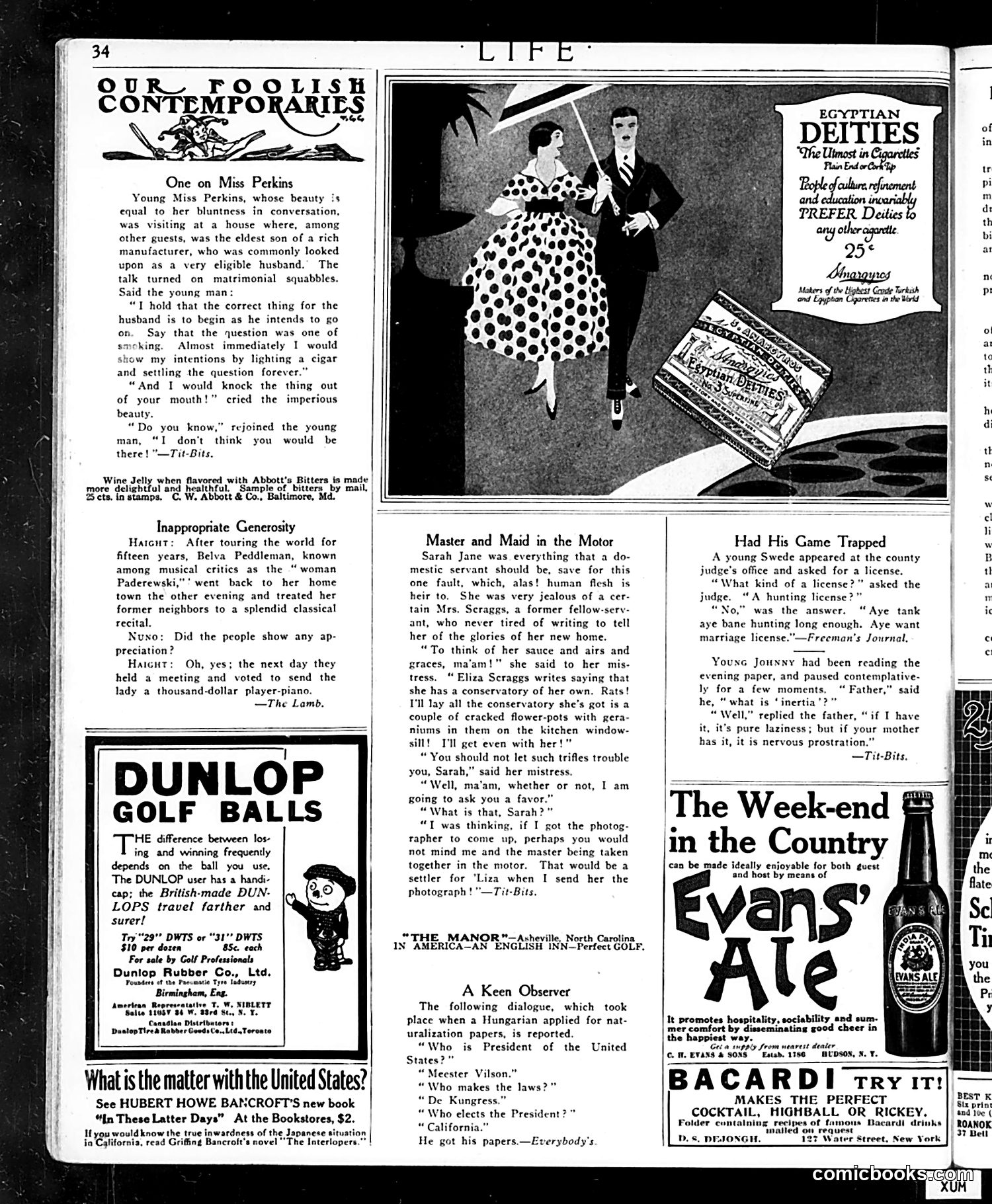
This page from *Life* magazine contains several short humorous anecdotes typical of early 20th-century satirical humor: **"One on Miss Perkins"** depicts a young woman asserting dominance over an eligible bachelor by threatening to knock a cigar from his mouth—mocking Victorian gender expectations and the "new woman" asserting independence. **"Inappropriate Generosity"** jokes that a touring classical musician (Belva Peddleman, presented as a female Paderewski) receives a player-piano rather than genuine artistic appreciation—satirizing small-town philistinism. **"Master and Maid"** shows a servant jealous of a rival's social advancement, seeking to impress by posing with her employers in their motor car—mocking class aspiration and servant gossip. **"A Keen Observer"** contains anti-immigrant humor: a Hungarian applicant answers civics questions incorrectly ("California" elects the President), yet receives naturalization papers anyway—reflecting period xenophobia about immigration standards. The ads emphasize golf balls, ale, and player-pianos—targeting affluent leisure consumers. The humor assumes reader familiarity with servant hierarchies, courtship conventions, and immigrant stereotypes now largely forgotten.
This page satirizes three prominent scientists at the Rockefeller Institute in New York—Flexner, Carrel, and Noguchi—attacking them as fraudulent showmen rather than legitimate researchers. The satire's points: - **Dr. Flexner** invented an anti-meningitis serum that allegedly kills patients as surely as the disease itself; eight children died after receiving it in Cincinnati. - **Dr. Carrel** claimed he could transplant new organs and limbs but failed when tested in a hospital, managing only to preserve dead baby skin in ice. - **Noguchi** claims to have discovered the hydrophobia microbe, though the satire notes it was already identified multiple times by others. The author compares the Institute's self-promotion to circus theatrics (Barnum and Bailey), accusing Rockefeller of funding publicity stunts rather than genuine science. The piece mocks their European tours and grand announcements as marketing for "charlatan" medicine.
This page contains a satirical dialogue titled "Still at It—Then" that uses a hotel as a metaphor for society or the political system. Two men debate reform strategy: the first advocates for activism and agitation to rouse dissatisfied guests (citizens) to demand change, while the second argues such efforts are futile and counterproductive, preferring gradualism or acceptance of the status quo. The satire targets the second man's passivity and defeatism—his claim that the hotel "will be there after you go" and his demand for guaranteed "results" before supporting reform. The first man's retort ("soft") suggests the second man would appeal to those in power through accommodation rather than pressure from below. This reflects early 20th-century debates between radical reformers and pragmatists about social change, labor conditions, and institutional reform. The page also includes period advertisements and a poem by Edmund J. Kiefer promoting the August *Metropolitan* magazine, which apparently featured spiritualist content.
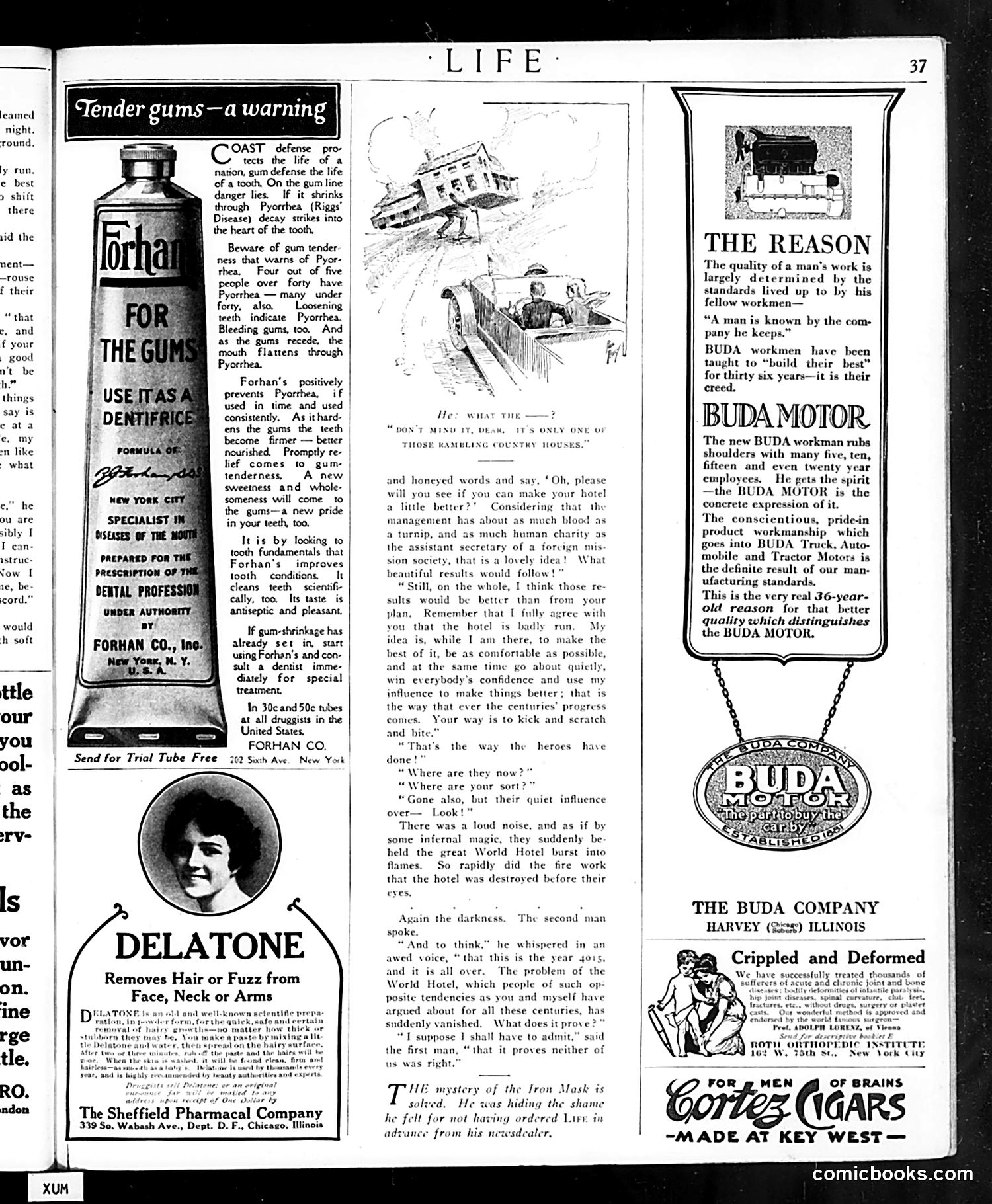
This page contains mostly **advertisements and an unrelated fictional narrative**—not political satire. The main content is a short story about two characters debating hotel management philosophy. One advocates quiet, constructive influence; the other favors aggressive complaint ("kicking and scratching"). The story's futuristic twist—the hotel mysteriously burns down in the year 4015—appears designed to humorously suggest both approaches prove equally irrelevant. The advertisements dominate: **Forhan's toothpaste** warns of pyorrhea (gum disease) as a serious health threat; **Delatone** offers hair removal; **Buda Motor Company** emphasizes worker standards and quality; and **Coffex Cigars** targets men. **No identifiable political figures or satire appear here.** The page reflects early 20th-century advertising concerns (dental health fears, gender norms around appearance) and corporate messaging about manufacturing pride, but contains no partisan commentary or caricature.
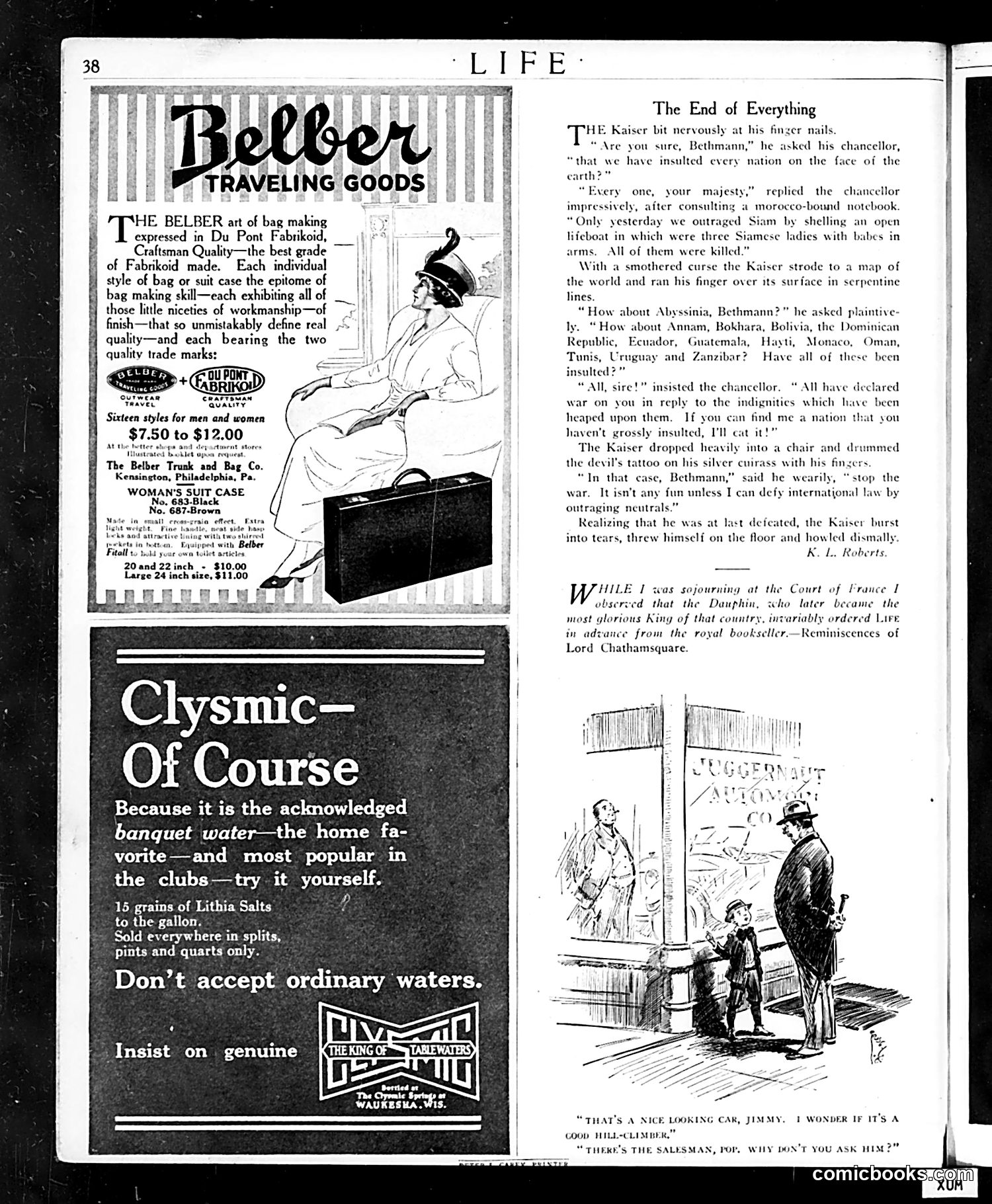
This satirical piece mocks German Kaiser Wilhelm II's aggressive foreign policy during World War I. The joke presents the Kaiser obsessively consulting his chancellor about which nations remain to insult or attack. When the chancellor confirms that virtually every nation on Earth—from major powers to tiny ones like Monaco and Oman—has already declared war on Germany in response to German provocations, the Kaiser despairs that he's run out of enemies to antagonize. The satire targets Germany's systematic antagonism of neutral and allied nations throughout WWI. By treating diplomatic insults as a checklist to complete, the cartoon ridicules the Kaiser's belligerent approach and suggests his expansionist aggression has isolated Germany completely. The exaggeration emphasizes how thoroughly German policy had alienated the world. The cartoon is by K.L. Roberts and likely dates to 1915-1918.
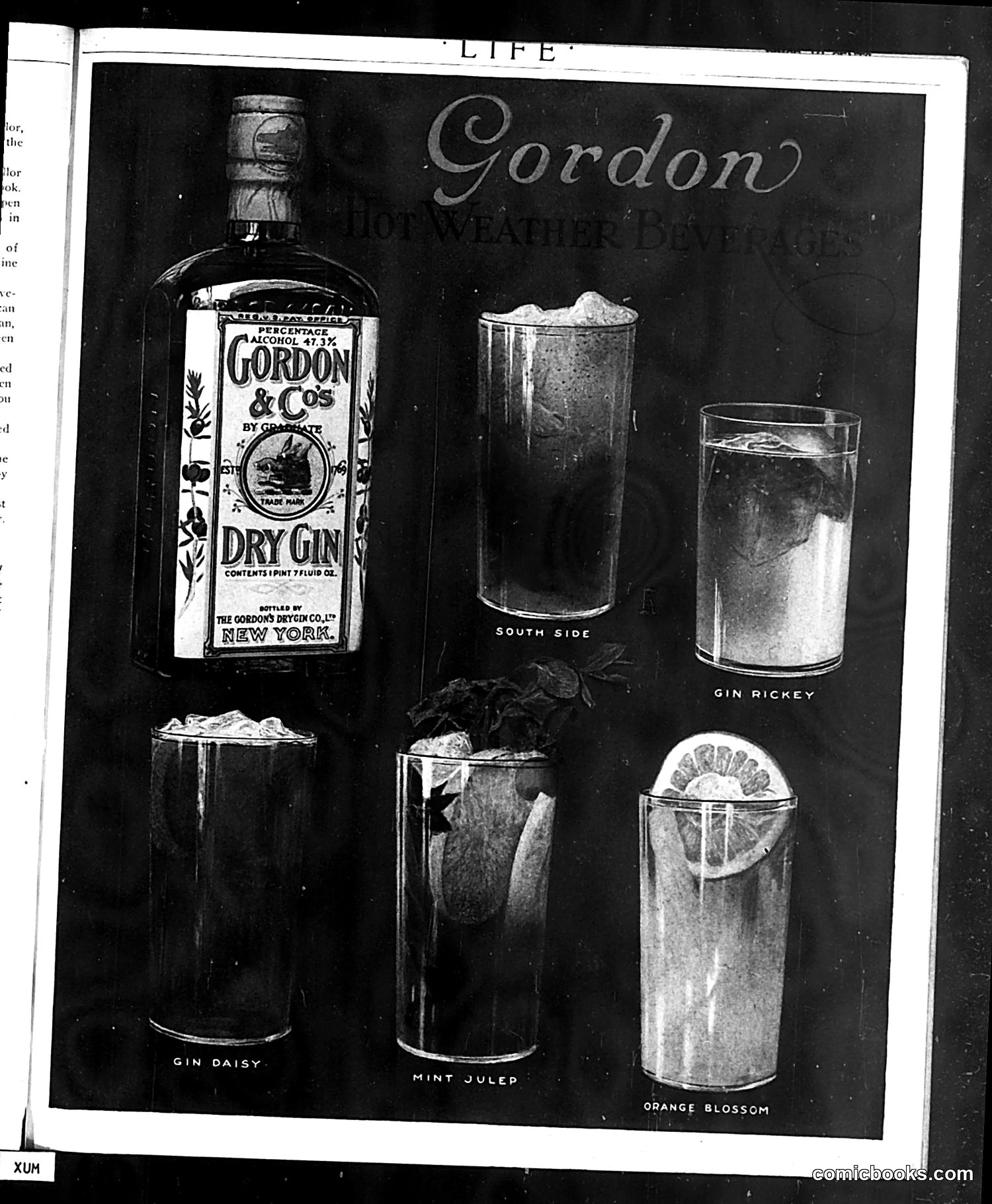
This is a **product advertisement**, not political satire. It showcases Gordon & Co's Dry Gin (47.3% alcohol, bottled in New York) and five cocktail recipes popular in the early 20th century: - **Gin Rickey** (gin with lime and soda) - **South Side** (gin-based) - **Gin Daisy** (gin with lemon and grenadine) - **Mint Julep** (traditional Southern drink) - **Orange Blossom** (gin cocktail) The layout displays the bottle prominently on the left, with illustrated drinks arranged around it. The heading "Gordon" suggests this appeared in *Life* magazine's advertising section during Prohibition or its immediate aftermath. This is straightforward commercial marketing promoting cocktail culture and specific gin preparations to readers, with no satirical intent.
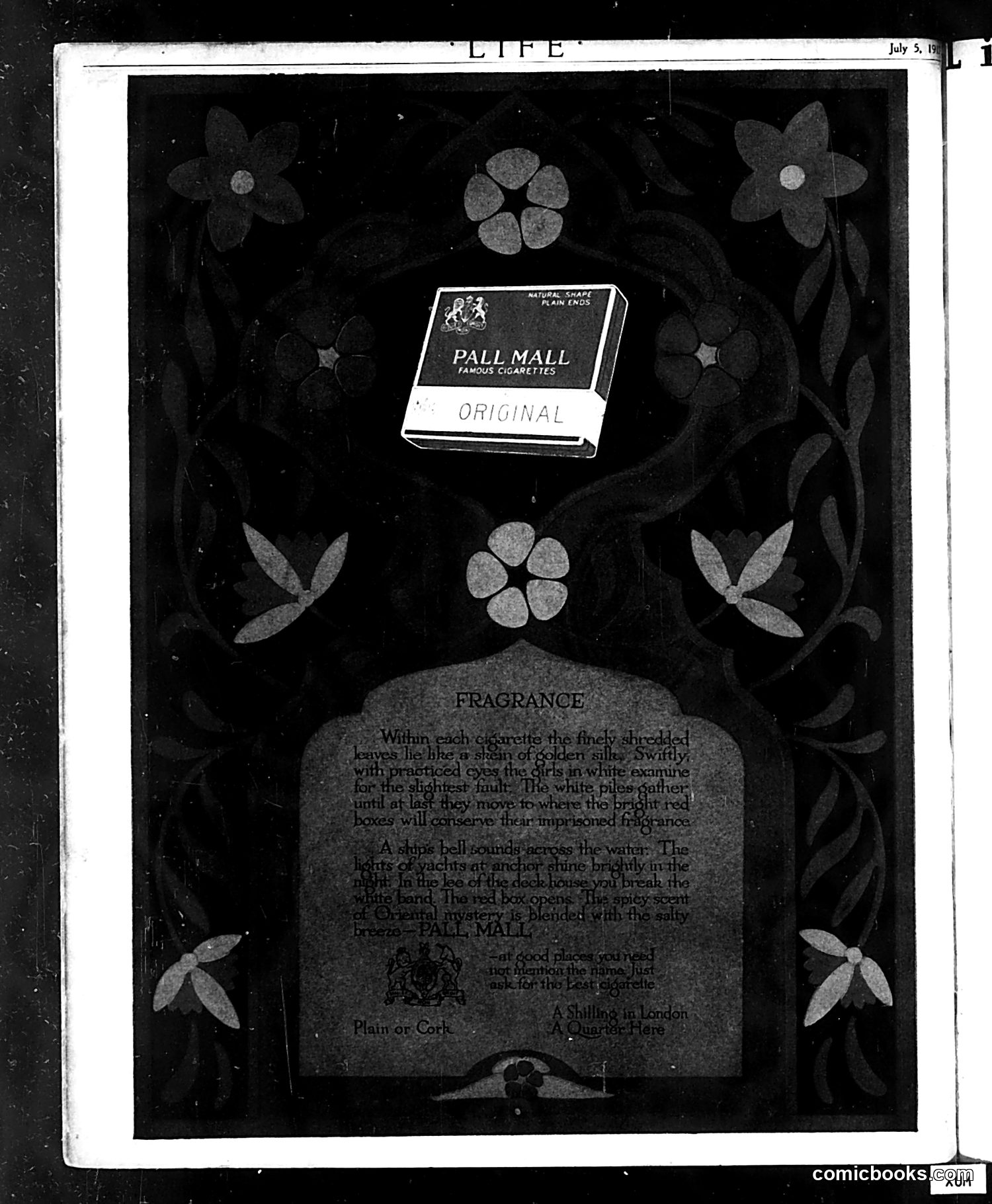
This is a **cigarette advertisement**, not political satire. It's a Pall Mall cigarettes ad from Life magazine (dated July 5, visible at top). The page features decorative floral designs surrounding a cigarette package and descriptive text about the product's "fragrance." The ad uses lyrical, poetic language to describe the smoking experience—references to "golden silks," "white piles," and exotic imagery ("ship bell sounds across water"). The ornamental flowers and romantic language represent typical **early 20th-century advertising techniques**, which marketed cigarettes with aesthetic and sensory appeal rather than health warnings. This would be shocking to modern readers given what we now know about tobacco. There is no political commentary or satire present—this is straightforward commercial advertising from an era when such promotions were standard magazine content.