
Life, 1917-07-05 · page 6 of 40
Life — July 5, 1917 — page 6: what you’re looking at
What you’re looking at
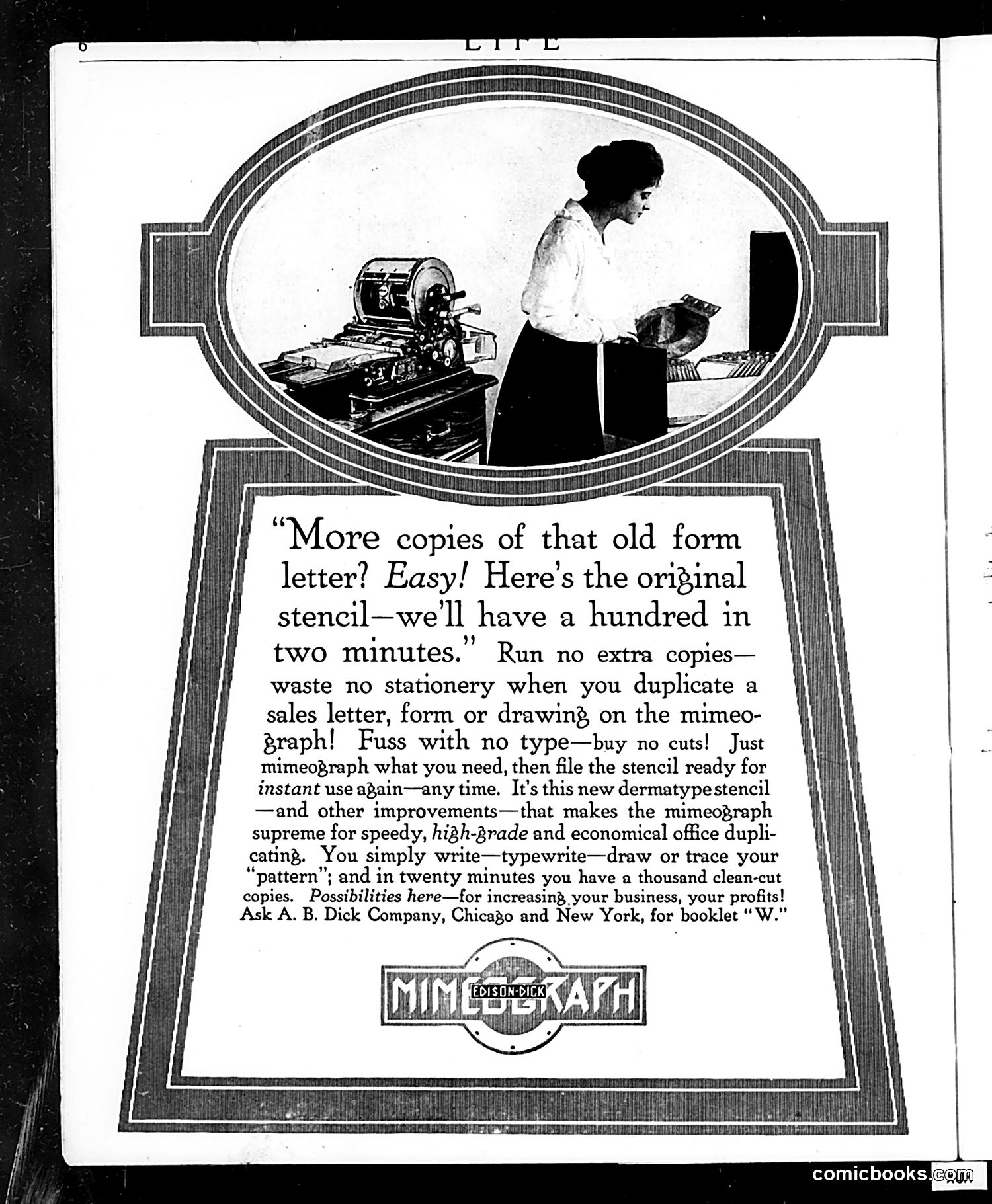
This is a **product advertisement**, not political satire. It promotes the mimeograph machine (marketed as "Mimeograph" by Edison-Dick Company) to early 20th-century office workers. The illustration shows a woman operating the device, duplicating a form letter. The ad's appeal is straightforward: businesses can save money and time by using mimeographs instead of handwritten or typeset copies. Key selling points include speed ("a hundred in two minutes"), cost savings ("waste no stationery"), and ease of use ("no type—buy no cuts"). The dermatype stencil technology mentioned represents a contemporary improvement. This is standard business advertising highlighting office efficiency—a major concern during the era's industrial expansion.
📄 Transcribed text from this page (OCR, searchable)
Machine-transcribed from the original scan — historical spelling and the odd misread are preserved.
“More copies of that old form letter? Easy! Here's the ori?inal stencil—we'll have a hundred in . ” . two minutes. Run no extra copies— waste no stationery when you duplicate a sales letter, form or drawing, on the mimeo- graph! Fuss with no type—buy no cuts! Just mimeopgraph what you need, then file the stencil ready for instant use again—any time. It's this new dermatypestencil —and other improvements—that makes the mimeograph supreme for speedy, high-grade and economical office dupli- cating. You simply write—typewrite—draw or trace your “pattern”; and in twenty minutes you have a thousand clean-cut copies. Possibilities here—for increasing, your business, your profits! Ask A. B. Dick Company, Chicago and New York, for booklet “W.” comicbooks ‘gom