
Life, 1917-07-05 · page 10 of 40
Life — July 5, 1917 — page 10: what you’re looking at
What you’re looking at
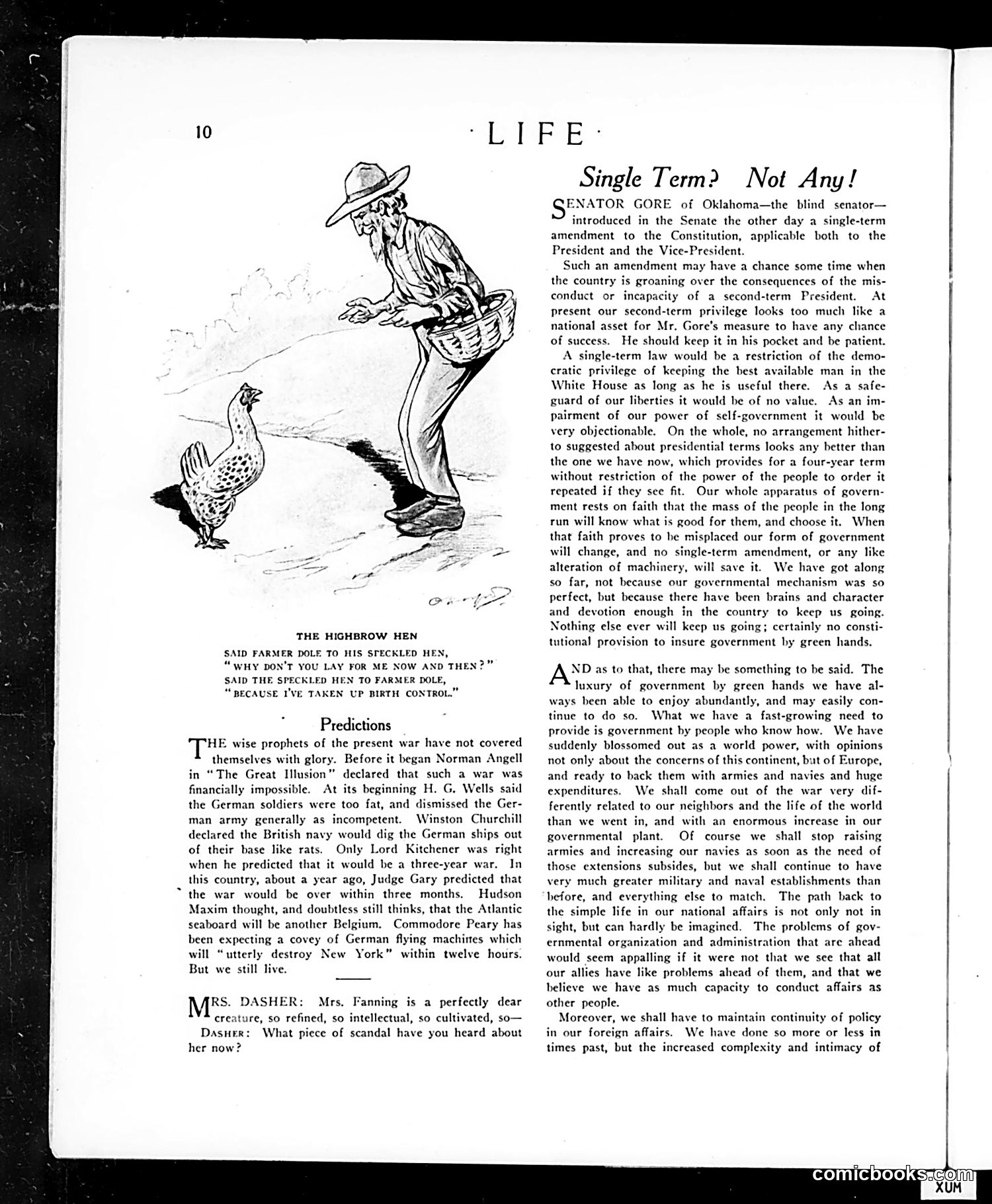
This cartoon satirizes Senator Thomas Gore of Oklahoma, who proposed a single-term amendment for the U.S. presidency. The image shows a farmer (representing common sense) confronting a speckled hen (representing Gore's proposal), with the caption: "Why don't you lay one egg a year instead of two?" The hen replies, "Because I've taken the best control." The joke mocks Gore's idea as impractical and counterintuitive—artificially restricting presidential terms would be foolish, like forcing a productive hen to lay fewer eggs. The accompanying article argues that single-term limits would restrict democratic choice and prevent capable leaders from continuing their work. The satire positions Gore's "highbrow" intellectual proposal as disconnected from practical governance.
📄 Transcribed text from this page (OCR, searchable)
Machine-transcribed from the original scan — historical spelling and the odd misread are preserved.
THE HIGHBROW HEN SAID FARMER DOLE TO HIS SPECKLED HEN, “WHY DON'T YOU LAY FOR ME NOW AND THEN?” SAID THE SPECKLED HEN TO FARMER DOLE, “BECAUSE I'VE TAKEN UP BIRTH CONTROL.’ Predictions HE. wise prophets of the present war have not covered themselves with glory. Before it began Norman Angell in “The Great Ilusion” declared that such a war was financially impossible. At its beginning H. G. Wells said the German soldiers were too fat, and dismissed the Ger- man army generally as incompetent. Winston Churchill declared the British navy would dig the German ships out of their base like rats. Only Lord Kitchener was right when he predicted that it would be a three-year war. In this country, about a year ago, Judge Gary predicted that the war would be over within three months. Hudson Maxim thought, and doubtless still thinks, that the Atlantic seaboard will be another Belgium. Commodore Peary has been expecting a covey of German flying machines which will “utterly destroy New York” within twelve hours. But we still live. MBS: DASHER: Mrs. Fanning is a perfectly dear creature, so refined, so intellectual, so cultivated, so— DasHer: her now? What piece of scandal have you heard about “eer: * Single Term? Not Any! ENATOR GORE of Oklahoma—the blind senator— introduced in the Senate the other day a single-term amendment to the Constitution, applicable both to the President and the Vice-President. Such an amendment may have a chance some time when the country is groaning over the consequences of the mis- conduct or incapacity of a second-term President. At present our second-term privilege looks too much like a national asset for Mr. Gore’s measure to have any chance of success. He should keep it in his pocket and be patient. A single-term law would be a restriction of the demo- cratic privilege of keeping the best available man in the White House as long as he is useful there. As a safe- guard of our liberties it would be of no value. As an im- pairment of our power of self-government it would be very objectionable. On the whole, no arrangement hither- to suggested about presidential terms looks any better than the one we have now, which provides for a four-year term without restriction of the power of the people to order it repeated if they see fit. Our whole apparatus of govern- ment rests on faith that the mass of the people in the long run will know what is good for them, and choose it. When that faith proves to be misplaced our form of government will change, and no single-term amendment, or any like alteration of machinery, will save it. We have got along so far, not because our governmental mechanism was so perfect, but because there have been brains and character and devotion enough in the country to keep us going. Nothing else ever will keep us going; certainly no consti- tutional provision to insure government by green hands. ND as to that, there may be something to be said. The luxury of government by green hands we have al- ways been able to enjoy abundantl. id may easily con- tinue to do so. What we have a fast-growing need to provide is government by people who know how. We have suddenly blossomed out as a world power, with opinions not only about the concerns of this continent, but of Europe, and ready to back them with armies and navies and huge expenditures. We shall come out of the war very dif- ferently related to our neighbors and the life of the world than we went in, and with an enormous increase in our governmental plant. Of course we shall stop raising armies and increasing our navies as soon as the need of those extensions subsides, but we shall continue to have very much greater military and naval establishments than hefore, and everything else to match, The path back to the simple life in our national affairs is not only not in sight, but can hardly be imagined. The problems of gov- ernmental organization and administration that are ahead would seem appalling if it were not that we see that all our allies have like problems ahead of them, and that we believe we have as much capacity to conduct affairs as other people. Moreover, we shall have to maintain continuity of policy in our foreign affai We have done so more or less in times past, but the increased complexity and intimacy of