
Life, 1917-07-05 · page 22 of 40
Life — July 5, 1917 — page 22: what you’re looking at
What you’re looking at
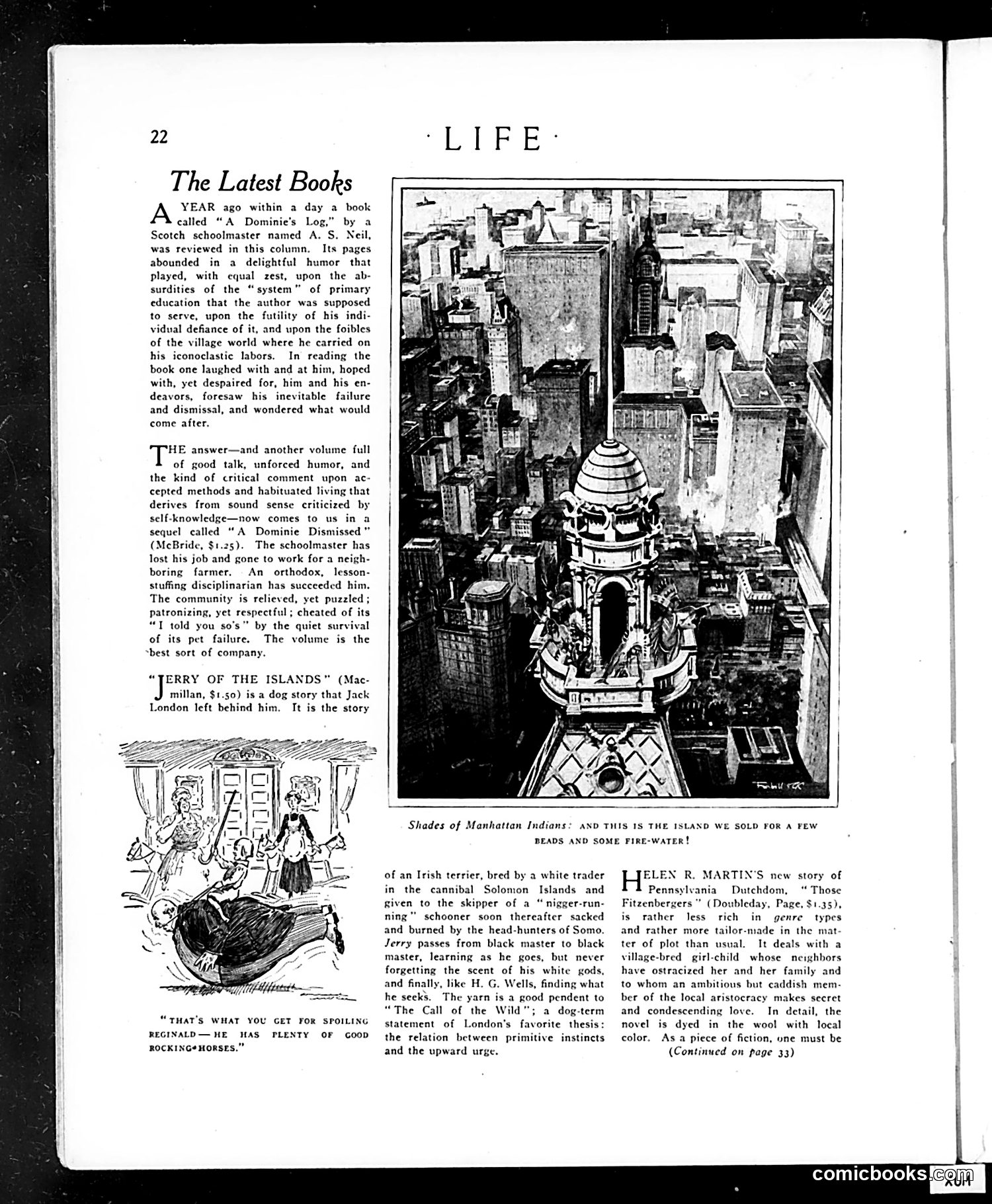
This page reviews three books, with one cartoon satirizing early 20th-century attitudes about Native Americans. The cartoon (captioned "Shades of Manhattan Indians") depicts a tall building viewed from above, comparing it to the historical sale of Manhattan Island. The caption reads: "AND THIS IS THE ISLAND WE SOLD FOR A FEW BEADS AND SOME FIRE-WATER!" **The satire:** This references the famous (likely apocryphal) story that Native Americans sold Manhattan to European settlers for worthless trinkets—specifically beads and alcohol. The cartoon sardonically suggests that modern real estate development represents a similarly exploitative or absurdly undervalued transaction. The joke relies on readers' familiarity with the stereotype of Native Americans as naive traders. It critiques either the original deal's unfairness or modern land speculation—though the cartoon's tone suggests it mocks Native Americans rather than sympathizing with their historical dispossession, reflecting the casual racism typical of 1910s-era American humor. The other content discusses books by A.S. Neill, Jack London, and Helen R. Martin.
📄 Transcribed text from this page (OCR, searchable)
Machine-transcribed from the original scan — historical spelling and the odd misread are preserved.
22 The Latest Books YEAR ago within a day a book called “A Dominie’s Log,” by a Scotch schoolmaster named A. S. Neil, was reviewed in this column. Its pages abounded in a delightful humor that played, with equal zest, upon the ab- surdities of the “system” of primary education that the author was supposed to serve, upon the futility of his indi- vidual defiance of it, and upon the foibles of the village world where he carried on his iconoclastic labors. In reading the LY book one laughed with and at him, hoped j with, yet despaired for, him and his en- deavors, foresaw his inevitable failure and dismissal, and wondered what would come after. i HE answer—and another volume full } of good talk, unforced humor, and the kind of critical comment upon ac- cepted methods and habituated living that derives from sound sense criticized by self-knowledge—now comes to us in a sequel called “A Dominie Dismissed ” (McBride, $1.25). The schoolmaster has lost his job and gone to work for a neigh- boring farmer. An orthodox, lesson- stuffing disciplinarian has succeeded him. The community is relieved, yet puzzled; patronizing, yet respectful ; cheated of its “T told you so's” by the quiet survival of its pet failure. The volume is the ~best sort of company. “JERRY OF THE ISLANDS” (Mac- millan, $1.50) is a dog story that Jack London left behind him. It is the story “THAT'S WHAT YOU GET FOR SPOILING REGINALD—HE MAS PLENTY OF GOOD ROCKING* HORSES.” Shades of Manhattan Indians: aNxb THIS 18 THE ISLAND WE SOLD FOR A FEW BEADS AND SOME FIRE-WATER! of an Irish terrier, bred by a white trader ELEN R. MARTIN'S new story of in the cannibal Solomon Islands and Pennsylvania Dutchdom, “ Those given to the skipper of a “nigger-run- Fitzenbergers ” (Doubleday, Page, $1.35). ning" schooner soon thereafter sacked is rather less rich in genre types and burned by the head-hunters of Somo. and rather more tailor-made in the mat- Jerry passes from black master to black ter of plot than usual. It deals with a master, learning as he goes, but never —village-bred_girl-child whose neighbors forgetting the scent of his white gods, have ostracized her and her family and and finally, like H. G. Wells, finding what to whom an ambitious but caddish _mem- he seeks. The yarn is a good pendent tober of the local aristocracy makes secret “The Call of the Wild”; a dog-term and condescending love. In detail, the statement of London's favorite thesis: novel is dyed in the wool with local the relation between primitive instincts color. As a piece of fiction, une must be and the upward urge. (Continued on page 33) comicbooks een