
Life, 1917-07-05 · page 18 of 40
Life — July 5, 1917 — page 18: what you’re looking at
What you’re looking at
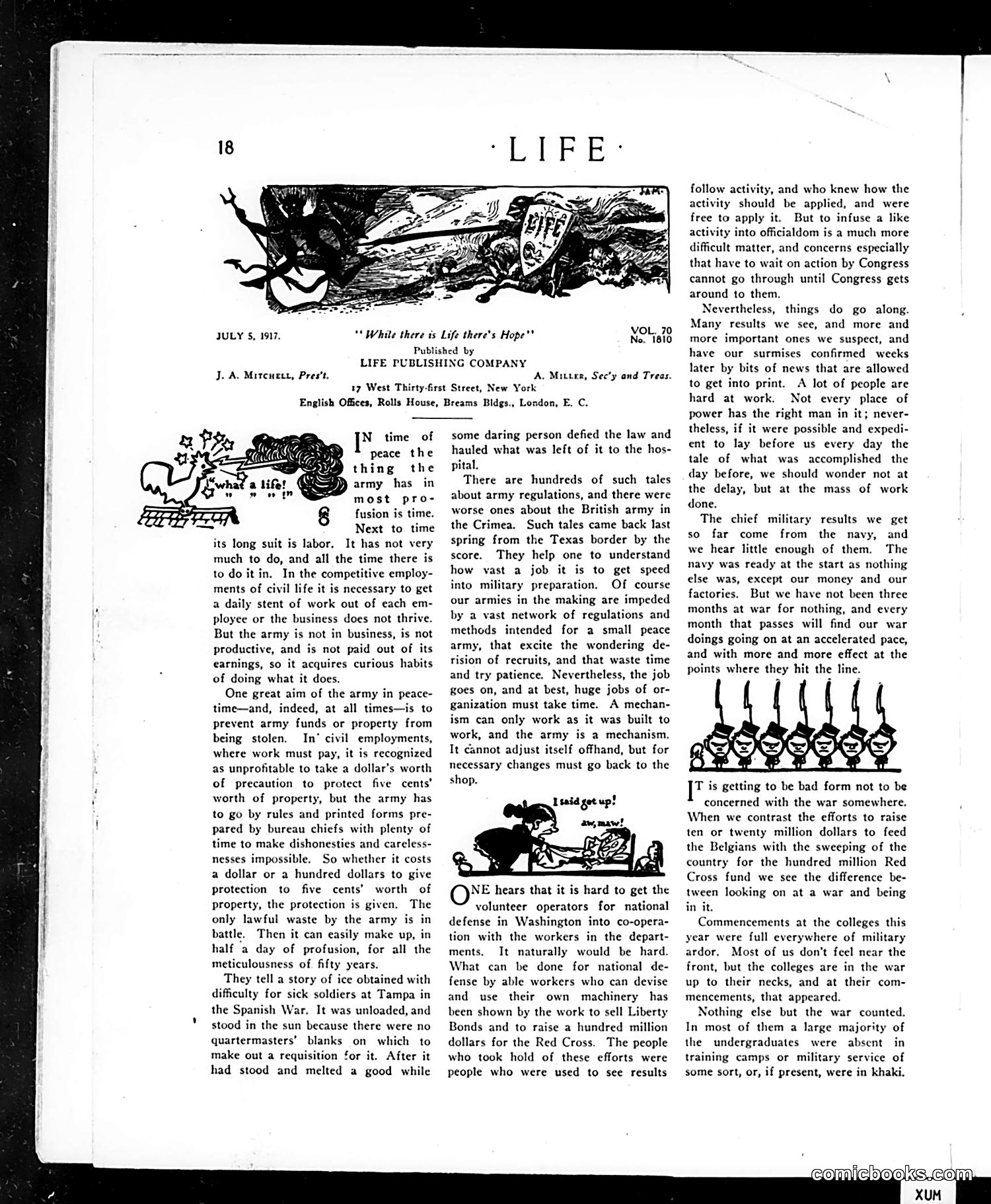
This page critiques **military bureaucratic inefficiency** during America's entry into World War I. The main article satirizes how peacetime army regulations—designed to prevent theft of minor property—create absurd delays in wartime mobilization. The central anecdote illustrates this: ice for sick soldiers in Tampa couldn't be distributed because there were no official requisition forms, so it melted unused. The author argues such rigid procedures waste time and impede military readiness, though he acknowledges that reorganizing an entire "mechanism" requires patience. The cartoon (bottom left) appears to show a soldier shouting "I said get up!"—likely mocking how soldiers waste energy on drill and formalities rather than productive work. The piece suggests that while military organization must function by rules, the tension between preventing small losses and enabling rapid wartime mobilization creates genuine problems for army efficiency.
📄 Transcribed text from this page (OCR, searchable)
Machine-transcribed from the original scan — historical spelling and the odd misread are preserved.
J. A. Mitcucts, Pres't. JULY 5, 1917. “* While there ts Life there's Hope"" Meat Published by LIFE PUBLISHING COMPANY A, Mitter, Sec’y and Treas. 17 West Thirty-first Street, New York English Offices, Rolls House, Breams Bldgs., London, E. C. a Pky ka ae N time of peace the thing the ‘ Sy army has in = most pro- & _ fusion is time. ret Next to time its long suit is labor. It has not very much to do, and all the time there is to do it in. In the competitive employ- ments of civil life it is necessary to get a daily stent of work out of each em- ployee or the business does not thrive. But the army is not in business, is not productive, and is not paid out of its earnings, so it acquires curious habits of doing what it does. One great aim of the army in peace- time—and, indeed, at all times—is to prevent army funds or property from being stolen. In‘ civil employments, where work must pay, it is recognized as unprofitable to take a dollar’s worth of precaution to protect five cents’ worth of property, but the army has to go by rules and printed forms pre- pared by bureau chiefs with plenty of time to make dishonesties and carel nesses impossible. So whether it costs a dollar or a hundred dollars to give Protection to five cents’ worth of property, the protection is given. The only lawful waste by the army is in battle. Then it can easily make up, in half ‘a day of profusion, for all the meticulousness of fifty years. They tell a story of ice obtained with difficulty for sick soldiers at Tampa in the Spanish War. It was unloaded, and stood in the sun because there were no quartermasters’ blanks on which to make out a requisition for it. After it had stood and melted a good while some daring person defied the law and hauled what was left of it to the hos- pital. There are hundreds of such tales about army regulations, and there were worse ones about the British army in the Crimea. Such tales came back last spring from the Texas border by the score. They help one to understand how vast a job it is to get speed into military preparation. Of course our armies in the making are impeded by a vast network of regulations and methods intended for a small peace army, that excite the wondering de- rision of recruits, and that waste time and try patience. Nevertheless, the job goes on, and at best, huge jobs of or- ganization must take time. A mechan- ism can only work as it was built to work, and the army is a mechanism. It cannot adjust itself offhand, but for necessary changes must go back to the shop. I said get up! S | O*E hears that it is hard to get the volunteer operators for national defense in Washington into co-opera- tion with the workers in the depart- ments. It naturally would be hard. What can be done for national de- fense by able workers who can devise and use their own machinery has been shown by the work to sell Liberty Bonds and to raise a hundred million dollars for the Red Cross. The people who took hold of these efforts were people who were used to see results follow activity, and who knew how the activity should be applied, and were free to apply it. But to infuse a like activity into officialdom is a much more difficult matter, and concerns especially that have to wait on action by Congress cannot go through until Congress gets. around to them. Nevertheless, things do go along. Many results we see, and more and more important ones we suspect, and have our surmises confirmed weeks later by bits of news that are allowed to get into print. A lot of people are hard at work. Not every place of power has the right man in it; never- theless, if it were possible and expedi- ent to lay before us every day the tale of what was accomplished the day before, we should wonder not at the delay, but at the mass of work done. The chief military results we get so far come from the navy, and we hear little enough of them. The navy was ready at the start as nothing else was, except our money and our factories. But we have not been three months at war for nothing, and every month that passes will find our war doings going on at an accelerated pace, and with more and more effect at the points where they hit the line. T is getting to be bad form not to be concerned with the war somewhere. When we contrast the efforts to raise ten or twenty million dollars to feed the Belgians with the sweeping of the country for the hundred million Red Cross fund we see the difference be- tween looking on at a war and being in it, Commencements at the colleges this year were full everywhere of military ardor. Most of us don't feel near the front, but the colleges are in the war up to their necks, and at their com- mencements, that appeared. Nothing else but the war counted. In most of them a large majority of the undergraduates were absent in training camps or military service of some sort, or, if present, were in khaki.