
Life, 1917-07-05 · page 36 of 40
Life — July 5, 1917 — page 36: what you’re looking at
What you’re looking at
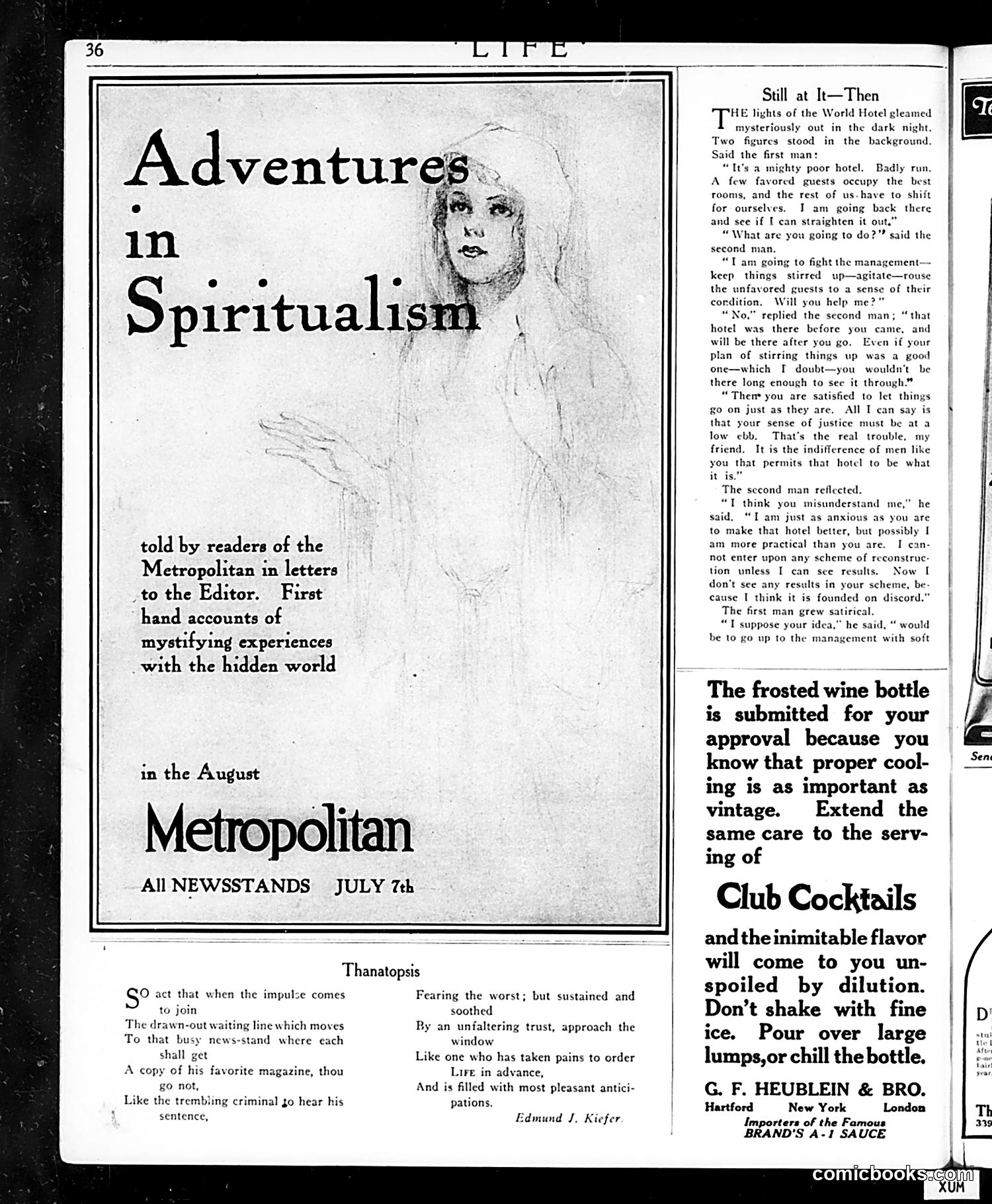
This page contains a satirical dialogue titled "Still at It—Then" that uses a hotel as a metaphor for society or the political system. Two men debate reform strategy: the first advocates for activism and agitation to rouse dissatisfied guests (citizens) to demand change, while the second argues such efforts are futile and counterproductive, preferring gradualism or acceptance of the status quo. The satire targets the second man's passivity and defeatism—his claim that the hotel "will be there after you go" and his demand for guaranteed "results" before supporting reform. The first man's retort ("soft") suggests the second man would appeal to those in power through accommodation rather than pressure from below. This reflects early 20th-century debates between radical reformers and pragmatists about social change, labor conditions, and institutional reform. The page also includes period advertisements and a poem by Edmund J. Kiefer promoting the August *Metropolitan* magazine, which apparently featured spiritualist content.
📄 Transcribed text from this page (OCR, searchable)
Machine-transcribed from the original scan — historical spelling and the odd misread are preserved.
Adventures Rt told by readers of the Metropolitan in letters _to the Editor. First hand accounts of mystifying experiences with the hidden world in the August Metropolitan All NEWSSTANDS JULY 7th Thanatopsis Ss° act that when the impulse comes to join The drawn-out waiting line which moves To that busy news-stand where each shall get A copy of his favorite magazine, thou go not, Like the trembling criminal go hear his sentence, Fearing the worst; but sustained and soothed By an unfaltering trust, approach the window Like one who has taken pains to order Lire in advance, And is filled with most pleasant antici- pations. Edmund J. Kiefer Still at It—Then HE lights of the World Hotel gleamed mysteriously out in the dark night. Two figures stood in the background. Said the first mant “t's a mighty poor hotel. Badly run. A few favored guests occupy the best rooms, and the rest of us.have to shift for ourselves, I am going back there and see if I can straighten it out, “What are you going to do?" said the second man. “Tam going to fight the management keep things stirred up—agitate—rouse the unfavored guests to a sense of their condition. Will you help me?" “No.” replied the second man; “that hotel was there before you came, and will be there after you go. Even if your plan of stirring things up was a good one—which I doubt—you wouldn't be there long enough to sec it through.” “Then you are satisfied to let things go on just as they are. All T can say is that your sense of justice must be at a low ebb, That's the real trouble, my friend. It is the indifference of men like you that permits that hotel to be what it is.” The sccond man reflected. “T think you misunderstand me,” he said, “I am just as anxious as you are to make that hotel better, but possibly I am more practical than you are. I can- not enter upon any scheme of reconstruc: tion unless I can see results. Now I don't see any results in your scheme, be cause I think it is founded on discord.” The first man grew satirical. “T suppose your idea,” he said, “ would be to go up to the management with soft The frosted wine bottle is submitted for your approval because you know that proper cool- ing is as important as vintage. Extend the same care to the serv- ing of Club Cocktails andthe inimitable flavor will come to you un- spoiled by dilution. Don’t shake with fine ice. Pour over large lumps,or chill the bottle. G. F. HEUBLEIN & BRO. Hartford New York London Importers of the Famous BRAND'S A-1 SAUCE Sen