
A complete issue · 42 pages · 1917
Life — February 22, 1917
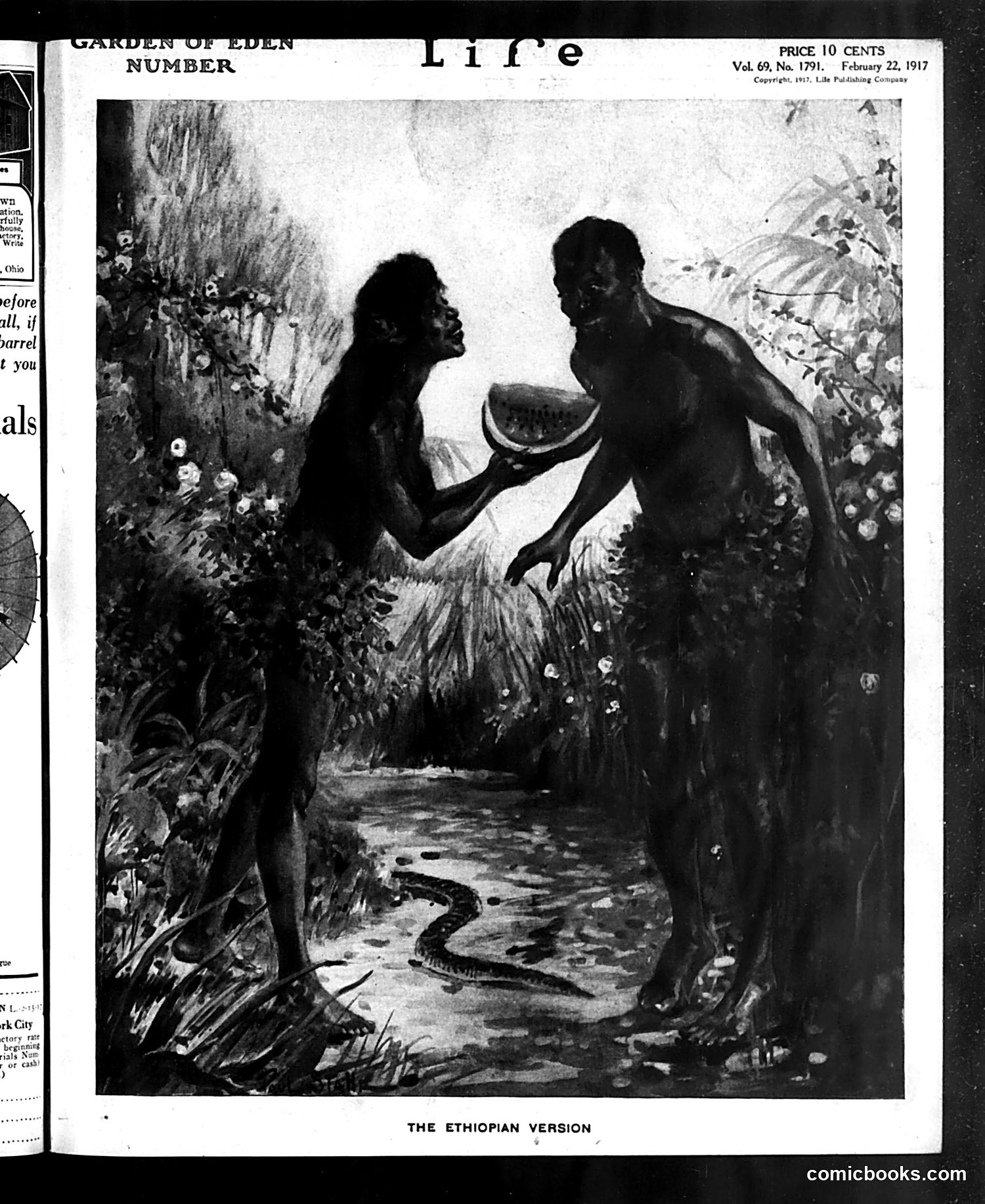
This 1917 *Life* magazine cover depicts two figures in a garden setting with a snake and fruit—clearly referencing the Biblical Garden of Eden scene. The caption "THE ETHIOPIAN VERSION" suggests this is a satirical reimagining of the Adam and Eve creation story through an Ethiopian cultural lens. The image appears to be commentary on racial or cultural perspectives on Western religious narratives. By labeling it an "Ethiopian version," the magazine implies this is how the story might be depicted in Ethiopian artistic or cultural tradition, contrasting with European artistic conventions of the era. Without additional context, the specific satirical point remains somewhat unclear, though it likely comments on cultural differences in religious interpretation or artistic representation during this period.
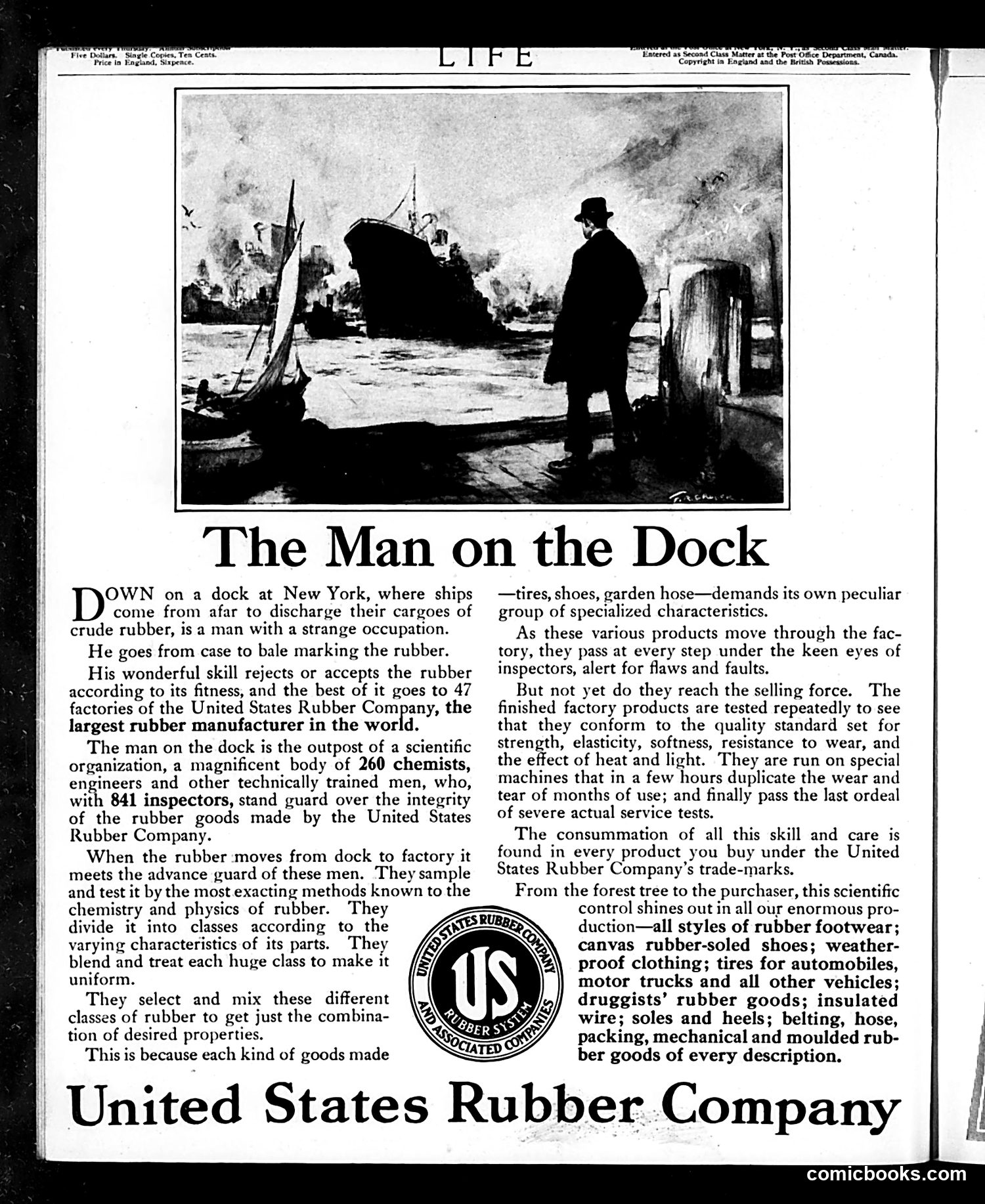
This is **primarily an advertisement**, not satire. The image shows a figure in dark clothing observing a dock scene with ships and industrial activity. The accompanying text describes the United States Rubber Company's quality control process—specifically how inspectors at New York docks evaluate incoming rubber shipments before factory processing. The "man on the dock" represents the company's quality inspector who examines rubber goods at every stage. The advertisement emphasizes the company's scientific approach: employing 260 chemists and engineers, testing products repeatedly, and maintaining rigorous standards. There is no political satire here. This is straightforward corporate messaging promoting the company's commitment to product quality and manufacturing excellence to potential consumers.
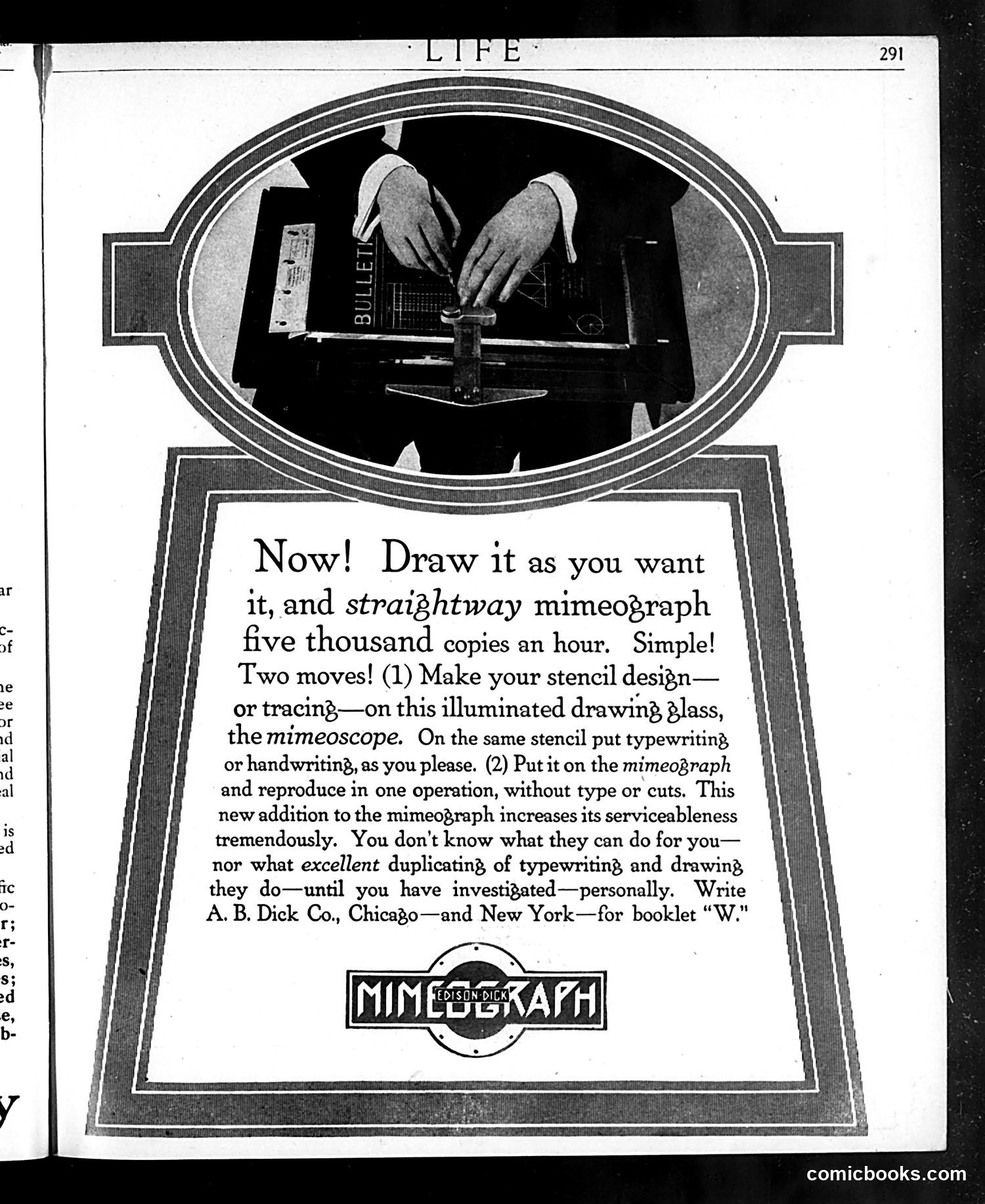
This page is primarily **advertising content**, not political satire. It promotes the "Mimeograph" (a early duplicating machine made by A.B. Dick Co., Chicago and New York). The advertisement demonstrates the mimeograph's convenience: users can draw or trace designs on an illuminated glass plate called a "mimeoscope," then place the stencil on the mimeograph to reproduce copies—"five thousand copies an hour." The photograph shows hands operating the device. The ad emphasizes the machine's appeal to businesses needing rapid document duplication without requiring separate typesetting or cutting. This reflects early 20th-century office technology marketing, targeting businesses seeking efficient reproduction solutions before photocopiers existed.
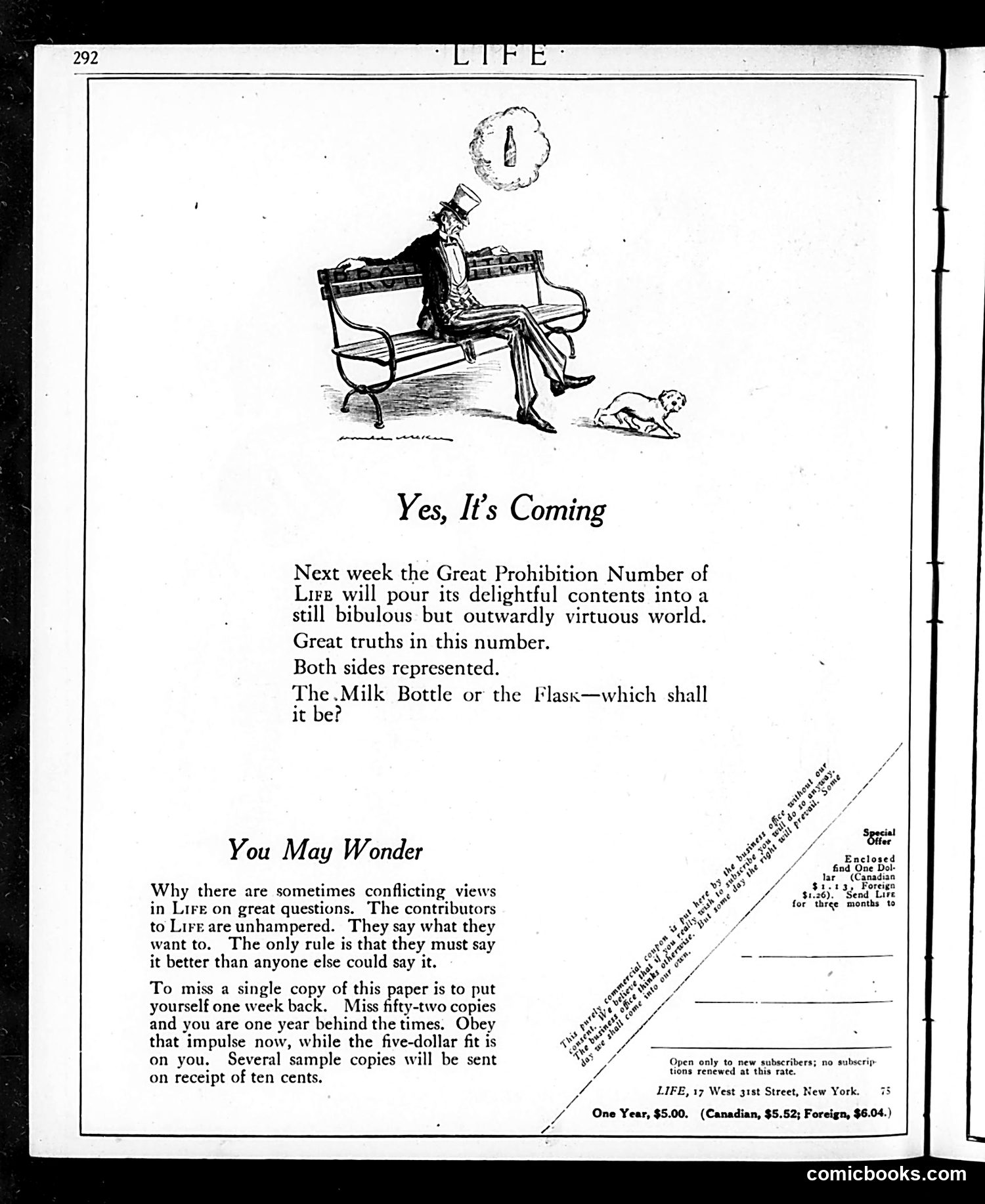
This is primarily a **house advertisement** for *Life* magazine itself, not political satire. The cartoon shows a well-dressed man on a park bench with a thought bubble, while a small child crawls nearby. The illustration announces an upcoming "Great Prohibition Number" of *Life*. **What this means:** The U.S. was in the Prohibition era (alcohol ban). *Life* is promoting a special issue examining both sides of the Prohibition debate—presenting arguments from supporters ("Milk Bottle") and opponents ("Flask"). The satire targets Prohibition itself as absurd policy. The text emphasizes *Life's* editorial approach: contributors express unfiltered opinions on major questions. The page also solicits subscriptions, noting that missing issues puts readers "one year behind the times."
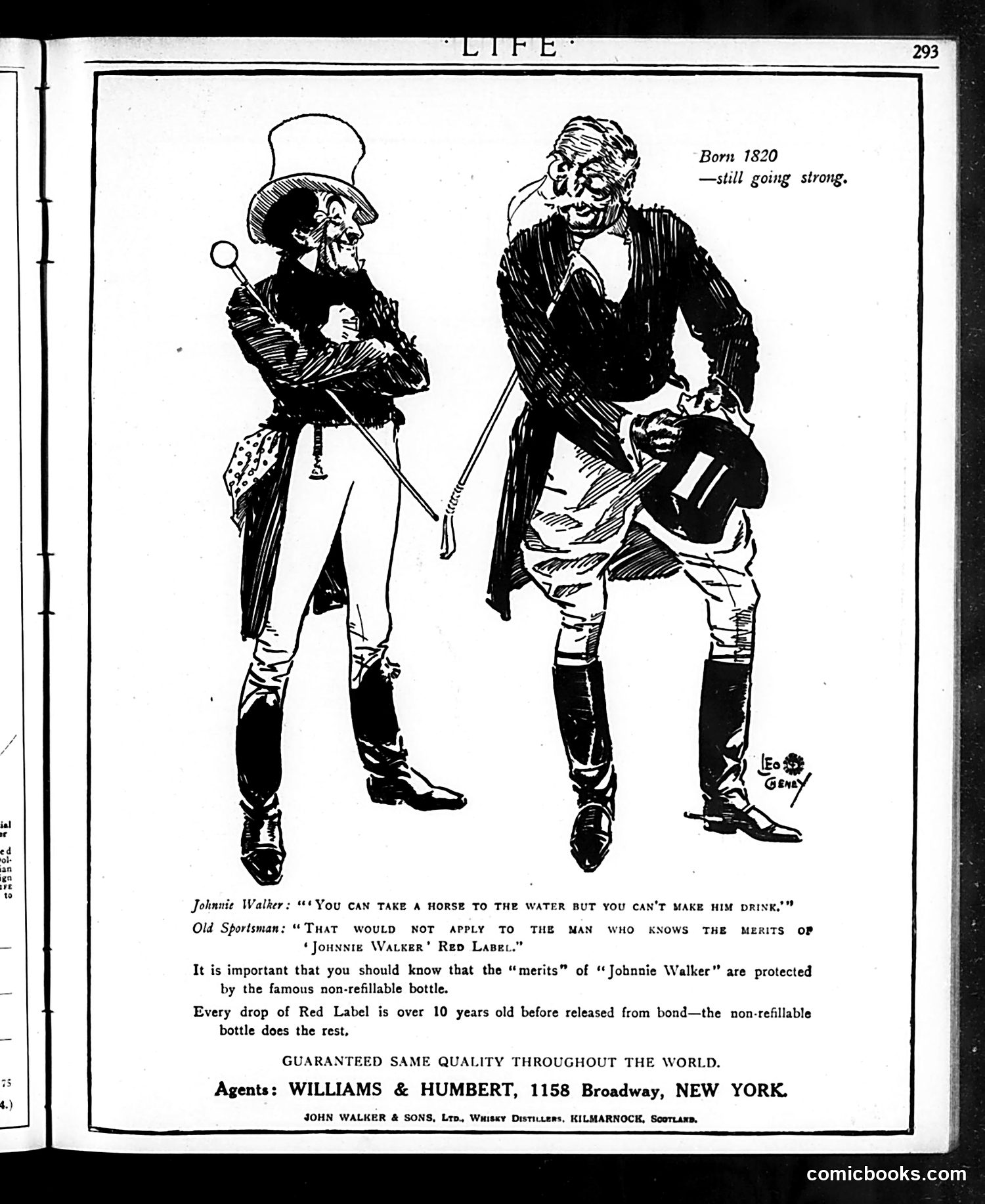
This page is primarily a **Johnnie Walker whisky advertisement** from Life magazine (page 293), not political satire. The cartoon depicts two figures in 19th-century military dress: one holding a child, another an older man ("Born 1820 — still going strong"). The text references a dialogue about Johnnie Walker Red Label whisky, using the metaphor that while you can force a horse to water, you cannot force it to drink — similarly, one cannot make someone appreciate quality without knowing its merits. The advertisement emphasizes that Johnnie Walker Red Label is aged over 10 years before release and maintains consistent quality worldwide. The agents listed are Williams & Humbert in New York, with production in Kilmarnock, Scotland. This is commercial messaging disguised as entertainment, typical of early 20th-century advertising strategy.
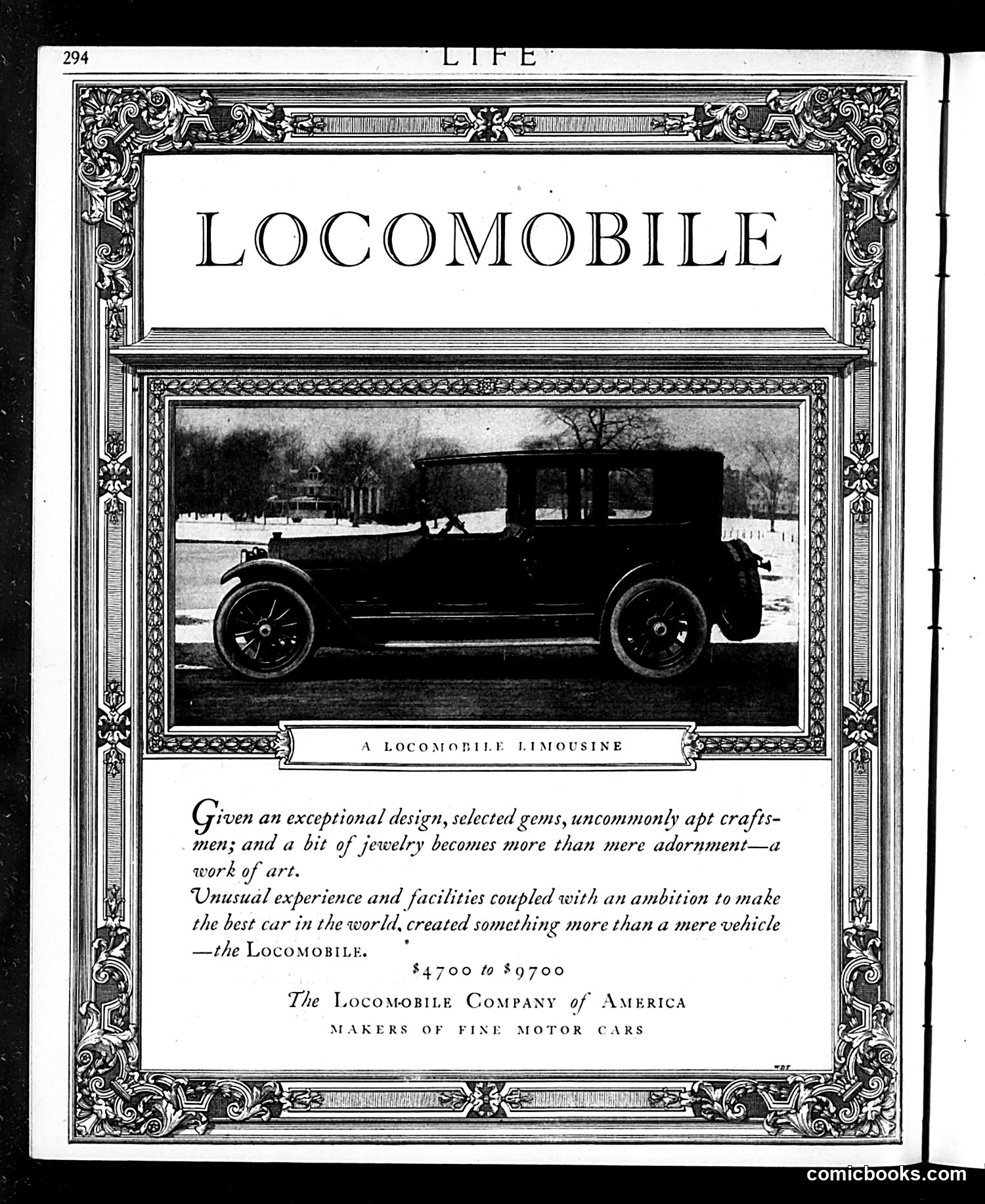
This is **not a cartoon or satire page**—it's a **luxury automobile advertisement** for the Locomobile Company of America, published in *Life* magazine (page 294). The page features a photograph of a Locomobile limousine and marketing copy emphasizing the vehicle's exceptional design, craftsmanship, and quality. The advertisement positions the car as a work of art rather than mere transportation, comparing its creation to jewelry-making. The decorative border and refined typography reflect the upscale audience *Life* targeted. The price range ($4,700 to $9,700) indicates this was a luxury product during the early automobile era. This represents early 20th-century automotive advertising strategy: appealing to wealthy consumers through appeals to taste and exclusivity rather than practical features.
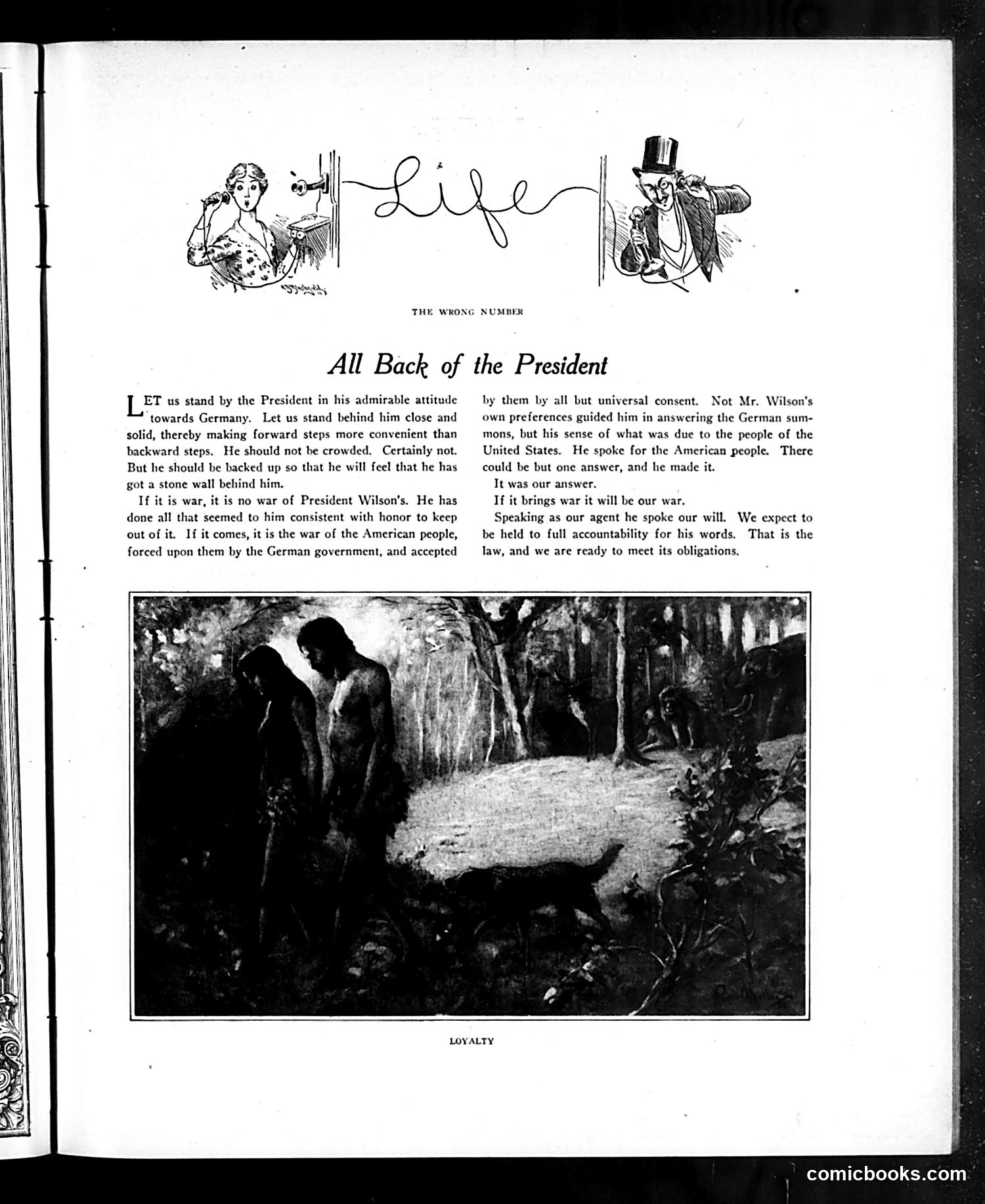
This page from *Life* magazine's section titled "The Wrong Number" supports President Wilson's conduct toward Germany, likely during World War I. The editorial argues Americans should unite behind Wilson's decisions, asserting his response to German aggression reflects the will of the American people, not personal preference. The two decorative figures flanking "Life" at the top appear to be satirical characters—possibly representing different political perspectives or social types of the era. The photograph captioned "Loyalty" below shows silhouetted figures in a forest, likely symbolizing unified American support or solidarity during wartime. The satire's point: questioning those who might oppose Wilson's war policies by emphasizing national unity as patriotic duty.
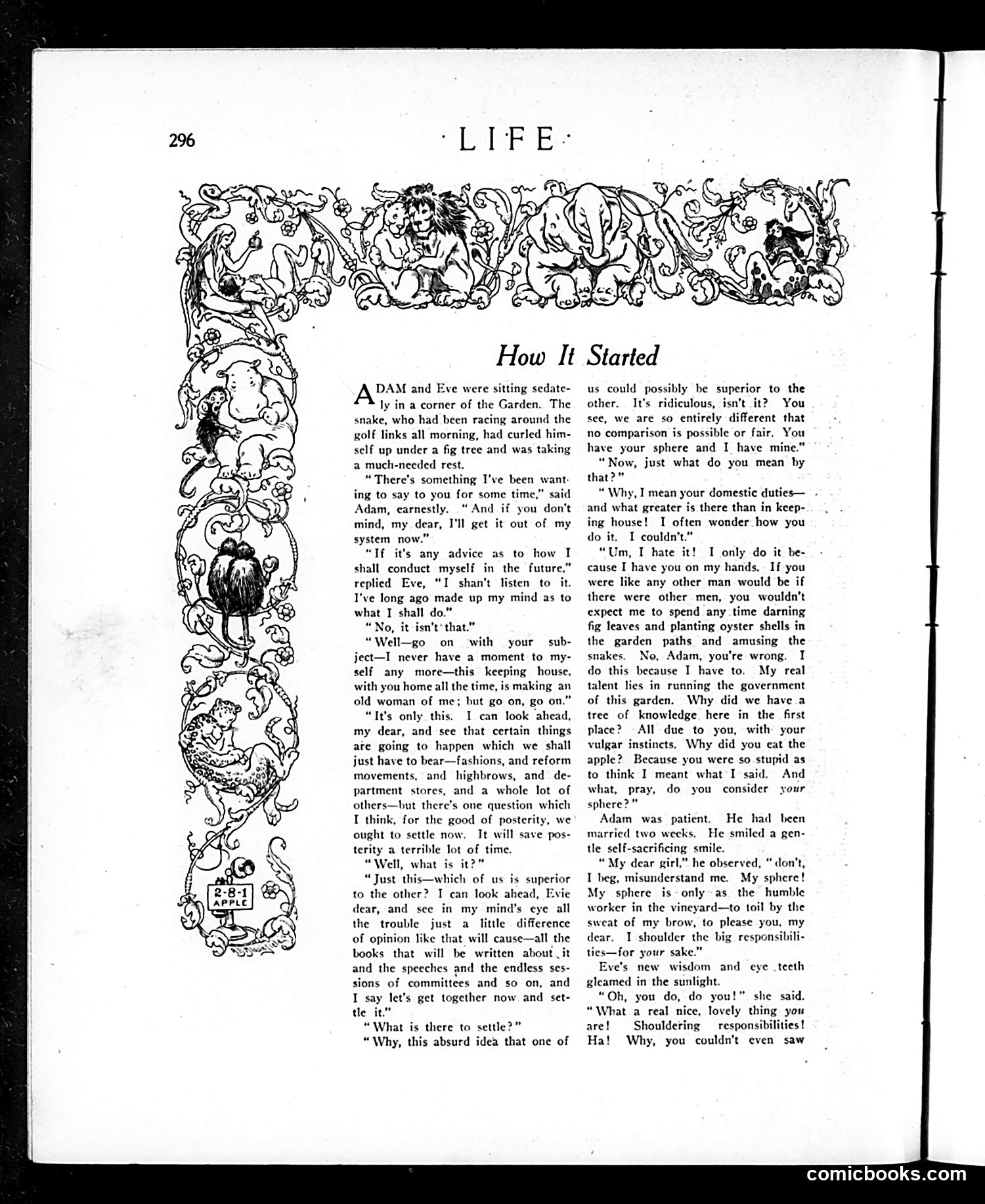
This page contains a short story titled "How It Started," featuring a dialogue between Adam and Eve in the Garden of Eden. The ornamental left margin depicts the Tree of Knowledge with various animals and fruits intertwined. The satire is social commentary on early marriage dynamics. Eve complains about housekeeping duties, asserting her intellect and capabilities beyond domestic work. Adam patronizingly dismisses her concerns, insisting her "sphere" is homemaking. The piece mocks the era's rigid gender roles by having Eve articulate feminist arguments—her intelligence shouldn't be confined to household management—while Adam responds with condescension typical of the period. By setting this in Eden, the author suggests these power imbalances are historically ancient and absurdly persistent, using biblical framing for contemporary marital satire.
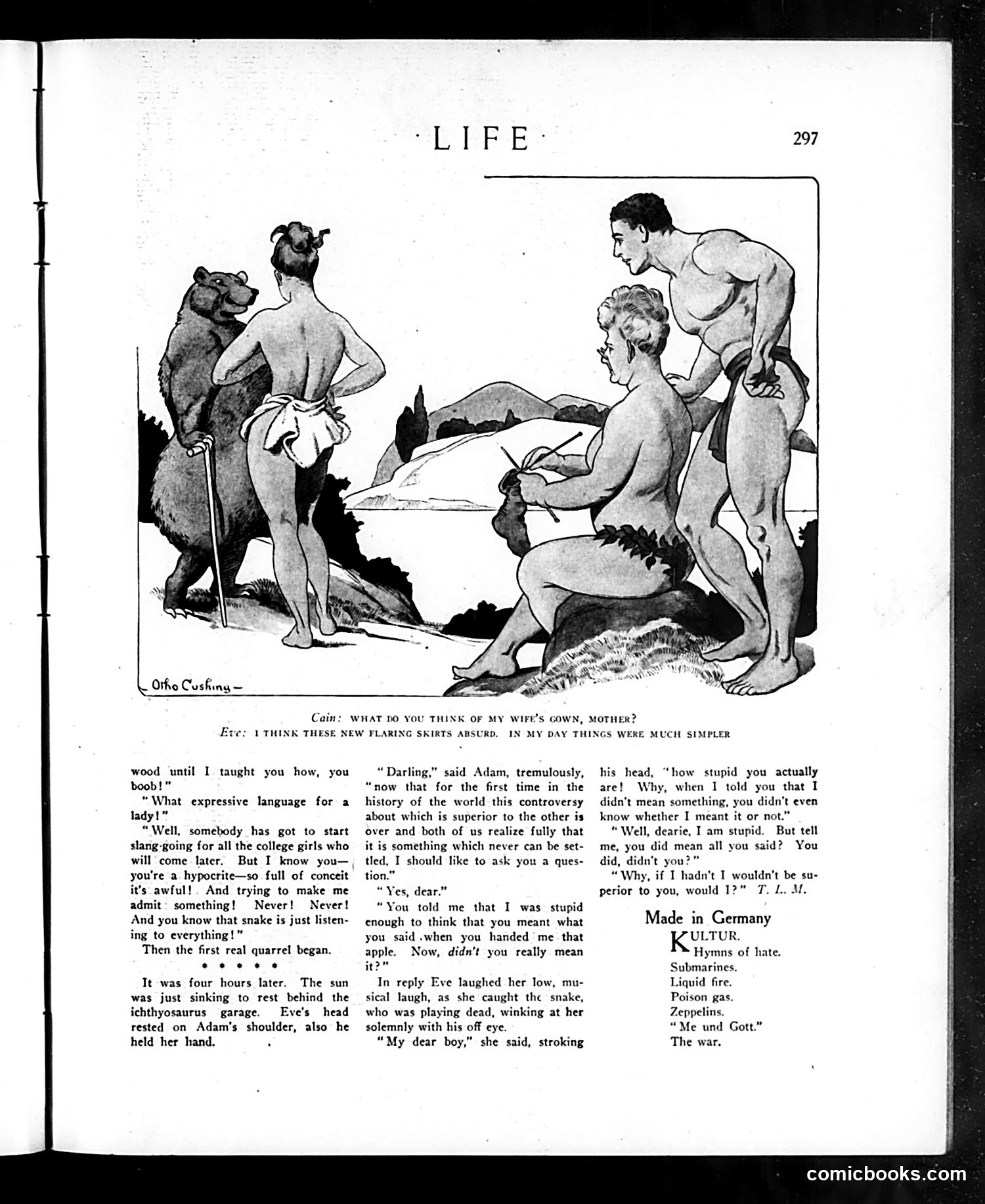
This cartoon satirizes gender dynamics and marital conflict through an absurdist scenario. The caption shows "Cain" complaining to "Eve" about her cow's appearance, while Eve defends modern fashion ("flaring skirts"), claiming her time was simpler. The joke hinges on anachronism: biblical Adam and Eve are depicted arguing about contemporary 1920s women's fashion—short skirts were controversial and considered immodest by conservative observers. Eve's defense that "my day things were much simpler" is ironic, since she's defending fashions that would have scandalized her actual era. The cartoon mocks both prudish male criticism of women's changing fashion and women's casual acceptance of these radical shifts. The artist (Otto Cushing) uses the biblical couple to comment on modern marriage tensions over evolving social norms.
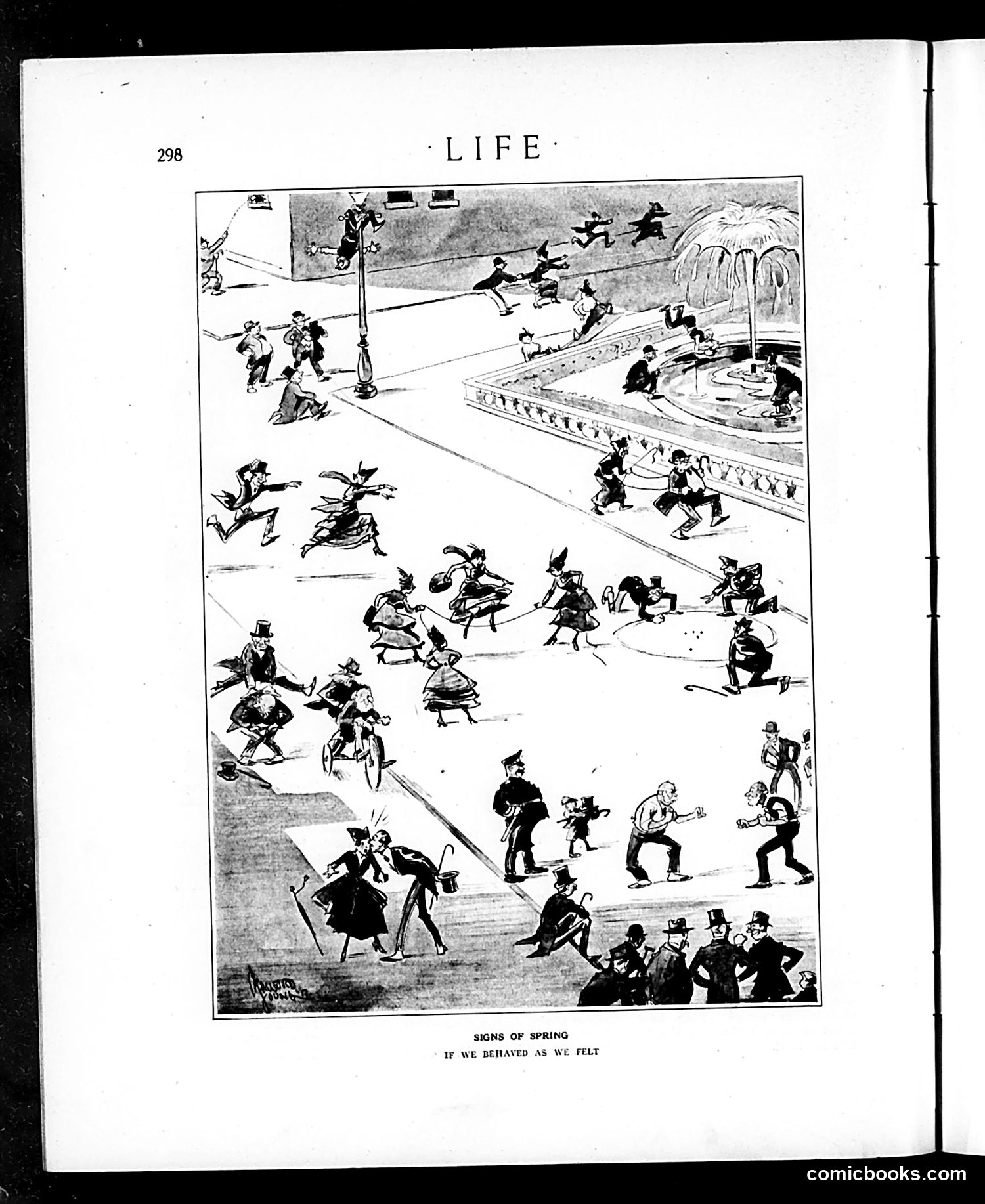
This satirical cartoon depicts spring as a season of uninhibited behavior and abandon. The illustration shows people of various social classes—from well-dressed gentlemen in top hats to working-class figures—engaging in chaotic, playful, and undignified activities throughout a public space. The satire suggests that spring awakens primal impulses that proper Victorian or early 20th-century society normally suppresses. The contrast between formal attire and wild behavior emphasizes the gap between social propriety and genuine human desires. The title's conditional phrase—"if we behaved as we felt"—implies that spring makes people *want* to abandon societal restraint, but they normally don't. This reflects period anxieties about civilization's thin veneer over human nature.
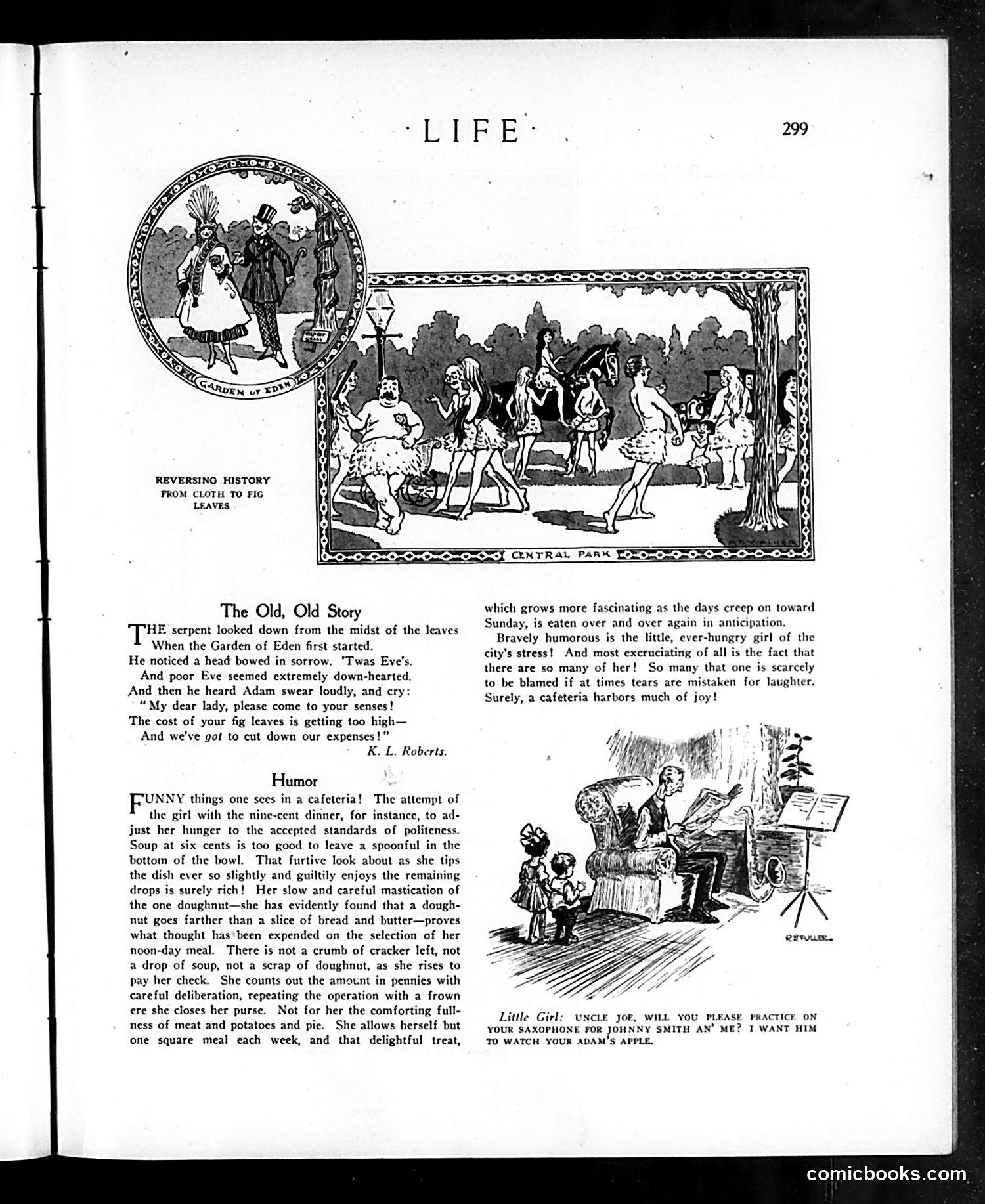
This page contains two distinct pieces of social satire: **"The Old, Old Story"** (top) depicts the Garden of Eden with a modern twist—Eve complains to Adam that their expenses are too high and they must "cut down our expenses." The satire mocks contemporary marital dynamics, suggesting that even humanity's original couple faced nagging financial pressures, framing modern economic anxiety as timeless domestic conflict. **"Humor"** (middle section) humorously catalogs a cafeteria girl's meticulous penny-counting and careful meal selection, illustrating Depression-era or post-war economic scarcity. She obsesses over every cent spent on a modest lunch. **The bottom illustration** shows a child asking "Uncle Joe" to practice saxophone while watching her father's apple—domestic humor about noise and parental annoyance with children's musical practice.
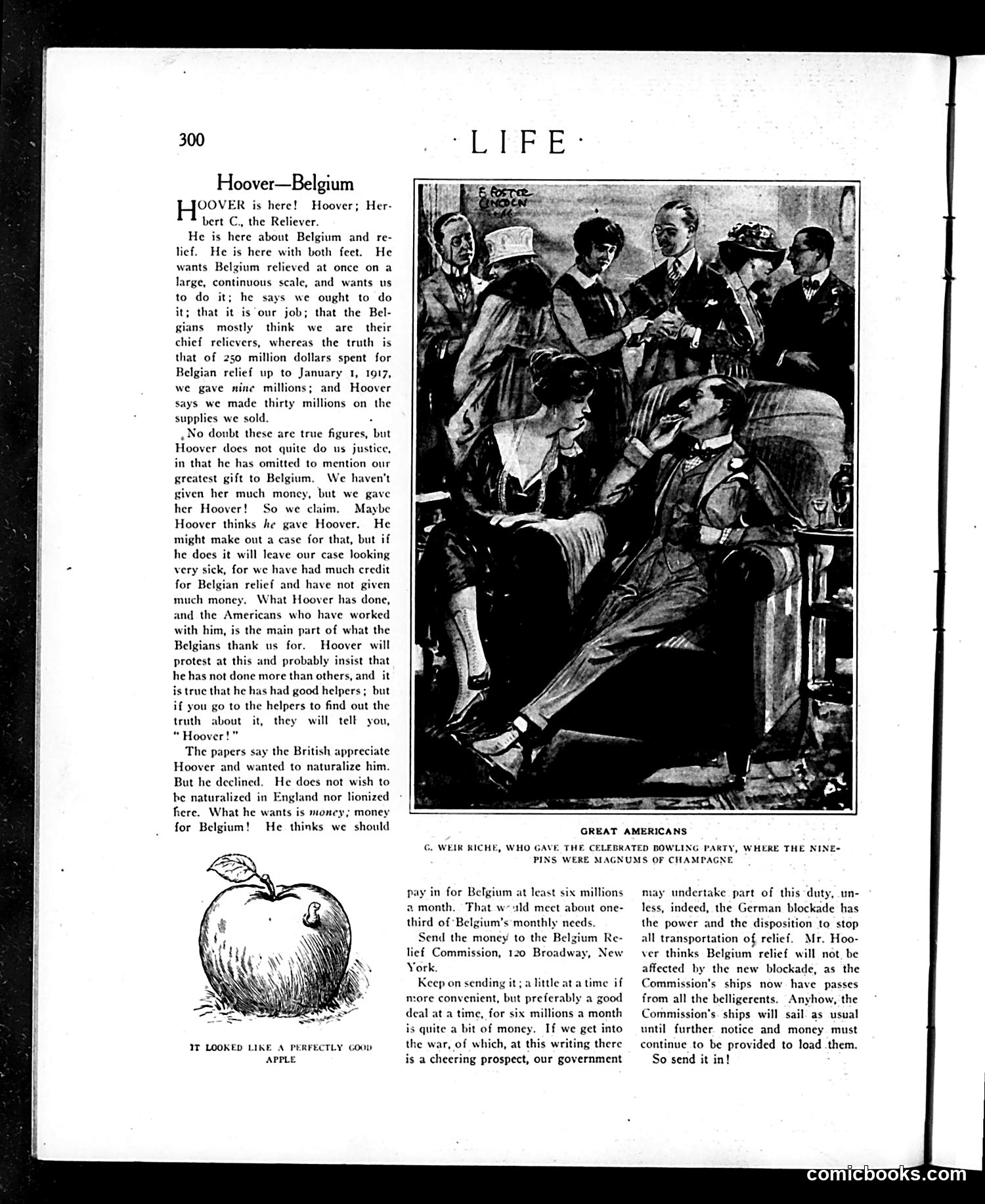
This page discusses Herbert Hoover's role as "Reliever" providing Belgian humanitarian aid during World War I. The text debates Hoover's contributions, claiming Americans (particularly Hoover) deserve credit for Belgian relief efforts, while Hoover himself apparently sought only financial compensation rather than public recognition or naturalization in England. The photograph shows what appears to be a formal gathering or "bowling party" hosted by C. Weir Riche, described as a "Great American" who gave a celebrated event with "nine pins" and "magnums of champagne." The apple illustration is captioned "It looked like a perfectly good apple," likely a visual pun about Hoover's wholesome public image. The satirical thrust critiques Hoover's motivations and credit-taking regarding wartime relief work.
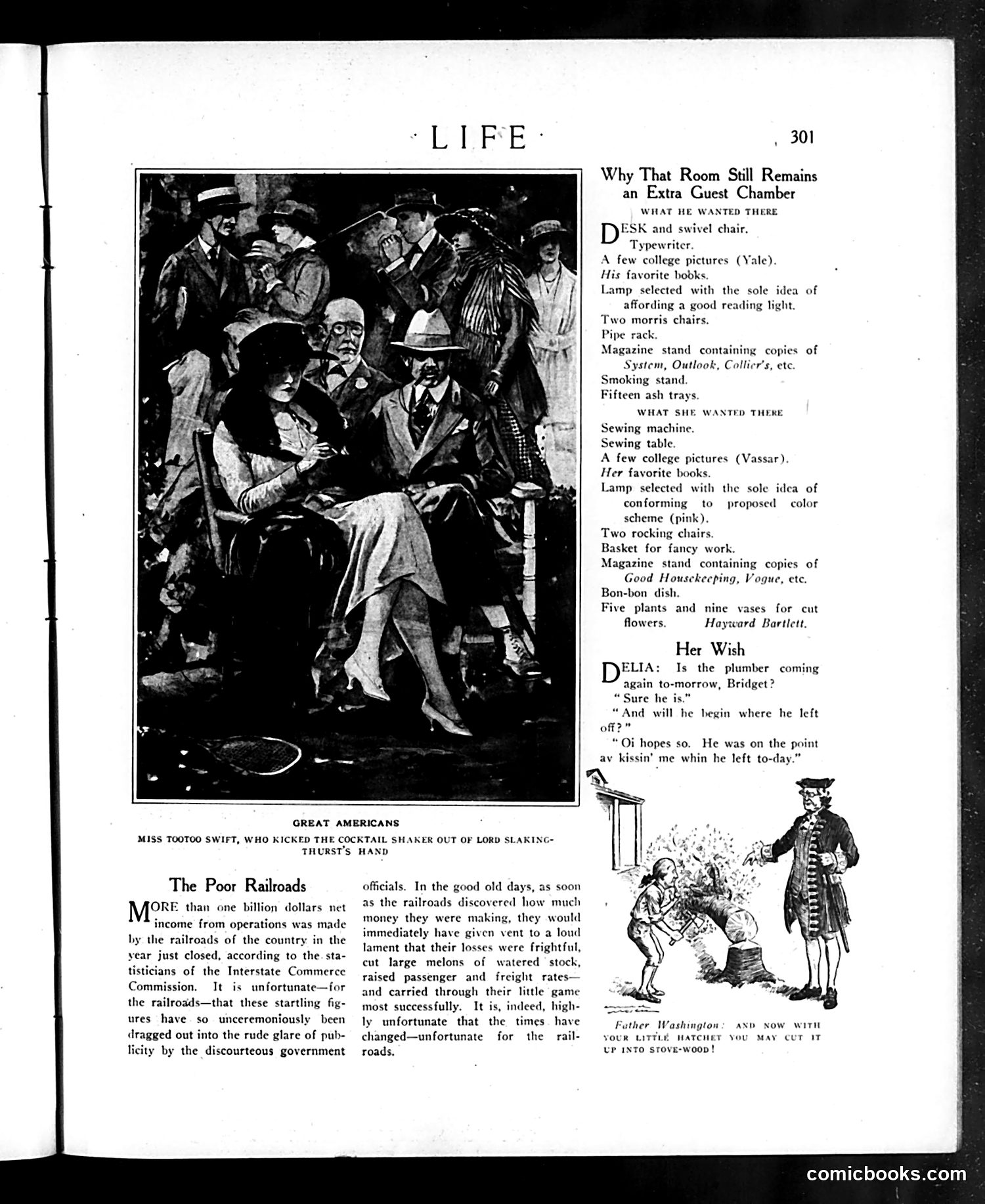
This page contains two distinct items: **Top section:** "Why That Room Still Remains an Extra Guest Chamber" lists furnishings a husband and wife each wanted for a spare bedroom—his choices (desk, typewriter, Yale pictures, lamp, smoking stand, magazines) versus hers (sewing machine, sewing table, Vassar pictures, rocking chairs, fancy-work basket, magazines). The humor lies in the satirical gender divide: his space emphasizes intellectual/leisure pursuits; hers emphasizes domestic crafts. The "extra guest chamber" remains unused because they can't agree. **Lower section:** "The Poor Railroads" discusses how American railroads earned over one billion dollars net income yet faced government criticism for allegedly "watered stock" and other financial practices. The text suggests railroads were unfairly blamed during an era of changing economic fortunes. **Bottom cartoon:** "Father Washington—And Now With Your Little Hatchet You May Cut It Up Into Stove-Wood!" appears to satirize government attempts to break up or regulate railroad monopolies.
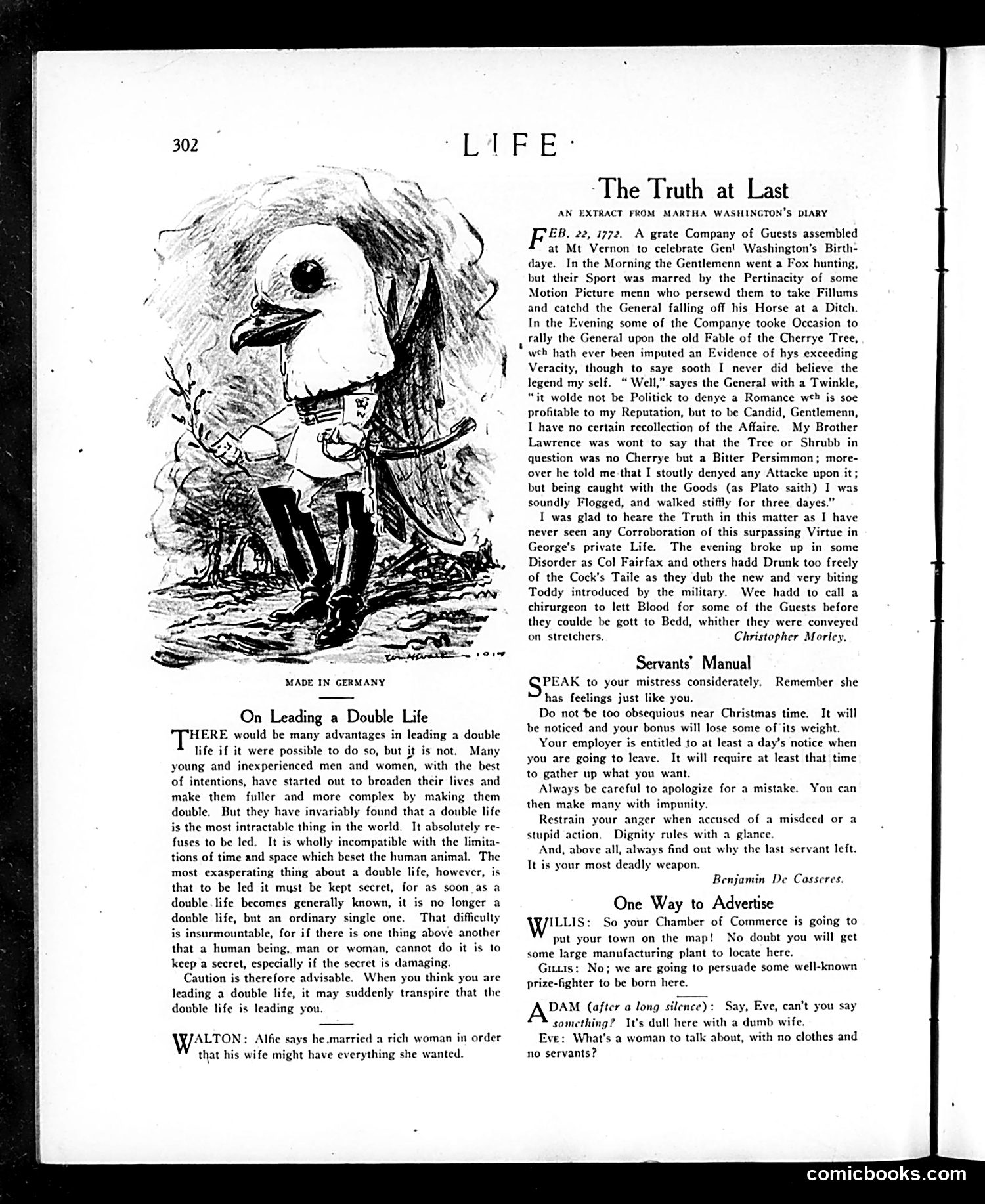
The main cartoon titled "On Leading a Double Life" depicts a figure in military dress (appears to be a bird-headed character, possibly satirizing a military officer) engaged in duplicitous behavior. The text discusses the impossibility of maintaining a secret "double life," warning that such deception inevitably becomes known and cannot coexist with societal respectability. Below this, "Servants' Manual" and "One Way to Advertise" contain satirical dialogues mocking servant behavior and small-town boosterism, respectively. The date (FEB. 22, 1777) and "Martha Washington's Diary" reference suggest this page uses historical framing for contemporary social commentary, likely from the early 20th century when Life published satirical pieces about American manners and social hypocrisy.
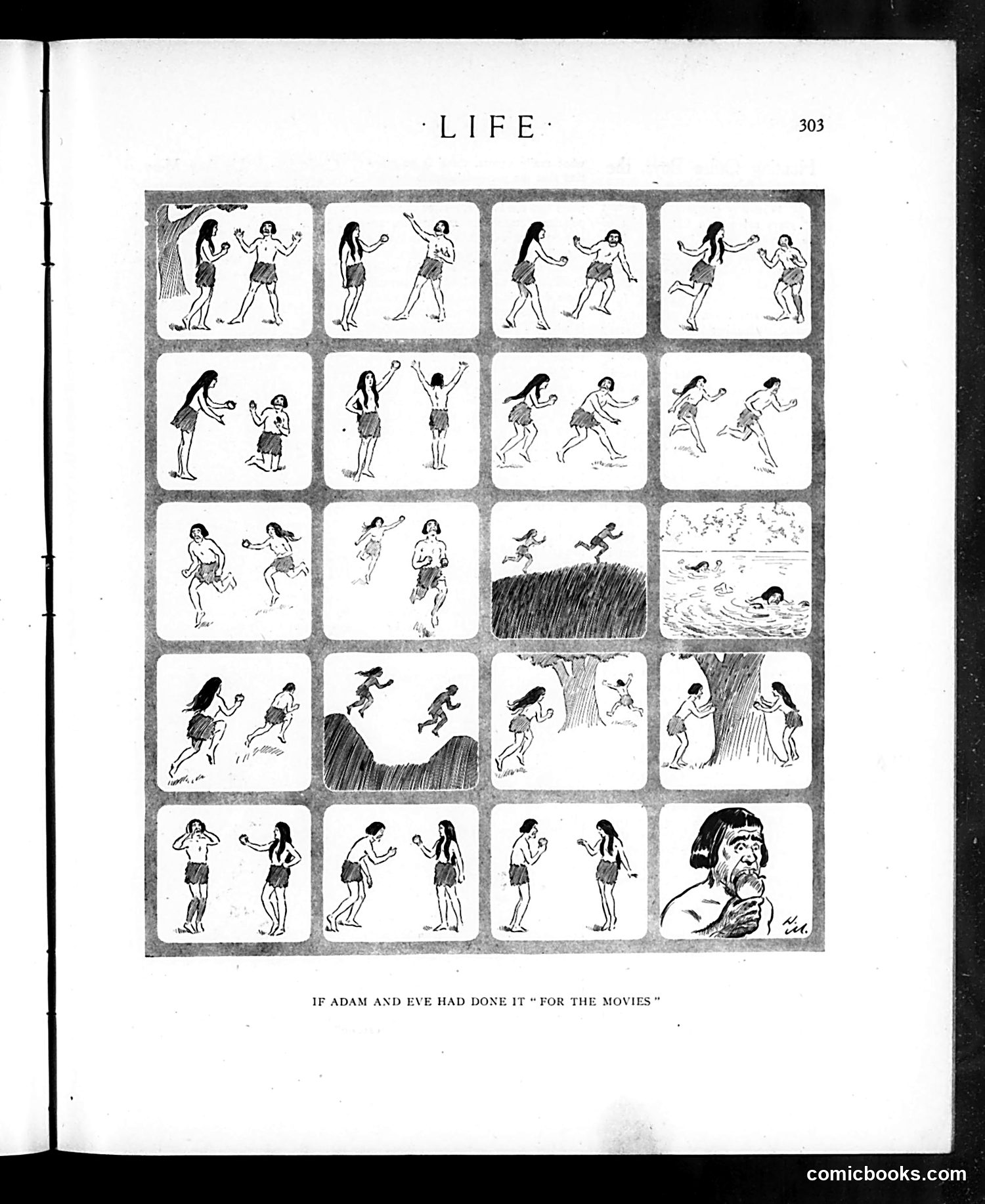
This is a humorous cartoon strip depicting the Biblical story of Adam and Eve reimagined as if they were performing for early cinema. The sequential panels show the couple engaged in various physical activities and gestures—playing catch, running, jumping, swimming, and posing—rather than the traditional narrative of temptation and the Fall of Man. The satire mocks both silent film acting conventions (exaggerated physical movements and theatrical poses) and the era's tendency to sensationalize or trivialize serious subjects for entertainment. By reducing the sacred Biblical narrative to vaudeville-like physical comedy, the cartoon critiques how Hollywood adapted famous stories, emphasizing spectacle over substance. This reflects early 20th-century anxieties about cinema's cultural influence.
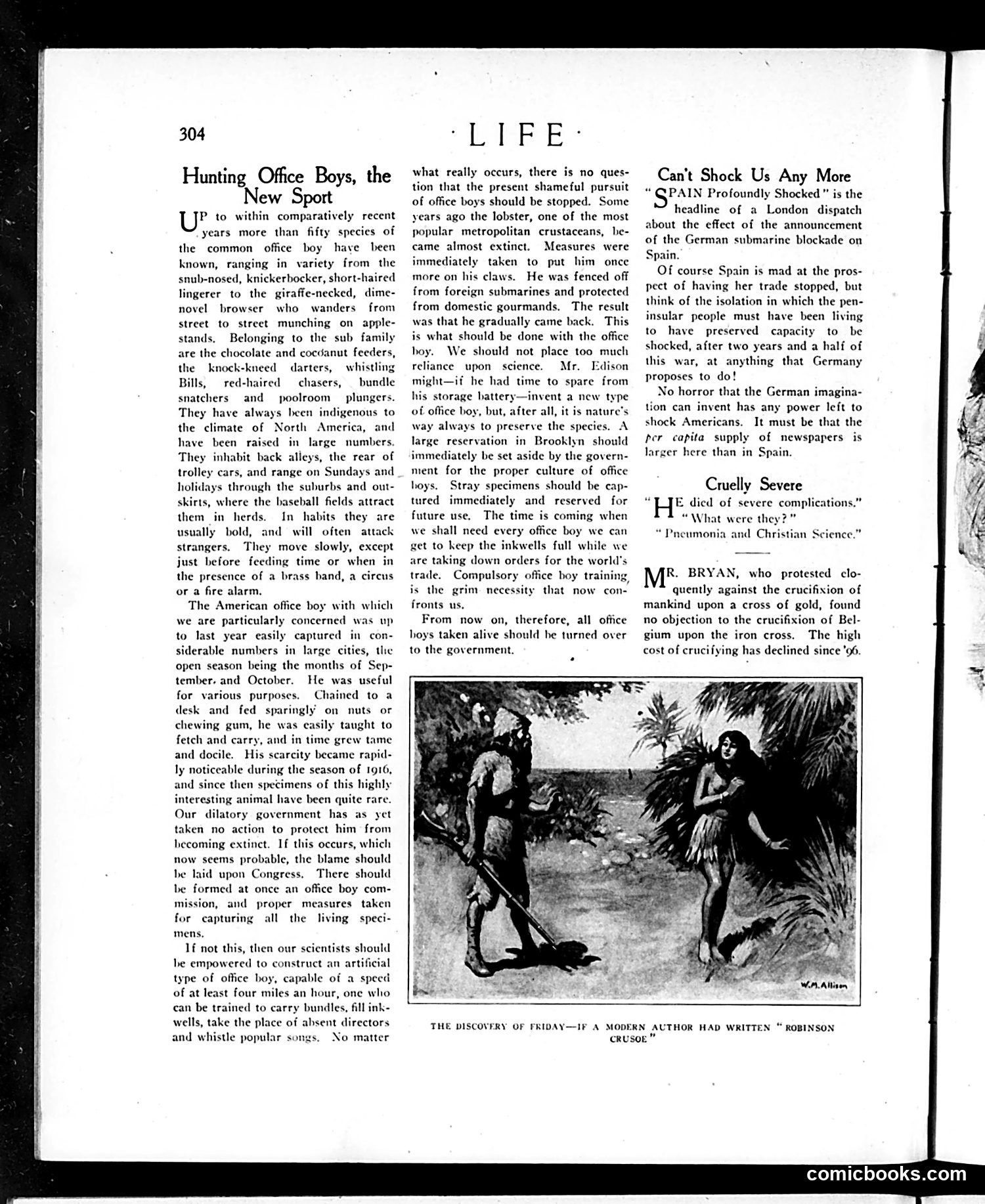
This piece satirizes the depletion of office boys during World War I (circa 1916). The author mock-seriously treats office boys as an endangered species requiring government protection—a humorous response to their actual scarcity as young men enlisted or left for war work. The satire uses naturalist language ("sub family," "indigenous," "open season") to describe office boys as hunted animals, cataloging varieties like "snub-nosed" and "red-haired chasers." The joke escalates absurdly: proposing government "reservations" to preserve them, suggesting mechanical replacements, and demanding "compulsory office boy training." The accompanying illustration depicts a castaway scene (likely Robinson Crusoe reference based on the caption), reinforcing themes of scarcity and isolation. The secondary article dismisses Spain's shock at German submarine blockades as performative—Spain's capacity for shock has been exhausted by war's horrors. Together, these pieces reflect American wartime anxieties about labor shortages and war's numbingly destructive effects.
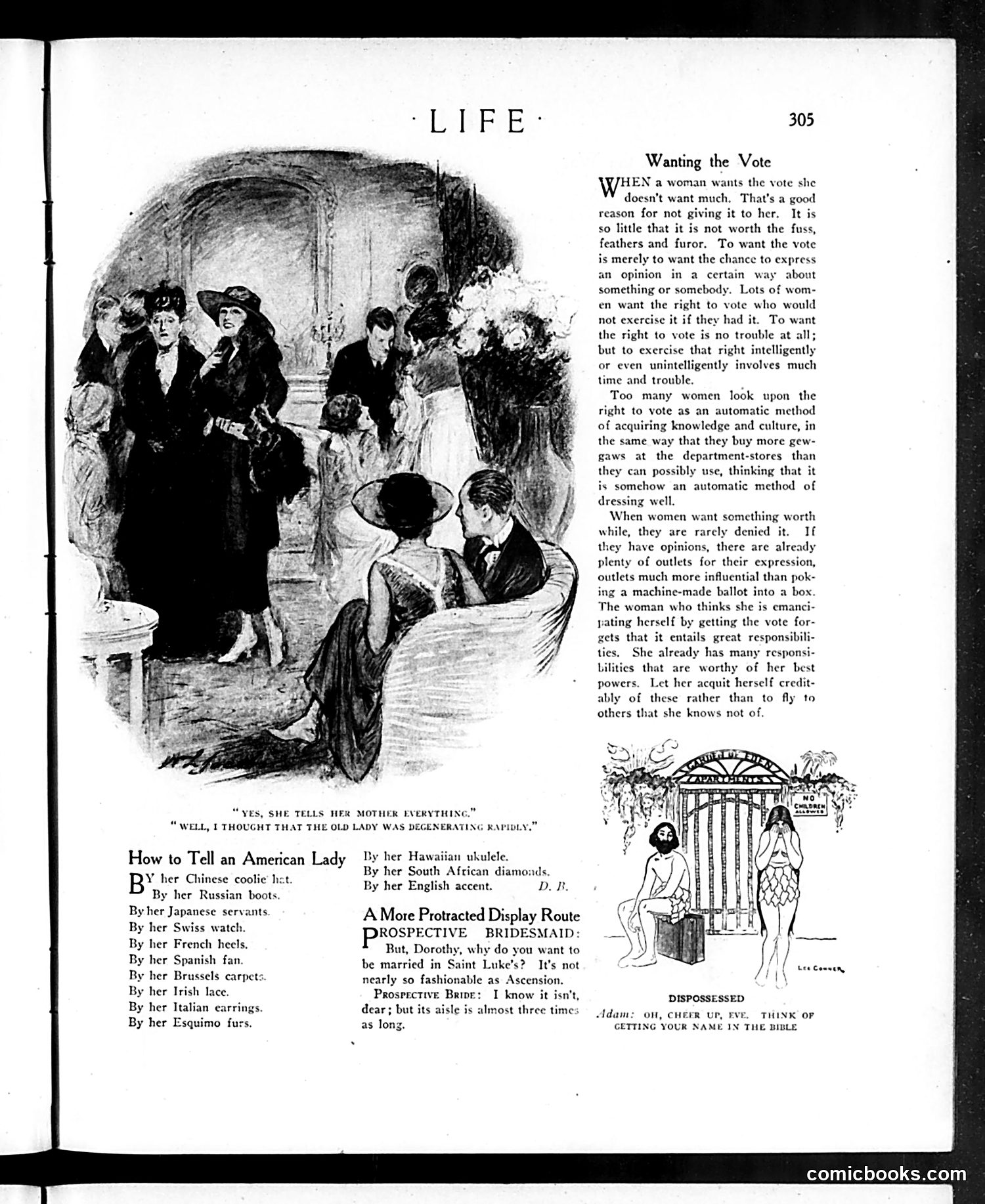
This page satirizes women's suffrage through multiple pieces. The main essay dismisses women's voting rights as trivial, arguing women already have sufficient outlets for opinions and shouldn't burden themselves with civic responsibilities they're unprepared for. The piece uses condescending logic: if women don't care much about voting, why give it to them? It also mocks women for treating voting like a consumer purchase—automatically acquiring culture through acquisition rather than genuine engagement. The accompanying humor pieces target wealthy American women's materialism: "How to Tell an American Lady" lists not character traits but foreign luxury goods (Hawaiian ukuleles, South African diamonds, Russian boots). The bridesmaid cartoon mocks superficial wedding fashions. **Context:** This reflects pre-1920 anti-suffrage sentiment, portraying female voters as intellectually unserious, materialistic, and incapable of intelligent civic participation—common arguments against women's suffrage during this era.
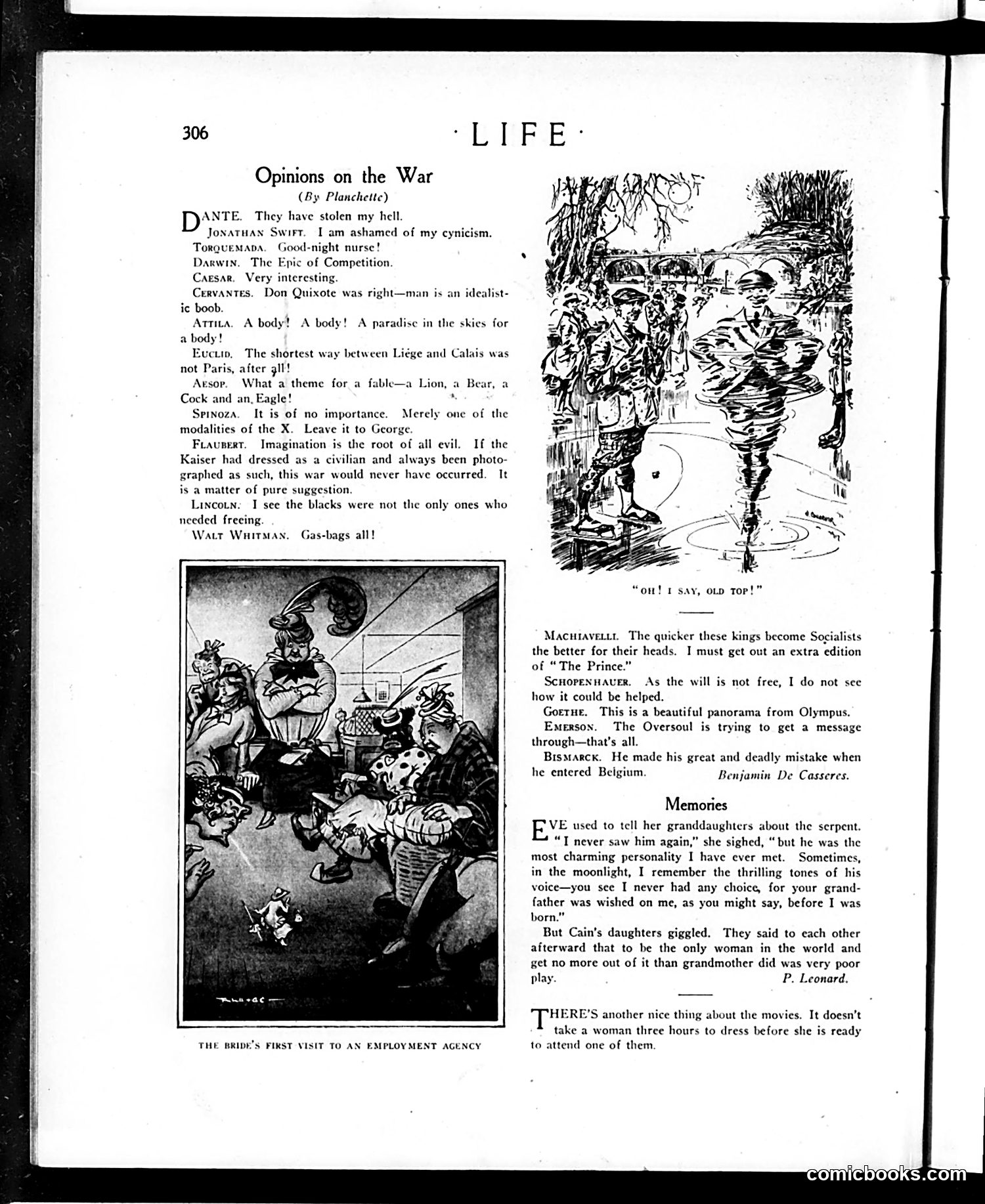
This page uses a spiritualist device ("planchette"—a ouija board pointer) to imagine how famous historical and literary figures would comment on World War I. The satire works by placing their known philosophies against modern mechanized warfare, creating absurdist contrasts: Dante finds his Hell outdone; Darwin sees "competition"; Cervantes notes man's idealism makes him a "boob." The political point emerges clearly: Lincoln observes enslaved peoples needed freeing (suggesting war frees nations); Bismarck's comment that entering Belgium was a "great and deadly mistake" references Germany's controversial invasion. Machiavelli jokes about kings becoming Socialists (war driving radical change). The lower cartoon, "The Bride's First Visit to an Employment Agency," appears unrelated wartime satire about labor shortages—women entering the workforce as men enlisted. The page satirizes both the war's absurdity and its social consequences through high-minded literary voices rendered increasingly cynical.
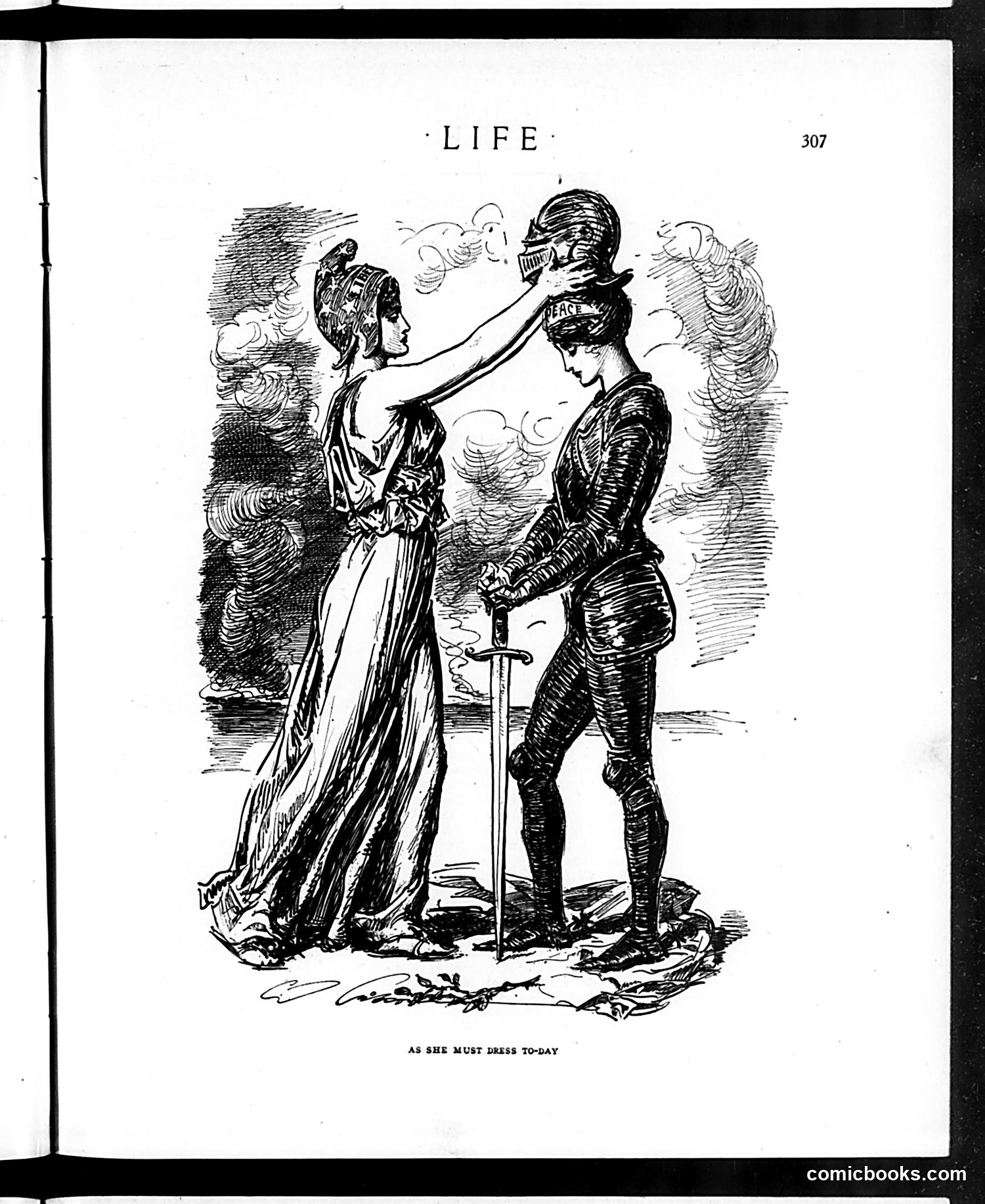
This is a satirical cartoon from *Life* magazine (page 307) titled "As She Must Dress To-Day." The image depicts two figures: a woman in classical flowing robes (labeled "Peace") being fitted by a figure in military armor (labeled "War"). The woman appears to be being dressed or constrained by the military figure, suggesting that wartime needs override peacetime preferences. The satire critiques how women's fashion and freedoms are subordinated to military demands during wartime. The classical allegorical figures—Peace and War—suggest this is commentary on a specific historical period when women's dress codes or social roles changed due to military necessity, likely WWI or WWII era rationing and uniform requirements. The cartoon's message: warfare fundamentally reshapes civilian life, including how women must present themselves, illustrating the pervasive control military exigencies exert over society.
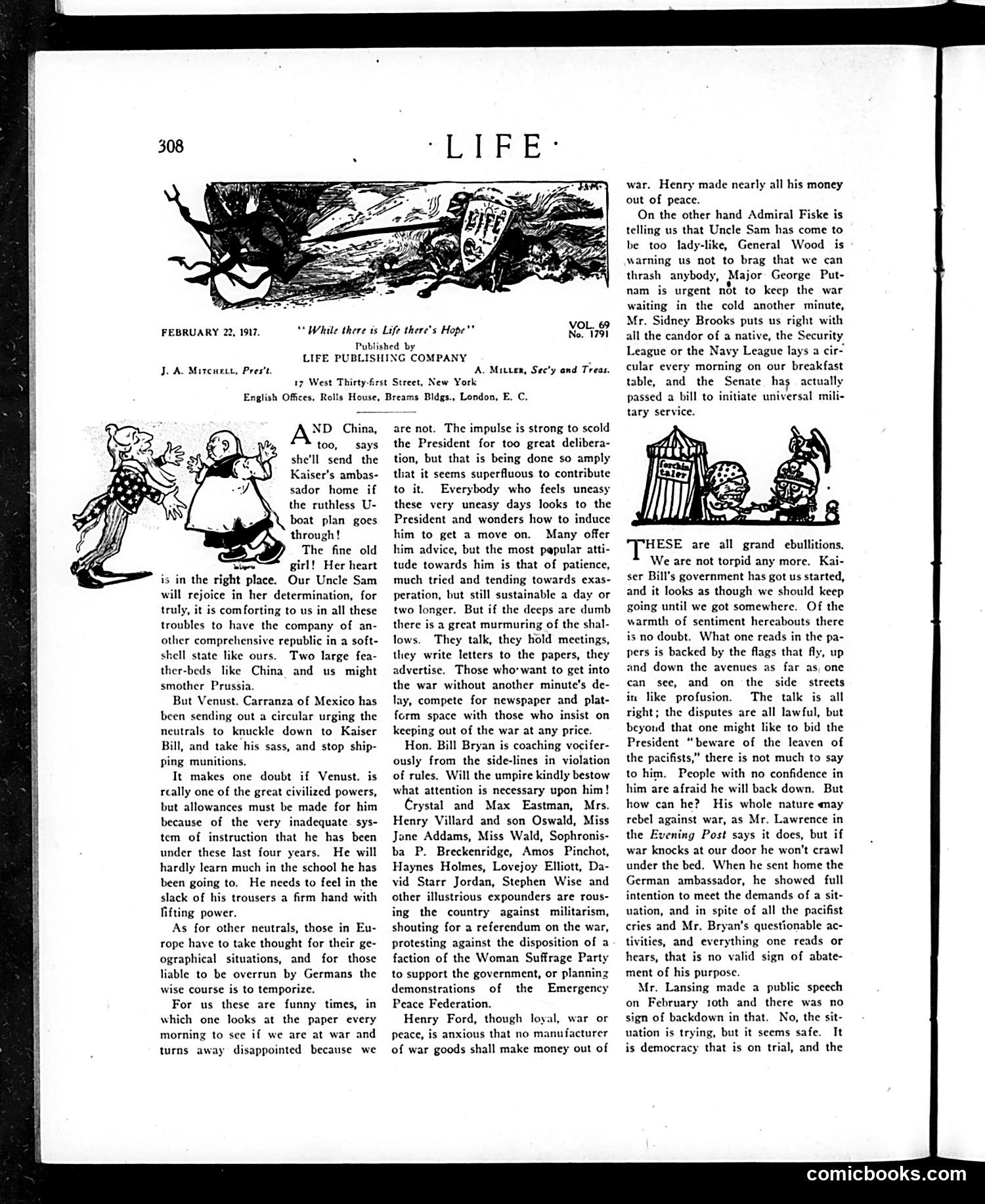
This page presents editorial commentary on American neutrality during World War I, approximately two months before the U.S. entered the war. The **cartoon** (top left) depicts a woman labeled as China, offering support to Uncle Sam—satirizing China's declaration against German U-boats as performative rather than meaningful. The **text** catalogs the chaotic domestic debate over entering the war. It mocks Mexico's Venustiano Carranza for urging neutrals to resist Kaiser Bill, suggesting he's intellectually unfit for such advice. The author then lists prominent figures on both sides: pacifists like William Jennings Bryan, Jane Addams, and the Emergency Peace Federation opposing intervention, versus militarists like Admiral Fiske and General Wood demanding action. The satire's point: America is paralyzed by conflicting voices—patriots want war immediately, peace advocates demand a referendum, and the President faces pressure from all directions. The phrase "we turn away disappointed because we are not" at war captures the author's ironic frustration with American indecision during an increasingly urgent global crisis.
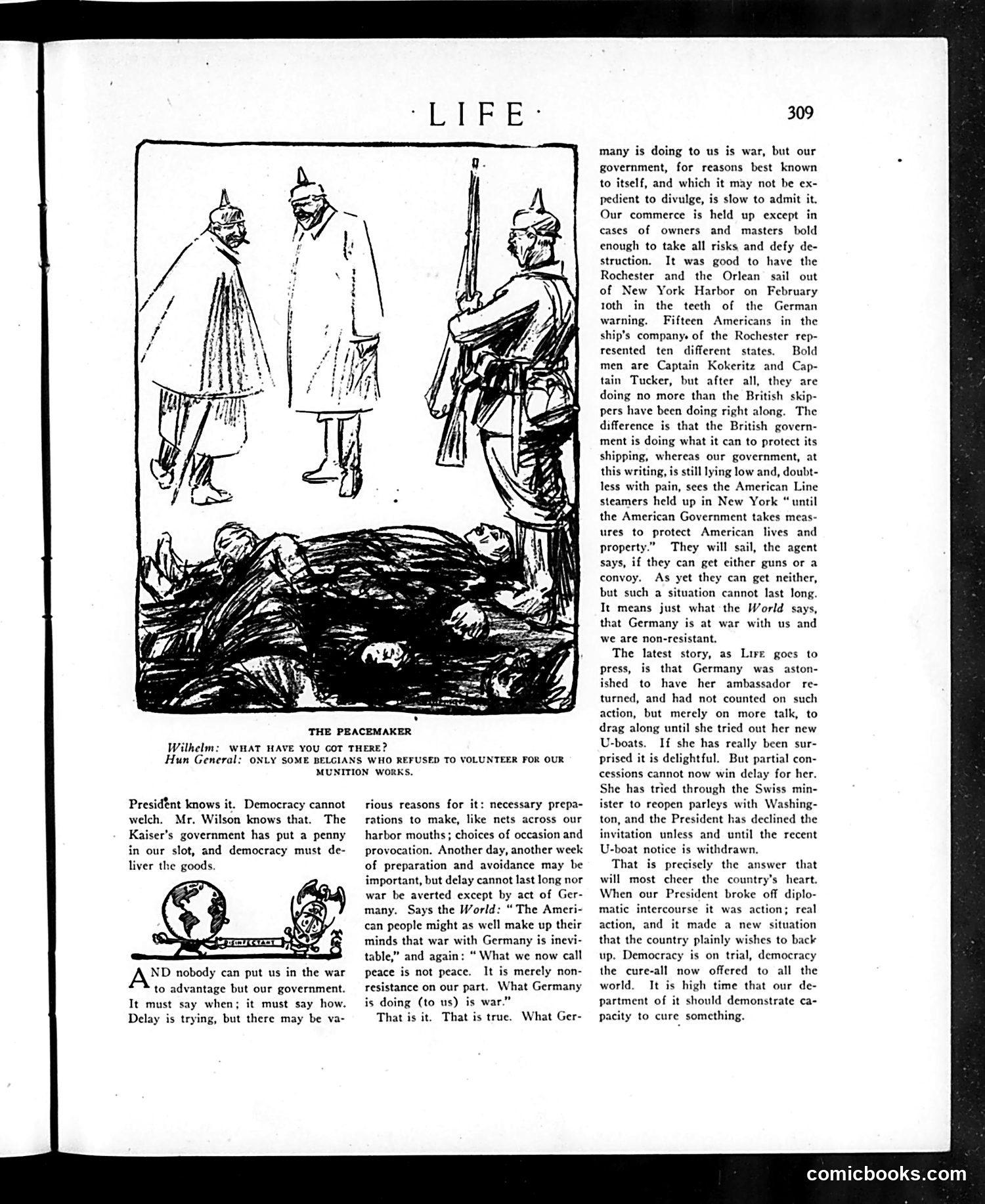
This cartoon critiques American reluctance to enter World War I. The sketch shows German soldiers (identifiable by spiked helmets) displaying dead Belgian civilians to "Wilhelm" (Kaiser Wilhelm II), claiming they are "Belgians who refused to volunteer for munition works"—referencing documented German atrocities and forced labor in occupied Belgium. The accompanying text argues that President Wilson's government knows Germany is effectively "at war" with America through submarine attacks on merchant ships and destruction of commerce, yet remains officially neutral and non-resistant. Life's editors criticize this inaction, citing specific ships (Rochester, Orlean) that sailed despite German warnings, and American steamers held in New York lacking government protection. The satire's point: America cannot claim neutrality while suffering German aggression; democratic principles demand the government acknowledge this reality and act decisively. The cartoon shows Germany's brutality to emphasize why continued passivity is morally and practically untenable.
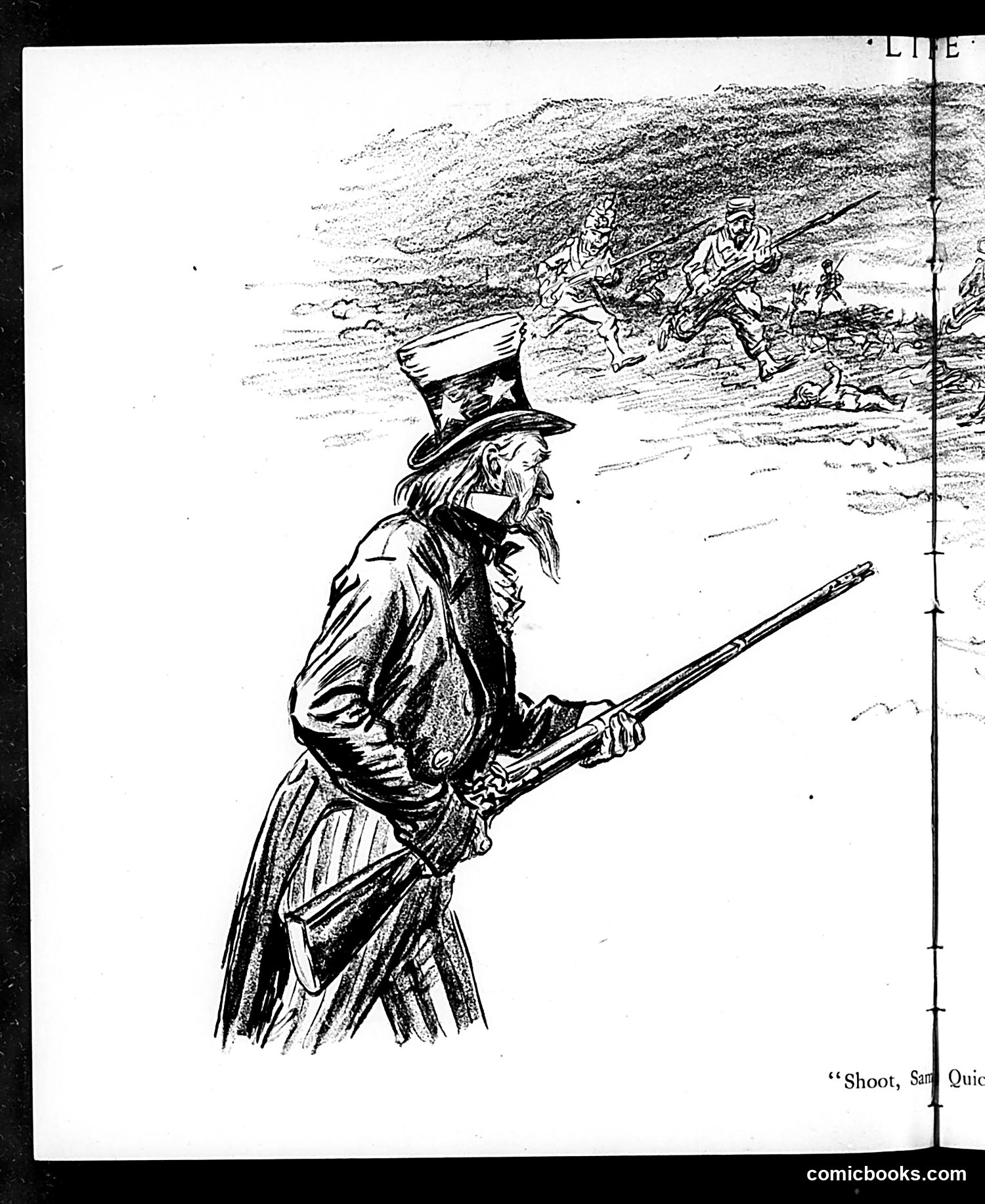
This appears to be a satirical illustration from *Life* magazine featuring **Uncle Sam** (identifiable by his distinctive top hat with a star) holding a rifle, depicted in a commanding or aggressive posture. In the background, soldiers or military figures are visible on a hillside, suggesting a battle or military campaign scene. The visible caption fragment reads "Shoot, Sa[m]..." which appears to be addressing Uncle Sam directly, likely as a command or exhortation related to military action. The exact historical context is unclear from this image alone—it could reference any number of American military conflicts or interventions from the late 19th or early 20th century. Without the complete caption or publication date visible, the specific political target of this satire cannot be definitively identified.
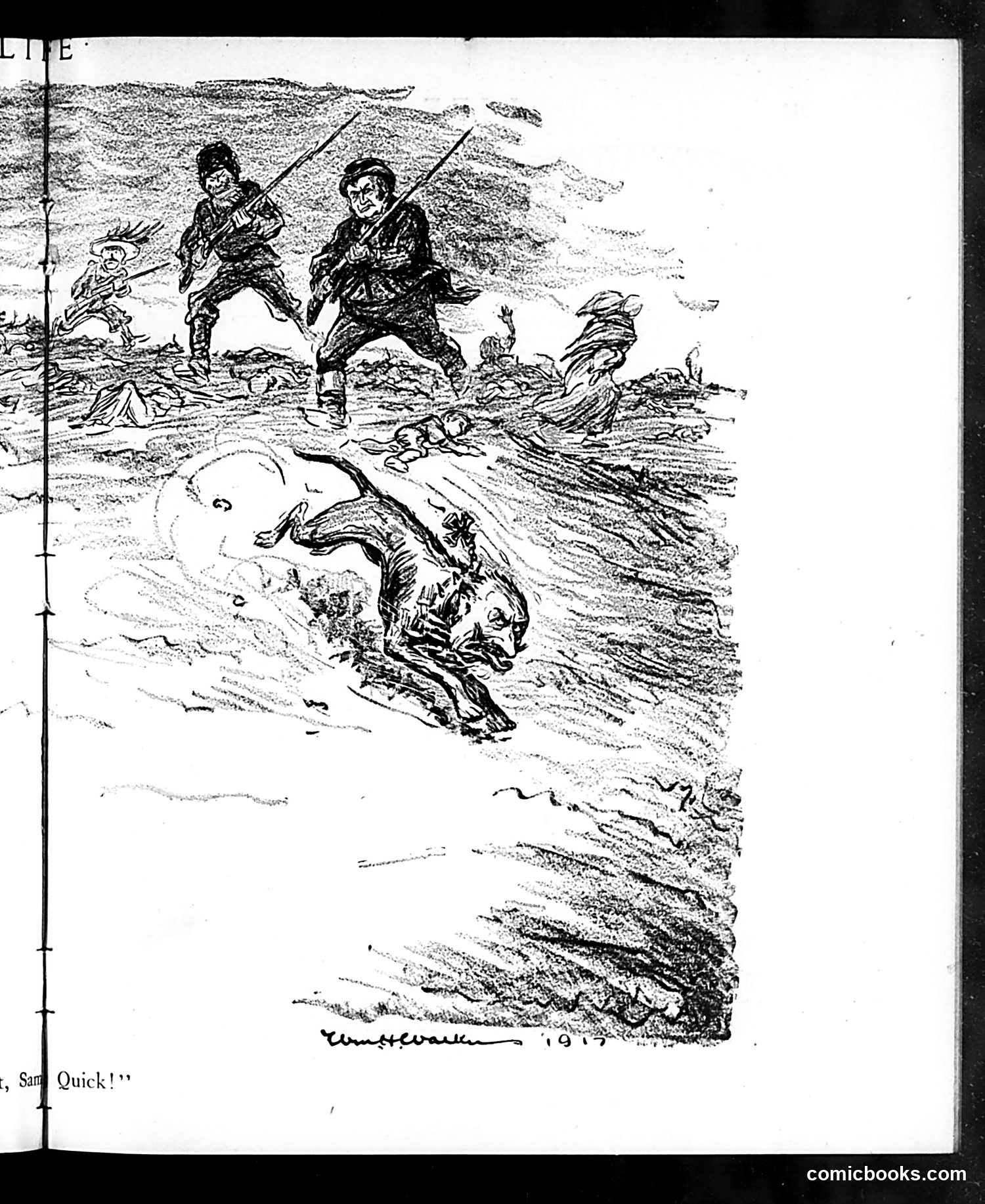
This is a WWI-era political cartoon dated 1917, depicting soldiers in combat. Two armed soldiers stand in a trench or battlefield, while additional figures appear to be engaged in action. In the foreground, a figure appears to be falling or struggling. The caption "Quick!" suggests urgency or alarm. The cartoon likely satirizes either military incompetence, the chaos of trench warfare, or American military preparedness as the U.S. entered World War I in 1917. Without additional context or clearer identification of specific figures, the precise satirical target remains unclear—whether it mocks military leadership, enlisted soldiers' training, or civilian attitudes toward the conflict. The style and composition suggest critique of wartime conditions or military conduct.
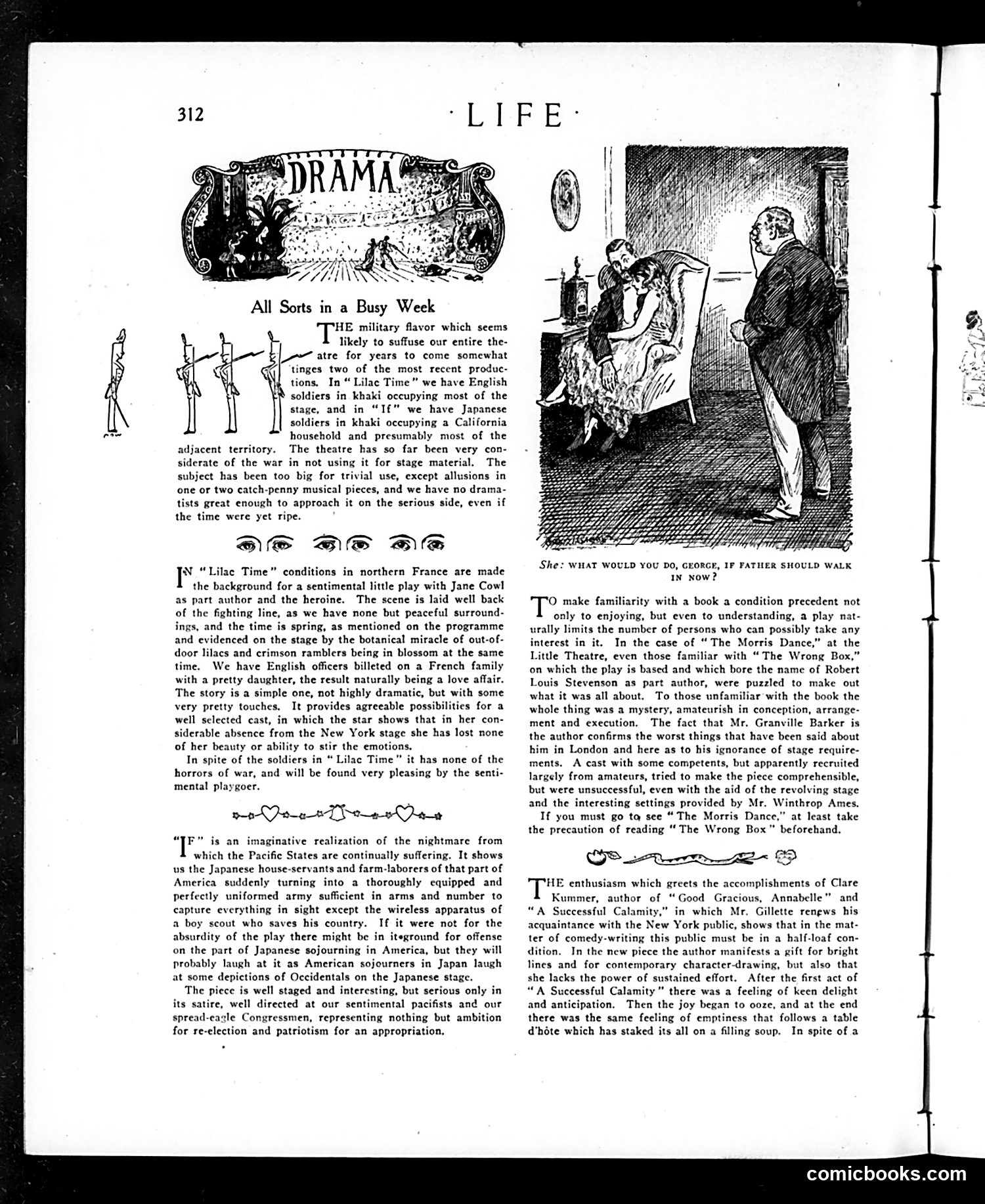
This page reviews three theatrical productions: **"Lilac Time"** features English soldiers in France during WWI, presenting a sentimental love story between officers billeted with a French family. The reviewer notes the theatre has respectfully avoided trivializing the ongoing war through serious drama, instead offering pleasant escapism with spring scenery and romantic elements. **"If"** imagines a Japanese invasion of California, depicting servants and laborers suddenly becoming a uniformed army. The reviewer treats this as satirical commentary on American pacifists and self-interested congressmen, not as serious anti-Japanese propaganda, comparing it to how Japanese audiences laugh at Western caricatures. **"The Morris Dance"** (based on "The Wrong Box") receives criticism for being incomprehensible to audiences unfamiliar with its source material—the illustration shows a domestic scene, likely depicting plot confusion. The cartoonish military figures at top appear to represent the soldier-heavy casting of contemporary productions.
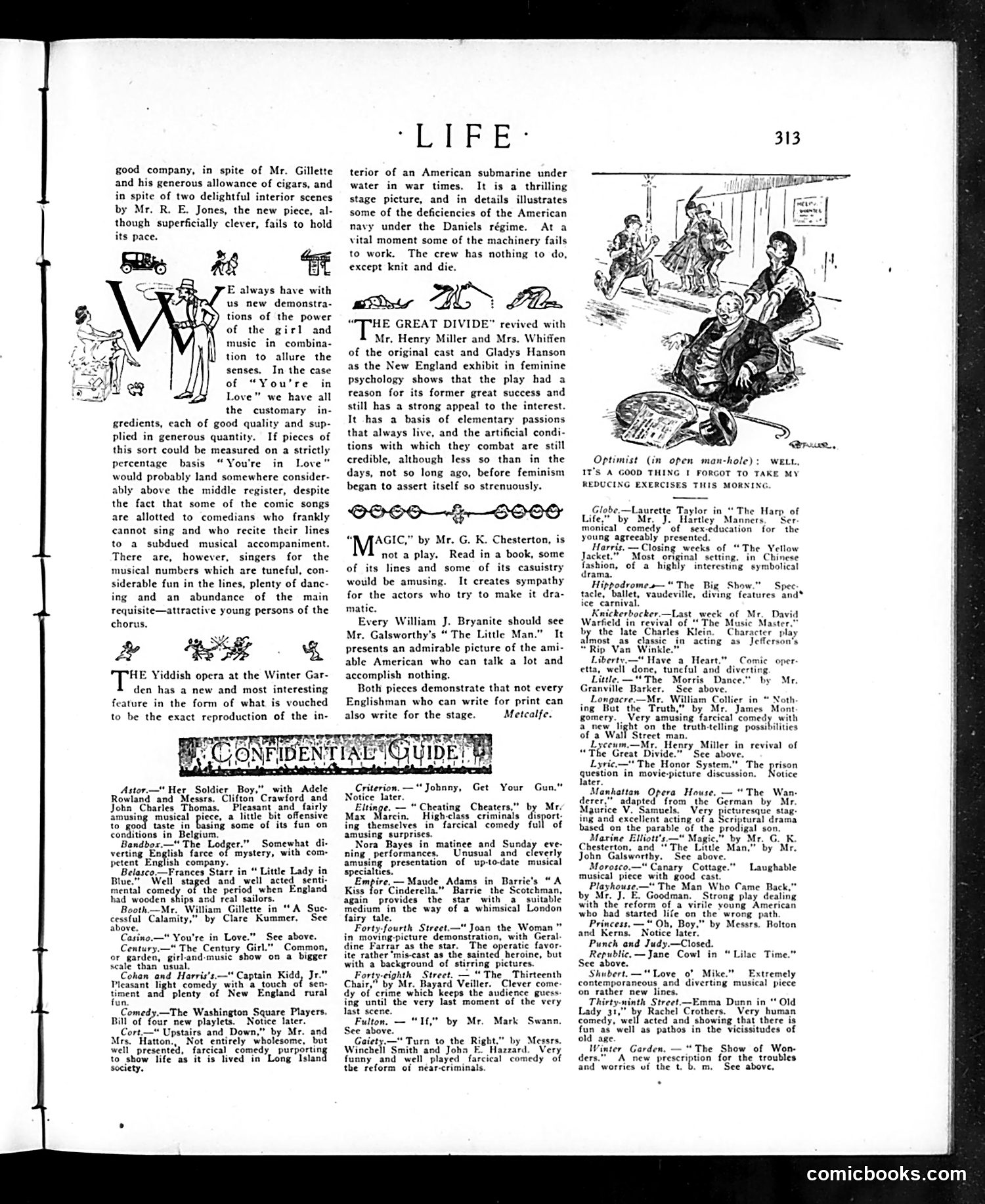
This page is primarily **theater criticism** rather than political satire. It reviews Broadway productions of the era (likely 1910s based on references). The cartoon at top-right depicts an "Optimist" doing morning exercises—a simple visual gag about maintaining positive attitude. **Key theatrical references:** - "A Successful Calamity" with William Gillette - "You're in Love" (criticized for weak comedians who can't sing) - A Yiddish opera at Winter Garden featuring a realistic submarine set - "The Great Divide" revival with original cast - G.K. Chesterton's "Magic" - Galsworthy's "The Little Man" (satirizing talkative but ineffectual Americans) The critique of the submarine scene mentions the "Daniels régime"—likely Secretary of the Navy Josephus Daniels, suggesting the play critiqued naval preparedness. The reviews are **snobbishly dismissive** of popular musical comedies while praising serious drama. Modern readers would mainly note the theatrical landscape of the 1910s and period attitudes toward entertainment quality.
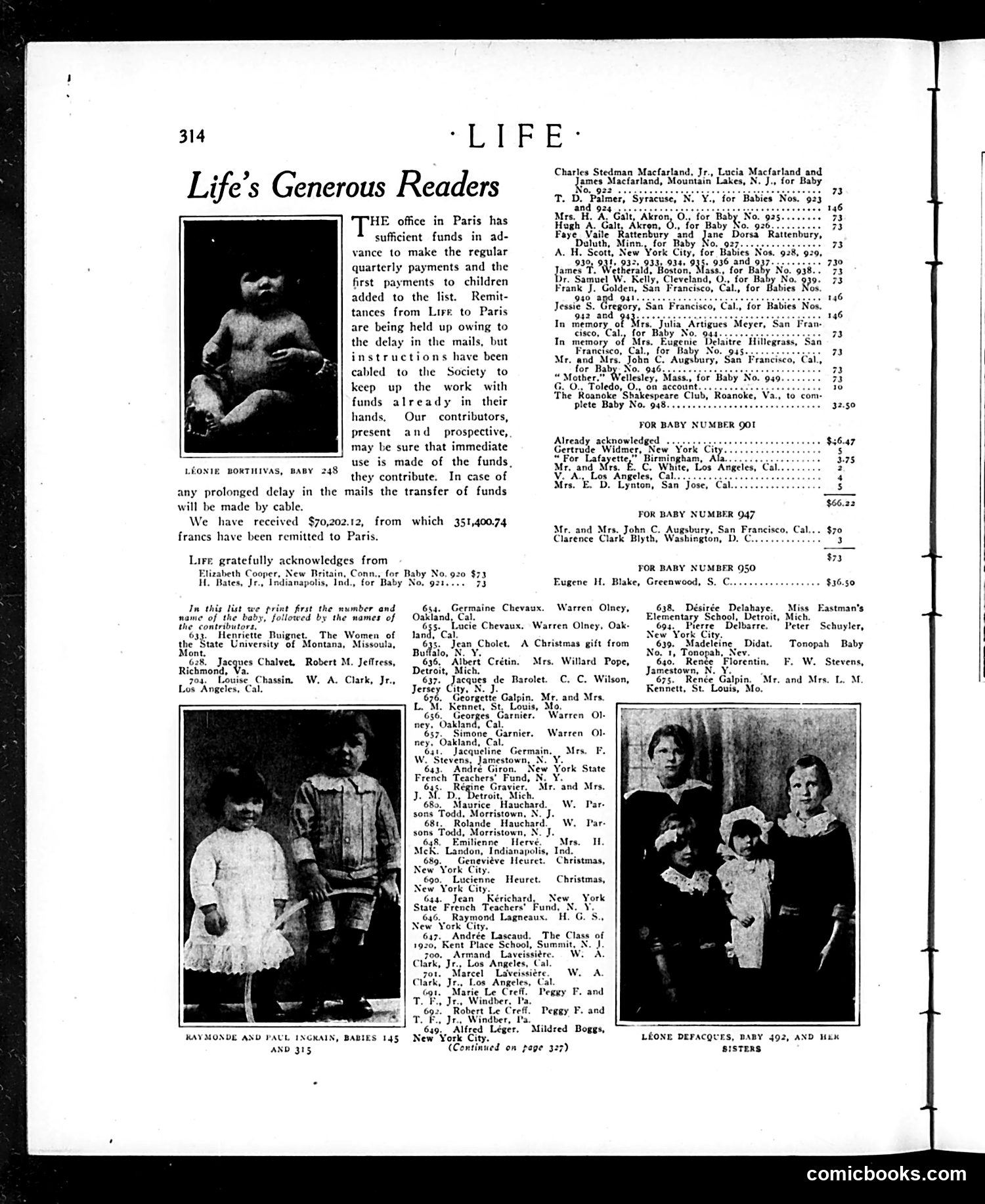
This is **not a cartoon or satire**, but rather a charitable fundraising page. Life magazine operated a program sponsoring French children (likely orphans or war victims from World War I, given the Paris office reference and dates around 1920s). The page lists **donors and the babies they sponsored**, with identification numbers. The text explains that Life's Paris office collects funds for quarterly payments to children on its charity list. Remittances are delayed due to mail delays, but Life assures donors their contributions are immediately used. The photographs show the sponsored babies and children. The elaborate donor list demonstrates Life's readers' generous participation in international relief work—a major charitable concern of the era for American publications addressing post-WWI European hardship. This represents **philanthropic journalism** rather than political commentary or satire.
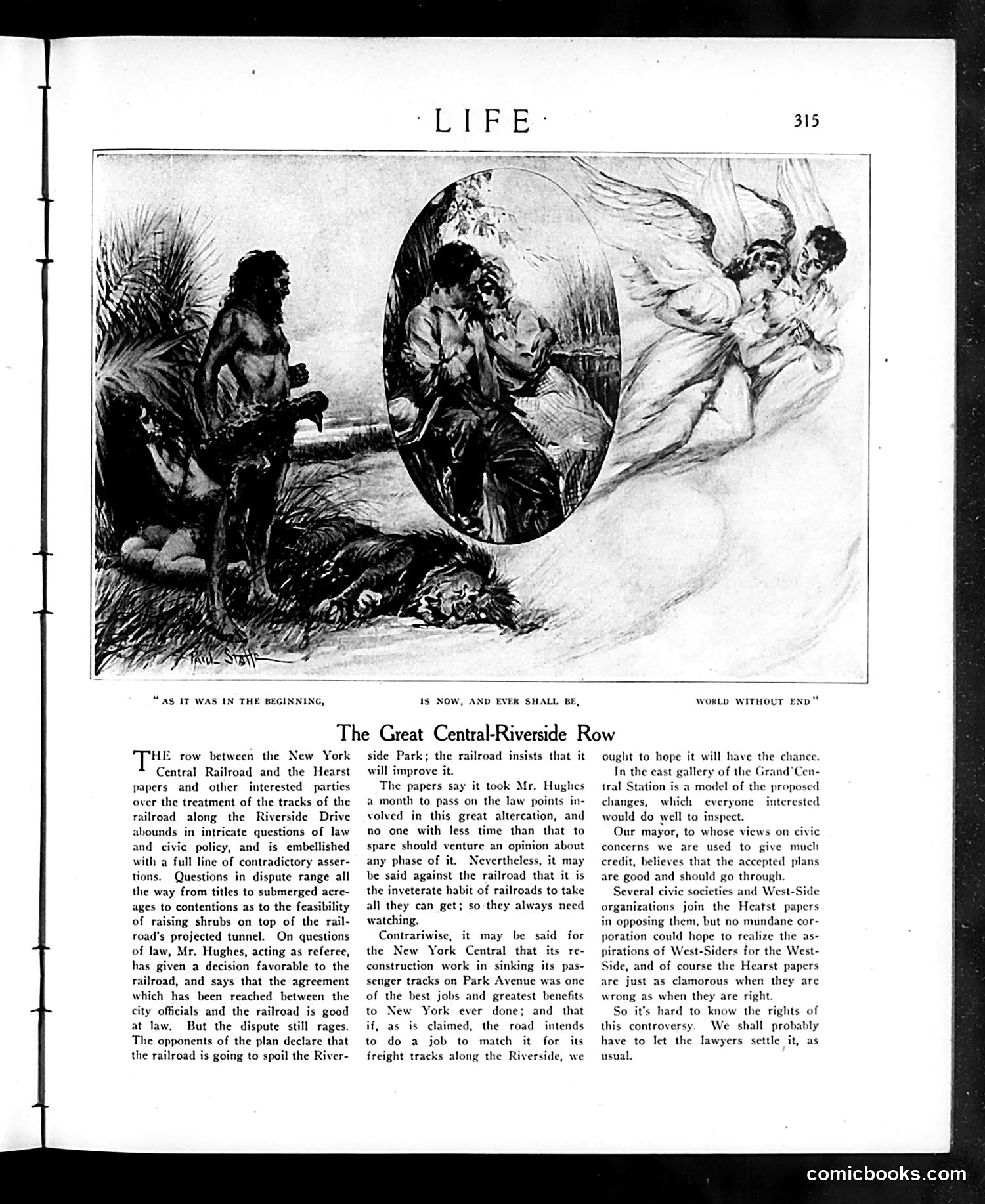
This cartoon illustrates a major New York City controversy over the New York Central Railroad's plans to rebuild its tracks along Riverside Drive. The central image shows a monkey (representing the railroad) gazing into a mirror held by cherubs—a satirical comment on the dispute's endless, circular nature. The actual conflict involved: - **The railroad** claiming reconstruction would improve the park - **The Hearst papers and civic groups** opposing the project as destructive - **Mr. Hughes** (likely Charles Evans Hughes, a prominent legal arbiter) ruling in the railroad's favor after a month of deliberation The article's tone is weary resignation: both sides claim righteousness, the dispute involves complex legal questions, and railroads historically "take all they can get." The epigraph ("As it was in the beginning...world without end") reinforces the endless, cyclical nature of such civic arguments. The satire suggests New Yorkers will ultimately leave such controversies to lawyers to resolve.
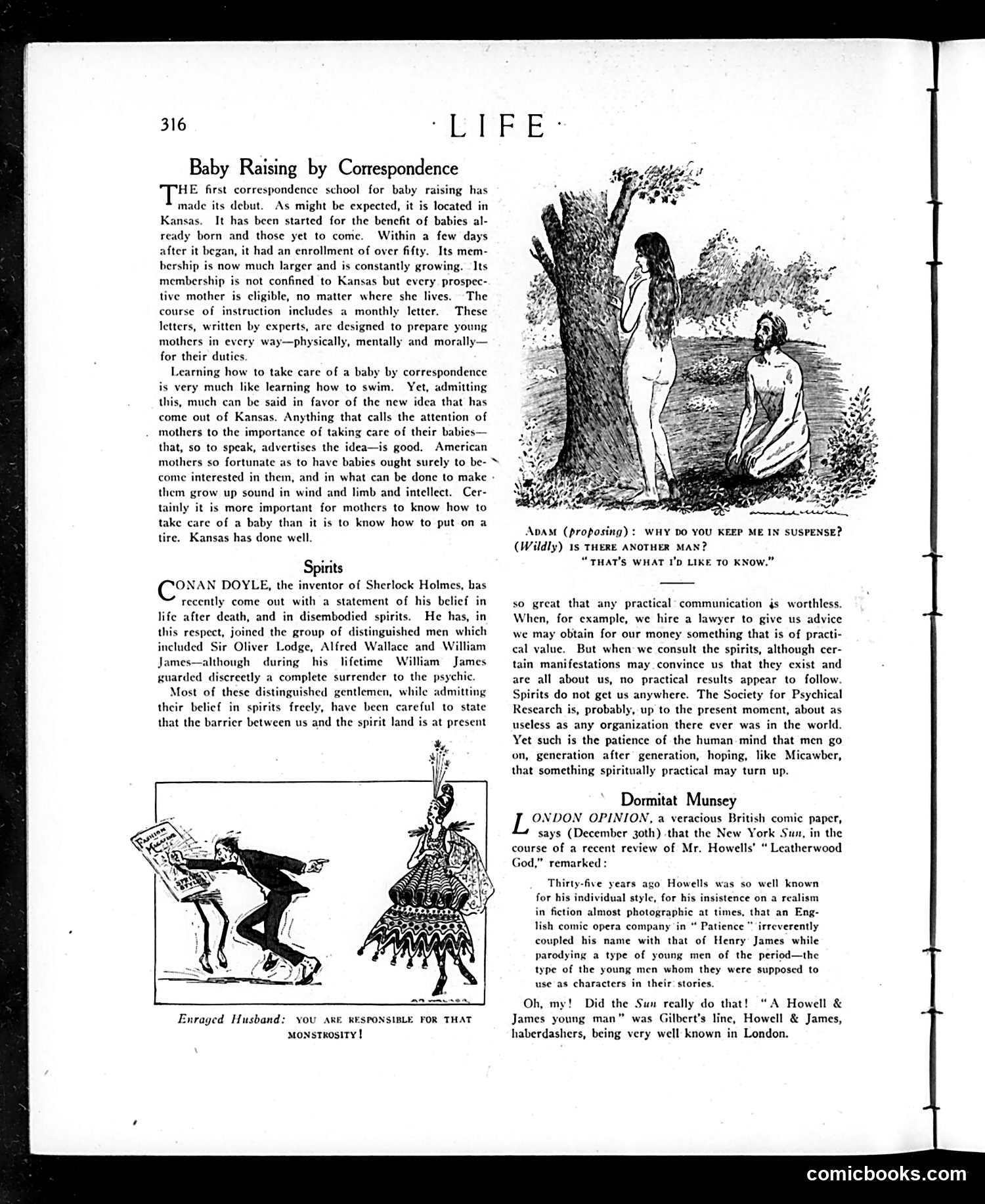
This page contains three separate satirical pieces: **Baby Raising by Correspondence**: Life mocks a newly-opened Kansas correspondence school teaching motherhood via monthly letters. The satire is gentle—while comparing learning baby care by mail to learning to swim by correspondence seems absurd, the article admits the school at least raises awareness about child care, which Life considers worthwhile. **Spirits**: This section ridicules famous figures like Arthur Conan Doyle and William James who publicly believed in communicating with the dead. Life's point: spiritualism produces no practical results. Consultations with spirits are useless compared to hiring a lawyer—spirits "do not get us anywhere," yet people persist generation after generation hoping for something "spiritually practical." **Dormitat Munsey**: This brief item notes a British publication's humorous observation that the *New York Sun* mistakenly attributed a Gilbert & Sullivan opera parody to author William Dean Howells, when it actually referenced the London haberdasher Howell & James. The cartoon shows a woman asking a man why he keeps her in suspense about another possible rival.
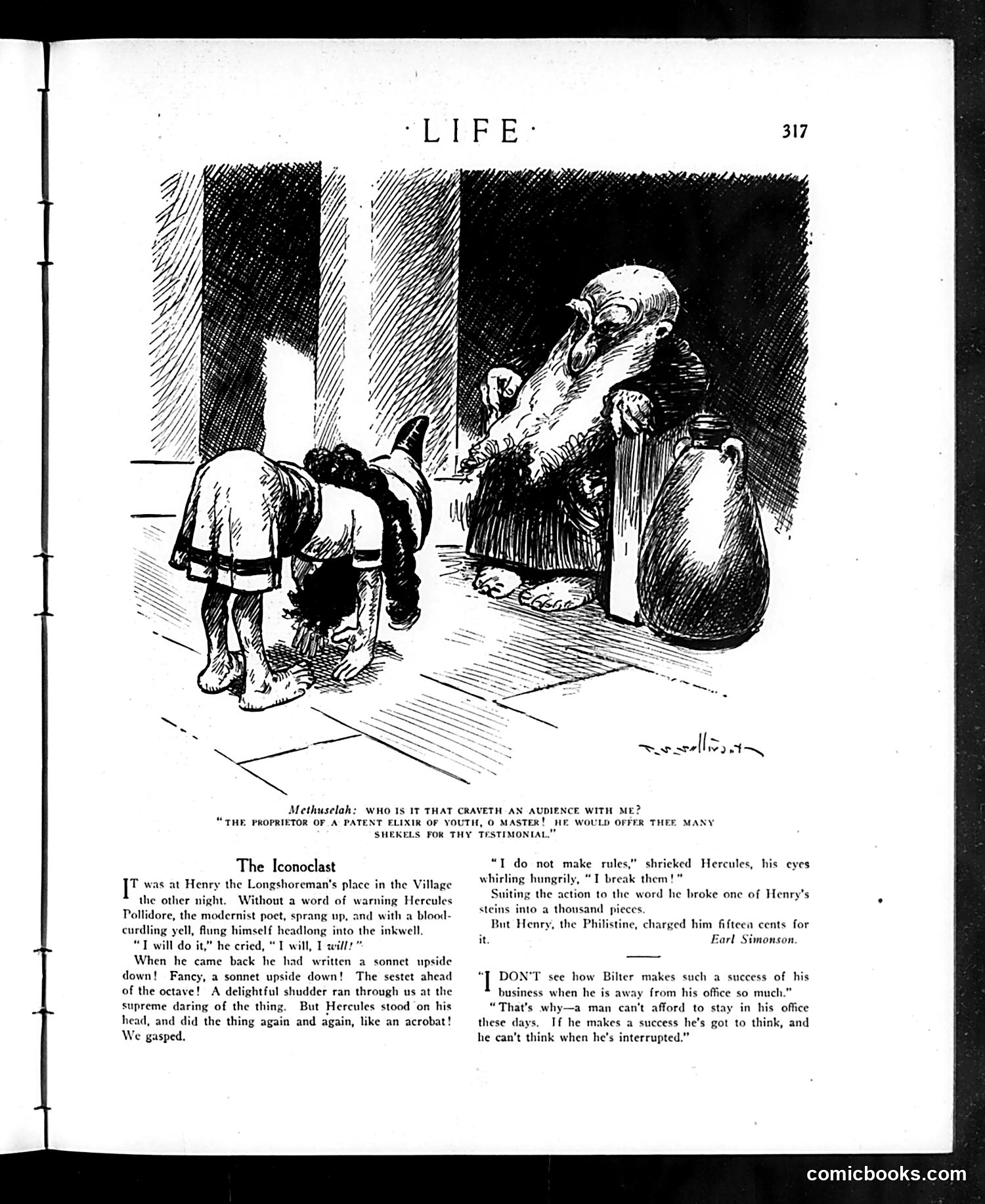
This Life magazine page contains two satirical pieces mocking early 20th-century cultural trends. **Top cartoon ("Methuselah"):** An elderly man pitches a "patent elixir of youth" to what appears to be an ancient biblical figure. This satirizes the era's proliferation of bogus anti-aging products and snake-oil salesmen promising fountain-of-youth remedies to wealthy consumers. **"The Iconoclast" story:** The piece ridicules the artistic avant-garde and modernist movement. Hercules Pollidore, a "modernist poet," performs absurd acts (diving into inkwells, writing sonnets upside-down) that he presents as revolutionary rule-breaking. The satire's punchline: when he breaks a beer stein, the bar owner simply charges him 15 cents—treating his "artistic rebellion" as ordinary destruction requiring payment. This mocks how modernists justified shocking behavior as artistic innovation, while ordinary people saw it as mere vandalism. The final anecdote about "Bilter" shifts tone, offering practical business advice rather than satire.
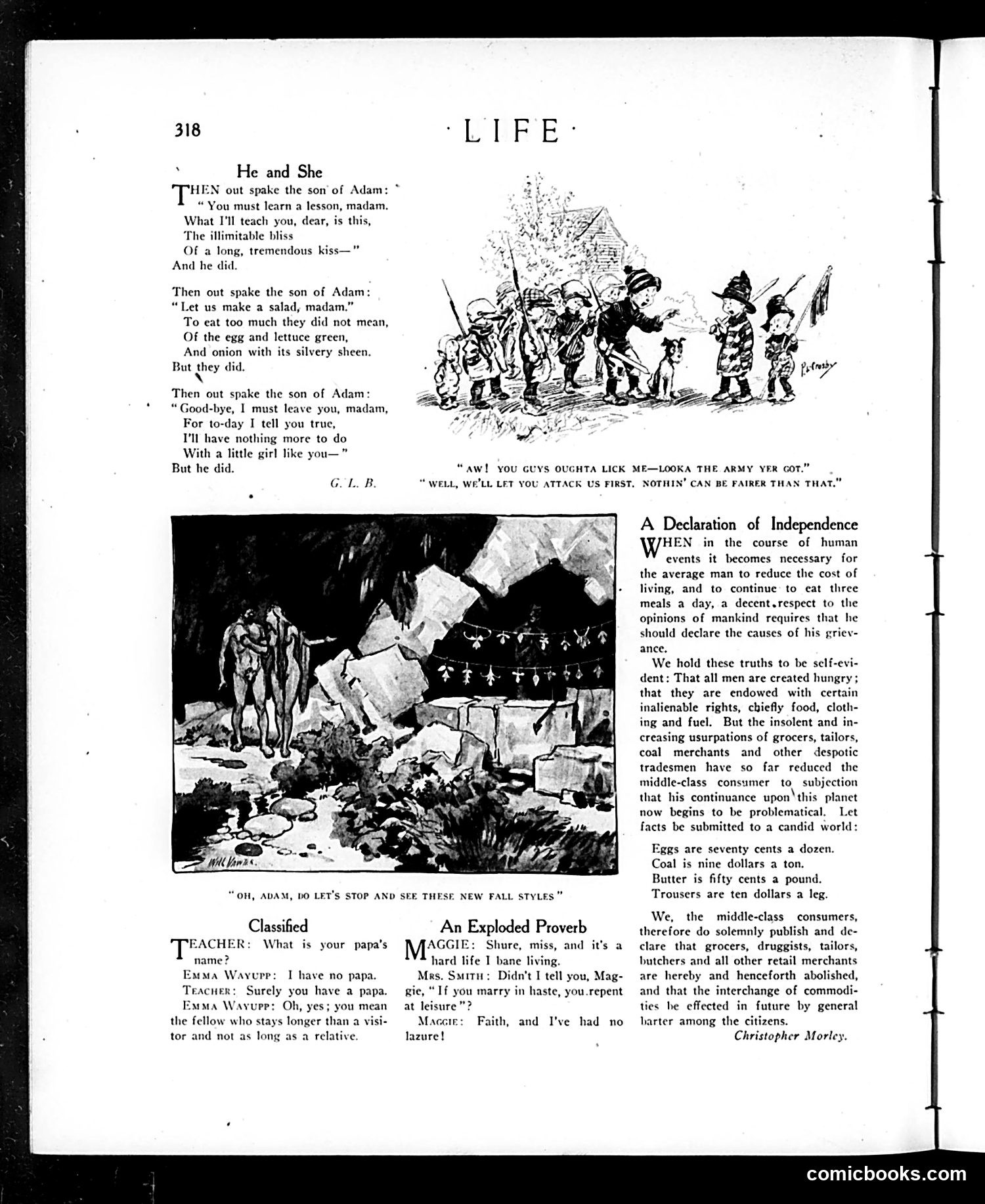
This page contains three satirical pieces mocking early 20th-century social issues. **"He and She"** parodies male courtship rhetoric through repetitive verse: a man makes grand romantic declarations ("tremendous kiss," romantic salad dinner, goodbye), yet contradicts himself by staying—satirizing male hypocrisy and inconsistency in relationships. **The children's cartoon** shows kids discussing military surrender terms, likely referencing contemporary war anxieties with dark humor about fair combat. **"A Declaration of Independence"** is the page's centerpiece—a mock-serious parody of the actual Declaration, but grievances concern inflated prices (eggs 70¢/dozen, coal $9/ton, butter 50¢/pound, trousers $10). It "declares" middle-class consumers' rebellion against merchants and grocers, treating economic hardship as tyranny. The satire suggests everyday people face genuine oppression through rising costs. **"Classified" and "An Exploded Proverb"** are brief comic dialogues about poverty and marriage regrets, reinforcing themes of economic and domestic struggle. The overall message: post-WWI inflation devastates ordinary citizens more than political revolution ever could.
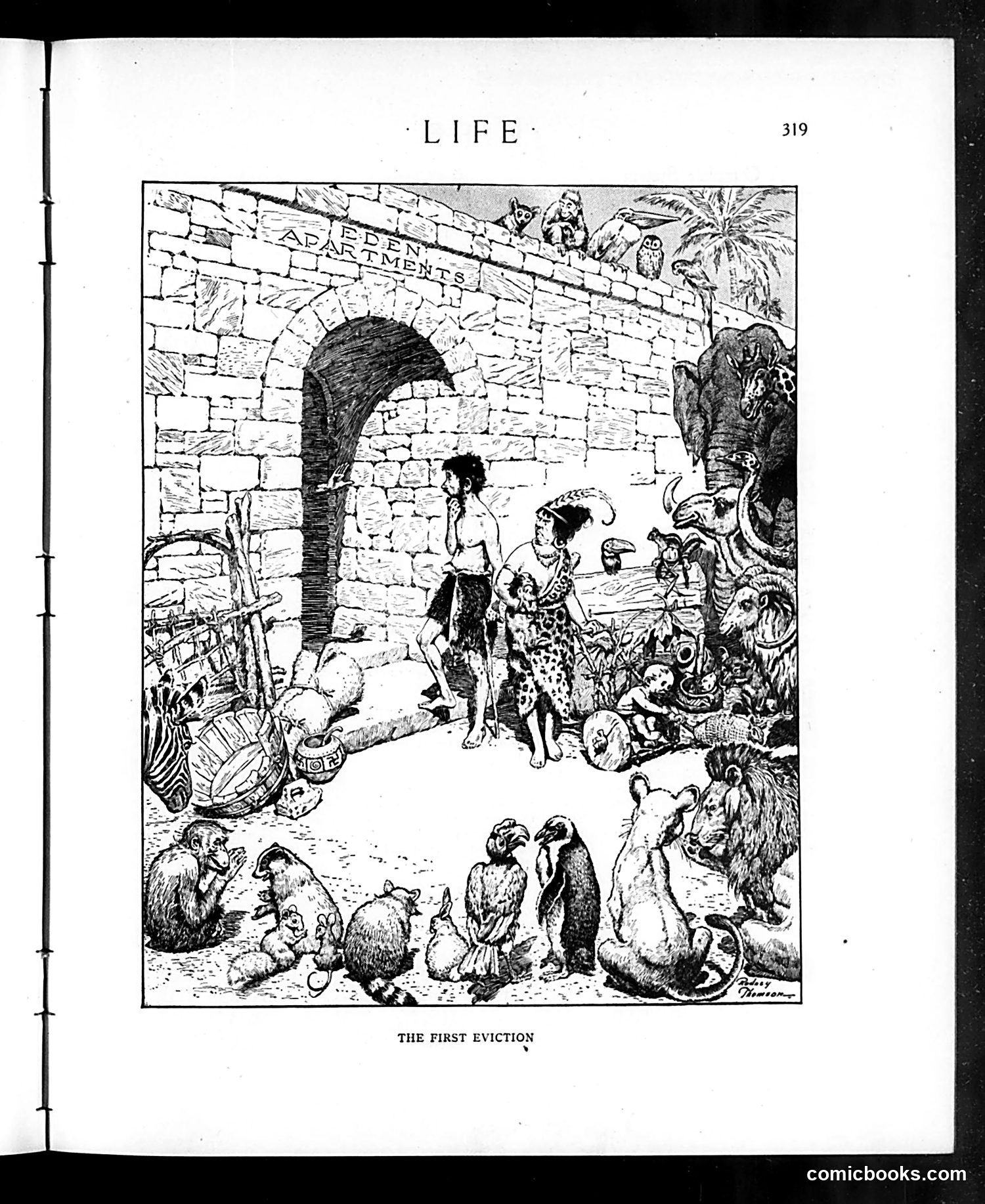
This is a satirical illustration depicting Adam and Eve being expelled from the Garden of Eden. The cartoon reimagines the biblical expulsion as a modern eviction, with the stone archway labeled "APARTMENTS" suggesting a landlord-tenant conflict rather than divine punishment. Two nude human figures stand center, facing various animals (monkeys, birds, lions, and other creatures) arranged around them. The juxtaposition appears to mock contemporary housing disputes or tenancy laws by treating humanity's original sin as a real-estate matter. The satire likely comments on actual eviction practices of the era or housing policy debates, using the biblical narrative as a humorous framework. The specific political or social target remains somewhat unclear without additional context about Life magazine's publication date and contemporary issues.
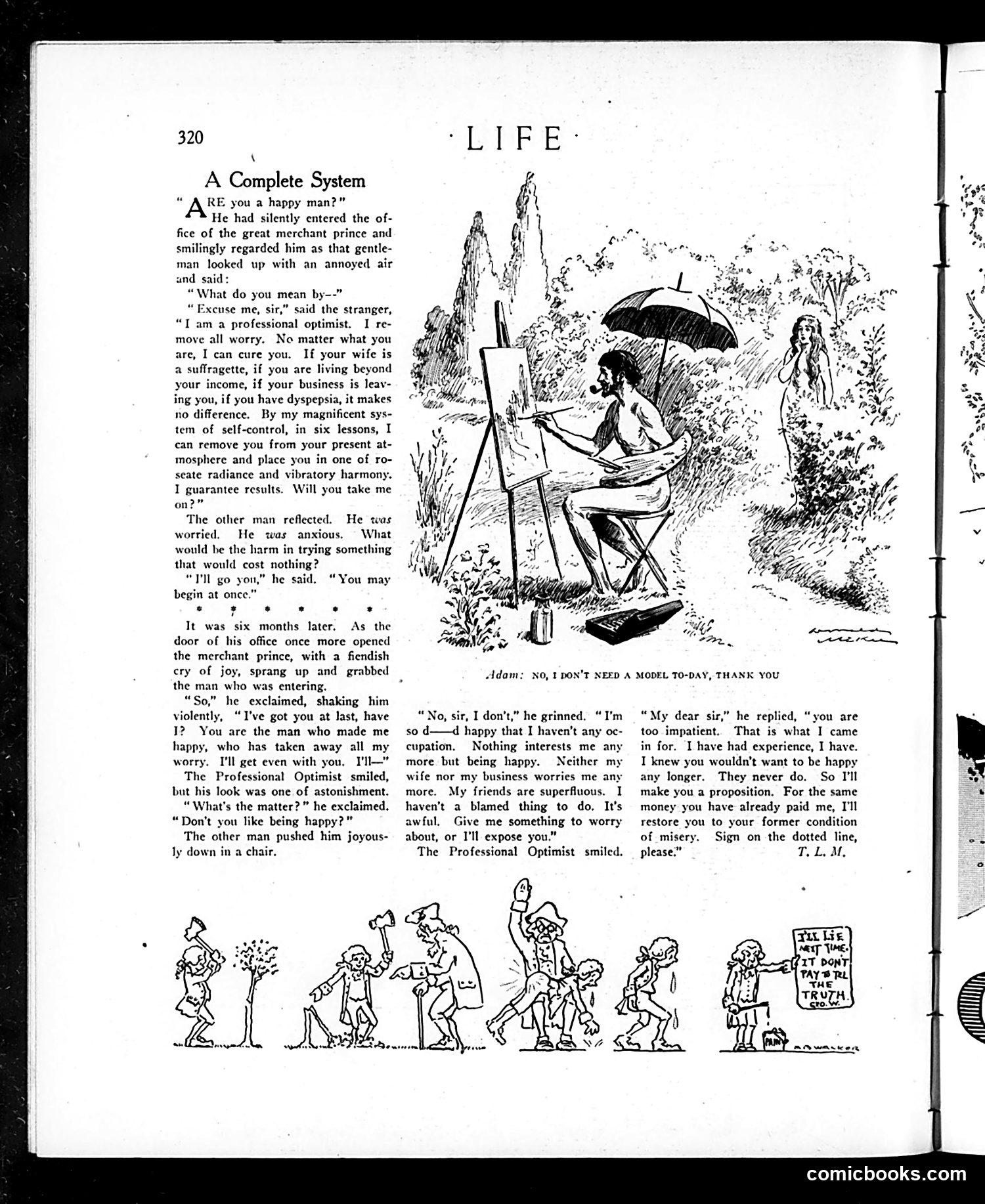
This story satirizes the "New Thought" optimism movement popular in early 20th-century America—the idea that positive thinking and self-control could cure all life's problems. A "professional optimist" promises a wealthy merchant prince he can eliminate worry through six lessons in mental discipline, claiming it works regardless of circumstances (nagging wife, business failure, digestive troubles). The merchant agrees. Six months later, the merchant is furious—but not because the system failed. He's *too happy*. With all worries gone, he has no motivation, purpose, or interest in anything. Life has become meaningless. The twist ending: the optimist cheerfully offers to *reverse* the treatment for the same fee, restoring the merchant to his former miserable but purposeful state. The satire mocks both the era's optimism fad and human nature itself—suggesting that worry, struggle, and dissatisfaction may be necessary for meaningful existence. Happiness without purpose is presented as worse than purposeful misery.
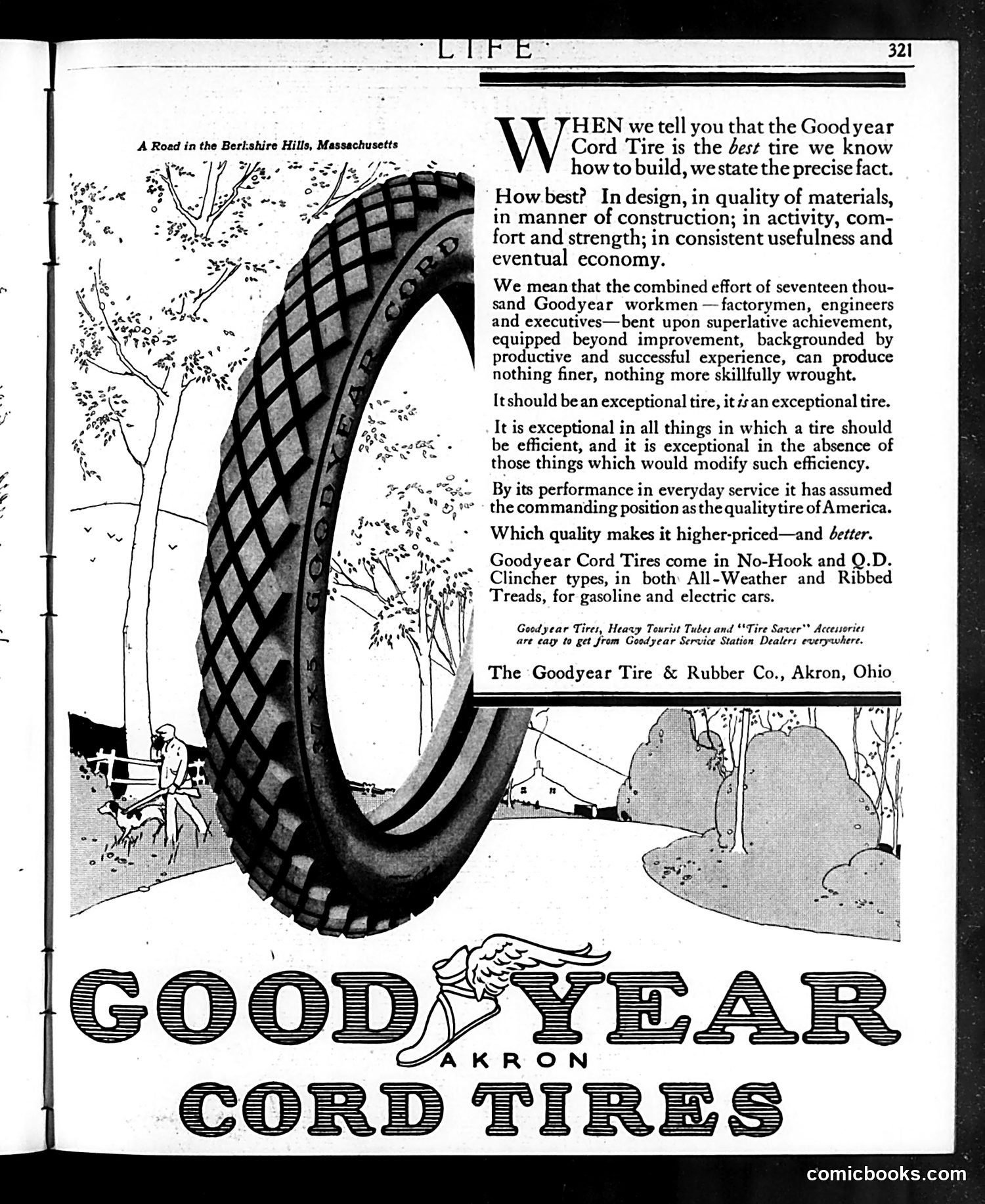
This is not satire or a political cartoon—it's a **straightforward product advertisement** for Goodyear Cord Tires, occupying page 321 of *Life* magazine. The image shows a large tire dominating a Berkshire Hills landscape, with a small car and figure for scale. The accompanying text is a earnest marketing pitch emphasizing the tire's superior design, materials, and manufacturing quality. Goodyear claims their product represents "the quality tire of America" and justifies its higher price through exceptional craftsmanship by "seventeen thousand" workers. The ad mentions practical details—different tread types and compatibility with both gasoline and electric cars (indicating early 20th-century vintage when electric vehicles were still common). It directs readers to Goodyear Service Station Dealers. For modern readers: this represents early automotive advertising's focus on *quality and engineering credibility* rather than style or lifestyle marketing. The rural landscape positioning suggests reliability for everyday driving on varied terrain.
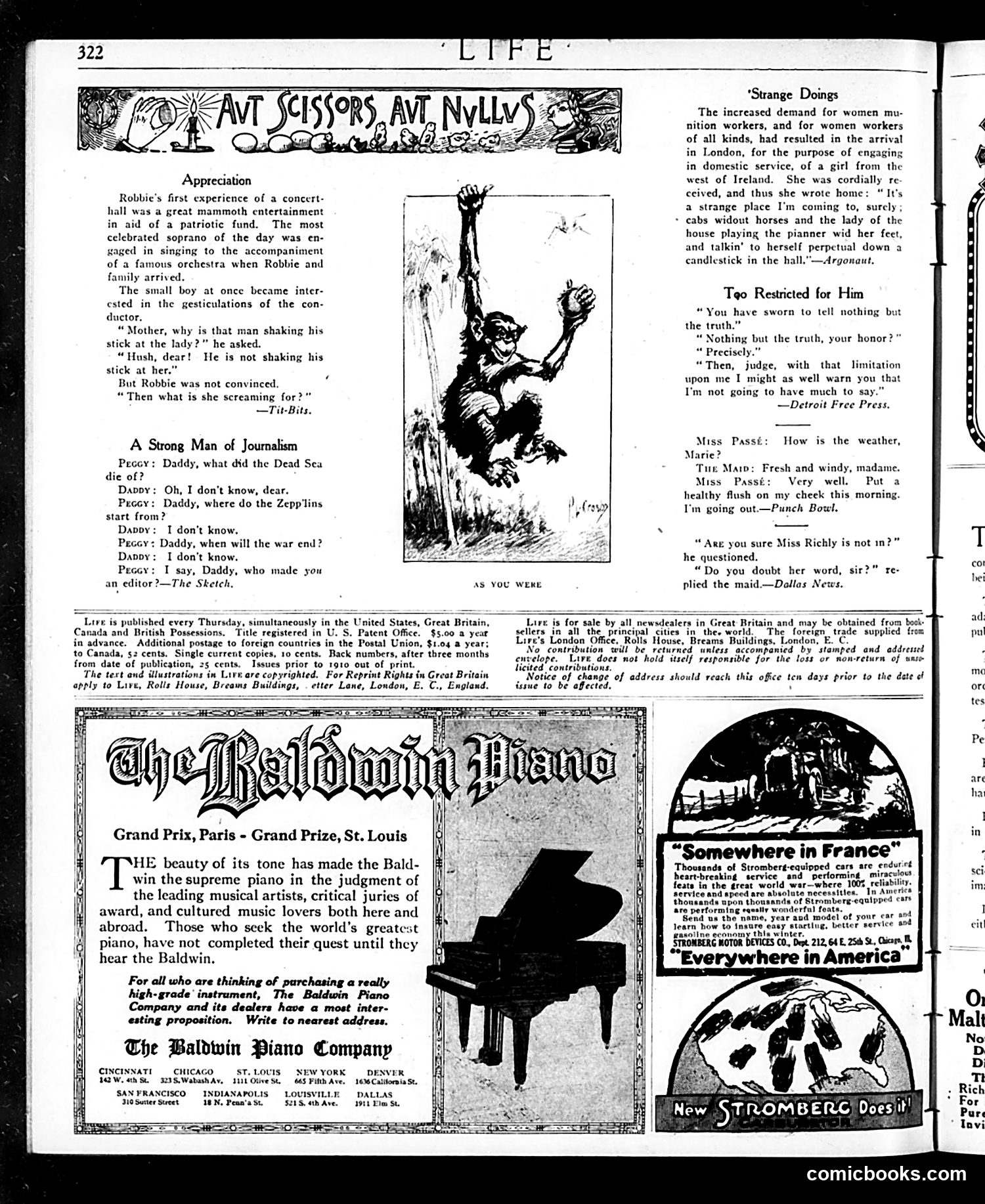
This page contains several humorous short items typical of early 20th-century satirical journalism, plus advertisements. **The cartoons/jokes:** 1. **"Appreciation"** - A child's literal misinterpretation: he assumes the orchestra conductor is "shaking his stick at" the soprano because she's "screaming." The humor relies on the boy's innocent inability to understand conducting. 2. **"A Strong Man of Journalism"** - A father repeatedly answers "I don't know" to children's questions about current events (the Dead Sea, Zeppelins, when WWI will end), then is asked "who made you an editor?" The satire attacks newspaper editors for claiming expertise while lacking real knowledge. 3. **Other brief items** mock pretentious behavior, witness testimony limitations, and casual conversation. **Context:** This appears to be wartime-era Life (references to "munition workers" and Zeppelins suggest WWI). The page emphasizes domestic humor and social observation typical of the magazine's satirical approach.
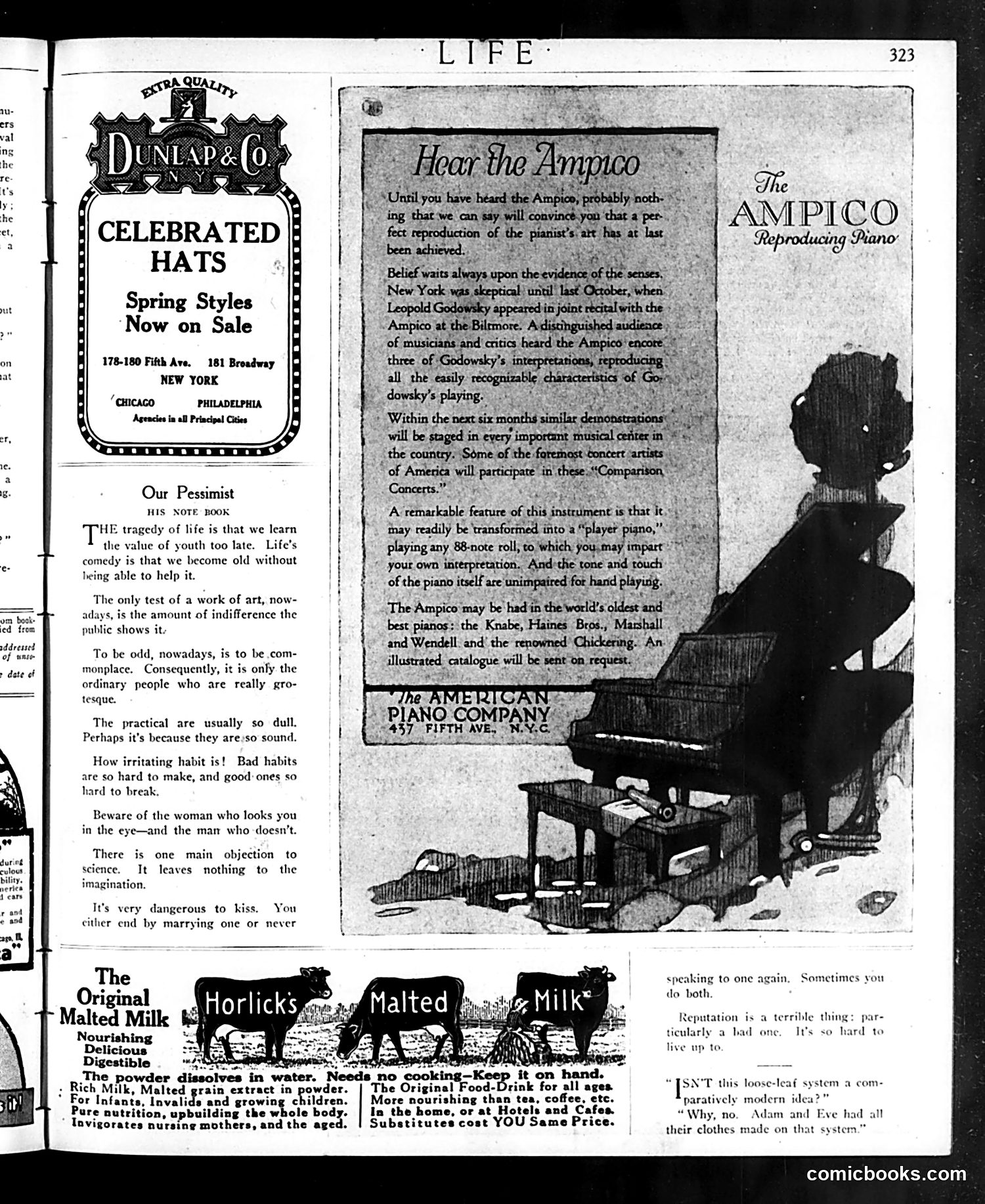
This page is primarily **advertising with one satirical column**. The main content is "Our Pessimist"—a cynical humor column offering bite-sized observations about human nature. Examples include: "Life's comedy is that we become old without being able to help it" and "It's very dangerous to kiss. You either end by marrying one or never." The advertisements include Dunlap & Co. hats, Horlick's Malted Milk, and the Ampico reproducing piano (which could play recorded performances). At the page bottom, a brief joke plays on the phrase "loose-leaf system": when a man asks if it's a "comparatively modern idea," his companion jokes that Adam and Eve had it too—because "their clothes made on that system" (i.e., fig leaves, which are loose). The satire targets middle-class life, vanity, and social anxieties typical of 1920s Life magazine humor.
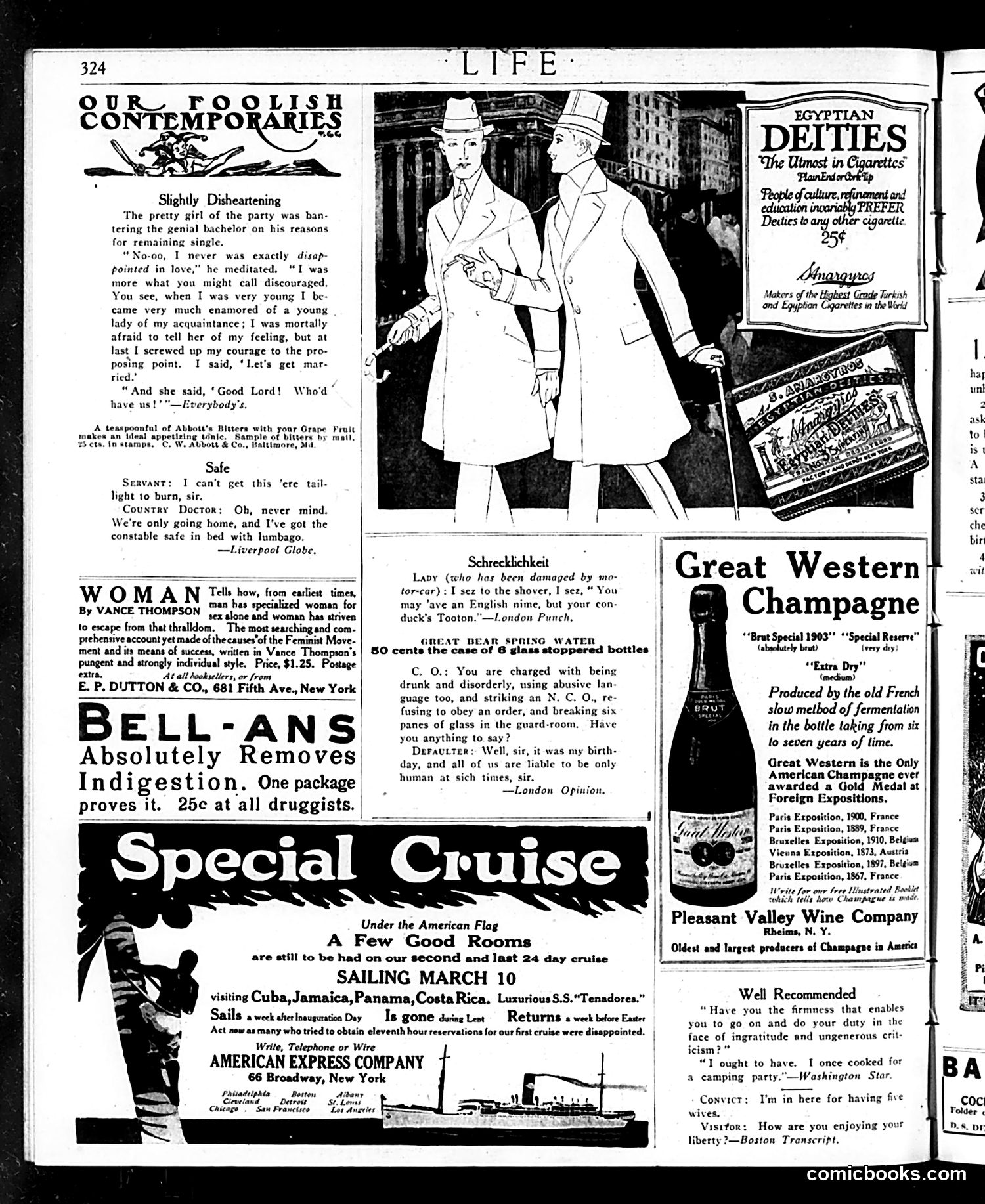
This page from *Life* magazine features humorous anecdotes mocking social behavior of the era: **"Slightly Disheartening"**: A bachelor explains his bachelorhood by recounting a failed proposal. When he finally gathered courage to propose to a young woman, her shocked response—"Good Lord! Who'd have us?"—devastated him. The joke: her rejection was so emphatic it discouraged him from romance entirely. **"Safe"**: A servant complains about a broken lamp to a country doctor, who replies they needn't worry since the constable is safely bedridden with lumbago. The satire targets rural medical practice and suggests the doctor is unconcerned about law enforcement being incapacitated. **"Schrecklichkeit"**: A woman hit by a motorcar complains the driver has an English name but "German conduct" (referencing "Schrecklichkeit"—German frightfulness). This likely dates post-1914, playing on anti-German sentiment during WWI. The page is primarily satirical commentary on contemporary social mishaps, complemented by period advertisements for champagne, cruises, and digestive remedies.
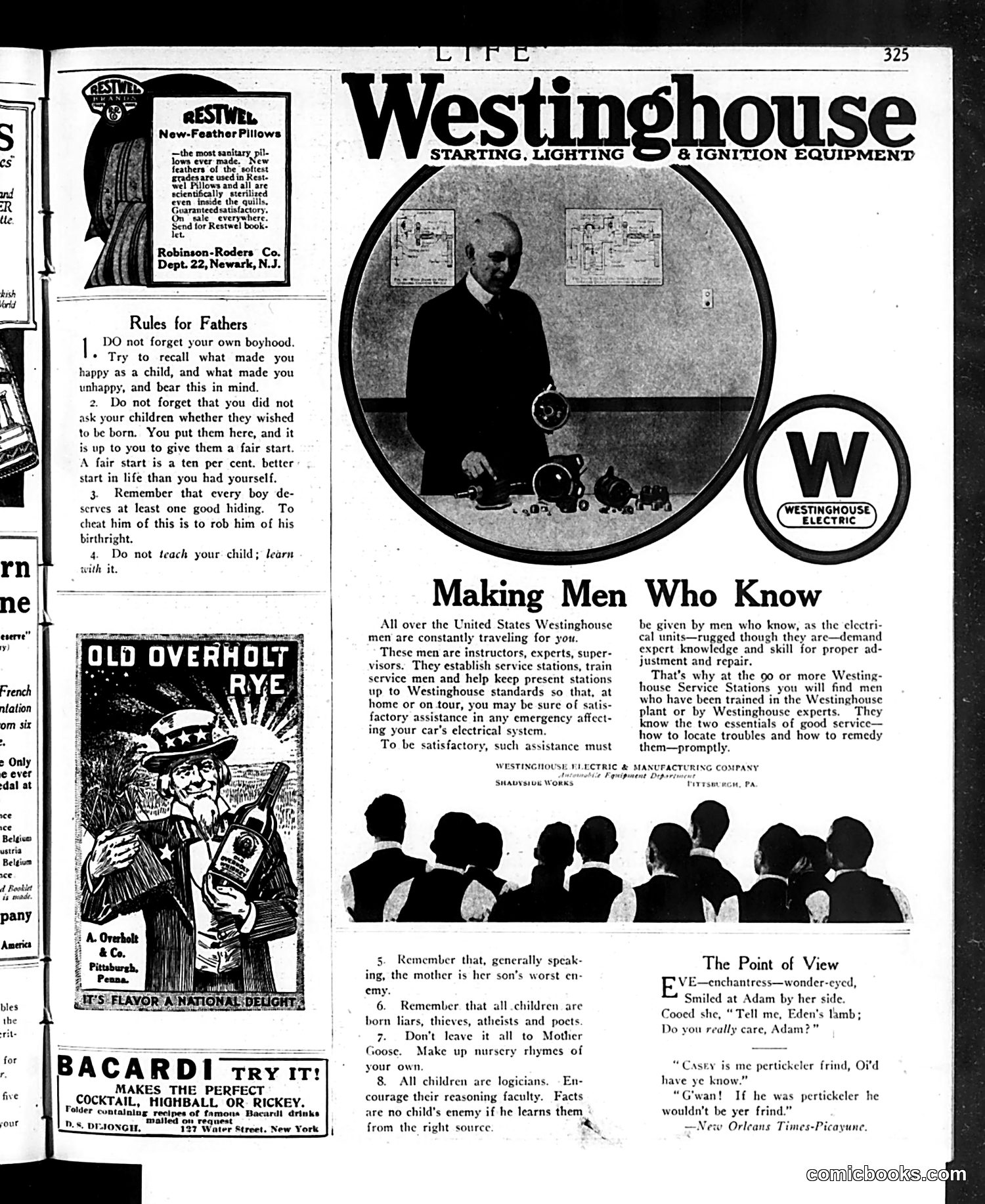
This page is primarily **advertising and advice content** rather than political satire. It features: **"Rules for Fathers"**: A humorous advice column offering eight parenting principles, including somewhat contradictory guidance (remember your boyhood; mothers are enemies; encourage reasoning). The satirical tone mocks Victorian parenting orthodoxy. **Advertisements**: - Restwel pillows (sanitary bedding) - Old Overholt Rye whiskey - Bacardi cocktails - Westinghouse electrical equipment **"The Point of View"**: A brief, sentimental poem about Eve and Adam, followed by an Irish-dialect joke about friendship priorities (appearing to reference Irish-American working-class speech patterns). The Westinghouse ad emphasizes their trained service network across America—standard corporate promotional material. Overall, this is a typical early-20th-century Life magazine page mixing light humor, practical advice, and advertisements rather than pointed political commentary.
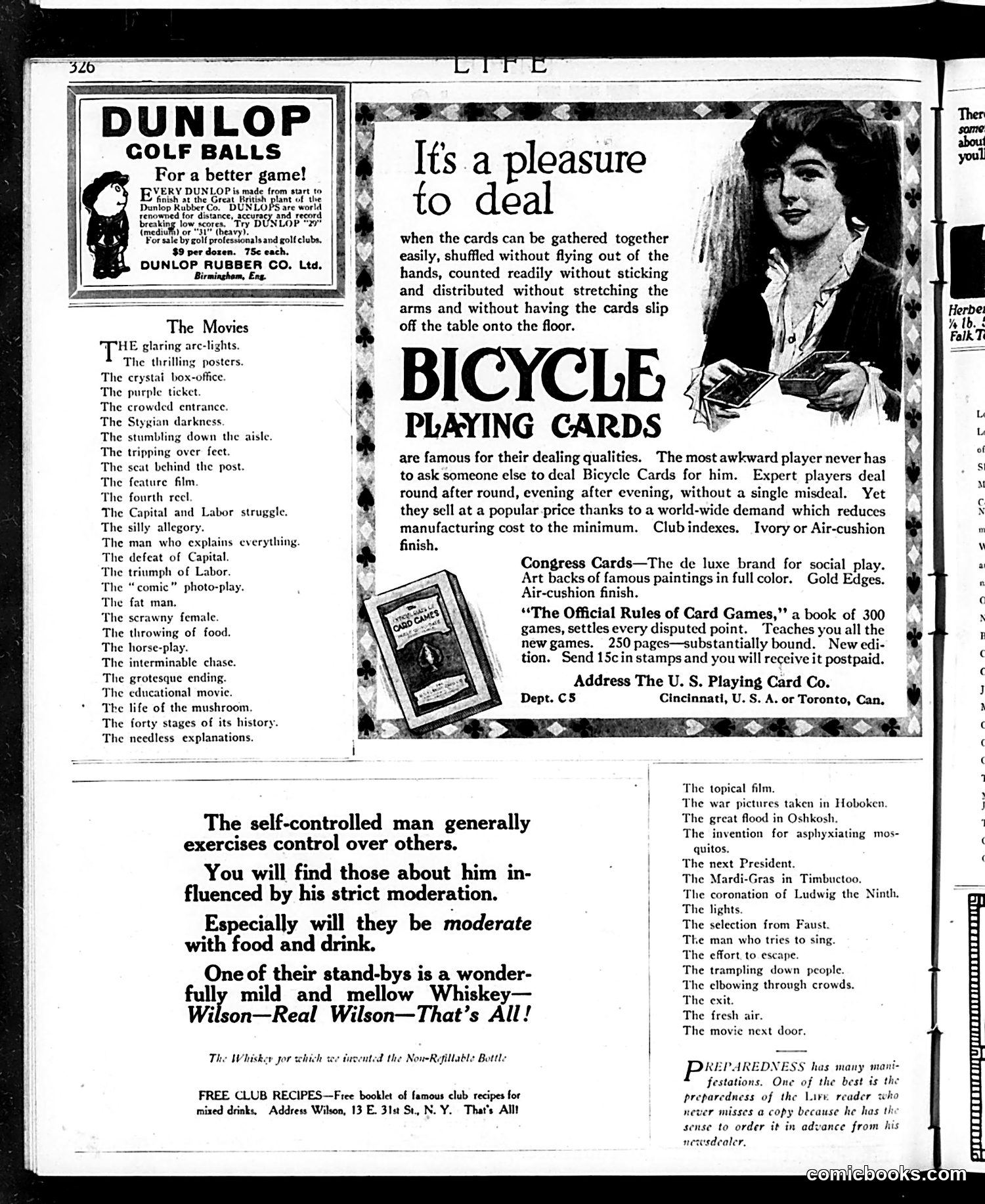
This page is primarily **advertising**, not political satire. It contains three product ads (Dunlop Golf Balls, Bicycle Playing Cards, and Wilson Whiskey) surrounding a humorous list titled "The Movies." **"The Movies" section** is satirical commentary on cinema clichés circa the 1920s. It mocks the predictable formulaic elements of films: melodramatic plots ("Capital and Labor struggle," "The triumph of Labor"), physical comedy ("horse-play," "throwing of food"), and recurring scenes ("The interminable chase," "The grotesque ending"). The list pokes fun at how movies recycled the same tired tropes and stock situations. **The Wilson Whiskey ad** uses a now-problematic appeal to masculine self-control and moderation—ironically advertising alcohol by claiming "self-controlled men" drink whiskey. The phrase "That's All!" is the brand's slogan. **The overall tone** is lighthearted mockery of popular entertainment and consumer goods typical of *Life* magazine's satirical approach during this period.
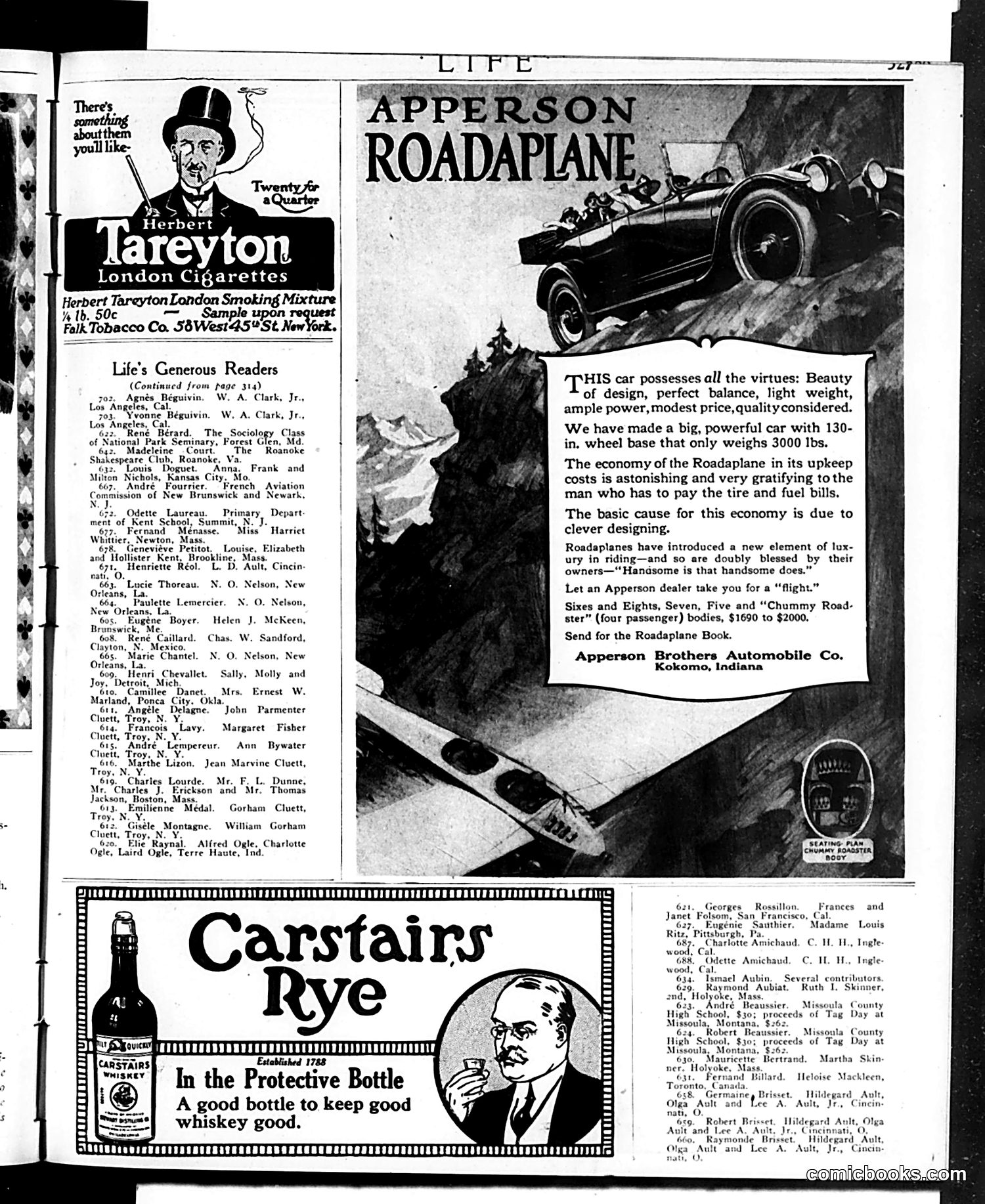
This page is primarily **advertising**, not political satire. It contains three ads interspersed with a list of donors ("Life's Generous Readers"). **Herbert Tareyton cigarettes**: A straightforward product ad featuring a man in a top hat promoting London smoking tobacco—typical early 20th-century cigarette marketing. **Apperson Roadaplane automobile**: A car manufacturer's advertisement emphasizing engineering claims (economy, light weight, powerful engine). The dramatic illustration shows the vehicle on a mountain road—common advertising imagery to suggest capability and adventure. **Carsairs Rye whiskey**: A brief ad using the slogan "A good bottle to keep good whiskey good"—a play on protective packaging. The figure appears to be a satisfied drinker, reflecting pre-Prohibition marketing (Prohibition began 1920). The reader list suggests *Life* magazine donors, likely recipients of a French relief fund given the French names and references to French institutions. There is no discernible political cartoon or satire on this page.
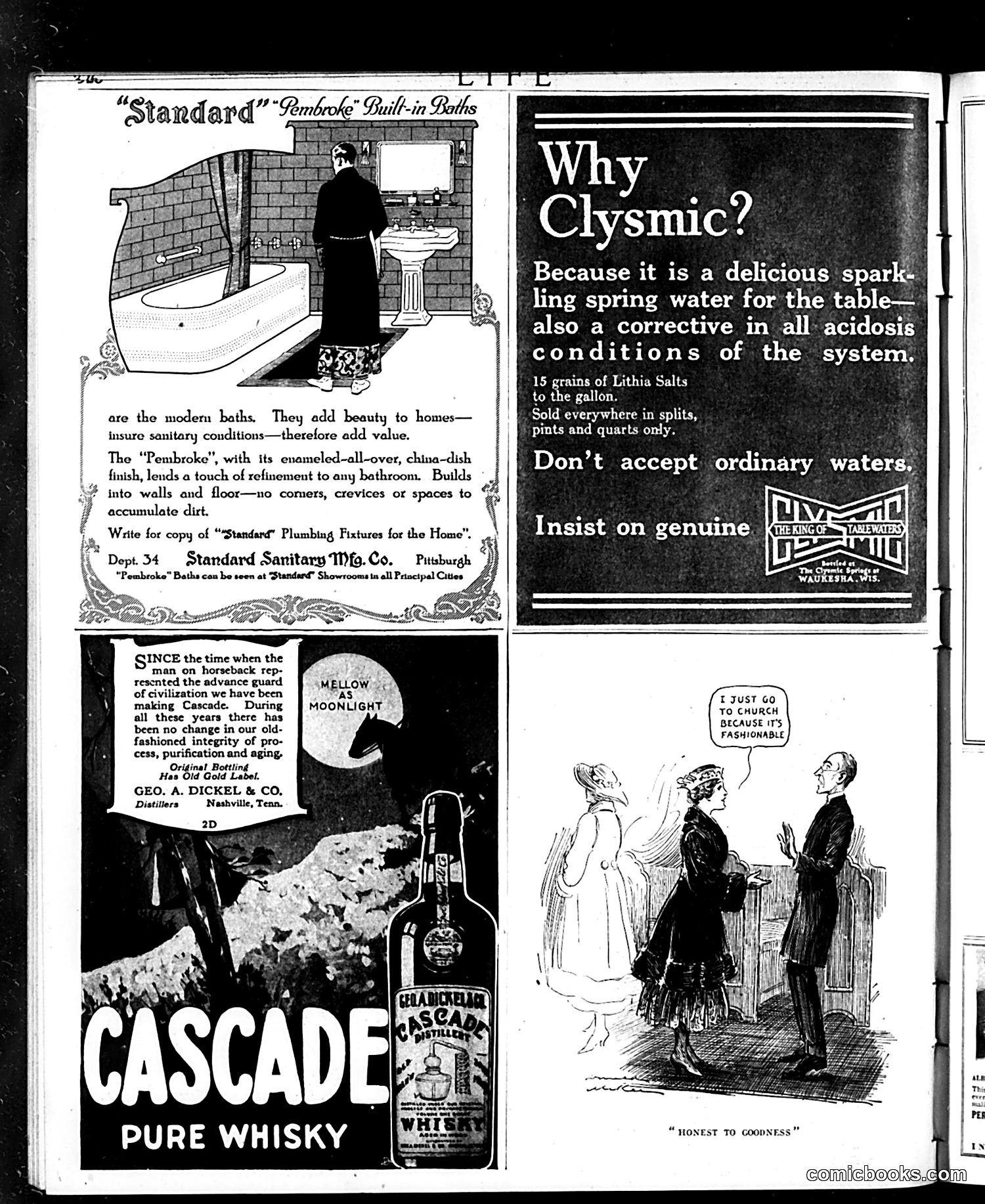
This page consists primarily of **advertisements**, not political satire or editorial cartoons. The ads include: - **Standard Sanitary Manufacturing**: promoting "Pembroke" bathroom fixtures - **Cascade Pure Whisky**: emphasizing traditional distilling methods - **Clysmic**: mineral water marketed as a health corrective for "acidosis conditions" The only cartoon element is a small sketch titled "Honest to Goodness" depicting a conversation where a woman states she attends church "because it's fashionable." This appears to be **gentle social satire** mocking superficial religiosity—the joke being that church attendance motivated by fashion rather than genuine faith is hypocritical. The ironic title underscores this critique. The cartoon reflects early 20th-century concerns about materialism and social conformity undermining authentic religious practice.
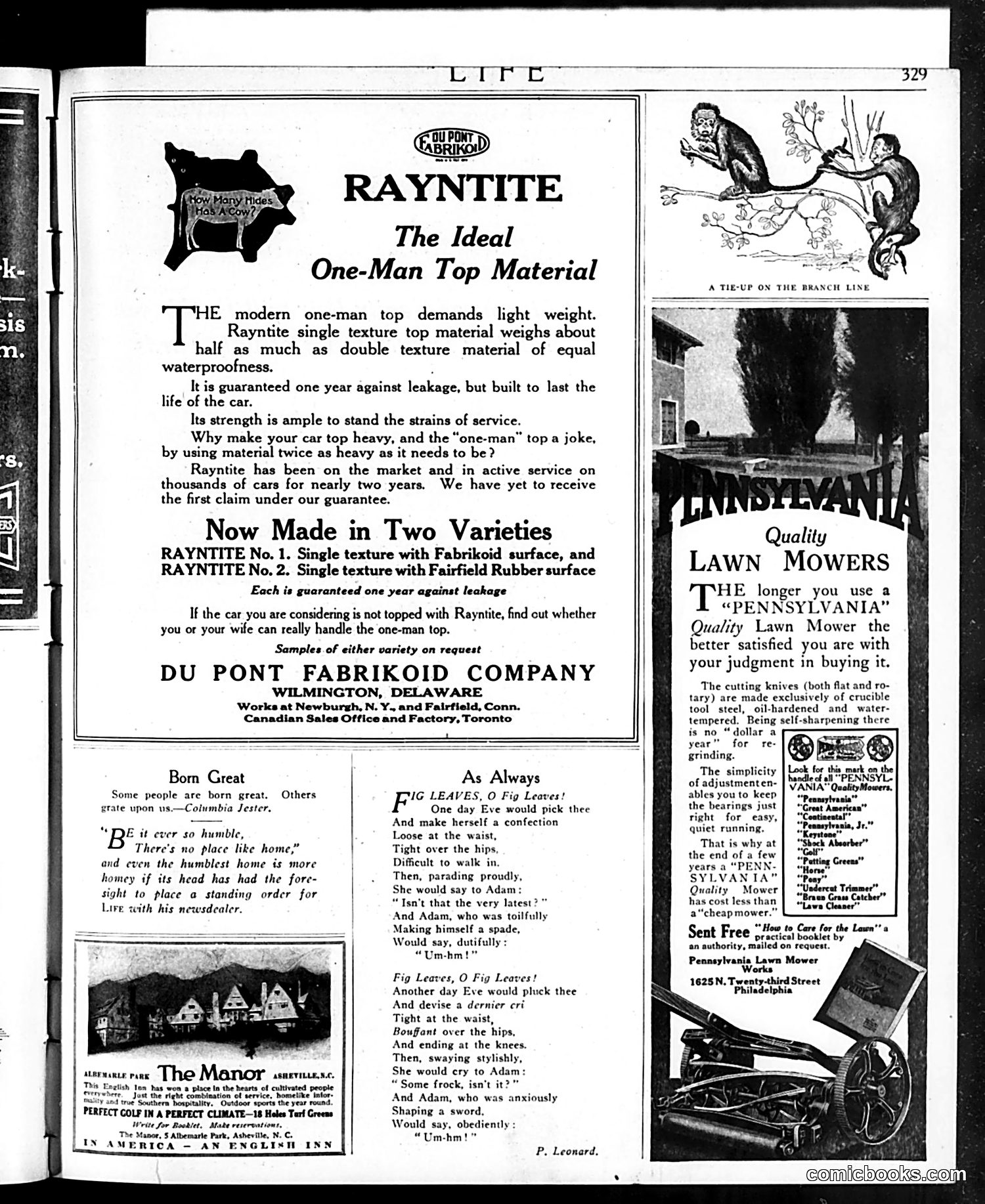
This is primarily an **advertising page** from Life magazine, not a political cartoon. The main content features three separate advertisements: **Rayntite** (top left): A Du Pont product selling car convertible tops, emphasizing that their lightweight material is strong enough that car owners (especially wives) won't struggle to operate the "one-man top." **Pennsylvania Lawn Mowers** (right): A straightforward product ad highlighting durability and self-sharpening blades. **The satirical poem** (center): "Fig Leaves, O Fig Leaves!" by P. Leonard mocks women's fashion, specifically how women constantly change hemlines and silhouettes while seeking male approval. Eve repeatedly shows Adam new outfits (tight waist, loose hips, changing hem lengths), and he dutifully approves—a commentary on both female fashion anxiety and male passivity in relationships. **The Manor** (bottom): A resort advertisement. The page reflects 1920s consumer culture and gender dynamics, with humor targeting women's supposed fashion obsession.
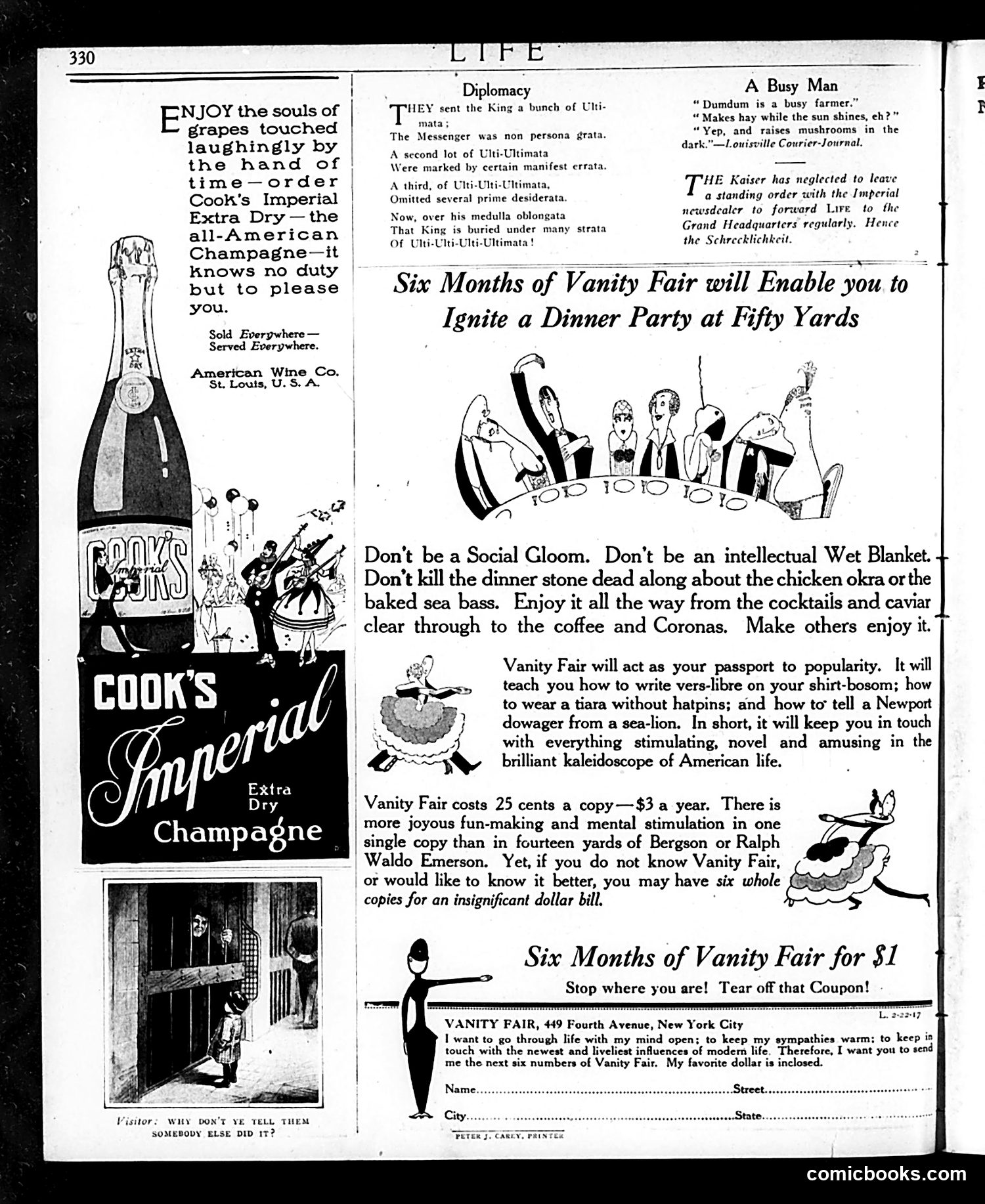
This page mixes advertising with light satirical content typical of early 20th-century Life magazine. **"Diplomacy" poem** satirizes diplomatic correspondence with the German Kaiser (Wilhelm II), likely during World War I tensions. The escalating "Ultimata" and "Ulti-Ulti-Ultimata" mock the repetitive, escalating demands between nations—culminating in the Kaiser being "buried under" layers of diplomatic notes. The joke references both diplomatic breakdown and the Kaiser's notorious aggressiveness. **"A Busy Man"** is a rural humor piece: a farmer simultaneously makes hay (traditional saying) AND grows mushrooms in the dark—a joke about industriousness taken absurdly far, or possibly alluding to something illicit (mushroom cultivation being secretive work). **"Kaiser neglected to leave standing order"** references the Kaiser's failure to maintain proper German newspaper subscriptions—mocking him as negligent, with "*Schrecklichkeit*" (German brutality) being the satirical consequence. It's a comedic jab at German imperial carelessness. The page is primarily **advertising for Cook's Champagne and Vanity Fair magazine**, using satirical framing to appeal to sophisticated readers.