
Life, 1917-02-22 · page 25 of 42
Life — February 22, 1917 — page 25: what you’re looking at
What you’re looking at
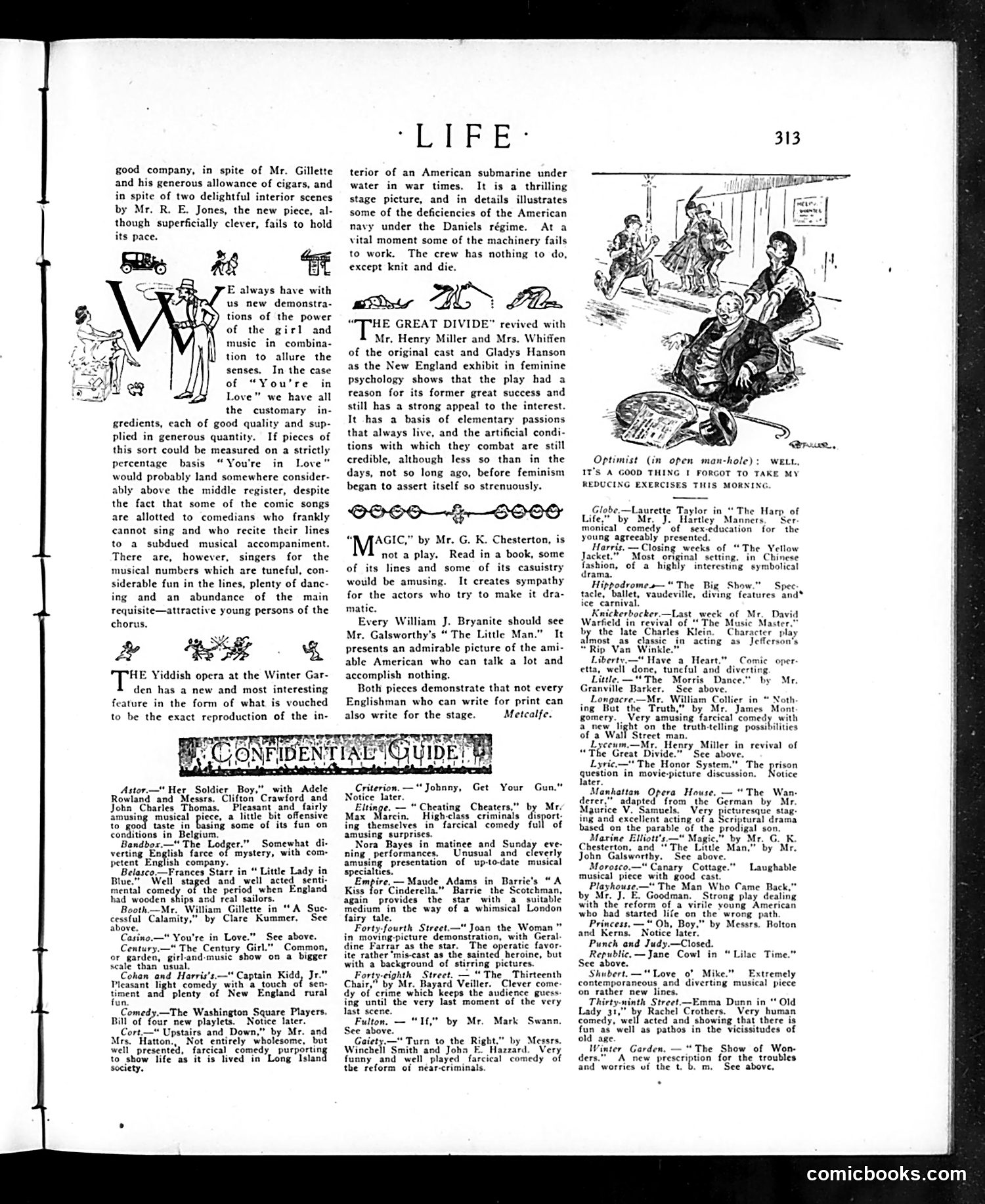
This page is primarily **theater criticism** rather than political satire. It reviews Broadway productions of the era (likely 1910s based on references). The cartoon at top-right depicts an "Optimist" doing morning exercises—a simple visual gag about maintaining positive attitude. **Key theatrical references:** - "A Successful Calamity" with William Gillette - "You're in Love" (criticized for weak comedians who can't sing) - A Yiddish opera at Winter Garden featuring a realistic submarine set - "The Great Divide" revival with original cast - G.K. Chesterton's "Magic" - Galsworthy's "The Little Man" (satirizing talkative but ineffectual Americans) The critique of the submarine scene mentions the "Daniels régime"—likely Secretary of the Navy Josephus Daniels, suggesting the play critiqued naval preparedness. The reviews are **snobbishly dismissive** of popular musical comedies while praising serious drama. Modern readers would mainly note the theatrical landscape of the 1910s and period attitudes toward entertainment quality.
📄 Transcribed text from this page (OCR, searchable)
Machine-transcribed from the original scan — historical spelling and the odd misread are preserved.
good company, in spite of Mr. Gillette and his generous allowance of cigars, and in spite of two delightful interior scenes by Mr. R. E. Jones, the new piece, al- though superficially clever, fails to hold its pace. Ke EE E always have with us new demonstra- tions of the power of the girl and music in combina- tion to allure the senses. In the case of “You're in Love” we have all the customary in- gredients, cach of good quality and sup- plied in generous quantity. If pieces of this sort could be measured on a strictly percentage basis “You're in Love" would probably land somewhere consider- ably above the middle register, despite the fact that some of the comic songs are allotted to comedians who frankly cannot sing and who recite their lines to a subdued musical accompaniment. There are, however, singers for the musical numbers which are tuneful, con- siderable fun in the lines, plenty of danc- ing and an abundance of the main requisite—attractive young persons of the a at HE Yiddish opera at the Winter Gar- den has a new and most interesting feature in the form of what is vouched to be the exact reproduction of the in- rt ONFIDED TIAL) Astor.—" Her Soldier Boy," with Adele Rowland and Messrs. Clifton’ Crawford and John Charles Thomas. Pleasant and fairly amusing musical piece, a little bit offensive to good taste in basing some of its fun on conditions in Belgium. A Bandbox.—" The Lodger." Somewhat di- verting English farce of mystery, with com- petent English company. Z Belasco.—Frances Starr in “Little Lady in Blue.” Well staged and well acted senti- mental comedy, of the period when England had wooden ships and real sailors. Booth.—Mr. William Gillette in “A Sue cessful Calamity,” by Clare Kummer. See above. Casino.—" You're in Love.” See above. Century.—" The Century Girl.” Common, or garden, girl-and-music show on a bigger scale than’ usual. ; Cohan and Harris's.—" Captain Kidd Jr.” Pleasant light comedy with a touch of sen: iment and plenty of New England rural un. Comedy,—The Washington Square Players. Bill of four new playlets. Notice later. Cort—" Upstairs and Down,” by Mr. and Mrs, Hatton., Not entirely wholesome, but well’ presented, farcical comedy purportin to show life as it is lived in Long Islan society. ~ EEE terior of an American submarine under water in war times. It is a thrilling stage picture, and in details illustrates some of the deficiencies of the American navy under the Daniels régime. At a vital moment some of the machinery fails to work. The crew has nothing to do, except knit and die. revived with “THE GREAT DIVIDE” Mr, Henry Miller and Mrs. Whiffen of the original cast and Gladys Hanson as the New England exhibit in feminine psychology shows that the play had a reason for its former great success and still has a strong appeal to the interest. It has a basis of elementary passions that always live, and the artificial condi- tions with which they combat are still credible, although less so than in the days, not so long ago, before feminism began to assert itself so strenuously. COCO GOO * 'AGIC,” by Mr. G. K. Chesterton, is not a play. Read in a book, some of its lines and some of its casuistry would be amusing. It creates sympathy for the actors who try to make it dra- matic. Every William J. Bryanite should see Mr. Galsworthy’s “ The Little Man.” It presents an admirable picture of the ami- able American who can talk a lot and accomplish nothing. Both pieces demonstrate that not every Englishman who can write for print can also write for the stage. Metcalfe. Criterion. —‘‘Jobnny, Get Your Gun.” Notice later. Eltinge, — “Cheating Cheaters," by Mr. Max Marcin, High-class criminals disport- ing themselves in’ farcical comedy full of amusing surprises. Nora Bayes in matinee and Sunday eve- ning performances. Unusual and cleverly amusing presentation of up-to-date musical specialties. Empire, — Maude, Adams in Barrie's “A Kiss for Cinderella.” Barrie the Scotchman, again provides the star with a suitable medium in the way of a whimsical London fairy tale. Forty-fourth Street.—" Joan the Woman” in moving-picture demonsiration, with Geral- dine Farrar as the star. The operatic favor. ite rather ‘miseast as the sainted heroine, but with a background of stirring pictures. Forty-eighth Street. — “The Thirteenth Chair,” by Mr. Bayard Veiller. Clever come dy of crime which keeps the audience guess ing until the very last moment of the very last scene. Fulton. — “If,” by Mr. See above. Gaiety. —* Turn to the Right." by Messrs. Winchell Smith and Joha E. Hazzard. Very funny and well played farcical comedy of the reform of near-criminals. Mark Swann, Optimist (in open man-hole): wett, 17'S A GOOD THING I FORGOT TO TAKE MY REDUCING EXERCISES THIS MORNING. Globe,—Laurette Taylor in “ The Harp of Life.” by Mr. J. Hartley Manners. Ser monical comedy ‘of sex-education for the young agreeably presented. Harris. — Closing weeks of “The Yellow Jacket.’ Most original setting. in Chinese fashion, of a highly interesting symbolical drama. Hippodromes—“ The Big Show." Spec tacle, ballet, vaudeville, diving features and ice Carnival, Knickerbocker.—Last_ week of Mr. David Warfield in revival of “The Music Master, the late Charles Klei Character play almost as classic in acting as Jefferson's “Rip Van Winkle.” “Have a Heart.” Comic oper- etta, well’ done, tuneful and diverting Little. <The Morris Dance.” by Mr. Granville Barker. See above. _ Longacre.—Mr. William Collier in “ Noth ing But the Truth,” by Mr. James Mont gomery.., Very amusing farcical comedy. with a neve light on the truth-telling possibilities of a Wall Street man. Lyceum.—Mr. Henry Miller in revival of “The Great Divide.” See above. Lyric." The Honor System.” The question in movie-picture discussion. later. Manhattan Opera House. — “The Wan- derer,” adapted from the German by Mr. Maurice V. Samuels. Very picturesque, stag: ing and excellent acting of a Scriptural drama based on the parable of the prodigal son. Marine Elliott's —" Magic,” by Mr. G.. K. Chesterton, and “The Little Man,” by Mr. John Galswarthy. See above. Morosco.—" Canary Cottage.” musical piece with good cast. Playhouse.—" The Man Who Came Back,” by Mr. J. E. Goodman. Strong play dealing with the reform of a virile young American who had started life on the wrong path Princess. —“ Oh, Boy,” by Messrs. Rolton and Kerns. Notice later. Punch and Judy.—Closed. Republic, —Jane Cowl in “Lilac Time.” See above Shubert. —"Love 0’ Mike." Extremely contemporaneous and diverting musical piece on rather new lines, Thirty-ninth Street—Emma Dunn in“ Old Lady 31,” by Rachel Crothers. Very human comedy, ‘well acted and showing that there is fun aswell as pathos in the vicissitudes of rison Notice Laughable ter Garden, —“The Show of Won- A new prescription for the troubles and worries uf the t. b. m, See above, comicbooks.com