
Life, 1917-02-22 · page 16 of 42
Life — February 22, 1917 — page 16: what you’re looking at
What you’re looking at
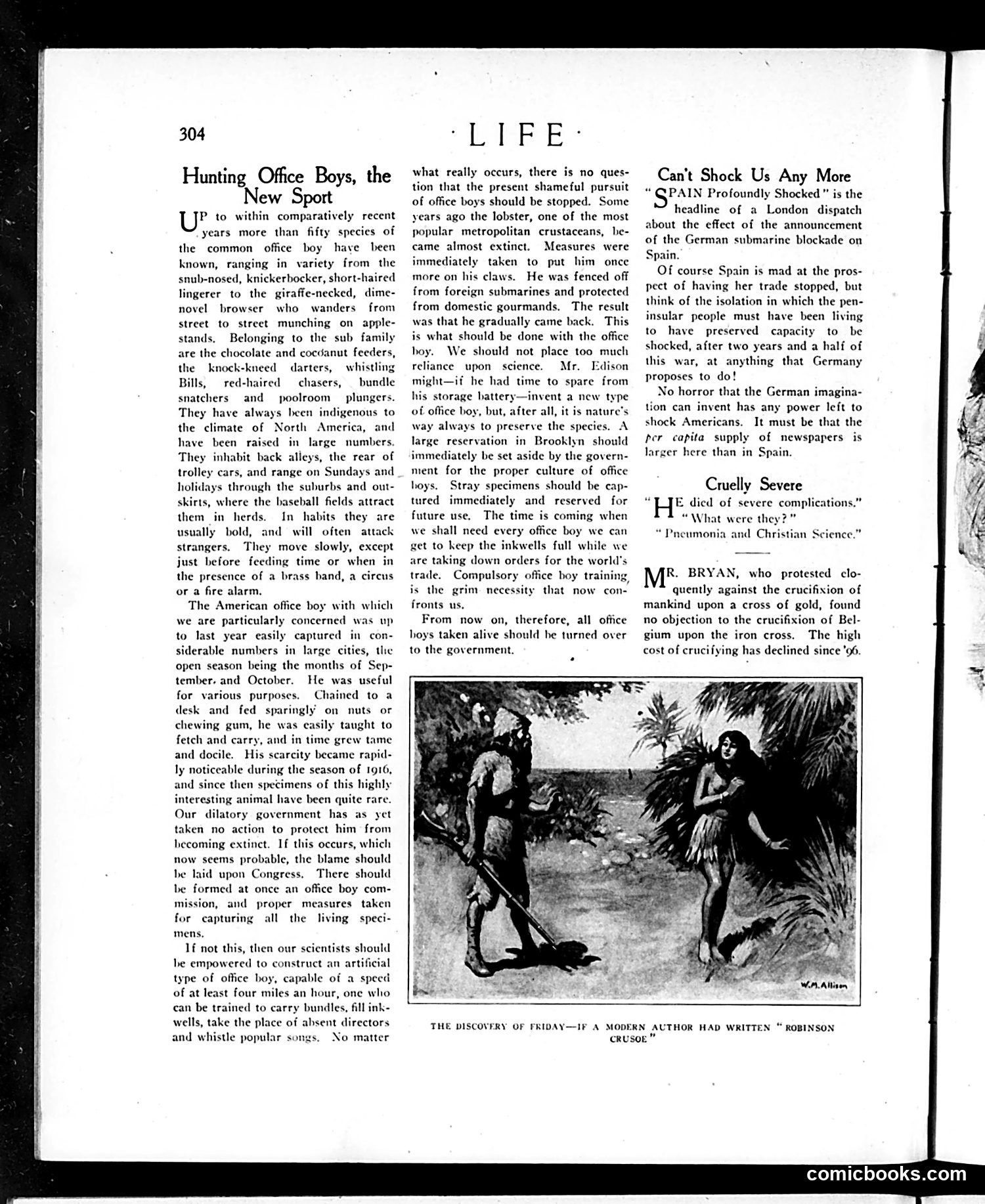
This piece satirizes the depletion of office boys during World War I (circa 1916). The author mock-seriously treats office boys as an endangered species requiring government protection—a humorous response to their actual scarcity as young men enlisted or left for war work. The satire uses naturalist language ("sub family," "indigenous," "open season") to describe office boys as hunted animals, cataloging varieties like "snub-nosed" and "red-haired chasers." The joke escalates absurdly: proposing government "reservations" to preserve them, suggesting mechanical replacements, and demanding "compulsory office boy training." The accompanying illustration depicts a castaway scene (likely Robinson Crusoe reference based on the caption), reinforcing themes of scarcity and isolation. The secondary article dismisses Spain's shock at German submarine blockades as performative—Spain's capacity for shock has been exhausted by war's horrors. Together, these pieces reflect American wartime anxieties about labor shortages and war's numbingly destructive effects.
📄 Transcribed text from this page (OCR, searchable)
Machine-transcribed from the original scan — historical spelling and the odd misread are preserved.
304 Hunting Office Boys, the New Sport P to within comparatively recent years more than fifty species of the common office boy have been known, ranging in variety from the snub-nosed, knickerbocker, short-haired ingerer to the giraffe-necked, dime- novel browser who wanders from street to street munching on apple- stands. Belonging to the sub family are the chocolate and cocdanut feeders, the knock-kneed darters, whistling Bills, red-haired chasers, _ bundle snatchers and poolroom _ plungers. They have always been indigenous to the climate of North America, and have been raised in large numbers. They inhabit back alleys, the rear of trolley cars, and range on Sundays and holidays through the suburbs and out- skirts, where the baseball fields attract them in herds. In habits they are usually bold, and will often attack strangers, They move slowly, except just before feeding time or when in the presence of a brass hand, a circus or a fire alarm. The American office boy with which we are particularly concerned was up to last year easily captured in con- siderable numbers in large cities, the open season being the months of Sep- tember, and October. He was useful for various purpos Chained to a desk and fed sparingly on nuts or chewing gum, he was easily taught to fetch and carry, and in time grew tame and docile. His scarcity became rapid- ly noticeable during the season of 1916, and since then specimens of this highly interesting animal have been quite rare. Our dilatory government has as yet taken no action to protect him from hecoming extinct. If this occurs, which now seems probable, the blame should he laid upon Congress. There should le formed at once an office boy com- mission, and proper measures. taken for capturing all the living speci- mens. If not this he empowered to construct an artificial type of office boy, capable of a speed of at least four miles an hour, one who can be trained to carry bundles, fill ink- wells, take the place of absent directors and whistle popular songs. No matter then our scientists should ‘Lhe E * what really occurs, there is no ques- tion that the present shameful pursuit of office boys should be stopped. Some years ago the lobster, one of the most popular metropolitan crustaceans, be- came almost extinct. Measures were immediately taken to put him once more on his claws. He was fenced off from foreign submarines and protected from domestic gourmands. The result vas that he gradually came back. This is what should be done with the office We should not place too much reliance upon science. Mr. E might—if he had time to spare from his storage hattery—invent a new type of office boy, but, after all, it is nature's way always to preserve the species. A large reservation in Brooklyn should immediately be set aside by the govern- ment for the proper culture of office hoys. Stray specimens should be cap- tured immediately and reserved for future use. The time is coming when we shall need every office boy we can get to keep the inkwells full while we are taking down orders for the world’s trade. Compulsory office boy training is the grim necessity that now con- fronts us. From now on, therefore, all office hoys taken alive should he turned over to the government. ison Can't Shock Us Any More “ QPAIN Profoundly Shocked" is the headline of a London dispatch about the effect of the announcement of the German submarine blockade on Spain. Of course Spain is mad at the pros- pect of having her trade stopped, but think of the isolation in which the pen- insular people must have been living to have preserved capacity to be shocked, after two years and a half of this war, at anything that Germany proposes to do! No horror that the German imagina- tion can invent has any power left to shock Americans. It must be that the per capita supply of newspapers is larger here than in Spain. Cruelly Severe dicd of severe complications.” What were they?” “Pneumonia and Christian Science.” R. BRYAN, who protested clo- quently against the crucifixion of mankind upon a cross of gold, found no objection to the crucifixion of Bel- gium upon the iron cross. The high cost of crucifying has declined since ‘96. THE DISCOVERY OF FRIDAY—IF A MODERN AUTHOR HAD WRITTEN “ ROBINSON comicbooks.com