
Life, 1917-02-22 · page 32 of 42
Life — February 22, 1917 — page 32: what you’re looking at
What you’re looking at
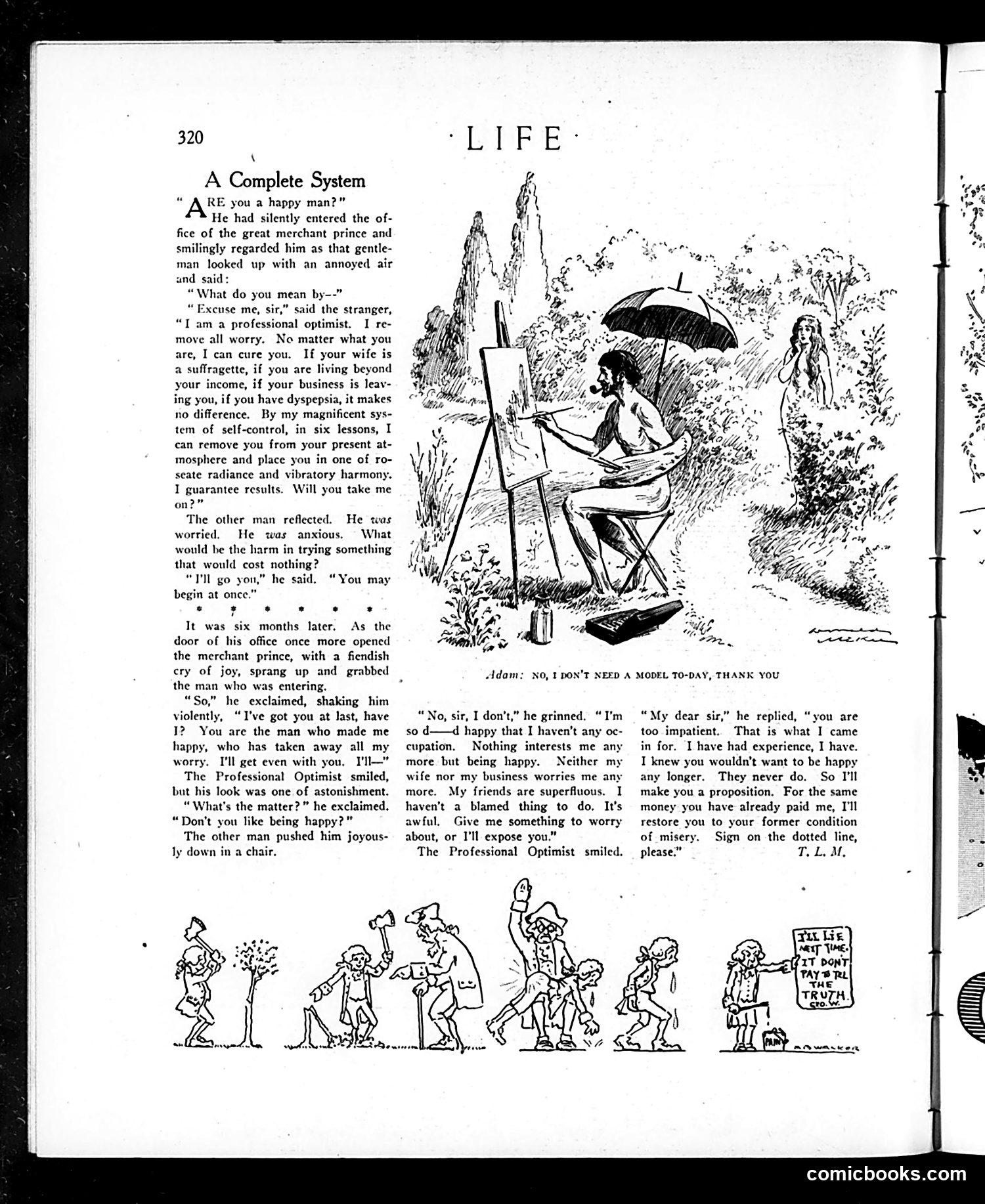
This story satirizes the "New Thought" optimism movement popular in early 20th-century America—the idea that positive thinking and self-control could cure all life's problems. A "professional optimist" promises a wealthy merchant prince he can eliminate worry through six lessons in mental discipline, claiming it works regardless of circumstances (nagging wife, business failure, digestive troubles). The merchant agrees. Six months later, the merchant is furious—but not because the system failed. He's *too happy*. With all worries gone, he has no motivation, purpose, or interest in anything. Life has become meaningless. The twist ending: the optimist cheerfully offers to *reverse* the treatment for the same fee, restoring the merchant to his former miserable but purposeful state. The satire mocks both the era's optimism fad and human nature itself—suggesting that worry, struggle, and dissatisfaction may be necessary for meaningful existence. Happiness without purpose is presented as worse than purposeful misery.
📄 Transcribed text from this page (OCR, searchable)
Machine-transcribed from the original scan — historical spelling and the odd misread are preserved.
320 \ A Complete System “ A RE you a happy man?” He had silently entered the of- fice of the great merchant prince and smilingly regarded him as that gentle- man looked up with an annoyed air and said: “What do you mean by--” “Excuse me, sir,” said the stranger, “Iam a professional optimist. I re- move all worry. No matter what you are, I can cure you. If your wife is a suffragette, if you are living beyond your income, if your business is leav- ing you, if you have dyspepsia, it makes no difference. By my magnificent sys- tem of self-control, in six lessons, I can remove you from your present at- mosphere and place you in one of ro- seate radiance and vibratory harmony. I guarantee results. Will you take me on?” The other man reflected. He twas worried. He was anxious. What would be the harm in trying something that would cost nothing? “Tl go you,” he said. “You may begin at once.” * @ 1-6 oe) 8 . It was six months later, As the door of his office once more opened the merchant prince, with a fiendish cry of joy, sprang up and grabbed the man who was entering. “So,” he exclaimed, shaking him violently, “I've got you at last, have 1? You are the man who made me happy, who has taken away all my worry. I'll get even with you. I'll—" The Professional Optimist smiled, but his look was one of astonishment. “What's the matter?” he exclaimed. “Don't you like being happy?” The other man pushed him joyous- ly down in a chair. Adam: NO, 1 DON'T NEED A MODEL TO-DAY, THANK YOU “No, sir, I don’t,” he grinned. “I'm so d—d happy that I haven’t any oc- cupation. Nothing interests me any more but being happy. Neither my wife nor my business worries me any more. My friends are superfluous. 1 haven't a blamed thing to do. It's awful. Give me something to worry about, or I'll expose you.” The Professional Optimist smiled. “My dear sir,” he replied, “you are too impatient. That is what I came in for. I have had experience, I have. I knew you wouldn't want to be happy any longer. They never do. So I'll make you a proposition. For the same money you have already paid me, I'll restore you to your former condition of misery. Sign on the dotted line, please.” T. Loaf. comicbooks.com