
Life, 1917-02-22 · page 27 of 42
Life — February 22, 1917 — page 27: what you’re looking at
What you’re looking at
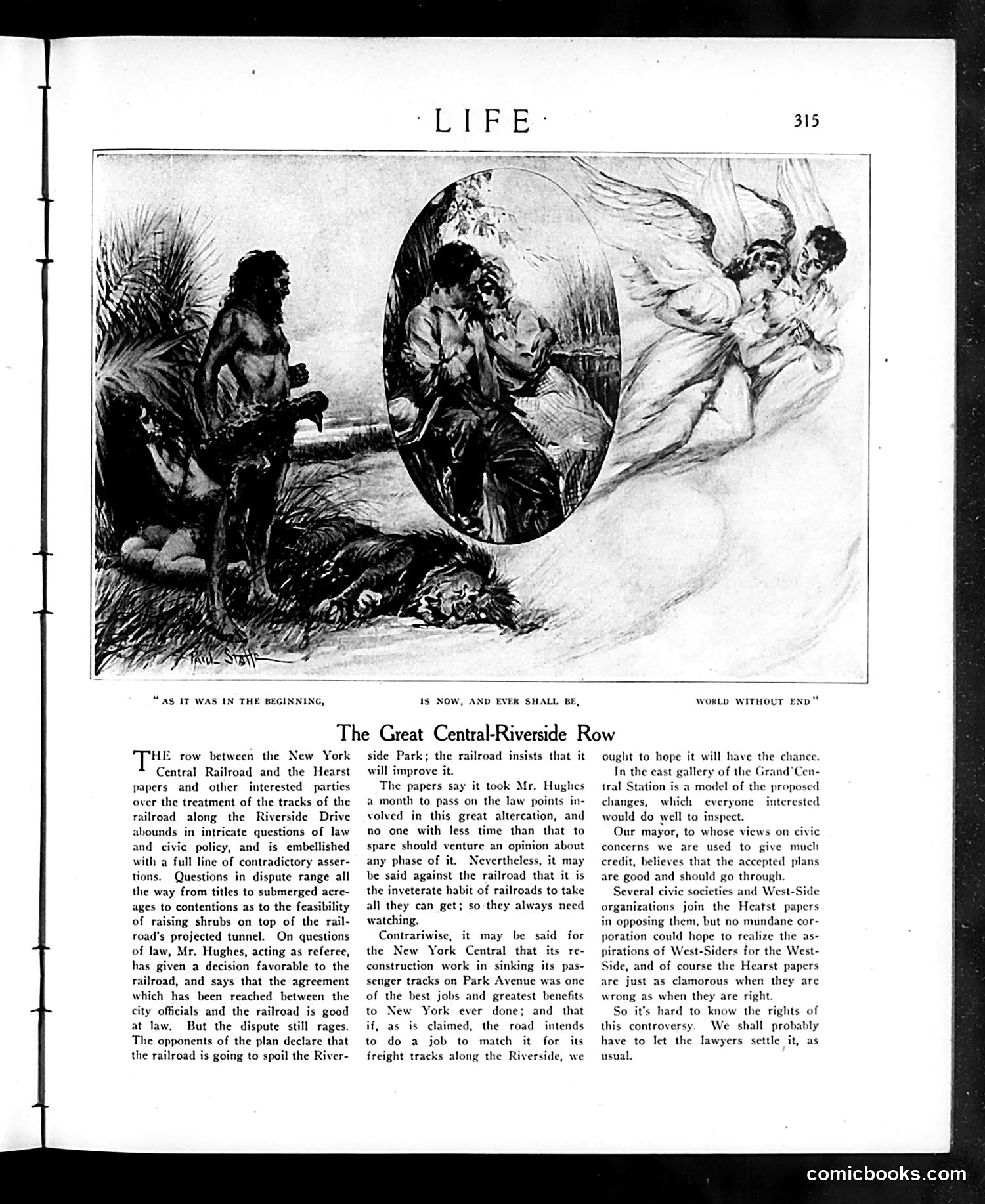
This cartoon illustrates a major New York City controversy over the New York Central Railroad's plans to rebuild its tracks along Riverside Drive. The central image shows a monkey (representing the railroad) gazing into a mirror held by cherubs—a satirical comment on the dispute's endless, circular nature. The actual conflict involved: - **The railroad** claiming reconstruction would improve the park - **The Hearst papers and civic groups** opposing the project as destructive - **Mr. Hughes** (likely Charles Evans Hughes, a prominent legal arbiter) ruling in the railroad's favor after a month of deliberation The article's tone is weary resignation: both sides claim righteousness, the dispute involves complex legal questions, and railroads historically "take all they can get." The epigraph ("As it was in the beginning...world without end") reinforces the endless, cyclical nature of such civic arguments. The satire suggests New Yorkers will ultimately leave such controversies to lawyers to resolve.
📄 Transcribed text from this page (OCR, searchable)
Machine-transcribed from the original scan — historical spelling and the odd misread are preserved.
“AS IT WAS IN THE BEGINNING, IS NOW, AND EVER SHALL BE, WORLD WITHOUT END” The Great Central-Riverside Row T! E row between the New York Central Railroad and the Hearst papers and other interested parties over the treatment of the tracks of the railroad along the Riverside Drive abounds in intricate questions of law and civic policy, and is embellished with a full line of contradictory asser- tions. Questions in dispute range all the way from titles to submerged acre- ages to contentions as to the feasibility of raising shrubs on top of the rail- road's projected tunnel. On questions of law, Mr. Hughes, acting as referee, has given a decision favorable to the railroad, and says that the agreement which has been reached between the city officials and the railroad is good at law. But the dispute still rages. The opponents of the plan declare that the railroad is going to spoil the River- side Park; the railroad insists that it will improve it. The papers say it took Mr. Hughes a month to pass on the law points in- volved in this great altercation, and no one with less time than that to spare should venture an opinion about any phase of it. Nevertheless, it may be said against the railroad that it is the inveterate habit of railroads to take all they can get; so they always need watching. Contrariwise, it may be said for the New York Central that its re- construction work in sinking its pas- senger tracks on Park Avenue was one of the best jobs and greatest benefits to New York ever done; and that if, as is claimed, the road intends to do a job to match it for its freight tracks along the Riverside, we ought to hope it will have the chance. In the cast gallery of the Grand’Ce tral Station is a model of the proposed changes, which everyone interested would do well to inspect. Our mayor, to whose views on civic concerns we are used to give much credit, believes that the accepted plans are good and should go through. Several civic societies and West-Side organizations join the Heatst papers in opposing them, but no mundane cor- poration could hope to realize the as- pirations of West-Siders for the West- le, and of course the Hearst papers are just as clamorous when they are wrong as when they are right. So it’s hard to know the rights of this controversy. We shall probably have to let the lawyers settle it, as usual. comicbooks.com