
Life, 1917-02-22 · page 24 of 42
Life — February 22, 1917 — page 24: what you’re looking at
What you’re looking at
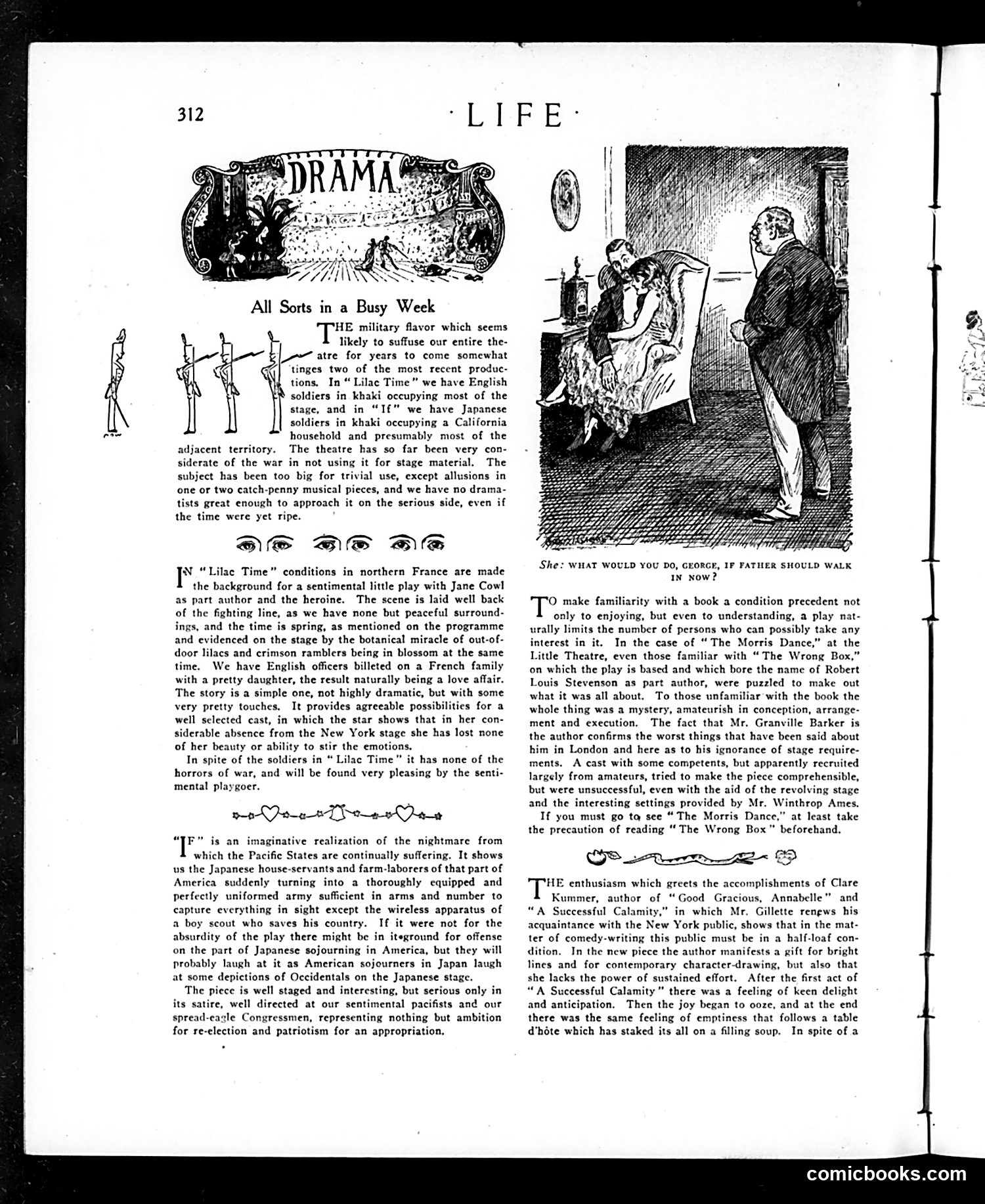
This page reviews three theatrical productions: **"Lilac Time"** features English soldiers in France during WWI, presenting a sentimental love story between officers billeted with a French family. The reviewer notes the theatre has respectfully avoided trivializing the ongoing war through serious drama, instead offering pleasant escapism with spring scenery and romantic elements. **"If"** imagines a Japanese invasion of California, depicting servants and laborers suddenly becoming a uniformed army. The reviewer treats this as satirical commentary on American pacifists and self-interested congressmen, not as serious anti-Japanese propaganda, comparing it to how Japanese audiences laugh at Western caricatures. **"The Morris Dance"** (based on "The Wrong Box") receives criticism for being incomprehensible to audiences unfamiliar with its source material—the illustration shows a domestic scene, likely depicting plot confusion. The cartoonish military figures at top appear to represent the soldier-heavy casting of contemporary productions.
📄 Transcribed text from this page (OCR, searchable)
Machine-transcribed from the original scan — historical spelling and the odd misread are preserved.
atre for years to come somewhat tinges two of the most recent produc- tions. In “ Lilac Time” we have English soldiers in khaki occupying most of the stage, and in “If” we have Japanese siderate of the war in not using it for stage material, The subject has been too big for trivial use, except allusions in ‘one or two catch-penny musical pieces, and we have no drama- tists great enough to approach it on the serious side, even if the time were yet ripe. as part author and the heroine. The scene is laid well back of the fighting line, as we have none but peaceful surround- ings, and the time is spring, as mentioned on the programme and evidenced on the stage by the botanical miracle of out-of- door lilacs and crimson ramblers being in blossom at the same very pretty touches, It provides agreeable possibilities for a well selected cast, in which the star shows that in her con- siderable absence from the New York stage she has lost none of her beauty or ability to stir the emotions, In spite of the soldiers in “ Lilac Time” it has none of the All Sorts in a Busy Week soldiers in khaki occupying a California Dec Ae DES time. We have English officers billeted on a French family horrors of war, and will be found very pleasing by the senti- HE military flavor which seems eA His household and presumably most of the I “Lilac Time” conditions in northern France are made with a pretty daughter, the result naturally being a love affair. mental playgoer. ikely to suffuse our entire the- adjacent territory. The theatre has so far been very con- the background for a sentimental little play with Jane Cowl The story is a simple one, not highly dramat vith some mCP Te Ce TC is an imaginative realization of the nightmare from which the Pacific States are continually suffering. It shows us the Japanese house-servants and farm-laborers of that part of America suddenly turning into a thoroughly equipped and perfectly uniformed army sufficient in arms and number to capture everything in sight except the wireless apparatus of a boy scout who saves his country. If it were not for the absurdity of the play there might be in iteground for offense on the part of Japanese sojourning in America, but they will probably laugh at it as American sojourners in Japan laugh at some depictions of Occidentals on the Japanese stage. The piece is well staged and interesting, but serious only in its satire, well directed at our sentimental pacifists and our spread-eagle Congressmen, representing nothing but ambition for re-election and patriotism for an appropriation. She: WHAT WOULD YoU DO, GEORGE, IF FATHER SHOULD WALK IN Now? 'O make familiarity with a book a condition precedent not only to enjoying, but even to understanding, a play nat- urally limits the number of persons who can possibly take any interest in it. In the case of “The Morris Dance,” at the Little Theatre, even those familiar with “The Wrong Box,” on which the play is based and which bore the name of Robert Louis Stevenson as part author, were Puzzled to make out what it was all about. To those unfamiliar with the book the whole thing was a mystery, amateurish in conception, arrange- ment and execution. The fact that Mr. Granville Barker is the author confirms the worst things that have been said about him in London and here as to his ignorance of stage require- ments. A cast with some competents, but apparently recruited largely from amateurs, tried to make the piece comprehensible, but were unsuccessful, even with the aid of the revolving stage and the interesting settings provided by Mr. Winthrop Ames. If you must go ta see “The Morris Dance,” at least take the precaution of reading “ The Wrong Box” beforehand. CP t= © 'HE enthusiasm which greets the accomplishments of Clare Kummer, author of “Good Gracious, Annabelle” and A Successful Calamity,” in which Mr. Gillette renews his acquaintance with the New York public, shows that in the mat- ter of comedy-writing this public must be in a half-loaf con- dition. In the new piece the author manifests a gift for bright lines and for contemporary character-drawing, but also that she lacks the power of sustained effort. After the first act of “A Successful Calamit: there was a feeling of keen delight and anticipation. Then the joy began to ooze, and at the end there was the same feeling of emptiness that follows a table d’hote which has staked its all on a filling soup. In spite of a comicbooks.com