
A complete issue · 42 pages · 1916
Life — December 14, 1916
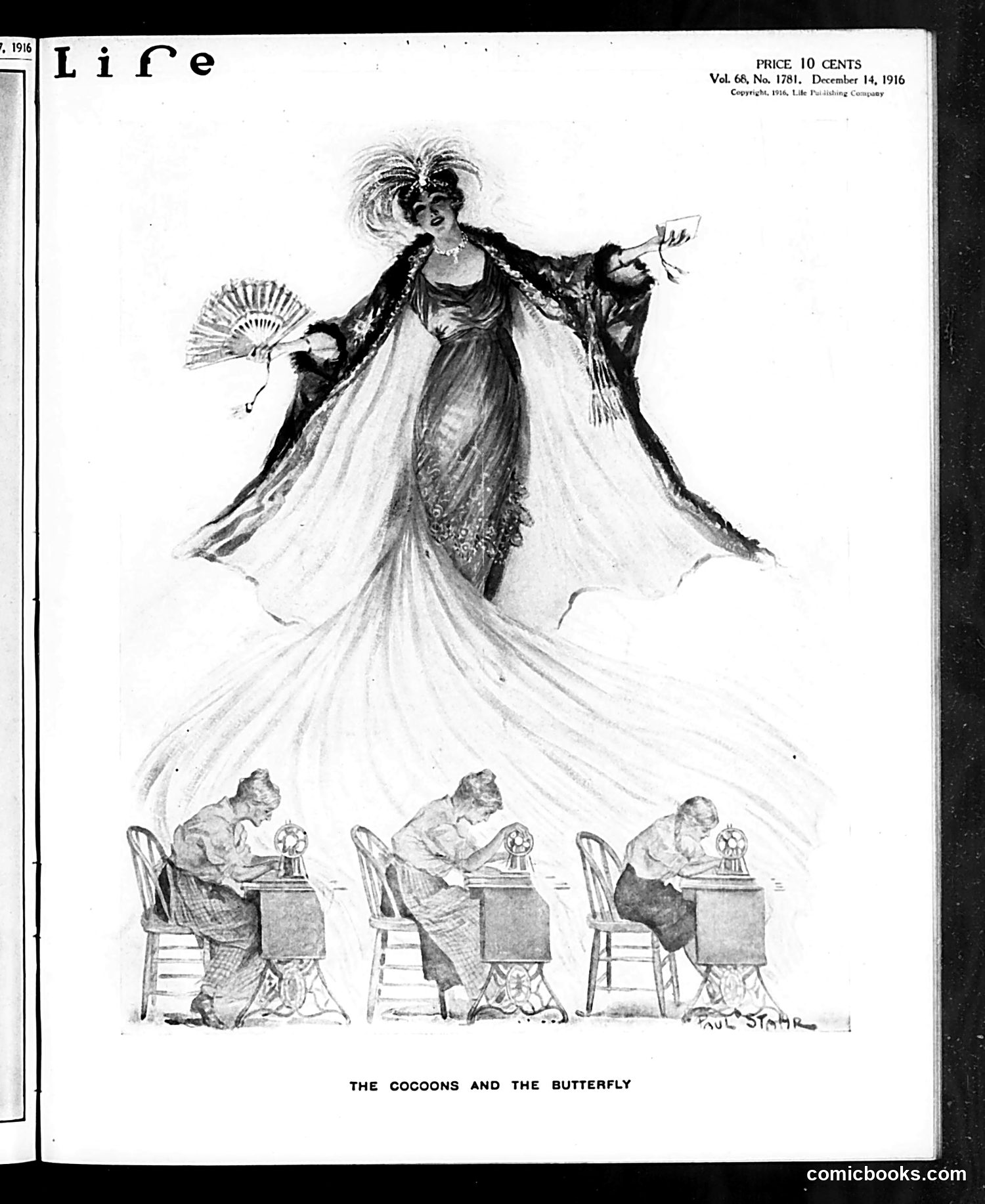
This 1916 *Life* magazine cartoon uses metamorphosis as political allegory. The ethereal "butterfly" figure at top—adorned with elaborate feathers, jewelry, and flowing garments—represents feminine wealth, leisure, or perhaps a socialite. Below, three figures hunched over work tables appear to be the "cocoons," laboring at what looks like sewing, needlework, or manufacturing. The satire critiques the economic relationship between working-class women (cocoons, trapped in industrial labor) and wealthy women (the butterfly, who enjoys transformation and freedom). The title suggests these working women's labor enables the luxury and leisure of their social superiors. This reflects Progressive Era concerns about labor exploitation and class inequality, particularly regarding women's work.

This page is primarily a **whisky advertisement**, not political satire. It promotes Cascade Pure Whisky, produced by Geo. A. Dickel & Company in Nashville, Tennessee. The ad features a bottle of whisky alongside a romantic moonlit landscape photograph. The tagline "Mellow as Moonlight" emphasizes smoothness and quality. The descriptive text uses poetic language—"moon-bathed landscape," "woodland stream," "storehouse of Mother Earth"—to associate the whisky with natural purity and aged craftsmanship. The "old gold label" and "aged in wood" claims stress authenticity and premium production. This represents typical early 20th-century alcohol marketing, using imagery and metaphor to convey quality to consumers before modern regulations restricted such advertising.
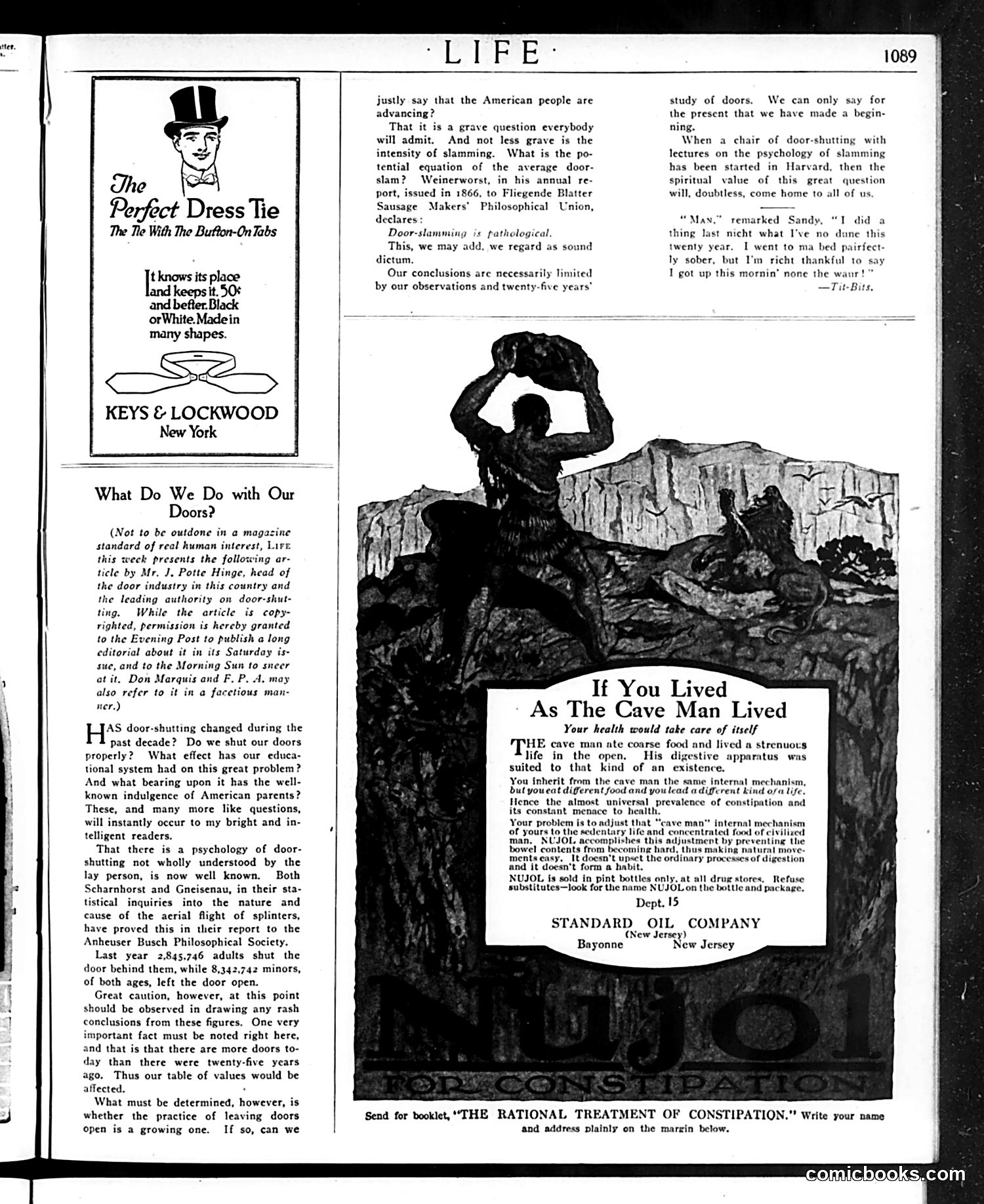
This page is primarily **advertisements and health content** rather than political satire. The top ad promotes "The Perfect Dress Tie" by Keys & Lockwood. The main article, "What Do We Do with Our Doors?", discusses door-slamming as a social problem, citing statistics that 245,746 adults and 8,342,742 minors left doors open annually. The piece treats door-slamming as a psychological issue worthy of serious analysis. The large illustration shows a cave man and relates to a Standard Oil Company advertisement promoting NUJOL (mineral oil) for digestive health, humorously suggesting that a "cave man" had better digestion than modern civilized people due to simpler diet—a common early 20th-century health marketing trope contrasting "natural" versus industrial living.
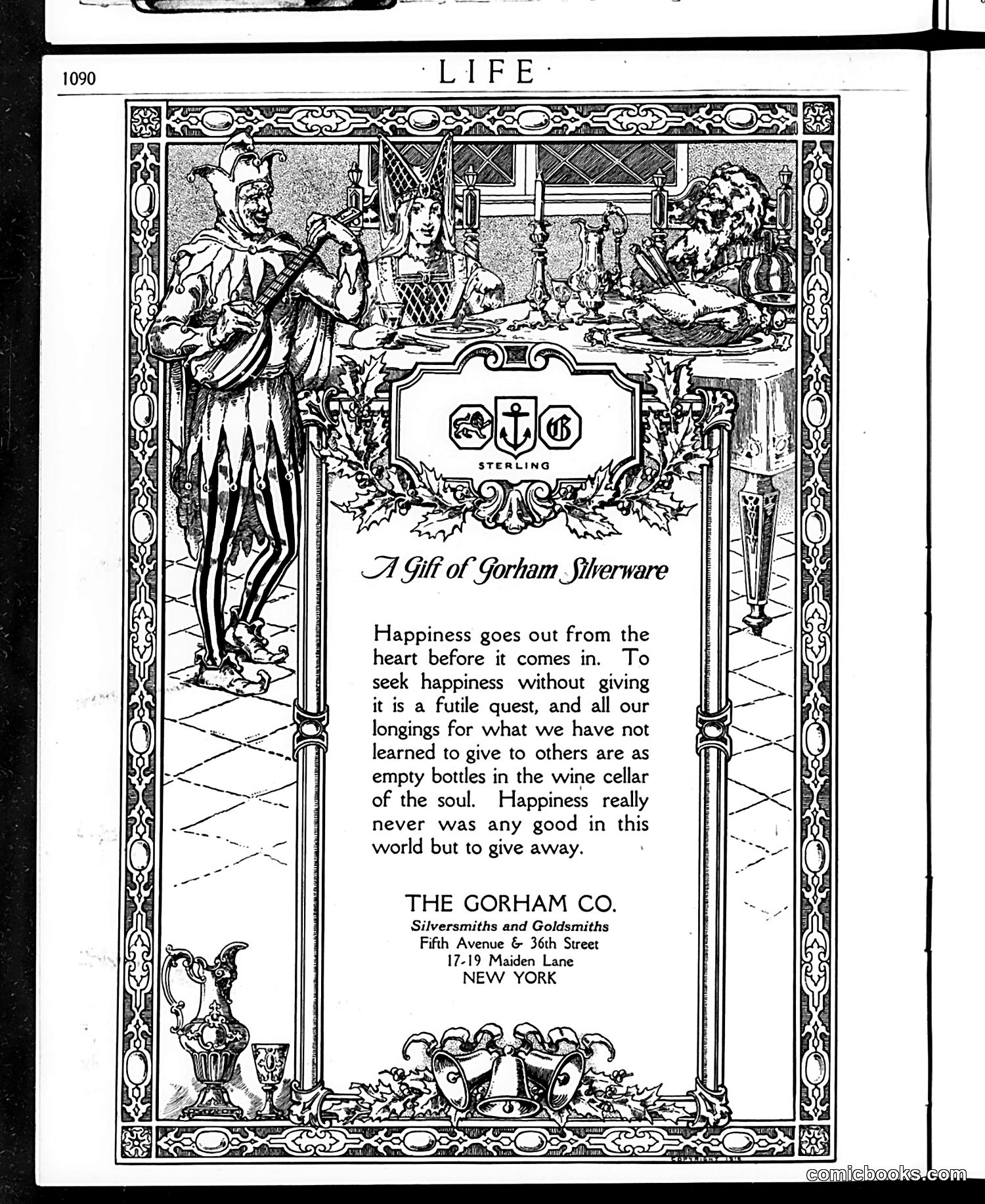
This is primarily a **Gorham Company advertisement** for silverware, not political satire. The page features decorative illustrations of a jester and dining scene rather than a political cartoon. The ad promotes "A Gift of Gorham Silverware" with a philosophical message about happiness: "Happiness goes out from the heart before it comes in. To seek happiness without giving it is a futile quest...Happiness really never was any good in this world but to give away." The imagery—a medieval jester, formal dining setting, and ornate borders—creates an elegant, timeless aesthetic meant to appeal to wealthy readers. The Gorham Company, located at Fifth Avenue and 36th Street in New York, positions luxury silverware as a means of expressing generosity and social refinement. This is commercial messaging, not editorial content or satire.
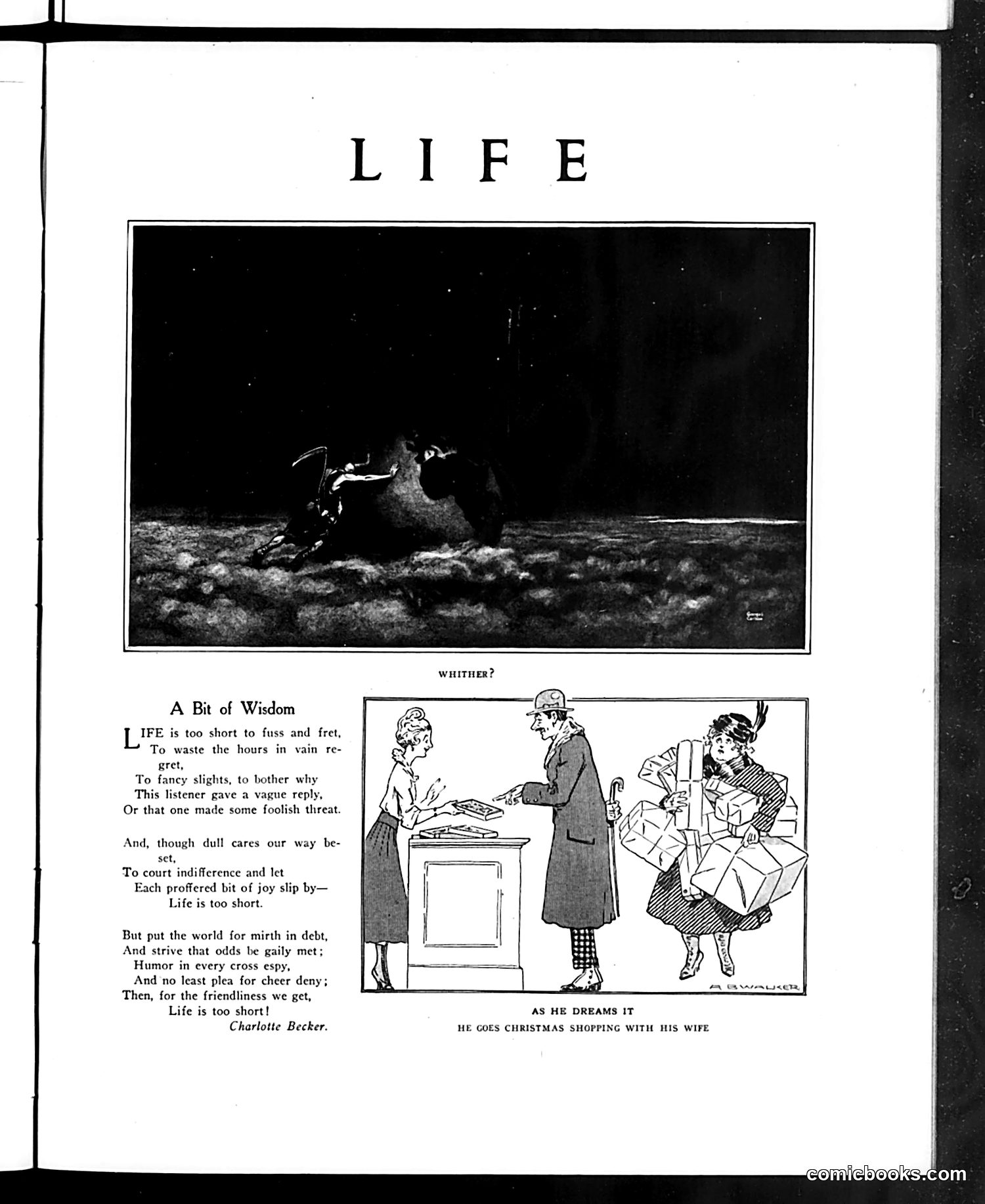
The page contains two distinct elements: **Top image**: A dramatic black-and-white photograph of what appears to be a person in distress or action on dark ground—the subject and context are unclear from the image alone. **Bottom cartoon and poem**: Titled "A Bit of Wisdom" by Charlotte Becker, the poem advises against wasting life on trivial complaints and quarrels. The accompanying cartoon, captioned "AS HE DREAMS IT," satirizes male Christmas shopping behavior—showing a man imagining himself shopping peacefully with his wife, while the reality depicted suggests the experience is chaotic (a woman frantically wrapping presents appears overwhelmed). The satire targets the contrast between husbands' idealized expectations and the actual stress of holiday shopping with spouses.
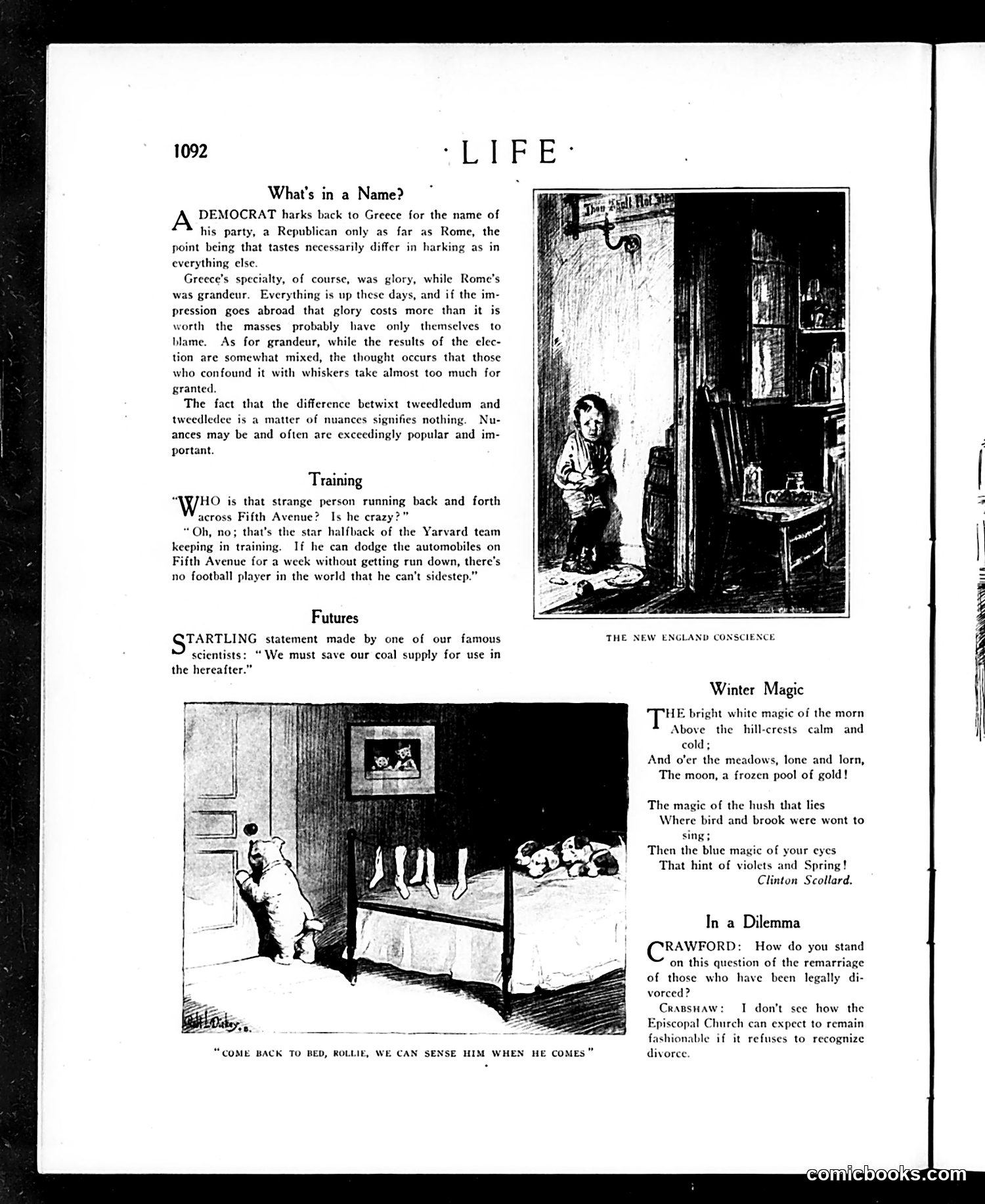
This page contains three distinct editorial pieces from *Life* magazine: 1. **"What's in a Name?"** - A political commentary contrasting Democrats and Republicans, suggesting both parties differ only in superficial ways ("tweedledum and tweedledee"). The piece appears satirical about party distinctions. 2. **"Training"** - A brief joke about someone running back and forth on Fifth Avenue, with a punchline referencing a Harvard football player's ability to sidestep automobiles. 3. **Two cartoons**: The upper illustration is titled "The New England Conscience"; the lower shows a man pointing at a bed with the caption "Come back to bed, Rollie, we can sense him when he comes." The lower cartoon appears to satirize spiritualism or séance culture—likely mocking the popular early-20th-century practice of contacting spirits through mediums. The humor relies on contemporary fascination with the supernatural.
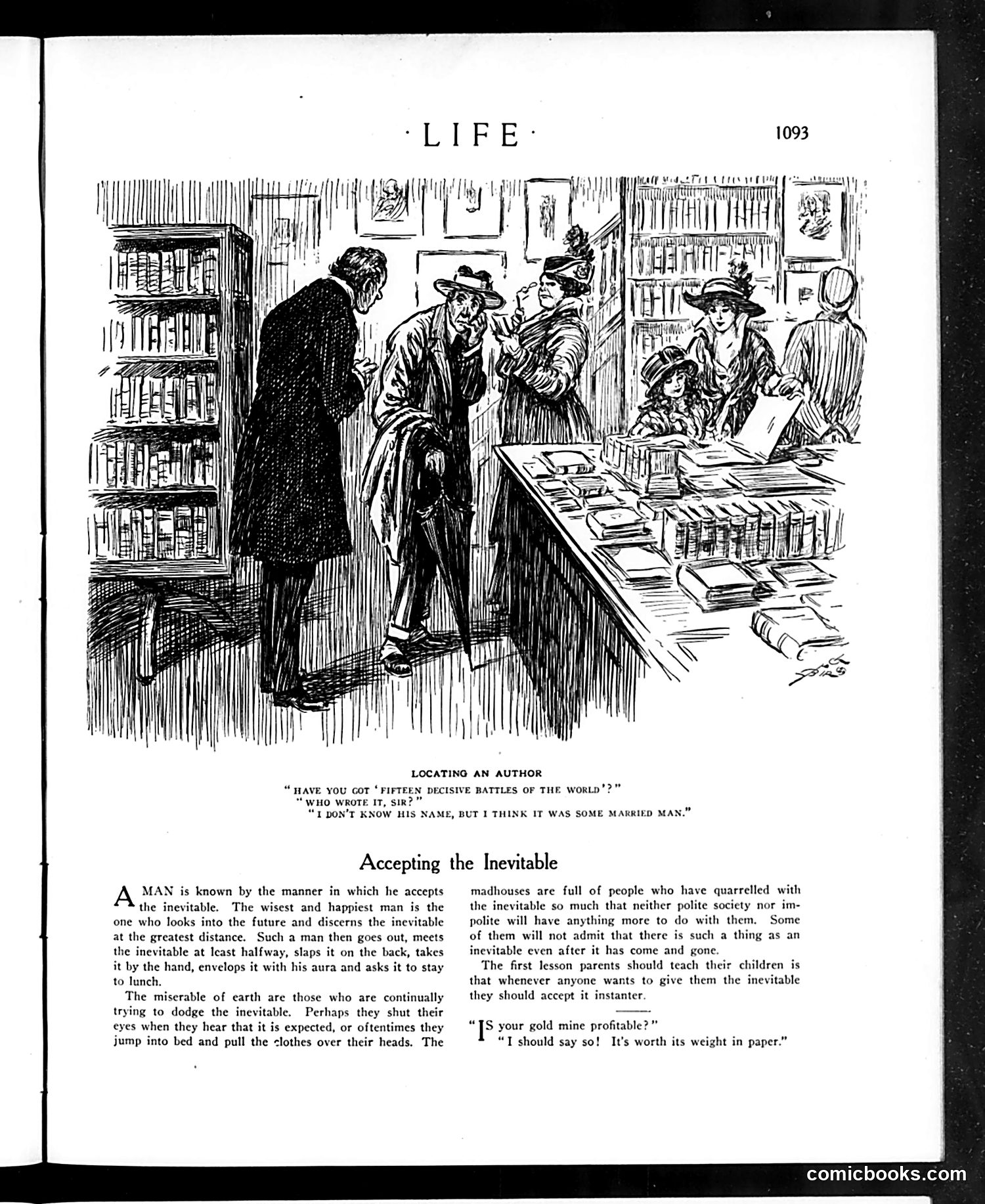
This page from *Life* magazine contains a cartoon and essay about accepting life's disappointments. **The Cartoon** ("Locating an Author") depicts a bookstore scene where a customer asks a clerk about the author of "Fifteen Decisive Battles of the World." The clerk responds that he doesn't know the author's name but thinks "it was some married man"—a joke implying that married men are so burdened by domestic responsibilities they have no identity of their own. **The Essay** ("Accepting the Inevitable") philosophically discusses how wise people accept life's inevitable hardships rather than futilely resisting them. It uses the metaphor of gold mining to illustrate acceptance, concluding with a dialogue where someone notes their gold mine is "worth its weight in paper"—a light joke about dubious financial value. Both pieces use gentle humor to comment on practical life realities: marital subordination and financial uncertainty.
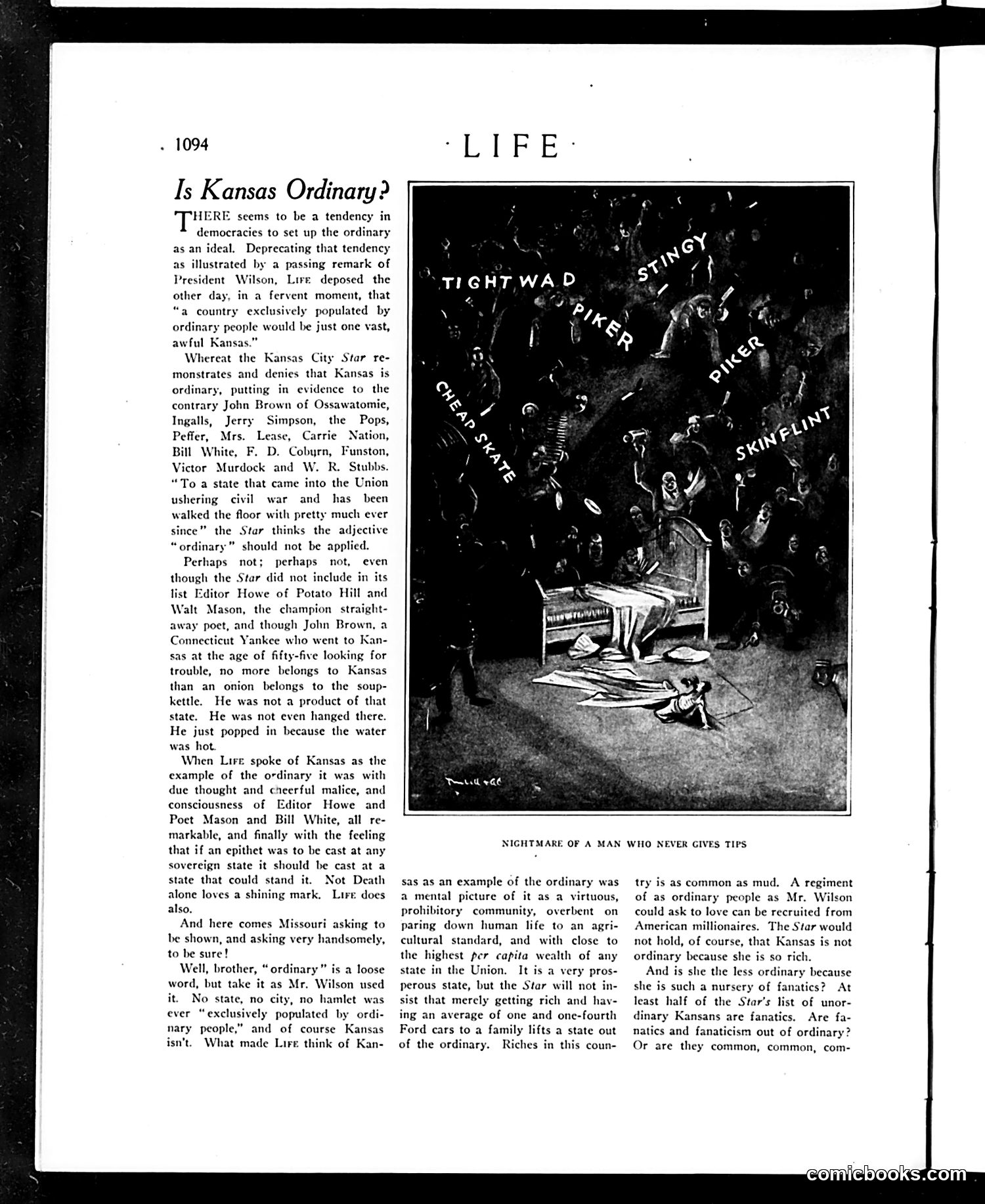
This page debates whether Kansas deserves its reputation as an "ordinary" state. President Wilson apparently called Kansas "a country exclusively populated by ordinary people" — meant as an insult. The text defends Kansas by listing notable citizens: John Brown (abolitionist), various editors and writers. It argues Kansas produced extraordinary people despite Wilson's dismissal. The cartoon titled "Nightmare of a Man Who Never Gives Tips" depicts a man tormented by angry spirits labeled with Kansas river names (Piker River, Stingy, Tightwad, Skinflint, Cimarron). The imagery suggests Kansas residents are miserly or cheap — playing on regional stereotypes. The satire works both ways: defending Kansas's actual contributions while poking fun at Kansans' supposed stinginess.
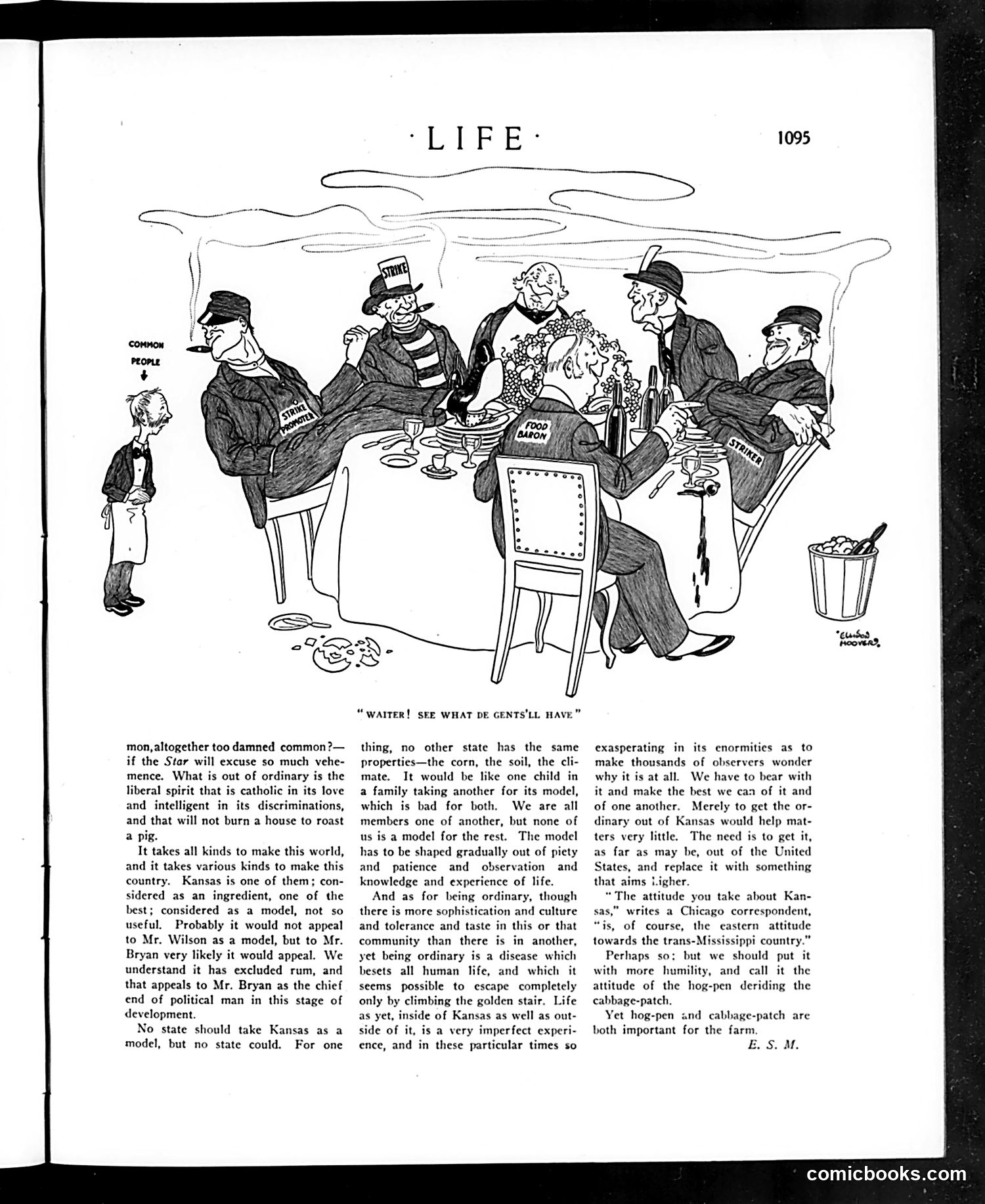
This cartoon satirizes wealthy, upper-class men dining together while a small child labeled "Common People" stands excluded outside. The diners wear hats labeled with various interests (one reads "Food Baron"), suggesting they represent powerful economic or political elites. The accompanying text discusses Kansas as a state model, critiquing its ordinary character while defending it against eastern dismissal. The satire appears to be about **class division and economic inequality**: the privileged few feast together while ordinary people remain marginalized observers. The waiter's question ("See what de gents'll have") emphasizes their exclusive access to resources and power, contrasting sharply with the child's exclusion from the table.
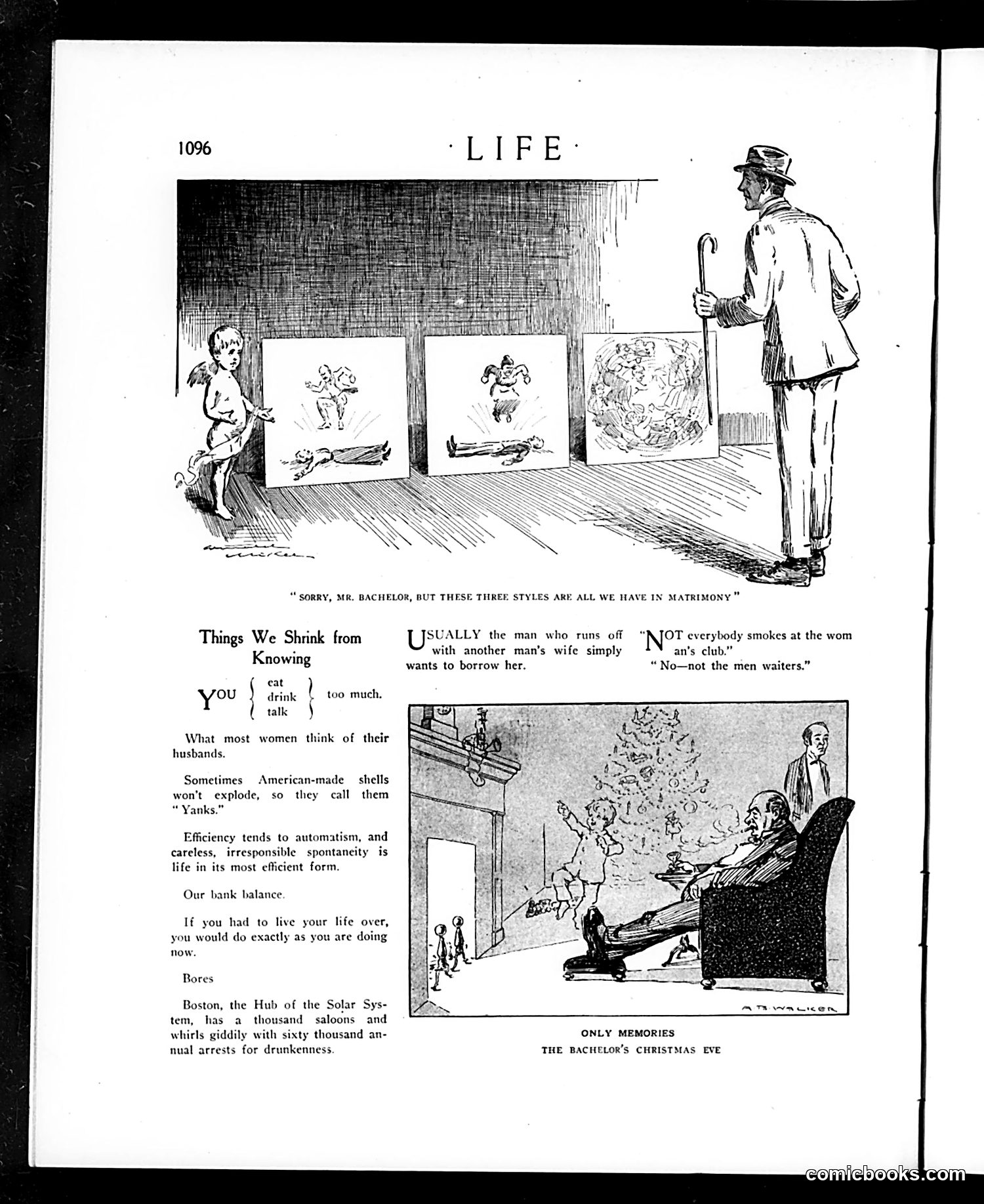
**Top Cartoon**: A man shows three artworks to a bachelor client, saying "Sorry, Mr. Bachelors, but these three styles are all we have in matrimony." The joke satirizes marriage as having limited "styles" or options—suggesting matrimony itself is a constraining, repetitive institution rather than offering genuine choice. **Column "Things We Shrink from Knowing"**: A series of witty observations about social hypocrisy, including remarks about women's views of husbands, unexploded American shells ("Yanks"), efficiency, and Boston's high drunkenness arrests. The tone mocks polite society's unwillingness to acknowledge uncomfortable truths. **Bottom Cartoon**: Titled "Only Memories: The Bachelor's Christmas Eve," depicts a lonely bachelor observing a family Christmas through a window—nostalgic satire about bachelor isolation versus domestic contentment.
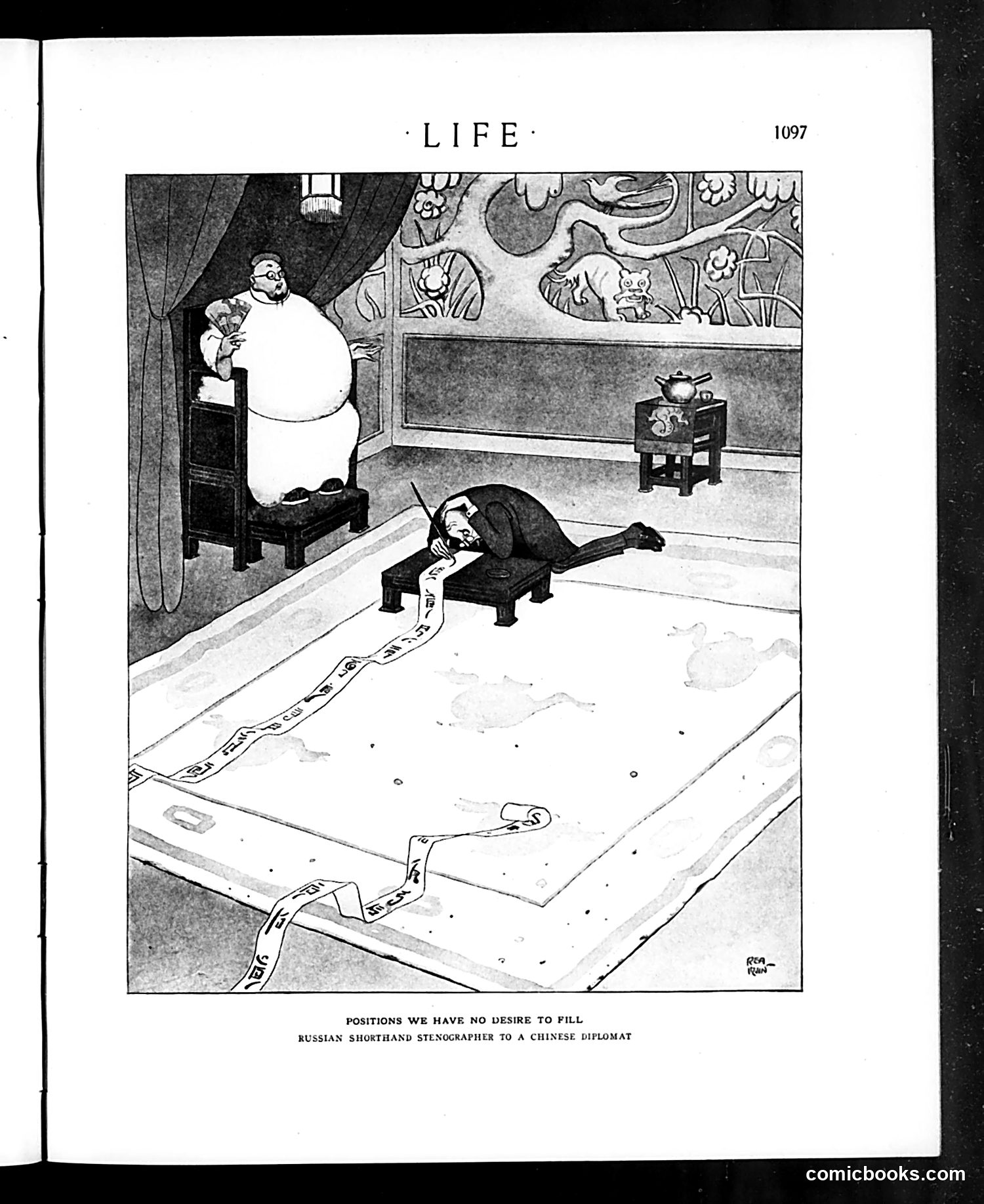
This Life magazine cartoon satirizes diplomatic tensions between Russia and China. The caption reads: "POSITIONS WE HAVE NO DESIRE TO FILL: RUSSIAN SHORTHAND STENOGRAPHER TO A CHINESE DIPLOMAT." The image shows a Chinese diplomat (seated, appearing rotund) dictating to a Russian stenographer who lies prostrate on the floor, struggling to keep up with an impossibly long ribbon of shorthand notes. The visual joke suggests that Russia would never accept such a subordinate, servile position to China—literally crawling beneath a Chinese official. This appears to reference Cold War-era Sino-Soviet tensions, mocking the idea of Russian subservience to Chinese authority as absurd and undesirable. The exaggerated physical positions emphasize the humiliation such a role would represent.
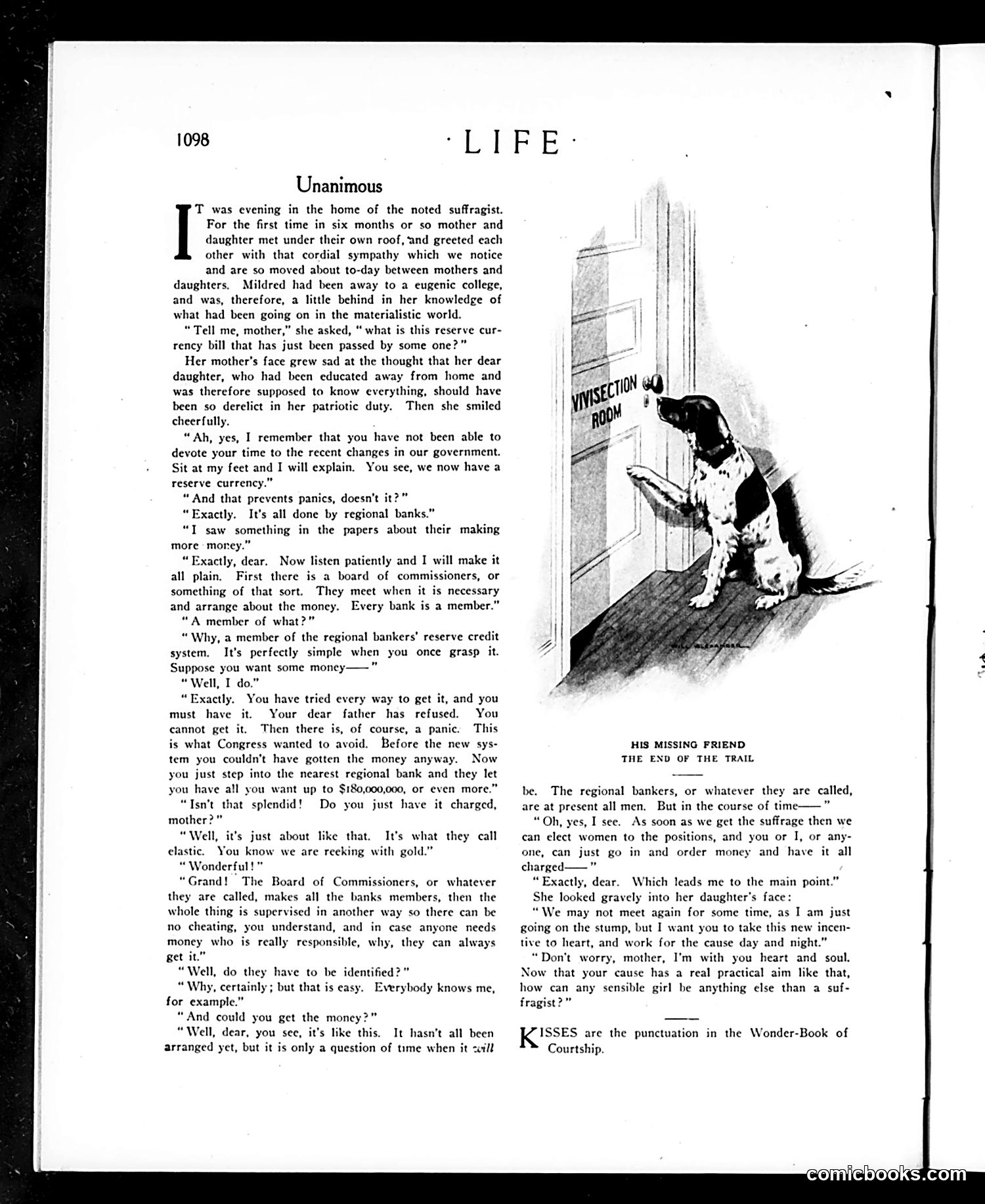
This page contains a story titled "Unanimous" about a mother and daughter discussing recent government financial reforms. The mother explains a new "reserve currency" system managed by regional banks through a "Board of Commissioners," designed to prevent financial panics by controlling money supply. The illustration shows a cow labeled "VIVISECTION ROOM" - a satirical reference to the Federal Reserve System's creation. The cow represents the public being subjected to monetary experimentation. The satire critiques how ordinary citizens (here, the daughter) are kept ignorant of complex financial mechanisms while these systems directly affect their lives. The conversation exposes how elite institutions make crucial economic decisions with minimal public understanding or democratic input, a common Progressive-era concern about centralized banking power.
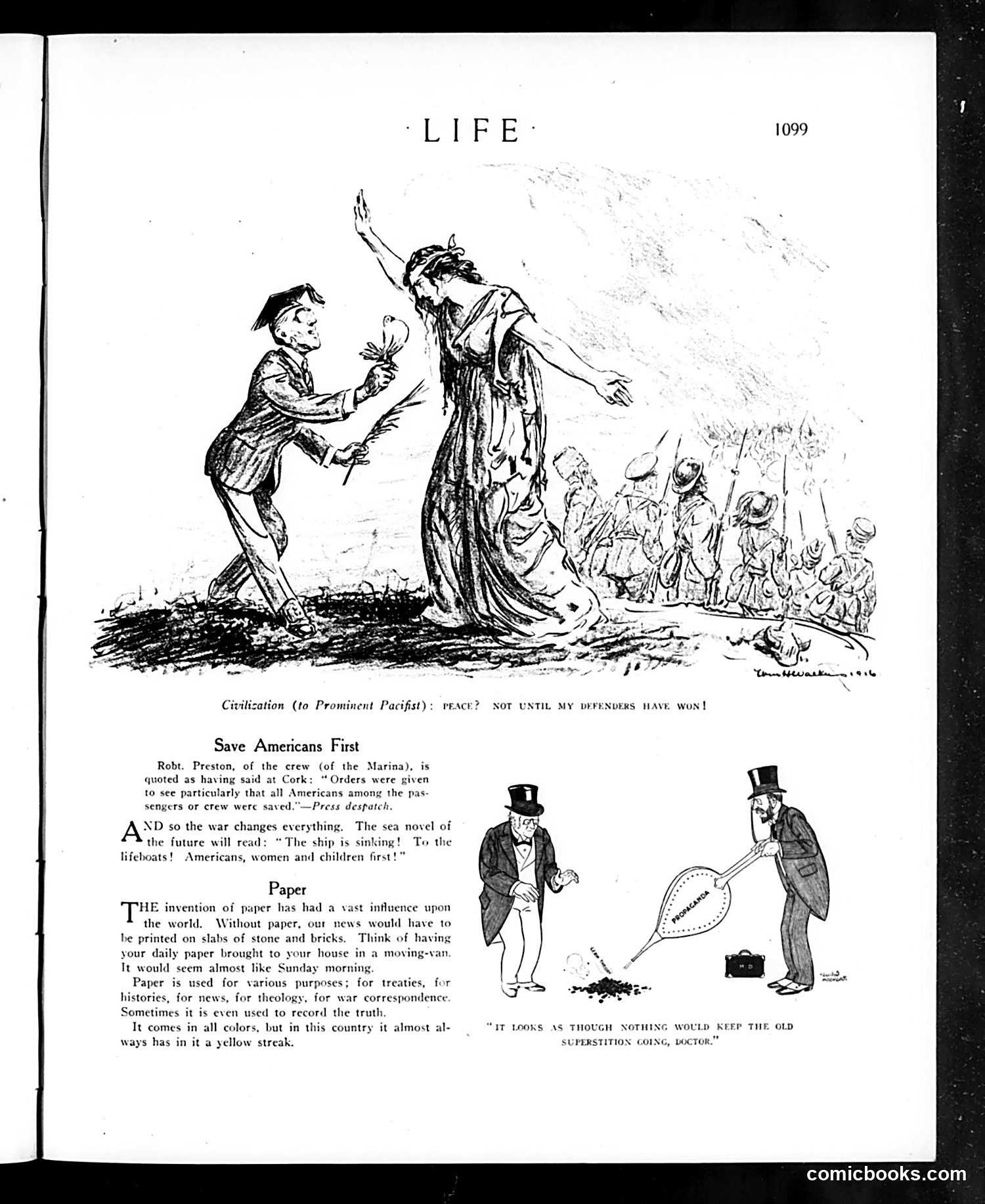
This page from *Life* magazine contains anti-war satire from World War I era. The top cartoon depicts "Civilization (to Prominent Pacifist): Peace? Not until my defenders have won!" A female figure representing Civilization gestures dismissively at a small man (the pacifist) while armed soldiers march behind her—mocking pacifists who opposed American involvement. The lower section includes a piece on paper's importance and a cartoon showing two gentlemen with a butterfly net catching something labeled with superstitions, captioned "It looks as though nothing would keep the old superstition going, doctor." The "Save Americans First" section references priorities during wartime. Overall, the page argues for continued military commitment while ridiculing both pacifist opposition and outdated superstitious thinking.
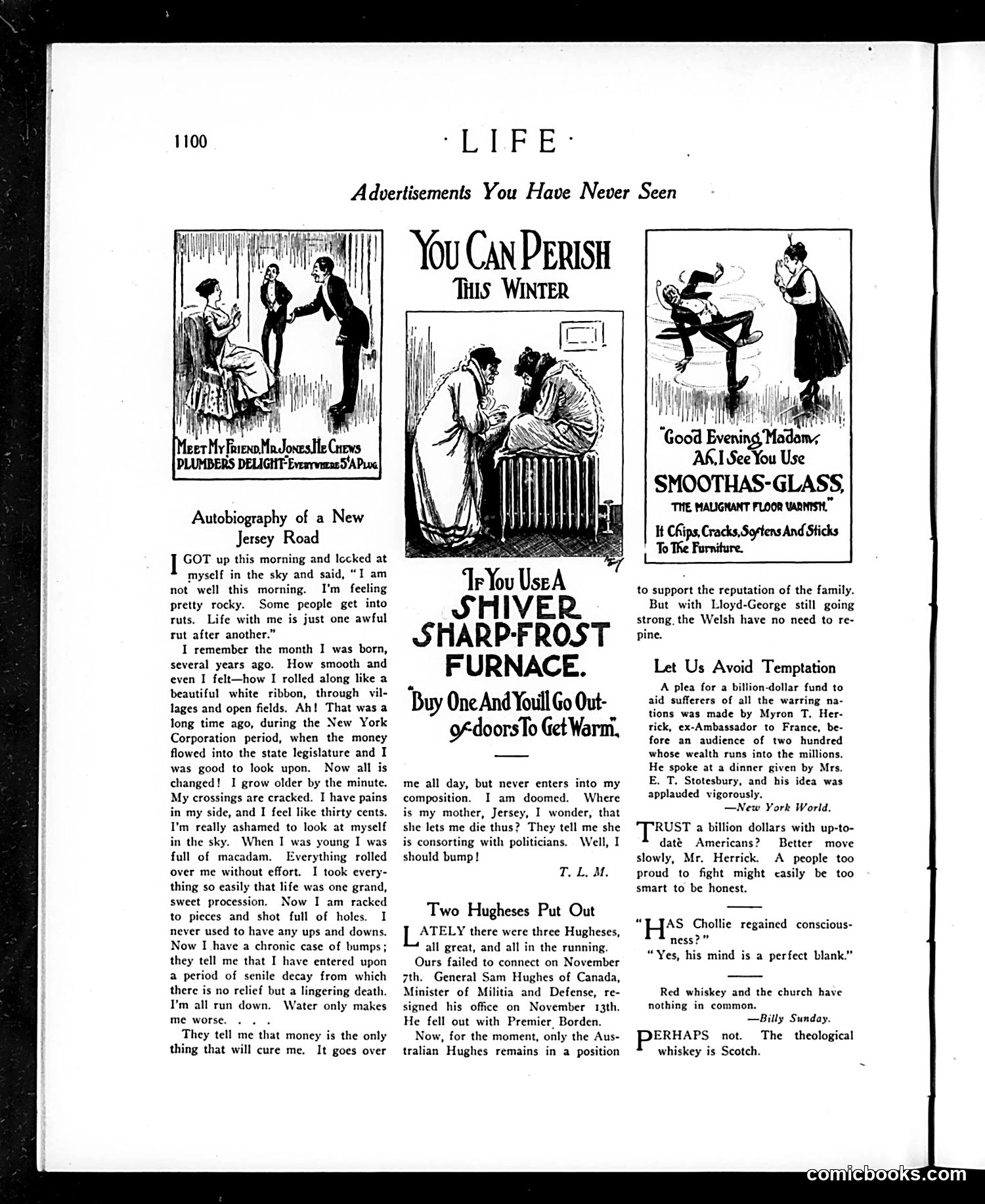
This page contains satirical advertisements and short humor pieces typical of Life magazine's format. The fake ads mock consumer products: "Smoothas-Glass" floor varnish (humorously causing people to slip), and a "Shiver Sharp-Frost Furnace" that fails to keep homes warm in winter—both playing on common household frustrations. The "Autobiography of a New Jersey Road" is a humorous first-person narrative from the perspective of a deteriorating road, complaining about its decline from prosperity during the New York Corporation period to present neglect and damage. Short joke pieces follow, including one about "Two Hughesses" (likely referencing historical figures named Hughes) and quips about whiskey and religion. The overall tone is lighthearted domestic satire targeting everyday American consumer products and infrastructure problems.
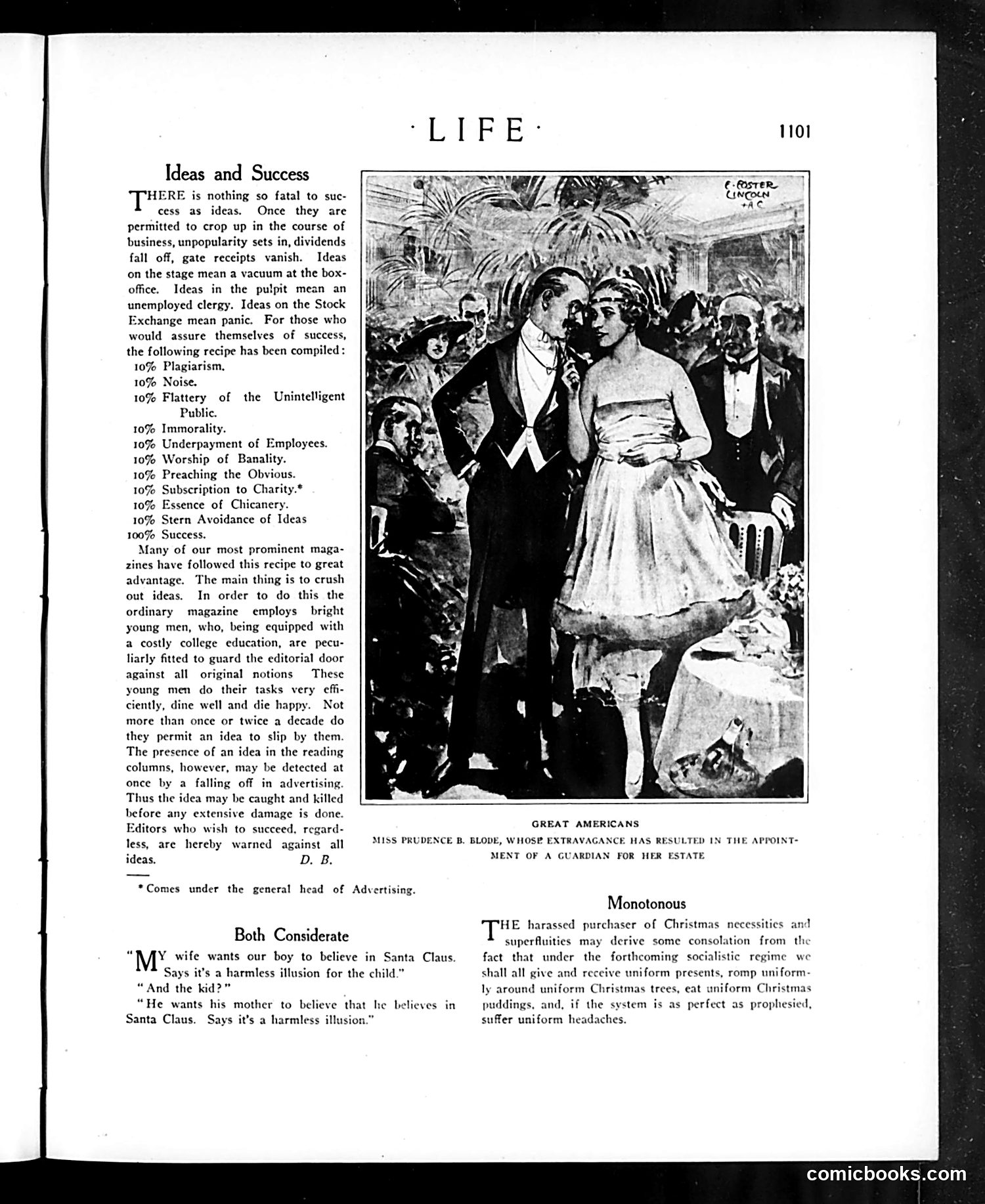
This page contains satirical commentary on editorial practices and social issues: **"Ideas and Success"** critiques magazines that strip ideas of originality. The "recipe" lists components like plagiarism, noise, and flattery—suggesting publications manufacture bland content through formula rather than genuine thought. The warning to editors to "guard the editorial door against all original notions" is tongue-in-cheek criticism of risk-averse publishing. **"Great Americans"** photograph shows Miss Prudence B. Blodge receiving a guardianship appointment, likely satirizing nepotism or arbitrary wealth management among the privileged classes. **"Both Considerate"** and **"Monotonous"** are brief humorous dialogues about belief in Santa Claus and socialist uniformity, respectively—typical period satire on parenting, childhood, and political ideology.
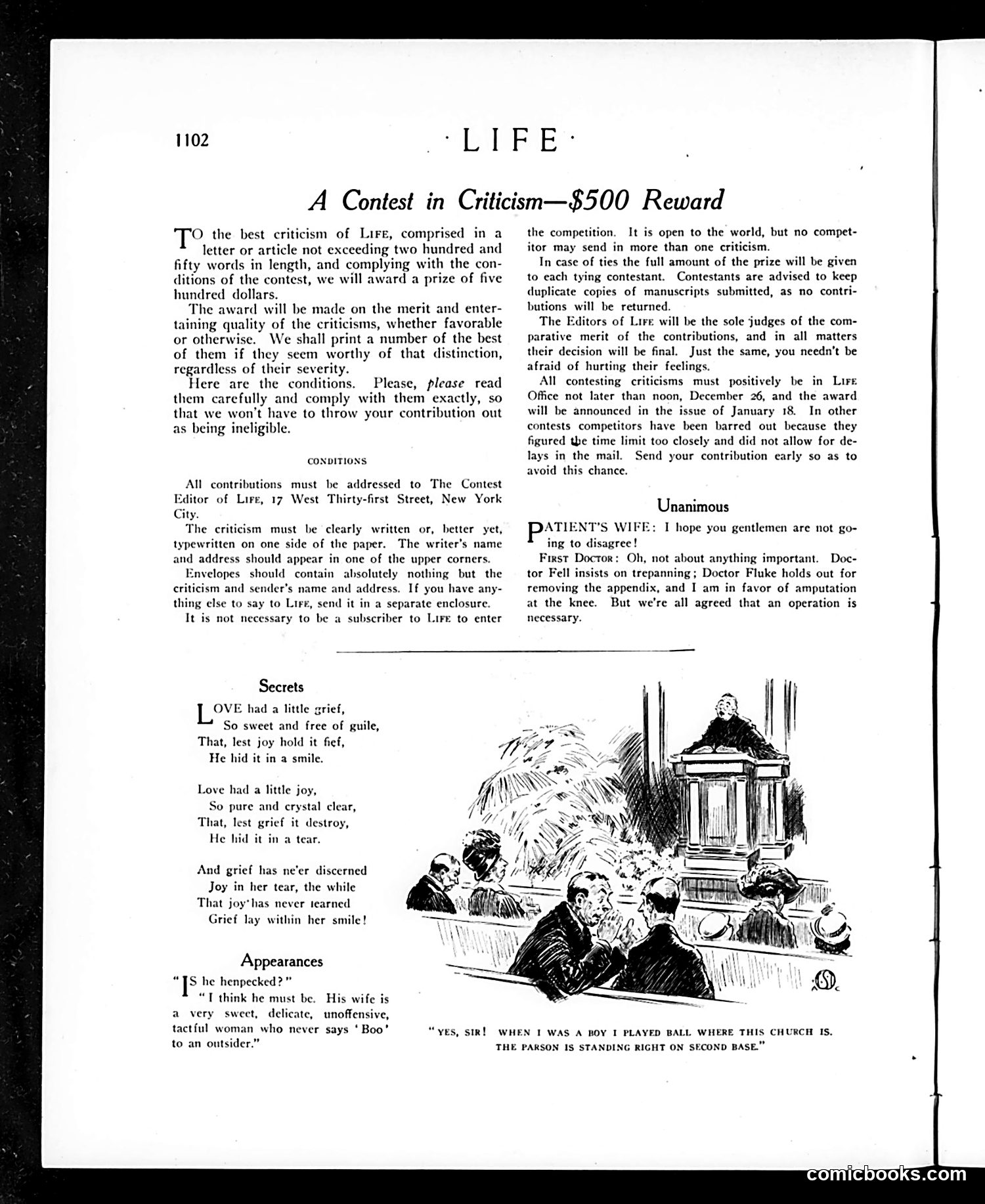
This page contains three distinct satirical pieces: **Contest Announcement**: Life magazine is soliciting reader criticism of itself, offering a $500 prize (substantial for the era). The satirical tone lies in Life inviting—even encouraging—harsh criticism of its own publication, suggesting confidence or self-aware irony about its quality. **Medical Satire ("Unanimous")**: Three doctors completely disagree on treatment (trepanning vs. appendectomy vs. amputation) for a patient, yet claim unanimous agreement that "an operation is necessary." This mocks medical overconfidence and the era's tendency toward aggressive surgery as a default treatment, regardless of actual diagnosis. **Poem & Illustrations**: "Secrets" is sentimental Victorian verse about hidden emotions. The cartoon below depicts a church funeral service with mourners; the caption jokes about a boy who played baseball where the church now stands—the parson is positioned where "second base" was. This contrasts the solemnity of death with casual childhood nostalgia, creating dark humor through juxtaposition.
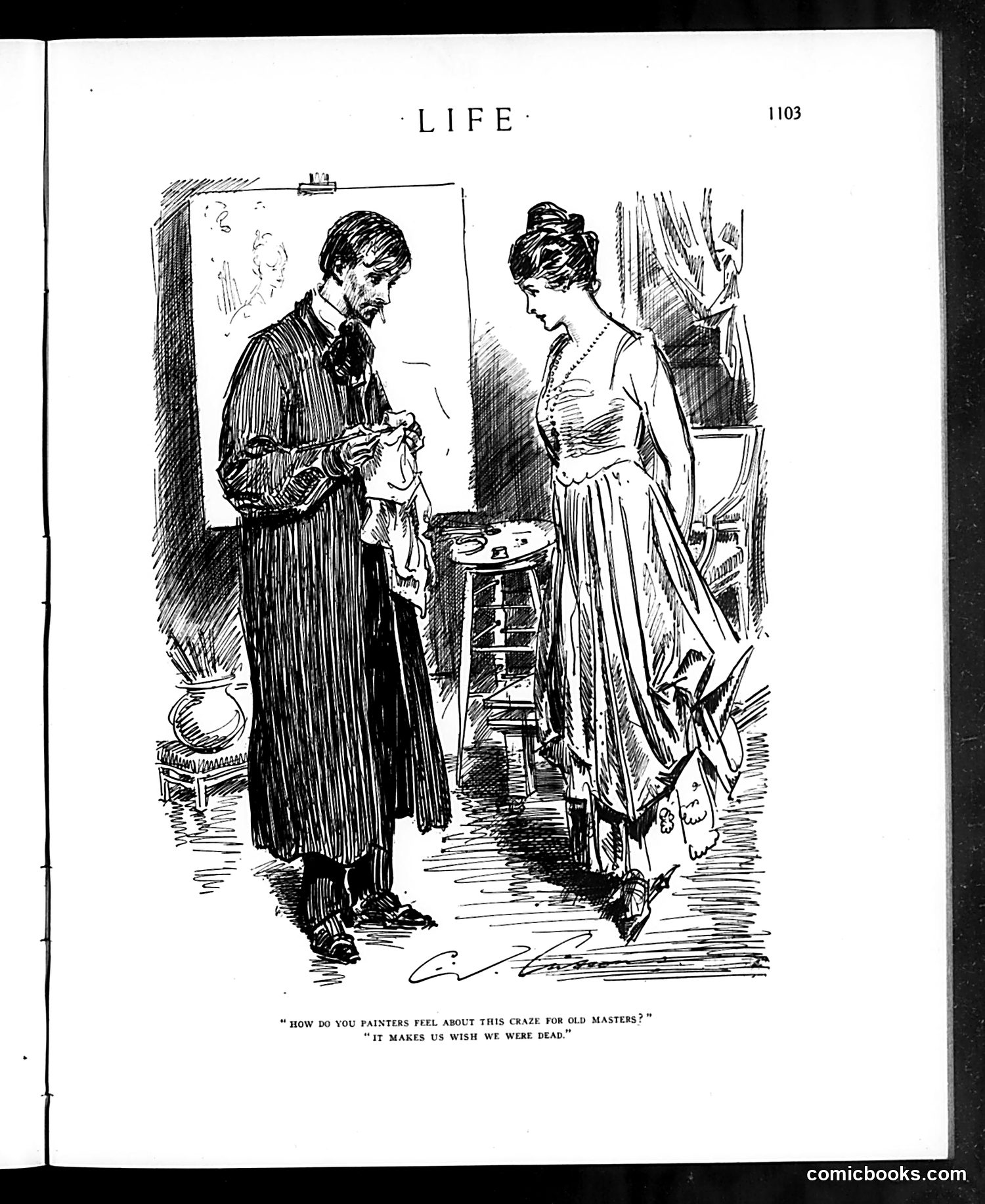
This single-panel cartoon depicts a man in artist's robes showing a painting to an elegantly dressed woman in what appears to be an art studio. The caption reads: "How do you painters feel about this craze for old masters?" / "It makes us wish we were dead." The satire targets the art world's obsession with Old Masters paintings during this period. The joke is that contemporary painters feel obsolete and demoralized because wealthy collectors and society figures are exclusively pursuing historical artworks rather than supporting living artists. The woman's fashionable appearance suggests she represents the moneyed class driving this collecting trend. The cartoon mocks both the snobbery of art collecting and the economic hardship it creates for working painters of the era.
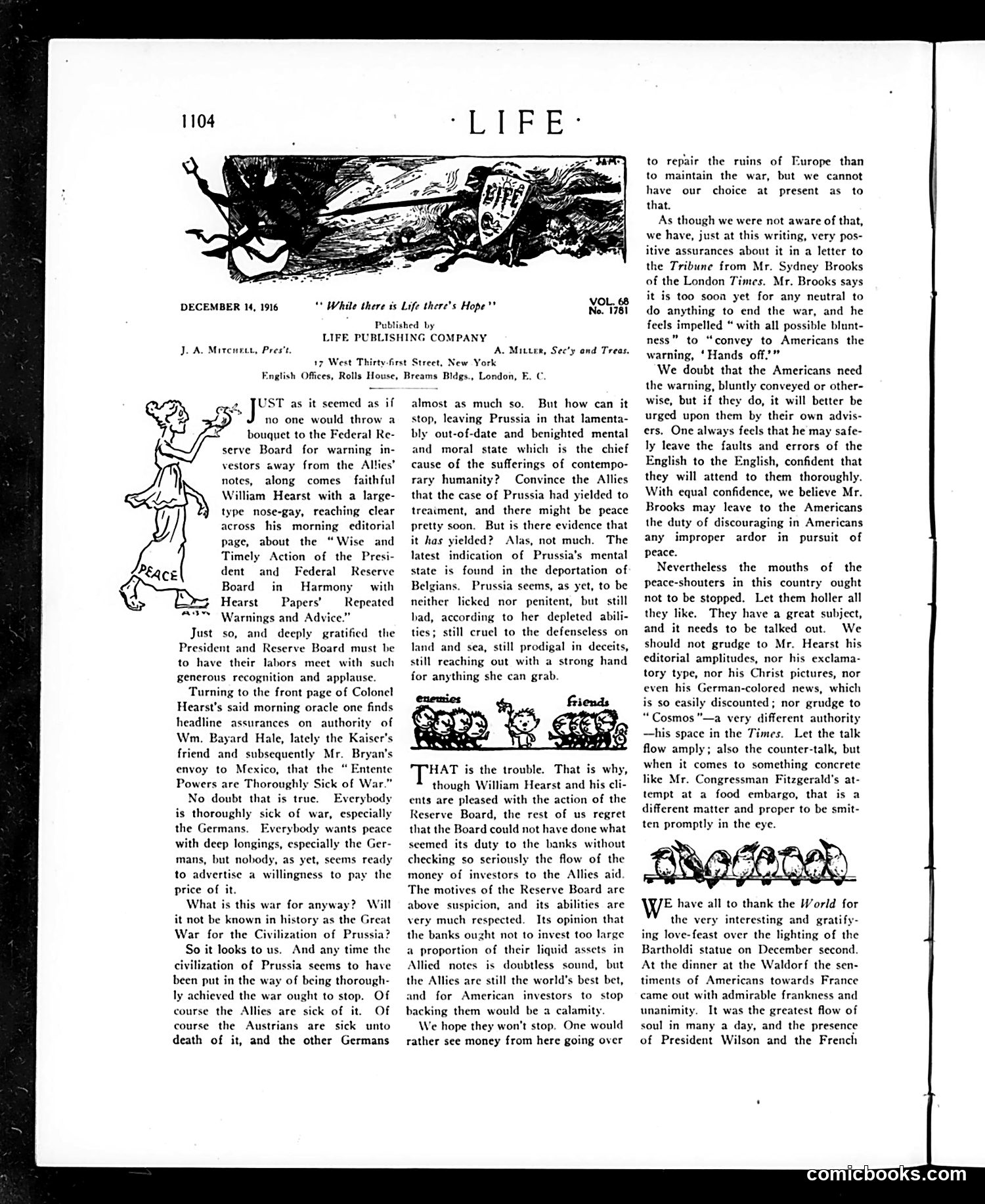
This page critiques William Randolph Hearst's contradictory editorial positions on World War I financing. The satire operates on two levels: **The Hypocrisy:** Hearst simultaneously praised the Federal Reserve Board for discouraging American investment in Allied war bonds while his own newspapers (via correspondent Wm. Bayard Hale, identified as "the Kaiser's friend") claimed the "Entente Powers are Thoroughly Sick of War"—implying peace was near and investment unnecessary. **The Argument:** Life's editors argue that since Germany (Prussia) remains unrepentant and cruel (citing Belgian deportations), the Allies *must* continue fighting. Therefore, American financial support isn't warmongering but moral necessity. Hearst's simultaneous positions are presented as either naive or duplicitous. **The Stakes:** This reflects genuine 1916 debate over America's role—published before U.S. entry into WWI (April 1917). The piece defends banker financing of the Allies as supporting civilization against Prussian militarism, while mocking Hearst's apparent pro-German sympathies masked by peace rhetoric.
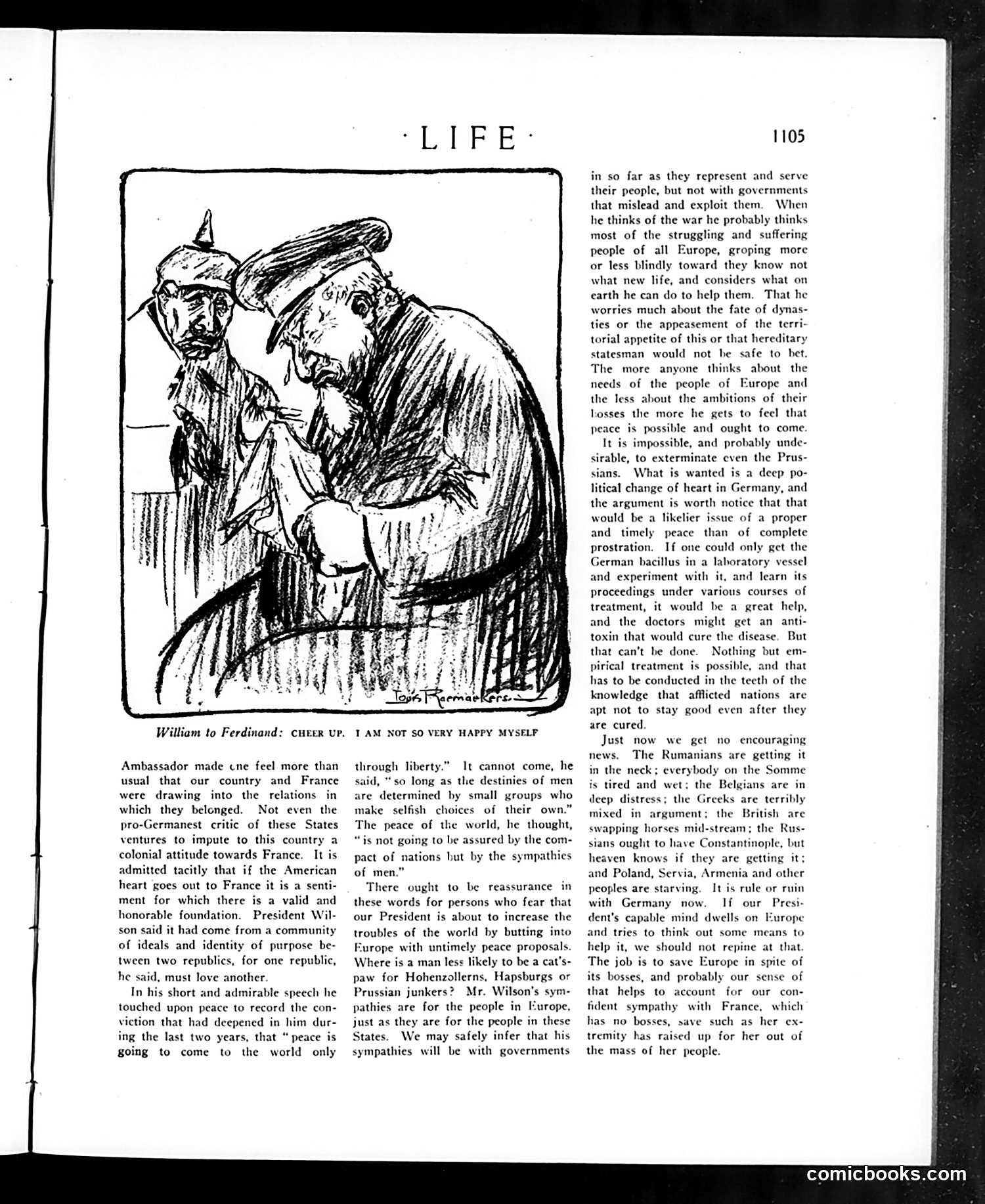
**The Figures:** The cartoon depicts two military leaders—likely German Kaiser Wilhelm II (left, with spiked helmet) and Austro-Hungarian Emperor Franz Ferdinand (right)—in a conversation. Wilhelm tells Ferdinand "cheer up, I am not so very happy myself," suggesting shared wartime misery among Europe's rulers. **Historical Context:** This appears from WWI era (references to Somme, Romania, Belgium fighting). The accompanying article discusses President Wilson's peace philosophy—that lasting peace requires liberty and popular sympathy rather than dynastic compromises. **The Satire's Point:** The cartoon mocks Europe's hereditary autocrats by showing them unhappy despite their power, while the editorial argues Wilson correctly prioritizes ordinary Europeans' suffering over preserving these rulers' territorial ambitions. The joke implies these crowned heads deserve their misery, given their role in prolonging the war.
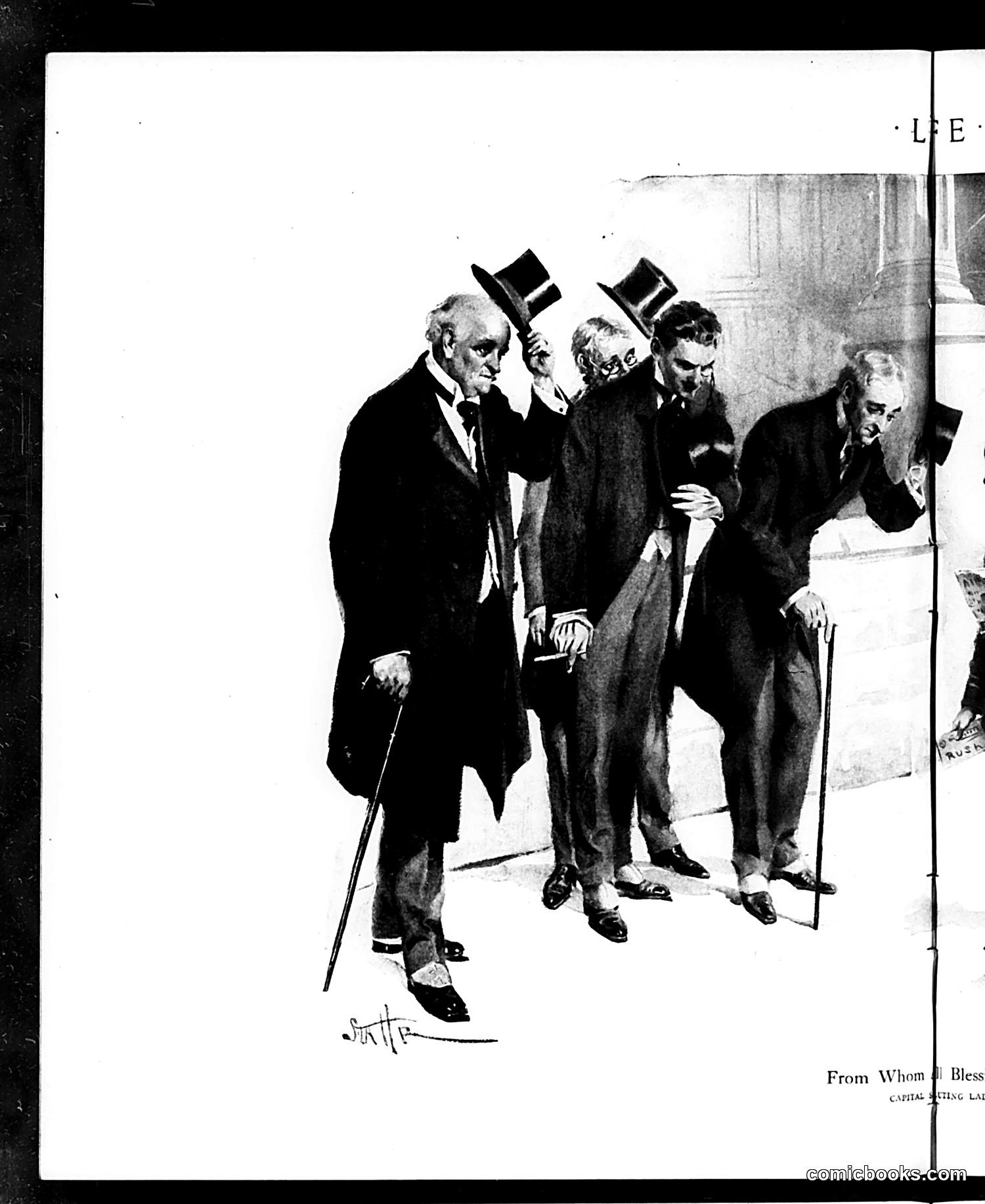
This is a political cartoon from Life magazine showing five gentlemen in formal Victorian/Edwardian dress (top hats and morning coats). Four men appear distressed or uncomfortable, while one on the left holds a cane and seems composed. The title "From Whom" (likely "From Whom it Stings" based on the partial OCR) suggests the cartoon criticizes capitalists or wealthy figures. The scene appears to depict businessmen reacting to some form of criticism or "sting"—possibly labor agitation, taxation, or social reform pressure. The formal dress and body language suggest established wealth, while their discomfort indicates satire directed at their position. However, without the complete caption or date, I cannot definitively identify the specific figures or which historical economic controversy is referenced. The artwork style suggests early 20th century.
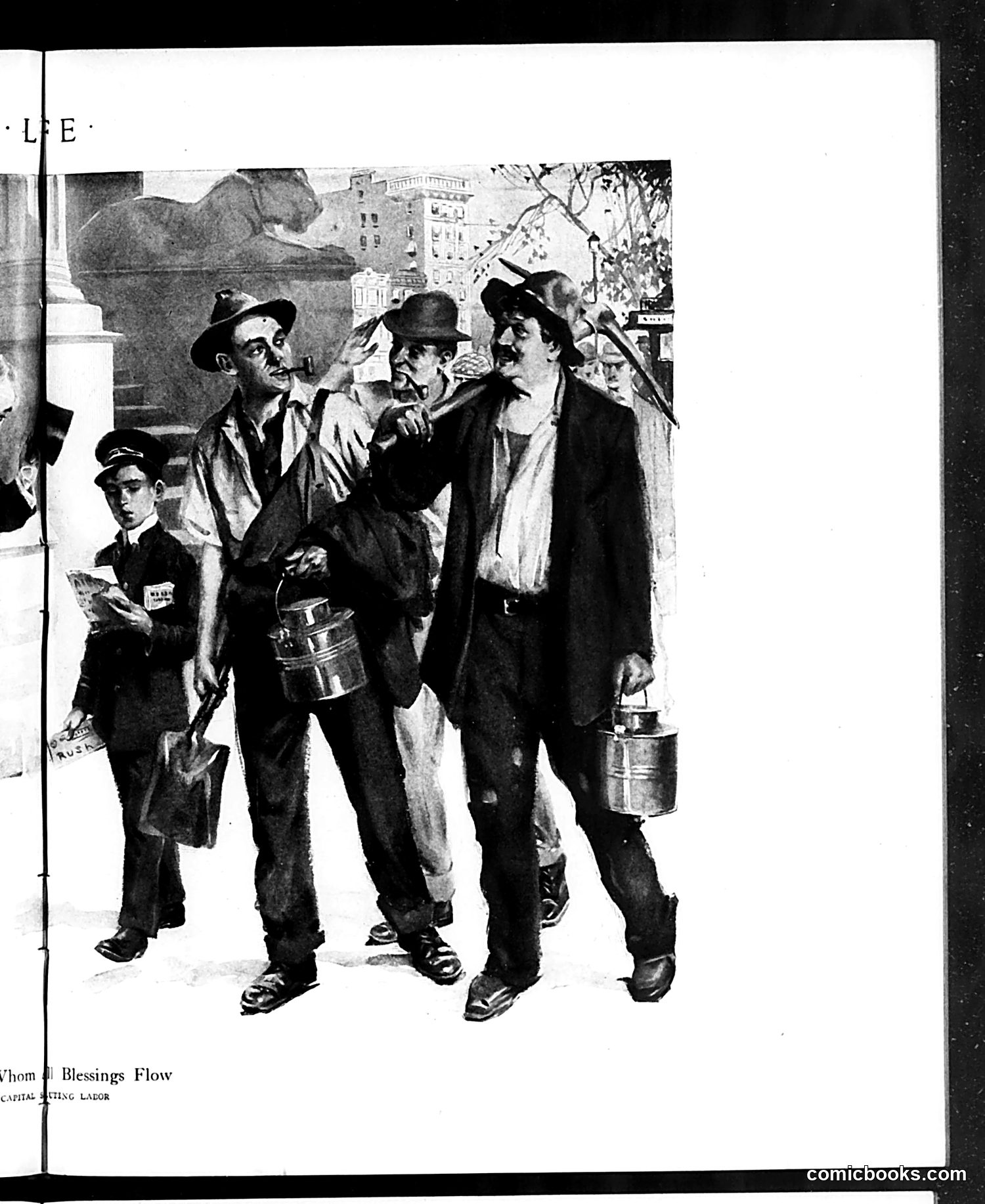
This appears to be a satirical cartoon about labor and capitalism. The image shows four working-class men (carrying buckets, wearing work clothes and hats) in an urban setting with buildings in the background. The caption "Whom Blessings Flow" combined with the subtitle referencing "Capital" and "Labor" suggests this is political commentary on the relationship between capital owners and laborers. The satire likely critiques how wealthy capitalists claim that their prosperity creates benefits ("blessings") that supposedly flow down to workers—a concept known as "trickle-down economics." The working men's expressions and body language suggest skepticism about whether such promised benefits actually reach them. The image captures early-to-mid 20th century labor movement concerns about economic inequality and workers' share of industrial wealth.
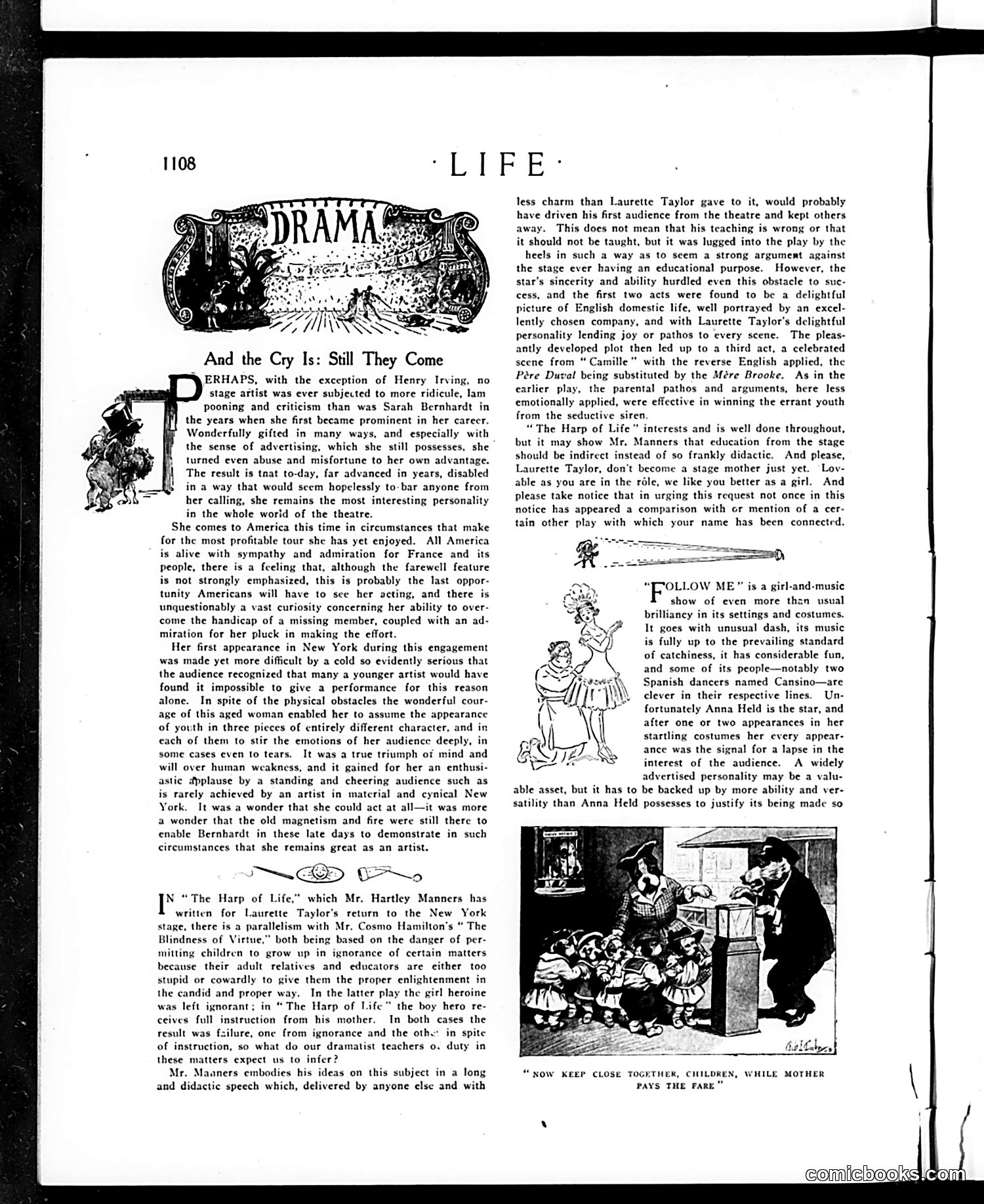
This page discusses two theatrical productions and performers from the early 20th century: **Sarah Bernhardt**: The text praises the aging French actress's recent American tour, emphasizing her remarkable resilience despite being disabled (having lost a limb) and performing while ill. The article notes she overcame physical handicaps through sheer willpower and artistry, earning standing ovations even in "cynical New York." **"The Harp of Life"**: A play by Hartley Manners starring Laurette Taylor. The critic notes it addresses child education frankly—comparing it to another play ("The Blindness of Virtue") that tackled similar themes. The criticism is that while Taylor's charm carries a didactic speech about instructing children, the heavy-handed moralizing feels artificially inserted into the plot, raising questions about theater's educational role. The page includes theatrical illustrations and photographs supporting these reviews.
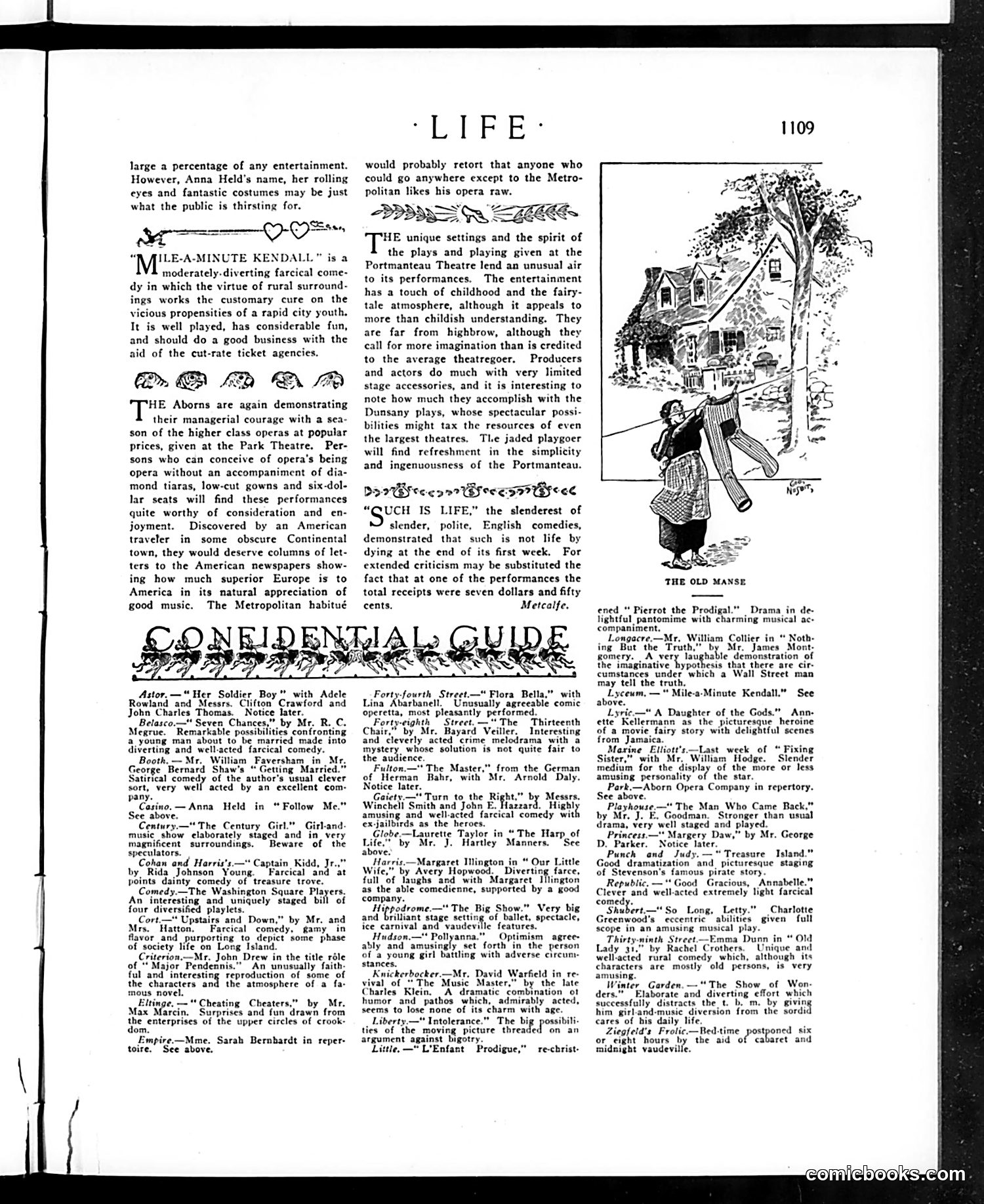
This page is primarily a **theater review section** with minimal visual satire. The small illustration shows "The Old Manse"—a rustic cottage scene, likely accompanying discussion of a Portmanteau Theatre production with fairy-tale or pastoral themes. The text reviews multiple Broadway productions, including comment on **Anna Held** (a popular entertainer known for elaborate costumes and "rolling eyes"), whose name apparently drew audiences regardless of production quality. There's gentle mockery of the **Metropolitan Opera's** social pretension—the reviewer sarcastically suggests that appreciating opera without expensive trappings (diamond tiaras, low-cut gowns, six-dollar seats) proves superiority. The reviews themselves employ satirical wit: "Such is Life" ironically "died" after one week; various comedies are praised or mildly mocked for their construction and appeal. **Context for modern readers**: This represents early 20th-century theater criticism blending entertainment journalism with social commentary about class, taste, and New York's cultural hierarchy.
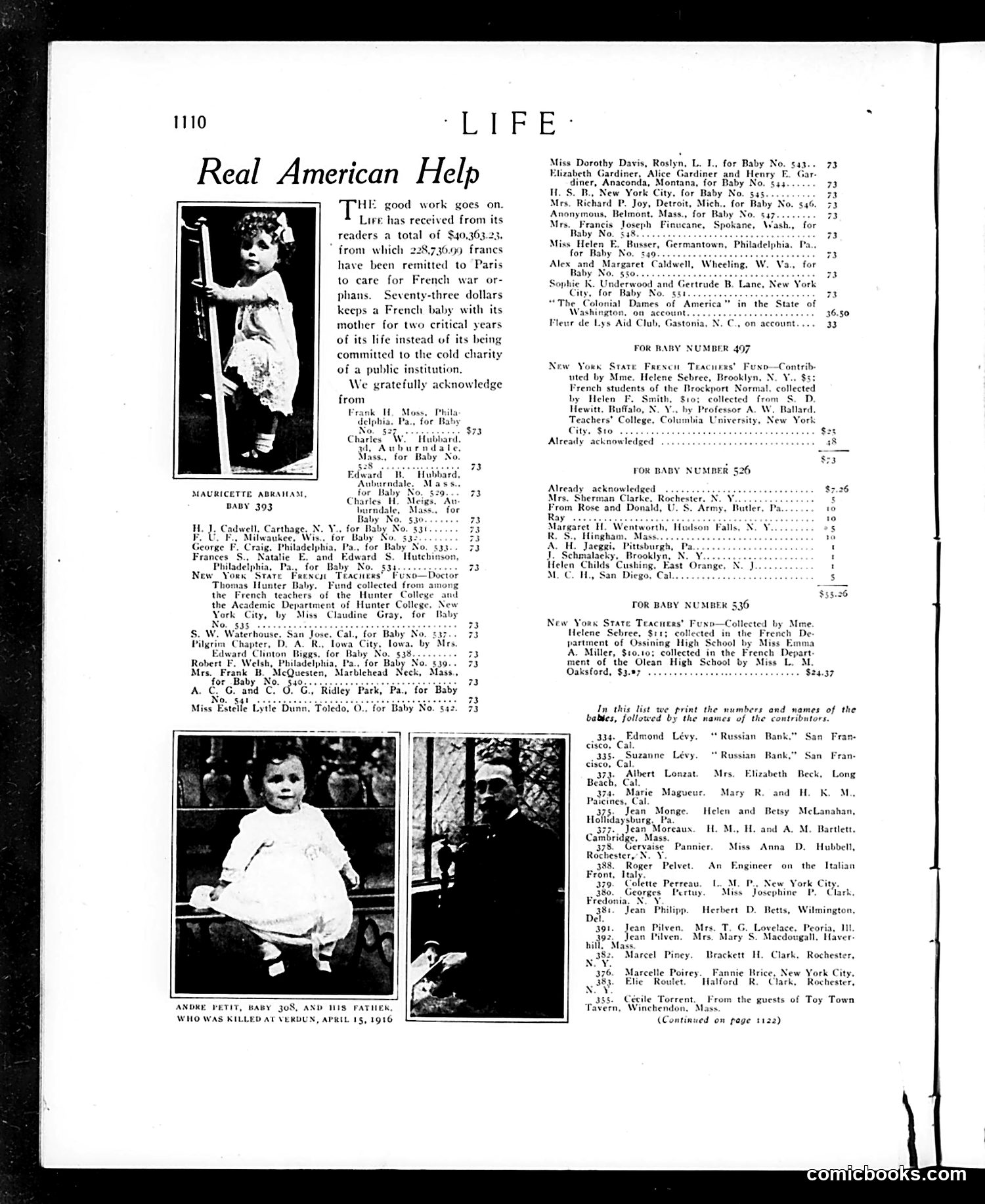
This page documents **Life magazine's fundraising campaign for French war orphans** during or after World War I. The article describes the magazine's success in collecting donations to support French children—specifically, the funds keep babies with their mothers rather than placing them in institutions. The listed donations show contributions from individuals and organizations (teachers' funds, civic groups, the Colonial Dames of America) across the United States. Each baby receives a number; donors are matched with their supported child. The two photographs show beneficiaries: **Mauricette Abraham (Baby 393)** and **André Petit, Baby 308, and his father** (who was killed at Verdun on April 13, 1916). For modern readers: this illustrates American philanthropic response to European wartime suffering, demonstrating both patriotic solidarity with France and the period's belief that charitable giving could meaningfully assist distant victims. The naming of individual babies personalized giving and created emotional connection across continents.
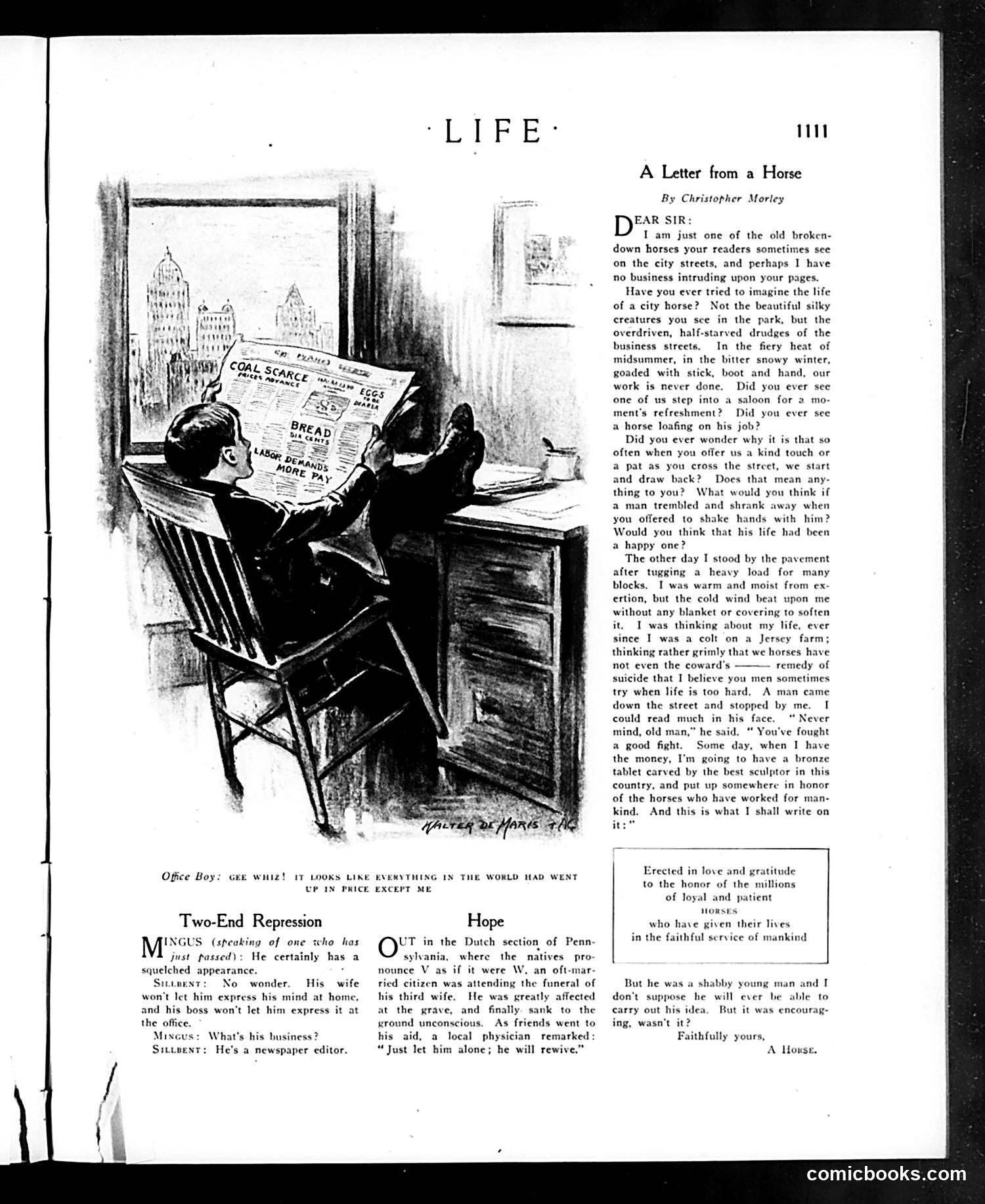
**The Cartoons:** 1. **"Office Boy"** (top): A newspaper office boy observes that everything has gone up in price except himself—a joke about wage stagnation during inflation. 2. **"Two-End Repression"**: A man appears miserable because his wife censors him at home and his boss censors him at work. The punchline reveals he's a newspaper editor—ironic since editors typically control speech, but he's silenced everywhere else. 3. **"Hope"** (bottom): A linguistic joke. In Dutch Pennsylvania, a man attending his *third* wife's funeral faints at the grave. A doctor says "he will rewive" (using the Dutch pronunciation of "revive" as "rewive"), creating dark humor: the man will recover, then presumably marry again. **"A Letter from a Horse"** is a sentimental essay by Christopher Morley personifying an overworked city horse, advocating for animal welfare and compassion toward working animals—a Progressive-era social concern.
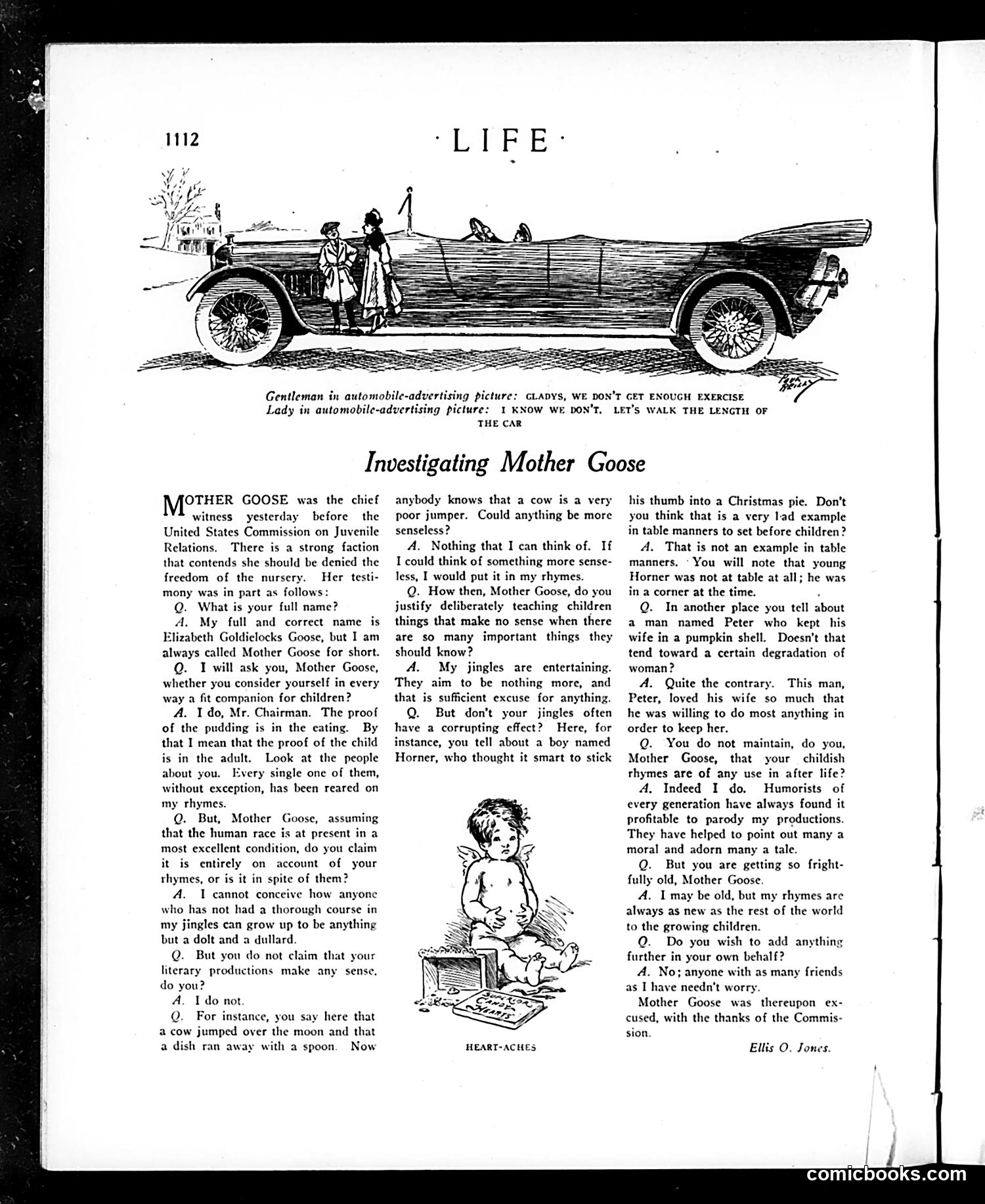
This satirical interview mocks progressive-era reformers who sought to regulate children's literature and upbringing. Mother Goose appears before a "Commission on Juvenile Relations" (a real type of early 20th-century body concerned with child welfare) to defend her nursery rhymes against charges that they're nonsensical, immoral, and unsuitable for children. The satire works by having Mother Goose unapologetically defend the absurdity of her rhymes—she admits they make no sense but argues they're entertaining and that children raised on them turned out fine. The interrogator challenges specific rhymes (cow jumping the moon, Jack Horner's theft, Peter's treatment of his wife) as teaching bad lessons. The joke is that reformers' earnest concern about children's moral development is portrayed as ridiculous—attacking beloved, harmless fairy tales as dangerous. The cartoon at top reinforces this theme: wealthy automobile owners joke about not getting enough exercise while sitting in a car, satirizing how modern conveniences (and modern anxieties) disconnect people from common sense.
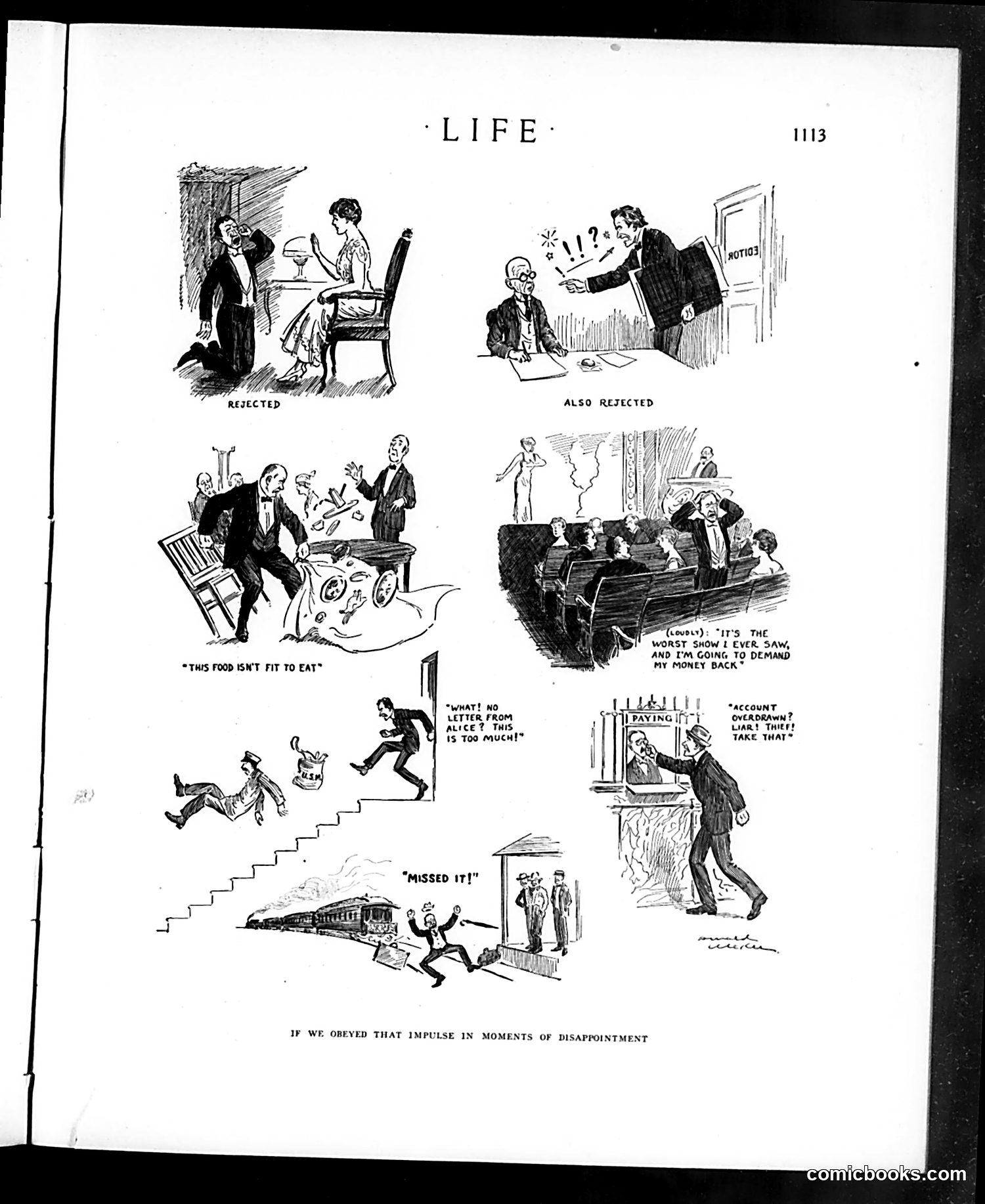
This page satirizes impulsive reactions to disappointment. The title "IF WE OBEYED THAT IMPULSE IN MOMENTS OF DISAPPOINTMENT" frames seven scenarios showing exaggerated consequences of acting on momentary frustration: - A rejected suitor threatens violence - An evicted tenant confronts a landlord with notice - A diner complains food is inedible - A theater patron demands refunds loudly - Someone misses a train while chasing it - A man receives bad news about his bank account - A cashier is accused of theft and struck Each vignette depicts increasingly absurd or violent responses to minor problems—romantic rejection, poor service, financial mishaps. The humor lies in contrasting the triviality of the provocation with the extreme, socially unacceptable reactions. The satire mocks how people might *feel* like responding during frustration, while implying civilized restraint is necessary. It's commentary on self-control and proper behavior during life's inevitable disappointments.
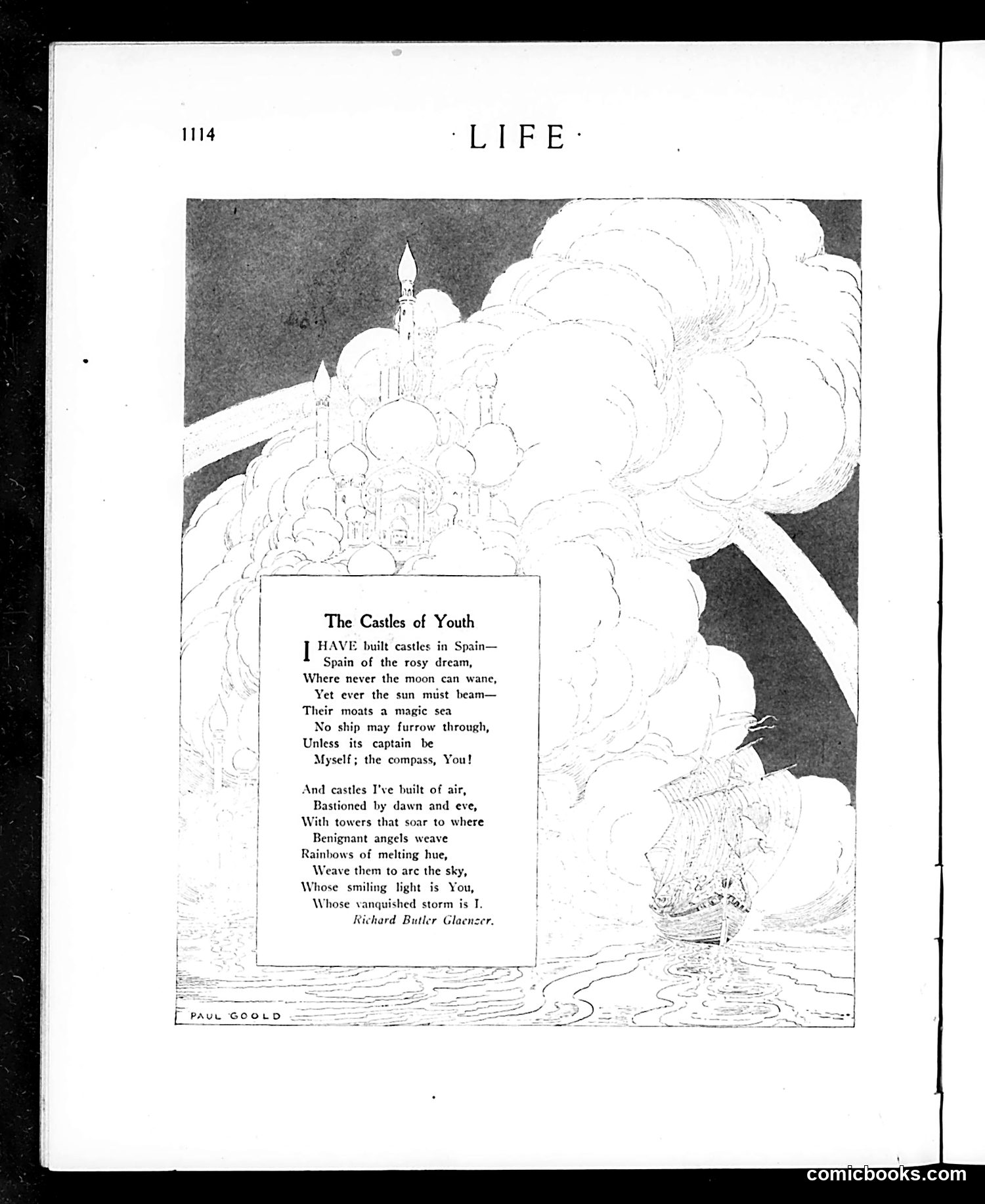
This is not a political cartoon but rather a **romantic/sentimental poem** illustrated by artist Paul Gould. The piece is titled "The Castles of Youth" and uses metaphorical language about idealized dreams. The poem, credited to Richard Butler Glaenzer, employs the classical phrase "castles in Spain" (meaning fanciful, unrealistic dreams) to describe romantic idealization. The speaker addresses a beloved, suggesting their love has built imaginary castles—both fantastical ("Spain of the rosy dream") and ethereal ("castles of air"). The imagery of magical moats, towers, angels, and rainbows reflects early 20th-century Romantic sensibility. The poem's conceit is that the speaker's dreams are anchored by the beloved ("You"), while the speaker themselves represents struggle or difficulty ("vanquished storm"). Gould's illustration—featuring swirling clouds, towers, and dreamlike architecture—visually reinforces this escapist, romantic theme rather than offering political commentary.
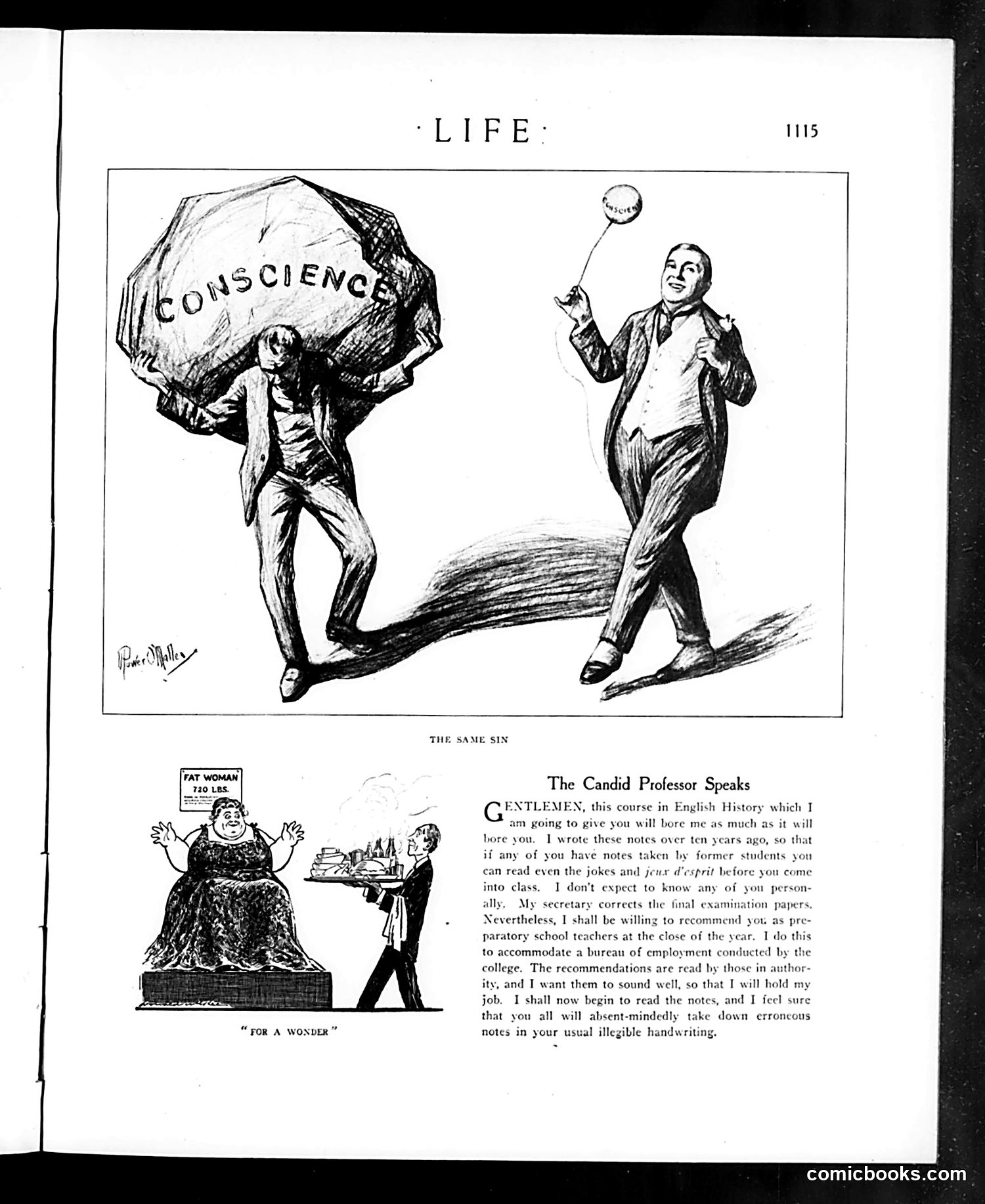
**Top Cartoon ("The Same Sin"):** A man struggles under a boulder labeled "CONSCIENCE" while another man playfully tosses a balloon. The satire suggests hypocrisy—both men are guilty of the same moral failing, but one acknowledges it while the other distracts himself with frivolity. **"The Candid Professor Speaks":** This is satirical commentary on academic corruption and indifference. The professor admits he: - Recycles decade-old lecture notes - Doesn't know his students - Has his secretary grade exams - Writes recommendations primarily to maintain his job rather than honestly assess students The satire highlights institutional dishonesty in early 20th-century higher education—the gap between academia's pretenses and the reality of lazy, self-interested teaching motivated by job security rather than educational integrity. **Bottom Cartoon ("For a Wonder"):** An overweight woman labeled "720 LBS" is served food. The crude humor relies on weight-based mockery common to the era.
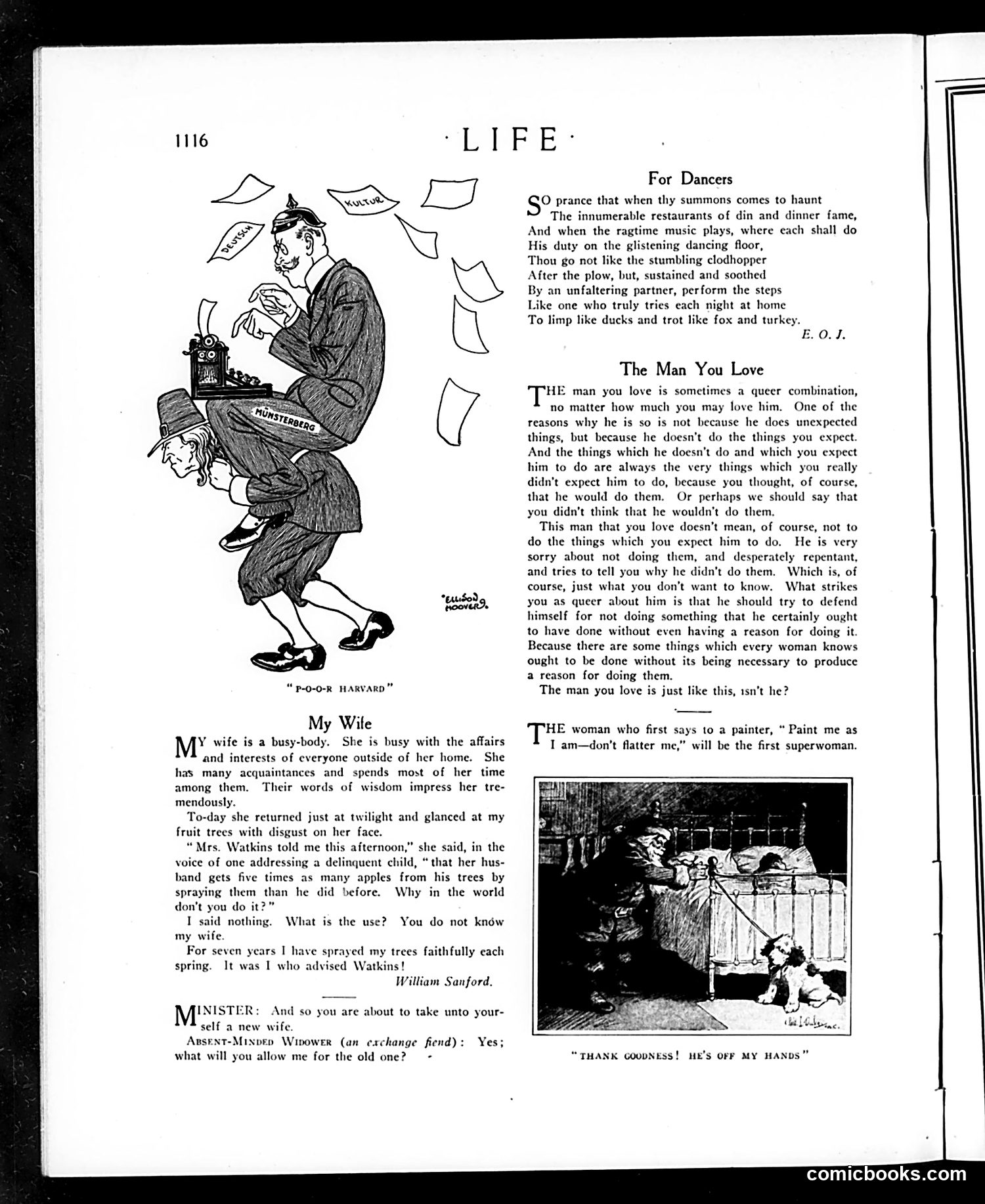
This satirical page from *Life* magazine targets domestic frustrations through multiple pieces: **"My Wife"** mocks the busy-body housewife who neglects her own home while dispensing unsolicited advice from neighbors. The joke: the wife criticizes her husband's apple trees, unaware *he* originally gave the neighbor the spraying advice she's now parroting back to him. **"Poor Harvard"** (cartoon) depicts a scholarly figure burdened by papers—likely satirizing Harvard University's administrative or academic excess. **The minister exchange** jokes darkly about remarriage: a widower asks what trade-in value he'll receive for his "old" wife, suggesting wives are disposable goods. **"For Dancers"** is verse mocking dancers who haven't practiced at home, performing clumsily at restaurants and dinner clubs. **"The Man You Love"** is philosophical satire about romantic contradiction: women expect men to intuitively know what needs doing without being told, yet resent their attempts to explain failures. All pieces reflect early 20th-century gender anxiety and marital discord humor.
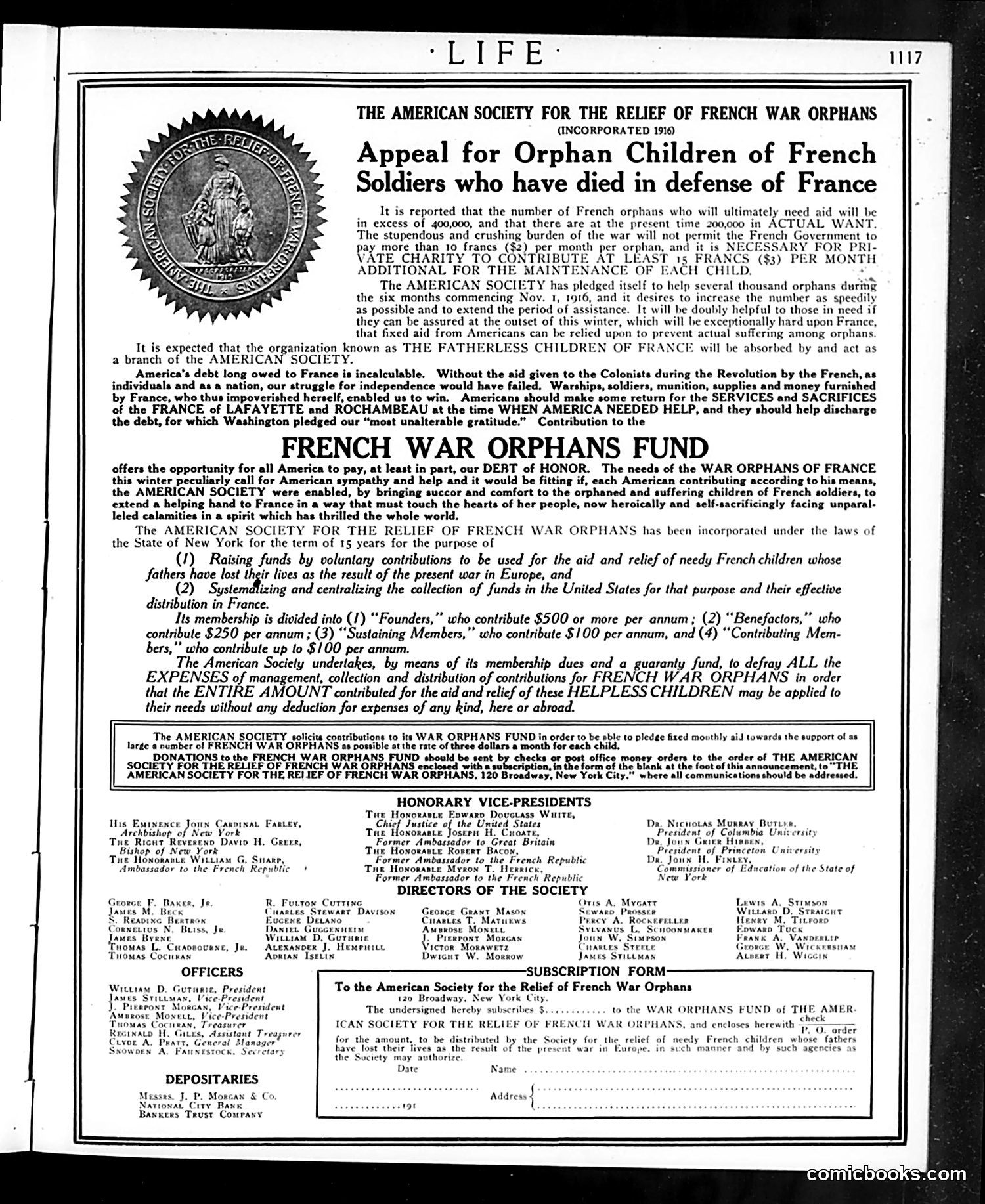
This is **not a cartoon**, but a charity appeal advertisement. Published during World War I, it solicits American donations for French war orphans—an estimated 400,000 children whose fathers died in combat. The appeal invokes historical reciprocity: France aided American independence; now America should repay that "debt of honor" by supporting French civilians devastated by the war. References to Lafayette and Rochambeau underscore this obligation. The organization guarantees donors that **all contributions go directly to orphans**—no administrative overhead—a significant selling point during an era of skepticism toward charity organizations. The membership structure (Founders at $500+, down to Contributing Members at $100 annually) reflects Progressive-era philanthropic hierarchy, appealing to different economic classes. This reflects American pre-1917 neutrality sentiment shifting toward Franco-British sympathy, months before U.S. entry into the war.
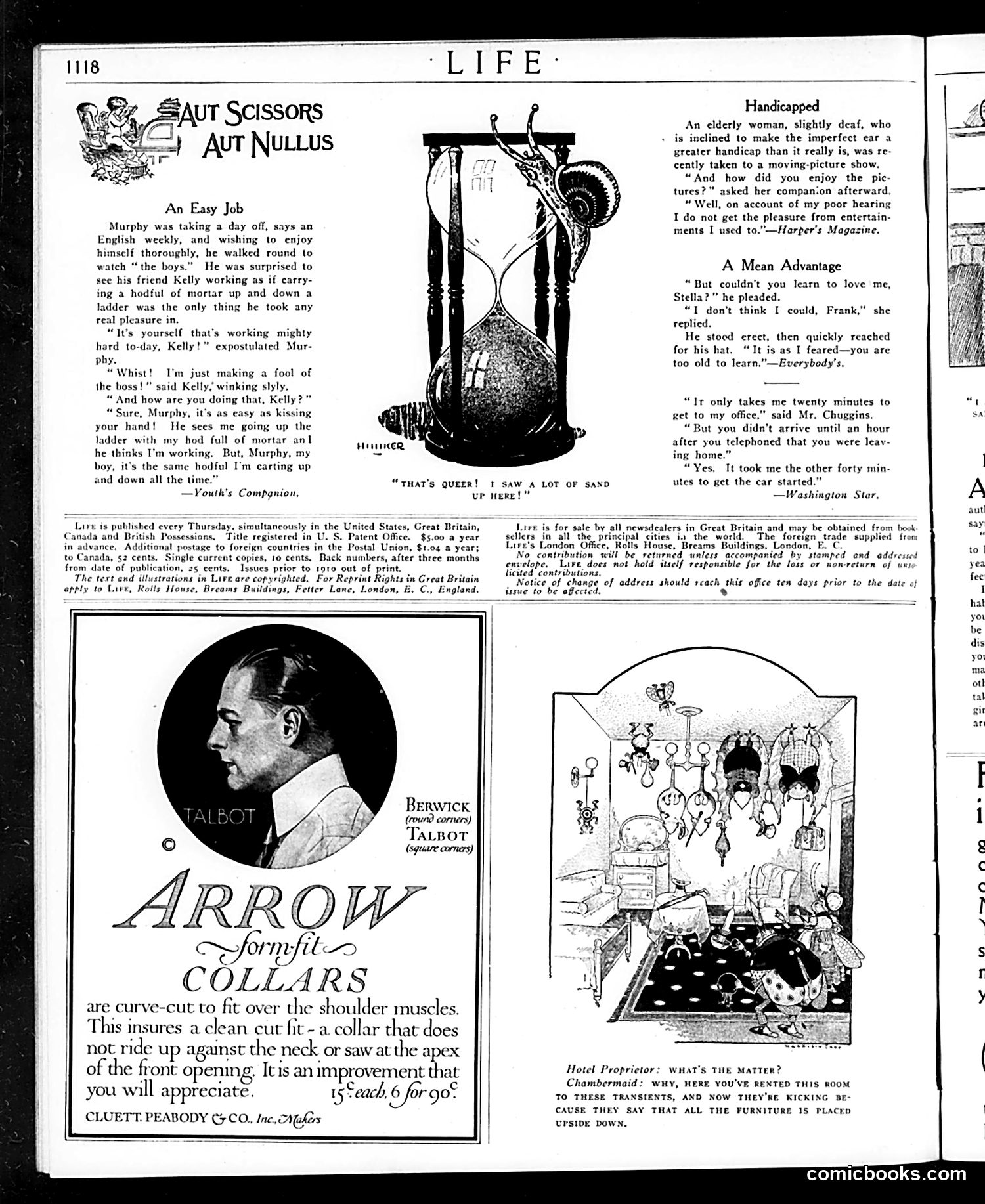
This page contains several brief humorous anecdotes and advertisements typical of early 20th-century American humor magazines. **The Main Comic Strip** shows two workers: Kelly deceives his boss by repeatedly carrying the same hodful of mortar up and down a ladder, making it appear he's working when he's actually idle. The joke exploits a common workplace trope—the employee fooling management through the appearance of busyness. **The Remaining Content** consists of short joke items on various themes: a deaf woman at a movie theater; a man using deafness as a romantic rejection excuse; a man spending 40 minutes starting his car; and hotel staff complaining about furniture placement by transients. **Advertising** for Arrow Formfit Collars and other products fills the remaining space. The overall tone reflects gentle, workplace-focused humor typical of the era—no sharp political commentary, just lighthearted observations about everyday life and social interactions.
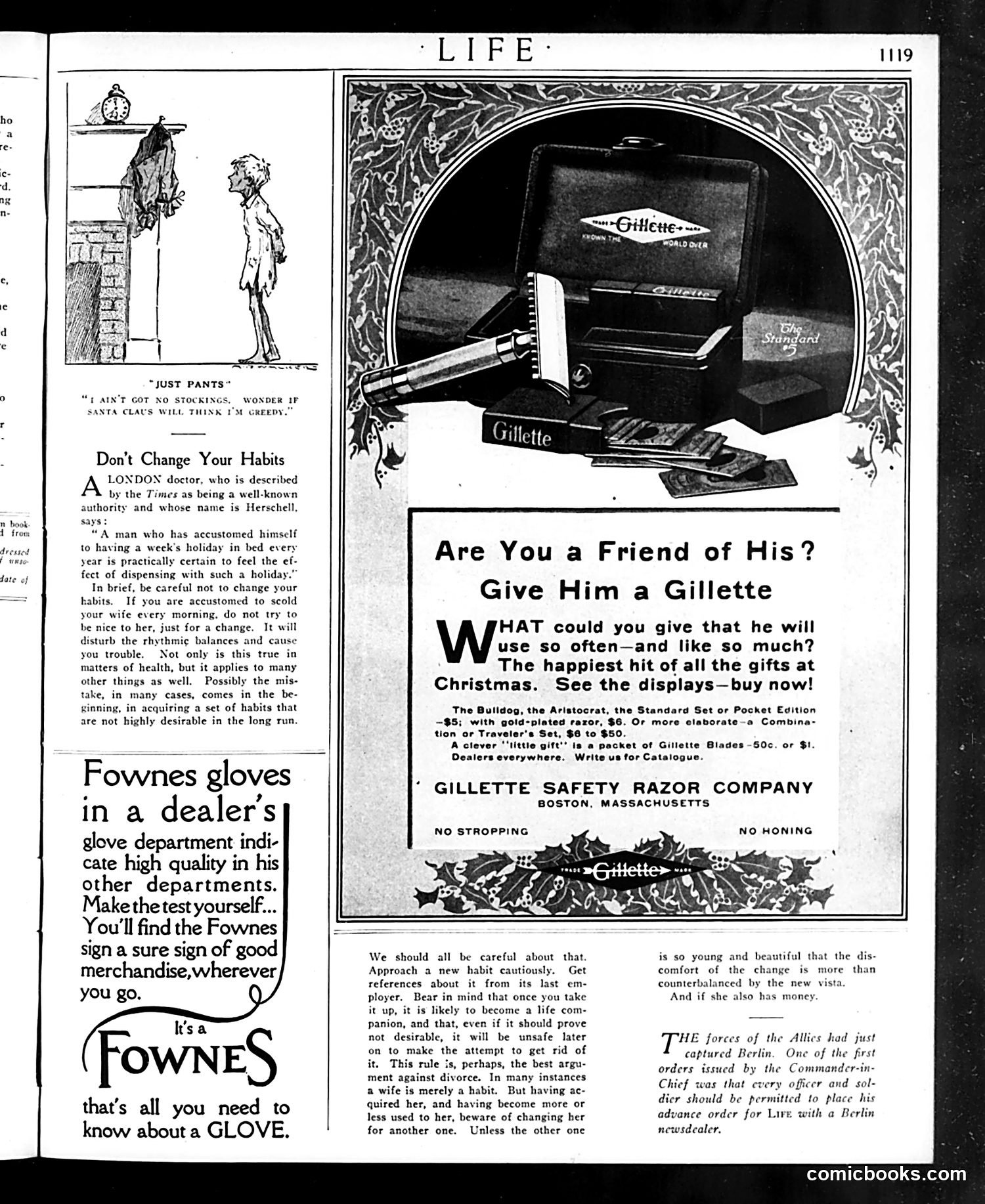
This page contains satirical commentary and period advertising from an American publication, likely early 20th century. **"Just Pants" cartoon:** A humorous Christmas-themed sketch showing a child in minimal clothing worried Santa will think them greedy for lacking stockings—a joke about wartime rationing or poverty. **"Don't Change Your Habits" essay:** Satirizes a London doctor's advice about maintaining established routines. The piece ironically extends this to absurd conclusions, suggesting one shouldn't change bad habits (scolding one's wife daily) because disruption causes discomfort. The closing marriage analogy—advising against divorce unless the replacement woman is "young, beautiful" AND wealthy—is biting social satire mocking both habit psychology and marital dynamics. **Advertisements:** Fownes gloves and Gillette Safety Razors occupy the remaining space, typical period marketing emphasizing quality and practicality as Christmas gifts. The page's closing anecdote references WWI (Allied capture of Berlin), dating this publication to 1918-1919.
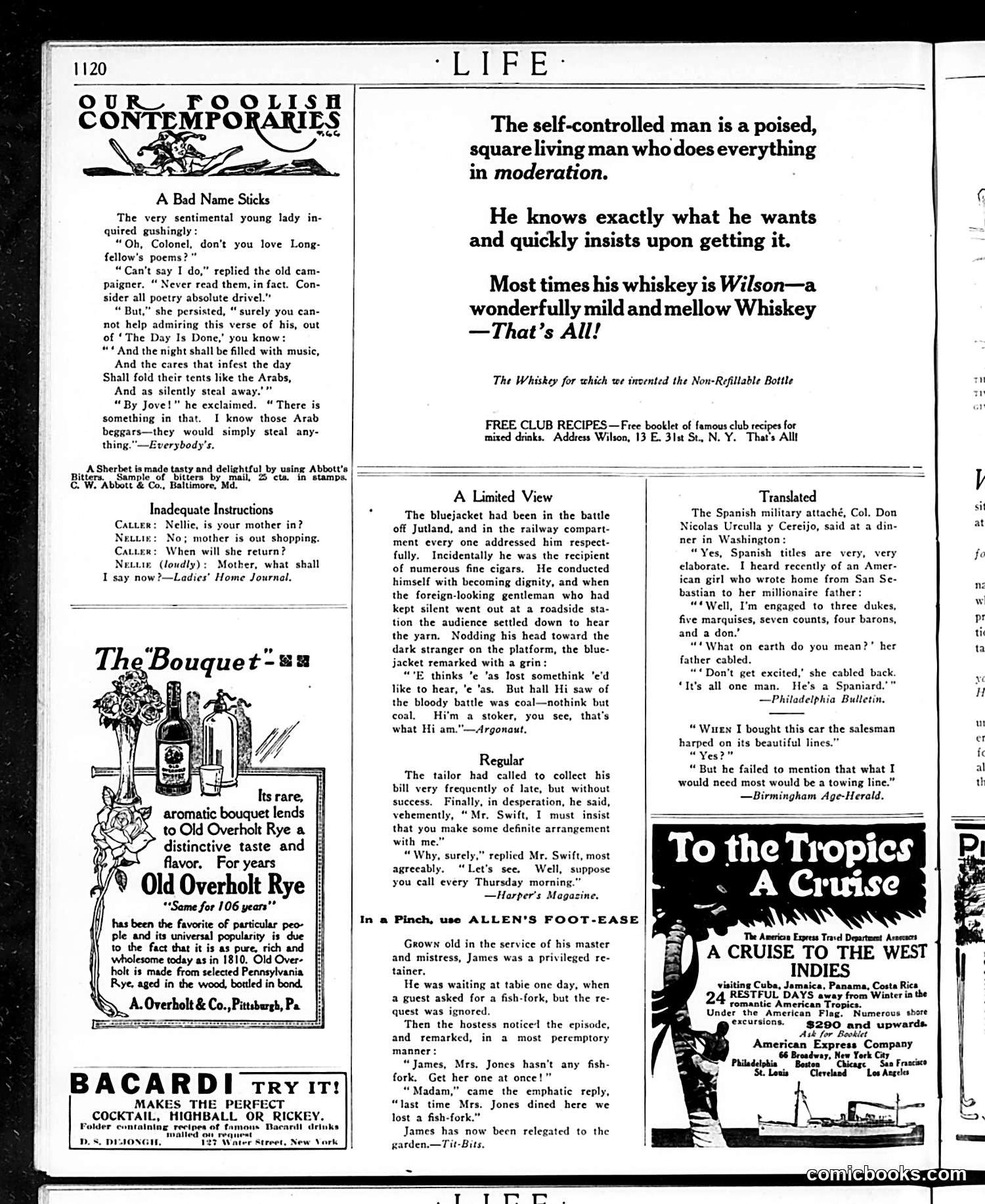
This is primarily a **satirical humor and advertising page** from Life magazine, circa 1920s. The content includes: **"Our Foolish Contemporaries" section**: A column of short comic anecdotes mocking human behavior. "A Bad Name Sticks" satirizes a sentimental young woman who quotes Longfellow to an old soldier, who dismisses poetry until she quotes lines about Arabs stealing away—at which point he exclaims he "knows those Arab beggars" and would steal anything. The joke targets both romantic pretension and ethnic stereotyping. **Other humor pieces**: Include jokes about inadequate parenting instructions, a naval stoker's limited war perspective (seeing only coal during the Battle of Jutland), and a servant's vindictive refusal to provide a fish fork based on a previous loss. **Advertisements**: For whiskey (Wilson, Old Overholt Rye, Bacardi), promoting these as sophisticated choices for the "self-controlled man" and cocktail culture. **Travel advertisement**: American Express cruise line. The page exemplifies Life's format: light social satire mixed with upscale consumer advertising.
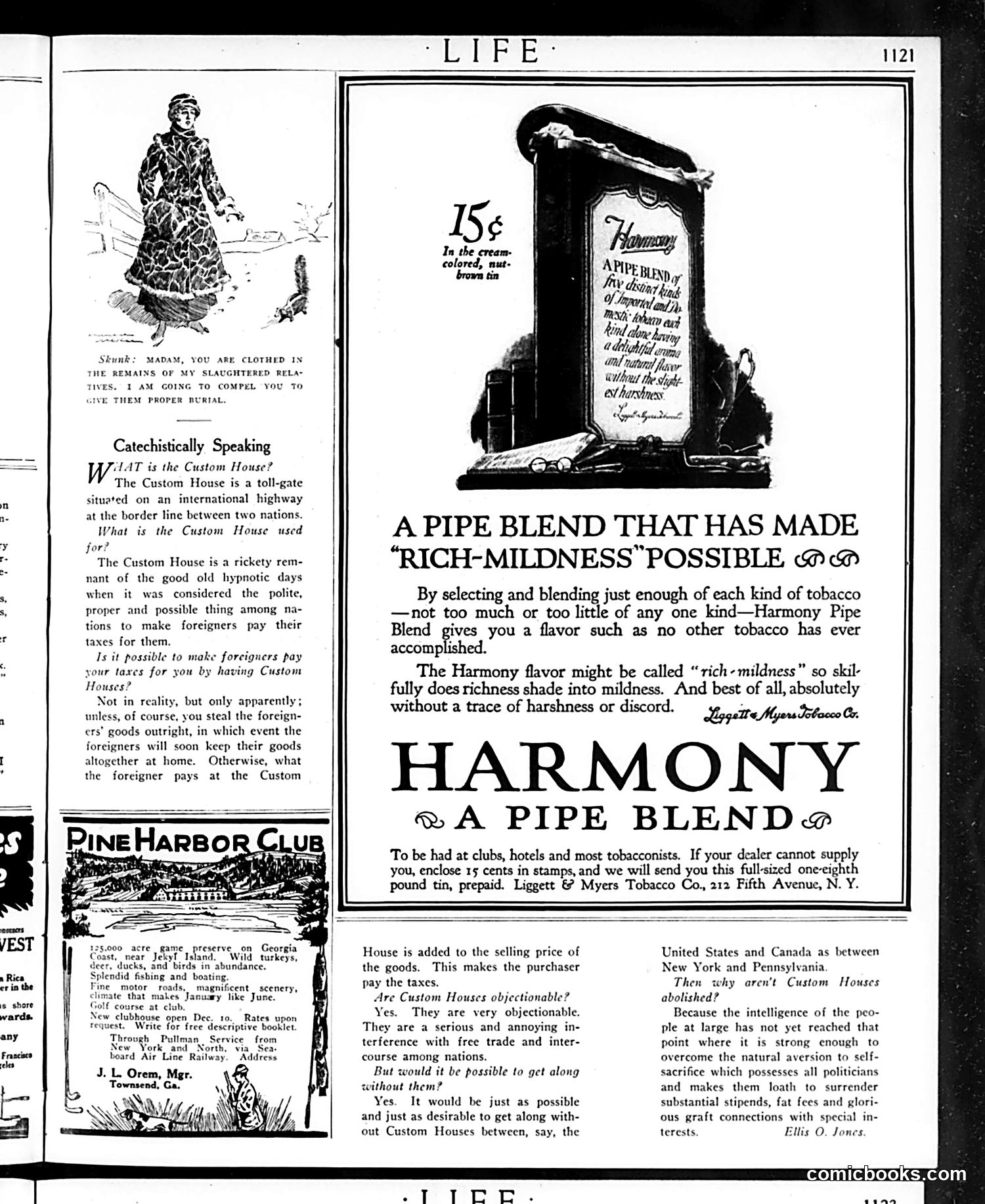
This page contains two distinct items: **Left side:** A political cartoon criticizing tariffs and customs houses. A skunk, dressed in a woman's fur coat, confronts her—the skunk represents foreign nations whose goods are taxed at the U.S. border. The accompanying "Catechistically Speaking" educational dialogue satirizes the Custom House system as an outdated, hypocritical institution that ostensibly collects taxes from foreigners but actually steals their goods and enriches corrupt politicians through graft. The piece argues that removing tariffs between nations (using the U.S.-Canada example) would be as logical as removing them between states, but politicians won't eliminate the system because they profit from it. **Right side:** A full-page advertisement for Harmony Pipe Blend tobacco, featuring a decorative pipe monument and marketing copy emphasizing the tobacco's "rich-mildness." The page juxtaposes anti-protectionist political critique with commercial advertising—typical of Life's satirical-yet-commercial format.
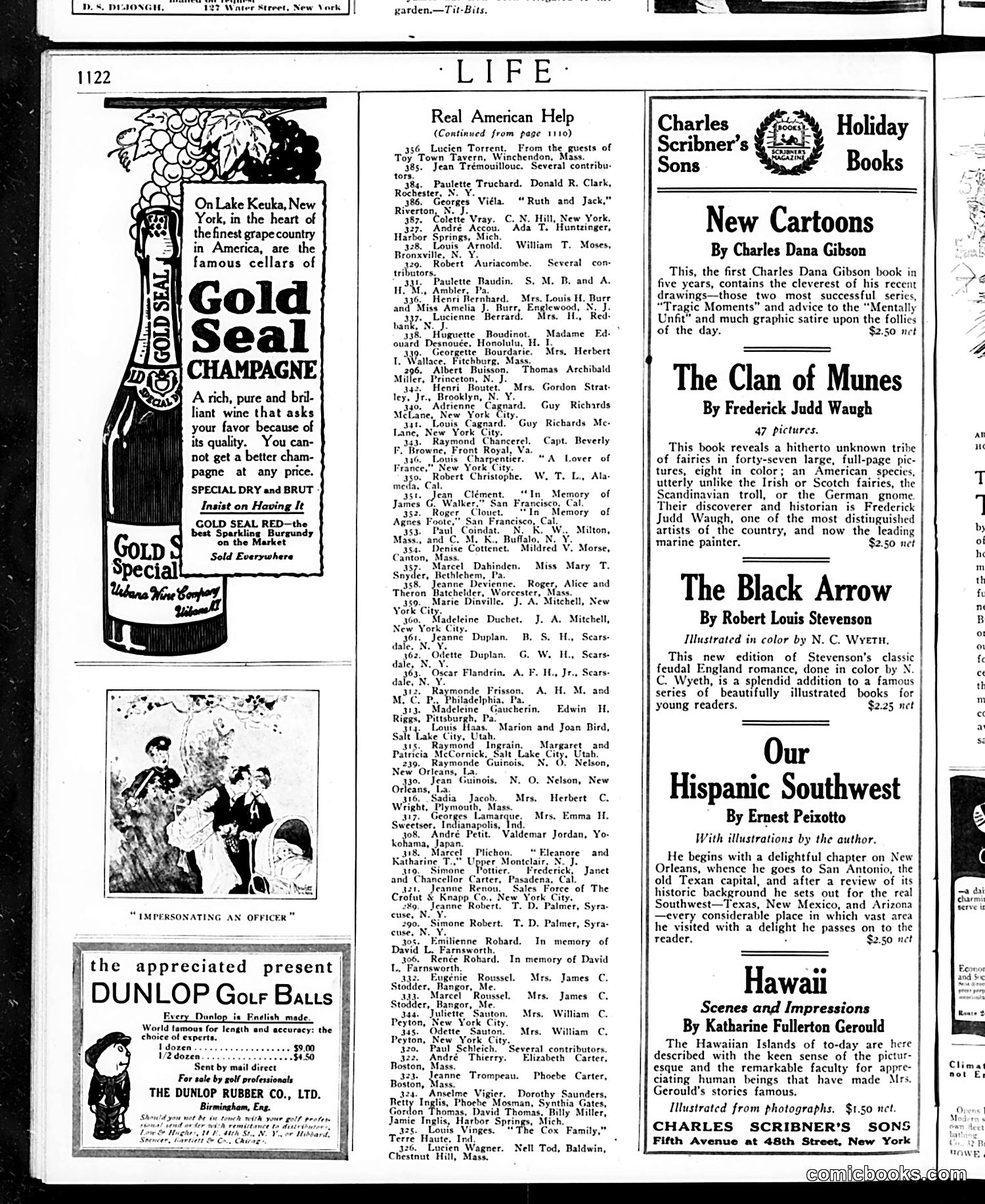
This page is primarily **advertising and book listings**, not political satire. The main content consists of: 1. **Wine & Golf Equipment Ads**: Gold Seal Champagne and Dunlop Golf Balls advertisements occupy the left side—commercial material typical of *Life* magazine. 2. **The Cartoon**: "Impersonating an Officer" (bottom left) shows a figure in military uniform being confronted. Without additional context, the specific satire is unclear—it may reference military impersonation laws or wartime concerns, but the exact target cannot be determined from the image alone. 3. **Book Advertisements**: The right side features Charles Scribner's Sons holiday books, including titles like *The Clan of Munes* and *The Black Arrow*—standard publishing promotion. 4. **"Real American Help" Section**: A lengthy list of contributors to some publication or charity effort, suggesting community involvement during this period. The page lacks the overt political commentary one might expect from *Life* magazine's satirical tradition. It reads primarily as a commercial and literary supplement.
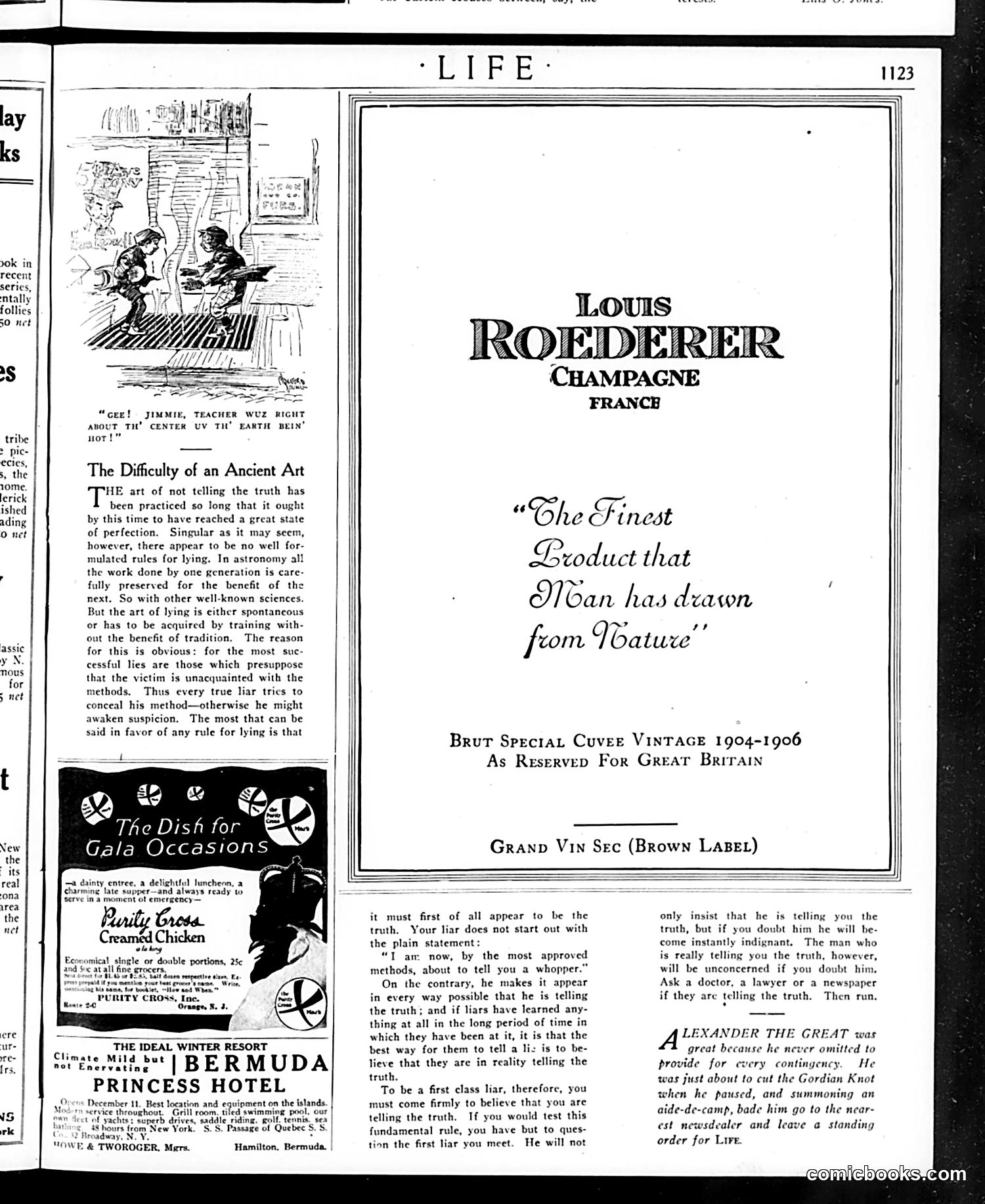
This page mixes advertising with satirical commentary. The main cartoon (top left) shows a teacher and student, with the student saying "Gee! Jimmie, teacher wuz right about th' center uv th' earth bein' hot!"—a simple joke about a schoolboy learning basic science. The substantial text article, "The Difficulty of an Ancient Art," is a humorous essay about lying. It argues that successful liars must *believe their own lies* to be convincing. The piece satirizes human nature by suggesting that liars who appear confident and indignant when doubted are more persuasive than truth-tellers who remain calm. It's social satire about how conviction—not truth—persuades people. The page closes with a joke about Alexander the Great, suggesting even history's greatest conqueror would pause to subscribe to *Life* magazine—self-promotional humor typical of the era. The rest is period advertising for champagne, chicken dishes, and Bermuda tourism.
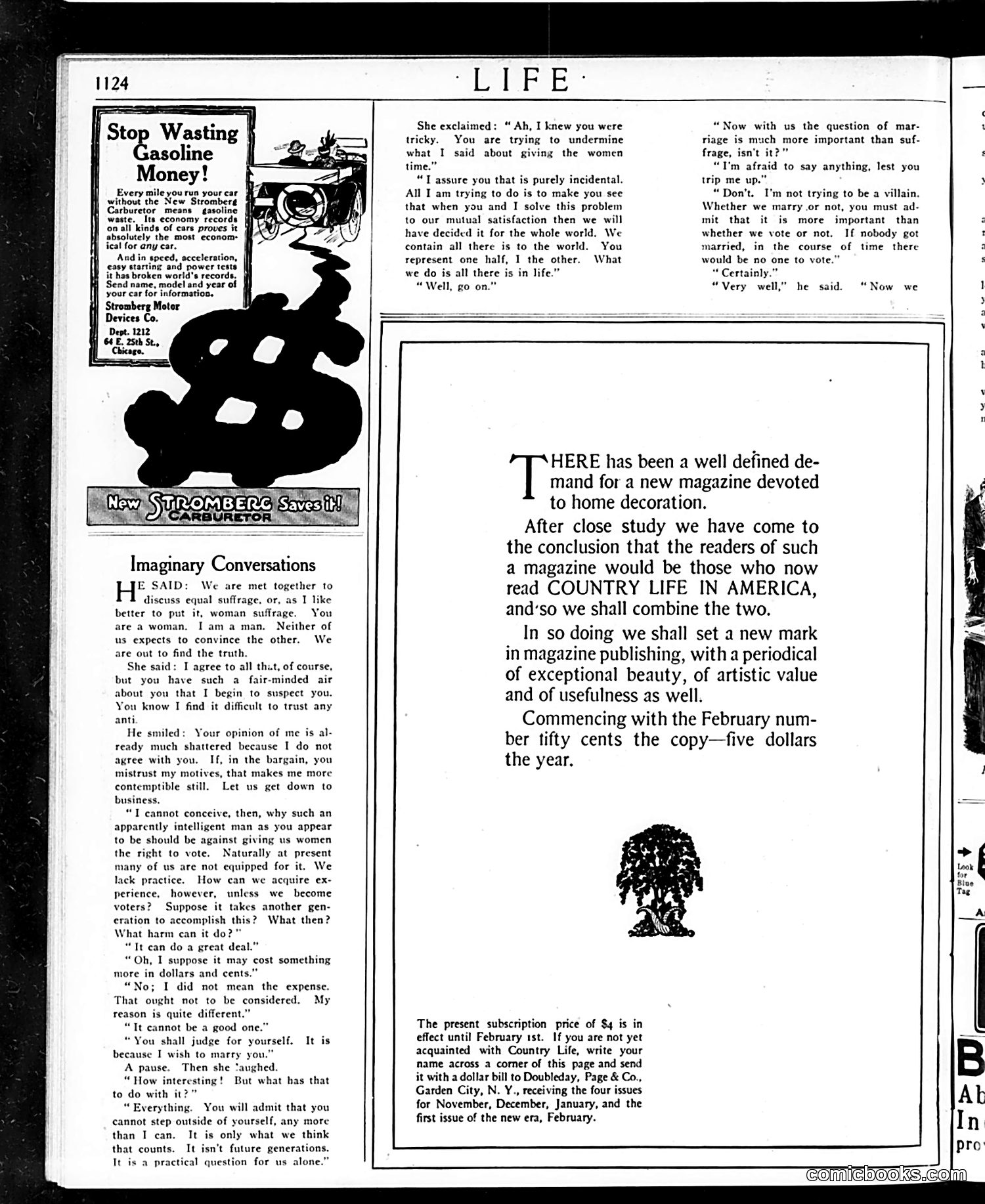
This page contains three distinct elements: **1. Stromberg Carburetor Advertisement** (top left): A practical commercial ad promising fuel economy, featuring a large dollar sign graphic. This reflects early automotive advertising emphasizing efficiency. **2. "Imaginary Conversations" (center-left):** A satirical dialogue about women's suffrage between a man and woman. The man argues against voting rights, claiming marriage is more important than suffrage—essentially that women shouldn't vote because they need to focus on marriage and having children to perpetuate society. The piece gently mocks this anti-suffrage position through the woman's skeptical responses, positioning her as the rational party. This reflects the active suffrage debate of the era. **3. Magazine Announcement (right):** Announcing a merger between "Country Life in America" and a new home decoration magazine, targeting readers interested in domestic topics. The page exemplifies Life's satirical approach to contemporary social issues, particularly the contentious suffrage question, while mixing commercial advertisements—standard magazine content of the period.
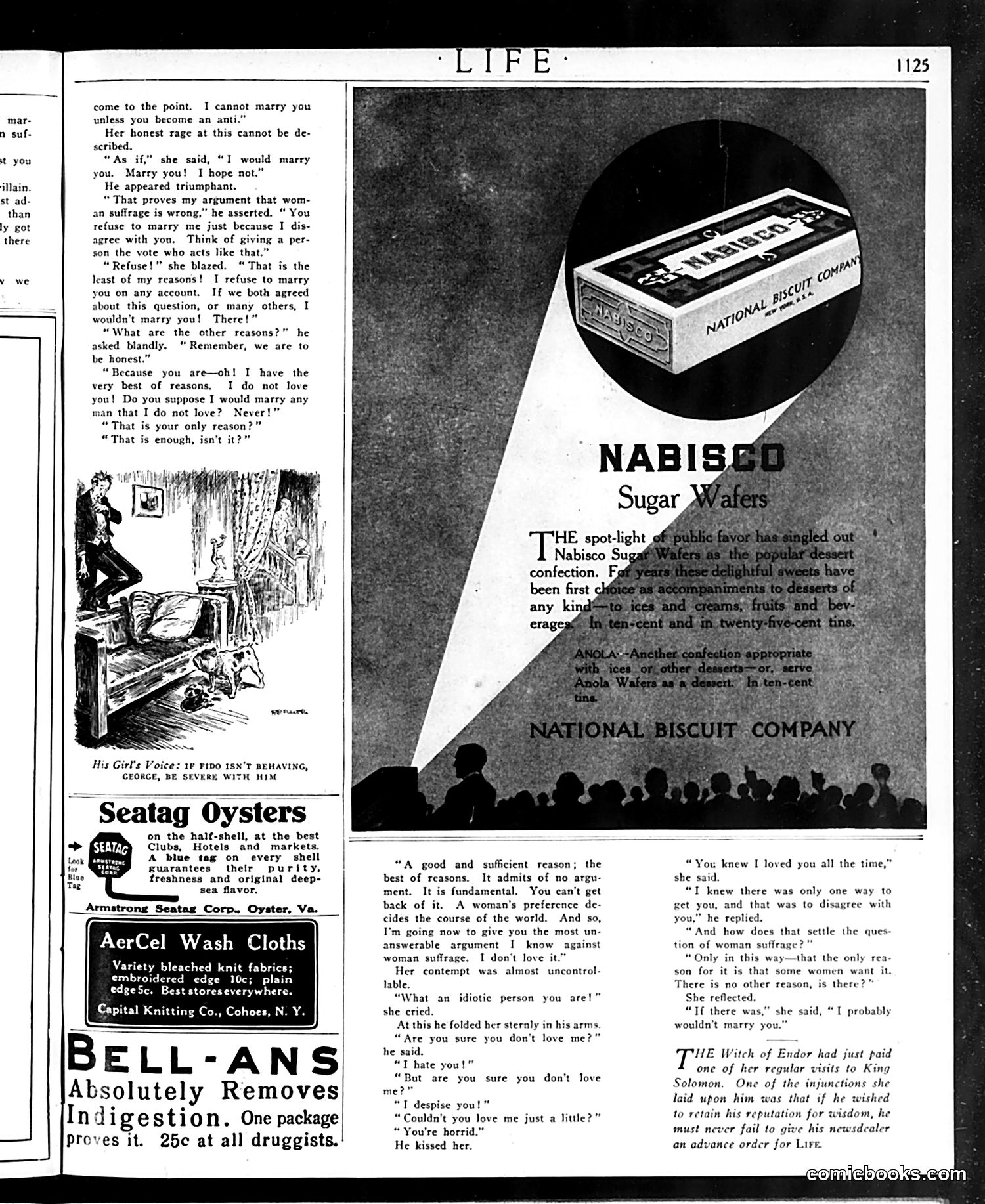
This page satirizes anti-suffrage arguments through a romantic dialogue. A man opposes giving women the vote, claiming they're too emotional and irrational to vote responsibly—using as "proof" that his female companion refuses to marry him simply because they disagree politically. The woman's actual reason (she doesn't love him) exposes his absurd logic: he mistakes political disagreement for the irrationality he claims proves women unfit for voting. The satire culminates when he "wins" her through sheer stubbornness, then claims this proves woman suffrage is unnecessary—women don't need votes because they already control men through romantic preference. Life magazine, a pro-suffrage publication, uses the cartoon to mock anti-suffrage rhetoric as transparently self-serving and logically backwards. The "His Girl's Voice" caption adds comedic distance, suggesting readers should recognize the man's reasoning as ridiculous.
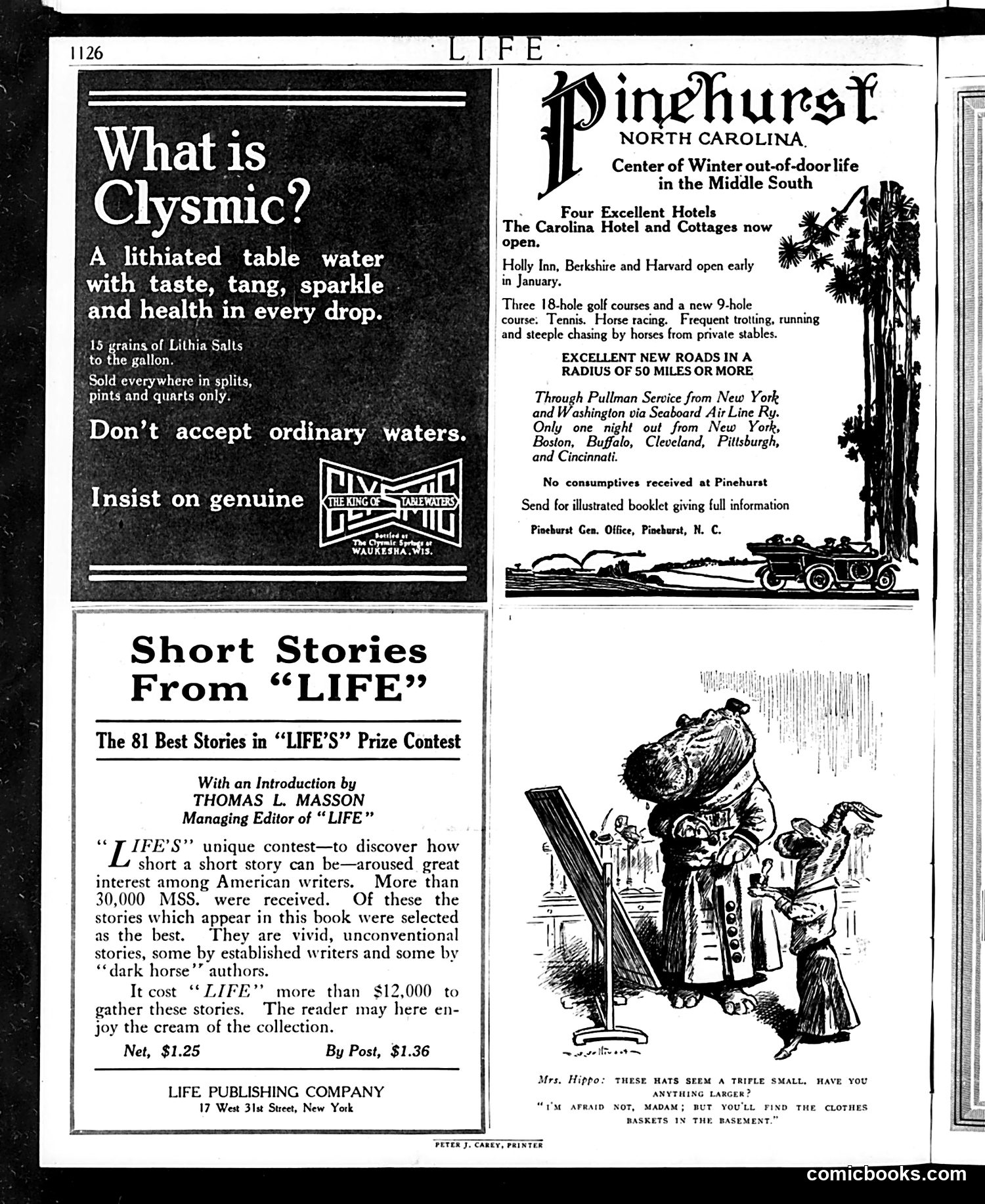
This page combines **advertisements and a cartoon**: ## Cartoon (Bottom Right) A hippo matron asks a shop clerk if he has larger hats, implying her enormous head size. The clerk directs her to the "clothes baskets in the basement"—a joke suggesting she's too large for normal merchandise and should look among storage items instead. It's straightforward physical comedy mocking obesity, typical of early 20th-century humor. ## Advertisements The page primarily advertises Clysmic lithiated table water (left), promoting its health benefits; Pinehurst, North Carolina as a winter resort destination (top right); and a Life Publishing Company book of prize-winning short stories (center). The Pinehurst ad notably states "**No consumptives received**"—explicitly excluding tuberculosis patients, reflecting era-specific health anxieties and segregation practices. The overall content reflects 1920s concerns: patent medicines, leisure travel marketing, and popular entertainment publications.
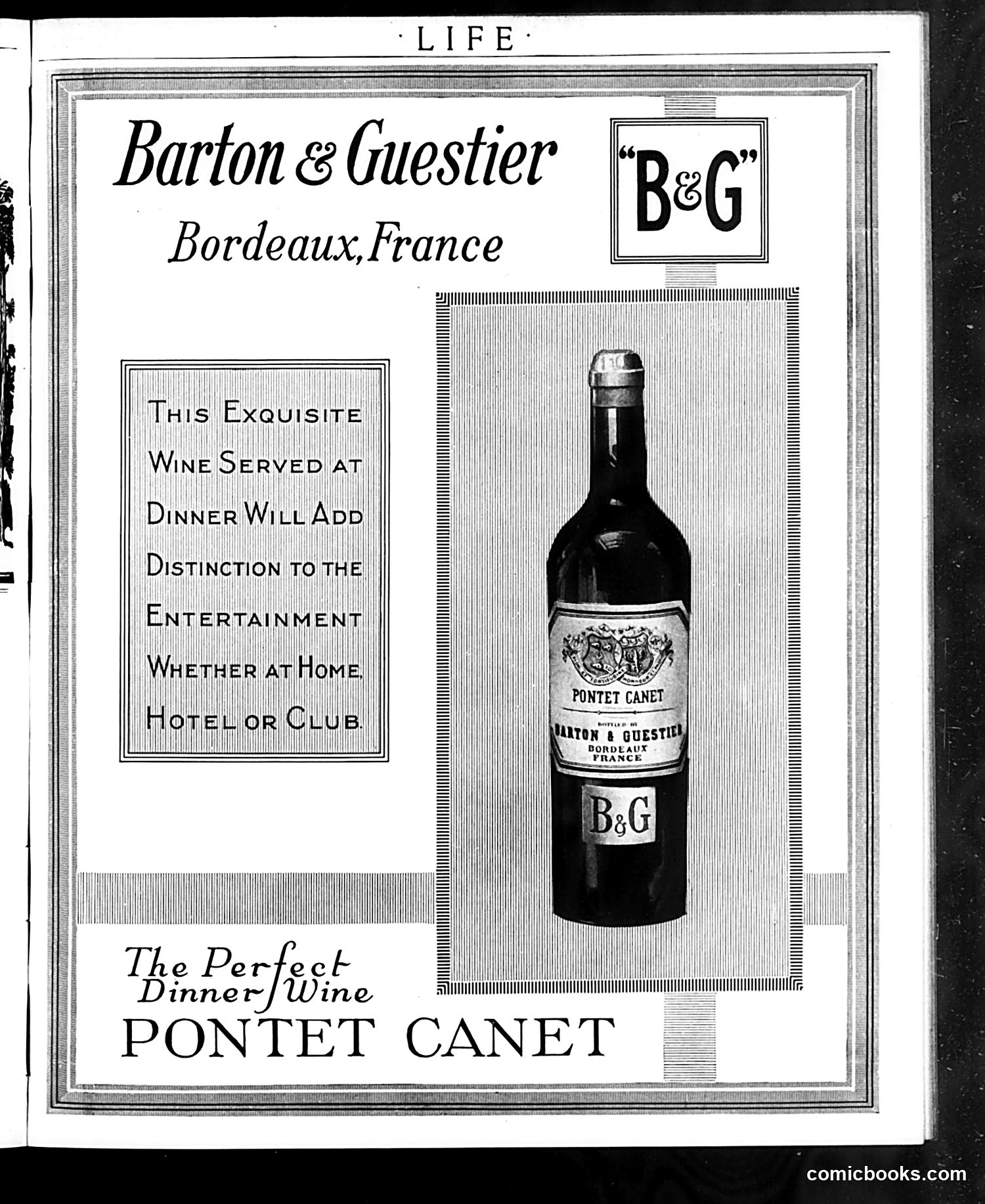
This is a **wine advertisement**, not a political cartoon. It promotes Barton & Guestier's "Pontet Canet" Bordeaux wine from France, marketed as "The Perfect Dinner Wine." The ad uses aspirational messaging typical of early 20th-century advertising, claiming the wine will "add distinction to the Entertainment whether at Home, Hotel or Club." This appeals to middle- and upper-class readers seeking social refinement. The page appears in *Life* magazine, which was primarily a humor and satire publication but also carried advertisements. The B&G logo and wine bottle image are straightforward product promotion with no satirical content—this is commercial advertising using the magazine's pages, not editorial commentary.
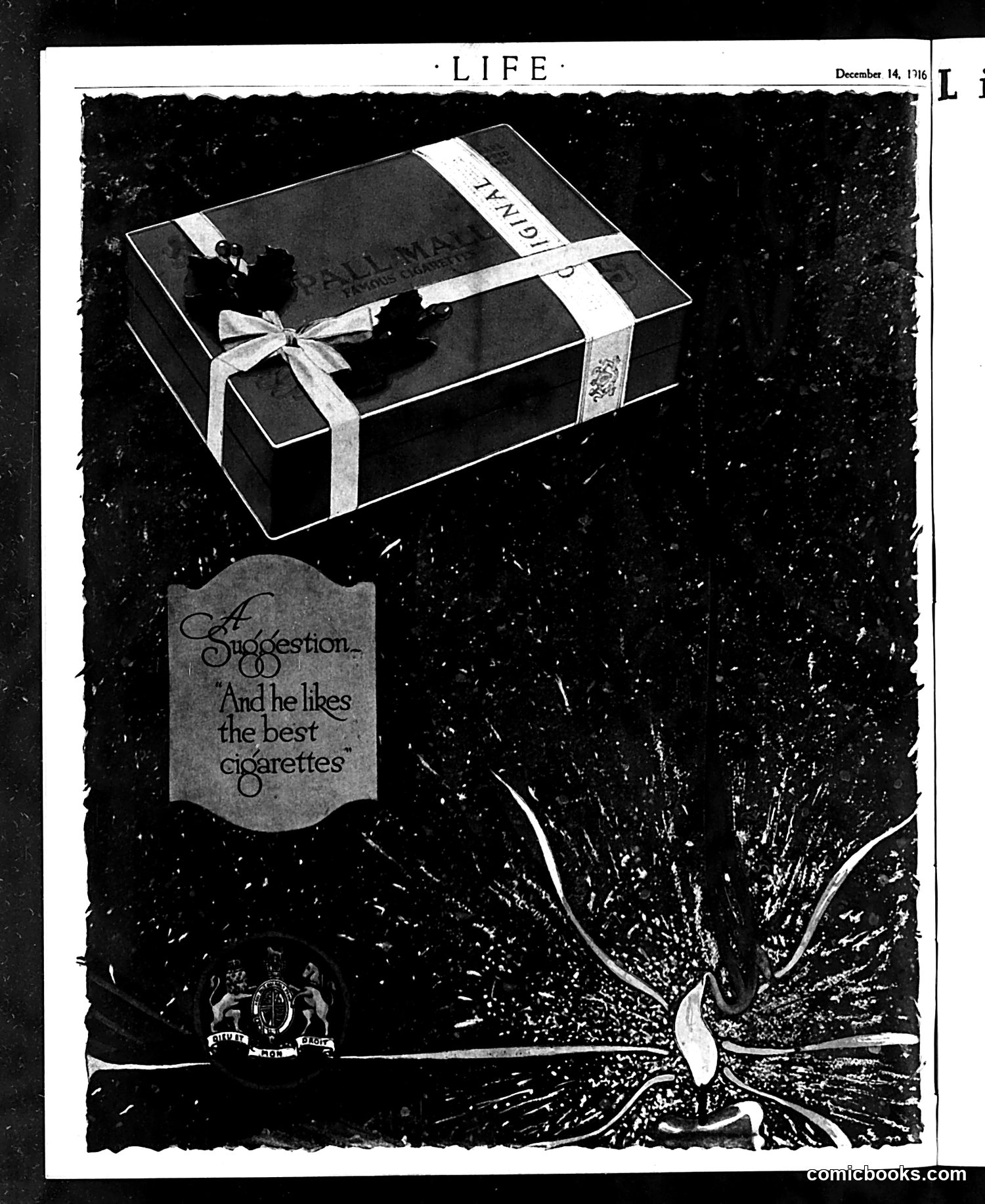
This is a cigarette advertisement from Life magazine, dated December 14, 1916. It shows an elegantly wrapped gift box with a ribbon and bow, featuring text that reads "A Suggestion" and "And he likes the best cigarettes." This is not political satire or a cartoon—it's a commercial advertisement. The "suggestion" targets gift-givers during the holiday season, proposing cigarettes as an appropriate present for men. The wrapped-box presentation emphasizes gifting and luxury. By modern standards, this advertisement is notable primarily for openly marketing cigarettes without health warnings, which would be illegal today. The ad reflects early-20th-century attitudes when smoking was socially acceptable and widely promoted, particularly as a masculine consumer good suitable for holiday gift-giving.