
Life, 1916-12-14 · page 19 of 42
Life — December 14, 1916 — page 19: what you’re looking at
What you’re looking at
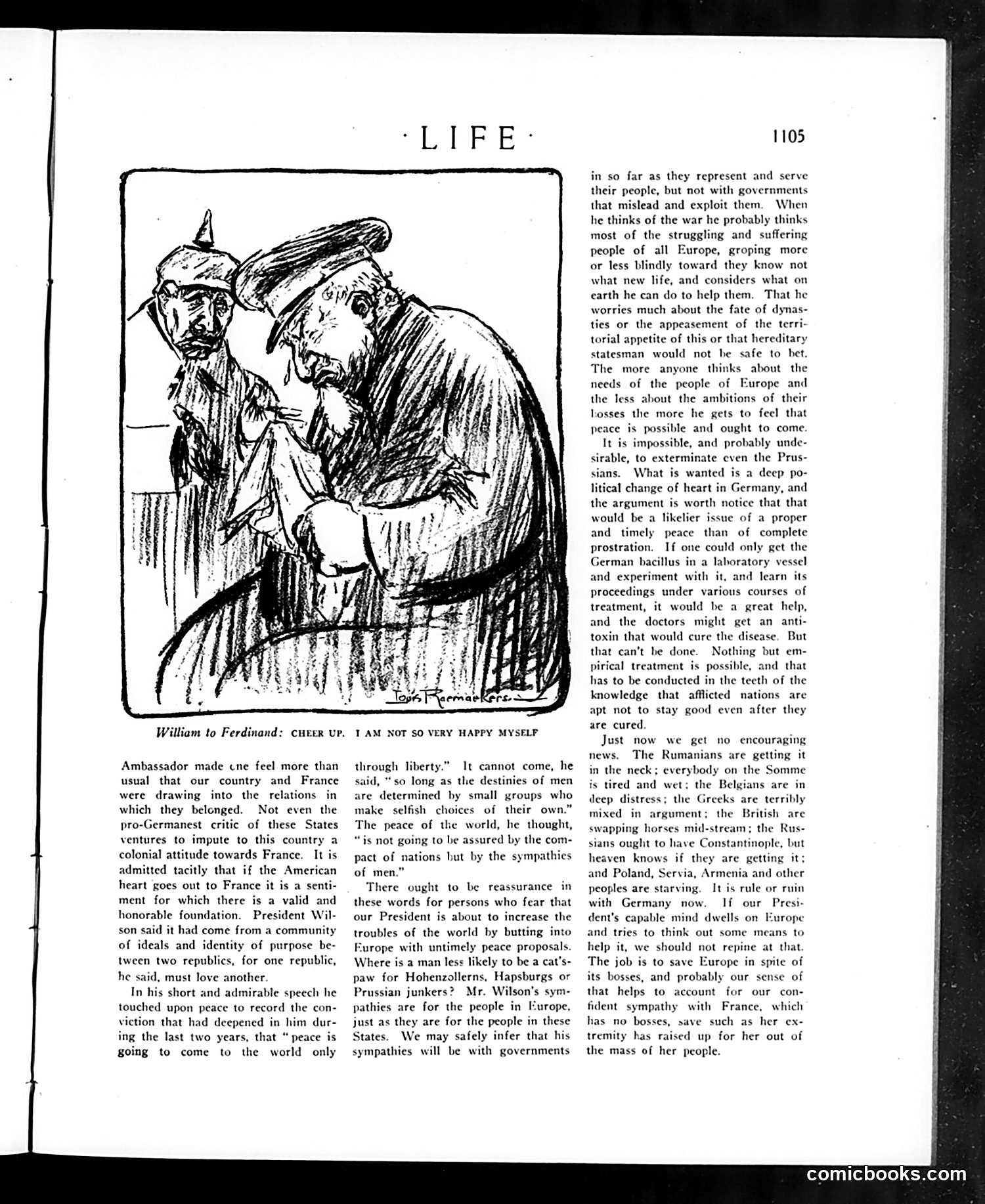
**The Figures:** The cartoon depicts two military leaders—likely German Kaiser Wilhelm II (left, with spiked helmet) and Austro-Hungarian Emperor Franz Ferdinand (right)—in a conversation. Wilhelm tells Ferdinand "cheer up, I am not so very happy myself," suggesting shared wartime misery among Europe's rulers. **Historical Context:** This appears from WWI era (references to Somme, Romania, Belgium fighting). The accompanying article discusses President Wilson's peace philosophy—that lasting peace requires liberty and popular sympathy rather than dynastic compromises. **The Satire's Point:** The cartoon mocks Europe's hereditary autocrats by showing them unhappy despite their power, while the editorial argues Wilson correctly prioritizes ordinary Europeans' suffering over preserving these rulers' territorial ambitions. The joke implies these crowned heads deserve their misery, given their role in prolonging the war.
📄 Transcribed text from this page (OCR, searchable)
Machine-transcribed from the original scan — historical spelling and the odd misread are preserved.
William to Ferdinand: curer vp. Ambassador made cne feel more than usual that our country and France were drawing into the relations in which they belonged. Not even the pro-Germanest critic of these States ventures to impute to this country a colonial attitude towards France. It i admitted tacitly that if the American heart goes out to France it is a senti- ment for which there is a valid and honorable foundation. President Wil- son said it had come from a community of ideals and identity of purpose be- tween two republics, for one republic, he said, must love another. In his short and admirable speech he touched upon peace to record the con- viction that had deepened in him dur- ing the last two years, that “peace is going to come to the world only "LIP E” 1 AM NOT SO VERY HAPPY MYSELF through liberty.” It cannot come, he said, “so long as the destinies of men are determined by small groups who make selfish choices of their own.” The peace of world, he thought, “js not going to be assured by the com- pact of nations but by the sympa of men.” There ought to be reassurance in these words for persons who fear that our President is about to increase the troubles of the world by butting into Europe with untimely peace proposals. Where is a man less likely to be a cat’ paw for Hohenzollerns, Hapsburgs Prussian junkers? Mr. Wilson's sym- pathies are for the people in Europe, just as they are for the people in these States. We may safely infer that his sympathies will be with governments hies 1105 in so far as they represent and serve their people, but not with governments that mislead and exploit them. When he thinks of the war he probably thinks most of the struggling and suffering people of all Europe, groping more or less blindly toward they know not what new life, and considers what on earth he can do to help them. That he worries much about the fate of dynas- ties or the appeasement of the terri- torial appetite of this or that hereditary statesman would not he safe to bet. The more anyone thinks about the needs of the people of Europe and the less about the ambitions of their Losses the more he gets to feel that peace is possible and ought to come. It is impossible, and probably unde- sirable, to exterminate even the Prus- jans. What is wanted is a deep po- litical change of heart in Germany, and the argument is worth notice that that would be a likelier issue of a proper and timely peace than of complete prostration. If one could only get the German bacillus in a laboratory vessel and experiment with and learn its proceedings under various courses of treatment, it would be a great help, and the doctors might get an anti- toxin that would cure the disease. But that can't be done. Nothing but em- pirical treatment is possible, and that has to be conducted in the teeth of the knowledge that afflicted nations are apt not to stay good even after they are cured. Just now we get no encouraging news. The Rumanians are getting it in the neck; everybody on the Somme is tired and wet; the Belgians are in deep distress; the Greeks are terribly mixed in argument; the British are swapping horses mid-stream; the Rus- sians ought to have Constantinople, but heaven knows if they are getting it; and Poland, Servia, Armenia and other peoples are starving. It is rule or ruin with Germany now. If our Presi- dent's capable mind dwells on Europe and tries to think out some means to help it, we should not repine at that. The job is to save Europe in spite of its bosses, and probably our sense of that helps to account for our con- fident sympathy with France, which has no bosses, save such as her ex- tremity has raised up for her out of the mass of her people. comicbooks.com